The FBI is Great at Disrupting (Its Own) “Terror Plots”

index

By Kevin Carson

Source: Center for a Stateless Society

On January 14 the US Department of Justice announced that the Joint Terrorism Task Force had disrupted the latest “domestic terrorism plot” — this time by “a Cincinnati-area man … to attack the U.S. Capital and kill government officials.” House Speaker  John Boehner immediately cited the disrupted plot as evidence that Congress should think carefully before refusing to renew the NSA’s bulk data collection powers. Only it turns out the feds had at least as much to do with hatching the plot as did the alleged plotter, Christopher Cornell.

The FBI investigator became aware of Cornell’s pro-ISIS comments on Twitter thanks to a tip-off from an unnamed informant who “began cooperating with the FBI in order to obtain favorable treatment with respect to his criminal exposure on an unrelated case.” The informant, on FBI orders, arranged two meetings with Cornell where they discussed attacks on the capital, after which the FBI arrested him to “prevent” the attacks. In other words, it identified Cornell as a suspect entirely on the basis of his expression of radical political opinions, with the help of a jailhouse snitch who rolled over in response to prosecutorial blackmail. And the actual “plot” was worked out only in subsequently arranged meetings in which one party — working for the FBI — may well have been leading Cornell. It wasn’t for nothing that ecological activist Judi Bari said “the first person to mention bringing dynamite is probably a fed.”

In this the Cornell case has a lot in common with a great many other so-called “domestic terrorism plots” federal law enforcement has “disrupted,” going back to the Lackawanna Six. A good example is the so-called “plot” of the Newburgh Four, who supposedly plotted to blow up synagogues and attack a military base. The judge commented that the government “came up with the crime, provided the means, and removed all relevant obstacles,” in the process making a terrorist out of a man “whose buffoonery is positively Shakespearean in scope” (“US: Terrorism Prosecutions Often An Illusion,” Human Rights Watch, July 21, 2014).

This reminds me of a story I read — from Dilbert cartoonist Scott Adams, I think — about a software company that offered programmers a bonus for every bug they detected in code. Predictably, creating bugs to “detect” became a major source of revenue for employees. H.L. Mencken once remarked on government’s tendency “to keep the populace alarmed (and hence clamorous to be led to safety) by menacing it with an endless series of hobgoblins, all of them imaginary.”

We see this in the dismaying, Starship Troopers-like media narrative involving any and all armed government personnel in uniform. Last weekend’s highest U.S. box office receipts came not from Selma (the story of oppressed people organizing to fight for their freedom) but from American Sniper. The latter movie glorifies a vile wretch who gloated over all the “savages” (his word for any male age 16 to 60) he murdered in Iraq, on the grounds that he was saving American troops from being shot at. Never mind that the people in Iraq were shooting back at an invading army in their own country. Domestically, we see the same phenomenon with shows like COPS, and local news coverage of police in paramilitary gear (breathlessly referred to as “the authorities” by nitwit reporters) storming alleged “meth labs.”

And remember, the very concept of a “sting operation” (also known as “entrapment”) invokes the principle that some human beings are superior to the law. The first professional police forces were justified on the grounds that they were simply being paid to exercise the same posse comitatus powers of “citizen’s arrest” possessed by any other member of society. By that standard, if it’s illegal for an ordinary citizen to solicit or instigate illegal activity, it should be illegal for anyone — including uniformed state officials.

But most importantly, this is an example of how the state mostly “solves” problems of its own making — and has an incentive to keep creating more problems to justify giving it the power and resources to “solve” them.


Education and the “Progressive” Corporate State

anti_public_education_propaganda_by_8manderz8-d5xz1cj

By Kevin Carson

Source: Center for a Stateless Society

Speaking in Knoxville, Tennessee on January 9 US president Barack Obama unveiled an initiative to provide two years of community college tuition-free, nationwide, to anyone meeting attendance and grade requirements. The idea, inspired by a similar program in Tennessee, aims to make two years of college as universal as high school is now. Obama’s proposal is in keeping, in more ways than one, with traditions going back to the origins of the American corporate state 150 years ago.

Since the mid-19th century, a few hundred large industrial corporations and banks have dominated the American economy. And the American state, functionally, has been closely intertwined with the interests of those corporations. One of its functions is to subsidize the corporate bottom line and artificially prop up the rate of profit by socializing provision of a growing share of inputs — among them the cost of reproducing and training human labor power.

The first statewide public school systems were introduced in New England to meet mill owners’ need for a workforce that was docile, obedient and educated to minimal standards; a function supplemented by education in “100% Americanism” at the turn of the 20th century, and a home economics curriculum in the ’20s and ’30s aimed at processing students into good mass consumers.

As recounted by New Left historian David Noble in America by Design, federal government aid to land grant colleges coincided with the national railroad and industrial corporations’ growing need for trained mechanical and industrial engineers. This trajectory carries through the GI Bill and to Obama’s latest proposal.

These institutional developments were accompanied by the rise of a meritocratic legitimizing ideology which replaced earlier American notions of equality and autonomy. Rather than genuine equality based on widespread economic empowerment and self-employment, the new meritocratic ideology treated step hierarchies of wealth, skill and managerial authority as both normal and necessary, but relied on the ideal of universal education to justify the ideology as “democratic.” With the widespread availability of secondary, higher and technical education, the theory goes, the individual’s rise in the managerial-technical hierarchy is limited only by their own willingness to learn and work. This peculiar American religion combines the existence of deep structural inequalities in wealth and power with the moralistic assumption that everyone gets exactly what they deserve.

The official White House happy talk, predictably, takes the corporate state’s assumptions for granted: “In our growing global economy, Americans need to have more knowledge and more skills to compete — by 2020, an estimated 35 percent of job openings will require at least a bachelor’s degree, and 30 percent will require some college or an associate’s degree.” That it’s the place of the “growing global economy” and the corporate HR departments in it to set the “required” qualifications for labor, and the place of the state’s education system to process people to those standards, goes without saying.

Never mind that globalization, concentration of economic power in the hands of a few giant, capital-intensive corporations, and a wage system that separates labor from both ownership and control of work, are none of them natural or inevitable processes. They all result from the deliberate policies of a state in league with capital.

The real irony is that the system of power Obama’s proposal is designed to serve is doomed to extinction. The revolution in cheap small-scale machine tools means an end to the material rationale for the wage system, and to corporate control of production. Coupled with the rise of open-source or pirated textbooks, free online lectures and syllabi and DIY learning networks, it also means an end to control over access to employment by the unholy alliance of big universities and human resources departments. In an economy where a few months’ wages can purchase a garage factory full of open-source tools and the economy is dominated by commons-based peer production and craft production in self-managed shops, credentialing will be largely stackable and ad hoc, negotiated informally to suit the needs of the groups of people working together.

The days of the educational Cult of Moloch and its human sacrifices are numbered.

Related post: Schools are Becoming Privatized Prisons


“Protect and Serve?” More like Hate and Fear

dyqniri

By Kevin Carson

Source: Center for a Stateless Society

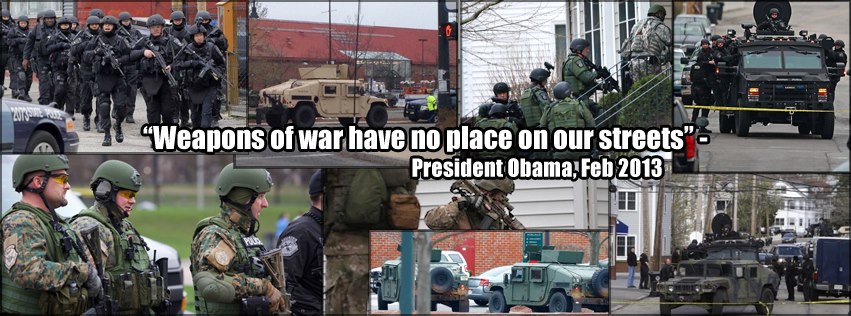
The recent trajectory of events leading up to the shooting of NYPD officers Wenjian Liu and Rafael Ramos, and the nationwide police backlash afterward, have made it clearer than ever how police feel about the public they supposedly protect and serve: they’re terrified of us. For more than twenty years, the Drug War and associated police militarization encouraged an increasing tendency of urban police to see local populations as a dangerous occupied enemy. In Radley Balko’s Rise of the Warrior Cop they admit to stopping and exiting patrol cars randomly in non-white neighborhoods solely to make a show of force, reminding cowed residents who’s boss. And thanks to the mushroom proliferation of SWAT teams (originally designed for use in rare situations like hostage crises) even in small towns, and the enormous flow of surplus military equipment to local police forces like Ferguson, that hostile and fearful attitude towards the local population has spread downward into suburbs and towns.

Meanwhile internal police culture has taken on the same paranoid coloring that caused Lt. Calley and his men to snap and massacre the population of My Lai. Since Hill Street Blues days, cops have commonly described their jobs patrolling the community using “Band of Brothers” rhetoric reminiscent of extended recon missions in Vietnam. But these self-perceptions are utterly detached from reality. Soldiers in Vietnam actually had a high risk of getting killed. But police on-duty casualty rates have fallen steadily for decades. Policing is the ninth-most dangerous job (the top two are logging and fishing); sanitation work is twice as deadly.

That embattled self-image has been the police norm, to an increasing extent, for the past twenty years or more. In recent years police resentment ratcheted further upward over the “chilling effect” of widespread citizen recording of brutality with smart phones, and social media criticism after the Occupy camp shutdowns. But internal police culture went into full-blown panic mode in response to protests over the shooting of Michael Brown, and to the nationwide #WeCantBreathe and #BlackLivesMatter demonstrations after the verdicts in the Michael Brown and Eric Garner shootings.

On police-only message boards, off-duty cops feel free to admit how they really see us: a bunch of sniveling ingrates too spoiled to appreciate the “thin blue line” protecting them from chaos.  Virtually any unarmed non-white person killed by a cop is referred to in such venues as a “criminal” or “thug.” Police apologists go frantically to work digging up dirt on the victims. They depict the victims in language appealing to the most bestial, menacing stereotypes of black men (like the fixation on 12-year-old Tamir Rice’s height and the description of Michael Brown as a hulking linebacker grunting like an animal).

Poul Anderson once wrote that government is the only institution that’s entitled to kill you for disobeying it. That comes through loud and clear with the police — especially the “entitled” part. A police union spokesman flat-out said, if you don’t want to get killed, obey police orders without question. (As if even that were a sufficient guarantee, considering the people having epileptic seizures or in diabetic comas who were killed for “resisting arrest.”) Among the general public “Stop resisting! Stop resisting!” is a punchline, but police even joke among themselves about literally getting away with murder (for example those “We Show Up Early to Beat the Crowds” t-shirts).

To police any criticism at all, even a suggestion that police may sometimes engage in racial profiling or excessive force, is seen as an existential threat. Those same police message boards mentioned above were rife with complaints that protests over the Brown and Garner verdicts were creating an “open season” on cops. The NYPD union gave Mayor Bill de Blasio notice, after he mentioned warning his biracial son to be especially careful around cops, that he would not be welcome at police funerals.

Police paranoia increased its simmer to a boil in response to the protests over Brown’s death and the verdicts; the shooting of Liu and Ramos made it an exploding pressure cooker. Internal NYPD emails accused de Blasio of having “blood on his hands” for his remarks, and implicated protestors as accomplices. Police nationwide have echoed the sentiments.

In short, the cops blame everyone for the hostility that led to Liu’s and Ramos’s death except themselves. Police are professionals at playing the victim card.

The NYPD now considers itself at war. Cops only patrol in pairs, serving warrants and summonses only when absolutely necessary to make an arrest. After decades of asserting how inconceivably dangerous their jobs are, the NYPD responds to two line-of-duty deaths in a force of thousands — the first in THREE YEARS — like it was Pearl Harbor. That speaks volumes about how privileged and entitled they really are.

We can safely assume that, NYPD officers minimize interactions with the public to when an arrest is absolutely necessary, rates of crime by both the public and the cops themselves can only decrease. While they’re at it, maybe they can go on strike — another phenomenon that’s historically associated with drastic drops in the crime rate. That’s one good way of taking criminals off the street.

Surprise: The Drug War Isn’t About Drugs

Drug-War1By Kevin Carson

Source: Center for a Stateless Society

On the morning of November 6 the US Federal Bureau of Investigation trumpeted its takedown of the Silk Road 2.0 website and the arrest of  alleged operator Blake Benthall.

In so doing the FBI demonstrated, once again, that the War on Drugs has nothing to do with anything its propagandists claim it’s about. If drug criminalization is a public safety issue — about fighting violent crime and gangs, or preventing overdoses and poisoning — shutting down Silk Road is one of the dumbest things the feds can do. Silk Road was a secure, anonymous marketplace in which buyers and sellers could do business without the risk of violence associated with street trade. And the seller reputational system meant that drugs sold on Silk Road were far purer and safer than their street counterparts.

This is true of all the other selling points for the Drug War. Hillary Clinton, in possibly one of the stupidest remarks ever uttered by a human being, says legalizing narcotics is a bad idea “because there’s too much money in it” — referring, presumably, to the lucrative drug trade and the cartels fighting over it.

But there’s so much money in it, and the cartels fight to control it, only because it’s illegal. That’s what happens when you criminalize stuff people want to buy: You create black markets with much higher prices, which organized crime gangs fight to control. Alcohol prohibition created the gangster culture of the 1920s. It’s been with us ever since. When Prohibition was repealed, organized crime just shifted to fighting over other illegal markets. The more consensual, non-violent activities are made illegal, the larger the portion of the economy that’s turned into black markets for gangs to fight over.

In related news, the Mexican drug cartels are reportedly making less money since the legalization or decriminalization of pot in several American states. I wonder why.

Perhaps the biggest joke is that the War on Drugs is fought to reduce drug use. No doubt many people involved in the domestic enforcement side of the Drug War actually believe this, but the left hand doesn’t know what the right hand’s doing. The narcotics trade is an enormous source of money for the criminal gangs that control it, and guess what? The US intelligence community is one of the biggest criminal drug gangs in the world, and the global drug trade is a great way for it to raise money to do morally repugnant stuff it can’t get openly funded by Congress. It’s been twenty years since journalist Gary Webb revealed the Reagan cabinet’s collusion with drug cartels in marketing cocaine inside the United States, to raise money for the right-wing Contra death squads in Nicaragua — a revelation he was gaslighted and driven to suicide for by the US intelligence community and mainstream press.

Now we hear that the US is “losing the drug war in Afghanistan.” Well, obviously — it’s a war that’s designed to be lost. The Taliban were so easy to overthrown in the fall of 2001 because they really did try to stamp out opium poppy cultivation, and with a fair degree of success. This didn’t sit well with the Afghan populace, which traditionally makes a lot of money growing poppies. But the Northern Alliance — which the United States turned into the national government of Afghanistan — was quite friendly to poppy cultivation in its territory. When the Taliban was overthrown, poppy and heroin cultivation resumed normal levels. Putting the US in charge of a “war on drugs in Afghanistan” is like putting Al Capone in charge of alcohol prohibition.

Besides, actually “winning” the drug war would mean ending it. And who in US domestic law enforcement wants to cut off the source of billions in federal aid and military equipment, militarized SWAT teams and unprecedented surveillance and civil forfeiture powers? This is a war meant to go on forever, just like the so-called War on Terror.

The state always encourages moral panic and “wars” on one thing or another in order to keep us afraid, so we’ll give it more power over our lives. Don’t believe its lies.


At the Stuff They Don’t Want You to Know podcast Ben and Matt share their views on the War on Drugs.

mp3 link: http://podcasts.howstuffworks.com/hsw/podcasts/stdwytk-audio/2014-11-14-stdwytk-war-on-drugs.mp3

Perceptions of Power

Fascism-s-b-called-Corporatism-Mussolini

By

Source: Center for a Stateless Society

Parsing Political Divides in the Mainstream and in Anarchism

CNBC describes the Corporate Perception Indicator as “a far-reaching survey of business executives and the general population from 25 markets,” “research firm Penn Schoen Berland survey[ing] 25,012 individuals and 1,816 business executives.” The results of the survey show quite unsurprisingly that the general public associates government with words like “corruption,” “lies,” “incompetence,” and “thieves.” As for big business, the words that came to the minds of those surveyed included, again, “corruption” and “thieves,” also “monopoly” and “power.” Interestingly, overall perceptions of both corporations and government appear to be largely negative. In American political discourse, the political right is characterized by a perceptible overpraise of business, devoted to a view of corporations that sees them as essentially free market actors, “creators” and “doers” that give us progress and innovation. Even if this is not true of everyone on the American right, certainly such sentiments are important to the right’s narrative on free markets. The right looks on government, in contrast, as the bungling and inept meddler attempting to hold back our industrious and our productive, the supporter of the lazy and parasitic who would rather live on the government dole than work for a living.

On the left, corporations are perceived as putting profits above people, as willing to do anything to suck more and more of the world’s natural wealth into the hands of a grasping, extravagant one percent. Government, on the other hand, is treated as the agent of “the greater good” or “the public good,” a kind of benevolent, altruistic mother to us all.

In the United States, people who identify themselves as free marketers or libertarians are much more likely to align with the former of these competing narratives, the right’s assertion that the corporation is the home of the movers and the shakers, the creative and energetic champions of free enterprise. This relationship between self-identified libertarians and the American right helps explain the broader anarchist movement’s pardonable reluctance to accept individualist or market anarchists as the genuine article. Further, hostility toward communism has a long history in individualist anarchism, typified by Benjamin Tucker’s frequent denunciations, yet certainly preceding them.[1]

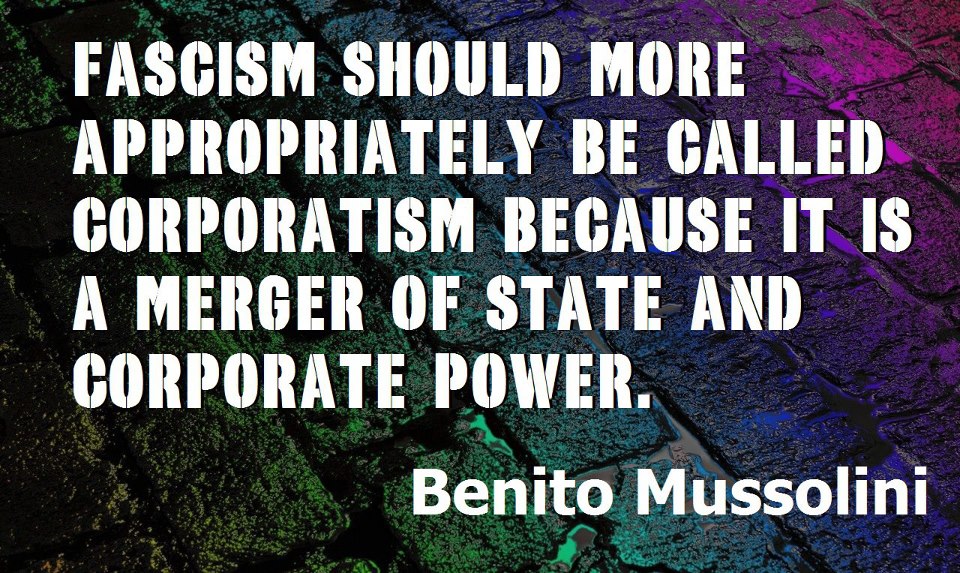
We may observe at this juncture that both the right and the left share the historically and empirically ridiculous theory that government and corporate power are locked in an eternal war. But it is a great politico-economic myth that governments and large corporations operate at variance with one another, that one must align herself in her political commitments with one or the other, never both, never neither. For left wing individualists, surveys which demonstrate dissatisfaction with and negative attitudes toward both actually make perfect sense. That big business should be associated with greed and governments with corruption is hardly astonishing or remarkable. Further, these results underline the problem with seeing corporate power and government power as rivals, rather than seeing them much more accurately as codependent partners in crime, mutually reinforcing components parts of a larger phenomenon we might call a ruling class or power elite.

We needn’t risk the cognitive dissonance that comes with treating the State as the great restraint upon the socially destructive avarice of multinational corporations. For we find, whenever we bother to look, that elites in the business community regularly work with the public sector to create conditions accommodating to monopolism. The ideal of free and open competition, however championed in corporate press releases and political campaigning, is nowhere to be found and indeed never has been. Thus do market anarchists prosecute our laissez faire critique of capitalism. We come from an older tradition of American libertarians, radicals who contemned capitalism as much as any communist, but understood the importance of individual rights and mutually beneficial trade.

It is interesting to witness anarchist communists and syndicalists develop strict, exclusionary criteria for anarchism, particularly insofar as the arguable father of our doctrine, Pierre-Joseph Proudhon, was neither, his mutualism containing many market-friendly if not outright pro-market elements. No less important for anarchism as it developed in America is Josiah Warren, whose first forays into anarchist thought antedate Proudhon. If market or individualist anarchism represents a form of “pseudo-intellectualism,” then some of the anarchist tradition’s brightest lights must apparently be relegated to the dustbin of history. Granting that opposition to not only political but also economic authority is a necessary condition for the true anarchist, individualists like Warren (and his followers such as Benjamin Tucker) more than qualify.

Whether our communist and syndicalist comrades admit it or not, free market ideas figured prominently in fledgling anarchist thought, regarded as perfectly consistent with and a natural outgrowth of, to quote Warren, “the absolute right of supreme individuality.” Considering Warren as an example, many contemporary anarchists may not know that anarchist luminary Peter Kropotkin acknowledged Warren as an inspiration and, in the words of Crispin Sartwell, “a precursor of (and influence on?) Proudhon.” In discussing Warren’s legacy, Sartwell observes one of the major, continuing tensions between the individualist and communist strains of anarchism, the debate on “lifestyle anarchism.” Sartwell argues, quite correctly in the author’s view, that Warren “belongs squarely in what is called by its opponents ‘lifestyle anarchism’: that strain concerned with creating alternatives within the interstices in the existing system rather than arming to overthrow it.” “Peaceful Revolutionist” that he was, Warren emphasized experiments in the creation of practical alternatives to dominant economic and social modalities. To Warren, the whole of life was open to and the subject of reform. This holistic approach, the universality of his critique of the existing state of affairs, he likely inherited from Robert Owen, even while dispensing with other aspects of Owenite thinking. Indeed, Warren’s departure from Owen and his ideas offers us an illuminative proxy for the tensions and debates that still divide individualist from communist elements within anarchism. Warren worried about the overwhelming of the individual within combinations and, paraphrasing Sartwell, imposed a priori schemes. Communists often tend to see the undisciplined “lifestylism” of Warren-type experimentation as essentially bourgeois, outside of or ancillary to genuine class struggle.

Discussing early figures in anarchism such as Warren opens opportunities to reflect on the similarities that unite all anarchists. We can pause to wonder what someone with Warren’s breadth of interests and hopes for reform might think of twenty-first century problems and perceptions thereof.

As all anarchists understand, politics is at bottom conquest, spoliation and rape. Everything else, everything peaceful, voluntary and consensual is something different, throwing the distinction between the “politics means” and the “economic means” once again into sharp relief. The economic means to wealth is defined by the normal, even obvious standards we refer to in interactions with merchants, our friends, and family, the mutually beneficial guidelines we use to cooperate and trade with coequals. The political means, by contrast, is the acquisition of wealth by aggression, by forcible extraction through systematic privilege. The State, being the organization with a monopoly on the legal use of force, is the wellspring of such privilege. As Josiah Warren pointed out in Equitable Commerce:

Theorists have told us that laws and governments are made for the security of person and property; but it must be evident to most minds, that they never have, never will accomplish this professed object; although they have had the world at their control for thousands of years, they have brought it to a worse condition than that in which they found it, in spite of immense improvements in mechanism, division of labor, and other elements of civilization to aid them. On the contrary, under the plausible pretext of securing person and property, they have spread wholesale destruction, famine, and wretchedness in every frightful form over all parts of the earth, where peace and security might otherwise have prevailed. They have shed more blood, committed more murders, tortures, and other frightful crimes in the struggles against each other for the privilege of governing, than society ever would or could have suffered in the total absence of all government whatever.

A deep, principled loathing of both big business and government unites all anarchists. Confronted with the alarming realities of the present moment, its authoritarian repressions and economic maladies, anarchists ought to help one another in peaceful projects to build a freer, better world. Data such as those contained in the Corporate Perception Indicator survey show a world fully primed for our anti-authoritarian, anti-capitalist critiques. It falls upon us to communicate our message, to do the constructive work of inaugurating a new order.

[1] Relatedly, in True Civilization, Josiah Warren wrote, “What is called conservatism has all the time been entirely right in its objections to communism, and in insisting on individual ownership and individual responsibilities both of which communism annihilates; conservatism has also shown wisdom in its aversion to sudden and great changes, for none have been devised that contained the elements of success.”


 

The “Makers” and “Takers” — Not Who You Think

corporate_welfare_medium

By Kevin Carson

Source: Center for a Stateless Society

The old “53% vs. 47%” meme that got so much attention in the 2012 election resurfaced this week when it came out that Colorado gubernatorial candidate Bob Beauprez apparently first coined it at a 2010 Rotary Club speech. The 47% who pay no income tax, he said back then, are “dependent on the largesse of government” and “perfectly happy that someone else is paying the bill.” The talking point got traction with the Tea Party and was soon picked up by politicians like Paul Ryan (who warned we were approaching “a net majority of takers vs. makers”) and Mitt Romney.

Of course this is pure buncombe.  It presupposes that high taxable incomes result primarily from being “makers,” when the truth is just the opposite. The higher your income, in fact, the more likely you’re a taker who’s — all together now! — dependent on government.

It’s possible to get moderately wealthy — say, an income that qualifies you for the “top 1%,” which is somewhere under $400,000, or assets in the low millions — through genuine entrepreneurship. Even at this level, of course, it’s more likely you have an income heavily inflated by membership in a licensing cartel, or help manage a highly authoritarian, statist corporation where your “productivity” — and bonuses — are defined by how effectively you shaft the people whose skills, relationships and other human capital are actually responsible for the organization’s productivity. But it’s at least possible to get this rich by being a maker of sorts, by being more adept than others at anticipating and meeting real human needs.

But you don’t get to be super-rich — to the tune of hundreds of millions or billions of dollars — by making stuff. You get that filthy rich only through crime of one sort or another (even if it’s technically perfectly legal in this society). You get the really big-time money not by making stuff or doing stuff, but by controlling the conditions under which other people are allowed to make stuff and do stuff. You get super-rich by getting into a position where you can fence off opportunities to produce, enclosing those natural opportunities as a source of rent. You do it by collecting tolls and tribute from those who actually make stuff, as a condition of not preventing them from doing so. In other words you get super-rich by being a parasite and extorting protection money from productive members of society, with the help of government.

So don’t be fooled by the fact that some of us aren’t paying any income taxes. We pay lots of taxes — to rich takers who live off our largesse. The portion of your rent or mortgage that results from the enormous tracts of vacant and unimproved land held out of use through artificial property rights is a tax to the landlord. The 95% of the price of drugs under patent, or Bill Gates’s software, is a tax you pay to the owners of “intellectual property” monopolies. So is the portion of the price you pay for manufactured goods, over and above actual materials and labor, that results from embedded rents on patents and enormous brand-name markups on (for example) Nike sneakers over and above the few bucks a pair the sweatshops contract to make them for. So is the estimated 20% oligopoly price markup for industries where a few corporations control half or more of output. If by chance you do pay federal income tax, half of it goes to support the current military establishment or pay off debt from past wars — wars fought for the sake of giant corporations.

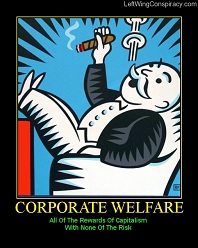
The “takers,” in short, are the people Romney spoke to at $1000/plate fundraisers, who pay Hillary Clinton several hundred grand for a speech reassuring them Wall Street’s not to blame. The entire Fortune 500, the entire billionaire plutocracy, depends on largesse from us makers — and they can only do it with government help.