
Media Responds With Apathy, Disappointment as US-Backed Coup Gov’t Concedes Defeat in Bolivia

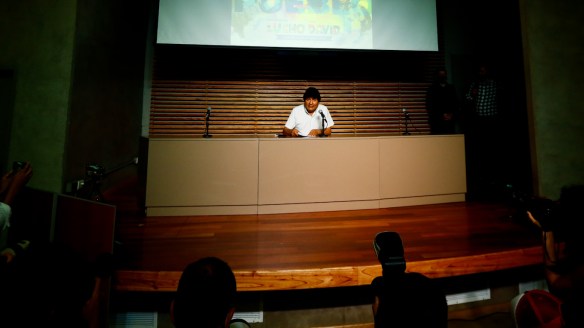
Former Bolivian President Evo Morales attends a press conference in Buenos Aires, Argentina, after general elections in his home country, Monday, Oct. 19. 2020. (AP Photo/Marcos Brindicci)

Across the spectrum, corporate media has endorsed last year’s rightwing takeover of Bolivia, refusing to label it as a coup. Coverage of Sunday’s historical elections hasn’t been much better.

By Alan Macleod

Source: Mint Press News

Bolivia’s Movement to Socialism (MAS) party is celebrating what appears to be a crushing, landslide victory in Sunday’s elections. Although official vote counting is far from over, exit polls show an overwhelming triumph for the socialists, and a repudiation of the right-wing military government of Jeanine Añez, who has ruled since the coup last November. At the same time, the corporate press appears less than pleased about the return to democracy for the Andean country.

In order to win outright in the first round, the top candidate needs at least 40 percent of the popular vote and a lead of 10 points over their nearest rival, and multiple polls have indicated that the MAS ticket of Luis Arce and David Choquehuanca has won more than 50 percent, and have achieved a lead of over 20 points on their nearest challenger, Carlos Mesa (president between 2003 and 2005) — quite a feat in a five-way election. The MAS is also expected to have won a large majority in the senate.

Añez, who came to power in a coup overthrowing President Evo Morales last November, and whose government has constantly postponed the election throughout the year, knew the game was up and lauded the MAS on their remarkable achievement. “We do not yet have an official count, but from the data we have, Mr. Arce and Mr. Choquehuanca have won the election. I congratulate the winners and ask them to govern with Bolivia and democracy in mind,” she wrote. Añez decided to drop out of the election herself last month in an attempt to boost Mesa’s chances of stopping Arce. However, today Mesa accepted defeat as well. “The result is overwhelming and clear. The difference is wide,” he lamented.


Media disappointment at return of democracy

Across the spectrum, corporate media endorsed the events of November, refusing to label them a coup. The New York Times editorial board claimed that the “increasingly autocratic” tyrant Morales had actually “resigned,” after “protests” over a “highly fishy vote.” The Washington Post did the same. “There can be little doubt who was responsible for the chaos: newly resigned president Evo Morales,” their editorial board wrote, as they expressed their relief that Bolivia was finally in the hands of “more responsible leaders” like Añez, (who, at the time, was giving security forces orders to shoot her opponents in the streets). Despite this, The Wall Street Journal’s board decided the events of November constituted “a democratic outbreak in Bolivia.”

Today, therefore, the corporate press is in a very tough spot, as they have to explain to their readers why the Bolivian people have just handed an overwhelming, landslide victory to a party they have been presenting as an authoritarian dictatorship who were overthrown by popular protests last year.

A number of outlets solved this by simply fastidiously avoiding reporting on the events of November or using the word “coup” to describe them. NPR’s Philip Reeves, for example, claimed Morales “resigned” amid an annulled election after “allegations of fraud,” leading to an “interim government” (Añez’s own public relations-minded phrase for her administration). The word “coup” only appears in the mouth of Morales, someone whose credibility the outlet has spent months undermining. Other organizations like Deutsche Welt and Bloomberg failed to use the word at all in their reporting.

The Associated Press, meanwhile, referenced the coup, but did not use the word, instead describing it as when “police and military leaders suggested he [Morales] leave.” It takes great linguistic skill to refrain from using by far the most appropriate word to describe events in Bolivia for what they are: a coup. Indeed, the linguistic gymnastics necessary to avoid using the word would be genuinely impressive were not an exercise in deceit and manufacturing consent for regime change.

CNN at least included the phrase “claims of a coup,” but presents it beside apparently equally justified “allegations of fraud among contested national elections.” But these two things are nothing like the same. One is a statement of fact while another is a debunked, discredited talking point used to overthrow a legitimate government.

Meanwhile, the BBC’s article on the election had an entire section called “why is the country so divided” which did not mention the massacres, the firesale of the country’s economy, the repression of media or activists, the persecution of the MAS or the U.S. role in overthrowing the elected government. Instead, it presented Morales himself as the prime agent of polarization, a common tactic among media discussing enemy states.

The New York Times also published a long, in-depth article on the election, yet it appeared that the only MAS “supporters” it was willing to quote were ones who constantly badmouthed Morales, the article also suggesting that MAS’ figures might be inflated, despite the fact they have now been accepted by Añez and Mesa as essentially accurate.

As such the corporate press refused to cover the incredible story of nationwide nonviolent resistance to authoritarian rule, forcing a government into accepting its own defeat, reminiscent of Gandhi’s campaign against the British in India.

A year of political turbulence

Last October, Morales won an unprecedented and not uncontentious fourth term. Yet the U.S.-backed opposition refused to accept the results, claiming that they had been rigged. The Organization of American States immediately backed them up, producing a flawed report on election meddling, something that was almost immediately disproven. Nevertheless, the right-wing mobilized and began a widespread campaign of terror, targeting, attacking, and kidnapping MAS politicians. On November 10, police and military commanders joined the coup, demanding Morales resign or else they would take matters into their own hands. Morales decided to flee to Mexico but made clear he was only leaving to prevent a bloodbath.

The military picked Añez, a little known senator from a party who gained only four percent of the public vote, to become president. She immediately granted security forces total pre-immunity for all crimes committed during the “re-establishment of order.” Her new interior minister, Arturo Murillo, oversaw the creation of masked, black-clad paramilitary units specifically aimed at political subversives, foreigners, and human rights groups. Journalists were attacked and, in one case, beaten to death, while foreign and alternative media were shut down completely. Murillo promised to “hunt down” his opponents like dogs. Morales himself was charged with crimes against humanity and faces spending the rest of his life in prison if he returns to his home country. Other MAS leaders on yesterday’s ballot also face long prison terms on dubious charges.

https://twitter.com/AliMortell/status/1318221632306089985

Añez pushed through the privatization of natural resources and state-owned businesses while in office, accepting loans from predatory organizations like the International Monetary Fund. She also reorientated her country’s foreign policy away from an independent path towards one completely in line with U.S. foreign policy aims, pulling out of multiple regional alliances and entering new ones. Under Morales, for example, Bolivia had declared Israel a ‘terrorist state.” Yet less than a month after the coup, Añez and Murillo were inviting IDF troops to the country to train their police forces in dealing with “leftist terrorism.”

The government’s response to the coronavirus pandemic has also taken on a decidedly right-wing tone. Cuts to health provisions and the expulsion of hundreds of Cuban doctors (whom the government labeled as “terrorists”) caused the public health system to crash just before the pandemic became worldwide news. As a result, Bolivia has the third-highest COVID-19 death per capita rate in the world, comfortably surpassing the United States in severity. Añez herself contracted the virus in July.

Añez used the intensity of the pandemic as justification to continually suspend the elections she claimed she would hold, calling herself merely an “interim president.” Yet many inside the country felt the coronavirus was being used as an excuse to keep herself in power indefinitely. Throughout the year, Bolivia was engulfed in near continual protests, shutting the country down. As a result, the summer was marked by the rise of the virus and by a weeks-long peaceful general strike calling for elections. Fearing a potential revolution, Añez conceded and agreed to hold them in October.

After months of organized popular struggle in the face of a coup government that had been massacring them, Sunday’s result has been widely interpreted as a repudiation of the coup and a vote for socialism. MintPress’ Ollie Vargas, who has never made a secret of his political persuasions, said in the wake of the results:

On a personal level, I can’t believe this is finally happening, but it’s what we’ve always known. Despite the massacres, despite the persecution, despite U.S. intervention, the MAS is back and even more powerful. They can’t put a lid on the majority of the people.”

Morales celebrated the ascension of his former minister of finance to Bolivia’s top job. “We’ve received our democracy” he declared. “Sisters and brothers: the will of the people has been imposed. There has been a resounding victory for the MAS. Our political movement will have a majority in both houses. We have returned millions, now we are going to restore dignity and freedom to the people,” he added on Twitter.

Arce himself was in an equally joyous mood, telling Vargas last night that, “It seems that a great part of the Bolivian people have recovered their soul.” “I think the Bolivian people want to retake the path we were on,” he added. MAS supporters took to the streets to celebrate their victory, made all the more unlikely given the repression they have been subject to under Añez’s military regime.

Fears of violence and vote rigging against the MAS were rife, especially as the government had blocked foreign election observers from overseeing events, threatening to jail them. On Saturday, Argentinian congressman Federico Fagioli, an official observer representing his government, was arrested by police at El Alto airport. Video of the incident shows Fagioli shouting “I am being kidnapped” as multiple officers pick him up and forcefully carry him away.

What’s Next?

If Añez’s government does indeed step down, it will represent only the second time in Latin American history that a U.S.-backed coup against a progressive administration has been overturned. However, in Venezuela in 2002, the countercoup took less than 48 hours. In Bolivia, people have organized for nearly a year to achieve the same ends, giving the government far more time to embed and establish itself. The Bolivian people have a long history of organized struggle bringing down governments. In the early 2000s, nationwide protests against gas and water privatizations rocked the country, toppling unrepresentative regimes (including that of Mesa’s in 2005), setting the stage for Morales to become the most influential figure in Bolivian politics of the last 15 years.

The first indigenous president in the majority indigenous country’s history, Morales ran on the idea of 21st-century socialism, using his country’s considerable mineral wealth to fund social programs that cut poverty by half and extreme poverty by three-quarters, halving unemployment and increasing the country’s GDP by 50 percent. Yet his nationalization program and his outspoken criticism of capitalism and American imperialism on the world stage made him a prime target for regime change in Washington, who strongly supported the events of November, immediately recognizing and supporting Añez’s legitimacy.

Despite the fact that the MAS’ electoral victory looks certain, it is far from clear what sort of resistance they will face from other sources of power. “The next few days will be key for consolidating democracy in Bolivia. The MAS will need to embrace the patriotic elements within the police and military, to ensure the U.S./Murillo don’t launch a second coup against the majority of Bolivians,” Vargas warned. And how will the MAS deal with the coup plotters themselves, clearly guilty of serious human rights abuses. Are they really in any position to exert authority over the situation?

Of late, wherever there are governments critical of U.S. power (Cuba, Nicaragua, Venezuela, Iran, etc.) they are met with crushing sanctions in an attempt to destroy their ability to oppose Washington. Bolivia under Morales had already been labeled by some in the U.S. as a “narco-dictatorship.” If Arce does indeed come to rule his country, will he receive the Nicolas Maduro treatment?

For MAS supporters, however, those are questions for a different day. Today, they are celebrating a stunning and historic victory cheered by progressives the world over but angering Washington and corporate journalists in equal measure.

US Again Complicit in an Illegal Coup, This Time in Bolivia

Pen and watercolor of Bolivia’s Evo Morales. (Flickr/Arturo Espinosa)

By Marjorie Cohn

Source: Consortium News

Once again, the United States is complicit in an illegal coup d’état in Latin America, this time in Bolivia. On Nov. 10, a right-wing, anti-indigenous group seized power after the Bolivian military’s removal of President Evo Morales, who had declared victory in the Oct. 20 presidential election.

The United States’ fingerprints are all over the coup. Advisers from the U.S. Southern Command have been stationed on Bolivia’s border with Argentina, Ivanka Trump made a surprising visit to an Argentine province near the Bolivian border in September, the pro-U.S. Organization of American States (OAS) cast unfounded doubt on Morales’s election victory, and the U.S.’s National Endowment for Democracy provided suspicious grants to Bolivia.

At least 32 people have been killed and hundreds injured since the coup began. Sacha Llorenti, Bolivian ambassador to the United Nations, told Democracy Now!, “We are going through not just a coup d’état, but a violent one.” Indeed, it has resulted in “the rise of a far-right regime of terror,” professor Gabriel Hetland wrote in The Washington Post.

Morales — Bolivia’s first indigenous leader in a country where 65 percent of the people are indigenous — received 10 percent more votes than Carlos Mesa, the second-place candidate who has close ties to the U.S. government. Mesa was in regular communication with U.S. officials who were trying to destabilize Morales, U.S. government cables published by WikiLeaks reveal.

The day after the election, the U.S.-funded OAS sought to delegitimize the election results. “The OAS Mission expresses its deep concern and surprise at the drastic and hard-to-explain change in the trend of the preliminary results revealed after the closing of the polls,” it stated.

But the Center for Economic and Policy Research (CEPR) published a comprehensive statistical analysis on Nov. 8 that found no evidence of fraud or irregularities in the election and determined that the results reflected highly similar patterns from past elections. Other research conducted by CELAG (Centro Estratégico Latinoamericano de Geopolítica) confirmed CEPR’s findings and identified insufficient evidence to support the assertions in the OAS statement.

CEPR Co-director Mark Weisbrot noted in an op-ed for Market Watch, “The OAS isn’t all that independent at the moment, with the Trump administration actively promoting this military coup, and Washington having more right-wing allies in the OAS than they did just a few years ago.”

The OAS was established during the Cold War to prevent the proliferation of leftist governments. USAID considers OAS a critical tool in “promot[ing] US interests in the Western hemisphere by countering the influence of anti-US countries” such as Bolivia.

The Nov. 10 military coup led to the forced resignation of Morales, who received asylum in Mexico. Right-wing politician Jeanine Añez declared herself interim president, and Donald Trump immediately recognized her illegitimate claim to the presidency. Añez then issued a decree immunizing the military from criminal liability “for carrying out necessary actions in their legitimate defense while performing their constitutional duties.” Morales supporters accused Añez of giving soldiers “carte blanche” to shoot demonstrators. Bolivia’s human rights ombudsman and reporters have documented widespread injuries and fatalities from gunshots.

U.S. Involvement

During Morales’s nearly 14 years in office, his Movement Towards Socialism (MAS) party reduced poverty by 42 percent and extreme poverty by 60 percent. It cut unemployment by 50 percent and nearly tripled the per-capita G.D.P. “It’s indisputable that Bolivians are healthier, wealthier, better educated, living longer and more equal than at any time in this South American nation’s history,” Anthony Faiola wrote in The Washington Post.

There was discontent about Morales seeking a fourth term among some sectors in Bolivia, who thought there should be space for new leadership. But Morales had a strong record of establishing policies to help the people of Bolivia, which angered the U.S. government, Western corporations and the corporate media, “who function as ideological shock troops against leftist governments in Latin America,” Alan MacLeod wrote at Fairness and Accuracy in Reporting.

The U.S. and Argentine governments helped to engineer the Bolivian coup, Stella Calloni reported in Resumen: Latinoamerico. She cited the presence of advisers from the U.S. Southern Command on the Argentine border with Bolivia.

Calloni also documented “the surprising trip of Ivanka Trump” to the Argentine province of Jujuy near the Bolivian border on Sept. 4-5. Accompanied by 2,500 U.S. agents and Undersecretary of State John Sullivan, Ivanka Trump was ostensibly there to “visit” a small NGO dedicated to furthering women’s rights, and she delivered an “aid” package of $400 million for “road works.” Alicia Canqui Condori, national representative of MAS, said that, “in Jujuy Donald Trump’s daughter had met with Gov. Gerardo Morales to plan what happened in Bolivia.”

Moreover, according to Calloni, Bolivian Gen. Williams Kaliman, who “suggested” that Morales resign after the election, traveled to the United States 72 hours after the coup began and he received $1 million from the U.S. embassy in Bolivia. Like many Latin American strongmen over the years, at least six of the top military leaders involved in the coup, including Kaliman, were trained at the notorious U.S. Army School of the Americas (now called the Western Hemisphere Institute for Security Cooperation) in Fort Benning, Georgia.

Months before the coup, Bolivia concluded a $2.3 billion deal with a Chinese consortium to mine lithium. Bolivia has 70 percent of the world’s supply of lithium, which is used in car batteries, electronic devices and weapons systems. “The idea that there might be a new social compact for the lithium was unacceptable to the main transnational mining companies,” Vijay Prashad wrote. U.S. and Canadian companies sought to make a lithium agreement with Bolivia but they could not meet Morales’s conditions. “Morales himself was a direct impediment to the takeover of the lithium fields by the non-Chinese transnational firms,” according to Prashad. “He had to go.”

Meddling in Latin America

U.S. complicity in the Bolivian coup follows in a sordid tradition of meddling in the political and economic affairs of Latin American countries. “For many years, the US government has provided overt financial support to opposition political parties and civic groups, including to many of the groups that have been engaged in violent insurrections and coup plotting since at least 2008,” Thomas Field wrote in Jacobin.

One key vehicle that the U.S. government uses as a cover for its imperialist policies is the National Endowment for Democracy (NED). After disturbing revelations of covert CIA operations in the second half of the 1970s, NED was established under President Ronald Reagan. “The idea was that the NED would do somewhat overtly what the CIA had been doing covertly for decades, and thus, hopefully, eliminate the stigma associated with CIA covert activities,” William Blum wrote in 2005. NED co-founder Allen Weinstein concurred, stating in 1991, “A lot of what we do today was done covertly 25 years ago by the CIA.” Although ostensibly a private, nonprofit organization, NED is largely funded by the United States. “In effect,” Blum noted, “the CIA has been laundering money through NED.”

Peter Haberfeld, a retired lawyer and labor organizer who has studied the “Pink Tide” governments in Latin America, documented NED grants in Bolivia. He told Truthout that “between 2016 and 2019, NED gave grants to over 30 organizations for ‘democracy promotion’ in Bolivia. The grants total $3,209,887.”

Haberfeld said the grants were officially earmarked for “lofty objectives such as expanding participation by women, youth, media and entrepreneurs in a vibrant political process, particularly in connection with elections,” but cautioned “it is wise to be suspicious.” Haberfeld cited author Neil A. Burron, who wrote in “The New Democracy Wars: The Politics of North American Democracy Promotion in the Americas,” that “democracy promotion is typically formulated to advance commercial, geopolitical and security objectives that conflict with a genuine commitment to democracy development.” Burron noted, “For the U.S., the political manipulation of democracy promotion in support of a North American-led regional order is a continuation of long-standing forms of intervention [that have been] used as a license to meddle in the domestic affairs of others.”

NED was complicit in the Iran-Contra affair in the 1980s, manipulated the 1990 Nicaraguan elections, heavily funded the 2002 failed coup attempt against socialist President Hugo Chavez in Venezuela, and supported the opposition to progressive President Jean-Bertrand Aristide in Haiti in the 1990s. Between 1990 and 1992, NED donated a quarter-million dollars to the Cuban-American National Foundation, the violent anti-Castro group based in Miami.

In 2018, under the guise of “democracy,” “human rights” and “entrepreneurship,” NED funneled more than $23 million to opposition groups in Latin American countries, including Venezuela, Nicaragua, Cuba and Bolivia.

Former National Security Advisor John Bolton called Venezuela, Cuba and Nicaragua the “Troika of Tyranny” in November 2018. A few months later, in April 2019, the U.S. government orchestrated another unsuccessful coup in Venezuela. Juan Guaidó, Washington’s chosen puppet to seize power from President Nicolás Maduro, was funded by NED.

Trump not only took aim at the progress President Barack Obama had made toward normalization of relations with Cuba, he has escalated the U.S. economic war on Cuba and unleashed untold numbers of lawsuits that threaten to destroy the fragile Cuban economy.

The Obama administration, led by former Secretary of State Hillary Clinton, supported the 2009 coup in Honduras. The fraudulent election following the coup was financed by NED and the State Department, ushering in a repressive and militarized regime. Conditions deteriorated, leading to the exodus of thousands of Honduran children fleeing north.

U.S. Complicity Is Illegal

U.S. complicity in the coup in Bolivia is illegal under both U.S. and international law. The United Nations Charter prohibits the use of or threat to use force against the territorial integrity or political independence of another nation. The International Covenant on Civil and Political Rights guarantees the right to self-determination.

The Charter of the Organization of American States, to which the U.S. is a party, forbids any country from intervening in the internal or external affairs of another country. The OAS charter declares that, “Every State has the right to choose, without external interference, its political, economic, and social system and to organize itself in the way best suited to it, and has the duty to abstain from intervening in the affairs of another State.”

The Foreign Assistance Act forbids the United States from assisting a country “whose duly elected head of government is deposed by military coup or decree.”

There has been global condemnation of the coup. Sixty-four organizations of jurists, lawyers, NGOs, social movements and trade unions from around the world, including the International Association of Democratic Lawyers and the National Lawyers Guild, sent a letter to the UN High Commissioner for Human Rights Michelle Bachelet, urging her to strongly condemn the human rights violations resulting from the coup.

Fourteen members of the House of Representatives sent a letter to Secretary of State Mike Pompeo saying they were “deeply concerned” about the contribution of the Trump administration to the “escalating political and human rights crisis” in Bolivia.

Over 800 scholars, activists and public figures published an open letter demanding that the United States and the international community halt all support to the right-wing, anti-indigenous regime that took power after the military coup.

Veterans For Peace condemned the racist coup in Bolivia and demanded an end to U.S. intervention in Latin America:

Veterans For Peace stands in solidarity with the Indigenous majority in Bolivia who are resisting the racist, right-wing takeover of their democracy. We demand that the coup be stopped and democracy restored in Bolivia. As military veterans who have been used and abused in too many unjust wars, we demand an end to 200 years of U.S. intervention in Latin America.

The situation in Bolivia is volatile and there is danger it could devolve into civil war. This is the time to urge senators and Congress members to end all U.S. support for the illegitimate regime, demand free and fair elections with all political parties represented, and insist that fundamental human rights of all Bolivians are protected.

Bolivia coup led by Christian fascist paramilitary leader and millionaire – with foreign support

Bolivian coup leader Luis Fernando Camacho is a far-right multi-millionaire who arose from fascist movements in the Santa Cruz region, where the US has encouraged separatism. He has courted support from Colombia, Brazil, and the Venezuelan opposition.

By Max Blumenthal and Ben Norton

Source: The Grayzone

When Luis Fernando Camacho stormed into Bolivia’s abandoned presidential palace in the hours after President Evo Morales’s sudden November 10 resignation, he revealed to the world a side of the country that stood at stark odds with the plurinational spirit its deposed socialist and Indigenous leader had put forward.

With a Bible in one hand and a national flag in the other, Camacho bowed his head in prayer above the presidential seal, fulfilling his vow to purge his country’s Native heritage from government and “return God to the burned palace.”

“Pachamama will never return to the palace,” he said, referring to the Andean Mother Earth spirit. “Bolivia belongs to Christ.”

Bolivia’s extreme right-wing opposition had overthrown leftist President Evo Morales that day, following demands by the country’s military leadership that he step down.

Virtually unknown outside his country, where he had never won a democratic election, Camacho stepped into the void. He is a powerful multi-millionaire named in the Panama Papers, and an ultra-conservative Christian fundamentalist groomed by a fascist paramilitary notorious for its racist violence, with a base in Bolivia’s wealthy separatist region of Santa Cruz.

Camacho hails from a family of corporate elites who have long profited from Bolivia’s plentiful natural gas reserves. And his family lost part of its wealth when Morales nationalized the country’s resources, in order to fund his vast social programs — which cut poverty by 42 percent and extreme poverty by 60 percent.

In the lead-up to the coup, Camacho met with leaders from right-wing governments in the region to discuss their plans to destabilize Morales. Two months before the putsch, he tweeted gratitude: “Thank you Colombia! Thank you Venezuela!” he exclaimed, tipping his hat to Juan Guaido’s coup operation. He also recognized the far-right government of Jair Bolsonaro, declaring, “Thank you Brazil!”

Camacho had spent years leading an overtly fascist separatist organization called the Unión Juvenil Cruceñista. The Grayzone edited the following clips from a promotional historical documentary that the group posted on its own social media accounts:

While Camacho and his far-right forces served as the muscle behind the coup, their political allies waited to reap the benefits.

The presidential candidate Bolivia’s opposition had fielded in the October election, Carlos Mesa, is a “pro-business” privatizer with extensive ties to Washington. US government cables published by WikiLeaks reveal that he regularly corresponded with American officials in their efforts to destabilize Morales.

Mesa is currently listed as an expert at the Inter-American Dialogue, a DC-based think tank funded by the US government’s soft-power arm USAID, various oil giants, and a host of multi-national corporations active in Latin America.

Evo Morales, a former farmer who rose to prominence in social movements before becoming the leader of the powerful grassroots political party Movement Toward Socialism (MAS), was Bolivia’s first Indigenous leader. Wildly popular in the country’s substantial Native and peasant communities, he won numerous elections and democratic referenda over a 13-year period, often in landslides.

On October 20, Morales won re-election by more than 600,000 votes, giving him just above the 10 percent margin needed to defeat opposition presidential candidate Mesa in the first round.

Experts who did a statistical analysis of Bolivia’s publicly available voting data found no evidence of irregularities or fraud. But the opposition claimed otherwise, and took to the streets in weeks of protests and riots.

The events that precipitated the resignation of Morales were indisputably violent. Right-wing opposition gangs attacked numerous elected politicians from the ruling leftist MAS party. They then ransacked the home of President Morales, while burning down the houses of several other top officials. The family members of some politicians were kidnapped and held hostage until they resigned. A female socialist mayor was publicly tortured by a mob.

Following the forced departure of Morales, coup leaders arrested the president and vice president of the government’s electoral body, and forced the organization’s other officials to resign. Camacho’s followers proceeded to burn Wiphala flags that symbolized the country’s Indigenous population and the plurinational vision of Morales.

The Organization of American States, a pro-US organization founded by Washington during the Cold War as an alliance of right-wing anti-communist countries in Latin America, helped rubber stamp the Bolivian coup. It called for new elections, claiming there were numerous irregularities in the October 20 vote, without citing any evidence. Then the OAS remained silent as Morales was overthrown by his military and his party’s officials were attacked and violently forced to resign.

The day after, the Donald Trump White House enthusiastically praised the coup, trumpeting it as a “significant moment for democracy,” and a “strong signal to the illegitimate regimes in Venezuela and Nicaragua.”

Emerging from the shadows to lead a violent far-right putsch

While Carlos Mesa timidly condemned the opposition’s violence, Camacho egged it on, ignoring calls for an international audit of the election and emphasizing his maximalist demand to purge all supporters of Morales from government. He was the true face of the opposition, concealed for months behind the moderate figure of Mesa.

A 40-year-old multi-millionaire businessman from the separatist stronghold of Santa Cruz, Camacho has never run for office. Like Venezuelan coup leader Juan Guaidó, whom more than 80 percent of Venezuelans had never heard of until the US government anointed him as supposed “president,” Camacho was an obscure figure until the coup attempt in Bolivia hit its stride.

He first created his Twitter account on May 27, 2019. For months, his tweets went ignored, generating no more than three or four retweets and likes. Before the election, Camacho did not have a Wikipedia article, and there were few media profiles on him in Spanish- or English-language media.

Camacho issued a call for a strike on July 9, posting videos on Twitter that got just over 20 views. The goal of the strike was to try to force the resignation of Bolivian government’s electoral organ the Supreme Electoral Tribunal (TSE). In other words, Camacho was pressuring the government’s electoral authorities to step down more than three months before the presidential election.

It was not until after the election that Camacho was thrust into the limelight and transformed into a celebrity by corporate media conglomerates like the local right-wing network Unitel, Telemundo, and CNN en Español.

All of a sudden, Camacho’s tweets calling for Morales to resign were lighting up with thousands of retweets. The coup machinery had been activated.

Mainstream outlets like the New York Times and Reuters followed by anointing the unelected Camacho as the “leader” of Bolivia’s opposition. But even as he lapped up international attention, key portions of the far-right activist’s background were omitted.

Left unmentioned were Camacho’s deep and well-established connections to Christian extremist paramilitaries notorious for racist violence and local business cartels, as well as the right-wing governments across the region.

It was in the fascist paramilitaries and separatist atmosphere of Santa Cruz where Camacho’s politics were formed, and where the ideological contours of the coup had been defined.

Cadre of a Francoist-style fascist paramilitary

Luis Fernando Camacho was groomed by the Unión Juvenil Cruceñista, or Santa Cruz Youth Union (UJC), a fascist paramilitary organization that has been linked to assassination plots against Morales. The group is notorious for assaulting leftists, Indigenous peasants, and journalists, all while espousing a deeply racist, homophobic ideology.

Since Morales entered office in 2006, the UJC has campaigned to separate from a country its members believed had been overtaken by a Satanic Indigenous mass.

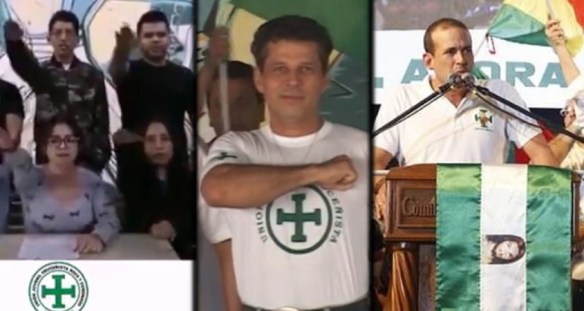
The UJC is the Bolivian equivalent of Spain’s Falange, India’s Hindu supremacist RSS, and Ukraine’s neo-Nazi Azov battalion. Its symbol is a green cross that bears strong similarities to logos of fascist movements across the West.

And its members are known to launch into Nazi-style sieg heil salutes.

https://twitter.com/GrayzoneProject/status/1194137427474038784

Even the US embassy in Bolivia has described UJC members as “racist” and “militant,” noting that they “have frequently attacked pro-MAS/government people and installations.”

After journalist Benjamin Dangl visited with UJC members in 2007, he described them as the “brass knuckles” of the Santa Cruz separatist movement. “The Unión Juvenil has been known to beat and whip campesinos marching for gas nationalization, throw rocks at students organizing against autonomy, toss molotov cocktails at the state television station, and brutally assault members of the landless movement struggling against land monopolies,” Dangl wrote.

“When we have to defend our culture by force, we will,” a UJC leader told Dangl. “The defense of liberty is more important than life.”

Camacho was elected as vice president of the UJC in 2002, when he was just 23 years old. He left the organization two years later to build his family’s business empire and rise through the ranks of the Pro-Santa Cruz Committee. It was in that organization that he was taken under the wing of one of the separatist movement’s most powerful figures, a Bolivian-Croatian oligarch named Branko Marinkovic.

In August, Camacho tweeted a photo with his “great friend,” Marinkovic. This friendship was crucial to establishing the rightist activist’s credentials and forging the basis of the coup that would take form three months later.

Camacho’s Croatian godfather and separatist powerbroker

Branko Marinkovic is a major landowner who ramped up his support for the right-wing opposition after some of his land was nationalized by the Evo Morales government. As chairman of the Pro-Santa Cruz Committee, he oversaw the operations of the main engine of separatism in Bolivia.

In a 2008 letter to Marinkovic, the International Federation for Human Rights denounced the committee as an “actor and promoter of racism and violence in Bolivia.”

The human rights group added that it “condemn[ed] the attitude and secessionist, unionist and racist discourses as well as the calls for military disobedience of which the Pro-Santa Cruz Civic Committee for is one of the main promoters.”

In 2013, journalist Matt Kennard reported that the US government was working closely with the Pro-Santa Cruz Committee to encourage the balkanization of Bolivia and to undermine Morales. “What they [the US] put across was how they could strengthen channels of communication,” the vice president of the committee told Kennard. “The embassy said that they would help us in our communication work and they have a series of publications where they were putting forward their ideas.”

In a 2008 profile on Marinkovic, the New York Times acknowledged the extremist undercurrents of the Santa Cruz separatist movement the oligarch presided over. It described the area as “a bastion of openly xenophobic groups like the Bolivian Socialist Falange, whose hand-in-air salute draws inspiration from the fascist Falange of the former Spanish dictator Franco.”

The Bolivian Socialist Falange was a fascist group that provided safe haven to Nazi war criminal Klaus Barbie during the Cold War. A former Gestapo torture expert, Barbie was repurposed by the CIA through its Operation Condor program to help exterminate communism across the continent. (Despite its antiquated name, like the German National Socialists, this far-right extremist group was violently anti-leftist, committed to killing socialists.)

The Bolivian Falange came into power in 1971 when its leader, Gen. Hugo Banzer Suarez, ousted the leftist government of Gen. Juan Jose Torres Gonzales. The government of Gonzales had infuriated business leaders by nationalizing industries and antagonized Washington by ousting the Peace Corps, which it viewed as an instrument of CIA penetration. The Nixon administration immediately welcomed Banzer with open arms and courted him as a key bulwark against the spread of socialism in the region. (An especially ironic 1973 dispatch appears on Wikileaks showing Secretary of State Henry Kissinger thanking Banzer for congratulating him on his Nobel Peace Prize).

The movement’s putschist legacy persevered during the Morales era through organizations like the UJC and figures such as Marinkovic and Camacho.

The Times noted that Marinkovic also supported the activities of the UJC, describing the fascist group as “a quasi-independent arm of the committee led by Mr. Marinkovic.” A member of the UJC board told the US newspaper of record in an interview, “We will protect Branko with our own lives.”

Marinkovic has espoused the kind of Christian nationalist rhetoric familiar to the far-right organizations of Santa Cruz, calling, for instance, for a “crusade for the truth” and insisting that God is on his side.

The oligarch’s family hails from Croatia, where he has dual citizenship. Marinkovic has long been dogged by rumors that his family members were involved in the country’s powerful fascist Ustashe movement.

The Ustashe collaborated openly with Nazi German occupiers during World War Two. Their successors returned to power after Croatia declared independence from the former Yugoslavia – a former socialist country that was intentionally balkanized in a NATO war, much in the same way that Marinkovic hoped Bolivia would be.

Marinkovic denies that his family was part of the Ustashe. He claimed in an interview with the New York Times that his father fought against the Nazis.

But even some of his sympathizers are skeptical. A Balkan analyst from the private intelligence firm Stratfor, which works closely with the US government and is popularly known as the “shadow CIA,” produced a rough background profile on Marinkovic, speculating, “Still don’t know his full story, but I would bet a lot of $$$ that this dude’s parents are 1st gen (his name is too Slavic) and that they were Ustashe (read: Nazi) sympathizers fleeing Tito’s Communists after WWI.”

The Stratfor analyst excerpted a 2006 article by journalist Christian Parenti, who had visited Marinkovic at his ranch in Santa Cruz. Evo Morales’ “land reform could lead to civil war,” Marinkovic warned Parenti in the Texas-accented English he picked up while studying at the University of Texas.

Today, Marinkovic is an ardent supporter of Brazil’s far-right leader Jair Bolsonaro, whose only complaint about Chilean dictator Augusto Pinochet was that he “didn’t kill enough.”

Marinkovic is also a public admirer of Venezuela’s far-right opposition. “Todos somos Leopoldo” — “we are all Leopoldo,” he tweeted in support of Leopoldo López, who has been involved in numerous coup attempts against Venezuela’s elected leftist government.

While Marinkovic denied any role in armed militant activity in his interview with Parenti, he was accused in 2008 of playing a central role in an attempt to assassinate Morales and his Movement Toward Socialism party allies.

He told the New York Times less than two years before the plot developed, “If there is no legitimate international mediation in our crisis, there is going to be confrontation. And unfortunately, it is going to be bloody and painful for all Bolivians.”

An assassination plot links Bolivia’s right to international fascists

In April 2009, a special unit of the Bolivian security services barged into a luxury hotel room and cut down three men who were said to be involved in a plot to kill Evo Morales. Two others remained on the loose. Four of the alleged conspirators had Hungarian or Croatian roots and ties to rightist politics in eastern Europe, while another was a right-wing Irishman, Michael Dwyer, who had only arrived in Santa Cruz six months before.

The ringleader of the group was said to be a former leftist journalist named Eduardo Rosza-Flores who had turned to fascism and belonged to Opus Dei, the traditionalist Catholic cult that emerged under the dictatorship of Spain’s Francisco Franco. In fact, the codename Rosza-Flores assumed in the assassination plot was “Franco,” after the late Generalissimo.

During the 1990s, Rosza fought on behalf of the Croatian First International Platoon, or the PIV, in the war to separate from Yugoslavia. A Croatian journalist told Time that the “PIV was a notorious group: 95% of them had criminal histories, many were part of Nazi and fascist groups, from Germany to Ireland.”

By 2009, Rosza returned home to Bolivia to crusade on behalf of another separatist movement in Santa Cruz. And it was there that he was killed in a luxury hotel with no apparent source of income and a massive stockpile of guns.

The government later released photos of Rosza and a co-conspirator posing with their weapons. Publication of emails between the ringleader and Istvan Belovai, a former Hungarian military intelligence officer who served as a double agent for the CIA, cemented the perception that Washington had a hand in the operation.

Marinkovic was subsequently charged with providing $200,000 to the plotters. The Bolivian-Croatian oligarch initially fled to the United States, where he was given asylum, then relocated to Brazil, where he lives today. He denied any involvement in the plan to kill Morales.

As journalist Matt Kennard reported, there was another thread that tied the plot to the US: the alleged participation of an NGO leader named Hugo Achá Melgar.

“Rozsa didn’t come here by himself, they brought him,” the Bolivian government’s lead investigator told Kennard. “Hugo Achá Melgar brought him.”

The Human Rights Foundation destabilizes Bolivia

Achá was not just the head of any run-of-the-mill NGO. He had founded the Bolivian subsidiary of the Human Rights Foundation (HRF), an international right-wing outfit that is known for hosting a “school for revolution” for activists seeking regime change in states targeted by the US government.

HRF is run by Thor Halvorssen Jr., the son of the late Venezuelan oligarch and CIA asset Thor Halvorssen Hellum. The first cousin of the veteran Venezuelan coup plotter Leopoldo Lopez, Halvorssen was a former college Republican activist who crusaded against political correctness and other familiar right-wing hobgoblins.

After a brief career as a firebrand right-wing film producer, in which he oversaw a scandalous “anti-environmentalist” documentary financed by a mining corporation, Halvorssen rebranded as a promoter of liberalism and the enemy of global authoritarianism. He launched the HRF with grants from right-wing billionaires like Peter Thiel, conservative foundations, and NGOs including Amnesty International. The group has since been at the forefront of training activists for insurrectionary activity from Hong Kong to the Middle East to Latin America.

Though Achá was granted asylum in the US, the HRF has continued pushing regime change in Bolivia. As Wyatt Reed reported for The Grayzone, HRF “freedom fellow” Jhanisse Vaca Daza helped trigger the initial stage of the coup by blaming Morales for the Amazon fires that consumed parts of Bolivia in August, mobilizing international protests against him.

At the time, Daza posed as an “environmental activist” and student of non-violence who articulated her concerns in moderate-seeming calls for more international aid to Bolivia. Through her NGO, Rios de Pie, she helped launch the #SOSBolivia hashtag, which signaled the imminent foreign-backed regime-change operation.

Courting the regional right, prepping the coup

While HRF’s Daza rallied protests outside Bolivian embassies in Europe and the US, Fernando Camacho remained behind the scenes, lobbying right-wing governments in the region to bless the coming coup.

In May, Camacho met with Colombia’s far-right President Ivan Duque. Camacho was helping to spearhead regional efforts at undermining the legitimacy of Evo Morales’ presidency at the Inter-American Court of Human Rights, seeking to block his candidacy in the October election.

That same month, the rightist Bolivian agitator also met with Ernesto Araújo, the chancellor of Jair Bolsonaro’s ultra-conservative administration in Brazil. Through the meeting, Camacho successfully secured Bolsonaro’s backing for regime change in Bolivia.

This November 10, Araújo enthusiastically endorsed the ouster of Morales, declaring that “Brazil will support the democratic and constitutional transition” in the country.

Then in August, two months before Bolivia’s presidential election, Camacho held court with officials from Venezuela’s US-appointed coup regime. These included Gustavo Tarre, Guaido’s faux Venezuelan OAS ambassador, who formerly worked at the right-wing Center for Strategic and International Studies (CSIS) think tank in Washington.

After the meeting, Camacho tweeted gratitude to the Venezuelan coup-mongers, as well as to Colombia and Brazil.

Mesa and Camacho: a marriage of capitalist convenience

Back in Bolivia, Carlos Mesa occupied the spotlight as the opposition’s presidential candidate.

His erudite image and centrist policy proposals put him in a seemingly alternate political universe from fire-breathing rightists like Camacho and Marinkovic. For them, he was a convenient front man and acceptable candidate who promised to defend their economic interests.

“It might be that he is not my favorite, but I’m going to vote for him, because I don’t want Evo,” Marinkovic told a right-wing Argentine newspaper five days before the election.

Indeed, it was Camacho’s practical financial interests that appeared to have necessitated his support for Mesa.

The Camacho family has formed a natural gas cartel in Santa Cruz. As the Bolivian outlet Primera Linea reported, Luis Fernando Camacho’s father, Jose Luis, was the owner of a company called Sergas that distributed gas in the city; his uncle, Enrique, controlled Socre, the company that ran the local gas production facilities; and his cousin, Cristian, controls another local gas distributor called Controgas.

According to Primera Linea, the Camacho family was using the Pro-Santa Cruz Committee as a political weapon to install Carlos Mesa into power and ensure the restoration of their business empire.

Mesa has a well-documented history of advancing the goals of transnational companies at the expense of his own country’s population. The neoliberal politician and media personality served as vice president when the US-backed President Gonzalo “Goni” Sanchez de Lozada provoked mass protests with his 2003 plan to allow a consortium of multinational corporations to export the country’s natural gas to the US through a Chilean port.

Bolivia’s US-trained security forces met the ferocious protests with brutal repression. After presiding over the killing of 70 unarmed protesters, Sanchez de Lozada fled to Miami and was succeeded by Mesa.

By 2005, Mesa was also ousted by huge demonstrations spurred by his protection of privatized natural gas companies. With his demise, the election of Morales and the rise of the socialist and rural Indigenous movements behind him were just beyond the horizon.

US government cables released by WikiLeaks show that, after his ouster, Mesa continued regular correspondence with American officials. A 2008 memo from the US embassy in Bolivia revealed that Washington was conspiring with opposition politicians in the lead-up to the 2009 presidential election, hoping to undermine and ultimately unseat Morales.

The memo noted that Mesa had met with the chargé d’affaires of the US embassy, and had privately told them he planned to run for president. The cable recalled: “Mesa told us his party will be ideologically similar to a social democratic party and that he hoped to strengthen ties with the Democratic party. ‘We have nothing against the Republican party, and have in fact gotten support from IRI (International Republican Institute) in the past, but we think we share more ideology with the Democrats,’ he added.”

wikileaks bolivia carlos mesa

Today, Mesa serves as an in-house “expert” at the Inter-American Dialogue, a neoliberal Washington-based think tank focused on Latin America. One of the Dialogue’s top donors is the US Agency for International Development (USAID), the State Department subsidiary that was exposed in classified diplomatic cables published on Wikileaks for strategically directing millions of dollars to opposition groups including those “opposed to Evo Morales’ vision for indigenous communities.”

Other top funders of the Dialogue include oil titans like Chevron and ExxonMobil; Bechtel, which inspired the initial protests against the administration in which Mesa served; the Inter-American Development Bank, which has forcefully opposed Morales’ socialist-oriented policies; and the Organization of American States (OAS), which helped delegitimize the Morales’s re-election victory with dubious claims of irregular vote counts.

Finishing the job

When Carlos Mesa touched off nationwide protests in October by accusing the Evo Morales government of committing electoral fraud, the right-wing firebrand hailed by his followers as “Macho Camacho” emerged from the shadows. Behind him was the hardcore separatist shock force that he led in Santa Cruz.

Mesa faded into the distance as Camacho emerged as the authentic face of the coup, rallying his forces with the uncompromising rhetoric and fascist symbology that defined the Unión Juvenil Cruceñista paramilitary.

As he declared victory over Morales, Camacho exhorted his followers to “finish the job, let’s get the elections going, let’s start judging the government criminals, let’s put them in jail.”

Back in Washington, meanwhile, the Trump administration released an official statement celebrating Bolivia’s coup, declaring that “Morales’s departure preserves democracy.”