Geopolitical Chessboard Shifts Against US Empire

By Pepe Escobar

Source: The Unz Review

The geopolitical chessboard is in perpetual shift – and never more than in our current incandescent juncture.

A fascinating consensus in discussions among Chinese scholars – including those part of the Asian and American diasporas – is that not only Germany/EU lost Russia, perhaps irretrievably, but China gained Russia, with an economy highly complementary to China’s own and with solid ties with the Global South/Global Majority that can benefit and aid Beijing.

Meanwhile, a smatter of Atlanticist foreign policy analysts are now busy trying to change the narrative on NATO vs. Russia, applying the rudiments of realpolitik.

The new spin is that it’s “strategic insanity” for Washington to expect to defeat Moscow, and that NATO is experiencing “donor fatigue” as the sweatshirt warmonger in Kiev “loses credibility”.

Translation: it’s NATO as a whole that is completely losing credibility, as its humiliation in the Ukraine battlefield is now painfully graphic for all the Global Majority to see.

Additionally, “donor fatigue” means losing a major war, badly. As military analyst Andrei Martyanov has relentlessly stressed, “NATO ‘planning’ is a joke. And they are envious, painfully envious and jealous.”

A credible path ahead is that Moscow will not negotiate with NATO – a mere Pentagon add-on – but offer individual European nations a security pact with Russia that would make their need to belong to NATO redundant. That would assure security for any participating nation and relieve pressure on it from Washington.

Bets could be made that the most relevant European powers might accept it, but certainly not Poland – the hyena of Europe – and the Baltic chihuahuas.

In parallel, China could offer peace treaties to Japan, South Korea and the Philippines, and subsequently a significant part of the US Empire of Bases might vanish.

The problem, once again, is that vassal states don’t have the authority or power to comply with any agreement ensuring peace. German businessmen, off the record, are sure that sooner or later Berlin may defy Washington and do business with the Russia-China strategic partnership because it benefits Germany.

Yet the golden rule still has not been met: if a vassal state wants to be treated as a sovereign state, the first thing to do is to shut down key branches of the Empire of Bases and expel US troops.

Iraq is trying to do it for years now, with no success. One third of Syria remains US-occupied – even as the US lost its proxy war against Damascus due to Russian intervention.

The Ukraine Project as an existential conflict

Russia has been forced to fight against a neighbor and kin that it simply can’t afford to lose; and as a nuclear and hypersonic power, it won’t.

Even if Moscow will be somewhat strategically weakened, whatever the outcome, it’s the US – in the view of Chinese scholars – that may have committed its greatest strategic blunder since the establishment of the Empire: turning the Ukraine Project into an existential conflict, and committing the entire Empire and all its vassals to a Total War against Russia.

That’s why we have no peace negotiations, and the refusal even of a cease fire; the only possible outcome devised by the Straussian neocon psychos who run US foreign policy is unconditional Russian surrender.

In the recent past, Washington could afford to lose its wars of choice against Vietnam and Afghanistan. But it simply can’t afford to lose the war on Russia. When that happens, and it’s already on the horizon, the Revolt of the Vassals will be far reaching.

It’s quite clear that from now on China and BRICS+ – with expansion starting at the summit in South Africa next month – will turbo-charge the undermining of the US dollar. With or without India.

There will be no imminent BRICS currency – as noted by some excellent points in this discussion. The scope is huge, sherpas are only in the initial debating stages, and the broad outlines have not been defined yet.

The BRICS+ approach will evolve from improved cross border settlement mechanisms – something everyone from Putin to Central Bank head Elvira Nabiullina have stressed – to eventually a new currency way further down the road.

This would probably be a trade instrument rather than a sovereign currency like the euro. It will be designed to compete against the US dollar in trade, initially among BRICS+ nations, and capable of circumventing the hegemonic US dollar ecosystem.

The key question is how long the Empire’s fake economy – clinically deconstructed by Michael Hudson – can hold out in this wide spectrum geoeconomic war.

Everything is a ‘national security threat’

On the electronic technology front, the Empire has gone no holds barred to impose global economic dependency, monopolizing intellectual property rights and as Michael Hudson notes, “extracting economic rent from charging high prices for high-technology computer chips, communications, and arms production.”

In practice, not much is happening other than the prohibition for Taiwan to supply valuable chips to China, and asking TSMC to build, as soon as possible, a chip manufacturing complex in Arizona.

However, TSMC chairman Mark Liu has remarked that the plant faced a shortage of workers with the “specialized expertise required for equipment installation in a semiconductor-grade facility.” So the much lauded TSMC chip plant in Arizona won’t start production before 2025.

The top Empire/vassal NATO demand is that Germany and the EU must impose a Trade Iron Curtain against the Russia-China strategic partnership and their allies, thus ensuring “de-risk” trade.

Predictably, US Think Tankland has gone bonkers, with American Enterprise Institute hacks rabidly stating that even economic de-risking is not enough: what the US needs is a hard break with China.

In fact that dovetails with Washington smashing international free trade rules and international law, and treating any form of trade and SWIFT and financial exchanges as “national security threats” to US economic and military control.

So the pattern ahead is not China imposing trade sanctions on the EU – which remains a top trade partner for Beijing; it’s Washington imposing a tsunami of sanctions on nations daring to break the US-led trade boycott.

Russia-DPRK meets Russia-Africa

Only this week, the chessboard went through two game-changing moves: the high-profile visit by Russian Defense Minister Sergei Shoigu to the DPRK, and the Russia-Africa summit in St. Petersburg.

Shoigu was received in Pyongyang as a rock star. He had a personal meeting with Kim Jong-Un. The mutual goodwill leads to the strong possibility of North Korea eventually joining one of the multilateral organizations carving the path towards multipolarity.

That would be, arguably, an extended Eurasian Economic Union (EAEU). It could start with an EAEU-DPRK free trade agreement, such as the ones struck with Vietnam and Cuba.

Russia is the top power in the EAEU and it can ignore sanctions on the DPRK, while BRICS+, SCO or ASEAN have too many second thoughts. A key priority for Moscow is the development of the Far East, more integration with both Koreas, and the Northern Sea Route, or Arctic Silk Road. The DPRK is then a natural partner.

Getting the DPRK into the EAEU will do wonders for BRI investment: a sort of cover which Beijing does not enjoy for the moment when it invests in the DPRK. That could become a classic case of deeper BRI-EAEU integration.

Russian diplomacy at the highest levels is going all out to relieve the pressure over the DPRK. Strategically, that’s a real game-changer; imagine the huge and quite sophisticated North Korean industrial-military complex added to the Russia-China strategic partnership and turning the whole Asia-Pacific paradigm upside down.

The Russia-Africa summit in St. Petersburg, in itself, was another game-changer that left collective West mainstream media apoplectic. That was nothing less than Russia publicly announcing, in words and deeds, a comprehensive strategic partnership with the whole of Africa even as a hostile collective West wages Hybrid War – and otherwise – against Afro-Eurasia.

Putin showed how Russia holds a 20% share of the global wheat market. In the first 6 months of 2023, it had already exported 10 million tons of grain to Africa. Now Russia will be providing Zimbabwe, Burkina Faso, Somalia and Eritrea with 25-50 thousand tons of grain each in the next 3-4 months, for free.

Putin detailed everything from approximately 30 energy projects across Africa to the expansion of oil and gas exports and “unique non-energy applications of nuclear technology, including in medicine”; the launching of a Russian industrial zone near the Suez Canal with products to be exported throughout Africa; and the development of Africa’s financial infrastructure, including connection to the Russian payment system.

Crucially, he also extolled closer ties between the EAEU and Africa. A forum panel, “EAEU-Africa: Horizons of Cooperation”, examined the possibilities, which include closer continental connection with both the BRICS and Asia. A torrent of free trade agreements may be in the pipeline.

The scope of the forum was quite impressive. There were “de-neocolonialization” panels, such as “Achieving Technological Sovereignty Through Industrial Cooperation” or “New World Order: from the Legacy of Colonialism to Sovereignty and Development.”

And of course the International North South Transportation Corridor (INSTC) was also discussed, with major players Russia, Iran and India set to promote its crucial extension to Africa, escaping NATO littorals.

Separate from the frantic action in St. Petersburg, Niger went through a military coup. Although the end-result remains to be seen, Niger is likely to join neighboring Mali in reasserting its foreign policy independence from Paris. French influence is also being at least “reset” in the Central African Republic (CAR) and Burkina Faso. Translation: France and the West are being evicted all across the Sahel, one-step at a time, in an irreversible process of decolonization.

Beware the Pale Horses of Destruction

These movements across the chessboard, from the DPRK to Africa and the chip war against China, are as crucial as the coming, shattering humiliation of NATO in Ukraine. Yet not only the Russia-China strategic partnership but also key players across the Global South/Global Majority are fully aware that Washington views Russia as a tactical enemy in preparation for the overriding Total War against China.

As it stands, the still unresolved tragedy in Donbass as it keeps the Empire busy, and away from Asia-Pacific. Yet Washington under the Straussian neocon psychos is increasingly mired in Desperation Row, making it even more dangerous.

All that while the BRICS+ “jungle” turbo-charges the necessary mechanisms capable of sidelining the unipolar Western “garden”, as a helpless Europe is being driven to an abyss, forced to split itself from China, BRICS+ and the de facto Global Majority.

It doesn’t take a seasoned weatherman to see which way the steppe wind blows – as the Pale Horses of Destruction plot the trampling of the chessboard, and the wind begins to howl.
The BRICS Reshape the Global Geopolitical Map

By Manuel F. Diaz

Source: InfoBrics.org

Thirty years ago, pluripolarity was far from a reality in a world that had been under U.S. hegemony since the collapse of the Soviet Union in 1991. Today, however, humanity is taking important steps toward forming a plural geopolitics whose protagonists are the emerging countries that challenge Western power.

The turning point towards a new form of integration, which will generate a new world political balance, occurred in 2009 when Brazil, Russia, India, and China held the first BRIC summit.

After the incorporation of South Africa to this group in 2010, the BRICS has generated such real prospects that other nations with productive capacity and diversified economies have expressed interest in joining. Among them are Saudi Arabia, Algeria, Argentina, the United Arab Emirates, and Mexico.

In the article “Can the BRICS Trump the IMF and the World Bank?,” Palestinian-American journalist Ramzy Baroud noted that “one of the biggest opportunities and challenges” the BRICS now faces is expanding its membership while maintaining its current growth.

Recent financial reports revealed that the BRICS have the world’s largest gross domestic product (GDP) and that economic bloc contributes 31.5 percent of global GDP, while the Group of Seven (G7) stuck at 30.7 percent.

The International Monetary Fund (IMF) and the World Bank (WB) are known for providing financial support to developing countries under conditions that, under the pretext of defending human rights or democracy, seek to favor the privatization of public goods and the opening of domestic markets for Western foreign investors.

Due to these politically-driven conditionalities, the struggle for alternatives to the IMF-WB mechanisms becomes a political task. The Global South requires international institutions that are not interested in indirectly manipulating or controlling national economies.

That is the call for the BRICS to evolve towards integration schemes that go beyond the exclusively economic realm, although the basis of the fight against the U.S.-controlled institutions is the formation of an alternative economy.

Recently, the BRICS placed a capital of US$50 billion for the launch of their New Development Bank (NDB), which will be chaired by former Brazilian president Dilma Rousseff.

This happened at a time when presidents Xi Jinping (China) and Lula da Silva (Brazil) showed a shared interest in influencing the peaceful solution of the Ukrainian conflict.

Under these circumstances, to argue that the BRICS are a group with purely economic interests is to ignore much of the its history.

“The timing of the BRICS expansion, the stern political discourse of its members, potential members and allies, the repeated visits by top Russian and Chinese diplomats to Africa and other regions of the Global South, etc… indicate that the BRICS have become the new geopolitical, economic and diplomatic platform for the countries of the South,” said Baroud.

Meanwhile, the Western powers, whose economies are struggling to stay afloat, are closely and suspiciously watching the changes taking place in the Global South at the hands of the BRICS.

The Hegemon Will Go Full Hybrid War Against BRICS+

The Hybrid War 2.0 against the Global South has not even started. Swing states, you have all been warned.

By Pepe Escobar

Source: Global Research

U.S. Think Tank Land hacks are not exactly familiar with Montaigne: “On the highest throne in the world, we still sit only on our own bottom.”

Hubris leads these specimens to presume their flaccid bottoms are placed high above anyone else’s. The result is that a trademark mix of arrogance and ignorance always ends up unmasking the predictability of their forecasts.

U.S. Think Tank Land – inebriated by their self-created aura of power – always telegraphs in advance what they’re up to. That was the case with Project 9/11 (“We need a new Pearl Harbor”). That was the case with the RAND report on over-extending and unbalancing Russia. And now that’s the case with the incoming

American War on BRICS as outlined by the chairman of the New York-based Eurasia Group.

It’s always painful to suffer through the intellectually shallow Think Thank Land wet dreams masquerading as “analyses” but in this particular case key Global South players need to be firmly aware of what awaits them.

Predictably, the whole “analysis” revolves around the imminent, devastating humiliation to the Hegemon and its vassals: what happens next in country 404, also known – for now – as Ukraine.

Brazil, India, Indonesia and Saudi Arabia are dismissed as “four major fence-sitters” when it comes to the U.S./NATO proxy war against Russia. It’s the same old “you’re with us or against us” trope.

But then we are presented with the six major Global South culprits: Brazil, India, Indonesia, Saudi Arabia, South Africa and Turkey.

In yet another crude, parochial remix of a catch phrase referring to the American elections, these are qualified as the key swing states the Hegemon will need to seduce, cajole, intimidate and threaten to assure its dominance of the “rules-based international order”.

Saudi Arabia and South Africa are added to a previous report focused on the “four major fence sitters”.

The swing state manifesto notes that all of them are G-20 members and “active in both geopolitics and geoeconomics” (Oh really? Now that’s some breaking news). What it does not say is that three of them are BRICS members (Brazil, India, South Africa) and the other three are serious candidates to join BRICS+: deliberations will be turbo-charged in the upcoming BRICS summit in South Africa in August.

So it’s clear what the swing state manifesto is all about: a call to arms for the American war against the BRICS.

So BRICS packs no punch

The swing state manifesto harbors wet dreams of near-shoring and friend-shoring moving away from China. Nonsense: enhanced intra-BRICS+ trade will be the order of the day from now on, especially with the expanded practice of trade in national currencies (see Brazil-China or within ASEAN), the first step towards widespread de-dollarization.

The swing states are characterized as “not a new incarnation” of the Non-Aligned Movement (NAM), or “other groupings dominated by the Global South, such as the G-77 and BRICS.”

Talk about exponential nonsense. This is all about BRICS+ – which now has the tools (including the NDB, the BRICS bank) to do what NAM could never accomplish during the Cold War: establish the framework of a new system bypassing Bretton Woods and the interlocking coercion mechanisms of the Hegemon.

As for stating that BRICS has not “packed much punch” that only reveals U.S. Think Tank Land’s cosmic ignorance of what BRICS + is all about.

The position of India is only considered in terms of being a Quad member – defined as a “U.S.-led effort to balance China”. Correction: contain China.

As for the “choice” of swing states of choosing between the U.S. and China on semiconductors, AI, quantum technology, 5G and biotechnology, that’s not about “choice”, but to what level they are able to sustain Hegemon pressure to demonize Chinese technology.

Pressure on Brazil, for instance, is much heavier than on Saudi Arabia or Indonesia.

In the end though, it all comes back to the Straussian neocon obsession: Ukraine. The swing states, in varying degrees, are guilty of opposing and/or undermining the sanctions dementia. Turkey, for instance, is accused of channeling “dual-use” items to Russia. Not a word on the U.S. financial system viciously forcing Turkish banks to stop accepting Russian MIR payment cards.

On the wishful thinking front, this pearl stands out among many: “The Kremlin seems to believe it can make a living by turning its trade south and east.”

Well, Russia is already making excellent living all across Eurasia and a vast expanse of the Global South.

The economy has re-started (drivers are domestic tourism, machine building and the metals industry); inflation is at only 2.5% (lower than anywhere in the EU); unemployment is at only 3.5%; and head of the Central Bank Elvira Nabiullina said that by 2024 growth will be back to pre-SMO levels.

U.S. Think Tankland is congenitally incapable of understanding that even if BRICS+ nations may still have some serious trade credit issues to iron out, Moscow has already shown how even an implied hard backing of a currency can turn out to be an instant game changer. Russia is at the same time backing not only the ruble but also the yuan.

Meanwhile, the Global South de-dollarization caravan moves on relentlessly – as much as the proxy war hyenas may keep howling in the dark. When the full – staggering – scale of NATO’s humiliation in Ukraine unfolds, arguably by mid-summer, the de-dollarization high-speed train will be fully booked, non-stop.

“Offer you can’t refuse” rides again

If all of the above was not already silly enough, the swing state manifesto doubles down on the nuclear front, accusing them of “future (nuclear) proliferation risks”: especially – who else – Iran.

By the way, Russia is defined as a “middle power, but one in decline”. And “hyper-revisionist” to boot. Oh dear: with “experts” like this, the Americans don’t even need enemies.

And yes, by now you may be excused to roar with laughter: China is accused of attempting to direct and co-opt BRICS. The “suggestion” – or “offer you can’t refuse”, Mafia-style – to the swing states is that you cannot join a “Chinese-directed, Russian-assisted body actively opposing the United States.”

The message is unmistakable: “The threat of a Sino-Russian co-optation of an expanded BRICS—and through it, of the global south—is real, and it needs to be addressed.”

And here are the recipes to address it. Invite most swing states to the G-7 (that was a miserable failure). “More high-level visits by key U.S. diplomats” (welcome to cookie distributor Vicky Nuland). And last but not least, Mafia tactics, as in a “nimbler trade strategy that begins to crack the nut of access to the U.S. market.”

The swing state manifesto could not but let the Top Cat out of the bag, predicting, rather praying that “U.S.-China tensions rise dramatically and turn into a Cold War-style confrontation.” That’s already happening – unleashed by the Hegemon.

So what would be the follow-up? The much sought after and spun-to-death “decoupling”, forcing the swing states to “align more closely with one side or the other”. It’s “you’re with us or against us” all over again.

So there you go. Raw, in the flesh – with inbuilt veiled threats. The Hybrid War 2.0 against the Global South has not even started. Swing states, you have all been warned.

Schrödinger’s War – And Orwell’s

By Raúl Ilargi Meijer

Source: The Automatic Earth

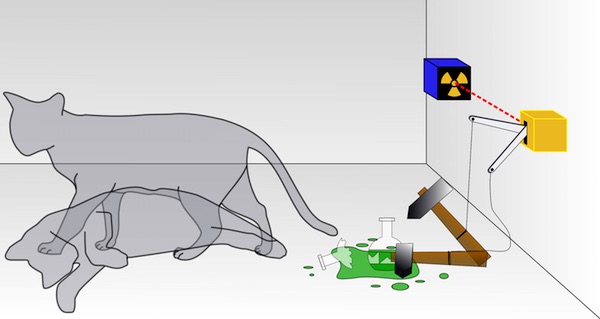
Physicist Erwin Schrödinger in 1935 tried to explain the (consequences of the) uncertainty principle, defined by Werner Heisenberg as a core theme of Albert Einstein’s view of quantum mechanics, to … Albert Einstein. The latter must have been thrilled. Even though he did not like the uncertainty principle (God does not play dice). The thought experiment became known as “Schrödinger’s cat”. Since you cannot know both a particle’s position and its speed -and that’s just one example-, you have to assume all possible outcomes are valid (superposition). Only when you “look” does one particular outcome become the “reality”. It’s all part of the subatomic “world”

Wikipedia: “In Schrödinger’s original formulation, a cat, a flask of poison, and a radioactive source are placed in a sealed box. If an internal monitor (e.g. a Geiger counter) detects radioactivity (i.e. a single atom decaying), the flask is shattered, releasing the poison, which kills the cat. The Copenhagen interpretation implies that, after a while, the cat is simultaneously alive and dead. Yet, when one looks in the box, one sees the cat either alive or dead, not both alive and dead. This poses the question of when exactly quantum superposition ends and reality resolves into one possibility or the other.”

As I’m trying to explain this, I very much have to wonder if I get it right. And I always thought that follows the uncertainty principle too: I can understand it and not understand it both at the same time. A physicist might fare a bit better, but it won’t come easy.

This is what I was thinking of with regards to the war in Ukraine. Before the fighting started, all possible outcomes seemed equally possible. If you did not look too closely at numbers of soldiers and weaponry, that is. But once it did start (when Schrödinger’s box was opened), it became clear very rapidly that Ukraine had no chance of winning. So why are we still acting as if the box remains closed? Because that way we get to spend billions more on armory, and we get western people to support Zelensky and his neo-nazis as those same people suffer from high prices for everything. Any outcome is still possible!

Take the Kakhovka dam narrative, or Nord Stream or any of the numerous other examples. When both sides accuse each other of perpetrating a certain event, Schrödinger’s box remains closed. Which is exactly what our politicians and arms makers desire. They don’t want us to know that they’ve been beaten by Russia, because you would no longer support their policies and their arms purchases. They want “superposition”. They can’t very well declare victory -though they try-, but they don’t need to either. They need uncertainty. Politicians, arms makers and media. They all profit from keeping you in the dark.

The best comment on Kakhovka I’ve seen perhaps comes from @CheburekiMan on Twitter: “Restoring water flow to the North Crimean Canal was top priority for Russia, the very first act of the SMO. Before Kiev shut off the flow in 2014, the canal was supplying 85% of Crimea’s water. So much depended on it, from crops to industry to drinking water, that’s how important it is. Now the pro-Ukraine bleating sheep want people to believe that Russia would wreck the dam, empty the reservoir and cause serious harm to its own people by running the canal dry. It’s so bonkers that one has to seriously consider such ideas are the result of brain damage, or perhaps fetal alcohol syndrome.”

Where Orwell comes in is in the terminology. Where “War equals Peace”. The EU pays its member states for the second hand weapons they “donate” to Kiev, through something called the European Peace Fund (aka Facility). Mass weapons deliveries that get huge numbers of people killed, are labeled “Peace”. Zelensky touts a plan labeled a Peace Plan, which demands Russia give back all territories, pay war reparations, deliver Putin et al to some international criminal court etc. The chance of that happening is of course zero, but as long as Schrödinger’s box remains closed, anything is possible. Still, it is a War Plan, not a Peace Plan.

Similarly, Zelensky and his international backers are organizing a Peace Summit, where everybody is invited except Russia. That makes it a War Summit. The suggestion made to westerners is that this is a globally supported initiative, but it is only a small part of the world population (10%?) that supports it. NATO+Japan+Australia. Did I leave anyone out? New Zealand? Ha ha ha, I read that Jacinda Ardern was made a dame. If you know a better illustration of how deep we’ve sunk, I’m game.

All the rest of the world is much more interested in the economic developments that involve BRICS+. 31 and counting nations have expressed interest in joining. And they’re not going to risk their potential role in that over a local fight far away that they know is long decided. US/NATO, in provoking this war, have lost not only the fight, but much more importantly, their economic power. Recently, the G7 were talking about what they were going to do in Central Asia. Which is basically all the “-Stans” left over after the Soviet Union dissolved. But the G7 is not going to do anything, it has no power there anymore. All these countries want to join the BRICS+. Why would you join a waning power if you have a shot at joining a power in its ascendancy, that all your neighbors are also joining?

The same attitude is prevalent in Africa, South America, East Asia, etc. Full of countries that remember how they were treated through the years by first Europe and then the US. The world has changed beyond recognition since the start of Russia’s SMO, and the “globalist west” is the only “region” that doesn’t recognize this. The USD won’t be replaced tomorrow as the reserve currency, but it doesn’t have to be. The process goes step by step, and is unstoppable. Hemingway’s famous words about how you go bankrupt (first gradually, then suddenly) have us on the wrong foot here. We only look at the “suddenly” part when it comes to the reserve currency, and ignore all the “gradually” steps. And then one day we will wake up and everything’s changed.

The rest of the world sees Schrödinger’s box as open. Only the west thinks that it’s still closed, and all possible outcomes are still viable.

The Big Stiff: Russia-Iran dump the dollar and bust US sanctions

News of Russian banks connecting to Iran’s financial messaging system strengthens the resistance against US-imposed sanctions on both countries and accelerates global de-dollarization.  

By Pepe Escobar

Source: The Cradle

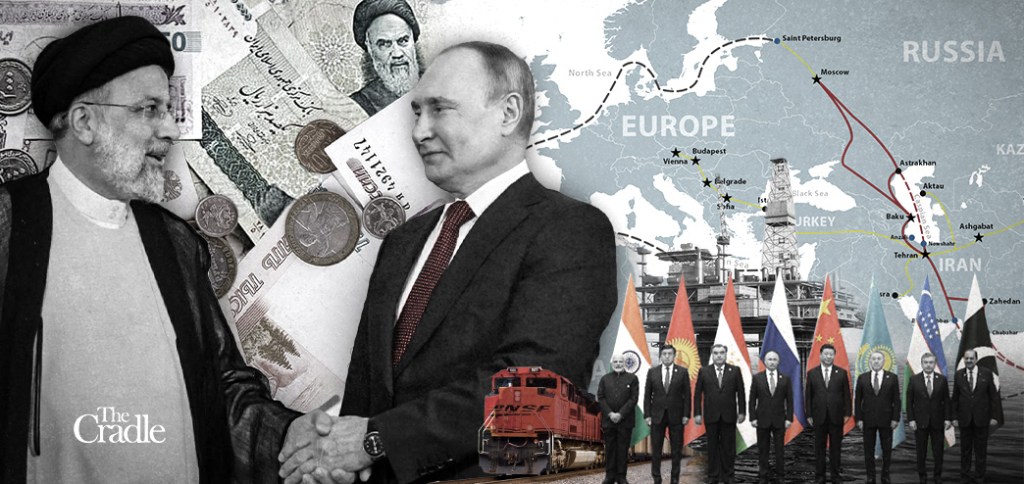
The agreement between the Central Banks of Russia and Iran formally signed on 29 January connecting their interbank transfer systems is a game-changer in more ways than one.

Technically, from now on 52 Iranian banks already using SEPAM, Iran’s interbank telecom system, are connecting with 106 banks using SPFS, Russia’s equivalent to the western banking messaging system SWIFT.

Less than a week before the deal, State Duma Chairman Vyachslav Volodin was in Tehran overseeing the last-minute details, part of a meeting of the Russia-Iran Inter-Parliamentary Commission on Cooperation: he was adamant both nations should quickly increase trade in their own currencies.

Ruble-rial trade

Confirming that the share of ruble and rial in mutual settlements already exceeds 60 percent, Volodin ratified the success of “joint use of the Mir and Shetab national payment systems.” Not only does this bypass western sanctions, but it is able to “solve issues related to mutually beneficial cooperation, and increasing trade.”

It is quite possible that the ruble will eventually become the main currency in bilateral trade, according to Iran’s ambassador in Moscow, Kazem Jalali: “Now more than 40 percent of trade between our countries is in rubles.”

Jalali also confirmed, crucially, that Tehran is in favor of the ruble as the main currency in all regional integration mechanisms. He was referring particularly to the Russian-led Eurasian Economic Union (EAEU), with which Iran is clinching a free trade deal.

The SEPAM-SPFS agreement starts with a pilot program supervised by Iran’s Shahr Bank and Russia’s VTB Bank. Other lenders will step in once the pilot program gets rid of any possible bugs.

The key advantage is that SEPAM and SPFS are immune to the US and western sanctions ruthlessly imposed on Tehran and Moscow. Once the full deal is up and running, all Iranian and Russian banks can be interconnected.

It is no wonder the Global South is paying very close attention. This is likely to become a landmark case in bypassing Belgium-based SWIFT – which is essentially controlled by Washington, and on a minor scale, the EU. The success of SEPAM-SPFS will certainly encourage other bilateral or even multilateral deals between states.

It’s all about the INSTC

The Central Banks of Iran and Russia are also working to establish a stable coin for foreign trade, replacing the US dollar, the ruble, and the rial. This would be a digital currency backed by gold, to be used mostly in the Special Economic Zone (SEZ) of Astrakhan, in the Caspian Sea, already very busy moving plenty of Iranian cargo.

Astrakhan happens to be the key Russian hub of the International North-South Transportation Corridor (INSTC), a vast network of ship, rail, and road routes which will drastically increase trade from Russia – but also parts of Europe – across Iran to West Asia and South Asia, and vice-versa.

And that reflects the full geoconomic dimension of the SEPAM-SPFS deal. The Russian Central Bank moved early to set up SPFS in 2014, when Washington began threatening Moscow with expulsion from SWIFT. Merging it with the Iranian SEPAM opens up a whole new horizon, especially given Iran’s ratification as a full member of the Shanghai Cooperation Organization (SCO), and now a leading candidate to join the extended BRICS+ club.

Already three months before the SEPAM-SPFS agreement, the Russian Trade Representative in Iran, Rustam Zhiganshin, was hinting that the decision “to create an analog of the SWIFT system” was a done deal.

Tehran had been preparing the infrastructure to join Russia’s Mir payment system since last summer. But after Moscow was hit with extremely harsh western sanctions and Russian banks were cut off from SWIFT, Tehran and Moscow decided, strategically, to focus on creating their own non-SWIFT for cross-border payments.

All that relates to the immensely strategic geoeconomic role of the INSTC, which is a much cheaper and faster trade corridor than the old Suez Canal route.

Russia is Iran’s largest foreign investor

Moreover, Russia has become Iran’s largest foreign investor, according to Iranian Deputy Finance Minister Ali Fekri: this includes “$2.7 billion worth of investment to two petroleum projects in Iran’s western province of Ilam in the past 15 months.” That’s about 45 percent of the total foreign investment in Iran over the October 2021 – January 2023 period.

Of course the whole process is in its initial stages – as Russia-Iran bilateral trade amounts to only US$3 billion annually. But a boom is inevitable, due to the accumulated effect of SEPAM-SPFS, INSTC, and EAEU interactions, and especially further moves to develop Iran’s energy capacity, logistics, and transport networks, via the INSTC.

Russian projects in Iran are multi-faceted: energy, railways, auto manufacturing, and agriculture. In parallel, Iran supplies Russia with food and automotive products.

Ali Shamkhani, the secretary of Iran’s Supreme National Security Council, is fond of reminding anyone that Russia and Iran “play complementary roles in global energy and cargo transit.” The Iran-EAEU free agreement (FTA) is nearly finalized – including zero tariffs for over 7,500 commodities.

In 2022, the EAEU traded more than $800 billion worth of goods. Iran’s full access to the EAEU will be inestimable in terms of providing a market gateway to large swathes of Eurasia – and bypassing US sanctions as a sweet perk. A realistic projection is that Tehran can expect $15 billion annual trade with the five members of the EAEU in five years, as soon as Iran becomes the sixth member.

The legacy of Samarkand

Everything we are tracking now is in many ways a direct consequence of the SCO summit in Samarkand last September, when Russian President Vladimir Putin and his Chinese counterpart Xi Jinping, in person, placed their bet on strengthening the multipolar world as Iran signed a memorandum to join the SCO.

Putin’s private talks with Iranian President Ebrahim Raisi in Samarkand were all about deep strategy.

The INSTC is absolutely crucial in this overall equation. Both Russia and Iran are investing at least $25 billion to boost its capabilities.

Ships sailing the Don and Volga Rivers have always traded energy and agricultural commodities. Now Iran’s Maritime News Agency has confirmed that Russia will grant their ships the right of passage along the inland waterways on the Don and Volga.

Meanwhile, Iran is already established as the third largest importer of Russian grain. From now on, trade on turbines, polymers, medical supplies, and automotive parts will be on a roll.

Tehran and Moscow have signed a contract to build a large cargo vessel for Iran to be used at the Caspian port of Solyanka. And RZD logistics, a subsidiary of Russian railway RZD, operates container cargo trains regularly from Moscow to Iran. The Russian Journal for Economics predicts that just the freight traffic on INTSC could reach 25 million tons by 2030 – no less than a 20-fold increase compared to 2022.

Inside Iran, new terminals are nearly ready for cargo to be rolled off ships to railroads crisscrossing the country from the Caspian to the Persian Gulf. Sergey Katrin, head of Russia’s Chamber of Commerce and Industry, is confident that once the FTA with the EAEU is on, bilateral trade can soon reach $40 billion a year.

Tehran’s plans are extremely ambitious, inserted in an “Eastern Axis” framework that privileges regional states Russia, China, India, and Central Asia.

Geostrategically and geoeconomically, that implies a seamless interconnection of INSTC, EAEU, SCO, and BRICS+. And all of this is coordinated by the one Quad that really matters: Russia, China, India, and Iran.

Of course there will be problems. The intractable Armenia-Azerbaijan conflict might be able to derail the INSTC: but note that Russia-Iran connections via the Caspian can easily bypass Baku if the need arises.

BRICS+ will cement the dollar’s descent

Apart from Russia and Iran, Russia and China have also been trying to interface their banking messaging systems for years now. The Chinese CBIBPS (Cross-Border Inter-Bank Payments System) is considered top class. The problem is that Washington has directly threatened to expel Chinese banks from SWIFT if they interconnect with Russian banks.

The success of SEPAM-SPFS may allow Beijing to go for broke – especially now, after the extremely harsh semiconductor war and the appalling balloon farce. In terms of sovereignty, it is clear that China will not accept US restrictions on how to move its own funds.

In parallel, the BRICS in 2023 will delve deeper into developing their mutual financial payments system and their own reserve currency. There are no less than 13 confirmed candidates eager to join BRICS+ – including Asian middle powers like Iran, Saudi Arabia, and Indonesia.

All eyes will be on whether – and how – the $30 trillion-plus indebted US will threaten to expel BRICS+ from SWIFT.

It’s enlightening to remember that Russia’s debt to GDP ratio stands at only 17 percent. China’s is 77 percent. The current BRICS without Russia are at 78 percent. BRICS+ including Russia may average only 55 percent. Strong productivity ahead will come from a BRICS+ supported by a gold and/or commodities-backed currency and a different payment system that bypasses the US dollar. Strong productivity definitely will not come from the collective west whose economies are entering recessionary times.

Amid so many intertwined developments, and so many challenges, one thing is certain. The SEPAM-SPFS deal between Russia and Iran may be just the first sign of the tectonic plates movement in global banking and payment systems.

Welcome to one, two, one thousand payment messaging systems. And welcome to their unification in a global network. Of course that will take time. But this high-speed financial train has already left the station.

Why the CIA Attempted a ‘Maidan Uprising’ in Brazil

By Pepe Escobar

Source: The Unz Review

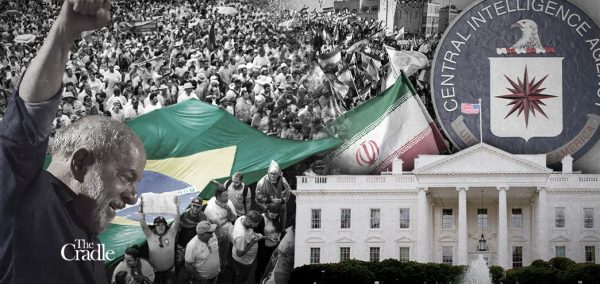
A former US intelligence official has confirmed that the shambolic Maidan remix staged in Brasilia on 8 January was a CIA operation, and linked it to the recent attempts at color revolution in Iran.

On Sunday, alleged supporters of former right-wing President Jair Bolsonaro stormed Brazil’s Congress, Supreme Court, and presidential palace, bypassing flimsy security barricades, climbing on roofs, smashing windows, destroying public property including precious paintings, while calling for a military coup as part of a regime change scheme targeting elected President Luis Inacio “Lula” da Silva.

According to the US source, the reason for staging the operation – which bears visible signs of hasty planning – now, is that Brazil is set to reassert itself in global geopolitics alongside fellow BRICS states Russia, India, and China.

That suggests CIA planners are avid readers of Credit Suisse strategist Zoltan Pozsar, formerly of the New York Fed. In his ground-breaking 27 December report titled War and Commodity Encumbrance, Pozsar states that “the multipolar world order is being built not by G7 heads of state but by the ‘G7 of the East’ (the BRICS heads of state), which is a G5 really but because of ‘BRICSpansion’, I took the liberty to round up.”

He refers here to reports that Algeria, Argentina, Iran have already applied to join the BRICS – or rather its expanded version “BRICS+” – with further interest expressed by Saudi Arabia, Turkiye, Egypt, Afghanistan, and Indonesia.

The US source drew a parallel between the CIA’s Maidan in Brazil and a series of recent street demonstrations in Iran instrumentalized by the agency as part of a new color revolution drive: “These CIA operations in Brazil and Iran parallel the operation in Venezuela in 2002 that was highly successful at the start as rioters managed to seize Hugo Chavez.”

Enter the “G7 of the East”

Straussian neo-cons placed at the top of the CIA, irrespective of their political affiliation, are livid that the “G7 of the East” – as in the BRICS+ configuration of the near future – are fast moving out of the US dollar orbit.

Straussian John Bolton – who has just publicized his interest in running for the US presidency – is now demanding the ouster of Turkey from NATO as the Global South realigns rapidly within new multipolar institutions.

Russian Foreign Minister Sergey Lavrov and his new Chinese counterpart Qin Gang have just announced the merging of the China-driven Belt and Road Initiative (BRI) and the Russia-driven Eurasia Economic Union (EAEU). This means that the largest 21st century trade/connectivity/development project – the Chinese New Silk Roads – is now even more complex, and keeps expanding.

That sets the stage for the introduction, already being designed at various levels, of a new international trading currency aimed at supplanting then replacing the US dollar. Apart from an internal debate among the BRICS, one of the key vectors is the discussion team set up between the EAEU and China. When concluded, these deliberations will be presented to BRI-EAEU partner nations and of course the expanded BRICS+.

Lula at the helm in Brazil, in what is now his third non-successive presidential term, will offer a tremendous boost to BRICS+, In the 2000s, side by side with Russian President Putin and former Chinese President Hu Jintao, Lula was a key conceptualizer of a deeper role for BRICS, including trade in their own currencies.

BRICS as “the new G7 of the East,” as defined by Pozsar, is beyond anathema – as much for Straussian neo-cons as for neoliberal.

The US is being slowly but surely expelled from wider Eurasia by concerted actions of the Russia-China strategic partnership.

Ukraine is a black hole – where NATO faces a humiliation that will make Afghanistan look like Alice in Wonderland. A feeble EU being forced by Washington to de-industrialize and buy US Liquified Natural Gas (LNG) at absurdly high cost has no essential resources for the Empire to plunder.

Geoeconomically, that leaves the US-denominated “Western Hemisphere,” especially immense energy-rich Venezuela as the key target. And geopolitically, the key regional actor is Brazil.

The Straussian neo-con play is to pull all stops to prevent Chinese and Russian trade expansion and political influence in Latin America, which Washington – irrespective of international law and the concept of sovereignty, continues to call “our backyard.” In times where neoliberalism is so “inclusive” that Zionists wear swastikas, the Monroe Doctrine is back, on steroids.

All about the ‘strategy of tension’

Clues for Maidan in Brazil can be obtained, for instance, at the US Army Cyber Command at Fort Gordon, where it’s no secret the CIA deployed hundreds of assets across Brazil ahead of the recent presidential election – faithful to the “strategy of tension” playbook.

CIA chatter was intercepted at Fort Gordon since mid-2022. The main theme then was the imposition of the widespread narrative that ‘Lula could only win by cheating.’

A key target of the CIA operation was to discredit by all means the Brazilian electoral process, paving the way for a prepackaged narrative that is now unraveling: a defeated Bolsonaro fleeing Brazil and seeking refuge at former US president Donald Trump’s Mar-a-Lago mansion. Bolsonaro, advised by Steve Bannon, did flee Brazil, skipping Lula’s inauguration, but because he’s terrified he may be facing the slammer sooner rather than later. And by the way, he is in Orlando, not Mar-a-Lago.

The icing on the stale Maidan cake was what happened this past Sunday: fabricating a 8 January in Brasilia mirroring the events of 6 January, 2021 in Washington, and of course imprinting the Bolsonaro-Trump link on people’s minds.

The amateurish nature of 8 January in Brasilia suggests CIA planners got lost in their own plot. The whole farce had to be anticipated because of Pozsar’s report, which everyone-who-matters has read across the New York-Beltway axis.

What is clear, is that for some factions of the powerful US establishment, getting rid of Trump at all costs is even more crucial than crippling Brazil’s role in BRICS+.

When it comes to the internal factors of Maidan in Brazil, borrowing from novelist Gabriel Garcia Marquez, everything walks and talks like the Chronicle of a Coup Foretold. It is impossible that the security apparatus around Lula could not have foreseen these events, especially considering the tsunami of signs on social networks.

So there must have been a concerted effort to act softly – without any preventive big sticks – while just emitting the usual neoliberal babble.

After all, Lula’s cabinet is a mess, with ministers constantly clashing and some members supporting Bolsonaro even a few months ago. Lula calls it a “national unity government,” but it is more like a tawdry patchwork job.

Brazilian analyst Quantum Bird, a globally respected physics scholar who has returned home after a long stint in NATO lands, notes how there are “too many actors in play and too many antagonistic interests. Among Lula’s ministers, we find Bolsonarists, neoliberal-rentiers, climate interventionism converts, identity politics practitioners and a vast fauna of political neophytes and social climbers, all well aligned with Washington’s imperial interests.”

CIA-stoked ‘militants’ on the prowl

One plausible scenario is that powerful sectors of the Brazilian military – at the service of the usual Straussian neo-con think tanks, plus global finance capital – could not really pull off a real coup, considering massive popular rejection, and had to settle at best for a “soft” farce. That illustrates just how much this self-aggrandizing and highly corrupt military faction is isolated from Brazilian society.

What is deeply worrying, as Quantum Bird notes, is that the unanimity in condemning 8 January from all quarters, while no one took responsibility, “shows how Lula navigates virtually alone in a shallow sea infested by sharpened corals and hungry sharks.”

Lula’s position, he adds, “decreeing a federal intervention all by himself, without strong faces of his own government or relevant authorities, shows an improvised, disorganized and amateurish reaction.”

And all that, once again, after CIA-stoked “militants” had been organizing the “protests” openly on social media for days.

The same old CIA playbook though remains at work. It still boggles the mind how easy it is to subvert Brazil, one of the natural leaders of the Global South. Attempted old school coups cum regime change/color revolution scripts will keep being played – remember Kazakhstan in early 2021, and Iran only a few months ago.

As much as the self-aggrandizing faction of the Brazilian military may believe they control the nation, if Lula’s significant masses hit the streets in full force against the 8 January farce, the army’s impotence will be graphically imprinted. And since this is a CIA operation, the handlers will order their tropical military vassals to behave like ostriches.

The future, unfortunately, is ominous. The US establishment will not allow Brazil, the BRICS economy with the best potential after China, to be back in business with full force and in synch with the Russia-China strategic partnership.

Straussian neo-cons and neoliberals, certified geopolitical jackals and hyenas, will get even more ferocious as the “G7 of the East,” Brazil included, moves to end the suzerainty of the US dollar as imperial control of the world vanishes.

Goodbye G20, hello BRICS+

The increasingly irrelevant G20 Summit concluded with sure signs that BRICS+ will be the way forward for Global South cooperation.

By Pepe Escobar

Source: The Cradle

The redeeming quality of a tense G20 held in Bali – otherwise managed by laudable Indonesian graciousness – was to sharply define which way the geopolitical winds are blowing.

That was encapsulated in the Summit’s two highlights: the much anticipated China-US presidential meeting – representing the most important bilateral relationship of the 21st century – and the final G20 statement.

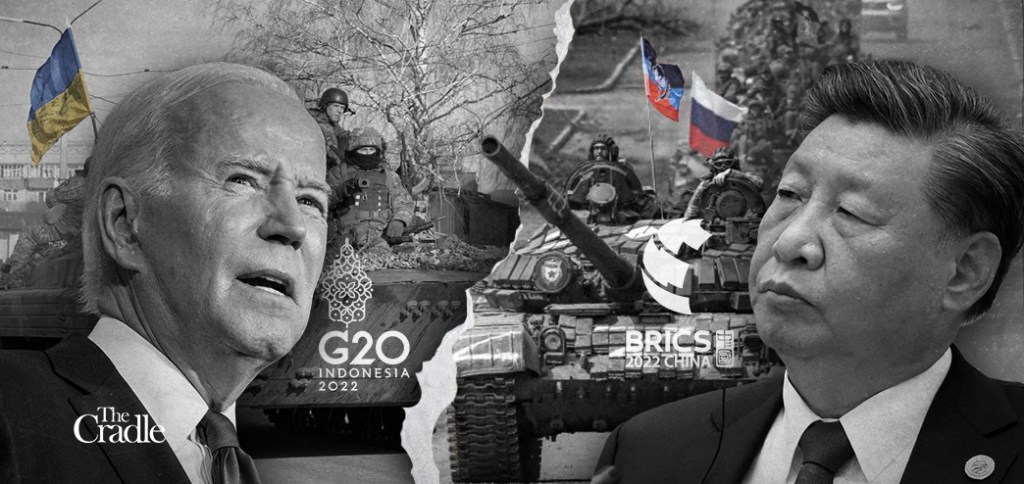
The 3-hour, 30-minute-long face-to-face meeting between Chinese President Xi Jinping and his US counterpart Joe Biden – requested by the White House – took place at the Chinese delegation’s residence in Bali, and not at the G20 venue at the luxury Apurva Kempinski in Nusa Dua.

The Chinese Ministry of Foreign Affairs concisely outlined what really mattered. Specifically, Xi told Biden that Taiwan independence is simply out of the question. Xi also expressed hope that NATO, the EU, and the US will engage in “comprehensive dialogue” with Russia. Instead of confrontation, the Chinese president chose to highlight the layers of common interest and cooperation.

Biden, according to the Chinese, made several points. The US does not seek a New Cold War; does not support “Taiwan independence;” does not support “two Chinas” or “one China, one Taiwan”; does not seek “decoupling” from China; and does not want to contain Beijing.

However, the recent record shows Xi has few reasons to take Biden at face value.

The final G20 statement was an even fuzzier matter: the result of arduous compromise.

As much as the G20 is self-described as “the premier forum for global economic cooperation,” engaged to “address the world’s major economic challenges,” the G7 inside the G20 in Bali had the summit de facto hijacked by war. “War” gets almost double the number of mentions in the statement compared to “food” after all.

The collective west, including the Japanese vassal state, was bent on including the war in Ukraine and its “economic impacts” – especially the food and energy crisis – in the statement. Yet without offering even a shade of context, related to NATO expansion. What mattered was to blame Russia – for everything.

The Global South effect

It was up to this year’s G20 host Indonesia – and the next host, India – to exercise trademark Asian politeness and consensus building. Jakarta and New Delhi worked extremely hard to find wording that would be acceptable to both Moscow and Beijing. Call it the Global South effect.

Still, China wanted changes in the wording. This was opposed by western states, while Russia did not review the last-minute wording because Foreign Minister Sergey Lavrov had already departed.

On point 3 out of 52, the statement “expresses its deepest regret over the aggression of the Russian Federation against Ukraine and demands the complete and unconditional withdrawal of armed forces from the territory of Ukraine.”

“Russian aggression” is the standard NATO mantra – not shared by virtually the whole Global South.

The statement draws a direct correlation between the war and a non-contextualized “aggravation of pressing problems in the global economy – slowing economic growth, rising inflation, disruption of supply chains, worsening energy, and food security, increased risks to financial stability.”

As for this passage, it could not be more self-evident: “The use or threat of use of nuclear weapons is inadmissible. The peaceful resolution of conflicts, efforts to address crises, as well as diplomacy and dialogue, are vital. Today’s era must not be of war.”

This is ironic given that NATO and its public relations department, the EU, “represented” by the unelected eurocrats of the European Commission, don’t do “diplomacy and dialogue.”

Fixated with war

Instead the US, which controls NATO, has been weaponizing Ukraine, since March, by a whopping $91.3 billion, including the latest presidential request, this month, of $37.7 billion. That happens to be 33 percent more than Russia’s total (italics mine) military spending for 2022.

Extra evidence of the Bali Summit being hijacked by “war” was provided by the emergency meeting, called by the US, to debate what ended up being a Ukrainian S-300 missile falling on a Polish farm, and not the start of WWIII like some tabloids hysterically suggested.

Tellingly, there was absolutely no one from the Global South in the meeting – the sole Asian nation being the Japanese vassal, part of the G7.

Compounding the picture, we had the sinister Davos master Klaus Schwab once again impersonating a Bond villain at the B20 business forum, selling his Great Reset agenda of “rebuilding the world” through pandemics, famines, climate change, cyber attacks, and – of course – wars.

As if this was not ominous enough, Davos and its World Economic Forum are now ordering Africa – completely excluded from the G20 – to pay $2.8 trillion to “meet its obligations” under the Paris Agreement to minimize greenhouse gas emissions.

The demise of the G20 as we know it

The serious fracture between Global North and Global South, so evident in Bali, had already been suggested in Phnom Penh, as Cambodia hosted the East Asia Summit this past weekend.

The 10 members of ASEAN had made it very clear they remain unwilling to follow the US and the G7 in their collective demonization of Russia and in many aspects China.

The Southeast Asians are also not exactly excited by the US-concocted IPEF (Indo-Pacific Economic Framework), which will be irrelevant in terms of slowing down China’s extensive trade and connectivity across Southeast Asia.

And it gets worse. The self-described “leader of the free world” is shunning the extremely important APEC (Asia-Pacific Economic Cooperation) summit in Bangkok at the end of this week.

For very sensitive and sophisticated Asian cultures, this is seen as an affront. APEC, established way back in 1990s to promote trade across the Pacific Rim, is about serious Asia-Pacific business, not Americanized “Indo-Pacific” militarization.

The snub follows Biden’s latest blunder when he erroneously addressed Cambodia’s Hun Sen as “prime minister of Colombia” at the summit in Phnom Penh.

Lining up to join BRICS

It is safe to say that the G20 may have plunged into an irretrievable path toward irrelevancy. Even before the current Southeast Asian summit wave – in Phnom Penh, Bali and Bangkok – Lavrov had already signaled what comes next when he noted that “over a dozen countries” have applied to join BRICS (Brazil, Russia, India, China, South Africa).

Iran, Argentina, and Algeria have formally applied: Iran, alongside Russia, India, and China, is already part of the Eurasian Quad that really matters.

Turkey, Saudi Arabia, Egypt, and Afghanistan are extremely interested in becoming members. Indonesia just applied, in Bali. And then there’s the next wave: Kazakhstan, UAE, Thailand (possibly applying this weekend in Bangkok), Nigeria, Senegal, and Nicaragua.

It’s crucial to note that all of the above sent their Finance Ministers to a BRICS Expansion dialogue in May. A short but serious appraisal of the candidates reveals an astonishing unity in diversity.

Lavrov himself noted that it will take time for the current five BRICS to analyze the immense geopolitical and geoeconomic implications of expanding to the point of virtually reaching the size of the G20 – and without the collective west.

What unites the candidates above all is the possession of massive natural resources: oil and gas, precious metals, rare earths, rare minerals, coal, solar power, timber, agricultural land, fisheries, and fresh water. That’s the imperative when it comes to designing a new resource-based reserve currency to bypass the US dollar.

Let’s assume that it may take up to 2025 to have this new BRICS+ configuration up and running. That would represent roughly 45 percent of confirmed global oil reserves and over 60 percent of confirmed global gas reserves (and that will balloon if gas republic Turkmenistan later joins the group).

The combined GDP – in today’s figures – would be roughly $29.35 trillion; much larger than the US ($23 trillion) and at least double the EU ($14.5 trillion, and falling).

As it stands, BRICS account for 40 percent of the global population and 25 percent of GDP. BRICS+ would congregate 4.257 billion people: over 50 percent of the total global population as it stands.

BRI embraces BRICS+

BRICS+ will be striving towards interconnection with a maze of institutions: the most important are the Shanghai Cooperation Organization (SCO), itself featuring a list of players itching to become full members; strategic OPEC+, de facto led by Russia and Saudi Arabia; and the Belt and Road Initiative (BRI), China’s overarching trade and foreign policy framework for the 21st century. It is worth pointing out that early all crucial Asian players have joined the BRI.

Then there are the close links of BRICS with a plethora of regional trade blocs: ASEAN, Mercosur, GCC (Gulf Cooperation Council), Eurasia Economic Union (EAEU), Arab Trade Zone, African Continental Free Trade Area, ALBA, SAARC, and last but not least the Regional Comprehensive Economic Partnership (RCEP), the largest trade deal on the planet, which includes a majority of BRI partners.

BRICS+ and BRI is a match everywhere you look at it – from West Asia and Central Asia to the Southeast Asians (especially Indonesia and Thailand). The multiplier effect will be key – as BRI members will be inevitably attracting more candidates for BRICS+.

This will inevitably lead to a second wave of BRICS+ hopefuls including, most certainly, Azerbaijan, Mongolia, three more Central Asians (Uzbekistan, Tajikistan, and gas republic Turkmenistan), Pakistan, Vietnam, and Sri Lanka, and in Latin America, a hefty contingent featuring Chile, Cuba, Ecuador, Peru, Uruguay, Bolivia, and Venezuela.

Meanwhile, the role of the BRICS’s New Development Bank (NDB) as well as the China-led Asia Infrastructure Investment Bank (AIIB) will be enhanced – coordinating infrastructure loans across the spectrum, as BRICS+ will be increasingly shunning dictates imposed by the US-dominated IMF and the World Bank.

All of the above barely sketches the width and depth of the geopolitical and geoeconomic realignments further on down the road – affecting every nook and cranny of global trade and supply chain networks. The G7’s obsession in isolating and/or containing the top Eurasian players is turning on itself in the framework of the G20. In the end, it’s the G7 that may be isolated by the BRICS+ irresistible force.

The international political debacle proves that the unipolar system is crumbling

By Guilherme Wilbert

Source: The Saker

With the recent political events involving such different parts of the world, but usually for the same reasons: popular dissatisfaction, rising prices, and the like. And these causes arise with the decision-making errors of Western leaders, who end up suppressing popular opinion, in what generates a kind of democratic government in the archetype but doesn’t really care about its people.

The most practical example arises when countries try to enter into military alliances without popular consultation as to whether the people agree with what is at stake. The Nordics in NATO were a very clear example of this.

The politicians who now manage the finances of powers within Europe were clearly not prepared for what is happening, mainly because in the global production chain, which involves Russia, now sanctioned, reflects much more on the sanctioning regional economy than on the sanctioned one. Plus it destroys on many economic fronts the Global South, which directly receives the reflections of these mistakes.

People who have been put through a bureaucracy because economic power has a lot of money and unfortunately are leading Europe into disaster, but without realizing it the entire Western world as we know it. With recent cases of foreign attempts to interfere in legitimately elected governments to try to stop the advance to the multipolar world, which at this point of the championship has no more brakes.

The recent death of Shinzo Abe, former prime minister of Japan (which until then was considered one of the safest countries in the world), proves that even a supposedly quiet and peaceful nation can be the target of serious terrorist attacks like the one mentioned, and this proves that the unipolarity system is disappearing, even if it takes some along the way, unfortunately.

The political debacle unfortunately caused by the cited mistakes of Western leaders such as the sanctions, has generated dissatisfaction to the extreme point of an assassination with a homemade artifact against a prominent leader of the Asian world (many may be wondering why in the reasoning Japan would be characterized as part of the “Western World” despite being in Asia and this is because Japanese diplomacy is strongly influenced by Washington, in which it functions as a kind of diplomacy semi-colonized by the Americans).

It was not avoidable, but it could be delayed

The multipolar world was going to emerge one way or another, but the mistakes of the Western leaders accelerated a process that would still take some years, and it can’t cope since it governs for less than 1 billion people (G7 population). And Operation Z in Ukraine was the trigger for a lack of diplomatic tact and will to war that even caused Ukraine’s allied leaders to fall, such as Boris Johnson.

The bankruptcy of Europe was also imminent, since the various economic dependencies, including on Russian gas, prove that the continent, despite being so-called First World, was unable to generate an economy based on a real production of resources. And all attempts to escape from this dependency would lead to at least 10 years of pipeline works and economic agreements-treaties between other countries and them.

So it’s not like it was easy either to have prevented what was predestined to happen, but it could have been delayed if there was the right diplomacy, since the war was avoidable. But how? Simple. I’ll explain.

What was Putin’s key argument? “Ukraine cannot join NATO!”

And what could the West have done? Generated a document in multilateral coordination with the appropriate entities recognizing that the security of Russia, a member of the UN Security Council, was an important issue and Ukraine would not join the Atlanticist military alliance. Or: they could put 50,000 or 100,000 troops inside Kiev to stand up to the Russians since Biden shortly before the Special Military Operation began, acknowledged that Putin would “invade Ukraine,” so they knew the risks. But they did neither.

They wanted this war but it is not going as planned because the political debacle is happening, with the leaders who support the Atlanticist platforms falling away little by little, leaving the enthusiasts of the multipolar world standing like Putin and Xi Jinping in their proper nuclear strongholds.

Moreover, it is interesting to note how parts of the Global South opposed the various diplomatic and economic sanctions on Russia, showing that they were unwilling to continue functioning as American semi-colonies in diplomatic and other matters.

It was inevitable that a totally new world would emerge out of the totally destroyed old world, because that is the natural way of what comes after destruction: reconstruction or new construction. And that is what is happening to the world at present, in that we see prominent leaders being murdered in the open or resignations due to inability of governance, clear signs of destruction.

And after the destruction will come the construction, of which we don’t know what it will look like yet, but the first bricks have already been laid.

The BRICS+ is the only economic bloc capable of guiding the birth of the multipolar world

The BRICS+ unlike any grouping of countries into an economic bloc, has no regional or cultural limitations. On the contrary, countries from all over the world that are so different are aligned in the same multipolar thinking there, in what is seen different if you consider the G7 or NAFTA, which are limiting organizations in their birth, since they don’t carry the discourse of multipolarism ingrained, besides using destabilizing agents such as NATO for a kind of stick to impose their policies on sovereign countries.

The ability to unite so many enthusiasts of the multipolar world will be the driving force of the industrial revolution that we will see happen, which will bring the world into a state of bonanza again because even war will end one day and sanctions will be seen as useless because integration has already begun to happen. Currency baskets are being considered within the BRICS+ to escape the American monetary hegemony, which is a BIG thing!

So, to close the reasoning, I conclude that the multipolar world was something that was inevitably going to happen, but it was accelerated because of the mistakes of its enemies.


Guilherme Wilbert is a law graduate interested in geopolitics and international law.