
The Weird Politics Of Aspartame: Conspiracy Theory Or Startling Truth?

050406aspartame3

By Paanii Powell Cleaver

Source: Inquisitr

Earlier this month, news wires and Twitter feeds were abuzz with info about the potential danger of certain artificial sweeteners.

In reality, recent reports about the potential perils of low-calorie sweeteners are not exactly breaking news. Almost 20 years ago, on December 29, 1996, Mike Wallace conducted an eye-opening segment about aspartame, also known as NutraSweet, on 60 Minutes.

The segment aired in response to a flurry of reports noting a dramatic increase in brain tumors and other serious health issues following the approval of aspartame for use in dry foods in 1981. Fifteen years after its somewhat dubious approval, (the most controversial FDA decision to date), more than 7,000 consumer reports of adverse reaction to aspartame had been delivered to the FDA. As reported by 60 Minutes, the litany of consumer complaints included severe headaches, dizziness, respiratory issues, and seizures. The FDA countered with a statement that aspartame was the most tested product in FDA history.

Dr. Virginia V. Weldon, a pediatrician from Missouri and Vice President of Public Policy for the Monsanto Company from 1989 through 1998, told 60 Minutes that aspartame is “one of the safest food ingredients ever approved by the Food and Drug Administration.”

Dr. John W. Olney, a neuroscientist at Washington University School of Medicine, vehemently disagreed with Dr. Weldon’s assessment of the controversial super sweetener. Notable for his discovery of the brain-harming effects of an amino acid called glutamate, Dr. Olney was influential in legislating the ban of MSG in baby food. At the time of the 60 Minutes segment, he had been studying the effects of aspartame and other compounds on brain health for more than two decades.

Olney told 60 Minutes’ Mike Wallace that since the approval of aspartame, there had been “a striking increase in the incidence of malignant brain tumors.” The doctor did not directly blame aspartame for the increase. He did, however, state that there was enough questionable evidence to merit reevaluating the chemical compound. He said that the FDA should reassess aspartame and that “this time around, they should do it right.”

Dr. Erik Millstone, Professor of Science Policy at the University of Sussex, told 60 Minutes that Searle’s testing procedures in the early 1970s were so flawed that there was no way to know for certain if aspartame was safe for human consumption. Millstone claimed that the company’s failure to dissect a test animal that died during an aspartame experiment was merely one example of “deficiencies” in Searle’s conduct. He also noted that when test mice presented with tumors, the tumors were “cut out and discarded and not reported.” In addition, Dr. Millstone told Mike Wallace that G.D. Searle and contractors hired by the drug company administered antibiotics to some test animals yet neglected to reveal this information in official reports.

In 1974, after the G.D. Searle company had already manufactured a significant quantity of aspartame, then-commissioner of the FDA, Alexander Schmidt, came very close to approving the chemical for human food purposes. Relying solely on evidence provided by Searle, the FDA allowed a mere 30 days for the public to respond before putting the FDA seal of approval on the now-controversial food additive. Dr. John Olney wasted no time in joining forces with James Turner, a public interest attorney who also worked with consumer advocate Ralph Nader. Just before the allotted time for public response ran out, Dr. Olney and his attorney petitioned the FDA with data that indicated the dangerous similarities between aspartame and glutamate.

In his 1970 best seller, The Chemical Feast, Turner detailed numerous ways the FDA shirked its obligation to protect the American people. At the time of its publication, Time magazine described the tome as “the most devastating critique of a U.S. government agency ever issued.”

In response to Dr. Olney’s allegations that aspartame was potentially as brain-damaging as glutamate, the FDA called for a task force to investigate the matter. By late 1975, the FDA found that Searle’s own research into the safety of aspartame was so flawed that they stayed the approval process, citing “a pattern of conduct which compromises the scientific integrity of the studies.”

Former U.S. Senator Howard Metzenbaum told 60 Minutes that when Searle presented information to the FDA in 1974, the drug company “willfully misrepresented” and omitted facts that may have halted approval of what would soon become its best-selling product. Metzenbaum went on to say that the FDA was so disturbed by its findings, it forwarded a file to the U.S. Attorney’s Chicago office in 1975 in the interest of calling a grand jury to determine whether criminal indictments against Searle were warranted.

When did the grand jury convene? Never. According to 60 Minutes, U.S. Attorney Samuel Skinner requested a grand jury investigation in 1977 but recused himself from the case when he was offered a job at the Sidley & Austin law firm, which also happened to be the Chicago law firm that represented the G.D. Searle company. The investigation was stalled until the statute of limitations ran its course, and no grand jury ever heard the case against Searle’s questionable research standards. Skinner, by the way, did eventually accept the job with Searle’s Chicago law office.

In 1977, a new FDA task force convened in Skokie, Illinois, with the sole purpose of investigating the research methods employed by G.D. Searle in its effort to gain FDA approval of aspartame. The task force examined raw data from 15 studies that Searle used to back up its uniformly positive claims about aspartame. According to journalist Andrew Cockburn, the task force noted numerous “falsifications and omissions” in Searle’s research reports.

In 1980, at the tail end of the Carter administration, the FDA conducted two-panel investigations into claims that aspartame caused brain tumors. Led by scientific and medical experts, each panel concluded that more tests were needed to prove the safety of the sweetener. Both panels concluded that aspartame should not be approved at that time.

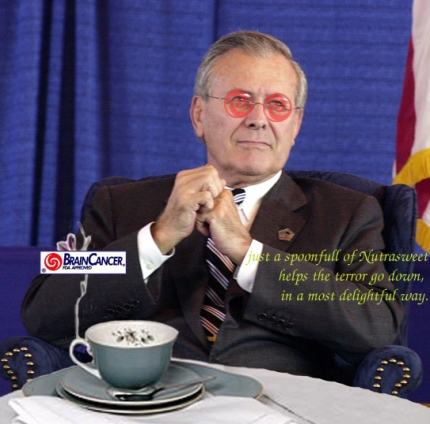
So, how does the fellow in the cover picture figure into this equation?

If you do not recognize the face in the feature photo, here is a memory refresher: The man in the pic — and up to his ears in the aspartame controversy — is Donald Rumsfeld. Perhaps best known as Secretary of Defense during the George W. Bush presidency, Donald Rumsfeld also happened to be CEO of the G.D. Searle drug company when Ronald Reagan was sworn in as President of the United States on January 1981.

Regardless of its safety or potential peril, the fact remains that without the clout and political influence of Donald Rumsfeld, aspartame might never have been approved for human use at all.

Donald Rumsfeld, who at one time aspired to be Reagan’s running mate, was a member of the new president’s transition team. Part of the team’s duties involved the selection of a new FDA Commissioner. Rumsfeld et al chose a pharmacist with no experience in food additive science to lead the agency.

On January 21, 1981, Ronald Reagan’s first full day as president, the G.D. Searle company, headed by Donald Rumsfeld, reapplied for FDA approval of aspartame. That same day, in one of his first official acts, President Reagan issued an executive order that rescinded much of the FDA commissioner’s power.

In April 1981, newly appointed FDA commissioner Arthur Hayes Hull, Jr., put together a five-person panel tasked to reevaluate the agency’s 1975 decision to not approve aspartame as a food additive. At first, the panel voted 3-2 to uphold non-approval of the chemical sweetener. Hayes then invited another member to the official FDA panel, and the vote was retaken. The panel deadlocked, and Hayes contributed his own vote to break the tie. Two months later, the product that the FDA refused to approve for seven long years was suddenly approved for human consumption.

Four years later, in 1985, the Monsanto corporation bought G.D. Searle and established a separate division, The NutraSweet Company, to manage the sales and public relations of one of its best-selling and most profitable products. It may be worth noting that when Monsanto purchased Searle and the patent on aspartame, Donald Rumsfeld reportedly received a fat $12 million bonus.

Before reading this, how much did you know about the origins of aspartame? If you’re like most Americans, the answer is “not much.” And, if you’re like many Americans, your interest in a story such as this one will wane as soon as the next hot topic comes along. Perhaps this is the reason that there has been little if any public outcry regarding aspartame or the weird way that it received FDA approval.

Updates:

In 1987, UPI investigative journalist Gregory Gordon reported that Dr. Richard Wurtman, a neuroscientist at Massachusetts Institute of Technology and a die-hard supporter of aspartame during its 1981 rush to approval, had reversed his thoughts on the sweetener. He noted the once-ardent supporter as saying his views had evolved along with scientific studies and his increased skepticism of industry research standards.

In 1997, the U.K. government obliged makers of sweetened food to prominently include the words “with sweeteners” on product labels. Ten years later, U.K. supermarket chain Mark & Spencer announced the end of artificial sweeteners and coloring in their chilled goods and bakery departments, according to the Daily Mail.

In his well received 2007 book, Rumsfeld: His Rise, Fall and Catastrophic Legacy, author Andrew Cockburn described the results of the 1977 FDA task force that found “falsifications and omissions” in Searle’s research data. The New York Times called author Cockburn’s biographical tome “quite persuasive.”

In 2009, Woolworths, a South African retailer, announced that it would no long brand products containing aspartame.

On February 28, 2010, Dr. Arthur Hayes Hull, Jr., the FDA Commissioner who hurried aspartame to market and later squelched public fear of Tylenol during the 1982 poisoning scare, died in Connecticut. According to his New York Times obituary, Hayes was employed as president of E. M. Pharmaceuticals after his term at the FDA. Hayes succumbed to leukemia at age 76.

A 2011 report in the Huffington Post noted that 10,000 American consumers notified the FDA about the ill effects of aspartame between 1981 and 1995. According to the article, the use of aspartame elicited more complaints than any other product in history, comprising 75 percent of complaints received by the U.S. Food and Drug Administration.

In 2013, the EFSA (the British equivalent of the FDA), reiterated its claim that aspartame is harmless. Professor Erik Millstone responded with his own reevaluation of aspartame, in which he noted that every study the EFSA used to approve aspartame was funded by the same industry that manufactures and profits from the controversial sweetener.

Dr. John W. Olney passed away at the age of 83 on April 14, 2015. In addition to his campaigns against aspartame and glutamate, the doctor devoted half a century of his life to finding a cure for Multiple Sclerosis, the crippling neurological disease that claimed his own sister when she was 16. According to the St. Louis Post Dispatch, cause of death of the pioneering brain researcher included complications of ALS, a neurological disorder more commonly known as Lou Gehrig’s Disease.

Those interested in learning more about the approval of aspartame are invited to read the FDA Commissioner’s Final Report, published by the Department of Health and Human Services on July 24, 1981. A detailed version of the aspartame timeline is available at Rense.com.
15 News Stories from 2015 You Should Have Heard About But Probably Didn’t

Year_end_cropped_1_.560d8b1a89b8b

By Carey Wedler

Source: AntiMedia

In 2015, the iron fist of power clamped down on humanity, from warfare to terrorism (I repeat myself) to surveillance, police brutality, and corporate hegemony. The environment was repeatedly decimated, the health of citizens was constantly put at risk, and the justice system and media alike were perverted to serve the interests of the powers that be.

However, while 2015 was discouraging for more reasons than most of us can count, many of the year’s most underreported stories evidence not only a widespread pattern that explicitly reveals the nature of power, but pushback from human beings worldwide on a path toward a better world.

 1. CISA Pushed Through the Senate, Effectively Clamping Down on Internet Freedom: For years, Congress has attempted to legalize corporate and state control of the internet. First, in 2011, they attempted to pass PIPA and SOPA, companion bills slammed by internet and tech companies and ultimately defeated after overwhelming public outcry. Then they passed  CISPA — which the president had threatened to veto, having caught wind of the public’s opposition to heavy regulation of the internet (earlier this year, Obama reversed his position). However, corporate interests, like Hollywood’s studio monopoly, kept lawmakers’ tenacity afloat.

In October, Congress passed CISA, the Cybersecurity Information Sharing Act, but as the Electronic Freedom Foundation explained: “CISA is fundamentally flawed. The bill’s broad immunity clauses, vague definitions, and aggressive spying powers combine to make the bill a surveillance bill in disguise. Further, the bill does not address problems from the recent highly publicized computer data breaches that were caused by unencrypted files, poor computer architecture, un-updated servers, and employees (or contractors) clicking malware links.” Just before Christmas, Congress went even further, adding an amendment to the annual omnibus budget bill that strips CISA’s minimal privacy provisions even more. That budget bill was approved, though Representative Justin Amash of Michigan has vowed to introduce legislation to repeal the CISA provisions when Congress reconvenes.

But CISA wasn’t the only attack on citizens’ privacy this year. Though lawmakers touted the USA Freedom Act as a repeal of the mass surveillance state, in reality, it simply added a bureaucratic step to the process by which government agencies obtain private information. Further, a hack on Italian security firm, aptly called Hacker Tools, revealed that various agencies — including the DEA, NSA, Army, and FBI — possess software that enables them to, as Anti-Media reported, “view suspects’ photos, emails, listen to and record their conversations, and activate the cameras on their computers…” At the same time, the United Kingdom and France moved to tighten their already comprehensive surveillance States in the wake of multiple terrorist attacks. Though governments claim systematic surveillance is necessary to protect citizens — and Snowden’s leaks endangered that safety — the United States government has been unable to produce sufficient evidence the programs work. Instead, the documents the Department of Defense released this year as proof of the alleged endangerment were entirely redacted.

2. CIA Whistleblower Sent to Prison for Revealing Damning Information to a Journalist: While the government has no problem invading the privacy of its citizens, it offers swift backlash for those who attempt to violate its own clandestine operations. Jeffrey Sterling, a former CIA agent, had his first altercation with the CIA when he sued for racial discrimination in 2001. He was subsequently fired. Years later, the CIA filed espionage charges against him for speaking with New York Times journalist, James Risen. Sterling had revealed a botched CIA scheme, Operation Merlin, to infiltrate Iranian intelligence that ultimately worsened the situation, gave Iran a nuclear blueprint, and was deemed espionage, itself. Rather than acknowledge the woeful misstep, the CIA arrested him, charged him, and ultimately sentenced him to 42 months in prison. The trial was reportedly biased, but nevertheless, was severely underreported by the media. Sterling’s conviction reflects the ongoing war on whistleblowers, which Obama has successfully expanded during his presidency. Sterling joins the ranks of Edward Snowden, Chelsea (formerly Bradley) Manning, and others, including a whistleblower who worked for OSHA’s Whistleblower Protection Program and was fired for exposing dysfunction and incompetence within the ranks.

3. Press Freedom Continued to Deteriorate: An annual report from the World Press Freedom Index saw the United States slip 29 spots from last year, landing 49th out of 180 total. Investigative journalist Barrett Brown was sentenced to five years in prison for exposing the findings of hacker Jeremy Hammond. Brown was charged with obstructing justice, aiding and abetting, and separate charges of allegedly threatening the FBI in a rant. Hammond, who exposed severe violations of privacy on the part of Stratfor, a CIA contractor, was sentenced to ten years in prison. Brown’s experience was not an isolated incident. Journalists around the world, like several journalists who were killed while investigating ISIS in Turkey, faced increased danger. One small-town journalist in India was burned alive after exposing a corrupt politician.

4. Multiple Activists Arrested, Charged with Felonies for Educating Jurors About Their Rights: In an ongoing trend, otherwise peaceful, non-violent individuals were harassed by police and courts — not for exposing clandestine information, but for providing information to potential jurors about their rights in the courtroom. One Denver jury nullification activist, followed by another, was charged with multiple felonies for handing out pamphlets that explain a juror’s right to vote “not guilty” in a verdict, even if the defendant is clearly guilty. This right was established to allow jurors to vote with their conscience and question the morality of laws, from the 19th century’s Fugitive Slave Act to Prohibition, both of alcohol in the 1920s and of marijuana today. The Denver activists are awaiting trial, while more recently, a former pastor was charged with a felony for the same reason.

In other unjust convictions and failings of the “justice” system, an African-American man was sentenced to seven years in prison for barking at a police dog, a Kansas mother faces decades in prison for using marijuana to treat her debilitating Crohn’s disease, and a mentally ill man died in jail after being held for stealing five dollars worth of snacks from a convenience store. He was inexplicably awaiting transfer to a medical facility. Ross Ulbricht, founder of the dark web marketplace, the Silk Road, was sentenced to life in prison in spite of the fact that he committed no violent crimes — though the FBI attempted to paint a false picture that he did, albeit without filing formal charges. The prosecution was rife with corruption and scandal; two FBI agents involved in the case were charged with stealing Bitcoin during the investigation. In July, one admitted to stealing $700,000 worth of the digital currency.

5. Six-year-old Autistic Boy Killed by Police: 2015 established not only that the justice system remains broken, but the the enforcement class — police officers — continues to terrorize citizens. In one underreported case, a six-year-old boy was fatally caught in the crossfire of a police shootout against his father, who was unarmed. In another case, an African-American motorist was shot and killed by University of Cincinnati police over a missing front license plate. While high-profile cases of misconduct, including Freddie Gray and Sandra Bland, rightly dominated the news cycle, many more cases of police brutality received little attention. In fact, in 2015, it was revealed not only that the media-propagated “War on Cops” in America was a myth, but that American police kill exponentially more people in weeks than other countries’ police kill in years. On the bright side, many police officers did face charges — and even prosecution — in 2015, including one repeat rapist who cried upon being convicted of his crimes. The officers involved in the shooting of the six-year-old boy were also charged with murder.

6. Earth Enters Sixth Mass Extinction: 2015, like many years before, was disastrous for the environment. Researchers from Stanford University, University of California, Berkeley, and Princeton determined Earth is entering its sixth mass extinction, citing that species are disappearing at a rate 100 times faster than the normal rate between mass extinctions. Further, thanks, in part, to the widespread use of Monsanto’s glyphosate-based Roundup herbicide, populations of bees and Monarch butterflies dwindled — though, happily, the Monarchs appear to have bounced back. Polar bears also met continued endangerment.

The much-anticipated Paris Climate Conference yielded what many environmental activists deemed weak, if not fraudulent, solutions. Meanwhile, man-made environmental catastrophes endangered humans. In Flint, Michigan, lead levels in the water led to increased rates of contamination in children’s blood, prompting the mayor to declare a state of emergency. A massive methane gas leak in the San Fernando Valley, located just north of Los Angeles, has sickened residents and forced countless families to relocate. Authorities have been unable to stop the leak.

Thankfully, some measures to help the environment were taken, including creative solutions to stop animal poaching, the first flight of a solar-powered plane, the launch of a solar-powered airport in India, and Costa Rica’s successful effort to draw 99% of its energy from renewable sources.

7. Civilian Casualties in Western Wars Continue: Though ISIS and other terrorist groups were rightly condemned for killing civilians in 2015, the West pointed fingers while committing the same crimes. In fact, one U.N. report released in September found U.S. drone strikes have killed more civilians in Yemen than al-Qaeda. Another analysis released this year proved Obama’s drone wars have killed more people than were murdered during the Spanish Inquisition. Though the U.S. military’s bombing of a Doctors Without Borders (MSF) hospital received global attention and outrage, many other incidents went underreported. In May, one U.S. airstrike on Syria killed 52 civilians in one fell swoop. Additionally, U.S.-backed coalitions have bombed civilian populations, like in Yemen, where Saudi Arabia killed at least 500 children, not to mention thousands more adult civilians. In other egregious misdeeds, it was revealed that the U.S. military sanctions pedophilia in Afghanistan.

8. Insurrection at the Pentagon’s Defense Intelligence Agency Over Misleading Reports on ISIS: Over the summer, dissent grew within the ranks of the DIA, the Pentagon’s internal intelligence agency. In September, news broke that 50 intelligence analysts filed a report with the Department of Defense’s Inspector General to expose their superiors’ alleged manipulation of intelligence. The intention of the coverup was to downplay the threat of ISIS and the U.S.’s losing effort to fight it, all to maintain the Obama administration’s narrative the bombing campaigns have been successful.

Similar mishandlings of foreign affairs plagued 2015. It was revealed that the Pentagon had no idea what it did with $8.5 trillion, lost track of $500 million worth of weapons and equipment, and spent $43 million on a single gas station in Afghanistan. A DIA report released in June intimated the military was aware of the rising threat of ISIS, and not only allowed it, but welcomed it. The program to train moderate rebels in the fight cost half a billion dollars but yielded only four or five fighters. Further, multiple generals spoke out this year about the U.S. military’s role in creating ISIS. Additionally, news broke in 2015, that one ISIS recruiter had previously been trained by infamous Iraq War profiteer, Blackwater.

9. Activists Inch a Small Step Closer to Exposing the Actors Behind 9/11: Though few Americans heard about it, in August, a New York judge allowed a trial to move forward that could expose a potential government cover-up in the notorious terrorist attack. The ruling was tepid, allowing a 60 to 90 day window for the case to be dismissed or proceed. A later ruling hindered the effort, citing a reported lack of evidence; but activists have not stopped fighting for the release of 28 redacted pages from the 9/11 commission report that allegedly implicate Saudi Arabia (a majority of the hijackers on 9/11 were of Saudi origin).

Whatever the truth may be, 2015 witnessed growing doubts about the Saudi government, which beheaded more people than ISIS this year. It also sentenced a poet to beheading for writing poetry about his experience as a refugee from Palestine, sentenced a young man, Ali al-Nimr, to crucifixion for participating in anti-government protests, attempted to issue 350 lashings to a British man in possession of wine (though the U.K. intervened on his behalf, and that of al-Nimr; neither will be punished), and initiated a punishment of 1,000 lashings for a pro-democracy blogger, Raif Badawi.

10. The FDA Approved OxyContin for Use in Children: Though the approval of the powerful, addictive painkiller for use in 11-year-olds and younger children was unsurprising, the FDA’s justification was shocking. After lawmakers wrote a letter expressing concern to the FDA, the agency’s spokesperson, Eric Pahon, said the news was, in fact, not that serious because it was already standard practice. It’s important to stress that this approval was not intended to expand or otherwise change the pattern of use of extended-release opioids in pediatric patients,” Pahon said. “Doctors were already prescribing it to children, without the safety and efficacy data in hand with regard to the pediatric population.

However disturbing, the FDA’s decision comported with other events this year: President Obama appointed a pharmaceutical lobbyist Deputy Commissioner of medical and tobacco products, a study found swaths of heroin users graduate from prescription painkillers, and similarly, 75% of high school students who used heroin had previously abused pharmaceuticals.

In other stories regarding the misconduct of agencies tasked with keeping people safe, the FDA continued to allow meat companies to use a pharmaceutical additive banned in 150 countries, while whistleblowers at the USDA revealed several plants were producing pork filled with fingernails, hair, bile, and feces.

11. The Federal Government Finally Admitted Cannabis May Help Fight Brain Cancer: Though the government has long known about the medical benefits of cannabis — it holds patents on several medicinal qualities — the National Institute on Drug Abuse made waves this year when it published a document acknowledging the healing properties of cannabidiol, a non-psychoactive endocannabinoid. In particular, it noted “[e]vidence from one animal study suggests that extracts from whole-plant marijuana can shrink one of the most serious types of brain tumors.” Though more research is needed, the government’s admission was unexpected, albeit welcomed by many cannabis enthusiasts. Other studies this year revealed cannabis may help heal broken bones and is associated with lower rates of obesity.

Though many Americans still faced criminal prosecution for treating themselves and their children with cannabis, 2015 demonstrated the long-term trend of decriminalization and legalization will not be reversed. Nations around the world, from Ireland to Costa Rica to Canada laid groundwork to legalize marijuana to various degrees, while a majority of Americans now support legalization.

12. Nestle Paid $524 to Plunder the Public’s Water Resources: This year, Anti-Media reported on the insidious relationship between Nestle and the Forest Service in California. The investigation found not only that Nestle was using an expired permit to turn exponential profit on 27 million gallons of water, but that a former Forest Service official went on to consult for the company.

While corporate exploitation ran rampant in 2015, many countries around the world fought back. India banned one Nestle product for containing lead, while nations around the world banned Monsanto and GE products. Scotland, Denmark, and Bulgaria, among others, all moved to ban GE crops, while multiple lawsuits highlighted the serious potential health consequences of the widespread use of pesticides. Though corporate power remains all but monolithic, 2015 saw humans across the world rise up to resist it. Most recently (and comically), a proposed initiative in California is about to enter the next phase — signature gathering — to place it on the 2016 ballot. If placed on the ballot and passed, it will force California legislators to wear the logos of their top ten donors while they participate in legislative activities. The effort has drawn widespread praise and enthusiasm.

13. Establishment Caught Manipulating News to Fit Narratives: Following the death of Freddie Gray in Baltimore, contentious protests broke out, eventually resulting in limited rioting and looting. However, while the media attempted to paint protesters as aggressive, it failed to report officers’ systemic prohibition of their physical movement, to say nothing of the riot gear police showed up wearing. After being unable to move, a brick was thrown, but the media failed to reporting the instigation and discrimination law enforcement imposed that ultimately led the students and protesters to grow unruly.

In other manipulations, it was revealed that one Fox News contributor lied about his experience as a CIA agent; he had never been employed at the agency, and only obtained later national security jobs by lying about his CIA experience. Further, CBS edited out comments from Muslims, who discussed U.S. foreign policy as a driver of Islamic extremism during a televised focus group.

A study by fact checker, Politifact, revealed that all the major outlets surveyed — Fox News, CNN, and MSNBC— consistently report half-truths and lies. It is little wonder, then, that another survey found only 7% of Americans still harbor “a great deal of trust” in the mainstream media.

Still, it wasn’t just the media that lied. On multiple occasions, government agencies were caught attempting to distort facts. In March, news emerged that an IP address linked to the NYPD had attempted to edit the Wikipedia page on Eric Garner. Computers inside Britain’s parliament were linked to attempted edits on pages detailing sex scandals, among other transgressions. In a related story, the FBI reported it had foiled yet another terrorist plot, and once again, it was revealed the culprits were provided support from an informant working for the bureau.

14. TPP: In one of the most widely-contested pieces of legislation in recent memory, the Trans-Pacific Partnership moved forward, often in secret. The TPP has been condemned as a corporate power grab that ensures profit for pharmaceutical companies, among many other loathed industries. From clamping down on internet freedom to effectively sanctioning sex trafficking, TPP signals an ominous fate for the future of freedom.

15. Sharp Uptick in Islamophobia: Amid the carnage of the Paris terror attacks, the recent shooting in San Bernardino, and the surge in Syrian refugees seeking asylum in Western nations, attacks against Muslims skyrocketed in 2015. In the United States, Muslims have been attacked for praying in public, wearing traditional head scarves, and for simply being out in public. Sikhs have been caught in the crossfire for the crime of being brown and wearing cloth on their heads — and thus being confused with Muslims — while at least one Christian has been terrorized as a result of the unmitigated hate currently permeating modern society. Many European nations and U.S. states have rejected the influx of refugees from war-torn Syria.

Amid the increased hate against Muslims, however, has come an outpouring of love and tolerance. Muslim groups across the world have condemned terror attacks, raised money to help the families of victims, and promoted programs to discourage extremism. At the same time, citizens across Europe and throughout the United States have welcomed Syrian refugees with open arms.

2015 was a year of chaos, violence, hate, and an ongoing struggle of freedom versus oppression. In many ways, it was like the years, decades, and even centuries and millenia that came before. But amid the conflict and often discouraging headlines, humanity has continued to persevere, offering resistance to seemingly all-powerful forces and paving the way for, if nothing else, potential peace, freedom, and respect for human life.