A decade ago, discovering every significant media outlet in the western world as tabloid news would have been inconceivable. Well, the unbelievable is all around us pounding pure lies into our brains on behalf of people eviler than Emperor Caligula. Just Google Putin, Russia, or even China, and with some effort, you’ll see what I mean.
In the mainstream, your average American gets, President Joe Biden is some kind of Dwight Eisenhower or Harry Truman figure. A man who cannot find his way off a stage or navigate the White House lawn is somehow a fit chess competitor for Vladimir Putin. The latest snafu is about his visit with Ukraine’s Zelensky a day before Putin spoke about a new phase of Russian policy. The CNN headline read “Biden’s Ukraine visit upstages Putin and leaves Moscow’s military pundits raging.” As an American who served his country in the military and other capacities, it’s sickening. Get this.
These media outlets and the Neocons have Americans believing a Chinese weather balloon that blew off course was gathering vital US nuclear missile silo intel. And Joe Biden waited until it flew all the way across the country before launching a multi-million-dollar F-22 strike to kill the spy machine. Days later, US fighter pilots shot down UFOs over Alaska. The only positive note after that was the Internet memes poking fun at the senile President and our goofball policies. Oh, but there’s more, oh so much more.
The New York Times and the rest are providing pushback on the Biden-authorized Nord Stream sabotage reported by one of the world’s most respected investigative journalists, Seymour Hersh. The guy who uncovered the My Lai massacre and its cover-up during the Vietnam War, key facts on Watergate, CIA domestic spy, and a lot more busted the Biden administration for using Navy Seals to detonate undersea charges dooming a Russia to Germany gas pipeline. The Pulitzer Prize-winning journalist’s revelations should have caused a media frenzy, a UN summit, and a NATO emergency meeting. But the people in charge can’t have that. The story of the decade so far is being slid under the rug. The reason why is explained in something Russian Foreign Minister Sergey Lavrov said recently:
“In many cases, ruling elites in unfriendly countries do not act of their free will, but only because they must show solidarity within their block. NATO and the EU enforce heavy-handed discipline on their members at the initiative of an aggressive minority.”
“How America Took Out The Nord Stream Pipeline” should be a reason for Biden’s impeachment hearings to be planned. The Germans should be banning US military personnel from their borders. And the Russians should probably go ahead and declare war when it all pans out true. We have this from Hersh’s sources and research:
“Last June, the Navy divers, operating under cover of the highly publicized NATO exercise known as BALTOPS 22, planted the remotely triggered explosives that, three months later, destroyed three of the four Nord Stream pipelines, according to a source with knowledge of the operational planning.”
The pipelines, which supplied Germany and much of Europe with cheap gas to run industry and fueled the lives of millions, were sabotaged without so much as a mention of the plan to America’s lawmakers. Hersh went on to describe how Biden, Jake Sullivan, Victoria Nuland, and Anthony Blinken were key conspirators in the illegal plan to undermine a NATO ally just to get to Putin and Russia. Biden had announced months before, after a meeting with Germany’s Scholz, that if Russia invaded Ukraine, “there would be no pipeline.”
Of course, Biden and his scandalous minions knew Russia had to act to prevent further NATO shenanigans in Ukraine, as we learned from the revelations of former German Chancellor Angela Merkel about the Minsk accords being a ruse. Talk about world-class liars and thugs. America’s leadership makes the worst Israeli mafioso seem harmless as Mickey Mouse. These people will get our world blown up.
Now Biden, Zelensky, all the EU criminals, and even exiled Putin enemy and Russian mafioso Mikhail Borisovich Khodorkovsky have been seen at the Munich Security Council predicting Putin’s demise—some more. Once we’d have thought US presidents, New York Times publishers, and killer thugs kicked from Russia like bullying kids from the schoolyard would be strange bedfellows. But this Biden administration has to be the most corrupt bunch since the days of Al Capone and Lucky Luciano.
Get this, one of the men involved in the Hunter Biden laptop affair, Prof. Gal Luft, is now in leg irons in a Cyprus jail awaiting extradition to the US for, you won’t believe it, being an arms dealer. Luft had helped the FBI and other agencies with highly incriminating facts about Hunter Biden, and now he’s on a path like Jeffrey Epstein or Julian Assange. Hanged by the neck, or something like that. Oh, and congressional investigators are asking who paid millions of dollars for Hunter Biden’s art? The lunacy goes on, and on, and on.
I’ll leave off with the European Parliament bosses blocking public scrutiny of Ursula von der Leyen over a Pfizer contract she clearly benefitted from. And Pfizer gate is not the EU President’s only worry. She’s now pledged another €1 billion for Ukraine’s fast recovery. That is, if there is a Ukraine to rebuild once western weapons and mercenaries force the Russians to obliterate the country just to keep NATO and bio-weapons labs out. For me, it now seems obvious why the liberal world order has gone all in with this proxy war against Russia. If the citizens of our countries ever find out what their leaders have really done, there will be public hangings Mussolini style across the NATO cabal.
So, forget the tabloids except to use reverse psychology for understanding the news. If the White House says we did not blow up Nord Stream, you can bet your last dollar we did. Think about our track record, America’s I mean. Our leaders operate like very drunken Roman senators, and our military operates as if Hannibal were commanding the armed forces of every third-world country. We even have officials swearing that Putin does not have any nuclear weapons. No really. This is where we are with detente in the 21st century, on the verge of a new Dark Ages.
The U.S. Navy’s Diving and Salvage Center can be found in a location as obscure as its name—down what was once a country lane in rural Panama City, a now-booming resort city in the southwestern panhandle of Florida, 70 miles south of the Alabama border. The center’s complex is as nondescript as its location—a drab concrete post-World War II structure that has the look of a vocational high school on the west side of Chicago. A coin-operated laundromat and a dance school are across what is now a four-lane road.
The center has been training highly skilled deep-water divers for decades who, once assigned to American military units worldwide, are capable of technical diving to do the good—using C4 explosives to clear harbors and beaches of debris and unexploded ordinance—as well as the bad, like blowing up foreign oil rigs, fouling intake valves for undersea power plants, destroying locks on crucial shipping canals. The Panama City center, which boasts the second largest indoor pool in America, was the perfect place to recruit the best, and most taciturn, graduates of the diving school who successfully did last summer what they had been authorized to do 260 feet under the surface of the Baltic Sea.
Last June, the Navy divers, operating under the cover of a widely publicized mid-summer NATO exercise known as BALTOPS 22, planted the remotely triggered explosives that, three months later, destroyed three of the four Nord Stream pipelines, according to a source with direct knowledge of the operational planning.
Two of the pipelines, which were known collectively as Nord Stream 1, had been providing Germany and much of Western Europe with cheap Russian natural gas for more than a decade. A second pair of pipelines, called Nord Stream 2, had been built but were not yet operational. Now, with Russian troops massing on the Ukrainian border and the bloodiest war in Europe since 1945 looming, President Joseph Biden saw the pipelines as a vehicle for Vladimir Putin to weaponize natural gas for his political and territorial ambitions.
Asked for comment, Adrienne Watson, a White House spokesperson, said in an email, “This is false and complete fiction.” Tammy Thorp, a spokesperson for the Central Intelligence Agency, similarly wrote: “This claim is completely and utterly false.”
Biden’s decision to sabotage the pipelines came after more than nine months of highly secret back and forth debate inside Washington’s national security community about how to best achieve that goal. For much of that time, the issue was not whether to do the mission, but how to get it done with no overt clue as to who was responsible.
There was a vital bureaucratic reason for relying on the graduates of the center’s hardcore diving school in Panama City. The divers were Navy only, and not members of America’s Special Operations Command, whose covert operations must be reported to Congress and briefed in advance to the Senate and House leadership—the so-called Gang of Eight. The Biden Administration was doing everything possible to avoid leaks as the planning took place late in 2021 and into the first months of 2022.
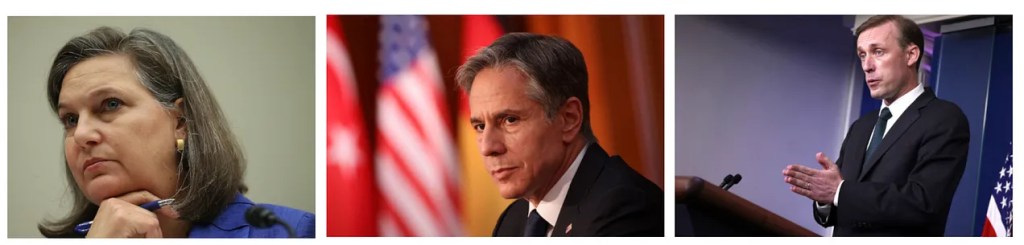
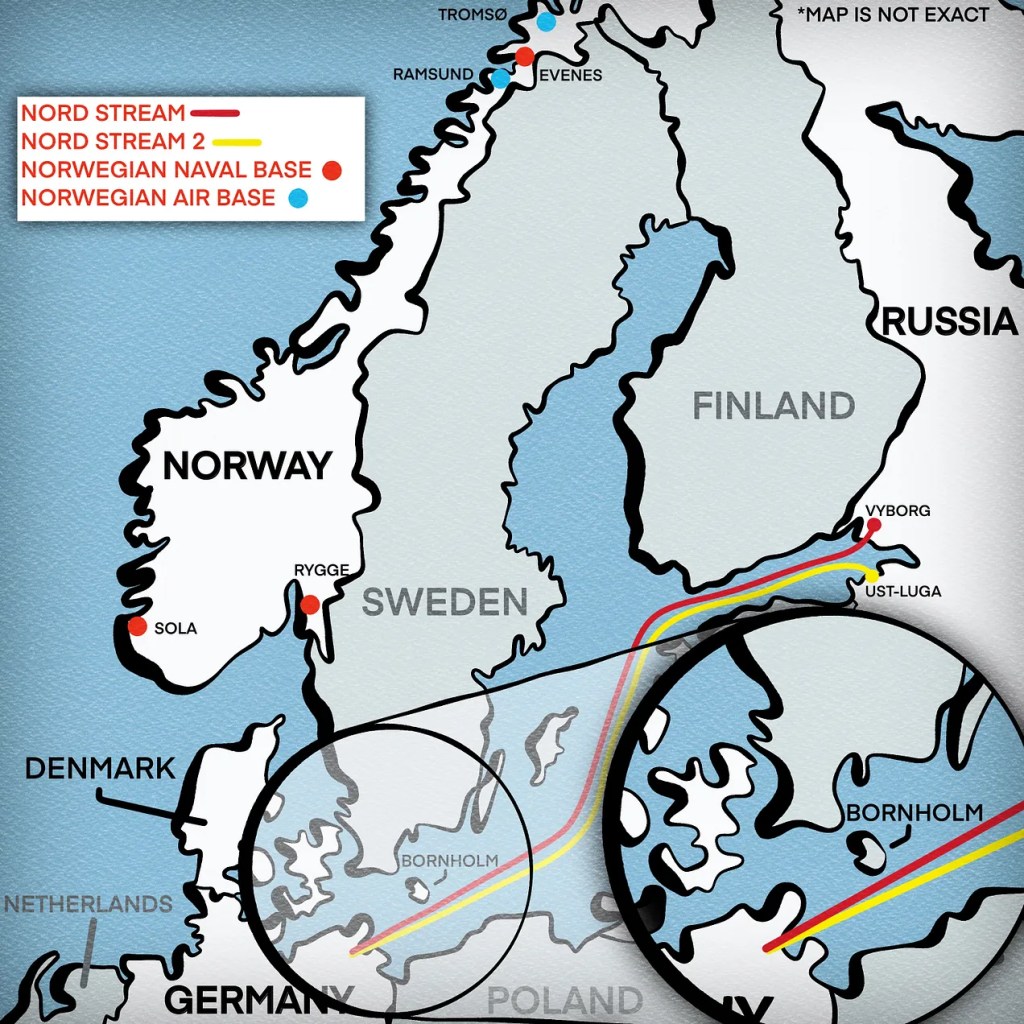
President Biden and his foreign policy team—National Security Adviser Jake Sullivan, Secretary of State Tony Blinken, and Victoria Nuland, the Undersecretary of State for Policy—had been vocal and consistent in their hostility to the two pipelines, which ran side by side for 750 miles under the Baltic Sea from two different ports in northeastern Russia near the Estonian border, passing close to the Danish island of Bornholm before ending in northern Germany.
The direct route, which bypassed any need to transit Ukraine, had been a boon for the German economy, which enjoyed an abundance of cheap Russian natural gas—enough to run its factories and heat its homes while enabling German distributors to sell excess gas, at a profit, throughout Western Europe. Action that could be traced to the administration would violate US promises to minimize direct conflict with Russia. Secrecy was essential.
From its earliest days, Nord Stream 1 was seen by Washington and its anti-Russian NATO partners as a threat to western dominance. The holding company behind it, Nord Stream AG, was incorporated in Switzerland in 2005 in partnership with Gazprom, a publicly traded Russian company producing enormous profits for shareholders which is dominated by oligarchs known to be in the thrall of Putin. Gazprom controlled 51 percent of the company, with four European energy firms—one in France, one in the Netherlands and two in Germany—sharing the remaining 49 percent of stock, and having the right to control downstream sales of the inexpensive natural gas to local distributors in Germany and Western Europe. Gazprom’s profits were shared with the Russian government, and state gas and oil revenues were estimated in some years to amount to as much as 45 percent of Russia’s annual budget.
America’s political fears were real: Putin would now have an additional and much-needed major source of income, and Germany and the rest of Western Europe would become addicted to low-cost natural gas supplied by Russia—while diminishing European reliance on America. In fact, that’s exactly what happened. Many Germans saw Nord Stream 1 as part of the deliverance of former Chancellor Willy Brandt’s famed Ostpolitik theory, which would enable postwar Germany to rehabilitate itself and other European nations destroyed in World War II by, among other initiatives, utilizing cheap Russian gas to fuel a prosperous Western European market and trading economy.
Nord Stream 1 was dangerous enough, in the view of NATO and Washington, but Nord Stream 2, whose construction was completed in September of 2021, would, if approved by German regulators, double the amount of cheap gas that would be available to Germany and Western Europe. The second pipeline also would provide enough gas for more than 50 percent of Germany’s annual consumption. Tensions were constantly escalating between Russia and NATO, backed by the aggressive foreign policy of the Biden Administration.
Opposition to Nord Stream 2 flared on the eve of the Biden inauguration in January 2021, when Senate Republicans, led by Ted Cruz of Texas, repeatedly raised the political threat of cheap Russian natural gas during the confirmation hearing of Blinken as Secretary of State. By then a unified Senate had successfully passed a law that, as Cruz told Blinken, “halted [the pipeline] in its tracks.” There would be enormous political and economic pressure from the German government, then headed by Angela Merkel, to get the second pipeline online.
Would Biden stand up to the Germans? Blinken said yes, but added that he had not discussed the specifics of the incoming President’s views. “I know his strong conviction that this is a bad idea, the Nord Stream 2,” he said. “I know that he would have us use every persuasive tool that we have to convince our friends and partners, including Germany, not to move forward with it.”
A few months later, as the construction of the second pipeline neared completion, Biden blinked. That May, in a stunning turnaround, the administration waived sanctions against Nord Stream AG, with a State Department official conceding that trying to stop the pipeline through sanctions and diplomacy had “always been a long shot.” Behind the scenes, administration officials reportedly urged Ukrainian President Volodymyr Zelensky, by then facing a threat of Russian invasion, not to criticize the move.
There were immediate consequences. Senate Republicans, led by Cruz, announced an immediate blockade of all of Biden’s foreign policy nominees and delayed passage of the annual defense bill for months, deep into the fall. Politico later depicted Biden’s turnabout on the second Russian pipeline as “the one decision, arguably more than the chaotic military withdrawal from Afghanistan, that has imperiled Biden’s agenda.”
The administration was floundering, despite getting a reprieve on the crisis in mid-November, when Germany’s energy regulators suspended approval of the second Nord Stream pipeline. Natural gas prices surged 8% within days, amid growing fears in Germany and Europe that the pipeline suspension and the growing possibility of a war between Russia and Ukraine would lead to a very much unwanted cold winter. It was not clear to Washington just where Olaf Scholz, Germany’s newly appointed chancellor, stood. Months earlier, after the fall of Afghanistan, Scholtz had publicly endorsed French President Emmanuel Macron’s call for a more autonomous European foreign policy in a speech in Prague—clearly suggesting less reliance on Washington and its mercurial actions.
Throughout all of this, Russian troops had been steadily and ominously building up on the borders of Ukraine, and by the end of December more than 100,000 soldiers were in position to strike from Belarus and Crimea. Alarm was growing in Washington, including an assessment from Blinken that those troop numbers could be “doubled in short order.”
The administration’s attention once again was focused on Nord Stream. As long as Europe remained dependent on the pipelines for cheap natural gas, Washington was afraid that countries like Germany would be reluctant to supply Ukraine with the money and weapons it needed to defeat Russia.
It was at this unsettled moment that Biden authorized Jake Sullivan to bring together an interagency group to come up with a plan.
All options were to be on the table. But only one would emerge.
PLANNING
In December of 2021, two months before the first Russian tanks rolled into Ukraine, Jake Sullivan convened a meeting of a newly formed task force—men and women from the Joint Chiefs of Staff, the CIA, and the State and Treasury Departments—and asked for recommendations about how to respond to Putin’s impending invasion.
It would be the first of a series of top-secret meetings, in a secure room on a top floor of the Old Executive Office Building, adjacent to the White House, that was also the home of the President’s Foreign Intelligence Advisory Board (PFIAB). There was the usual back and forth chatter that eventually led to a crucial preliminary question: Would the recommendation forwarded by the group to the President be reversible—such as another layer of sanctions and currency restrictions—or irreversible—that is, kinetic actions, which could not be undone?
What became clear to participants, according to the source with direct knowledge of the process, is that Sullivan intended for the group to come up with a plan for the destruction of the two Nord Stream pipelines—and that he was delivering on the desires of the President.
THE PLAYERS Left to right: Victoria Nuland, Anthony Blinken, and Jake Sullivan.
Over the next several meetings, the participants debated options for an attack. The Navy proposed using a newly commissioned submarine to assault the pipeline directly. The Air Force discussed dropping bombs with delayed fuses that could be set off remotely. The CIA argued that whatever was done, it would have to be covert. Everyone involved understood the stakes. “This is not kiddie stuff,” the source said. If the attack were traceable to the United States, “It’s an act of war.”
At the time, the CIA was directed by William Burns, a mild-mannered former ambassador to Russia who had served as deputy secretary of state in the Obama Administration. Burns quickly authorized an Agency working group whose ad hoc members included—by chance—someone who was familiar with the capabilities of the Navy’s deep-sea divers in Panama City. Over the next few weeks, members of the CIA’s working group began to craft a plan for a covert operation that would use deep-sea divers to trigger an explosion along the pipeline.
Something like this had been done before. In 1971, the American intelligence community learned from still undisclosed sources that two important units of the Russian Navy were communicating via an undersea cable buried in the Sea of Okhotsk, on Russia’s Far East Coast. The cable linked a regional Navy command to the mainland headquarters at Vladivostok.
A hand-picked team of Central Intelligence Agency and National Security Agency operatives was assembled somewhere in the Washington area, under deep cover, and worked out a plan, using Navy divers, modified submarines and a deep-submarine rescue vehicle, that succeeded, after much trial and error, in locating the Russian cable. The divers planted a sophisticated listening device on the cable that successfully intercepted the Russian traffic and recorded it on a taping system.
The NSA learned that senior Russian navy officers, convinced of the security of their communication link, chatted away with their peers without encryption. The recording device and its tape had to be replaced monthly and the project rolled on merrily for a decade until it was compromised by a forty-four-year-old civilian NSA technician named Ronald Pelton who was fluent in Russian. Pelton was betrayed by a Russian defector in 1985 and sentenced to prison. He was paid just $5,000 by the Russians for his revelations about the operation, along with $35,000 for other Russian operational data he provided that was never made public.
That underwater success, codenamed Ivy Bells, was innovative and risky, and produced invaluable intelligence about the Russian Navy’s intentions and planning.
Still, the interagency group was initially skeptical of the CIA’s enthusiasm for a covert deep-sea attack. There were too many unanswered questions. The waters of the Baltic Sea were heavily patrolled by the Russian navy, and there were no oil rigs that could be used as cover for a diving operation. Would the divers have to go to Estonia, right across the border from Russia’s natural gas loading docks, to train for the mission? “It would be a goat fuck,” the Agency was told.
Throughout “all of this scheming,” the source said, “some working guys in the CIA and the State Department were saying, ‘Don’t do this. It’s stupid and will be a political nightmare if it comes out.’”
Nevertheless, in early 2022, the CIA working group reported back to Sullivan’s interagency group: “We have a way to blow up the pipelines.”
What came next was stunning. On February 7, less than three weeks before the seemingly inevitable Russian invasion of Ukraine, Biden met in his White House office with German Chancellor Olaf Scholz, who, after some wobbling, was now firmly on the American team. At the press briefing that followed, Biden defiantly said, “If Russia invades . . . there will be no longer a Nord Stream 2. We will bring an end to it.”
Twenty days earlier, Undersecretary Nuland had delivered essentially the same message at a State Department briefing, with little press coverage. “I want to be very clear to you today,” she said in response to a question. “If Russia invades Ukraine, one way or another Nord Stream 2 will not move forward.”
Several of those involved in planning the pipeline mission were dismayed by what they viewed as indirect references to the attack.
“It was like putting an atomic bomb on the ground in Tokyo and telling the Japanese that we are going to detonate it,” the source said. “The plan was for the options to be executed post invasion and not advertised publicly. Biden simply didn’t get it or ignored it.”
Biden’s and Nuland’s indiscretion, if that is what it was, might have frustrated some of the planners. But it also created an opportunity. According to the source, some of the senior officials of the CIA determined that blowing up the pipeline “no longer could be considered a covert option because the President just announced that we knew how to do it.”
The plan to blow up Nord Stream 1 and 2 was suddenly downgraded from a covert operation requiring that Congress be informed to one that was deemed as a highly classified intelligence operation with U.S. military support. Under the law, the source explained, “There was no longer a legal requirement to report the operation to Congress. All they had to do now is just do it—but it still had to be secret. The Russians have superlative surveillance of the Baltic Sea.”
The Agency working group members had no direct contact with the White House, and were eager to find out if the President meant what he’d said—that is, if the mission was now a go. The source recalled, “Bill Burns comes back and says, ‘Do it.’”
THE OPERATION
Norway was the perfect place to base the mission.
In the past few years of East-West crisis, the U.S. military has vastly expanded its presence inside Norway, whose western border runs 1,400 miles along the north Atlantic Ocean and merges above the Arctic Circle with Russia. The Pentagon has created high paying jobs and contracts, amid some local controversy, by investing hundreds of millions of dollars to upgrade and expand American Navy and Air Force facilities in Norway. The new works included, most importantly, an advanced synthetic aperture radar far up north that was capable of penetrating deep into Russia and came online just as the American intelligence community lost access to a series of long-range listening sites inside China.
In return, the Norwegian government angered liberals and some moderates in its parliament last November by passing the Supplementary Defense Cooperation Agreement (SDCA). Under the new deal, the U.S. legal system would have jurisdiction in certain “agreed areas” in the North over American soldiers accused of crimes off base, as well as over those Norwegian citizens accused or suspected of interfering with the work at the base.
Norway was one of the original signatories of the NATO Treaty in 1949, in the early days of the Cold War. Today, the supreme commander of NATO is Jens Stoltenberg, a committed anti-communist, who served as Norway’s prime minister for eight years before moving to his high NATO post, with American backing, in 2014. He was a hardliner on all things Putin and Russia who had cooperated with the American intelligence community since the Vietnam War. He has been trusted completely since. “He is the glove that fits the American hand,” the source said.
Back in Washington, planners knew they had to go to Norway. “They hated the Russians, and the Norwegian navy was full of superb sailors and divers who had generations of experience in highly profitable deep-sea oil and gas exploration,” the source said. They also could be trusted to keep the mission secret. (The Norwegians may have had other interests as well. The destruction of Nord Stream—if the Americans could pull it off—would allow Norway to sell vastly more of its own natural gas to Europe.)
Sometime in March, a few members of the team flew to Norway to meet with the Norwegian Secret Service and Navy. One of the key questions was where exactly in the Baltic Sea was the best place to plant the explosives. Nord Stream 1 and 2, each with two sets of pipelines, were separated much of the way by little more than a mile as they made their run to the port of Greifswald in the far northeast of Germany.
The Norwegian navy was quick to find the right spot, in the shallow waters of the Baltic sea a few miles off Denmark’s Bornholm Island. The pipelines ran more than a mile apart along a seafloor that was only 260 feet deep. That would be well within the range of the divers, who, operating from a Norwegian Alta class mine hunter, would dive with a mixture of oxygen, nitrogen and helium streaming from their tanks, and plant shaped C4 charges on the four pipelines with concrete protective covers. It would be tedious, time consuming and dangerous work, but the waters off Bornholm had another advantage: there were no major tidal currents, which would have made the task of diving much more difficult.
After a bit of research, the Americans were all in.
At this point, the Navy’s obscure deep-diving group in Panama City once again came into play. The deep-sea schools at Panama City, whose trainees participated in Ivy Bells, are seen as an unwanted backwater by the elite graduates of the Naval Academy in Annapolis, who typically seek the glory of being assigned as a Seal, fighter pilot, or submariner. If one must become a “Black Shoe”—that is, a member of the less desirable surface ship command—there is always at least duty on a destroyer, cruiser or amphibious ship. The least glamorous of all is mine warfare. Its divers never appear in Hollywood movies, or on the cover of popular magazines.
“The best divers with deep diving qualifications are a tight community, and only the very best are recruited for the operation and told to be prepared to be summoned to the CIA in Washington,” the source said.
The Norwegians and Americans had a location and the operatives, but there was another concern: any unusual underwater activity in the waters off Bornholm might draw the attention of the Swedish or Danish navies, which could report it.
Denmark had also been one of the original NATO signatories and was known in the intelligence community for its special ties to the United Kingdom. Sweden had applied for membership into NATO, and had demonstrated its great skill in managing its underwater sound and magnetic sensor systems that successfully tracked Russian submarines that would occasionally show up in remote waters of the Swedish archipelago and be forced to the surface.
The Norwegians joined the Americans in insisting that some senior officials in Denmark and Sweden had to be briefed in general terms about possible diving activity in the area. In that way, someone higher up could intervene and keep a report out of the chain of command, thus insulating the pipeline operation. “What they were told and what they knew were purposely different,” the source told me. (The Norwegian embassy, asked to comment on this story, did not respond.)
The Norwegians were key to solving other hurdles. The Russian navy was known to possess surveillance technology capable of spotting, and triggering, underwater mines. The American explosive devices needed to be camouflaged in a way that would make them appear to the Russian system as part of the natural background—something that required adapting to the specific salinity of the water. The Norwegians had a fix.
The Norwegians also had a solution to the crucial question of when the operation should take place. Every June, for the past 21 years, the American Sixth Fleet, whose flagship is based in Gaeta, Italy, south of Rome, has sponsored a major NATO exercise in the Baltic Sea involving scores of allied ships throughout the region. The current exercise, held in June, would be known as Baltic Operations 22, or BALTOPS 22. The Norwegians proposed this would be the ideal cover to plant the mines.
The Americans provided one vital element: they convinced the Sixth Fleet planners to add a research and development exercise to the program. The exercise, as made public by the Navy, involved the Sixth Fleet in collaboration with the Navy’s “research and warfare centers.” The at-sea event would be held off the coast of Bornholm Island and involve NATO teams of divers planting mines, with competing teams using the latest underwater technology to find and destroy them.
It was both a useful exercise and ingenious cover. The Panama City boys would do their thing and the C4 explosives would be in place by the end of BALTOPS22, with a 48-hour timer attached. All of the Americans and Norwegians would be long gone by the first explosion.
The days were counting down. “The clock was ticking, and we were nearing mission accomplished,” the source said.
And then: Washington had second thoughts. The bombs would still be planted during BALTOPS, but the White House worried that a two-day window for their detonation would be too close to the end of the exercise, and it would be obvious that America had been involved.
Instead, the White House had a new request: “Can the guys in the field come up with some way to blow the pipelines later on command?”
Some members of the planning team were angered and frustrated by the President’s seeming indecision. The Panama City divers had repeatedly practiced planting the C4 on pipelines, as they would during BALTOPS, but now the team in Norway had to come up with a way to give Biden what he wanted—the ability to issue a successful execution order at a time of his choosing.
Being tasked with an arbitrary, last-minute change was something the CIA was accustomed to managing. But it also renewed the concerns some shared over the necessity, and legality, of the entire operation.
The President’s secret orders also evoked the CIA’s dilemma in the Vietnam War days, when President Johnson, confronted by growing anti-Vietnam War sentiment, ordered the Agency to violate its charter—which specifically barred it from operating inside America—by spying on antiwar leaders to determine whether they were being controlled by Communist Russia.
The agency ultimately acquiesced, and throughout the 1970s it became clear just how far it had been willing to go. There were subsequent newspaper revelations in the aftermath of the Watergate scandals about the Agency’s spying on American citizens, its involvement in the assassination of foreign leaders and its undermining of the socialist government of Salvador Allende.
Those revelations led to a dramatic series of hearings in the mid-1970s in the Senate, led by Frank Church of Idaho, that made it clear that Richard Helms, the Agency director at the time, accepted that he had an obligation to do what the President wanted, even if it meant violating the law.
In unpublished, closed-door testimony, Helms ruefully explained that “you almost have an Immaculate Conception when you do something” under secret orders from a President. “Whether it’s right that you should have it, or wrong that you shall have it, [the CIA] works under different rules and ground rules than any other part of the government.” He was essentially telling the Senators that he, as head of the CIA, understood that he had been working for the Crown, and not the Constitution.
The Americans at work in Norway operated under the same dynamic, and dutifully began working on the new problem—how to remotely detonate the C4 explosives on Biden’s order. It was a much more demanding assignment than those in Washington understood. There was no way for the team in Norway to know when the President might push the button. Would it be in a few weeks, in many months or in half a year or longer?
The C4 attached to the pipelines would be triggered by a sonar buoy dropped by a plane on short notice, but the procedure involved the most advanced signal processing technology. Once in place, the delayed timing devices attached to any of the four pipelines could be accidentally triggered by the complex mix of ocean background noises throughout the heavily trafficked Baltic Sea—from near and distant ships, underwater drilling, seismic events, waves and even sea creatures. To avoid this, the sonar buoy, once in place, would emit a sequence of unique low frequency tonal sounds—much like those emitted by a flute or a piano—that would be recognized by the timing device and, after a pre-set hours of delay, trigger the explosives. (“You want a signal that is robust enough so that no other signal could accidentally send a pulse that detonated the explosives,” I was told by Dr. Theodore Postol, professor emeritus of science, technology and national security policy at MIT. Postol, who has served as the science adviser to the Pentagon’s Chief of Naval Operations, said the issue facing the group in Norway because of Biden’s delay was one of chance: “The longer the explosives are in the water the greater risk there would be of a random signal that would launch the bombs.”)
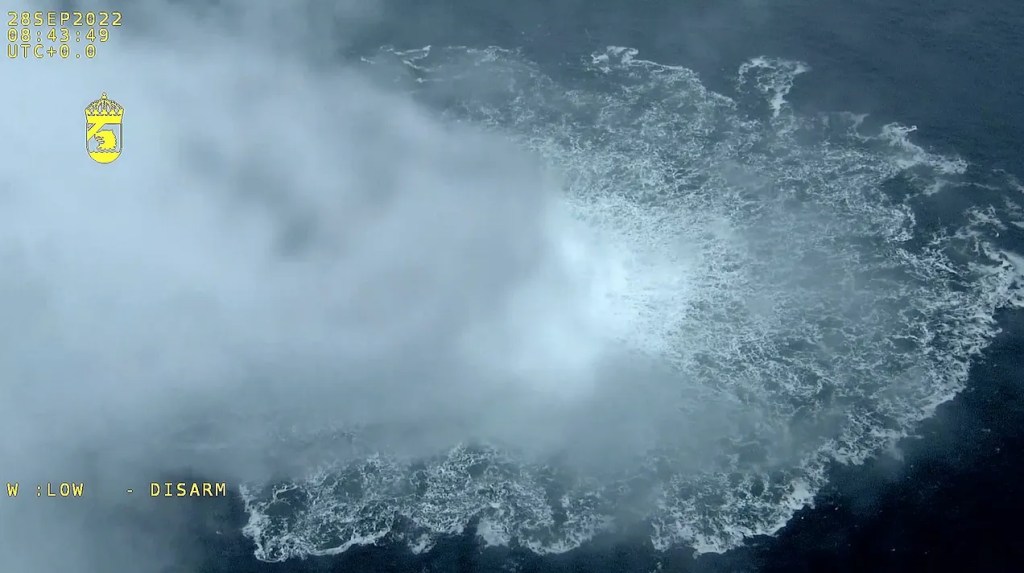
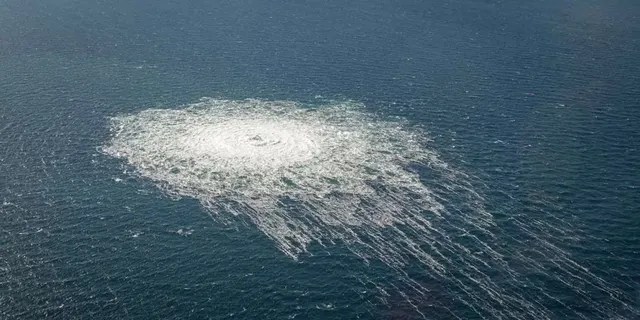
On September 26, 2022, a Norwegian Navy P8 surveillance plane made a seemingly routine flight and dropped a sonar buoy. The signal spread underwater, initially to Nord Stream 2 and then on to Nord Stream 1. A few hours later, the high-powered C4 explosives were triggered and three of the four pipelines were put out of commission. Within a few minutes, pools of methane gas that remained in the shuttered pipelines could be seen spreading on the water’s surface and the world learned that something irreversible had taken place.
FALLOUT
In the immediate aftermath of the pipeline bombing, the American media treated it like an unsolved mystery. Russia was repeatedly cited as a likely culprit, spurred on by calculated leaks from the White House—but without ever establishing a clear motive for such an act of self-sabotage, beyond simple retribution. A few months later, when it emerged that Russian authorities had been quietly getting estimates for the cost to repair the pipelines, the New York Times described the news as “complicating theories about who was behind” the attack. No major American newspaper dug into the earlier threats to the pipelines made by Biden and Undersecretary of State Nuland.
While it was never clear why Russia would seek to destroy its own lucrative pipeline, a more telling rationale for the President’s action came from Secretary of State Blinken.
Asked at a press conference last September about the consequences of the worsening energy crisis in Western Europe, Blinken described the moment as a potentially good one:
“It’s a tremendous opportunity to once and for all remove the dependence on Russian energy and thus to take away from Vladimir Putin the weaponization of energy as a means of advancing his imperial designs. That’s very significant and that offers tremendous strategic opportunity for the years to come, but meanwhile we’re determined to do everything we possibly can to make sure the consequences of all of this are not borne by citizens in our countries or, for that matter, around the world.”
More recently, Victoria Nuland expressed satisfaction at the demise of the newest of the pipelines. Testifying at a Senate Foreign Relations Committee hearing in late January she told Senator Ted Cruz, “Like you, I am, and I think the Administration is, very gratified to know that Nord Stream 2 is now, as you like to say, a hunk of metal at the bottom of the sea.”
The source had a much more streetwise view of Biden’s decision to sabotage more than 1500 miles of Gazprom pipeline as winter approached. “Well,” he said, speaking of the President, “I gotta admit the guy has a pair of balls. He said he was going to do it, and he did.”
Asked why he thought the Russians failed to respond, he said cynically, “Maybe they want the capability to do the same things the U.S. did.
“It was a beautiful cover story,” he went on. “Behind it was a covert operation that placed experts in the field and equipment that operated on a covert signal.
Not only had the USA the most to gain by this terrorist act which only a handful of militaries could have pulled off but, as Tucker Carlson shows, both Victoria Fuck the EU Nuland and Joe Biden himself had each earlier promised to decommission these pipelines by any necessary means and, as the same clip shows, these terrorist acts are part and parcel of America’s green energy policies, which Greta Thunberg, Extinction Rebellion and a host of other American assets have long promulgated.
The net result of these terrorist attacks is to render obsolete German popular demands to open Nord Stream 2 as both pipelines are now out of service for the foreseeable future.
Good news for the new Norwegian-Polish pipeline which opened on the same day the Americans blew up Nord Stream but bad news for German industry, which is relocating to the United States to survive these never ending below the belt blows to their viability.
Good news also for MEP Radek Sikorski and America’s other clowns who run Poland and who, like the American cat’s paw that they are, now believe themselves to be the king makers as to which West European countries will get oil and from whom.
And that is at the heart of Poland’s EU problem.
Because it has a large population, it demands to be an EU heavyweight, much as Germany and France are, rather than being the American lapdog that it currently is in this and all other matters.
The Jack Russell Baltic countries are likewise schizophrenic: fond as these Jack Russells may be of barking and sniping, they are, at day’s end, little mutts of no great consequence.
The same is increasingly becoming the case with Germany, which is allowing herself to be pulled like a rag doll hither and thither by the United States and her agents, who have holed the bedrocks of a stable currency and low inflation, upon which post-war German prosperity was built.
Back in saner days, German leaders like Angela Merkel commanded respect.
Bolstered by cheap Russian energy and her own technological, logistical and industrial relations genius, Germany was not only the beating economic heart of the European Union but was very much a major global player as well.
Now, Germany’s erstwhile leaders kowtow to Ursula von der Leyen and America’s other unelectable EU puppet assets.
Whilst trying to compete with the rising Chinese behemoth, Germany finds herself betrayed at every turn, most especially by her American overseer, who covets not only Germany’s export markets but her domestic ones as well.
Given that Germany’s major producer of toilet paper has folded, it seems Germany will be importing toilet paper as well as other “luxury goods” from the United States this winter.
Whereas Germany and the Netherlands are on their knees, the American economy is booming, at least until the mid term elections are over.
Without the CIA’s systematic destruction of the German and allied economies, it is quite likely that would not be the case and Biden’s war mongering Democrats would be annihilated in the November elections.
However, thanks to the self immolation of the German and British economies, that will not be the case and Biden’s cronies will be able to make some sort of argument that they kept the Good Ship America afloat.
And, should Biden prevail, Extinction Rebellion, Greta Thunberg, Ursula von der Leyen and those others who capsized the German economy should take their share of the credit.
As, perhaps, should those of us who vote for political parties that collude with Uncle Sam and thereby collude with Brzezinski’s blueprint for American hegemony.
Brzezinski’s basic thesis is that the United States must micro manage the conflicts and relationships it instigates in Europe, Asia, and the Middle East so that no rival superpower can arise to threaten the benefits that accrue to America by exploiting those regions.
It is within Brzezinski’s framework that American terrorism in Denmark, Armenia, Iraq, Ukraine and Syria all congeal into the one over riding thesis that America’s desire for hegemony is at the root of all our ills and Hollywood’s corresponding antithesis that America is a beacon of goodwill, democracy and all the other puerile garbage NATO’s studios churn out.
But it also helps to explain NATO’s phantom fears of red-green brown and similarly multi-colored alliances, where the far right, the far left and disaffected Muslims would unite to give them and their thieving ways the heave ho.
NATO, Joe Biden and Ursula von der Leyen fear no such thing.
What they do fear is a strong sovereign people, an alliance of Dutch or German citizens who would demand, as the French demanded in 1789, that these parasites and the self-serving political system they have cocooned themselves in get off their backs once and for all.
Now, though I don’t believe that the Germans are suddenly going to storm their equivalent of the Bastille, I would hope and even pray that Germany’s industrial, financial and labor leaders would lead Europe in calling time on Biden, von der Leyen and all their cronies who insist that we emulate Australian school children and eat crickets to save the environment, whilst Joe and Hunter Biden cause massive environmental havoc in the Baltic Sea, as well as in Ukraine, Yemen, Syria, Iraq, Libya, Armenia and the countless other sovereign nations they have destroyed.
US plan was always to stop EU buying Russia’s gas 2014 Rice:”You want to change the structure of energy dependence. You want to depend more on the North America energy platform … to have pipelines that don’t go through Ukraine & Russia” https://youtube.com/watch?v=aF0uYIjaTNE
Europe’s, and especially Germany’s industry, depends on cheap energy from Russia. Without it Europe will be de-industrialized and go broke.
The U.S. had threatened to disable the pipelines connecting Europe to Russia.
Pres. Biden: “If Russia invades…then there will be no longer a Nord Stream 2. We will bring an end to it.” Reporter: “But how will you do that, exactly, since…the project is in Germany’s control?” Biden: “I promise you, we will be able to do that.” abcn.ws/3B5SScx
Russia has no motive to destroy the pipelines it owns. These are valuable, long term assets and the gas that escaped from them yesterday was on its own worth some $600 to $800 million.
A pipeline that could be turned off and on again was a leverage point for Russia that gave it some negotiation power. A destroyed pipeline gives Russia no leverage. This is truly elementary. One can not spin that away.
During the war in Ukraine Russia has not stopped to deliver gas to Europe as contractually agreed. Instead European countries, Poland, Ukraine and Germany have blocked overland and sub sea pipelines that brought gas to Germany.
German people have protested against the U.S. ordered shut down of the Nord Stream II pipeline. (Nord Stream I was recently offline because Siemens was prevented by sanctions from maintaining its compressor turbines.)
Thousands of people in Gera in Germany against Olaf Scholz’s policy and the explosion of energy and gas prices. They demand an end to sanctions on Russia and the reopening of the Nord Stream 2 gas pipeline. Demonstrations also in other German cities but EU media censors them. Embedded video
A day after the protests the pipelines were sabotaged:
HERE IT IS Footage from the site of a gas leak on the underwater section of the Nord Stream. The video was published by the Danish military. Earlier, the Kremlin said that it was most likely about sabotage. The same opinion was expressed in the German government. Embedded video
Yesterday’s attack on the Nord Stream system is not unprecedented:
In 2015, the annual routine underwater survey of the Nord Stream 1 pipelines came across a remote operated vehicle rigged with explosives right next to one of the lines in Swedish waters. The umbilical cable had been cut. The drone’s national origin was never disclosed. 🧵
[T]he Swedish military has successfully cleared a remote operated vehicle (drone) rigged with explosives found near Line 2 of the Nord Stream Natural Gas offshore pipeline system.
The vehicle was discovered during a routine survey operation as part of the annual integrity assessment of the Nord Stream pipeline. Since it was within the Swedish Exclusive Economic Zone (EEZ) approximately 120 km away from the island of Gotland, the Swedes called on their armed forces to remove and ultimately disarm the object. … The national identity of the drone has not been verified so far, as many countries use Unmanned Underwater Vehicles (UUVs) of a similar construction, [Jesper Stolpe, Swedish Armed Forces spokesman,] said.
To destroy a sub sea pipeline requires more than a ROV/drone delivered shaped charge.
How strong is a Nord Stream pipe? Quite! The steel pipe itself has a wall of 4.1 centimeters (1.6 inches), and it’s coated with another 6-11 cm of steel-reinforced concrete. Each section of the pipe weighs 11 tonnes, which goes to 24-25 tonnes after the concrete is applied.
A Swedish seismologist said on Tuesday he was certain the seismic activity detected at the site of the Nord Stream pipeline gas leaks in the Baltic Sea was caused by explosions and not earthquakes nor landslides.
Bjorn Lund, seismologist at the Swedish National Seismic Network at Uppsala University, said seismic data gathered by him and Nordic colleagues showed that the explosions took place in the water and not in the rock under the seabed.
“BALTOPS, with the high degree of complexity, tested our collective readiness and adaptability, while also highlighting the strength of our Alliance and resolve in providing a maritime domain with freedom of navigation for all,” said Vice Adm. Gene Black, commander, U.S. Sixth Fleet and Naval Striking and Support Forces NATO (STRIKFORNATO).
Led by U.S. Sixth Fleet, BALTOPS 22 was command and controlled by STRIKFORNATO. From the staff’s headquarters in Oeiras, Portugal, Rear Adm. James Morley, STRIKFORNATO deputy commander, was responsible for ensuring participants met all training objectives. … [Rear Adm. John Menoni, commander, Expeditionary Strike Group Two,] also noted several instances in which forces stepped beyond know warfare methods to push limits with new technologies at sea and ashore. “Whether it was mine-hunting UUVs, persistent Intelligence, Surveillance, and Reconnaissance from an observable UAV, or demonstrating the value of the emerging Marine Corps concept of Expeditionary Advance Base Operations (EABO), our men and women continue to develop the tactics, techniques, and procedures that ultimately make meaningful contributions to Maritime Domain Awareness and increase the lethality of our forces.”
At sea, ships fine-tuned tactical maneuvering, anti-submarine warfare, live-fire training, mine countermeasures operations, and replenishments at sea. The Swedish submarine participating in the exercise, the U.K.’s Daring-class air-defense destroyer HMS Defender (D 36), and aircraft from other participating nations trained in anti-submarine warfare. Meanwhile, mine operations served as an ideal area of focus for testing new technology.
Scientists from five nations brought the latest advancements in Unmanned Underwater Vehicle (UUV) mine hunting technology to the Baltic Sea to demonstrate the vehicle’s effectiveness in operational scenarios. The BALTOPS Mine Counter Measure Task Group ventured throughout the Baltic region practicing ordnance location, exploitation, and disarming in critical maritime chokepoints.
While the Baltops 22 maneuver already took place in June and July of this year the U.S. Sixth Fleet left the Baltic Sea only a few days ago (in German, my translation):
Big Fleet Group From U.S. Navy Passes [German island passage] Fehmanbelt
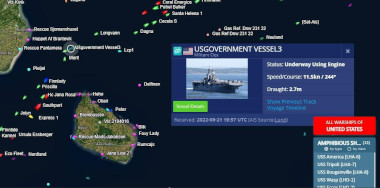
On Wednesday morning the amphibious assault ship USS Kearsarge, escorted by the Landing Ships USS Arlington and USS Gunston Hall, was en route towards west. Previously, the ships were part of US units that took part in NATO maneuvers and called at numerous ports in Germany, Scandinavia and the Baltic States.
The “USS Kearsarge”, flagship of the association and largest warship of the US Navy, which was in action in the Baltic Sea in the last 30 years, has 40 helicopters and fighter planes as well as more than 2000 soldiers on board, the escort ships about 1000. For the around 4,000 soldiers are heading back home on the east coast of the US after their six-month deployment.
A significant focus of BALTOPS every year is the demonstration of NATO mine hunting capabilities, and this year the U.S. Navy continues to use the exercise as an opportunity to test emerging technology, U.S. Naval Forces Europe-Africa Public Affairs said June 14.
In support of BALTOPS, U.S. Navy 6th Fleet partnered with U.S. Navy research and warfare centers to bring the latest advancements in unmanned underwater vehicle mine hunting technology to the Baltic Sea to demonstrate the vehicle’s effectiveness in operational scenarios.
Experimentation was conducted off the coast of Bornholm, Denmark, with participants from Naval Information Warfare Center Pacific, Naval Undersea Warfare Center Newport, and Mine Warfare Readiness and Effectiveness Measuring all under the direction of U.S. 6th Fleet Task Force 68.
Off the coast of Bornholm, Denmark, is where the pipelines were hit. Just days ago the USS Kearsarge was in that area:
An expeditionary detachment of US Navy ships led by the universal amphibious assault ship USS Kearsarge days ago was in the Baltic Sea It was 30 km from the site of the alleged sabotage on the Nord Stream-1 gas pipeline and 50 km from the threads of Nord Stream-2 gas pipeline
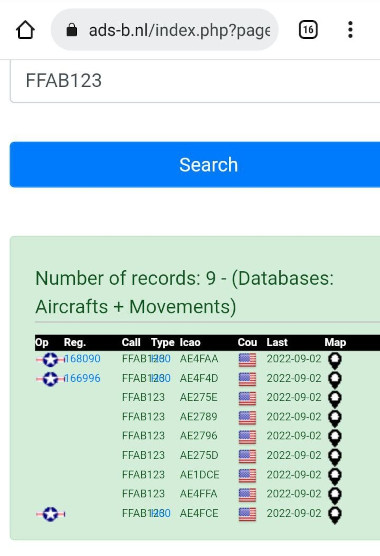
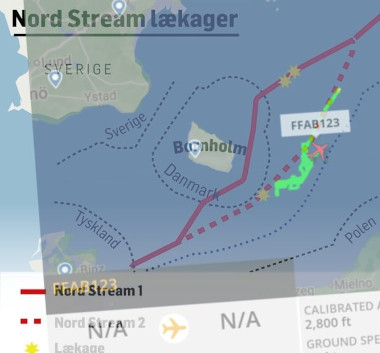
On September 2, interesting maneuvers performed by an American helicopter with the call sign FFAB123. Then it was assumed that this board was from the USS Kearsarge air wing, and today more details were looked.
According to the website ads-b.nl , this call sign was used by 6 boards that day, of which we managed to establish the side numbers of three. All of them are Sikorsky MH-60S.
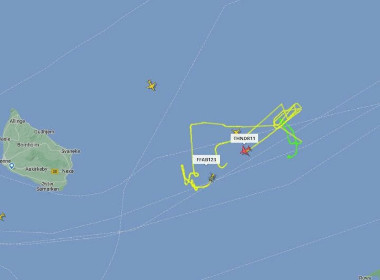
By superimposing the FFAB123 route on the scheme of yesterday’s accident, we get a rather interesting result — the helicopter either flew along the Nord Stream-2 highway, or even between the points where the accident occurred.
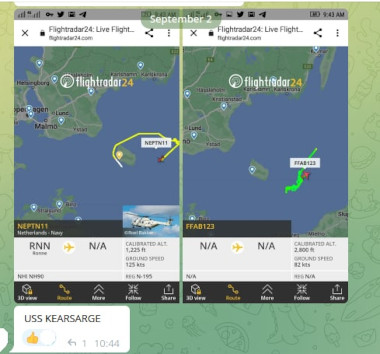
On Twitter, meanwhile, there were screenshots of other flights of American aviation — the following screenshot was taken on September 13.
The MH-60S carries big electromagnetic sensors which allows it to detect submarines, mines and – in the shallow waters of the Baltic Sea – sub sea pipelines.
This overlay picture of two others posted above is especially of interest:
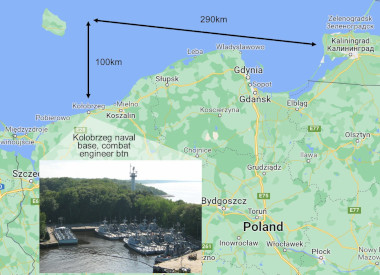
The U.S. military is not the only force that was near the area of the pipeline damage. Just a 100 kilometer south is the Polish naval base Kolobrzeg (the former German Kolberg) which harbors mine laying ships and the 8th Kołobrzeg Naval Combat Engineer Battalion. Naval combat engineers are experts in blowing up anything that is under water, be it mines or pipelines.
In 2021, while Nord Stream 2 was still being build, the Polish navy had interfered and endangered the pipe laying vessels in the very same place.
Gdy Wy mycie zęby, przebieracie się w piżamy i szykujecie do snu, jeden niestrudzony Polak wyrusza w swoją łodzią w kierunku Bornholmu mając na sercu dobro Polski a może i Niemiec …
Translated from Polish by Google When you brush your teeth, put on your pajamas and get ready to go to sleep, one tireless Pole sets off in his boat towards Bornholm with the good of Poland and maybe Germany at heart … Image
During the recent Ukraine crisis Poland has rejected to receive Russian gas. It closed the Yamal pipeline that transports natural gas from Russia to Germany. Poland continued to consume Russia gas. It received it from Germany which had received it through the Nord Stream I pipeline from Russia.
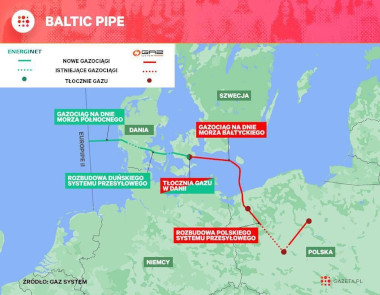
Poland and Denmark have build a new sub sea pipeline which connects it to the pipeline that brings Norwegian gas to the Netherlands and Europe.
The pipeline was opened yesterday, the very same day the Nord Stream system was sabotaged.
🎥The launching ceremony of the #BalticPipe gas pipeline with participation of PM @MorawieckiM , PM of Denmark Mette Frederiksen & @prezydentpl @AndrzejDuda. The Baltic Pipe is a strategic infrastructure project aimed at creating a new gas supply corridor on the European market. Video
The Baltic Pipe has a capacity of only 10 billion cubic meters per year. The Nord Stream system could carry up to 110 cubic meter per year. All of which is needed to keep Europe’s industries running.
The explosions at Bornholm are the new Polish strike for war in Europe against Chancellor Olaf Scholz. So far the Chancellery in Berlin is silent, tellingly.
The Poles should be reminded that other countries also have the capabilities to sabotage sub sea pipelines.
Radosław Sikorski is a former Minister of Defense and Foreign Minister of Poland. He is now a Member of the European Parliament. Yesterday he posted a picture of the gas escaping the damaged Nord Stream pipelines and thanked the U.S. for blowing them up.
In 2014 during the Maidan coup in Ukraine another notorious neoconservative, Assistant Secretary of State Victoria Nuland, told the U.S. ambassador to Ukraine, Geoffrey Pyatt, who should become the new prime minister of the Ukraine. She famously expressed her opinion about European concerns: “Fuck the EU” Nuland said. She is currently the U.S. Under Secretary of State for Political Affairs.
Over the last decades Germany has financed the Euro zone with up to 1.24 trillion Euros. (See also this thread). This was possible because Germany was exporting lots of industrial products and had a yearly surplus from its trade. With Germany’s industry going down because a lack of cheap energy that surplus will vanish. Europe, all of it, will become a poor continent.
9/ The European energy war will likely go down in history, together with the Treaty of Versailles and the trade wars of the 1930s, as one of the biggest economic policy errors in history.
10/ Another thing: when Trump was elected on a platform of milder protectionism, many people rightly pointed to the 1920s and 1930s and warned against these policies. These same people appear to have supported these much more 1920s/30s-like policies this past year. Ironic.
This reminds of President Joe Biden’s warning of a Russian invasion in Ukraine early this year.
It is easy to predict such events when you are the one who intends to cause them.
The U.S. knew that the Ukraine was going to launch an attack on the Donbas republics. The U.S. knew that Russia would intervene to help its brethren. Russia had said so. The Ukrainian attack started with artillery preparations on February 17. Russia intervened on February 24.
The above is a collection of the currently available facts. You can draw your own conclusions from them.






 After the Crash