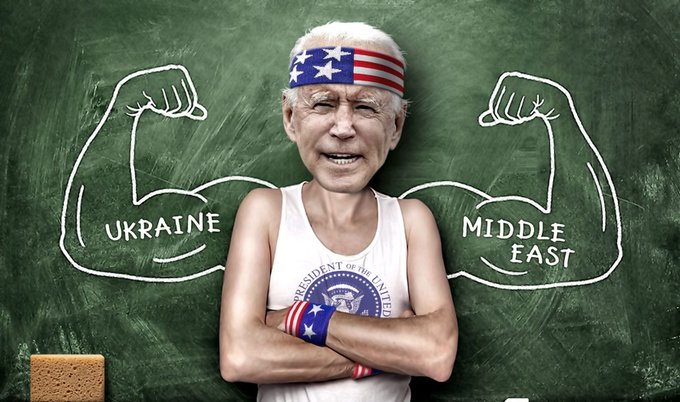
The outcome of US-led conflicts in Ukraine and West Asia will have a profound impact on the developing world order. Washington has already lost the former, and its major adversaries are vested in making sure it loses the latter too.
Geopolitical analysts broadly agree that the war in Ukraine and the West Asian crisis will dictate the trajectory of world politics in 2024. But a reductionist thesis appears alongside that views the Israel-Palestine conflict narrowly in terms of what it entails for the resilience of the US proxy war in Ukraine – the assumption being that the locus of world politics lies in Eurasia.
The reality is more complex. Each of these two conflicts has a raison d’être and dynamics of its own, while at the same time also being intertwined.
Washington’s neck-deep involvement in the current phase of the West Asian crisis can turn into a quagmire, since it is also tangled up with domestic politics in a way that the Ukraine war never has been. But then, the outcome of the Ukraine war is already a foregone conclusion, and the US and its allies have realized that Russia cannot be defeated militarily; the endgame narrows down to an agreement to end the conflict on Russia’s terms.
To be sure, the outcome of the Ukraine war and the denouement of the Israel-Palestine conflict, which is at the root of the West Asian crisis, will have a profound impact on the new world order, and the two processes reinforce each other.
Russia realizes this fully. President Vladimir Putin’s stunning ‘year-enders’ in the run-up to the New Year speak for themselves: daylong visits to Abu Dhabi and Riyadh (watched by a shell-shocked US President Joe Biden), followed by talks with Iran’s president and rounded off with a telephone conversation with the Egyptian president.
In the space of 48 hours or so, Putin touched base with his Emirati, Saudi, Iranian, and Egyptian colleagues who officially entered the portals of the BRICS on 1 January.
The evolving US intervention in the West Asian crisis can be understood from a geopolitical perspective only by factoring in Biden’s visceral hostility toward Russia. BRICS is in Washington’s crosshairs. The US understands perfectly well that the extra large presence of West Asian and Arab nations in BRICS — four out of ten member states — is central to Putin’s grand project to re-structure the world order and bury US exceptionalism and hegemony.
Saudi Arabia, the UAE, and Iran are major oil producing countries. Russia has been rather explicit that during its 2024 chairmanship of BRICS, it will push for the creation of a currency to challenge the petrodollar. Without doubt, the BRICS currency will be at the center stage of the grouping’s summit due to be hosted by Putin in Kazan, Russia in October.
In a special address on 1 January, marking the start of Russia’s BRICS Chairmanship, Putin stated his commitment to “enhancing the role of BRICS in the international monetary system, expanding both interbank cooperation and the use of national currencies in mutual trade.”
If a BRICS currency is used instead of the dollar, there could be significant impact on several financial sectors of the US economy, such as energy and commodity markets, international trade and investment, capital markets, technology and fintech, consumer goods and retail, travel and tourism, and so on.
The banking sector could take the first hit that might eventually spill over to the markets. And if Washington fails to fund its mammoth deficit, prices of all commodities could skyrocket or even reach hyperinflation triggering a crash of the US economy.
Meanwhile, the eruption of the Israel-Palestine conflict has given the US an alibi — ‘Israel’s self-defense’ — to claw its way back on the greasy pole of West Asian politics. Washington has multiple concerns, but at its core are the twin objectives of resuscitating the Abraham Accords (anchored on Saudi-Israeli proximity) and the concurrent sabotage of the Beijing-mediated Saudi-Iranian rapprochement.
The Biden administration was counting on the fact that an Israeli-Saudi deal would provide legitimacy to Tel Aviv and proclaim to the Islamic world that there was no religious justification for hostility towards Israel. But Washington senses that post-7 October it would not be able to secure a Saudi-Israel deal during this Biden term, and all that could be coaxed out of Riyadh is a door left ajar for future discussion on the topic. No doubt, it is a major blow to the US strategy to liquidate the Palestinian question.
In a medium term perspective, if the Russian-Saudi mechanism known as OPEC+ liberates the world oil market from US control, BRICS drives a dagger into the heart of US hegemony which is anchored on the dollar being the ‘world currency.’
Saudi Arabia recently signed a currency swap deal worth $7 billion with China in an attempt to shift more of their trade away from the dollar. The People’s Bank of China said in a statement that the swap arrangement will “help strengthen financial cooperation” and “facilitate more convenient trade and investment” between the countries.
Going forward, sensitive Saudi-Chinese transactions in strategic areas such as defense, nuclear technology, among others, will henceforth take place below the US radar. From a Chinese perspective, if its strategic trade is sufficiently insulated from any US-led program of anti-China sanctions, Beijing can position itself confidently to confront US power in the Indo-Pacific. This is a telling example of how the US strategy for the Indo-Pacific will lose traction as a result of its waning influence in West Asia.
The conventional wisdom is that preoccupation in volatile West Asia distracts Washington from paying attention to the Indo-Pacific and China. In reality, though, the waning influence in West Asia is complicating the capacity of the US to counter China both in the region as well as in the Indo-Pacific. The developments are moving in a direction where the credentials of the US as a great power are at an inflection point in West Asia – and that realization has leaked into other geographic regions around the world.
Way back in 2007, the distinguished political scientists John Mearsheimer of the University of Chicago and Stephen Walt of the John F. Kennedy School of Government at Harvard, wrote with great prescience in their famous 34,000-word essay entitled The Israel Lobby and US Foreign Policy that Israel has become a ‘strategic liability’ for the United States, but retains its strong support because of a wealthy, well-organized, and bewitching lobby that has a ‘stranglehold’ on Congress and US elites.
The authors warned that Israel and its lobby bear outsized their responsibility for persuading the Bush Administration to invade Iraq and, perhaps one day soon, to attack the nuclear facilities of Iran.
Interestingly, on New Year’s Eve, in a special report based on extensive briefing by top US officials, the New York Times highlighted that “No other episode [as the war in Gaza] in the past half-century has tested the ties between the United States and Israel in such an intense and consequential way.”
Clearly, even as Israel’s barbaric actions in Gaza and its colonial project in the occupied West Bank are exposed and laid bare, and the Israeli state’s campaign to force Palestinian population migration are in full view, two of the US strategic objectives in the region are unravelling: first, the restoration of Israel’s military superiority in the balance of forces regionally and vis-a-vis the Axis of Resistance, in particular; and second, the resuscitation of the Abraham Accords where the crown jewels would have been a Saudi-Israeli treaty.
Viewed from another angle, the directions in which West Asia’s crisis unfolds are being keenly watched by the world community, especially those in the Asia-Pacific region. Most notable here is that Russia and China have given the US a free hand to navigate its military moves – unchallenged, so far, in the Red Sea. This means that any conflagration in the region will be synonymous with a catastrophic breakdown of US strategy.
Soon after the US defeat in Afghanistan in Central Asia, and coinciding with an ignominious ending of the US-led proxy war by NATO against Russia in Eurasia, a violent, grotesque setback in West Asia will send a resounding message across all of Asia that the US-led bandwagon has run out of steam. Among the end users of this startling message, the countries of ASEAN stand at the forefront. The bottom line is that the overlapping tumultuous events in Eurasia and West Asia are poised to coalesce into a climactic moment for world politics.
U.S. Think Tank Land hacks are not exactly familiar with Montaigne: “On the highest throne in the world, we still sit only on our own bottom.”
Hubris leads these specimens to presume their flaccid bottoms are placed high above anyone else’s. The result is that a trademark mix of arrogance and ignorance always ends up unmasking the predictability of their forecasts.
U.S. Think Tank Land – inebriated by their self-created aura of power – always telegraphs in advance what they’re up to. That was the case with Project 9/11 (“We need a new Pearl Harbor”). That was the case with the RAND report on over-extending and unbalancing Russia. And now that’s the case with the incoming
It’s always painful to suffer through the intellectually shallow Think Thank Land wet dreams masquerading as “analyses” but in this particular case key Global South players need to be firmly aware of what awaits them.
Predictably, the whole “analysis” revolves around the imminent, devastating humiliation to the Hegemon and its vassals: what happens next in country 404, also known – for now – as Ukraine.
Brazil, India, Indonesia and Saudi Arabia are dismissed as “four major fence-sitters” when it comes to the U.S./NATO proxy war against Russia. It’s the same old “you’re with us or against us” trope.
But then we are presented with the six major Global South culprits: Brazil, India, Indonesia, Saudi Arabia, South Africa and Turkey.
In yet another crude, parochial remix of a catch phrase referring to the American elections, these are qualified as the key swing states the Hegemon will need to seduce, cajole, intimidate and threaten to assure its dominance of the “rules-based international order”.
Saudi Arabia and South Africa are added to a previous report focused on the “four major fence sitters”.
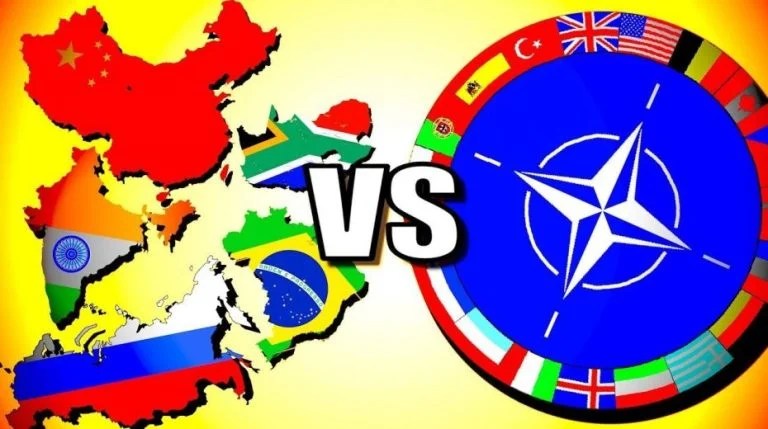
The swing state manifesto notes that all of them are G-20 members and “active in both geopolitics and geoeconomics” (Oh really? Now that’s some breaking news). What it does not say is that three of them are BRICS members (Brazil, India, South Africa) and the other three are serious candidates to join BRICS+: deliberations will be turbo-charged in the upcoming BRICS summit in South Africa in August.
So it’s clear what the swing state manifesto is all about: a call to arms for the American war against the BRICS.
So BRICS packs no punch
The swing state manifesto harbors wet dreams of near-shoring and friend-shoring moving away from China. Nonsense: enhanced intra-BRICS+ trade will be the order of the day from now on, especially with the expanded practice of trade in national currencies (see Brazil-China or within ASEAN), the first step towards widespread de-dollarization.
The swing states are characterized as “not a new incarnation” of the Non-Aligned Movement (NAM), or “other groupings dominated by the Global South, such as the G-77 and BRICS.”
Talk about exponential nonsense. This is all about BRICS+ – which now has the tools (including the NDB, the BRICS bank) to do what NAM could never accomplish during the Cold War: establish the framework of a new system bypassing Bretton Woods and the interlocking coercion mechanisms of the Hegemon.
As for stating that BRICS has not “packed much punch” that only reveals U.S. Think Tank Land’s cosmic ignorance of what BRICS + is all about.
The position of India is only considered in terms of being a Quad member – defined as a “U.S.-led effort to balance China”. Correction: contain China.
As for the “choice” of swing states of choosing between the U.S. and China on semiconductors, AI, quantum technology, 5G and biotechnology, that’s not about “choice”, but to what level they are able to sustain Hegemon pressure to demonize Chinese technology.
Pressure on Brazil, for instance, is much heavier than on Saudi Arabia or Indonesia.
In the end though, it all comes back to the Straussian neocon obsession: Ukraine. The swing states, in varying degrees, are guilty of opposing and/or undermining the sanctions dementia. Turkey, for instance, is accused of channeling “dual-use” items to Russia. Not a word on the U.S. financial system viciously forcing Turkish banks to stop accepting Russian MIR payment cards.
On the wishful thinking front, this pearl stands out among many: “The Kremlin seems to believe it can make a living by turning its trade south and east.”
Well, Russia is already making excellent living all across Eurasia and a vast expanse of the Global South.
The economy has re-started (drivers are domestic tourism, machine building and the metals industry); inflation is at only 2.5% (lower than anywhere in the EU); unemployment is at only 3.5%; and head of the Central Bank Elvira Nabiullina said that by 2024 growth will be back to pre-SMO levels.
U.S. Think Tankland is congenitally incapable of understanding that even if BRICS+ nations may still have some serious trade credit issues to iron out, Moscow has already shown how even an implied hard backing of a currency can turn out to be an instant game changer. Russia is at the same time backing not only the ruble but also the yuan.
Meanwhile, the Global South de-dollarization caravan moves on relentlessly – as much as the proxy war hyenas may keep howling in the dark. When the full – staggering – scale of NATO’s humiliation in Ukraine unfolds, arguably by mid-summer, the de-dollarization high-speed train will be fully booked, non-stop.
“Offer you can’t refuse” rides again
If all of the above was not already silly enough, the swing state manifesto doubles down on the nuclear front, accusing them of “future (nuclear) proliferation risks”: especially – who else – Iran.
By the way, Russia is defined as a “middle power, but one in decline”. And “hyper-revisionist” to boot. Oh dear: with “experts” like this, the Americans don’t even need enemies.
And yes, by now you may be excused to roar with laughter: China is accused of attempting to direct and co-opt BRICS. The “suggestion” – or “offer you can’t refuse”, Mafia-style – to the swing states is that you cannot join a “Chinese-directed, Russian-assisted body actively opposing the United States.”
The message is unmistakable: “The threat of a Sino-Russian co-optation of an expanded BRICS—and through it, of the global south—is real, and it needs to be addressed.”
And here are the recipes to address it. Invite most swing states to the G-7 (that was a miserable failure). “More high-level visits by key U.S. diplomats” (welcome to cookie distributor Vicky Nuland). And last but not least, Mafia tactics, as in a “nimbler trade strategy that begins to crack the nut of access to the U.S. market.”
The swing state manifesto could not but let the Top Cat out of the bag, predicting, rather praying that “U.S.-China tensions rise dramatically and turn into a Cold War-style confrontation.” That’s already happening – unleashed by the Hegemon.
So what would be the follow-up? The much sought after and spun-to-death “decoupling”, forcing the swing states to “align more closely with one side or the other”. It’s “you’re with us or against us” all over again.
So there you go. Raw, in the flesh – with inbuilt veiled threats. The Hybrid War 2.0 against the Global South has not even started. Swing states, you have all been warned.
The redeeming quality of a tense G20 held in Bali – otherwise managed by laudable Indonesian graciousness – was to sharply define which way the geopolitical winds are blowing.
That was encapsulated in the Summit’s two highlights: the much anticipated China-US presidential meeting – representing the most important bilateral relationship of the 21st century – and the final G20 statement.
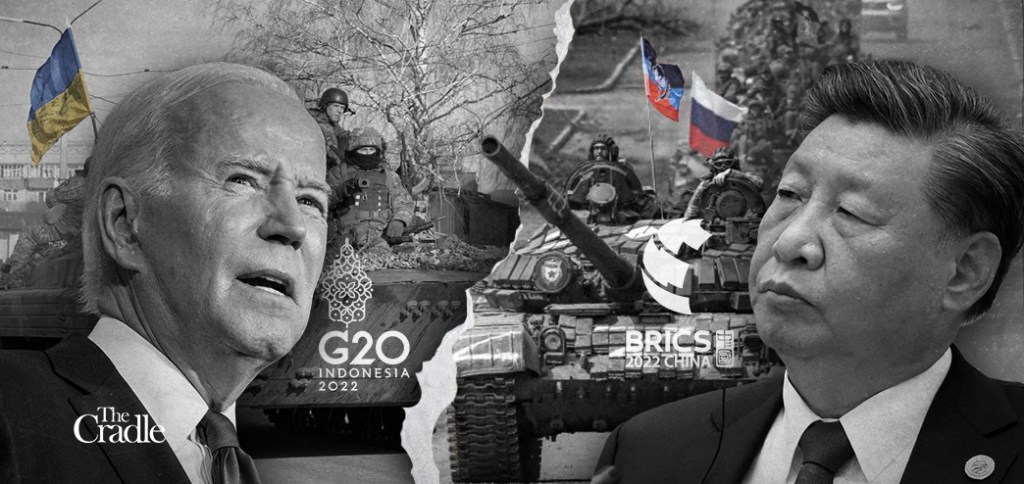
The 3-hour, 30-minute-long face-to-face meeting between Chinese President Xi Jinping and his US counterpart Joe Biden – requested by the White House – took place at the Chinese delegation’s residence in Bali, and not at the G20 venue at the luxury Apurva Kempinski in Nusa Dua.
The Chinese Ministry of Foreign Affairs concisely outlined what really mattered. Specifically, Xi told Biden that Taiwan independence is simply out of the question. Xi also expressed hope that NATO, the EU, and the US will engage in “comprehensive dialogue” with Russia. Instead of confrontation, the Chinese president chose to highlight the layers of common interest and cooperation.
Biden, according to the Chinese, made several points. The US does not seek a New Cold War; does not support “Taiwan independence;” does not support “two Chinas” or “one China, one Taiwan”; does not seek “decoupling” from China; and does not want to contain Beijing.
However, the recent record shows Xi has few reasons to take Biden at face value.
The final G20 statement was an even fuzzier matter: the result of arduous compromise.
As much as the G20 is self-described as “the premier forum for global economic cooperation,” engaged to “address the world’s major economic challenges,” the G7 inside the G20 in Bali had the summit de facto hijacked by war. “War” gets almost double the number of mentions in the statement compared to “food” after all.
The collective west, including the Japanese vassal state, was bent on including the war in Ukraine and its “economic impacts” – especially the food and energy crisis – in the statement. Yet without offering even a shade of context, related to NATO expansion. What mattered was to blame Russia – for everything.
The Global South effect
It was up to this year’s G20 host Indonesia – and the next host, India – to exercise trademark Asian politeness and consensus building. Jakarta and New Delhi worked extremely hard to find wording that would be acceptable to both Moscow and Beijing. Call it the Global South effect.
Still, China wanted changes in the wording. This was opposed by western states, while Russia did not review the last-minute wording because Foreign Minister Sergey Lavrov had already departed.
On point 3 out of 52, the statement “expresses its deepest regret over the aggression of the Russian Federation against Ukraine and demands the complete and unconditional withdrawal of armed forces from the territory of Ukraine.”
“Russian aggression” is the standard NATO mantra – not shared by virtually the whole Global South.
The statement draws a direct correlation between the war and a non-contextualized “aggravation of pressing problems in the global economy – slowing economic growth, rising inflation, disruption of supply chains, worsening energy, and food security, increased risks to financial stability.”
As for this passage, it could not be more self-evident: “The use or threat of use of nuclear weapons is inadmissible. The peaceful resolution of conflicts, efforts to address crises, as well as diplomacy and dialogue, are vital. Today’s era must not be of war.”
This is ironic given that NATO and its public relations department, the EU, “represented” by the unelected eurocrats of the European Commission, don’t do “diplomacy and dialogue.”
Fixated with war
Instead the US, which controls NATO, has been weaponizing Ukraine, since March, by a whopping $91.3 billion, including the latest presidential request, this month, of $37.7 billion. That happens to be 33 percent more than Russia’s total (italics mine) military spending for 2022.
Extra evidence of the Bali Summit being hijacked by “war” was provided by the emergency meeting, called by the US, to debate what ended up being a Ukrainian S-300 missile falling on a Polish farm, and not the start of WWIII like some tabloids hysterically suggested.
Tellingly, there was absolutely no one from the Global South in the meeting – the sole Asian nation being the Japanese vassal, part of the G7.
Compounding the picture, we had the sinister Davos master Klaus Schwab once again impersonating a Bond villain at the B20 business forum, selling his Great Reset agenda of “rebuilding the world” through pandemics, famines, climate change, cyber attacks, and – of course – wars.
As if this was not ominous enough, Davos and its World Economic Forum are now ordering Africa – completely excluded from the G20 – to pay $2.8 trillion to “meet its obligations” under the Paris Agreement to minimize greenhouse gas emissions.
The demise of the G20 as we know it
The serious fracture between Global North and Global South, so evident in Bali, had already been suggested in Phnom Penh, as Cambodia hosted the East Asia Summit this past weekend.
The 10 members of ASEAN had made it very clear they remain unwilling to follow the US and the G7 in their collective demonization of Russia and in many aspects China.
The Southeast Asians are also not exactly excited by the US-concocted IPEF (Indo-Pacific Economic Framework), which will be irrelevant in terms of slowing down China’s extensive trade and connectivity across Southeast Asia.
And it gets worse. The self-described “leader of the free world” is shunning the extremely important APEC (Asia-Pacific Economic Cooperation) summit in Bangkok at the end of this week.
For very sensitive and sophisticated Asian cultures, this is seen as an affront. APEC, established way back in 1990s to promote trade across the Pacific Rim, is about serious Asia-Pacific business, not Americanized “Indo-Pacific” militarization.
The snub follows Biden’s latest blunder when he erroneously addressed Cambodia’s Hun Sen as “prime minister of Colombia” at the summit in Phnom Penh.
Lining up to join BRICS
It is safe to say that the G20 may have plunged into an irretrievable path toward irrelevancy. Even before the current Southeast Asian summit wave – in Phnom Penh, Bali and Bangkok – Lavrov had already signaled what comes next when he noted that “over a dozen countries” have applied to join BRICS (Brazil, Russia, India, China, South Africa).
Iran, Argentina, and Algeria have formally applied: Iran, alongside Russia, India, and China, is already part of the Eurasian Quad that really matters.
Turkey, Saudi Arabia, Egypt, and Afghanistan are extremely interested in becoming members. Indonesia just applied, in Bali. And then there’s the next wave: Kazakhstan, UAE, Thailand (possibly applying this weekend in Bangkok), Nigeria, Senegal, and Nicaragua.
It’s crucial to note that all of the above sent their Finance Ministers to a BRICS Expansion dialogue in May. A short but serious appraisal of the candidates reveals an astonishing unity in diversity.
Lavrov himself noted that it will take time for the current five BRICS to analyze the immense geopolitical and geoeconomic implications of expanding to the point of virtually reaching the size of the G20 – and without the collective west.
What unites the candidates above all is the possession of massive natural resources: oil and gas, precious metals, rare earths, rare minerals, coal, solar power, timber, agricultural land, fisheries, and fresh water. That’s the imperative when it comes to designing a new resource-based reserve currency to bypass the US dollar.
Let’s assume that it may take up to 2025 to have this new BRICS+ configuration up and running. That would represent roughly 45 percent of confirmed global oil reserves and over 60 percent of confirmed global gas reserves (and that will balloon if gas republic Turkmenistan later joins the group).
The combined GDP – in today’s figures – would be roughly $29.35 trillion; much larger than the US ($23 trillion) and at least double the EU ($14.5 trillion, and falling).
As it stands, BRICS account for 40 percent of the global population and 25 percent of GDP. BRICS+ would congregate 4.257 billion people: over 50 percent of the total global population as it stands.
BRI embraces BRICS+
BRICS+ will be striving towards interconnection with a maze of institutions: the most important are the Shanghai Cooperation Organization (SCO), itself featuring a list of players itching to become full members; strategic OPEC+, de facto led by Russia and Saudi Arabia; and the Belt and Road Initiative (BRI), China’s overarching trade and foreign policy framework for the 21st century. It is worth pointing out that early all crucial Asian players have joined the BRI.
Then there are the close links of BRICS with a plethora of regional trade blocs: ASEAN, Mercosur, GCC (Gulf Cooperation Council), Eurasia Economic Union (EAEU), Arab Trade Zone, African Continental Free Trade Area, ALBA, SAARC, and last but not least the Regional Comprehensive Economic Partnership (RCEP), the largest trade deal on the planet, which includes a majority of BRI partners.
BRICS+ and BRI is a match everywhere you look at it – from West Asia and Central Asia to the Southeast Asians (especially Indonesia and Thailand). The multiplier effect will be key – as BRI members will be inevitably attracting more candidates for BRICS+.
This will inevitably lead to a second wave of BRICS+ hopefuls including, most certainly, Azerbaijan, Mongolia, three more Central Asians (Uzbekistan, Tajikistan, and gas republic Turkmenistan), Pakistan, Vietnam, and Sri Lanka, and in Latin America, a hefty contingent featuring Chile, Cuba, Ecuador, Peru, Uruguay, Bolivia, and Venezuela.
Meanwhile, the role of the BRICS’s New Development Bank (NDB) as well as the China-led Asia Infrastructure Investment Bank (AIIB) will be enhanced – coordinating infrastructure loans across the spectrum, as BRICS+ will be increasingly shunning dictates imposed by the US-dominated IMF and the World Bank.
All of the above barely sketches the width and depth of the geopolitical and geoeconomic realignments further on down the road – affecting every nook and cranny of global trade and supply chain networks. The G7’s obsession in isolating and/or containing the top Eurasian players is turning on itself in the framework of the G20. In the end, it’s the G7 that may be isolated by the BRICS+ irresistible force.
Introduction
During most of the past two decades Washington has aggressively launched military and economic wars against at least nine countries, either directly or through its military aid to regional allies and proxies. US air and ground troops have bombed or invaded Afghanistan, Iraq, Pakistan, Libya, Somalia, Syria, Yemen and Lebanon.
More recently Washington has escalated its global economic war against major economic rivals as well as against weaker countries. The US no longer confines its aggressive impulses to peripheral economic countries in the Middle East, Latin America and Southern Asia: It has declared trade wars against world powers in Asia, Eastern and Central Europe and the Gulf states.
The targets of the US economic aggression include economic powerhouses like Russia, China, Germany, Iran and Saudi Arabia, as well as Syria, Yemen, Venezuela, Cuba and the Donbas region of Ukraine.
There is an increasingly thinner distinction between military and economic warfare, as the US has frequently moved from one to the other, particularly when economic aggression has not resulted in ‘regime change’ – as in the case of the sanctions campaign against Iraq leading up to the devastating invasion and destruction.
In this essay, we propose to examine the strategies and tactics underlying Washington’s economic warfare, their successes and failures, and the political and economic consequences to target nations and to world stability.
Washington’s Economic Warfare and Global Power
The US has used different tactical weapons as it pursues its economic campaigns against targeted adversaries and even against its long-time allies.
Two supposed allies, Germany and Saudi Arabia, have been attacked by the Obama Administration and US Congress via ‘legal’ manipulations aimed at their financial systems and overseas holdings. This level of aggression against sovereign powers is remarkable and reckless. In 2016 the US Justice Department slapped a $14 billion dollar penalty on Germany’s leading international bank, Deutsche Bank, throwing the German stock market into chaos, driving the bank’s shares down 40% and destabilizing Germany’s financial system. This unprecedented attack on an ally’s major bank was in direct retaliation for Germany’s support of the European Commission’s $13 billion tax levy against the US-tax evading Apple Corporation for its notorious financial shenanigans in Ireland. German political and business leaders immediately dismissed Washington’s legalistic rhetoric for what it was: the Obama Administration’s retaliation in order to protect America’s tax evading and money laundering multinationals.
The chairman of the German parliament’s economic committee stated that the gross US attempt to extort Deutsche Bank had all the elements of an economic war. He noted that Washington had a “long tradition of using every available opportunity to wage what amounted to a trade war if it benefits their own economy” and the “extortionate damages claim” against Deutsche Bank were a punitive example. US economic sanctions against some of Germany’s major trade partners, like Russia, China and Iran, constitute another tactic to undermine Germany’s huge export economy. Ironically, Germany is still considered “a valued ally” when it comes to the US wars against Syria, Afghanistan and Iraq, which have driven millions of refugees to Europe creating havoc with Germany’s political, economic and social system and threatening to overthrow the government of ‘ally’ Angela Merkel.
The US Congress launched an economic-judicial war against its closest ally in the Gulf region when it approved legislation granting US victims of Islamist terrorism, especially related to the attacks on September 11, 2001, the right to sue the government of Saudi Arabia and seize its overseas assets. This included the Kingdom’s immense ‘sovereign funds’ and constitutes an arbitrary and blatant violation of Saudi sovereignty. This opens the Pandora’s Box of economic warfare by allowing victims to sue any government for sponsoring terrorism, including the United States! Saudi leaders immediately reacted by threatening to withdraw billions of dollars of assets in US Treasuries and investments.
The US economic sanctions against Russia are designed to strengthen its stranglehold on the economies of Europe which rely on trade with Russia. These have especially weakened German and Polish trade relations with Russia, a major market for German industrial exports and Polish agriculture products. Originally, the US-imposed economic sanctions against Moscow were supposed to harm Russian consumers, provoke political unrest and lead to ‘regime change’. In reality, the unrest it provoked has been mainly among European exporters, whose contracts with Russia were shredded and billions of Euros were lost. Furthermore, the political and diplomatic climate between Europe and Russia has deteriorated while Washington has ‘pivoted’ toward a more militaristic approach.
Results in Asia have been even more questionable: Washington’s economic campaign against China has moved awkwardly in two directions: Prejudicial trade deals with Asian-Pacific countries and a growing US military encirclement of China’s maritime trade routes.
The Obama regime dispatched Treasury Secretary Jack Lew to promote the Trans- Pacific Partnership (TPP) among a dozen regional governments, which would blatantly exclude China, Asia’s largest economic power. In a slap to the outgoing Obama Administration, the US Congress rejected his showpiece economic weapon against China, the TPP.
Meanwhile, Obama ‘encouraged’ his erstwhile ‘allies’ in the Philippines and Vietnam to sue China for maritime violations over the disputed ‘Spratly Islands’ before the Permanent Court of Arbitration. Japan and Australia signed military pacts and base agreements with the Pentagon aimed at disrupting China’s trade routes. Obama’s so-called ‘Pivot to Asia’ is a transparent campaign to block China from its markets and trading partners in Southeast Asia and Pacific countries of Latin American. Washington’s flagrant economic warfare resulted in slapping harsh import tariffs on Chinese industrial exports, especially steel and tires. The US also sent a ‘beefed up’ air and sea armada for ‘joint exercises’ along China’s regional trade routes and its access to critical Persian Gulf oil, setting off a ‘war of tension’.
In response to Washington’s ham-fisted aggression, the Chinese government deftly rolled out the Asian Infrastructure Investment Bank (AIIB) with over fifty countries eagerly signing on for lucrative trade and investment deals with Beijing. The AIIB’s startling success does not bode well for Obama’s ‘Pivot to Pacific Hegemony’.
The so-called US-EU-Iran accord did not end Washington’s trade war against Teheran. Despite Iran’s agreement to dismantle its peaceful uranium enrichment and nuclear research programs, Washington has blocked investors and tried to undermine trade relations, while still holding billions of dollars of Iranian state assets, frozen since the overthrow of the Shah in 1979. Nevertheless, a German trade mission signed on a three billion trade agreement with Iran in early October 2016 and called on the US to fulfill its side of the agreement with Teheran – so far to no avail.
The US stands alone in sending its nuclear naval armada to the Persian Gulf and threatens commercial relations. Even the Kingdom of Saudi Arabia, the longstanding enemy of the Iranian Islamic Republic, has agreed to a cooperative oil production arrangement at a recent OPEC meeting.
Washington’s declaration of economic warfare against two of its most strategic powerful allies, Germany and Saudi Arabia and three rising competitor world powers, has eroded US economic competitiveness, undermined its access to lucrative markets and increased its reliance on aggressive military strategies over diplomacy.
What is striking and perplexing about Washington’s style of economic warfare is how costly this has been for the US economy and for US allies, with so little concrete benefit.
US oil companies have lost billions in joint exploitation deals with Russia because of Obama’s sanctions. US bankers, agro-exporters, high-tech companies are missing out on lucrative sales just to ‘punish’ Russia over the incredibly corrupt and bankrupt US coup regime in Ukraine.
US multi-national corporations, especially those involved in Pacific Coast transport and shipyards, Silicon Valley high tech industry and Washington State’s agro-export producers are threatened by the US trade agreements that exclude China.
Iran’s billion dollar market is looking for everything from commercial airplanes to mining machinery. Huge trade deals have has been lost to US companies because Obama continues to impose de facto sanctions. Meanwhile, European and Asian competitors are signing contracts.
Despite Washington’s dependence on German technical knowhow and Saudi petro-dollar investments as key to its global ambitions, Obama’s irrational policies continue to undermine US trade.
Washington has engaged in economic warfare against ‘lesser economic powers’ that nevertheless play significant political roles in their regions. The US retains the economic boycott of Cuba; it wages economic aggression against Venezuela and imposes economic sanctions against Syria, Yemen and the Donbas region in eastern Ukraine. While these countries are not costly in terms of economic loss to US business interests, they exercise significant political and ideological influence in their regions, which undermine US ambitions.
Conclusion
Washington’s resort to economic warfare complements its military fueled empire building.
But economic and military warfare are losing propositions. While the US may extract a few billion dollars from Deutsch Bank, it will have lost much more in long-term, large-scale relations with German industrialists, politicians and financiers. This is critical because Germany plays the key role in shaping economic policy in the European Union. The practice of US multi-national corporations seeking off-shore tax havens in the EU may come to a grinding halt when the European Commission finishes its current investigations. The Germans may not be too sympathetic to their American competitors.
Obama’s Trans-Pacific Partnership (TPP) has not only collapse, it has compelled China to open new avenues for trade and cooperation with Asian-Pacific nations – exactly the opposite of its original goal of isolating Beijing. China’s Asia Infrastructure and Investment Bank (AIIB) has attracted 4 time more participants than Washington’s TPP and massive infrastructure projects are being financed to further bind ASEAN countries to China. China’s economic growth at 6.7% more than three times that of the US at 2%. Worse, for the Obama Administration, Washington has alienated its historically most reliable allies, as China, deepens economic ties and cooperation agreements with Thailand, Philippines, Pakistan, Cambodia and Laos.
Iran, despite US sanctions, is gaining markets and trade with Germany, Russia, China and the EU.
The Saudi-US conflict has yet to play-out but any escalation of law suits against the kingdom will result in the flight of hundreds of billions of investment dollars from the US.
In effect, Obama’s campaign of economic warfare may lead to the infinitely more costly military warfare and the massive loss of jobs and profits for the US economy. Washington is increasingly isolated. The only allies supporting its campaign of economic sanctions are second and third rate powers, like Poland and current corrupt parasites in Ukraine. As long as the Poles and Ukrainians can ‘mooch’ off of the IMF and grab EU and US ‘loans’, they will cheerlead Obama’s charge against Russia. Israel, as long as it can gobble up an additional $38 billion dollars in ‘aid’ from Washington, remains the biggest advocate for war against Iran.
Washington spends billions of US tax-payer dollars on its military bases in Japan, Philippines and Australia to maintain its hegemony in the Asia-Pacific region. Its allies, though, are salivating at the prospect for greater trade and infrastructure investment deals with China.
Economic warfare doesn’t work for the Washington because the US economy cannot compete, especially when it attacks its own allies and traditional partners. Its regional allies are keen to join the ‘forbidden’ markets and share in major investment projects funded by China. Asian leaders increasingly view Washington, with its ‘pivot to militarism’ as politically unreliable, unstable and dangerous. After the Philippine government economic mission to China, expect more to ‘jump ship’.
Economic warfare against declared adversaries can only succeed if the US is committed to free trade with its allies, ends punitive sanctions and stops pushing for exclusive trade treaties that undermine its allies’ economies. Furthermore, Washington should stop catering to the whims of special domestic interests. Absent these changes, its losing campaign of economic warfare can only turn into military warfare – a prospect devastating to the US economy and to world peace.
Please note James Petras’s new collection of essays with Clarity Press: THE END OF THE REPUBLIC AND THE DELUSION OF EMPIRE
A nightmare scenario of U.S. geopolitical strategists is coming true: foreign independence from U.S.-centered financial and diplomatic control. China and Russia are investing in neighboring economies on terms that cement Eurasian integration on the basis of financing in their own currencies and favoring their own exports. They also have created the Shanghai Cooperation Organization (SCO) as an alternative military alliance to NATO.[1] And the Asian Infrastructure Investment Bank (AIIB) threatens to replace the IMF and World Bank tandem in which the United States holds unique veto power.
More than just a disparity of voting rights in the IMF and World Bank is at stake. At issue is a philosophy of development. U.S. and other foreign investment in infrastructure (or buyouts and takeovers on credit) adds interest rates and other financial charges to the cost structure, while charging prices as high as the market can bear (think of Carlos Slim’s telephone monopoly in Mexico, or the high costs of America’s health care system), and making their profits and monopoly rents tax-exempt by paying them out as interest.
By contrast, government-owned infrastructure provides basic services at low cost, on a subsidized basis, or freely. That is what has made the United States, Germany and other industrial lead nations so competitive over the past few centuries. But this positive role of government is no longer possible under World Bank/IMF policy. The U.S. promotion of neoliberalism and austerity is a major reason propelling China, Russia and other nations out of the U.S. diplomatic and banking orbit.
On December 3, 2015, Prime Minister Putin proposed that Russia “and other Eurasian Economic Union countries should kick-off consultations with members of the SCO and the Association of Southeast Asian Nations (ASEAN) on a possible economic partnership.”[2] Russia also is seeking to build pipelines to Europe through friendly secular countries instead of Sunni jihadist U.S.-backed countries locked into America’s increasingly confrontational orbit.
Russian finance minister Anton Siluanov points out that when Russia’s 2013 loan to Ukraine was made, at the request of Ukraine’s elected government, Ukraine’s “international reserves were barely enough to cover three months’ imports, and no other creditor was prepared to lend on terms acceptable to Kiev. Yet Russia provided $3 billion of much-needed funding at a 5 per cent interest rate, when Ukraine’s bonds were yielding nearly 12 per cent.”[3]
What especially annoys U.S. financial strategists is that this loan by Russia’s National Wealth Fund was protected by IMF lending practice, which at that time ensured collectability by withholding credit from countries in default of foreign official debts, or at least not bargaining in good faith to pay. To cap matters, the bonds are registered under London’s creditor-oriented rules and courts.
Most worrisome to U.S. strategists is that China and Russia are denominating their trade and investment in their own currencies instead of dollars. After U.S. officials threatened to derange Russia’s banking linkages by cutting it off from the SWIFT interbank clearing system, China accelerated its creation of the alternative China International Payments System (CIPS), and its own credit card system to protect Eurasian economies from the threats made by U.S. unilateralists.
Russia and China are simply doing what the United States has long done: using trade and credit linkages to cement their diplomacy. This tectonic geopolitical shift is a Copernican threat to New Cold War ideology: Instead of the world economy revolving around the United States (the Ptolemaic idea of America as “the indispensible nation”), it may revolve around Eurasia. As long as global financial control remains grounded in Washington at the offices of the IMF and World Bank, such a shift in the center of gravity will be fought with all the power of an American Century (and would-be American Millennium) inquisition.
Any inquisition needs a court system and enforcement vehicles. So does resistance to such a system. That is what today’s global financial, legal and trade maneuvering is all about. And that is why today’s world system is in the process of breaking apart. Differences in economic philosophy call for different institutions.
To U.S. neocons the specter of AIIB government-to-government investment creates fear of nations minting their own money and holding each other’s debt in their international reserves instead of borrowing dollars, paying interest in dollars and subordinating their financial planning to the U.S. Treasury and IMF. Foreign governments would have less need to finance their budget deficits by selling off key infrastructure. And instead of dismantling public spending, a broad Eurasian economic union would do what the United States itself practices, and seek self-sufficiency in banking and monetary policy.
Imagine the following scenario five years from now. China will have spent half a decade building high-speed railroads, ports, power systems and other construction for Asian and African countries, enabling them to grow and export more. These exports will be coming online to repay the infrastructure loans. Also, suppose that Russia has been supplying the oil and gas energy for these projects on credit.
To avert this prospect, suppose an American diplomat makes the following proposal to the leaders of countries in debt to China, Russia and the AIIB: “Now that you’ve got your increased production in place, why repay? We’ll make you rich if you stiff our adversaries and turn back to the West. We and our European allies will support your assigning your nations’ public infrastructure to yourselves and your supporters at insider prices, and then give these assets market value by selling shares in New York and London. Then, you can keep the money and spend it in the West.”
How can China or Russia collect in such a situation? They can sue. But what court in the West will accept their jurisdiction?
That is the kind of scenario U.S. State Department and Treasury officials have been discussing for more than a year. Implementing it became more pressing in light of Ukraine’s $3 billion debt to Russia falling due by December 20, 2015. Ukraine’s U.S.-backed regime has announced its intention to default. To support their position, the IMF has just changed its rules to remove a critical lever on which Russia and other governments have long relied to ensure payment of their loans.
The IMF’s role as enforcer of inter-government debts
When it comes to enforcing nations to pay inter-government debts, the IMF is able to withhold not only its own credit but also that of governments and global bank consortia participating when debtor countries need “stabilization” loans (the neoliberal euphemism for imposing austerity and destabilizing debtor economies, as in Greece this year). Countries that do not privatize their infrastructure and sell it to Western buyers are threatened with sanctions, backed by U.S.-sponsored “regime change” and “democracy promotion” Maidan-style. The Fund’s creditor leverage has been that if a nation is in financial arrears to any government, it cannot qualify for an IMF loan – and hence, for packages involving other governments. That is how the dollarized global financial system has worked for half a century. But until now, the beneficiaries have been U.S. and NATO lenders, not been China or Russia.
The focus on a mixed public/private economy sets the AIIB at odds with the Trans-Pacific Partnership’s aim of relinquishing government planning power to the financial and corporate sector, and the neoliberal aim of blocking governments from creating their own money and implementing their own financial, economic and environmental regulation. Chief Nomura economist Richard Koo, explained the logic of viewing the AIIB as a threat to the U.S.-controlled IMF: “If the IMF’s rival is heavily under China’s influence, countries receiving its support will rebuild their economies under what is effectively Chinese guidance, increasing the likelihood they will fall directly or indirectly under that country’s influence.”[4]
This was the setting on December 8, when Chief IMF Spokesman Gerry Rice announced: “The IMF’s Executive Board met today and agreed to change the current policy on non-toleration of arrears to official creditors.” Russian Finance Minister Anton Siluanov accused the IMF decision of being “hasty and biased.”[5] But it had been discussed all year long, calculating a range of scenarios for a sea change in international law. Anders Aslund, senior fellow at the NATO-oriented Atlantic Council, points out:
The IMF staff started contemplating a rule change in the spring of 2013 because nontraditional creditors, such as China, had started providing developing countries with large loans. One issue was that these loans were issued on conditions out of line with IMF practice. China wasn’t a member of the Paris Club, where loan restructuring is usually discussed, so it was time to update the rules.
The IMF intended to adopt a new policy in the spring of 2016, but the dispute over Russia’s $3 billion loan to Ukraine has accelerated an otherwise slow decision-making process.[6]
The target was not only Russia and its ability to collect on its sovereign loan to Ukraine, but China even more, in its prospective role as creditor to African countries and prospective AIIB borrowers, planning for a New Silk Road to integrate a Eurasian economy independent of U.S. financial and trade control. The Wall Street Journal concurred that the main motive for changing the rules was the threat that China would provide an alternative to IMF lending and its demands for crushing austerity. “IMF-watchers said the fund was originally thinking of ensuring China wouldn’t be able to foil IMF lending to member countries seeking bailouts as Beijing ramped up loans to developing economies around the world.”[7] So U.S. officials walked into the IMF headquarters in Washington with the legal equivalent of suicide vests. Their aim was a last-ditch attempt to block trade and financial agreements organized outside of U.S. control and that of the IMF and World Bank.
The plan is simple enough. Trade follows finance, and the creditor usually calls the tune. That is how the United States has used the Dollar Standard to steer Third World trade and investment since World War II along lines benefiting the U.S. economy. The cement of trade credit and bank lending is the ability of creditors to collect on the international debts being negotiated. That is why the United States and other creditor nations have used the IMF as an intermediary to act as “honest broker” for loan consortia. (“Honest broker” means being subject to U.S. veto power.) To enforce its financial leverage, the IMF has long followed the rule that it will not sponsor any loan agreement or refinancing for governments that are in default of debts owed to other governments. However, as the afore-mentioned Aslund explains, the IMF could easily
change its practice of not lending into [countries in official] arrears … because it is not incorporated into the IMF Articles of Agreement, that is, the IMF statutes. The IMF Executive Board can decide to change this policy with a simple board majority. The IMF has lent to Afghanistan, Georgia, and Iraq in the midst of war, and Russia has no veto right, holding only 2.39 percent of the votes in the IMF. When the IMF has lent to Georgia and Ukraine, the other members of its Executive Board have overruled Russia.[8]
After the rules change, Aslund later noted, “the IMF can continue to give Ukraine loans regardless of what Ukraine does about its credit from Russia, which falls due on December 20.[9]
The IMF rule that no country can borrow if it is in default to a foreign government was created in the post-1945 world. Since then, the U.S. Government, Treasury and/or U.S. bank consortia have been party to nearly every major loan agreement. But inasmuch as Ukraine’s official debt to Russia’s National Wealth Fund was not to the U.S. Government, the IMF announced its rules change simply as a “clarification.” What its rule really meant was that it would not provide credit to countries in arrears to the U.S. government, not that of Russia or China.
It remains up to the IMF board – and in the end, its managing director – whether or not to deem a country creditworthy. The U.S. representative can block any foreign leaders not beholden to the United States. Mikhail Delyagin, Director of the Institute of Globalization Problems, explained the double standard at work: “The Fund will give Kiev a new loan tranche on one condition: that Ukraine should not pay Russia a dollar under its $3 billion debt. … they will oblige Ukraine to pay only to western creditors for political reasons.”[10]
The post-2010 loan packages to Greece are a case in point. The IMF staff saw that Greece could not possibly pay the sums needed to bail out French, German and other foreign banks and bondholders. Many Board members agreed, and have gone public with their whistle blowing. Their protests didn’t matter. President Barack Obama and Treasury Secretary Tim Geithner pointed out that U.S. banks had written credit default swaps betting that Greece could pay, and would lose money if there were a debt writedown). Dominique Strauss-Kahn backed the hard line US- European Central Bank position. So did Christine Lagarde in 2015, overriding staff protests.[11]
Regarding Ukraine, IMF executive board member Otaviano Canuto, representing Brazil, noted that the logic that “conditions on IMF lending to a country that fell behind on payments [was to] make sure it kept negotiating in good faith to reach agreement with creditors.”[12] Dropping this condition, he said, would open the door for other countries to insist on a similar waiver and avoid making serious and sincere efforts to reach payment agreement with creditor governments.
A more binding IMF rule is Article I of its 1944-45 founding charter, prohibiting the Fund from lending to a member state engaged in civil war or at war with another member state, or for military purposes in general. But when IMF head Lagarde made the last loan to Ukraine, in spring 2015, she merely expressed a vapid token hope there might be peace. Withholding IMF credit could have been a lever to force peace and adherence to the Minsk agreements, but U.S. diplomatic pressure led that opportunity to be rejected. President Porochenko immediately announced that he would step up the civil war with the Russian-speaking population in the eastern Donbass region.
The most important IMF condition being violated is that continued warfare with the East prevents a realistic prospect of Ukraine paying back new loans. The Donbas is where most Ukrainian exports were made, mainly to Russia. That market is being lost by the junta’s belligerence toward Russia. This should have blocked Ukraine from receiving IMF aid. Aslund himself points to the internal contradiction at work: Ukraine has achieved budget balance because the inflation and steep currency depreciation has drastically eroded its pension costs. But the resulting decline in the purchasing power of pension benefits has led to growing opposition to Ukraine’s post-Maidan junta. So how can the IMF’s austerity budget be followed without a political backlash? “Leading representatives from President Petro Poroshenko’s Bloc are insisting on massive tax cuts, but no more expenditure cuts; that would cause a vast budget deficit that the IMF assesses at 9-10 percent of GDP, that could not possibly be financed.”[13]
By welcoming and financing Ukraine instead of treating as an outcast, the IMF thus is breaking four of its rules:
Not to lend to a country that has no visible means to pay back the loan. This breaks the “No More Argentinas” rule, adopted after the IMF’s disastrous 2001 loan.
Not to lend to a country that repudiates its debt to official creditors. This goes against the IMF’s role as enforcer for the global creditor cartel.
Not to lend to a borrower at war – and indeed, to one that is destroying its export capacity and hence its balance-of-payments ability to pay back the loan.
Finally, not to lend to a country that is not likely to carry out the IMF’s austerity “conditionalities,” at least without crushing democratic opposition in a totalitarian manner.
The upshot – and new basic guideline for IMF lending – is to split the world into pro-U.S. economies going neoliberal, and economies maintaining public investment in infrastructure n and what used to be viewed as progressive capitalism. Russia and China may lend as much as they want to other governments, but there is no global vehicle to help secure their ability to be paid back under international law. Having refused to roll back its own (and ECB) claims on Greece, the IMF is willing to see countries not on the list approved by U.S. neocons repudiate their official debts to Russia or China. Changing its rules to clear the path for making loans to Ukraine is rightly seen as an escalation of America’s New Cold War against Russia and China.
Timing is everything in such ploys. Georgetown University Law professor and Treasury consultant Anna Gelpern warned that before the “IMF staff and executive board [had] enough time to change the policy on arrears to official creditors,” Russia might use “its notorious debt/GDP clause to accelerate the bonds at any time before December, or simply gum up the process of reforming the IMF’s arrears policy.”[14] According to this clause, if Ukraine’s foreign debt rose above 60 percent of GDP, Russia’s government would have the right to demand immediate payment. But President Putin, no doubt anticipating the bitter fight to come over its attempts to collect on its loan, refrained from exercising this option. He is playing the long game, bending over backward to behave in a way that cannot be criticized as “odious.”
A more immediate reason deterring the United States from pressing earlier to change IMF rules was the need to use the old set of rules against Greece before changing them for Ukraine. A waiver for Ukraine would have provided a precedent for Greece to ask for a similar waiver on paying the “troika” – the European Central Bank (ECB), EU commission and the IMF itself – for the post-2010 loans that have pushed it into a worse depression than the 1930s. Only after Greece capitulated to eurozone austerity was the path clear for U.S. officials to change the IMF rules to isolate Russia. But their victory has come at the cost of changing the IMF’s rules and those of the global financial system irreversibly. Other countries henceforth may reject conditionalities, as Ukraine has done, as well as asking for write-downs on foreign official debts.
That was the great fear of neoliberal U.S. and Eurozone strategists last summer, after all. The reason for smashing Greece’s economy was to deter Podemos in Spain and similar movements in Italy and Portugal from pursuing national prosperity instead of eurozone austerity. “Imagine the Greek government had insisted that EU institutions accept the same haircut as the country’s private creditors,” Russian finance minister Anton Siluanov asked. “The reaction in European capitals would have been frosty. Yet this is the position now taken by Kiev with respect to Ukraine’s $3 billion eurobond held by Russia.”[15]
The consequences of America’s tactics to make a financial hit on Russia while its balance of payments is down (as a result of collapsing oil and gas prices) go far beyond just the IMF. These tactics are driving other countries to defend their own economies in the legal and political spheres, in ways that are breaking apart the post-1945 global order.
Countering Russia’s ability to collect in Britain’s law courts
Over the past year the U.S. Treasury and State Departments have discussed ploys to block Russia from collecting by suing in the London Court of International Arbitration, under whose rules Russia’s bonds issued to Ukraine are registered. Reviewing the excuses Ukraine might use to avoid paying Russia, Prof. Gelpern noted that it might declare the debt “odious,” made under duress or corruptly. In a paper for the Peterson Institute of International Economics (the banking lobby in Washington) she suggested that Britain should deny Russia the use of its courts as a means of reinforcing the financial, energy and trade sanctions passed after Crimea voted to join Russia as protection against the ethnic cleansing from the Right Sector, Azov Battalion and other paramilitary groups descending on the region.[16]
A kindred ploy might be for Ukraine to countersue Russia for reparations for “invading” it and taking Crimea. Such a claim would seem to have little chance of success (without showing the court to be an arm of NATO politics), but it might delay Russia’ ability to collect by tying the loan up in a long nuisance lawsuit. But the British court would lose credibility if it permits frivolous legal claims (called barratry in English) such as President Poroshenko and Prime Minister Yatsenyuk have threatened.
To claim that Ukraine’s debt to Russia was “odious” or otherwise illegitimate, “President Petro Poroshenko said the money was intended to ensure Yanukovych’s loyalty to Moscow, and called the payment a ‘bribe,’ according to an interview with Bloomberg in June this year.”[17] The legal and moral problem with such arguments is that they would apply equally to IMF and U.S. loans. They would open the floodgates for other countries to repudiate debts taken on by dictatorships supported by IMF and U.S. lenders.
As Foreign Minister Sergei Lavrov noted, the IMF’s change of rules, “designed to suit Ukraine only, could plant a time bomb under all other IMF programs.” The new rules showed the extent to which the IMF is subordinate to U.S. aggressive New Cold Warriors: “since Ukraine is politically important – and it is only important because it is opposed to Russia – the IMF is ready to do for Ukraine everything it has not done for anyone else.”[18]
In a similar vein, Andrei Klimov, deputy chairman of the Committee for International Affairs at the Federation Council (the upper house of Russia’s parliament) accused the United States of playing “the role of the main violin in the IMF while the role of the second violin is played by the European Union, [the] two basic sponsors of the Maidan – the … coup d’état in Ukraine in 2014.”[19]
Putin’s counter-strategy and the blowback on U.S.-European relations
Having anticipated that Ukraine would seek excuses to not pay Russia, President Putin refrained from exercising Russia’s right to demand immediate payment when Ukraine’s foreign debt rose above 60 percent of GDP. In November he even offered to defer any payment at all this year, stretching payments out to “$1 billion next year, $1 billion in 2017, and $1 billion in 2018,” if “the United States government, the European Union, or one of the big international financial institutions” guaranteed payment.[20] Based on their assurances “that Ukraine’s solvency will grow,” he added, they should be willing to put their money where their mouth was. If they did not provide guarantees, Putin pointed out, “this means that they do not believe in the Ukrainian economy’s future.”
Implicit was that if the West continued encouraging Ukraine to fight against the East, its government would not be in a position to pay. The Minsk agreement was expiring and Ukraine was receiving new arms support from the United States, Canada and other NATO members to intensify hostilities against Donbas and Crimea.
But the IMF, European Union and United States refused to back up the Fund’s optimistic forecast of Ukraine’s ability to pay in the face of its continued civil war against the East. Foreign Minister Lavrov concluded that, “By having refused to guarantee Ukraine’s debt as part of Russia’s proposal to restructure it, the United States effectively admitted the absence of prospects of restoring its solvency.”[21]
In an exasperated tone, Prime Minister Dmitry Medvedev said on Russian television: “I have a feeling that they won’t give us the money back because they are crooks … and our Western partners not only refuse to help, but they also make it difficult for us.” Accusing that “the international financial system is unjustly structured,” he nonetheless promised to “go to court. We’ll push for default on the loan and we’ll push for default on all Ukrainian debts,” based on the fact that the loan
was a request from the Ukrainian Government to the Russian Government. If two governments reach an agreement this is obviously a sovereign loan…. Surprisingly, however, international financial organisations started saying that this is not exactly a sovereign loan. This is utter bull. Evidently, it’s just an absolutely brazen, cynical lie. … This seriously erodes trust in IMF decisions. I believe that now there will be a lot of pleas from different borrower states to the IMF to grant them the same terms as Ukraine. How will the IMF possibly refuse them?[22]
And there the matter stands. On December 16, 2015, the IMF’s Executive Board ruled that “the bond should be treated as official debt, rather than a commercial bond.”[23] Forbes quipped: “Russia apparently is not always blowing smoke. Sometimes they’re actually telling it like it is.”[24]
Reflecting the degree of hatred fanned by U.S. diplomacy, U.S.-backed Ukrainian Finance Minister Natalie A. Jaresko expressed an arrogant confidence that the IMF would back the Ukrainian cabinet’s announcement on Friday, December 18, of its intention to default on the debt to Russia falling due two days later. “If we were to repay this bond in full, it would mean we failed to meet the terms of the I.M.F. and the obligations we made under our restructuring.”[25]
Adding his own bluster, Prime Minister Arseny Yatsenyuk announced his intention to tie up Russia’s claim for payment by filing a multibillion-dollar counter claim “over Russia’s occupation of Crimea and intervention in east Ukraine.” To cap matters, he added that “several hundred million dollars of debt owed by two state enterprises to Russian banks would also not be paid.”[26] This makes trade between Ukraine and Russia impossible to continue. Evidently Ukraine’s authorities had received assurance from IMF and U.S. officials that no real “good faith” bargaining would be required to gain ongoing support. Ukraine’s Parliament did not even find it necessary to enact the new tax code and budget conditionalities that the IMF loan had demanded.
The world is now at war financially, and all that seems to matter is whether, as U.S. Defense Secretary Donald Rumsfeld had put matters, “you are for us or against us.” As President Putin remarked at the 70th session of the UN General Assembly regarding America’s support of Al Qaeda, Al Nusra and other allegedly “moderate” ISIS allies in Syria: “I cannot help asking those who have caused this situation: Do you realize now what you have done? … I am afraid the question will hang in the air, because policies based on self-confidence and belief in one’s exceptionality and impunity have never been abandoned.”[27]
The blowback
America’s unilateralist geopolitics are tearing up the world’s economic linkages that were put in place in the heady days after World War II, when Europe and other countries were so disillusioned that they believed the United States was acting out of idealism rather than national self-interest. Today the question is how long Western Europe will be willing to forego its trade and investment interests by accepting U.S.-sponsored sanctions against Russia, Iran and other economies. Germany, Italy and France already are feeling the strains.
The oil and pipeline war designed to bypass Russian energy exports is flooding Europe with refugees, as well as spreading terrorism. Although the leading issue in America’s Republican presidential debate on December 15, 2015, was safety from Islamic jihadists, no candidate thought to explain the source of this terrorism in America’s alliance with Wahabist Saudi Arabia and Qatar, and hence with Al Qaeda and ISIS/Daish as a means of destabilizing secular regimes in Libya, Iraq, Syria, and earlier in Afghanistan. Going back to the original sin of CIA hubris – overthrowing the secular Iranian Prime Minister leader Mohammad Mosaddegh in 1953 – U.S. foreign policy has been based on the assumption that secular regimes tend to be nationalist and resist privatization and neoliberal austerity.
Based on this assumption, U.S. Cold Warriors have aligned themselves against democratic regimes seeking to promote their own prosperity and resist neoliberalism in favor of maintaining their own traditional mixed public/private economies. That is the back-story of the U.S. fight to control the rest of the world. Tearing apart the IMF’s rules is only the most recent chapter. Arena by arena, the core values of what used to be American and European social democratic ideology are being uprooted by the tactics being used to hurt Russia, China and their prospective Eurasian allies.
The Enlightenment’s ideals were of secular democracy and the rule of international law applied equally to all nations, classical free market theory (of markets free from unearned income and rent extraction by special interests), and public investment in infrastructure to hold down the cost of living and doing business. These are all now to be sacrificed to a militant U.S. unilateralism. Putting their “indispensable nation” above the rule of law and parity of national interests (the 1648 Westphalia treaty, not to mention the Geneva Convention and Nuremburg laws), U.S. neocons proclaim that America’s destiny is to prevent foreign secular democracy from acting in ways other than in submission to U.S. diplomacy. Behind this lie the special U.S. financial and corporate interests that control American foreign policy.
This is not how the Enlightenment was supposed to turn out. Industrial capitalism a century ago was expected to evolve into an economy of abundance worldwide. Instead, we have American Pentagon capitalism, with financial bubbles deteriorating into a polarized rentier economy and a resurgence of old-fashioned imperialism. If and when a break comes, it will not be marginal but a seismic geopolitical shift.
The Dollar Bloc’s Financial Curtain
By treating Ukraine’s repudiation of its official debt to Russia’s National Wealth Fund as the new norm, the IMF has blessed its default. President Putin and foreign minister Lavrov have said that they will sue in British courts. The open question is whether any court exist in the West not under the thumb of U.S. veto?
America’s New Cold War maneuvering has shown that the two Bretton Woods institutions are unreformable. It is easier to create new institutions such as the AIIB than to retrofit the IMF and World Bank, NATO and behind it, the dollar standard – all burdened with the legacy of their vested interests.
U.S. geostrategists evidently thought that excluding Russia, China and other Eurasian countries from the U.S.-based financial and trade system would isolate them in a similar economic box to Cuba, Iran and other sanctioned adversaries. The idea was to force countries to choose between being impoverished by such exclusion, or acquiescing in U.S. neoliberal drives to financialize their economies under U.S. control.
What is lacking here is the idea of critical mass. The United States may arm-twist Europe to impose trade and financial sanctions on Russia, and may use the IMF and World Bank to exclude countries not under U.S. hegemony from participating in dollarized global trade and finance. But this diplomatic action is producing an equal and opposite reaction. That is the Newtonian law of geopolitics. It is propelling other countries to survive by avoiding demands to impose austerity on their government budgets and labor, by creating their own international financial organization as an alternative to the IMF, and by juxtaposing their own “aid” lending to that of the U.S.-centered World Bank.
This blowback requires an international court to handle disputes free from U.S. arm-twisting. The Eurasian Economic Union accordingly has created its own court to adjudicate disputes. This may provide an alternative to Judge Griesa’s New York federal kangaroo court ruling in favor of vulture funds derailing Argentina’s debt settlements and excluding that country from world financial markets.
The more nakedly self-serving U.S. policy is – from backing radical fundamentalist outgrowths of Al Qaeda throughout the Near East to right-wing nationalists in Ukraine and the Baltics – then the greater the pressure will grow for the Shanghai Cooperation Organization, AIIB and related institutions to break free of the post-1945 Bretton Woods system run by the U.S. State, Defense and Treasury Departments and their NATO superstructure of coercive military bases. As Paul Craig Roberts recently summarized the dynamic, we are back with George Orwell’s 1984 global fracture between Oceania (the United States, Britain and its northern European NATO allies as the sea and air power) vs. Eurasia as the consolidated land power.
Footnotes:
[1] The SCO was created in 2001 in Shanghai by the leaders of China, Russia, Kazakhstan, Kyrgyzstan, Tajikistan, and Uzbekistan. India and Pakistan are scheduled to join, along with Iran, Afghanistan and Belarus as observers, and other east and Central Asian countries as “dialogue partners.”
[2] “Putin Seeks Alliance to Rival TPP,” RT.com (December 04 2015). The Eurasian Economic Union was created in 2014 by Russia, Belarus and Kazakhstan, soon joined by Kyrgyzstan and Armenia. ASEAN was formed in 1967, originally by Indonesia, Malaysia the Philippines, Singapore and Thailand. It subsequently has been expanded. China and the AIIB are reaching out to replace World Bank. The U.S. refused to join the AIIB, opposing it from the outset.
[8] Anders Åslund, “Ukraine Must Not Pay Russia Back,” Atlantic Council, November 2, 2015 (from Johnson’s Russia List, November 3, 2015, #50).
[9] Anders Aslund, “The IMF Outfoxes Putin,” op. cit.
[10] Quoted in Tamara Zamyantina, “IMF’s dilemma: to help or not to help Ukraine, if Kiev defaults,” TASS, translated on Johnson’s Russia List, December 9, 2015, #9.
[11] I provide a narrative of the Greek disaster in Killing the Host (2015).
[15] Anton Siluanov, “Russia wants fair rules on sovereign debt,” Financial Times, op. cit.. He added: “Russia’s financing was not made for commercial gain. Just as America and Britain regularly do, it provided assistance to a country whose policies it supported. The US is now supporting the current Ukrainian government through its USAID guarantee programme.”
“Lavrov: U.S. admits lack of prospects of restoring Ukrainian solvency,” November 7, 2015, translated on Johnson’s Russia List, December 7, 2015, #38.[21]
[24] Kenneth Rapoza, “IMF Says Russia Right About Ukraine $3 Billion Loan,” Forbes.com, December 16, 2015. The article added: “the Russian government confirmed to Euroclear, at the request of the Ukrainian authorities at the time, that the Eurobond was fully owned by the Russian government.”


 After the Crash