Saturday Matinee: Jin Roh

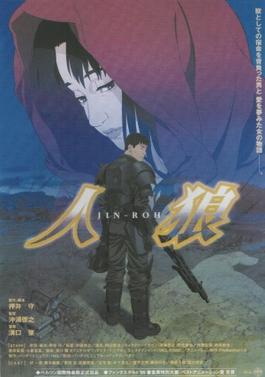
Jin Roh: The Wolf Brigade The Perfect Rainy Day Film

By Darrion Rilley

Source: Medium

Like every young anime fan, you relied on Reddit, Tumblr, or YouTube as your source of information when looking for new anime to watch; in particular, I was a fan of the ultraviolent Wicked City-type films. No one in my sphere of influence watched anime like that, but as a person who was raised young on 80s ultraviolent action flicks and cheesy slasher flicks. Most anime I watched did not scratch that itch I had. One day, while browsing YouTube, I saw a recommendation from my favorite anime reviewer. He just made a review on a little film named Jin Roh: The Wolf Brigade, a hidden late 90s gem that almost nobody talked about.

Jin Roh: The Wolf Brigade was released in Japan on June 3rd, 2000, and did not hit America until it was licensed by Bandai Entertainment and Viz Media for an English release, hitting theaters on May 25th, 2001. The Film chronologically is the third film in Mamoru Oshiis Kerberos Saga beginning in 1987. The Kerberos Saga ranges through various installments, such as live-action films, radio dramas, an original manga run, and a feature-animated film.

When I first experienced the film for myself, I was upset that something this beautiful felt hidden and almost forgotten by mainstream anime fans nowadays. However, my opinion changed when I showed my friends the film; rewatching it with new viewers fresh for the experience made me realize why Jin Roh is such an underrated gem in the first place.

Based on Mamoru Oshii’s original manga Kerberos Panzer Cop. Jin Roh takes place in an alternate timeline. Set in an alternate 1950s Japan, where after World War 2, Germany won the war, occupied Japan, and eventually denazified, leaving the country in economic and political ruin. The film follows Kazuki Fuse. A member of the Capital Police menacing paramilitary unit nicknamed Kerberos equipped with MG-42 machine guns and specialized nightmare-inducing Protect Gear that looks straight from a sci-fi movie.

We follow Fuse as he is embroiled in a web of political intrigue and personal turbulence after failing to stop a member of the terrorist group known as The Sect from detonating satchel charges that cause a blackout. The incident damages Kerberos’ reputation. Fuse, deeply haunted by guilt, is reprimanded for failing to stop the bomber and sent back to basic training for re-evaluation. Fuse, still remorseful, visits the courier’s grave, meets Kei Amemiya, a woman who claims to be the courier’s older sister, and develops a friendship. However, Kei is eventually revealed not to be the suicide bomber’s sister but a former member of the Sect who is being used as a pawn by the Capital Police to discredit Kerberos and disband the unit once and for all.

Jin Roh is unlike other anime like Akira or Ghost in the Shell, but it is as influential as the two. However, the film does not bombard the senses with a visual feast for the viewer. Even though many animators, including the director, worked on anime such as Paranoia Agent, Evangelion, Patlabor 2, and so on, the real magic comes in its sound design and soundtrack.

It is something you’ll quickly come to appreciate. The film’s attention to realism and subtlety in its sound design helps create a realistic environment; it’s purposeful and not distracting. Things sound squishy when they should; Fuze reassembling his MG-42 sounds real and so damn crisp to the ear; even the sound of a Molotov hitting the ground shows the care and level of detail that went into making every sound heard realistic.

I’m not discrediting the visuals because what you see visually is also curated and adds to the experience. Characters are distinct, and the world is visually stunning; on my second viewing, I realized I never noticed most of the weapons, uniforms, and vehicles seen are German or German-influenced. The Mauser C96 is the Kerberos standard sidearm. Capitol Police are seen carrying MP40s, and when Fuse is sent back to basic for training, we see members of the unit training with Sturmgewehr 44 rifles. It is what makes this film so distinct. There’s noticeable love and attention to detail carefully considered when developing the movie. I never understood why it was so underrated until I rewatched it with my friends. Watching the emotional roller coaster, my friends went on made me realize something. Jin Roh is meant to be a rainy-day film.

It should be a hidden gem. It’s a cozy watch, especially with the soundtrack composed by Hajime Mizoguchi in collaboration with Yoko Kanno. Even though the soundtrack is used sparsely compared to other films, it hits. There’s not a punch pulled when it comes to composing the soundtrack. It is orgasmic. It is why even though the film may not be as acclaimed as Akira, it’s memorable. And that’s what the legacy of this movie is supposed to be. Jin Roh is a memorable viewing experience.

While scenes can feel like they drag, they serve a purpose. The movie doesn’t care about your expectations as a viewer; hell, within the opening scene and throughout the film, it makes it a matter of fact. Surprisingly going as far as spoiling how the film will end with visual clues and off-screen exposition. It’s something sprinkled throughout with imagery of wolves or that Fuse figuratively and almost literally being a wolf.

The scene in the sewers with the wolf brigade still gives me chills. It is revealed the wolf brigade has been fully aware of the Public Security plan and used it as an opportunity to flush out those trying to eliminate the unit. Fuse himself is a deep-cover operative. Well aware of what’s going on. A wolf in sheep’s clothing. It is even more heartbreaking in the end. Just like the tale of Little Red Riding Hood, the wolf devoured Little Red Riding Hood. Fuse, distraught, realizes he has no other choice and kills Kei, cleaning up all loose ends.

Jin Roh on the surface, may be boring to some, or the use of the wolf and little red riding hood may be pretentious to others. Except, it is safe to say that is purely personal bias. Jin Roh is a stunning film. I encourage any anime fan who has not graced their screens with the movie, should. It should be watched and celebrated with other great pieces of animation. As the sea of new anime rises. Gems like Jin Roh are bound to be forgotten or passed over. The next time you are looking for a visually stunning; masterfully made; and well-curated film, watch Jin Roh: The Wolf Brigade. You won’t regret it.

Watch Jin Roh on tubi here: https://tubitv.com/movies/460471/jin-roh-dubbed

Saturday Matinee: Belladonna of Sadness

Reconsidering Belladonna of Sadness: Still powerful after almost 50 years

By Carmen Antreasian

Source: Anime Feminist

A cult film originally released in 1973, Belladonna of Sadness can be read as a second-wave feminist work. However, in order to understand the film as feminist, it is important to emphasize that the film’s plot is based on Jules Michelet’s La Sorcière (translated as Satanism and Witchcraft or The Witch of the Middle Ages in English), originally published in 1862. In his book Michelet discusses his conception of the Witch’s way of life and the persecution the Witch faced by feudal Christian societies in the Middle Ages. Michelet defends the Witch in his book as a champion of love and healing and defends witchcraft as a prelude to science: “…we shall mark the beginning of the professional man as juggler, astrologer, or prophet, necromancer, priest, physician. But at first the woman is everything”. Belladonna of Sadness follows Michelet’s same view, combining this 19th century vision of the liberated witch with second-wave feminist ideology to create a flawed but fascinating work that invites revisiting even all these years later. 

To those unfamiliar with the film, Belladonna of Sadness is the story of Jeanne and the persecution she faces as a woman in a feudal society. The story begins when newlywed Jeanne is gang-raped by the local baron and his attendants under the justification of “prima nocta”. When her husband falls ill, Jeanne becomes desperate and a clitoral/phallic demon appears to her and gives Jeanne wealth and influence as the village money-lender. She holds this role and this power until she is stripped of it–literally–and chased out of town. She ultimately “sells her soul to the devil”, which is the grown version of the initial phallic creature, and becomes a witch who lives apart from the village. Plague breaks out in the feudal society, and the villagers eventually join Jeanne, who builds a society that celebrates herbal medication and sexuality. Having lost power over the villagers, the baron offers her power as a means to control her knowledge; when she refuses to tell him, she is burnt at the stake.

This is a film written and directed by men (Yamamoto Eiichi and Fukuda Yoshiyuki) and is considered a Japanese “pink film”’ as it is includes graphic depictions of sex and nudityBelladonna of Sadness uses its “pink film” attributes in order to demonstrate the plight of the main character Jeanne as an example of Michelet’s Witch. Jeanne’s sexuality is the focal point of her journey and the catalyst for the social changes that occur throughout the story.

Created during the Japanese feminist movement of the early 1970sBelladonna of Sadness is a second-wave feminist film, and it’s impossible to talk about Japan’s women’s liberation without discussing the ideas of Tanaka Mitsu, arguably its most prominent leader. Tanaka fought against the popular notion of the woman as either a housewife or an object for male sexual pleasure. Instead, she advocated for the woman to be seen as an individual with agency over her own sexuality and shared her own life experiences with sexual assault, including rape and harassment, to inspire other women to support women’s liberation, a.k.a. uuman libu

This seems to pair nicely with Jeanne: she’s initially (and presumably) destined to fulfill a wifely role in marrying her lover Jean but instead is forced into the role of sex object when brutally raped by the baron and his cronies, and gains agency as an individual through the awakening of her own sexuality. After this awakening she does not fall into the housewife/male-sex-object binary but gains power and instead assumes a leadership role in the village. However, the phallic nature of Jeanne’s sexual awakening complicates this viewpoint. To explore this, it’s crucial to look at Jeanne’s initial encounter with the little creature who awakens her sexuality before “it” becomes “him”– the devil/phallus character.

When she first meets the devil/phallus character, Jeanne is in a desperate position. Not only is she emotionally scarred from being raped, but she lives in poverty with her ill husband who, despite telling her they would move on from her assault, later attempted to strangle her. One night while her husband is asleep, a small clitoral-esque creature appears.   

The clitoral creature states that it is her. It does not deny being “the devil”, but it is born of her desire. Her sexual awakening has begun. The clitoral creature then tickles her all over her body, making her laugh, and she questions how this small thing could give her power. Then it “teaches” her how to make it grow by rubbing itself in her hand, which turns “it” into a phallic creature that gives her sexual pleasure as she lays next to her sleeping husband. This is Jeanne’s first experience with masturbation, initiated by a clitoral-to-phallic creature, a personification of her individual sexuality—“I am you”—and summoned by her “screaming soul”. The agency of the “soul” is another important aspect of 1970s Japanese feminism, as Tanaka stated, “I want to have a stronger soul with which I can burn myself out either in heartlessness or in tenderness. Yes, I want a stronger soul.” Tanaka’s soul calls out for strength as Jeanne’s does for power, both qualities that were specifically reserved for men.

Jeanne’s individual sexual agency is exactly the kind of liberation Japanese feminists of the early 1970s envisioned, and in the film, it sets in motion Jeanne’s success within  feudal society. Her sexual awakening was triggered not by the horrific rape she experienced beforehand but by her own, albeit guided, exploration of sexual pleasure without another person. However, it must be noted that this devil creature is gendered with a distinct male voice and phallic appearance.To discuss this, it’s helpful to bring in another element of the 1970s: the psychoanalytic female subject. This idea comes from Jacques Lacan’s theory of sexuation, conceived in 1972-1973. While Belladonna was in production as this theory was being published, it’s a useful way to boil down 1970s psychoanalysis to one analytical lens for the purpose of this essay.

Why use psychoanalysis and, of all psychoanalytic theorists, why Lacan, a man who once said that his brand of psychoanalysis wasn’t applicable to the Japanese? Both psychoanalysis and second-wave feminism were popular ways of thinking in the early 1970s that sometimes overlapped and often-times butted heads. Jeanne may be a feminist character, but she is also one created by men. Jeanne may be a character in a Japanese film, but she is also one based on a French man’s story of a witch in the European Middle Ages within a European social structure. And while Lacan might be thoroughly outdated in real life, his influential work still makes for a compelling tool of literary analysis. 

Sexuation, to be dangerously brief, is Lacan’s theory of how a subject becomes a desiring subject through his/her sexuality. This theory relies on a binary, and there are different roles for male and female subjects. The female subject in sexuation fits one of three roles, two of which are to cater to the male subject and one that seeks what the male subject seeks: the “phallus”, otherwise known as power. Jeanne is the latter of the three. The phallus manifests when her sexuality is awakened; the phallus gives her power; when she is destitute and chased from the village, she seeks the phallus; again, the phallus gives her power. Jeanne fits the mold almost too perfectly… but does she?

If Jeanne were to truly fit Lacan’s mold as female-subject-who-seeks-the-phallus/power, then she would not be able to dismantle the patriarchal social structure once she becomes the leader of the village. Why? Because she would then be playing into a patriarchal structure herself, adhering to an identity constructed by men for a woman in power. When she first gains power and wealth in the feudal system, she continues to lead in accordance with it. She still pays and collects taxes—in fact, her husband becomes the tax collector—and she still meets with her superiors in the feudal system. Nothing systemic really changes except that she becomes the leader of the villagers and brings them wealth. 

Jeanne is exposed to the violence and greed of those men for which the system was created once they deem her a threat to their power, and so she is eventually chased out of the village and away from the system completely. This is the moment when she “sells her soul to the devil”. It is a desperate moment, as was the very first time the clitoral-phallic creature appeared to her. This time, though, the creature is entirely phallic, monstrously large and referred to as the devil, but there is one very important detail to remember: “I am you.” 

This phallic character, once a small creature on a spool of thread, is a manifestation of her sexuality. Yes, it is exceedingly heterosexual, and a product of male writers and animators, but Joanne still has agency to engage with the manifestation of sexual desire and independence she herself has cultivated. Albeit clearly depicted as masculine, the devil phallus does not adhere to the feudal social structure but rather an invitation to the possibility of something new, born of embodiment rather than socially constructed. 

Bodily knowledge, although depicted heteronormatively, is what creates Jeanne’s new society. The beautifully animated scene of Jeanne’s sexual experience with the devil is also full of Yonic imagery. When the devil appears to her, he parts the clouds by flying down in a circular motion, revealing a clear sky without a sun. Just before the devil lands, however, he shoots out of a shape in this clear blue sky: vaginally-shaped pink, red and purple oval. This vaginal space appears to stand in for the sun and allows the devil to manifest on the earth. This phallus originates from the vaginal.

Once Jeanne and the devil’s intercourse climaxes, images of modern—okay, 1973-modern—entertainment, technology and everyday life flash before the viewer’s eyes, signifying that she made it happen. This is in accordance with Michelet’s message that it is the woman who was first to create and resonates with 1970s Japanese feminist Raicho Hiratsuka’s sentiment that “in the beginning woman was the sun”, evidence of the importance of the aforementioned Yonic imagery in the film. Jeanne’s embodied sexuality sparks the possibility for all that will be created, even that which is phallic.

Jeanne gets another chance at dismantling the feudal patriarchal social structure when the black death, better known as the Plague, destroys the village. One of the not-dead-yet villagers finds himself near her, and she cures him with what he refers to as “poison,” telling him “poison is medicine.” He goes back to tell the others, who spread rumors that she is a witch but run to join her because of her healing powers, sympathy toward others, and rejection of social hierarchies and sexual norms. On these foundations she builds her own society, one that is inclusive, even to those who have wronged her and come to her for help. She builds a society based on liberation, kindness, and open-mindedness. 

She provides antidotes specifically related to female reproduction such as labor pain medication and birth control, access to which was a large part of the Japanese women’s liberation movement in the 1970s (and remains an issue there as it does abroad). People are free to have sex as often as they wish without worrying about the potential financial burden of having children. People are free to experiment sexually, shown in the orgy scene in Jeanne’s hair. Her new society is not a patriarchal one, but she also did not have to dismantle the previous patriarchal society to create her own. The Plague provides the conditions to build her feminist society separate from the existing feudal structure. Her society is not a rebellion or antithesis of the feudal structure but a revolutionary system of its own making.

Jeanne and her sexuality—from “selling her soul” to the devil/phallus, who is also a part of herself—demonstrate that a feminist society is possible, though its conception of what that might encompass is limited due in part to the restrictions of Michelet’s source material. The sexual symbolism in the villager’s activities are heterosexually binary, and the villagers all form man/woman pairs when they first engage with Jeanne’s society. The bodies of the villagers continue to be drawn as either clearly heteronormatively male or female as well.

The major exception is the non-heteronormative sexuality depicted in Jeanne’s alternative society during the long orgy scene in Jeanne’s hair, where the villagers are all connected in sexual positions and occasionally break out to showcase various other non-hetero sexual scenarios.There are moments of bisexuality seen in the orgy and one flash of two men together, but anytime a person strays from being either cis male or female, they are merged with an animal and meant to be comical. This lack of tender, intimate queerness even under liberation becomes the biggest failing of the film’s vision.

Ultimately, however, Jeanne and the villagers are forced to go back to feudal society. Jeanne’s husband comes to her, telling her she will be forgiven by the lord if she returns. She isn’t fooled by the lord’s blatant lie, but she knows that if she doesn’t go back, the lord will send troops to capture and kill her. She is in a lose-lose situation. The patriarchal structure proves its all-powerful authority, and that her separatism is impossible without dismantling the oppressive structures she fled. When she goes back, the lord does, in fact, offer her land in exchange for her knowledge.

He not only wants her power—the lord wants to indoctrinate her power into a patriarchal system, taking the feminine healer’s “witchcraft” and rebranding it as “science”. The lord desperately tries to get her to reveal her healing power by offering her more and more power in the feudal system, but Jeanne is not interested in being a part of his patriarchal hierarchy. She’s experienced the possibility of a feminist society and desires revolution over anything she could obtain in the existing structure.

During the film’s final moments, when Jeanne is burned at the stake, the faces of the women villagers watching her begin to change one by one to resemble her face, symbolizing the perpetuation of Jeanne’s influence. These villagers’ faces reflecting Jeanne’s face is a sign of Jeanne’s legacy. It is revolutionary in its admission that it’s possible to envision a society outside of the existing oppressive structure.

Watching the film in 2022 through an intersectional lens informed by evolving feminist and queer theories, Belladonna of Sadness may no longer seem progressive. The “girl power” message its male writers were trying to get across may be lost in its overwhelmingly graphic heterosexuality, and Michelet’s vision of The Witch may not resonate or hold the same power for contemporary viewers. 

The homogeneity of the womens’ faces at the end of the film demonstrate that the “girl power” Jeanne had put in motion is homogenous. It suggests that there is only one type of woman that can grasp and perpetuate Jeanne’s vision. Through a lens of queer and critical race theory, the womens’ faces merely play into existing power structures, as the faces are all the same and, most importantly, all white with feminine traits such as big eyes, dark eyelashes, full pink lips. A truly radical depiction of Jeanne’s society in these face changes to push against patriarchal power structures would include a wide array of faces.

Through hindsight it may not hold up today in some regards, but I firmly believe that it is still revolutionary in that it depicts the possibility of a society based in the power of sexual freedom, healing, and care, rather than one that merely reconfigures existing patriarchal structures. The society Jeanne creates outside the feudal land is radical. Her society is necessarily birthed of the female body; even the phallus cannot come into being without her sexuality. Belladonna of Sadness is a historically important film that deserves to be revisited and reconsidered. It helps us better understand current feminist thought by knowing where we’ve come from and, in analyzing its flaws as well as its more deeply embedded subversions, allows us to push current critical theory even further. 

____________________

Watch Belladonna of Sadness on Kanopy here: https://www.kanopy.com/en/product/584431

Saturday Matinee: Macross: Do You Remember Love?

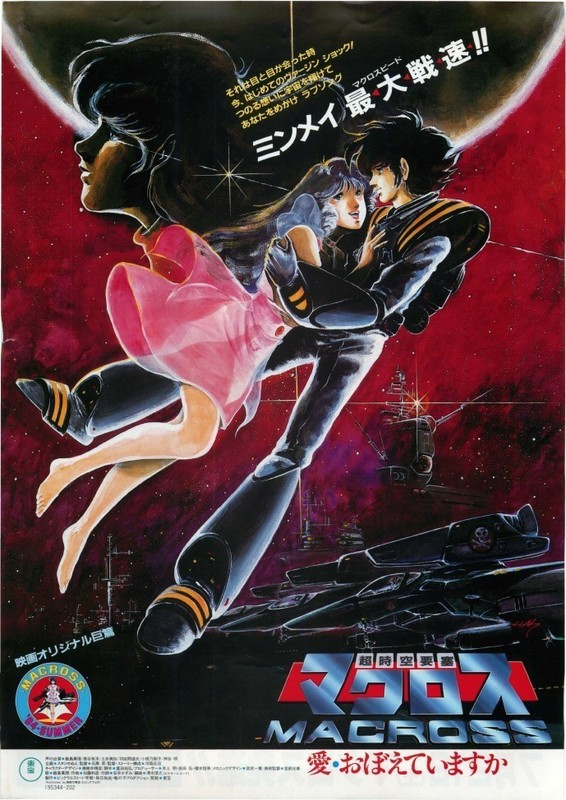
Remembering Macross: Do You Remember Love?

By Victor de la Cruz

Source: 3rd World Geeks

There have been so many anime movies that have come and gone. A lot of them have, deservedly so, have been called classics and must-watch animes. You’ve got your My Neighbor Totoro, Ghost in the Shell, Weathering with You, Your Name and Akira. They are undoubtedly classics in their own right and every anime fan needs to see them. But there always seems to be one anime film that’s left out of the conversation for one reason or another. I’m here to shine a spotlight on that anime that usually gets lost in the shuffle when people list down great anime movies.

That movie is Macross: Do You Remember Love?

But before I do talk about Macross: Do You Remember Love?, I do have to talk about my very complicated relationship with the first Macross franchise. Like most anime fans, the very first contact I had with Macross wasn’t actually called Macross. It was from Robotech. Now, Robotech was this weird mishmash of three animes, namely, Super Dimension Fortress Macross, Super Dimension Cavalry Southern Cross and Genesis Climber MOSPEADA. The original Japanese animes had nothing to do with each other. However, the people over at Harmony Gold had the bright idea to attempt to link these three disparate shows. The writers did a good job with what they were given but this did greatly affect how the later chapters, more specifically the Southern Cross story, was almost totally revamped to retrofit it into the overarching story. Thankfully, as it was the first chapter in Robotech, Macross was hardly touched story-wire. Basically, if all you have is the Robotech version of Macross, you’re still getting pretty much the original story.

I also have to mention that my first experience with Do You Remember Love? isn’t by watching the movie. The first time I did see the movie was the Clash of the Bionoids dub. And, god help me, I loved it! I managed to catch this by pure accident while channel surfing when I was a kid. Seeing they actually pushed out a movie based on Robotech (because I didn’t know any better then) blew my mind and maybe that was a part of why I loved it so much. It would be an easy excuse to say I was young and foolish to like something as bad as the dubbing done in Clash of the Bionoids. But there’s just something so earnest in the performances! Oh, I also didn’t know they cut out a lot of stuff from the original film but, hey, I didn’t know there was an unedited version back then! Of course, now that I’ve seen the original cut, it’s hard to go back to Clash of the Bionoids unless it’s to kind of laugh at some of the dialogue.

Anyway, back to Do You Remember Love? and why I believe it deserves to be called a classic. For one thing, just look at it! Despite it being released way back in 1984, a good 35 years ago now, Do You Remember Love? still looks incredible. I can’t deny they touched up the film to bring everything into high resolution. But even so, you gotta admire the amount of detail the animators put into each frame of animation here! The number of little things, like lights flashing on the screen, the wires that stick out of a console, how the shadows lay on objects realistically, the tiny details of the Valkyrie stabilization thrusters looks outstanding.

The animation of how the Valkyrie also transform from mode to mode so seamlessly is also incredible. Of course, you also have to love those spiraling missiles the Valkyrie fire at the enemy Zentradi and how well animated those things are. Considering this was way before computer animation was a thing, that means you had a bunch of animators drawing up each and every frame of those missiles careening at wild directions while making it look real. They did a fantastic job on Do You Remember Love?

I also have to commend the writers of managing to streamline the entire 36 episode arc into something that would fit into roughly a couple of hours. Well, it’s not exactly streamlining as Do You Remember Love? alters the story quite a bit. But the changes they did do make sense. The movie actually starts right in the middle of the Macross’ journey back to Earth and ends after the defeat of the Zentradi leader Boddole Zer. This does leave out a good chunk of story but it also cuts out the more boring parts. We get to see the Macross transform without having the long, complicated episode explaining how they figured out to do so. We don’t have the Macross return to Earth only to be exiled to deep space. We also don’t get the aftermath of the Macross War and see the Zentradi have difficulty integrating in human society. These may be part of the entire drama of Macross. But, by cutting out these more slower parts, Do You Remember Love? gets into the meatier part of the entire story, which does makes things more satisfying.

Of course, no talk about Do You Remember Love? can be made without talking about the phenomenal final act of the film. The big battle where the loose forces of the Zentradi, Meltradi and remaining humans join forces to attack Boddole Zer while Lynn Minmay sings the titular song. There’s just something to the entire buildup to the song and the beautiful simplicity of the lyrics that makes it come off as more awesome than it should be. Of course, it certainly doesn’t hurt that Mari Iijima, who does both the normal and singing voices of Lynn Minmay, sounds really ethereal with her performance of the song. There’s also a kind of beautiful message in the scene where a simple love song can touch even the hardest of hearts to make them do the right thing.

I’m not saying Do You Remember Love? is a flawless anime film. I actually have to say I have some problems with it. The melodrama can be irritating at times as the characters would suddenly start behaving like they’re in the middle of a cheap soap opera. Lynn Minmay can definitely be grating at times because of how bratty she comes off in certain scenes. And while I did give high praise to the writers for focusing on the more important elements of the series, there are a couple of times when things just seem to happen in order to move the story forward.

However, these shortcomings should not really detract from how great Do You Remember Love? actually is. There’s just an overall epic feel to the story and the animation, despite its age, seems to have richer details than the anime movies we get today. But it’s that really memorable final act that really clinches it for me. The song, while nothing great in itself, feels much more epic in scale because of everything that accompanies it. Honestly, I would’ve watched it for those final ten minutes and still feel satisfied with how well done everything is.

I honestly think Macross: Do You Remember Love? deserves a little love as it seems to have been lost in the shuffle of all of the other anime films out there. If you’re interested in watching it, you’re in luck! The entire movie is available on YouTube on the Macross channel. It’s not in super hi-def but the high quality animation will make you forget it isn’t.

Give it a watch if you can spare a couple of hours. You can thank me later.

Have you seen Macross: Do You Remember Love? What did you think of it? What other classic anime films do you think deserves a little more attention? Let me know in the comments section below!

Saturday Matinee: Night is Short, Walk on Girl

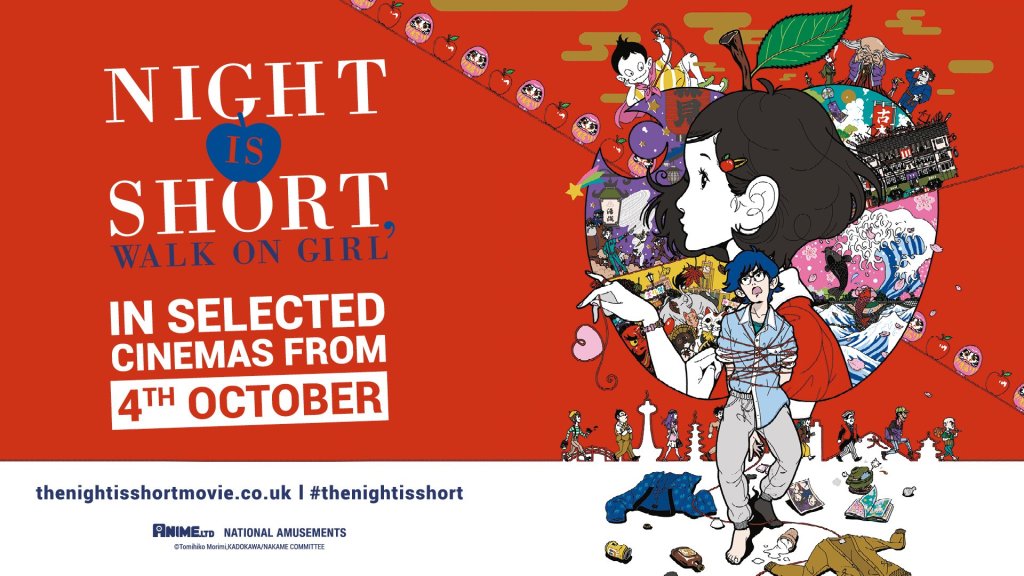
“Night is Short, Walk on Girl” (2017) is a surreal romantic comedy anime directed by Masaaki Yuasa and based on the 2006 novel of the same name by Tomihiko Morimi. The plot follows the intertwined adventures of a college senior pursuing a fellow student he’s infatuated by over the course of a wild night and the various characters they help and and are assisted by in the process. Stylistically and philosophically, it’s a cross between Yuasa’s 2004 masterpiece Mind Game and Jean-Pierre Jeunet’s Amélie (2001). This anime is also notable for being oddly prophetic with its out of left field subplot in the third act involving a flu-like epidemic originating from a selfish and cynical old oligarch.

Watch the film on Hoopla here: https://www.hoopladigital.com/title/14253206

Saturday Matinee: Genius Party double feature

Synopsis from Shout Factory:

“Simply mind-blowing. A must see!” – Niels Matthijs, Screen Anarchy

From groundbreaking animation outfit STUDIO 4°C (MFKZ, Mind Game) comes two extraordinary projects with a shared, simple vision: to take an all-star team of some of the best animators working in anime today, and give each free reign to tell a unique short story built around “the spirit of creativity.” The results are GENIUS PARTY and GENIUS PARTY BEYOND, two animated anthology films featuring contributions from directors Shoji Kawamori, Shinichiro Watanabe, Masaaki Yuasa, Mahiro Maeda, and many others. Full of boundless imagination, fantastic worlds, and unique visual styles, these two acclaimed films are now available for the first time in North America.

Watch both films through Kanopy here:

https://www.kanopy.com/product/genius-party

https://www.kanopy.com/product/genius-party-beyond


Saturday Matinee: Ghost in the Shell

“Ghost in the Shell” (1995) is a cyberpunk anime directed by Mamoru Oshii and based on the manga of the same name by Masamune Shirow. Set in 2029 Japan, the plot centers on Motoko Kusanagi, a cyborg public-security agent hunting a mysterious hacker known as the Puppet Master who has manipulated the minds of cyborg-human hybrids. With her partner Batou she corners the hacker, but questions about her own identity sends her quest in an unforeseen direction.

Saturday Matinee: Millenium Actress

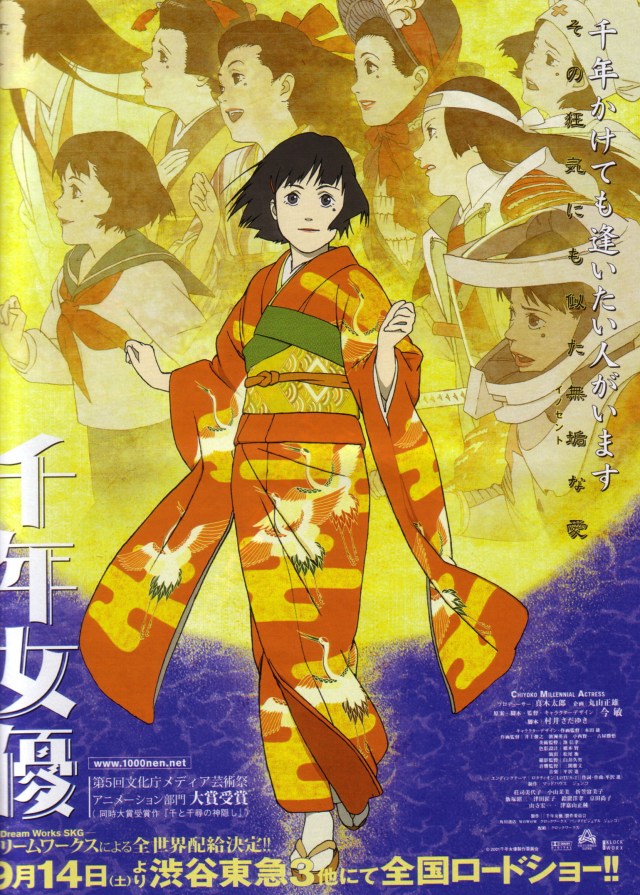
An enchanting Japanese animated film about a woman whose life is propelled by the yearning of her heart for a mysterious stranger.

Review by Frederic and Mary Ann Brussat

Source: Spirituality & Practice

In the opening scene of this exquisite Japanese animated film directed by Satoshi Kon [10/12/63 – 8/24/10], Genya Tachibana, a documentary filmmaker, and his cameraman are climbing a hill to the retreat of Chiyoko Fujiwara, a popular actress who mysteriously abandoned her career 30 years ago. The meeting with her has great significance for Genya since he has secretly been in love with her all these years and can’t wait to present the famous 70-year-old with an old key that was once her fondest possession. When she holds it in her hand, the memories of her past begin to unspool in a narrative that intermixes the movies she was in and the real events of her personal life. As an added treat that often provides some funny and delightful moments, Genya and his cameraman find themselves magically transported into the story as befuddled participants in Chiyoko’s movies and daily life.

The actress was born in 1923 when a gigantic earthquake hit Tokyo. She becomes an actress as a little girl despite the pleas of her mother that she is too timid. Oddly enough the most poignant moment in her early life is not her first major role but a brief encounter with an artist who is being pursued by government authorities for some unknown actions against the state. Chiyoko puts herself in jeopardy by taking this handsome and wounded stranger to their storage shed. In gratitude for her assistance, he presents her with a key. After he leaves, this remains a talisman of her love for him, and she recalls again and again his words that the key is the most important thing there is.

In each of her movies, Chiyoko moves through a different period of Japanese history from the fifteenth century to the space age playing a princess, a ninja, a geisha, and even an astronaut. Over the years, the actress still yearns for connection with the mysterious stranger. It is the force that carries her through her career and supercedes anything that she does on the screen. Of course, this intensity of feeling draws out the ire of a competing older actress and a man with a scar who is pursuing the artist. In this retelling of her life, the documentary filmmaker is always rescuing her in moments of distress. He did work on several films with her as a young man when he was breaking into the business, but she never knew of his ardor until they meet for the interview.

Spiritual writer Joan Chittister has written, “Longing is a compass that guides us through life. We may never get what we really want, that’s true, but every step along the way will be determined by it.” In this Japanese animated film, Chiyiko’s longing is represented by her always running to find the mysterious artist. Those who are propelled through their lives by a deep yearning of the heart are lucky individuals: some might even call them enchanted. Millennium Actress is an enchanting movie that will appeal to those who are looking for something special at the multiplex.

Watch the full film here: https://fantasyanime.com/anime/millennium-actress-sub

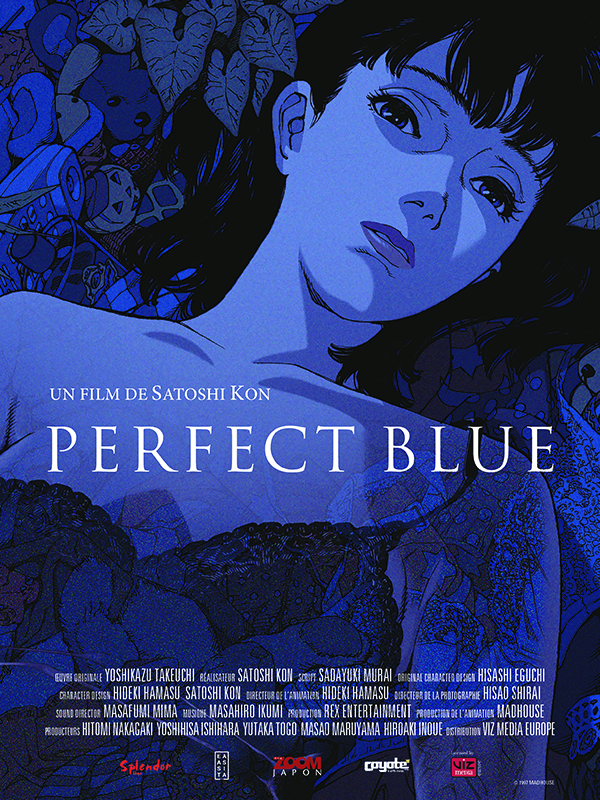
Saturday Matinee: Perfect Blue

“Perfect Blue” (1997) is a psychological thriller anime directed by Satoshi Kon, written by Sadayuki Murai, and based on the novel “Perfect Blue: Complete Metamorphosis” by Yoshikazu Takeuchi. The film follows Mima Kirigoe, a member of a Japanese idol group, who retires from music to pursue an acting career. As she becomes a victim of stalking, gruesome murders begin to occur, and she starts to lose her grip on reality. Like Kon’s later work, Paprika, the film deals with the blurring of the lines between fantasy and reality in contemporary culture.

Watch the film on Hoopla here: https://www.hoopladigital.com/title/12319819