
By Sheldon Richmond
Source: The Future of Freedom Foundation
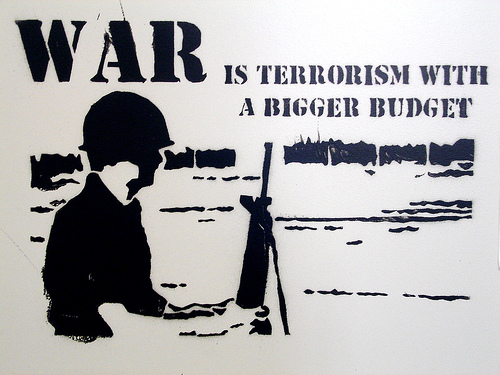
If you find no other argument against American intervention abroad persuasive, how about this one? When the U.S. government invades and occupies other countries, or when it underwrites other governments’ invasions or oppression, the people in the victimized societies become angry enough to want and even to exact revenge — against Americans.
Is the American empire worth that price?
We should ask ourselves this question in the wake of the weekend news that al-Shabaab, the militant Islamist organization that rules parts of Somalia ISIS-style, appeared to encourage attacks at American (and Canadian) shopping malls.
Maybe the Shabaab video was just a prank to scare us. Maybe it was an attempt to plant violent thoughts in the minds of Somalis living in the United States. No one believes that the organization itself is capable of attacking Americans where they live, but that doesn’t mean Shabaab-inspired violence is impossible.
At any rate, it’s unsettling to be advised to watch out for terrorism when we shop at the mall.
Here’s the thing: We don’t have to live this way. The empire is just not worth it. We must understand that people in the Middle East, Africa, and Central Asia who subscribe to fringe militant interpretations of Islam would not be wishing us harm except for the violence the U.S. government has inflicted or helped to inflict on Muslim societies for many decades. In fact, those militant interpretations wouldn’t be nearly so attractive without the American empire and its ally Israel.
Why won’t the media describe this context? It’s because their job, despite what they say, is to be the government’s megaphone, not its adversary.
Let’s look at Somalia, where the latest threat originated.
U.S. intervention goes back to 1992, when President George H.W. Bush sent the military into a civil war there. Among the military’s activities was the suppression of the Somalis’ use of the intoxicant khat, which has been part of their culture for millennia.
That’s right. The U.S. government imposed a war on the Somali drug of choice.
President Bill Clinton withdrew the forces after two Blackhawk helicopters were shot down, but that was not the end of U.S. intervention. After the September 11 attacks, Somali warlords seeking American largess played on the George W. Bush administration’s concerns about al-Qaeda. The CIA obliged the warlords with suitcases of cash. As a result, everyday life became intolerably violent. So when the Islamic Courts Union (ICU) — a relatively moderate coalition of Sharia courts in the capital, Mogadishu —drove out the warlords and produced a measure of peace and stability, the Somali people were relieved.
That should have been deemed satisfactory, except that the warlords and their American backers were unhappy with the new situation, as Jeremy Scahill reported in 2011. “Most of the entities that made up the Islamic Courts Union did not have anything resembling a global jihadist agenda,” Scahill wrote. “Nor did they take their orders from Al Qaeda.”
Nevertheless, the U.S. government was determined to oust the ICU. To achieve that goal the Bush administration in 2006 backed a military invasion by Ethiopia, Somalia’s long-time Christian adversary, which overthrew the ICU.
“The Ethiopian invasion was marked by indiscriminate brutality against Somali civilians,” Scahill wrote.
Ethiopian and Somali government soldiers secured Mogadishu’s neighborhoods by force, raiding houses in search of ICU combatants, looting civilian property and beating or shooting anyone suspected of collaboration with antigovernment forces.… If Somalia was already a playground for Islamic militants, the Ethiopian invasion blew open the gates of Mogadishu for Al Qaeda. Within some US counterterrorism circles, the rise of the Shabab in Somalia was predictable and preventable.
To make things worse, the U.S. government has waged a drone war, with civilian casualties, and special operations against the Somalis. According to Scahill, the CIA also operates a secret prison and other facilities there.
So the U.S.-sponsored intervention sowed the ground for the most militant group in Somalia, al-Shabaab. Had the ICU been left to govern, we might never have heard of these young Islamists, whom the Obama administration now uses to scare American shoppers.
We can live without the fear of terrorism — but only if the U.S. government stops antagonizing foreign populations that have never threatened us.
Sheldon Richman is vice president of The Future of Freedom Foundation and editor of FFF’s monthly journal, Future of Freedom. For 15 years he was editor of The Freeman, published by the Foundation for Economic Education in Irvington, New York. He is the author of FFF’s award-winning book Separating School & State: How to Liberate America’s Families; Your Money or Your Life: Why We Must Abolish the Income Tax; and Tethered Citizens: Time to Repeal the Welfare State. Calling for the abolition, not the reform, of public schooling. Separating School & State has become a landmark book in both libertarian and educational circles. In his column in the Financial Times, Michael Prowse wrote: “I recommend a subversive tract, Separating School & State by Sheldon Richman of the Cato Institute, a Washington think tank… . I also think that Mr. Richman is right to fear that state education undermines personal responsibility…” Sheldon’s articles on economic policy, education, civil liberties, American history, foreign policy, and the Middle East have appeared in the Washington Post, Wall Street Journal, American Scholar, Chicago Tribune, USA Today, Washington Times, The American Conservative, Insight, Cato Policy Report, Journal of Economic Development, The Freeman, The World & I, Reason, Washington Report on Middle East Affairs, Middle East Policy, Liberty magazine, and other publications. He is a contributor to the The Concise Encyclopedia of Economics. A former newspaper reporter and senior editor at the Cato Institute and the Institute for Humane Studies, Sheldon is a graduate of Temple University in Philadelphia. He blogs at Free Association. Send him e-mail.
 After the Crash