
By Robert Daniels
Source: RogerEbert.com
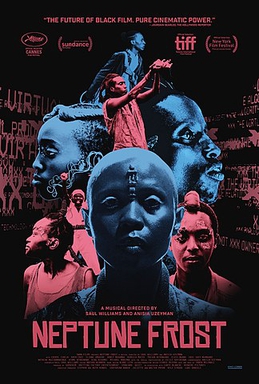
“Neptune Frost,” the dense Afrofuturist film from co-directors Saul Williams and Anisia Uzeyman, holds many resplendent identities at once: It’s a musical; it’s an intersex narrative; it’s a technological allegory espousing anticapitalist and anticolonialist views. It’s a collective dream coated in a blue lacquer dancing on the edge of something unrecognizable, something wholly transcendent. And it arrives with an exceptional display of bravura.
The film’s nimbleness, marked by a brazenness suggesting creators who allow their imaginations to be the moth that reaches for the stars, is apparent from the jump when the camera pans across the graveled gray and orange ridges of a mine. One of the miners, Tekno, beholds a chunk of coltan, the metal used to power our cellphones and other high-tech electronics, only to be summarily struck to death by the butt of a soldier’s gun. His grief-stricken brother Matalusa (Bertrand Ninteretse) cradles him as the other workers, accompanied by drums, with shovels hitting the ground for additional percussion, dance in mourning. This incident causes Matalusa to flee the mine, and a waking dream guides him to another dimension.
A similar, parallel vision, following the death of their aunt and a traumatic experience involving a pastor, pulls Neptune (Elvis “Bobo” Ngabo) away from their Rwandan village through the backroads of a country in upheaval. “I was born in my 23rd year,” explains Neptune in the film’s opening narration. And it’s not until Neptune transforms (this time played by Cheryl Isheja) that we figure out what exactly this ambiguous, yet potent line means.
Neptune is an intersex hacker exploring and disrupting binaries. They arrive in that other dimension, a village fed by a mysterious power source, to find Matalusa. There they discover a band of rebellious Black folks, such as Memory (Eliane Umuhire), Psychology (Trésor Niyongabo), and so forth who want to transform the world away from domineering colonialist powers, away from a totalitarian government known as the Authority, and out from one age into another. “Neptune Frost” demands your attention. Uzeyman’s luminous cinematography caresses black skin under blue and purple lights, allowing this talented group of actors to play to every corner of their innate beauty. The ingenious costumes by Cedric Mizero—a collection of wires, knobs, and hard drives—range from motherboard chic to a lightweight yet richly colored fabric that is elegant. The musical numbers, fusions of singer-songwriter Williams’ Afropunk style with atmospheric drones owing to Sun Ra, spring from the group so organically you immediately become fluent in their dynamic rhythms, moods, and tones.
While the artistry does dazzle, you never forget that “Neptune Frost” is a movie dedicated to the cause of liberation: a liberation of stolen resources and Black folks, and a freedom of the body. I found myself enraptured by the scenes of community building, of Africans bound together by a love for each other and a hope for the future moving toward revolutionary ends. The scenes of dance and happiness in this dimension, hidden away from white eyes (for the time being) is soul filling. In this ecstasy, in spite of an outside war-torn world, Neptune and Matalusa commit not just to the cause but to their shared spirit. Their bliss is idyllic, and therefore short lived. But it’s their willingness to challenge the Authority, through their romance and the acting of hacking, that serves as a battle cry against governments unwilling to serve their people.
While the logic guiding “Neptune Frost” is difficult to follow, this isn’t the kind of work you can sleepwalk through. It pushes the viewer. There are no wasted plot points, no unnecessary pieces of dialogue or needless landscapes. Every texture contains a million little stories. It is humbling to see two filmmakers so curious, and so creatively playful as to invite messiness and brilliance. In all its so muchness, “Neptune Frost” is a reminder of cinema’s infinite storytelling possibilities.
Watch Neptune Frost on Kanopy here: https://www.kanopy.com/en/product/neptune-frost

 After the Crash