Washington’s Military Addiction

bloody_us_flag_sized__large

And The Ruins Still to Come

By Tom Engelhardt

Source: TomDispatch.com

There are the news stories that genuinely surprise you, and then there are the ones that you could write in your sleep before they happen. Let me concoct an example for you:

“Top American and European military leaders are weighing options to step up the fight against the Islamic State in the Mideast, including possibly sending more U.S. forces into Iraq, Syria, and Libya, just as Washington confirmed the second American combat casualty in Iraq in as many months.”

Oh wait, that was actually the lead sentence in a May 3rd Washington Times piece by Carlo Muñoz.  Honestly, though, it could have been written anytime in the last few months by just about anyone paying any attention whatsoever, and it surely will prove reusable in the months to come (with casualty figures altered, of course).  The sad truth is that across the Greater Middle East and expanding parts of Africa, a similar set of lines could be written ahead of time about the use of Special Operations forces, drones, advisers, whatever, as could the sorry results of making such moves in [add the name of your country of choice here].

Put another way, in a Washington that seems incapable of doing anything but worshiping at the temple of the U.S. military, global policymaking has become a remarkably mindless military-first process of repetition.  It’s as if, as problems built up in your life, you looked in the closet marked “solutions” and the only thing you could ever see was one hulking, over-armed soldier, whom you obsessively let loose, causing yet more damage.

How Much, How Many, How Often, and How Destructively 

In Iraq and Syria, it’s been mission creep all the way.  The B-52s barely made it to the battle zone for the first time and were almost instantaneously in the air, attacking Islamic State militants.  U.S. firebases are built ever closer to the front lines.  The number of special ops forces continues to edge up.  American weapons flow in (ending up in god knows whose hands).  American trainers and advisers follow in ever increasing numbers, and those numbers are repeatedly fiddled with to deemphasize how many of them are actually there.  The private contractors begin to arrive in numbers never to be counted.  The local forces being trained or retrained have their usual problems in battle.  American troops and advisers who were never, never going to be “in combat” or “boots on the ground” themselves now have their boots distinctly on the ground in combat situations.  The first American casualties are dribbling in.  Meanwhile, conditions in tottering Iraq and the former nation of Syria grow ever murkier, more chaotic, and less amenable by the week to any solution American officials might care for.

And the response to all this in present-day Washington?

You know perfectly well what the sole imaginable response can be: sending in yet more weapons, boots, air power, special ops types, trainers, advisers, private contractors, drones, and funds to increasingly chaotic conflict zones across significant swaths of the planet.  Above all, there can be no serious thought, discussion, or debate about how such a militarized approach to our world might have contributed to, and continues to contribute to, the very problems it was meant to solve. Not in our nation’s capital, anyway.

The only questions to be argued about are how much, how many, how often, and how destructively.  In other words, the only “antiwar” position imaginable in Washington, where accusations of weakness or wimpishness are a dime a dozen and considered lethal to a political career, is how much less of more we can afford, militarily speaking, or how much more of somewhat less we can settle for when it comes to militarized death and destruction.  Never, of course, is a genuine version of less or a none-at-all option really on that “table” where, it’s said, all policy options are kept.

Think of this as Washington’s military addiction in action.  We’ve been watching it for almost 15 years without drawing any of the obvious conclusions.  And lest you imagine that “addiction” is just a figure of speech, it isn’t.  Washington’s attachment — financial, tactical, and strategic — to the U.S. military and its supposed solutions to more or less all problems in what used to be called “foreign policy” should by now be categorized as addictive.  Otherwise, how can you explain the last decade and a half in which no military action from Afghanistan to Iraq, Yemen to Libya worked out half-well in the long run (or even, often enough, in the short run), and yet the U.S. military remains the option of first, not last, resort in just about any imaginable situation?  All this in a vast region in which failed states are piling up, nations are disintegrating, terror insurgencies are spreading, humongous population upheavals are becoming the norm, and there are refugee flows of a sort not seen since significant parts of the planet were destroyed during World War II.

Either we’re talking addictive behavior or failure is the new success.

Keep in mind, for instance, that the president who came into office swearing he would end a disastrous war and occupation in Iraq is now overseeing a new war in an even wider region that includes Iraq, a country that is no longer quite a country, and Syria, a country that is now officially kaput.  Meanwhile, in the other war he inherited, Barack Obama almost immediately launched a military-backed “surge” of U.S. forces, the only real argument being over whether 40,000 (or even as many as 80,000) new U.S. troops would be sent into Afghanistan or, as the “antiwar” president finally decided, a mere 30,000 (which made him an absolute wimp to his opponents).  That was 2009.  Part of that surge involved an announcement that the withdrawal of American combat forces would begin in 2011.  Seven years later, that withdrawal has once again been halted in favor of what the military has taken to privately calling a “generational approach” — that is, U.S. forces remaining in Afghanistan into at least the 2020s.

The military term “withdrawal” may, however, still be appropriate even if the troops are staying in place.  After all, as with addicts of any sort, the military ones in Washington can’t go cold turkey without experiencing painful symptoms of withdrawal.  In American political culture, these manifest themselves in charges of “weakness” when it comes to “national security” that could prove devastating in the next election.  That’s why those running for office compete with one another in over-the-top descriptions of what they will do to enemies and terrorists (from acts of torture to carpet-bombing) and in even more over-the-top promises of “rebuilding” or “strengthening” what’s already the largest, most expensive military on the planet, a force better funded at present than those of at least the next seven nations combined.

Such promises, the bigger the better, are now a necessity if you happen to be a Republican candidate for president.  The Democrats have a lesser but similar set of options available, which is why even Bernie Sanders only calls for holding the Pentagon budget at its present staggering level or for the most modest of cuts, not for reducing it significantly.  And even when, for instance, the urge to rein in military expenses did sweep Washington as part of an overall urge to cut back government expenses, it only resulted in a half-secret slush fund or “war budget” that kept the goodies flowing in.

These should all be taken as symptoms of Washington’s military addiction and of what happens when the slightest signs of withdrawal set in.  The U.S. military is visibly the drug of choice in the American political arena and, as is only appropriate for the force that has, since 2002, funded, armed, and propped up the planet’s largest supplier of opium, once you’re hooked, there’s no shaking it.

Hawkish Washington

Recently, in the New York Times Magazine, journalist Mark Landler offered a political portrait entitled “How Hillary Clinton Became a Hawk.”  He laid out just how the senator and later secretary of state remade herself as, essentially, a military groupie, fawning over commanders or former commanders ranging from then-General David Petraeus to Fox analyst and retired general Jack Keane; how, that is, she became a figure, even on the present political landscape, notable for her “appetite for military engagement abroad” (and as a consequence, well-defended against Republican charges of “weakness”).

There’s no reason, however, to pin the war-lover or “last true hawk” label on her alone, not in present-day Washington.  After all, just about everyone there wants a piece of the action.  During their primary season debates, for instance, a number of the Republican candidates spoke repeatedly about building up the U.S. Sixth Fleet in the Mediterranean, while making that already growing force sound like a set of decrepit barges.

To offer another example, no presidential candidate these days could afford to reject the White House-run drone assassination program.  To be assassin-in-chief is now considered as much a part of the presidential job description as commander-in-chief, even though the drone program, like so many other militarized foreign policy operations these days, shows little sign of reining in terrorism despite the number of “bad guys” and terror “leaders” it kills (along with significant numbers of civilian bystanders).  To take Bernie Sanders as an example — because he’s as close to an antiwar candidate as you’ll find in the present election season — he recently put something like his stamp of approval on the White House drone assassination project and the “kill list” that goes with it.

Mind you, there is simply no compelling evidence that the usual military solutions have worked or are likely to work in any imaginable sense in the present conflicts across the Greater Middle East and Africa.  They have clearly, in fact, played a major role in the creation of the present disaster, and yet there is no place at all in our political system for genuinely antiwar figures (as there was in the Vietnam era, when a massive antiwar movement created space for such politics).  Antiwar opinions and activities have now been driven to the peripheries of the political system along with a word like, say, “peace,” which you will be hard-pressed to find, even rhetorically, in the language of “wartime” Washington.

The Look of “Victory”

If a history were to be written of how the U.S. military became Washington’s drug of choice, it would undoubtedly have to begin in the Cold War era.  It was, however, in the prolonged moment of triumphalism that followed the Soviet Union’s implosion in 1991 that the military gained its present position of unquestioned dominance.

In those days, people were still speculating about whether the country would reap a “peace dividend” from the end of the Cold War. If there was ever a moment when the diversion of money from the U.S. military and the national security state to domestic concerns might have seemed like a no-brainer, that was it.  After all, except for a couple of rickety “rogue states” like North Korea or Saddam Hussein’s Iraq, where exactly were this country’s enemies to be found?  And why should such a muscle-bound military continue to gobble up tax dollars at such a staggering rate in a reasonably peaceable world?

In the decade or so that followed, however, Washington’s dreams turned out to run in a very different direction — toward a “war dividend” at a moment when the U.S. had, by more or less universal agreement, become the planet’s “sole superpower.”  The crew who entered the White House with George W. Bush in a deeply contested election in 2000 had already been mainlining the military drug for years.  To them, this seemed a planet ripe for the taking.  When 9/11 hit, it loosed their dreams of conquest and control, and their faith in a military that they believed to be unstoppable.  Of course, given the previous century of successful anti-imperial and national independence movements, anyone should have known that, no matter the armaments at hand, resistance was an inescapable reality on Planet Earth.

Thanks to such predictable resistance, the drug-induced imperial dreamscape of the Busheviks would prove a fantasy of the first order, even if, in that post-9/11 moment, it passed for bedrock (neo)realism.  If you remember, the U.S. was to “take the gloves off” and release a military machine so beyond compare that nothing would be capable of standing in its path.  So the dream went, so the drug spoke.  Don’t forget that the greatest military blunder (and crime) of this century, the invasion of Iraq, wasn’t supposed to be the end of something, but merely its beginning.  With Iraq in hand and garrisoned, Washington was to take down Iran and sweep up what Russian property from the Cold War era still remained in the Middle East.  (Think: Syria.)

A decade and a half later, those dreams have been shattered, and yet the drug still courses through the bloodstream, the military bands play on, and the march to… well, who knows where… continues.  In a way, of course, we do know where (to the extent that we humans, with our limited sense of the future, can know anything).  In a way, we’ve already been shown a spectacle of what “victory” might look like once the Greater Middle East is finally “liberated” from the Islamic State.

The descriptions of one widely hailed victory over that brutal crew in Iraq — the liberation of the city of Ramadi by a U.S.-trained elite Iraqi counterterrorism force backed by artillery and American air power — are devastating.  Aided and abetted by Islamic State militants igniting or demolishing whole neighborhoods of that city, the look of Ramadi retaken should give us a grim sense of where the region is heading. Here’s how the Associated Press recently described the scene, four months after the city fell:

“This is what victory looks like…: in the once thriving Haji Ziad Square, not a single structure still stands. Turning in every direction yields a picture of devastation. A building that housed a pool hall and ice cream shops — reduced to rubble. A row of money changers and motorcycle repair garages — obliterated, a giant bomb crater in its place. The square’s Haji Ziad Restaurant, beloved for years by Ramadi residents for its grilled meats — flattened. The restaurant was so popular its owner built a larger, fancier branch across the street three years ago. That, too, is now a pile of concrete and twisted iron rods.

“The destruction extends to nearly every part of Ramadi, once home to 1 million people and now virtually empty.”

Keep in mind that, with oil prices still deeply depressed, Iraq essentially has no money to rebuild Ramadi or anyplace else. Now imagine, as such “victories” multiply, versions of similar devastation spreading across the region.

In other words, one likely end result of the thoroughly militarized process that began with the invasion of Iraq (if not of Afghanistan) is already visible: a region shattered and in ruins, filled with uprooted and impoverished people.  In such circumstances, it may not even matter if the Islamic State is defeated.  Just imagine what Mosul, Iraq’s second largest city and still in the Islamic State’s hands, will be like if, someday, the long-promised offensive to liberate it is ever truly launched.  Now, try to imagine that movement itself destroyed, with its “capital,” Raqqa, turned into another set of ruins, and remind me: What exactly is likely to emerge from such a future nightmare?  Nothing, I suspect, that is likely to cheer up anyone in Washington.

And what should be done about all this?  You already know Washington’s solution — more of the same — and breaking such a cycle of addiction is difficult even under the best of circumstances.  Unfortunately, at the moment there is no force, no movement on the American scene that could open up space for such a possibility.  No matter who is elected president, you already know more or less what American “policy” is going to be.

But don’t bother to blame the politicians and national security nabobs in Washington for this.  They’re addicts.  They can’t help themselves.  What they need is rehab.  Instead, they continue to run our world.  Be suitably scared for the ruins still to come.


Tom Engelhardt is a co-founder of the American Empire Project and the author of The United States of Fear as well as a history of the Cold War, The End of Victory Culture. He is a fellow of the Nation Institute and runs TomDispatch.com. His latest book is Shadow Government: Surveillance, Secret Wars, and a Global Security State in a Single-Superpower World.

Hillary Clinton’s war crimes are unforgivable. No real progressive could ever support her.

clinton-kissinger-2-article-header

By Zach Cartwright

Source: U.S. Uncut

Hillary Clinton made headlines with a speech in San Diego casting Donald Trump as unfit for the presidency due to the damage his incendiary rhetoric could cause. Simultaneously, the former Secretary of State sought to convince the California audience that she was the safer choice in foreign policy matters.

But when taking a closer look at US foreign policy under her leadership as the nation’s top diplomat, it’s obvious that Clinton could potentially be as disastrous as Trump if given the position of Commander-in-Chief.

Here are a few examples of countries where conditions are tremendously worse as a result of Hillary Clinton’s policies.

Hillary Clinton made Libya a failed state

In an April interview with Fox News, President Barack Obama, reflecting on his 7 years as Commander-in-Chief, admitted that ousting Libyan dictator Muammar Gaddafi was the biggest mistake of his presidency. While Obama took responsibility for the failure of Libya in that interview, he relied on the input of Hillary Clinton, his Secretary of State at the time.

In March of 2011, Clinton met with Mahmoud Jibril, who was leading the opposition to Gaddafi. As the New York Times reported, Clinton asked Jibril a series of questions about how his coalition planned to fill the power vacuum that would be created by Gaddafi’s ouster. And in the end, it was Clinton who convinced the White House that deposing Gaddafi was the right thing to do:

Her conviction would be critical in persuading Mr. Obama to join allies in bombing Colonel Qaddafi’s forces. In fact, Mr. Obama’s defense secretary, Robert M. Gates, would later say that in a “51-49” decision, it was Mrs. Clinton’s support that put the ambivalent president over the line.

The 2011 NATO-led invasion of Libya that took place after Clinton’s visit has since allowed extremist groups to seize power in an unprecedented takeover of much of the country over the last five years.

In 2014, the US State Department shut down the US embassy in Libya and issued a travel warning urging all Americans to stay away from the country. Roughly one year ago, Libya’s central bank, the last remaining institution in the failed state, was forced to flee to a city in the Eastern region of the country due to rebel forces encroaching on the bank’s facility in Tripoli, the capital. Libya is now a haven for terrorists, with thousands of ISIS soldiers using the country as a staging ground.

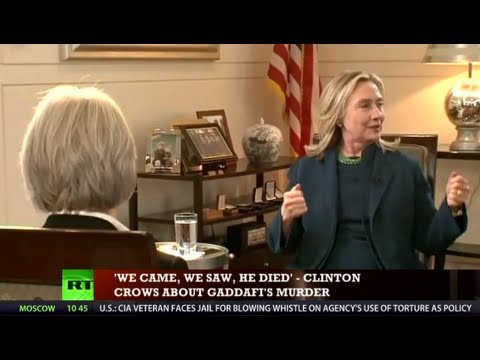
In an interview on CBS, Clinton laughed about Gaddafi’s slaying, proudly exclaiming, “We came, we saw, he died.”

Hillary Clinton deserves credit for poverty and instability in Haiti

In Haiti, the first state ever founded by freed black slaves, citizens are still fighting for political and economic freedom today, largely due to the influence of Bill and Hillary Clinton.

In 2011, Wikileaks published US State Department cables from 2008 and 2009 confirming that State Department officials were meeting behind closed doors with Haitian business leaders, plotting on how to stop the Haitian government from implementing a 37-cent hike in the minimum wage from $0.24 an hour to $0.61 cents an hour.

While Haitian President René Préval was initially neutral on the proposal of raising the minimum wage, he went on the record opposing the wage hike after consistent efforts from within the US Embassy in Haiti and the Haitian business lobby by July of 2009. Politifact rated the claim that Clinton’s State Department tried to suppress the wage hike as half-true, since there’s no link proving that Clinton directly played a role.

However, Clinton’s influence on Haiti didn’t stop there. As US Uncut previously reported, the former Secretary of State took an active role in swinging Haitian’s presidential elections in favor of corporate special interests. In the first round of Haiti’s presidential elections, thousands of citizens took to the streets demanding an annulment of election results, alleging that then-Haitian president Michel Martelly committed election fraud.

Martelly, who succeeded René Préval, is a close confidant of the Clinton family. In 2011, Martelly appointed Bill Clinton to an advisory board whose stated goal was to court foreign investors.

And in one of Hillary Clinton’s State Department emails made public, Clinton’s chief of staff received an email from another staffer openly boasting about using connections within the Haitian business elite to lobby for the withdrawal of Jude Célestin, Martelly’s political rival, from an upcoming runoff election. The aide, Kenneth Merten, predicted the news of the US interfering in election results would create widespread protests, and said he had called Martelly, asking him to plead with Haitians “to not pillage.”

While Martelly is no longer in power, his hand-picked successor, Jovenel Moïse, won the most recent election. However, watchdogs are calling the results fraudulent and demanding a new election. Ricardo Seitenfus, who has served as representative of the Organization of American States (OAS) for the last eight years, admitted that Haiti’s government is essentially a puppet of US interests, saying the Haitian election schedule is “subject to the U.S. schedule.” Hillary Clinton deserves to be closely scrutinized when touting her diplomacy record, as Haiti’s political instability is a result of her policies.

Honduras’ downfall resulted from a coup Clinton supported

In 2009, shortly after Obama took office and appointed Hillary Clinton as his Secretary of State, Honduran president Manuel Zelaya was arrested at gunpoint by the military and forced onto a plane to Costa Rica while a new government took power. While the US State Department didn’t directly oust Zelaya, it refused to call his ouster a coup, despite calls from the U.S. ambassador to Honduras and from Congress to do so. In her interview with the New York Daily News editorial board, Clinton defended her decision to keep sending aid to Honduras despite the violent overthrow of Zelaya:

I think, in retrospect, we managed a very difficult situation, without bloodshed, without a civil war, that led to a new election. And I think that was better for the Honduran people. But we have a lot of work to do to try to help stabilize that and deal with corruption, deal with the violence and the gangs and so much else.

However, the result of the coup was a massive amount of bloodshed, as gangs and drug cartels began to take more power in the absence of a stable government. In the year following the coup, Clinton’s State Department published a list of human rights abuses prevalent in Honduras:

“…unlawful killings by police and government agents, which the government took some steps to prosecute; arbitrary and summary killings committed by vigilantes and former members of the security forces; harsh prison conditions; violence against detainees; corruption and impunity within the security forces; lengthy pretrial detention and failure to provide due process of law; politicization, corruption, and institutional weakness of the judiciary; corruption in the legislative and executive branches; government restrictions on the recognition of some civil society groups; violence and discrimination against women; child prostitution and abuse; trafficking in persons; discrimination against indigenous communities; violence and discrimination against persons based on sexual orientation; ineffective enforcement of labor laws; and child labor.”

The horrific conditions in Honduras triggered a mass exodus of migrants to the US. As Telesur reported, approximately 9,000 child refugees fled Honduras in 2015. Also in 2015, Clinton defended the deportation of children back to the Central American countries they’re fleeing in order “send a message.” However, Clinton has since walked back that statement as her Democratic presidential primary battle with Bernie Sanders became more competitive.

Honduras-Activists-Berta-Cáceres-and-Nelson-Garcia-Assassinated-Called-Out-Hillary-Clinton-for-Backing-Honduran-Coup

This March, the violence in Honduras became a subject of international scrutiny when 44-year-old environmental activist Berta Caceres was assassinated in her home. Caceres had been an outspoken opponent of a proposed hydroelectric plant on indigenous land, and had recently gotten in an altercation with soldiers, police, and employees of a private power company while protesting the project just weeks before she was killed.

Clinton is responsible for the fall of Iraq and Syria (and the rise of ISIS)

In late 2011, after months of sustained anti-government protests inspired by the “Arab Spring” movement, Hillary Clinton called for the resignation of Syrian president Bashar al-Assad. Then, in April 2012, Clinton gave a speech in Turkey more forcefully calling specifically for regime change, saying, “Assad must go.” Those three words created the policies that led to both the rise of ISIS in Syria and the European refugee crisis of 2015.

One of Clinton’s last actions as Secretary of State was to call for the arming of Syrian rebels fighting Assad. As the London Telegraph reported, Clinton’s plan to give weapons to Assad’s enemies was backed by not only former Defense Secretary Leon Panetta, but also by former CIA director David Petraeus and General Martin Dempsey, chairman of the Joint Chiefs of Staff. While Obama initially rejected his Secretary of State’s plan, he eventually agreed to arm Syrian rebels in the goal of ousting Assad.

However, as ISIS began to get a foothold into Syria and Iraq, the “moderates” that received weapons from the US were eventually overtaken by ISIS fighters, who suddenly found themselves in the possession of military-grade weapons paid for with US tax dollars. In a study conducted by Conflict Armament Research, which tracks the movement of arms in war-torn regions, researchers found that ISIS has weapons and ammunition not just from the US, but also from coalition forces that are funded by the US government. The access to advanced weaponry was likely the reason for ISIS’ rapid expansion into Libya, Egypt, and elsewhere.

The consequences of destabilizing Syria and Iraq are apparent. Over one million refugees, largely from countries where the US intervened militarily, fled to Europe between 2015 and 2016, creating the world’s largest refugee crisis since World War II. In this chart compiled by Eurostat, the top three countries people are fleeing are Syria, Afghanistan, and Iraq:

refugeechart

Yemeni blood is on Hillary Clinton’s hands

Saudi Arabia’s invasion of Yemen, which started in 2015 and continues today, was made possible with arms purchased by the US government. Since Obama’s presidency, the US has sold approximately $46 billion in arms to the Saudis, with many of those weapons sales greenlighted by Hillary Clinton’s State Department. As US Uncut reported in April, Clinton was particularly focused on making sure the US came through for Saudi Arabia in a 2011 weapons deal. David Sirota of the International Business Times reported that Clinton argued the arms deal was “in the national interest.”

At press conferences in Washington to announce the department’s approval, an assistant secretary of state, Andrew Shapiro, declared that the deal had been “a top priority” for Clinton personally. Shapiro, a longtime aide to Clinton since her Senate days, added that the “U.S. Air Force and U.S. Army have excellent relationships in Saudi Arabia.”

Saudi Arabia is very likely using the weapons acquired from that 2011 exchange to wage brutal bombing campaigns in Yemen. In March, Foreign Policy magazine accused the US and its allies of complicity in war crimes by funding and arming the Saudi regime:

Hundreds of civilians have been killed in airstrikes while asleep in their homes, when going about their daily activities, or in the very places where they had sought refuge from the conflict. The United States, Britain, and others, meanwhile, have continued to supply a steady stream of weaponry and logistical support to Saudi Arabia and its coalition.

This week, the United Nations added the Saudi-led coalition to a blacklist of states and armed groups that violate children’s human rights during conflicts, with UN Secretary General Ban Ki-moon personally slamming the coalition for killing and maiming Yemeni children.

Hillary Clinton is completely right that Donald Trump is woefully unprepared to take on the responsibilities of Commander-in-Chief. But voters should also be leery of Clinton, who, despite having met with more world leaders than any presidential candidate in US history, is responsible for some of the worst foreign policy blunders of the 21st century.


Zach Cartwright is an activist and author from Richmond, Virginia. He enjoys writing about politics, government, and the media. Send him an email: zachcartwright88@gmail.com. 

Always Attack the Wrong Country

8lfjisz6

By Dmitry Orlov

Source: Club Orlov

There are numerous tactics available to those who aim to make problems worse while pretending to solve them, but misdirection is always a favorite. The reason to want to make problems worse is that problems are profitable—for someone. And the reason to pretend to be solving them is that causing problems, then making them worse, makes those who profit from them look bad.

In the international arena, this type of misdirection tends to take on a farcical aspect. The ones profiting from the world’s problems are the members of the US foreign policy and military establishments, the defense contractors and the politicians around the world, and especially in the EU, who have been bought off by them. Their tactic of misdirection is conditioned by a certain quirk of the American public, which is that it doesn’t concern itself too much with the rest of the world. The average member of the American public has no idea where various countries are, can’t tell Sweden from Switzerland, thinks that Iran is full of Arabs and can’t distinguish any of the countries that end in -stan. And so a handy trick has evolved, which amounts to the following dictum: “Always attack the wrong country.”

Need some examples? After 9/11, which, according to the official story (which is probably nonsense) was carried out by “suicide bombers” (some of them, amusingly, still alive today) who were mostly from Saudi Arabia, the US chose to retaliate by attacking Saudi ArabiaAfghanistan and Iraq.

When Arab Spring erupted (because a heat wave in Russia drove up wheat prices) the obvious place to concentrate efforts, to avoid a seriously bad outcome for the region, was Egypt—the most populous Arab country and an anchor for the entire region. And so the US and NATO decided to attack EgyptLibya.

When things went south in the Ukraine, whose vacillating government couldn’t make up its mind whether it wanted to remain within the Customs Union with Russia, its traditional trading partner, or to gamble on signing an agreement with the EU based on vague (and since then broken) promises of economic cooperation, the obvious place to go and try to fix things was the Ukraine. And so the US and the EU decided fix the UkraineRussia, even though Russia is not particularly broken. Russia was not amused; nor is it a country to be trifled with, and so in response the Russians inflicted some serious pain on the Washington establishmentfarmers within the EU.

Who was at fault exceedingly clear once the Ukrainians that managed to get into power (including some very nasty neo-Nazis) started to violate the rights of Ukraine’s Russian-speaking majority, including staging some massacres, in turn causing a large chunk of it to hold referendums and vote to secede. (Perhaps you didn’t know this, but the majority of the people in the Ukraine are Russian-speakers, and there is just one city of any size—Lvov—that is mostly Ukrainian-speaking. Mind you, I find Ukrainian to be very cute and it makes me smile whenever I hear it. I don’t bother speaking it, though, because any Ukrainian with an IQ above bathwater temperature understands Russian.) And so the US and the EU decided to fix things by continuing to put pressure on the UkraineRussia.

When Russia started insisting on a political rather than a military resolution to the crisis in the Ukraine, and helped negotiate the Minsk agreements together with the Ukraine, France and Germany, a similar thing happened. These agreements obligated the Ukrainian government to pass constitutional reforms to grant autonomy to its Russian regions in the east. The Ukrainian government refused to abide by these agreements. As a result, the US and the EU decided to put pressure on the UkrainianRussian government.

When a nasty terrorist group calling itself ISIS and composed of Islamic Salafi/Takfiri extremists started to seize power in large parts of Iraq, and then spread to Syria, something had to be done about it. These extremists were being financed by Turkey (which is still buying oil from them and sheltering them on its territory) and Saudi Arabia. And so the US and NATO decided to put some pressure on Turkey and Saudi ArabiaSyria.

In response to all this foolishness, Russia up and decided to actually go and fix something that was broken: Syria. And now Syria is on the mend, and members the misdirectorate in Washington are left scratching their heads.

So far so good. But this method of pretending to be solving problems by making them worse has some definite downsides.

For one thing, eventually even the dimmest, most geographically challenged bulbs in the general population start to get a clue, and then they start refusing to vote for the establishment candidates. Then it becomes hard to continue with the misdirecting because the people doing the misdirecting are voted out, and (horror of horrors!) somebody who might actually try to fix a problem or two might get voted in.

For another, continually making problems worse by attacking the wrong country tends to eventually make the sheer number problems get completely out of hand. Take the recent massive terror attack in Brussels, down the road from NATO headquarters, for which ISIS took credit. Recently, Europe has been experiencing a large-scale influx of people from the Middle East and North Africa, who have been forced to flee their native lands because of all the previous acts of misdirection, and a fair number of these people are ISIS terrorists. And so, to protect itself, NATO is planning to fight ISIS in EuropeSyria. Also, it is well known that the influx into Europe has been orchestrated by Turkey. In response, the EU has decided to put pressure ongive billions of euros to Turkey and tell Turkey that it is welcome to join the EU.

Lastly, this pattern has an overall momentum that, over time, becomes harder and harder to break. It starts out as just one group of plutocrats doing incredibly vile, underhanded but profitable things; later on, an even bigger group of plutocrats is doing equally vile but now completely idiotic, self-defeating, embarrassing things; and right near the end a really huge group of plutocrats is doing things that are absolutely suicidal—but they can’t stop themselves. You should be able to decide for yourselves when that point in time arrives, but I doubt that it is too far in the future.

War fraud: The great lies behind imperial warfare in the 21st century

By Mark Taliano

Source: Intrepid Report

The “War On Terror” and “The War On Drugs” are both fraudulent, and they are both related. In a classic example of “reverse projection”, ”the War on Terror” is literally a “War for Terror,” and the “War on Drugs” is literally a “War for Drugs.”

Terror, coupled with the illegal trade in narcotics, particularly heroin, is enabling the orchestration, and funding, of illegal warfare which serves the interests of an international oligarch class as it destroys humanity.

The barbarity of the military operations conducted by the West is beyond the imagination of most domestic audiences, even when details are publicized.

Broadly speaking, we can decode the 9/11 terror wars using a simple formula:

  • Problem
  • Reaction
  • Solution

NATO imperialists engineer or exploit problems to create reactions, with a view to creating previously planned solutions. Typically, problems (i.e, 9/11 crimes) serve to engineer public consent (reaction) for illegal invasions (solution).

The “end-game” also contradicts publically stated goals. Evidence demonstrates that the invasions of Afghanistan, Iraq, Libya, and Syria, as well as the war in Ukraine, were launched and prosecuted with a view to destroy each country through invasion, occupation, plunder, and to establish military footholds. The popular notion that the wars are being prosecuted for humanitarian purposes is absolutely ridiculous.

Afghanistan

In Afghanistan, for example, drug-trafficking warlords such as Gulbuddin Hekmatyar were used to create extremist “jihadist” armies (mujahideen) to destroy the Soviet-protected socialist republic. The long-standing CIA-terror group alliance, which pre-dates Afghanistan, continues to be empowered by profits from illegal drug trafficking: According to U.S sources, the production of opium (which is eventually processed into heroin) has increased “40-fold” since the initial invasion of Afghanistan.

So, the invasion destroyed a secular, socialist government and filled the vacuum with extremist drug-trafficking terrorist warlords. But imperialists gained a military foothold in the country.

Iraq

We all know now that the fraudulent “Weapons Of Mass Destruction” pretext was used for the criminal invasion of Iraq. The engineered problem was followed by mixed reactions from a less gullible public, but the invasion (solution), was launched (on the heels of genocidal sanctions) anyway.

Joe Quinn reports that in this invasion, US Death Squads manufactured a civil war to divert attention from the real culprits: the occupiers. A 10,000 strong “Shia militia” under US command is used to terrorize the population and to destroy Iraqi grassroots resistance. Often, the terrorists bomb civilian targets and falsely blame innocent groups—false flag tactics—which in turn create engineered friction and retaliation. Black propaganda operations are a CIA specialty. Consequently, Iraq is now an unstable terrorist quagmire, whereas before the invasion it was a modern, well-developed country free of any identifiable terror groups.

Libya

The NATO invasion of Libya, previously the wealthiest country in Africa, was also a product of repeated Western lies, and now, it too, is a hotbed of terrorism, vice, and drug trafficking. Erin Banco reports in “Drug And Human Trafficking In ‘Lawless’ Libya Is Funding ISIS” that the West’s “lack of foresight has enabled different groups of fighters to traffic a continuous supply of arms, drugs and people across Libya’s borders, helping to bankroll some of the world’s most violent terrorists.”

Syria

The invasion of Syria is following predictable patterns as well. A constellation of extremist, mercenary terror groups, including ISIS—all supported by the West—are trying to destroy Syria. Drug trafficking, stolen oil and artifacts are being used to finance the mass murder, and death squads, often under the cover of the Free Syrian Army (FSA) are being used to create a “civil war,” and to destroy President Assad’s government. The terror and mass murder are primarily orchestrated externally with a view to making Syria safe for Wahhabism, barbarity, and a NATO military presence.

A Wikileaks cable indicates that since 2011, more than 230,000 people have died and a million have been injured. But despite the so-far-successful alliance of Syria, Iran, and Russia in destroying the mercenary terrorists and in saving Syria, the West can take some consolation: the US already has a military foothold in the country. Only time will tell if the West succeeds in creating and sustaining yet another unstable, terrorist-infested vassal state.

Despite what naysayers might think, the NATO-perpetrated holocaust is in many respects a neocon success story: a succession of previously independent countries have been destroyed, and a NATO presence has been installed. In fact, the wars for Terror and Drugs are winning, despite ostensible setbacks.

The whole process of death and destruction is not rational or moral, and the degeneracy is beyond evil. Commentators call it imperialism.


Politicians Exploit School Shooting While Ignoring Bombing Victims

Ron_Paul_0723

By Ron Paul

Source: Ron Paul Institute

Following the recent Oregon school shooting, many politicians rushed to the microphones to call for new gun control laws. President Obama even called on gun control supporters to “politicize” the shooting, while some members of Congress worked to establish a special commission on gun violence.

The reaction to the shooting stands in stark contrast to the reaction to the US military’s bombing of an Afghanistan hospital run by the international humanitarian (and Nobel Peace Prize winning) group Doctors Without Borders.

Our Nobel Peace Prize winning president did apologize to his fellow Nobel laureate for the bombing. However, President Obama has not “politicized” this tragedy by using it to justify ending military involvement in Afghanistan. No one in Congress is pushing for a special commission to examine the human costs of US militarism, and the mainstream media has largely ignored Doctors Without Borders’ accusation that the bombing constitutes a war crime.

The reason for the different reactions to these two events is that politicians prefer to focus on events they can “politicize” to increase government power. In contrast, politicians ignore incidents that raise uncomfortable questions about US foreign policy.

If the political and media elites were really interested in preventing future mass shootings, they would repeal the federal “gun-free” schools law, for example. By letting shooters know that their intended victims are defenseless, the gun-free schools law turns schoolchildren into easy targets.

Even some who oppose gun control are using the shooting to justify expanding federal power instead of trying to repeal unconstitutional laws. Some opponents of new gun control laws say Congress should expand the federal role in identifying, tracking, and treating those with “mental health problems.” This ignores the fact that many shooters were using psychotropic drugs prescribed by a mental health professional when they committed the horrible acts. Furthermore, creating a system to identify and track anyone with a “mental health problem” could deny respect for individuals’ Second Amendment and other rights because they perhaps once sought counseling for depression while going through a divorce or coping with a loved one’s passing.

While our political and media elites are eager to debate how much liberty people must sacrifice for safety, they are desperate to avoid debating the morality of our foreign policy. To admit that the US military sometimes commits immoral acts is to admit that the US government is not an unalloyed force for good. Even many proponents of our recent wars support using the US military for “humanitarian” purposes. Thus they are as reluctant as the neoconservatives to question the fundamental goodness of US foreign policy.

Anyone who raises constitutional or moral objections to the US use of drones, bombs, indefinite detention, and torture risks being attacked as anti-American and soft on terrorism. The smear of “terrorist apologist” is also hurled at those who dare suggest that it is our interventionist foreign policy, not a hatred of freedom, that causes people in other countries to dislike the United States. Which is a more logical explanation for why someone would resent America — a family member killed in a drone attack launched by the US military or rage over our abundance of liberty?

The disparate reactions to the Oregon school shooting and the Afghanistan hospital bombing shows the political class is unwilling and unable to acknowledge that the US government cannot run the world, run our lives, or run the economy. Clearly, politicians will never stop expanding government and give us back our lost liberties unless and until the people demand it.

Was Afghanistan’s Invasion Also Based on Lies?

binladen01_04

It’s Time for a Real Investigation

By Jack Balkwill

Source: Dissident Voice

There appears to be a bigger lie than “weapons of mass destruction.”  It’s not simply that the illegal invasion of Iraq was based on lies, but that the entire “war on terrorism” is likely based on lies.

We were told by our government that Afghanistan was invaded for giving shelter to Osama bin Laden, who was responsible for the 9/11 attacks.  Mainstream press have pushed this so repeatedly that “9/11″ and “Osama bin Laden” have become interchangeable.

While working on this piece I asked the first three people I ran into at my local grocery store “Who was responsible for the 9/11 attacks?,”  three times getting “Osama bin Laden” for replies.  This is not scientific, yet it makes one wonder how this would work out in national polling.

But what if bin Laden was not responsible for the 9/11 attacks despite the drumbeat of government officials and the corporate press?  What if there has been a rush to judgment to make it appear the Bush regime was taking definitive action?

The invasion of Afghanistan certainly wasn’t about the Taliban – the Bush regime gave the Taliban $43 million in “aid” only four months before the 9/11 attacks, so were on friendly terms.

Following are three reasons to question official sources on their casus belli for invading Afghanistan.

Attempts to Peacefully Resolve the Issue

First, before the invasion of Afghanistan, the Taliban offered to try bin Laden in exchange for evidence that he was responsible for the 9/11 attacks.

President Bush provided no evidence, and invaded Afghanistan instead.

After the start of the U.S. air campaign, the Taliban offered to send bin Laden to a third country for trial if evidence could be provided that he had been involved in the 9/11 attacks – a proposal the United States also promptly rejected.

Why not provide evidence, if it were available, to prevent a war?  It was obvious that the people of Afghanistan would defend their country from a foreign invasion, as they had since Alexander the Great invaded, and there would be a great loss of life (see Roman Empire, British Empire, USSR, etc.).

There can only be two answers– that there was no evidence supporting the cause for invasion, or that former President Bush is a psychopath who doesn’t care about human life, so contemptuously ignored the request for evidence.

Bin Laden’s Denials

Second, bin Laden denied, more than once, in the months following 9/11, that he was involved in the dirty deed.  Less than a week after the 9/11 attacks, al Jazeera quoted bin Laden:  “The U.S. government has consistently blamed me for being behind every occasion its enemies attack it.  I would like to assure the world that I did not plan the recent attacks, which seem to have been planned by people for personal reasons.”

In an interview with Pakistan’s Karachi Ummat on 28 September 2001, bin Laden was quoted,

Neither I had any knowledge of these attacks nor I consider the killing of innocent women, children, and other humans as an appreciable act. Islam strictly forbids causing harm to innocent women, children, and other people. Such a practice is forbidden ever in the course of a battle. … I have already said that we are against the American system, not against its people, whereas in these attacks, the common American people have been killed.

This is a translation from Arabic to Urdu to English, and may not be entirely clear.  But for those who believe bin Laden was lying, I would suggest they come up with a motive for such a lie.  The USA had offered a $25 million reward for information leading to his capture, and President Bush had threatened “I want justice, and there’s an old poster out West that says, ‘Wanted Dead or Alive,’” so bin Laden had nothing to gain from such a lie – he was condemned either way.  Bin Laden’s followers would have admired him as a great hero for having taken on the USA, so he had much to gain by accepting responsibility for the 9/11 attacks, were it a fact.

Demonization

Third, there was an extensive effort to demonize bin Laden, at times with apparently false charges.  Why would this be necessary for one who was guilty?

Our government and corporate media, as one on National Security State issues, made him out to be abominable, and without providing evidence, unceasingly assumed his guilt.  Recordings were blasted and headlined in Western corporate print and electronic media of bin Laden accepting responsibility for 9/11.  The public were not given the same eyeball-grabbing headlines when the recordings were proven to be likely bogus.

Here is a Guardian report showing that Swiss Scientists suggested that an audio tape of bin Laden taking responsibility was likely faked, although widely broadcast in the corporate press as evidence of his involvement in 9/11 attacks.

Here’s a BBC report showing how the “smoking gun” video may have been faked, again, after the corporate press hyped the video as incontrovertible evidence.

Conclusion

The official version, that 19 Arab hijackers were responsible, has flaws.  One flaw was that many of the alleged hijackers have been found alive and well since 9/11.  Of course, it may be that the hijackers used pseudonyms to conceal their identities.

But getting beyond these 19 Arabs is difficult because they are all dead and cannot be interviewed.  Official government investigations into 9/11, much of which are classified, look like reflexive actions to neatly tie up loose ends rather than serious inquiries.

Certainly, as Ward Churchill pointed out (and lost his job for raising the issue), Arabs had a clear motive for the 9/11 attacks, with the UN revealing, only two years earlier, that the sanctions pushed mainly by the USA on the people of Iraq resulted in over 500,000 deaths of children under age five, mostly Arab, and most Arabs were aware of this and seething with anger.

To jump to the conclusion that bin Laden was behind the 9/11 attacks causes one to wonder, “Why then did the FBI never bring charges against bin Laden for the hijackings and murders?  Why did the wanted posters (up to his death he was on the FBI ten most wanted list) not mention the biggest crime, though they mentioned smaller terrorist incidents as reasons for his being on the list?

We may never know if bin Laden was responsible for 9/11, but his involvement was used as the excuse for invading Afghanistan and slaughtering a massive number of people, based on the assumption that they gave bin Laden refuge.

Just as nobody has been charged with a crime for the illegal invasion of Iraq based on lies, it would appear that an investigation is in order involving the justification behind invading Afghanistan, starting with the matter of proof that bin Laden was directly involved.  The American people and the people of Afghanistan have every right to be presented with the evidence.

Jack Balkwill is an activist in Virginia. He can be reached at libertyuv@hotmail.com Read other articles by Jack.

Related article: Who Was Really Behind the 9/11 Attacks?

Hillary Clinton: The International Neocon Warmonger

06

By Webster G. Tarpley

Source: Voltaire.net

Hillary Clinton has announced her candidacy for President of the United States. While the European press showers her with praise without thinking, Webster G. Tarpley recalls her balance sheet: in all circumstances, she supported war and corporate interests.

As the National Journal reported in 2014, even the pathetically weak anti-war left is not ready to reconcile with Hillary given her warmongering as Secretary of State. And with good reason. Scratching just lightly beneath the surface of Hillary Clinton’s career reveals the empirical evidence of her historic support for aggressive interventions around the globe.

Beginning with Africa, Hillary defended the 1998 cruise missile strike on the El Shifa pharmaceutical plant in the Sudanese capital of Khartoum, destroying the largest producer of cheap medications for treating malaria and tuberculosis and provided over 60% of available medicine in Sudan. In 2006 she supported sending United Nations troops to Darfur with logistical and technical support provided by NATO forces. Libyan leader Moammar Qaddafi was outspoken in his condemnation of this intervention, claiming it was not committed out of concern for Sudanese people but “…for oil and for the return of colonialism to the African continent.”

This is the same leader who was murdered in the aftermath of the 2011 NATO bombing of Libya; an attack promoted and facilitated with the eager support of Mrs. Clinton. In an infamous CBS news interview, said regarding this international crime: “We came, we saw, he died.” As Time magazine pointed out in 2011, the administration understood removing Qaddafi from power would allow the terrorist cells active in Libya to run rampant in the vacuum left behind. Just last month the New York Times reported that Libya has indeed become a terrorist safe haven and failed state— conducive for exporting radicals through “ratlines” to the conflict against Assad in Syria.

Hillary made prompt use of the ratlines for conflicts in the Middle East. In the summer of 2012, Clinton privately worked with then CIA director and subversive bonapartist David Petraeus on a proposal for providing arms and training to death squads to be used to topple Syria just as in Libya. This proposal was ultimately struck down by Obama, reported the New York Times in 2013, but constituted one of the earliest attempts at open military support for the Syrian death squads.

Her voting record on intervening in Afghanistan and Iraq is well known and she also has consistently called for attacking Iran. She even told Fareed Zakaria the State Department was involved “behind the scenes” in Iran’s failed 2009 Green Revolution. More recently in Foreign Policy magazine David Rothkopf wrote on the subject of the Lausanne nuclear accord, predicting a “snap-back” in policy by the winner of the 2016 election to the foreign policy in place since the 1980s. The title of this article? “Hillary Clinton is the Real Iran Snap-Back.” This makes Hillary the prime suspect for a return to the madcap Iranian policies that routinely threaten the world with a World War 3 scenario.

Hillary Clinton is not only actively aggressing against Africa and the Middle East. She was one of the loudest proponents against her husband’s hesitancy over the bombing of Kosovo, telling Lucina Frank: “I urged him to bomb,” even if it was a unilateral action.

While no Clinton spokesperson responded to a request by the Washington Free Beacon regarding her stance on Ukraine, in paid speeches she mentioned “putting more financial support into the Ukrainian government”. When Crimea decided to choose the Russian Federation over Poroshenko’s proto-fascist rump state, Hillary anachronistically called President Putin’s actions like “what Hitler did in the ‘30s.” As a leader of the bumbled ”reset” policy towards Russia, Hillary undoubtedly harbors some animus against Putin and will continue the destabilization project ongoing in Ukraine.

Not content with engaging in debacles in Eastern Europe, she has vocally argued for a more aggressive response to what she called the “rollback of democratic development and economic openness in parts of Latin America.” This indicates her willingness to allow the continuation of CIA sponsored efforts at South American destabilization in the countries of Venezuela, Bolivia, Ecuador, Argentina and Brazil.

It is one of the proud prerogatives of the Tax Wall Street Party to push out into the light the Wall Street and foundation-funded Democrats. The final blow to Hillary’s clumsy façade comes directly from arch-neocon Robert Kagan. Kagan worked as a foreign policy advisor to Hillary along with his wife, Ukraine madwoman Victoria Nuland, during Hillary’s term as Secretary of State. He claimed in the New York Times that his view of American foreign policy is best represented in the “mainstream” by the foreign policy of Hillary Clinton; a foreign policy he obviously manipulated or outright crafted. Kagan stated: “If she pursues a policy which we think she will pursue…it’s something that might have been called neocon, but clearly her supporters are not going to call it that; they are going to call it something else.” What further reason could any sane person need to refute Hillary? A vote for Hillary is a vote for the irrational return to war.

The “Giant Sucking Sound”: Clinton Gave US NAFTA and Other Free Trade Sellouts

“There is no success story for workers to be found in North America 20 years after NAFTA,” states AFL-CIO president Richard Trumka. Unlike other failures of his Presidency, Bill Clinton can not run from NAFTA. It was Vice President Al Gore, not a veto-proof Republican congress, who lobbied to remove trade barriers with low-wage Mexico.

The record of free trade is clear. Multinational corporations and Wall Street speculators realize incredible profits, wages remain stagnant in the US, poverty persists in the developing world, and the remaining industrial corporations in America and Canada are increasingly owned by Chinese, Indian and other foreign interests.

America’s free trade policy is upside down. Besides Canada, Australia and Korea, most of our “free” trade partners are low-wage sweatshop paradises like Mexico, Chile, Panama, Guatemala, Bahrain and Oman. The US does in fact apply tariffs on most goods and on most nations of origin – rates are set by the US International Trade Commission (USTIC), a quasi-public federal agency.

Since a German- or Japanese-made automobile would under USITC’s schedule be taxed 10% upon importation, Volkswagen and Toyota can circumvent taxation by simply building their auto assembly plants for the US market in Mexico. In Detroit, an auto assembly worker is paid between $14 and $28/hour, ($29,120-$58,240/yr); hard work for modest pay. In Mexico, the rate varies from $2-5/hour.

In China, all automobile imports regardless of origin are tariffed as high as 25%. This allows the Chinese to attract joint ventures with Volkswagen and Toyota, and to paraphrase Abraham Lincoln, “keep the jobs, the cars and the money.”

NAFTA-related job loss is not a question of productivity, currency manipulation, “fair trade,” environmental standards, etc. While these issues are not trivial, free trade – as Lincoln’s advisor Henry C. Carey proved – is a matter of simple accounting. Can an American family survive on $4,160/year ($2/hr)? If not, cars and their components will be built in Mexico. If we want cars built in the United States, the only solution is a general tariff (import tax) reflecting the difference between those wage standards, like the very tariffs repealed by Bill Clinton.

In the United States the “runaway shop” under NAFTA and CAFTA has sent trade deficits and unemployment soaring while wages drop relative to the cost of living. Yet Mexico and other “partners” receive no benefit either. Many manufacturing sectors in Mexico pay wages lower than the equivalent sector in China. Mexico is now the world leader in illegal narcotics exportation and weapons importation. The poverty level between 1994 and 2009 remained virtually identical. (52.4% – 52.3%). The shipping of raw materials to Mexico comprise the majority of so called American “exports”. The finished products from these exports are assembled and sold back to the United States at slave labor prices.

Don’t expect Hillary to behave differently with the coming “Trans-Pacific Partnership,” which seeks to replace an ascendant China with less-developed Vietnam and Malaysia. Vietnam would overtake India-allied Bangladesh in the global apparel trade, and Malaysia has a high-tech manufacturing sector poised to rival China’s. With America’s manufacturing economy in shambles, the Clinton machine can now be redirected to geopolitical maneuvers.


The Matrix Is Real and How It Will Change All Of Our Lives

M3_Hugo_Weaving_003

By Paul Craig Roberts

Source: King World News

Americans are the most manipulated people in history. Since 2008, the economy has been manipulated for the benefit of a few oversized banks “too big to fail.” US foreign policy has been manipulated to serve the hegemonic agenda of a handful of neoconservatives. These manipulations have undercut the consumer basis of the US economy and have pushed the American people into a conflict situation with Russia and China.

Lies, US Economic Collapse And Nuclear War

US economic collapse and nuclear war are the two most likely outcomes of Washington’s manipulations of the American people. Time and again, the American public has fallen for transparent lies and orchestrated events. 2015 is a decisive year. Will a credulous people cast off their gullibility, or will they be swept away by economic collapse and war?

There are reasons to believe that the government’s manipulations have overreached and are crossing the point of believability, even on the part of credulous Americans. Let’s review some of these manipulations — first, economic, and then foreign policy.

Unemployment Number Is Meaningless

On January 9, the US government told Americans that the unemployment rate had fallen to a comforting 5.6 percent, an indication that the Federal Reserve’s policy of Quantitative Easing was successful in restoring the US economy. A 5.6 percent rate of unemployment suggests that Americans have a reasonable chance of finding a job. Yet we know there are millions of discouraged workers who have given up looking for a job.

The explanation of this paradox is that the 5.6 percent unemployment rate (U.3) does not include unemployed people who have not looked for a job in the previous four weeks. These unemployed are called “discouraged workers.” If they have been discouraged for less than one year, they are counted in a seldom-reported measure of unemployment (U.6). This rate stands at 11.2 percent, twice as high as the unemployment rate stressed by government and financial media.

The 11.2 percent rate is an official measure, but it is not publicized because it indicates a dismal employment outlook 5.5 years after the 2008 recession was declared over, in June 2009. What kind of recovery is it when the unemployment rate remains at 11.2 percent years after the recession has officially ended?

The Great Lie Exposed

The story worsens. The 11.2 percent rate does not include the millions of unemployed long-term discouraged workers (those discouraged for more than one year). Prior to 1994, the US Bureau of Labor Statistics counted the long-term discouraged as unemployed, and the government of Canada still does. John Williams (shadowstats.com) continues to include the long-term discouraged. When the long- term discouraged are added to the U.6 measure, the rate of unemployment again doubles, to 23 percent.

In other words, the actual unemployment rate is actually four times higher than the comforting figure released January 9.

Inflation Rate Also Falls Victim

The government engages in similar deception with the inflation rate. If the price of an item in the index rises, a lower-priced item is substituted, thus eliminating inflation by substitution. Inflation also is eliminated by redefining a price rise as a quality improvement.

By undercounting inflation, the government reports price increases as real economic growth, denies cost-of-living increases to Social Security recipients, and justifies paying savers negative real interest rates. These manipulations provide banks with free money, thus boosting bank profits while encouraging the stock market with “good news.”

Americans who search for jobs without success know other Americans in the same situation. As time passes, they learn from experience that the unemployment rate cannot be low and falling when jobs are harder to find. People who shop for food and pay utility bills know inflation is far higher than the government reports. Experience and the passage of time make the government’s numbers less and less believable.

Global Financial Markets Manipulated

The financial markets also are manipulated. To protect the dollar from declining in value due to its overproduction, the Federal Reserve’s bullion bank agents drive down the price of gold and silver by dumping uncovered shorts in the futures market. Since 2011, we have had the extraordinary situation in which the prices of gold and silver have been driven down despite strong demand and constraints on supply — a result that can be achieved only by manipulation in the futures market.

The dollar’s value also is manipulated by foreign central banks in cooperation with Washington. The Japanese and European central banks print yen and euros to protect the dollar’s exchange value. If all major currencies also are being printed, the dollar cannot decline.

The government’s Plunge Protection Team can prevent major stock-market corrections by stepping in and purchasing S&P futures, thus preventing the market’s overvaluation from bursting the bubble.

These manipulations are apparent to experienced investors. Sooner or later, attentive Americans will realize that the government’s deceit is not limited to the marketplace, but extends into foreign policy.

Fooled Over And Over Into War

Ever since the Clinton regime’s demonizations of Yugoslavia and Serbia, Americans have been deceived into supporting expensive wars and foreign-policy positions that are not in their interest. Washington’s demonizations of the Taliban, Osama bin Laden, Saddam Hussein, Gaddafi, Assad, Iran and of Muslims generally have resulted in 14 years of wars in which seven or eight countries have been invaded, bombed and attacked with drones. Increasingly, people at home and abroad understand these wars and bombings are based on lies and deceptions.

The destruction of countries and the massive human hurt happened because the US government lied and deceived.

There were no weapons of mass destruction in Iraq. Assad did not use chemical weapons in Syria. Gaddafi did not issue Viagra to his troops to assist in the rape of Libyan women. Iran does not have a nuclear- weapons program.

Millions of Muslims have been killed, maimed and dislocated by these wars, and tens of thousands of American soldiers have been killed and physically or psychologically maimed. The destruction of countries and the massive human hurt happened because the US government lied and deceived.

The most extraordinary aspect of the Charlie Hebdo event is that the French cartoonists are being championed in the name of free speech. Yet the Anglo-American world does not have free speech. Free speech, if it involves criticism or exposure of the government, is being redefined as “domestic extremism.” Criticism of Washington now implies that the critic is hostile to the public, a possible extremist who must be deterred before he inflicts harm on innocents. As Glenn Greenwald noted, try satirizing Israelis in the manner that Charlie Hebdo satirized Muslims, and you will find out how little free speech there is. http://bit.ly/1xYF93V Free speech is used to demonize Washington’s hand-picked enemies. That’s about as far as it goes.

Washington Demonizing Russia

As 2014 drew to a close, Washington was at work demonizing Russia and its president. Russia no more invaded Ukraine than Saddam Hussein had weapons of mass destruction. But despite years of experience with the government’s foreign-policy lies, polls show that more than 60 percent of the US population has fallen for Washington’s demonization of Russia.

We now have two decades of evidence that Washington uses demonization as a prelude to war. Russia and China, recognizing Washington’s intent to destabilize, have formed a strategic alliance. War with Russia and China would not be like war with Iraq and Libya, or drone attacks on Yemen and Pakistan. Unlike Saddam Hussein and Iran, Russia and China do have weapons of mass destruction — plenty of them.

Whereas Americans are not subject to any meaningful retaliation from Washington’s wars against Muslims, Washington’s aggressive warlike policy toward Russia and China, ringing both countries with military bases while demonizing both with false charges, threatens the life of every American and every person on earth. A threat of this magnitude could pull Americans out of their insouciance and force them to confront the government over its dangerous manipulations of public opinion.

Governments successful with their deceptions end up overreaching. The Charlie Hebdo affair possibly is an overreach. The Paris shootings have many characteristics of a false-flag operation. The attack on the cartoonists’ office was a disciplined professional attack associated with special forces; yet the suspects later corralled and killed seemed bumbling and unprofessional. It is like they were two different sets of people.

Is This Really The Official Story?

Muslim terrorists are usually prepared to die in the attack; yet the two professionals who hit Charlie Hebdo so hard escaped. Their identities were established by the unprofessional and unlikely act of leaving their identification in the getaway car. This reminds me of the undamaged passport miraculously found among the ruins of the two World Trade Center towers. The incriminating passport was the only undamaged item in the entire ruins and was the basis for identifying the 9/11 alleged hijackers.

It is a plausible inference that the ID left in the getaway car was the ID of one of the two brothers later killed by police, from whom we will never hear anything, and not the ID of the professionals who attacked Charlie Hebdo. An important fact that supports this inference is the report that the third suspect in the attack, Hamyd Mourad, the alleged driver of the getaway car, when seeing his name circulating on social media as a suspect, realized the danger he was in and quickly turned himself in to police for protection against being murdered by security forces as a terrorist.

Hamyd Mourad says he has an ironclad alibi. If so, this makes him the despoiler of a false-flag attack. If that is the case, he is likely to be coerced or tortured into some sort of confession to support the official story. http://bit.ly/1Aai8pJ

Mainstream Media Clueless

The American and European media have ignored this important story. I googled Hamyd Mourad and all I found (January 12) was the main US and European media reporting that the third suspect had turned himself in. The news was reported in a fashion that gave credence to the accusation that the suspect who turned himself in was part of the attack. Not a single US mainstream media source reported that the alleged suspect turned himself in because he had an ironclad alibi. The list of sources that reported Mourad’s turning himself in to police report in a way that can be read as confirmation of his guilt.

Some merely reported it in a headline with no coverage in the report. The list of those I googled includes:

• The Washington Post (January 7, by Griff Witte and Anthony Faiola)

• Die Welt (Germany), “One suspect has turned himself in to police in connection with Wednesday’s massacre at the offices of Parisian satirical magazine, Charlie Hebdo”

• ABC News (January 7), “Youngest suspect in Charlie Hebdo Attack turns himself in”

• CNN (January 8), “Citing sources, the Agence France Presse news agency reported that an 18-year- old suspect in the attack had surrendered to police.”

High-Ranking Police Official Suddenly Commits Suicide?

Another puzzle in the official story that remains unreported, according to my 6 p.m. Google search on January 12, is the alleged suicide of a high-ranking member of the French Judicial Police who had a lead role in the Charlie Hebdo investigation. For unknown reasons, a police official involved in the most important investigation of a lifetime decided to kill himself in his police office in the middle of the night while writing his report on his investigation. The alternative media reports it: http://bit.ly/1xc8W1W So did the UK Telegraph. But no suspicion is seen in the police official’s death, and as far as the US “presstitute” media is concerned, it did not happen. There are no reports, domestic or foreign, at the time of writing, about his death and whether his report has disappeared.

Media Cloaks The Lies And Crimes Of Government

As Gerald Celente has pointed out for years and as Patrick L. Smith writes in CounterPunch (Vol. 21, No. 10, 2014), the media serve as presstitutes. The media justify withholding information from the public on the basis of patriotism. Patriotism requires the media to support the government, not the truth. Patrick Smith quotes former New York Times editor Jill Abramson, who says in defense of the New York Times misleading the American people: “Journalists are Americans, too. I consider myself to be a patriot.” Of course, journalists lie to us because their careers are controlled by government and corporations dependent on government. Patriotism has little to do with it, but it serves as a cover. Patriotism is like “national security,” a cloak for the lies and crimes of government.

Life In The Matrix

Here we have it. The media lie to us because they are patriots. We believe the lies because we are patriots. More likely, the fact of the matter might be that both the media and the people are morally and spiritually corrupt.

In other words, we willfully live in The Matrix and are our own worst enemy.