Exterminate All the Brutes

All settler colonial projects, including Israel, reach a point when they embrace wholesale slaughter and genocide to eradicate a native population that refuses to capitulate.

A Bird in the Hand – by Mr. Fish

By Chris Hedges

Source: Rise Up Times

During the siege in Sarajevo, when I was reporting for The New York Times, we never endured the level of saturation bombing and near total blockage of food, water, fuel and medicine that Israel has imposed on Gaza. We never endured hundreds of dead and wounded a day. We never endured the complicity of the international community in the Serbian campaign of genocide. We never endured Washington intervening to block ceasefire resolutions. We never endured massive arms shipments from the U.S. and other Western countries to sustain the siege. We never endured press reports from Sarajevo that were routinely discredited and dismissed by the international community, although 25 journalists were killed in the war by the besieging Serbian forces. We never endured Western governments justifying the siege as the right of the Serbs to defend themselves, although the U.N. peacekeepers sent to Bosnia were largely a public relations gesture, ineffective in halting the slaughter until forced to respond following the massacres of 8,000 Bosniak men and boys at Srebrenica.

I don’t mean to minimize the horror of the siege of Sarajevo, which gives me nightmares nearly three decades later. But what we suffered – three to four hundred shells a day, four to five dead a day, and two dozen wounded a day – is a tiny fraction of the wholesale death and destruction in Gaza. The Israeli siege of Gaza more resembles the Wehrmacht’s assault on Stalingrad, where over 90 percent of the city’s buildings were destroyed, than Sarajevo.

On Friday the Gaza Strip had all its communications severed. No Internet. No phone service. No electricity. Israel’s goal is the murder of tens, probably hundreds of thousands of Palestinians and the ethnic cleansing of those who survive into refugee camps in Egypt. It is an attempt by Israel to erase not only a people, but the idea of Palestine. It is a carbon copy of the massive campaigns of racialized slaughter by other settler colonial projects who believed that indiscriminate and wholesale violence could make the aspirations of an oppressed people, whose land they stole, go away. And like other perpetrators of genocide, Israel intends to keep it hidden.

Israel’s bombing campaign, one of the heaviest of the 21st century, has killed more than 7,300 Palestinians, nearly half of them children, along with 26 journalists, medical workers, teachers and United Nations staff. Some 1.4 million Palestinians in Gaza have been displaced and an estimated 600,000 are homeless. Mosques, 120 health facilities, ambulances, schools, apartment blocks, supermarkets, water and sewage treatment plants and power plants have been blasted into rubble. Hospitals and clinics, lacking fuel, medicine and electricity, have been bombed or are shutting down. Clean water is running out. Gaza, by the end of Israel’s scorched earth campaign, will be uninhabitable, a tactic the Nazis regularly employed when facing armed resistance, including in the Warsaw Ghetto and later Warsaw itself. By the time Israel is done, Gaza, or at least Gaza as we knew it, will not exist.

Not only are the tactics the same, but so is the rhetoric. Palestinians are referred to as animals, beasts and Nazis. They have no right to exist. Their children have no right to exist. They must be cleansed from the earth.

The extermination of those whose land we steal, whose resources we plunder and whose labor we exploit is coded within our DNA. Ask Native Americans. Ask Indians. Ask the Congolese. Ask the Kikuyu in Kenya. Ask the Herero in Namibia who, like Palestinians in Gaza, were gunned down and driven into desert concentration camps where they died of starvation and disease. Eighty thousand of them. Ask Iraqis. Ask Afghans. Ask Syrians. Ask Kurds. Ask Libyans. Ask indigenous peoples across the globe. They know who we are.

Israel’s distorted, settler colonial visage is our own. We pretend otherwise. We ascribe to ourselves virtues and civilizing qualities that are, as in Israel, flimsy justifications for stripping an occupied and besieged people of their rights, seizing their land and using prolonged imprisonment, torture, humiliation, enforced poverty and murder to keep them subjugated.

Our past, including our recent past in the Middle East, is built on the idea of subduing or wiping out the “inferior” races of the earth. We give these “inferior” races names that embody evil. ISIS. Al Qaeda. Hezbollah. Hamas. We use racist slurs to dehumanize them. “Haji” “Sand Nigger” “Camel Jockey” “Ali Baba” “Dung Shoveler” And then, because they embody evil, because they are less than human, we feel licensed, as Nissim Vaturi, a member of the Israeli parliament for the ruling Likud party said, to erase “the Gaza Strip from the face of the earth.”

Naftali Bennett, Israel’s former Prime Minister, in an interview on Sky News on Oct. 12 said, “We’re fighting Nazis,” in other words, absolute evil.

Not to be outdone, Prime Minister Benjamin Netanyahu described Hamas in a press conference with the German chancellor, Olaf Scholz, as “the new Nazis”.

Think about that. A people, imprisoned in the world’s largest concentration camp for sixteen years, denied food, water, fuel and medicine, lacking an army, air force, navy, mechanized units, artillery, command and control and missile batteries, is being butchered and starved by one of the most advanced militaries on the planet, and they are the Nazis?

There is an historical analogy here. But it is not one that Bennett, Netanyahu or any other Israeli leader wants to acknowledge.

When those who are occupied refuse to submit, when they continue to resist, we drop all pretense of our “civilizing” mission and unleash, as in Gaza, an orgy of slaughter and destruction. We become drunk on violence. This violence makes us insane. We kill with reckless ferocity. We become the beasts we accuse the oppressed of being. We expose the lie of our vaunted moral superiority. We expose the fundamental truth about Western civilization — we are the most ruthless and efficient killers on the planet. This alone is why we dominate the “wretched of the earth.” It has nothing to do with democracy or freedom or liberty. These are rights we never intend to grant to the oppressed.

“Honor, justice, compassion and freedom are ideas that have no converts,” Joseph Conrad, who wrote “Heart of Darkness,” reminds us. “There are only people, without knowing, understanding or feelings, who intoxicate themselves with words, repeat words, shout them out, imagining they believe them without believing in anything else but profit, personal advantage and their own satisfaction.”

Genocide lies at the core of Western imperialism. It is not unique to Israel. It is not unique to the Nazis. It is the building block of Western domination. The humanitarian interventionists who insist we should bomb and occupy other nations because we embody goodness — although they promote military intervention only when it is perceived to be in our national interest — are useful idiots of the war machine and global imperialists. They live in an Alice-in-Wonderland fairytale where the rivers of blood we spawn make the world a happier and better place. They are the smiley faces of genocide. You can watch them on your screens. You can listen to them spout their pseudo-morality in the White House and in Congress. They are always wrong. And they never go away.

Maybe we are fooled by our own lies, but most of the world sees us, and Israel, clearly. They understand our genocidal proclivities, rank hypocrisy and self-righteousness. They see that Palestinians, largely friendless, without power, forced to live in squalid refugee camps or the diaspora, denied their homeland and eternally persecuted, suffer the kind of fate once reserved for Jews. This perhaps is the final tragic irony. Those who were once in need of protection from genocide now commit it.


Urban Guerilla Warfare in Gaza: Why Israel will Ultimately Face Defeat

By Timothy Alexander Guzman

Source: Silent Crow News

The Israel Defense Forces (IDF) and with the possibility of US troops entering the war will face Hamas in Northern Gaza and that will quickly turn into a quagmire.  The main objective for Hamas was to lure Israeli forces into Gaza and fight their war, on their terms.  It is certain that Hamas who is considered a terrorist organization by the West will use ‘Hit and Run’ tactics that has defeated major colonial empires throughout history.  Hit and run basically means that Hamas will launch surprise attacks, then they will quickly pull-back before the IDF can respond.  This will continue throughout the war, so it is guaranteed that the number of dead Israeli troops will rise. 

The War in Vietnam is an example of how successful Hit and Run tactics were when a communist-led nationalist movement mobilized against France, a colonial empire which was defeated and eventually forced out of the country.  Then the US government decided to get involved under President Lyndon B. Johnson who feared that the North Vietnamese Army (NVA) and the Viet Congan armed communist movement allied with the NVA in South Vietnam, Cambodia and Laos formally known as the National Liberation Front of South Vietnam would soon make its way to the south and turn it into a communist stronghold. 

Washington was concerned about how Vietnam could create a domino effect of communist states in Southeast Asia, so they sent military “advisors” to assist the South Vietnamese army, and by early 1963, they had sent 12,000 US troops.  Two years later, 600,000 US troops were stationed in Vietnam in preparation to fight the NVA and the Viet Cong, but one of the major problems for US troops was that they were trained for a conventional war as they were obviously ill prepared to face the resistance in Vietnam who had a well-trained fighting force who used hit and run tactics, placed booby traps laced with bombs and conducted numerous ambushes that shook unsuspecting US troops throughout the war. 

For several years after, US troop deaths increased while they continued to bomb targets in North Vietnam.  The US had also bombed Cambodia and then Laos from March 18th, 1969, to May 26, 1970, in what was known as Operation Menu in hopes of striking the NVA and the Viet Cong believed to be in those countries to rest from battle fatigue, or to resupply and train their troops.   

Many civilians were killed in Southeast Asia, in Vietnam, close to a million people died with the majority being military personal.  By 1973, US troops began withdrawing from Southeast Asia with more than 58,000 dead and more than 300,000 injured including those who suffered from the psychological impact from the war and later turned to drugs and alcohol, many of them even committed suicide.

Hamas is the New ‘Viet Cong’?

So, who and what is Hamas exactly? Was Hamas an Israeli creation to rival the despised Yasser Arafat and the Palestinian Liberation Organization (PLO)?  Or maybe it was to create a civil war without any Israeli fighting in it? At the time, the Israelis probably saw it as a divide and conquer strategy to seize the remaining territories while Hamas and the PLO kill each other, at the time, I would guess that it seemed like the perfect idea for Zionist hardliners. 

In 2009, US Rep. Ron Paul (R-TX) gave a speech on the House floor and said that Israel had essentially created Hamas:

What’s happening in the Middle East, in particular with Gaza right now, we have some moral responsibility for both sides in a way because we provide help and funding for both Arab nations and Israel.  We definitely have a moral responsibility, especially now today the weapons being used to kill so many Palestinians are American weapons and American funds essentially are being used for this, but there’s a political liability, which I think is something we fail to look at because too often there’s so much blowback from our intervention in areas that we shouldn’t be involved in. 

You know Hamas, if you look at the history, you’ll find out that Hamas was encouraged and really started by Israel because they wanted Hamas to counteract Yasser Arafat, you say, well, yeah, it was better then and served its purpose, but we didn’t want Hamas to do this. So, then we, as Americans, say, well, we have such a good system; we’re going to impose this on the world. We’re going to invade Iraq and teach people how to be democrats. We want free elections. So, we encouraged the Palestinians to have a free election. They do, and they elect Hamas, So, we first, indirectly, and directly through Israel, helped establish Hamas. Then we have an election where Hamas becomes dominant, so we have to kill them. It just doesn’t make sense.

During the 80s, we were allied with Osama bin Laden, and we were contending with the Soviets. It was at that time our CIA thought it was good if we radicalize the Muslim world. So, we finance the Madrassas schools to radicalize the Muslims in order to compete with the Soviets. There is too much blowback. 

There are a lot of reasons why we should oppose this resolution. It’s not in the interest of the United States, it is not in the interest of Israel either

Hamas has evolved in some ways, to some people, they are the resistance against Israeli occupation, especially for the Palestinian children who personally experienced the Gaza war of 2008.  Young boys and girls at that time grew up without their mothers, fathers, brothers, and sisters who were either killed, imprisoned without due process, others were maimed and permanently injured by IDF forces.  The massive death toll and destruction was a shock to these children, many were and are still traumatized, then they became adults with deep rooted hatred towards the Israeli and US governments. 

Over the years, nothing has changed, the Palestinians living in the Gaza Strip and the West Bank fear for their lives as they face constant Israeli airstrikes and sniper fire in the largest outdoor prison on the planet and the list goes on, and people in the West wonder why some Palestinians have joined Hamas.

For more than 75 years of Israeli occupation, the Palestinians whether Muslim or Christian have been physically displaced and turned into refugees, many were murdered, jailed, tortured, harassed, spit-on, you name it, they had it.  They don’t care anymore, when people have nothing left to lose, they risk everything.  Palestinians prefer fighting for their freedoms rather than to live as slaves and who can blame them?  At any moment, they can get killed by an Israeli airstrike or bullet, they may even get stopped on the street by Israeli forces and get arrested for just being a Palestinian and possibly face torture in prison.

The Palestinians will not give up, they will fight with the support of most of the world. The majority of the Middle East supports Palestine.  Israel’s power is supported by the US government, both Democrats and Republicans fully support Israel even though the US is in $33 trillion in debt, which means the US government cannot even afford peace, let alone war.

Israel will not live in peace as long as it exists, sooner or later, Israelis living in occupied lands will have to make a hard decision, some will they stay and fight the Muslim world, others will leave to another destination and try to finally live in peace.       

In 2014, A US congressional candidate by the name of Allan Levene proposed a viable solution for Israel by creating a second ‘Israeli’ state in Eastern Texas.  According to the Times of Israel, Mr. Levene’s idea would allow “eminent domain” by the US government only if Israel withdraws to it pre-1967 borders although with over a million illegal Israeli settlers living on occupied land, that will never happen, but with that said, it could set the stage for a ‘New Israel’ within the United States:

Congressional candidate Allan Levene is proposing to cut the Gordian Knot of Middle East peace by creating a second State of Israel on the eastern coast of Texas, which he would call New Israel. The idea, briefly, is to take (through eminent domain) roughly 8,000 square miles of sparsely populated land bordering the Gulf of Mexico and give it to Israel as a second, non-contiguous part of the State of Israel. Israel would get the land only if it agrees to withdraw to its pre-1967 borders.

Israel wins because it would gain a new, peaceful territory far from the strife of the Middle East, in a place where, as Levene suggests, “the climate is similar,” and Israel could “have access to the Gulf of Mexico for international trade.” The U.S. wins because it would no longer need to send Israel billions of dollars a year in foreign aid. Texas wins because of all the construction jobs from building an entirely new state within its borders. The Palestinians win because they get the West Bank, and because now Israel, too, gets to see just how fun it is to have a non-contiguous state. Everybody wins!

Since the Christian Zionists based in the US Bible Belt are concerned about God’s Chosen people, why not give them a nice piece of land in the USA?  It will avoid World War III; the Israelis will be fully protected by the US military and its Christian Zionist population, and it can improve the economic landscape between the ‘New Israel’ and the US, so it is a major win for the Israelis and the Americans.

For Israel, hard choices will have to be made.  The fact is, Israel and the US cannot win a war in the Middle East.  If Israel is thinking about unleashing a nuclear bomb on Iran, it will completely backfire.  Israel will never be at peace; it will eventually be destroyed. 

As for the almighty US military machine, they will once again be defeated.  That’s the reality because Iran is not Iraq or Afghanistan, they have an advanced military and a people willing to fight to protect their land.  If Israel is allowed to carry out an attack to “cut the head of the snake” in Tehran, it will be suicide mission, so peace in the Middle East will be unattainable, in fact, it will be impossible. 

“Humanitarian Imperialism Created the Libyan Nightmare.”

NATO’s military intervention in Libya in 2011, which overthrew the regime of Muammar Gaddafi, resulted in a chaotic and murderous failed state. Libyans pay a horrific price for this catastrophe.

Business is Booming – by Mr. Fish

By Chris Hedges

Source: The Chris Hedges Report

“We came, we saw, he died,” Hillary Clinton famously quipped when Muammar Gaddafi, after seven months of U.S. and NATO bombing, was overthrown in 2011 and killed by a mob who sodomized him with a bayonet. But Gaddafi would not be the only one to die.  Libya, once the most prosperous and one of the most stable countries in Africa, a country with free healthcare and education, the right for all citizens to a home, subsidized electricity, water and gasoline, along with the lowest infant mortality rate and highest life expectancy on the continent, along with one of the highest literacy rates, swiftly fragmented into warring factions. There are currently two rival regimes battling for control in Libya, along with an array of rogue militias. 

The chaos that followed Western intervention saw weapons from the country’s arsenals flood the black market, with many snatched up by groups such as the Islamic State. Civil society ceased to function. Journalists captured images of migrants from NigeriaSenegal and Eritrea being beaten and sold as slaves to work in fields or on construction sites. Libya’s infrastructure, including its electrical grids, aquifers, oil fields and dams, fell into disrepair. And when the torrential rains from Storm Daniel —  the climate crisis being another gift to Africa from the industrialized world — overwhelmed two decrepit dams, walls of water 20 feet high raced down to flood the port of Derna and Benghazi, leaving up to 20,000 dead according to Abdulmenam Al-Gaiti, Mayor of Derna, and some 10,000 missing. 

“The fragmentation of the country’s disaster management and disaster response mechanisms, as well as deteriorating infrastructure, exacerbated the enormity of the challenges. The political situation is a driver of risk,” said Professor Petteri Taalas, Secretary General of the World Meteorological Organization.

Taalas told reporters last Thursday that “most of the human casualties” would have been avoided if there had been a “normally operating meteorological service” which “would have issued the [necessary] warnings and also the emergency management of this would have been able to carry out evacuations of the people.”

Western regime-change, carried out in the name of human rights under the doctrine of R2P (Responsibility to Protect), destroyed Libya – as it did Iraq – as a unified and stable nation. The flood victims are part of the tens of thousands of Libyan dead resulting from our “humanitarian intervention,” which rendered disaster relief non-existent. We bear responsibility for Libya’s prolonged suffering. But once we wreak havoc on a country in the name of saving its persecuted — regardless of whether they are being persecuted or not — we forget they exist. 

Karl Popper in “The Open Society and Its Enemies” warned against utopian engineering, massive social transformations, almost always implanted by force, and led by those who believe they are endowed with a revealed truth. These utopian engineers carry out the wholesale destruction of systems, institutions and social and cultural structures in a vain effort to achieve their vision. In the process, they dismantle the self-correcting mechanisms of incremental and piecemeal reform that are impediments to that grand vision. History is replete with murderous utopian social engineering — the Jacobins, the communists, the fascists and now, in our own age, the globalists, or neoliberal imperialists.

Libya, like Iraq and Afghanistan, fell victim to the self-delusions peddled by humanitarian interventionists — Barack Obama, Hillary Clinton, Ben Rhodes, Samantha Power and Susan Rice. The Obama administration armed and backed an insurgent force that they believed would do the bidding of the U.S.  Obama in a recent post urged people to support aid agencies to alleviate the suffering of the people of Libya, a plea that ignited an understandable backlash on social media.

There is no official tally of the casualties in Libya that have resulted directly and indirectly from the violence in Libya over the last 12 years. This is exacerbated by the fact that NATO failed to investigate casualties resulting from its seven month bombardment of the country in 2011. But the total figure of those killed and injured is likely in the tens of thousands. Action on Armed Violence recorded “8,518 deaths and injuries from explosive violence in Libya” from 2011 to 2020,  6,027 of which were civilian casualties.

In 2020, a statement published by seven U.N. agencies reported that “Close to 400,000 Libyans have been displaced since the start of the conflict nine years ago — around half of them within the past year, since the attack on the capital, Tripoli, [by Field Marshal Khalifa Belqasim Haftar’s forces] started.”

“The Libyan economy has been battered by the [civil war], the COVID-19 pandemic, and Russia’s invasion of Ukraine,” the World Bank reported in April of this year. “The country’s fragility is having far-reaching economic and social impact. GDP per capita declined by 50 percent between 2011 and 2020 while it could have increased by 68 percent if the economy had followed its pre-conflict trend,” the report says. “This suggests that Libya’s income per capita could have been 118 percent higher without the conflict. Economic growth in 2022 remained low and volatile due to conflict-related disruptions in oil production.”

Amnesty International’s 2022 Libya report also makes for grim reading. “Militias, armed groups and security forces continued to arbitrarily detain thousands of people,” it says. “Scores of protesters, lawyers, journalists, critics and activists were rounded up and subjected to torture and other ill-treatment, enforced disappearances and forced ‘confessions’ on camera.” Amnesty describes a country where militias operate with impunity, human rights abuses, including kidnappings and sexual violence, are widespread. It adds that “EU-backed Libyan coastguards and the Stability Support Authority militia intercepted thousands of refugees and migrants at sea and forcibly returned them to detention in Libya. Detained migrants and refugees were subjected to torture, unlawful killings, sexual violence and forced labour.”

Reports by the U.N. Support Mission to Libya (UNSMIL) are no less dire.

Stockpiles of weapons and ammunition — estimated to be between 150,000 and 200,000 tons — were looted from Libya with many being trafficked to neighboring states. In Mali, weapons from Libya fuelled a dormant insurgency by the Tuareg, destabilizing the country. It ultimately led to a military coup and a jihadist insurgency which supplanted the Tuareg, as well as a protracted war between the Malian government and jihadists.  This triggered another French military intervention and led to 400,000 people being displaced. Weapons and ammunition from Libya also made their way into other parts of the Sahel including Chad, Niger, Nigeria and Burkina Faso. 

The misery and carnage, which rippled out from a dismembered Libya, was unleashed in the name of democratization, nation-building, promoting the rule of law and human rights. 

The pretext for the assault was that Gaddafi was about to launch a military operation to massacre civilians in Benghazi where rebellious forces had seized power. It had as much substance as the charge that Saddam Hussein had weapons of mass destruction, another example of utopian social engineering that left over a million Iraqi dead and millions more driven from their homes. 

Gaddafi — who I interviewed for two hours in April 1995 near the gutted remains of his home that was bombed by U.S. warplanes in 1986 — and Hussein were targeted not because of what they did to their own people, although both could be brutal. They were targeted because their nations had large oil reserves and were independent of Western control. They renegotiated more favorable contracts for their nations with Western oil producers and awarded oil contracts to China and Russia. Gaddafi also gave the Russian fleet access to the port of Benghazi.

Hillary Clinton’s emails, obtained via a freedom of information request and published by WikiLeaks, also expose France’s concerns about Gaddafi’s efforts to “provide Francophone African Countries with an alternative to the French Fran (CFA).” Sidney Blumenthal, a longtime adviser to Clinton, reported on his conversations with French intelligence officers about the motivations of French President Nicholas Sarkozy, the chief architect of the attack on Libya. Blumenthal writes that the French president seeks “a greater share of Libyan oil”, increased French influence in the region, an improvement in his domestic political standing, a reassertion of French military power and an end to Gaddafi’s attempts to supplant French influence in “Francophone Africa.”

Sarkozy, who has been convicted on two separate cases of corruption and breach of campaign finance laws, faces a historic trial in 2025 for allegedly receiving millions of euros in secret illegal campaign contributions from Gadaffi, to assist with his successful 2007 presidential bid.            

These were the real “crimes” in Libya. But the real crimes always remain hidden, papered over by florid rhetoric about democracy and human rights. 

The American experiment, built on slavery, began with a genocidal campaign against Native Americans that was exported to the Philippines and, later, nations such as Vietnam. The narratives we tell ourselves about World War II, largely to justify our right to intervene around the globe, are a lie. It was the Soviet Union that destroyed the German army long before we landed at Normandy. We firebombed cities in Germany and Japan killing hundreds of thousands of civilians.  The war in the South Pacific, where one of my uncles fought, was bestial, characterized by rabid racism, mutilation, torture and the routine execution of prisoners. The atomic bombings of Hiroshima and Nagasaki were egregious war crimes. The U.S. routinely destroys democracies that nationalize U.S. and European corporations as in Chile, Iran and Guatemala, replacing them with repressive military regimes. Washington supported the genocides in Guatemala and East Timor. It embraces the crime of preemptive war. There is little in our history to justify the claim of unique American virtues. 

The nightmares we orchestrated in Iraq, Afghanistan and Libya are minimized or ignored by the press while the benefits are exaggerated or fabricated. And since the U.S. does not recognize the International Criminal Court, there is no chance of any American leader being held accountable for their crimes.

Human rights advocates have become a vital cog in the imperial project. The extension of U.S. power, they argue, is a force for good. This is the thesis of Samantha Power’s book “A Problem from Hell: America and the Age of Genocide.” They champion the R2P doctrine, unanimously adopted in 2005 at the U.N. World Summit. Under this doctrine, states are required to respect the human rights of their citizens. When these rights are violated, then sovereignty is nullified. Outside forces are permitted to intervene. Miguel d’Escoto Brockmann, the former president of the U.N. General Assembly, warned in 2009 that R2P could be misused “to justify arbitrary and selective interventions against the weakest states.” 

“Since the end of the Cold War, the idea of human rights has been made into a justification for intervention by the world’s leading economic and military powers, above all, the United States, in countries that are vulnerable to their attacks,” writes Jean Bricmont in “Humanitarian Imperialism: Using Human Rights to Sell War.”  “Until the U.S. invasion of Iraq, [a] large part of the left was often complicit in this ideology of intervention, discovering new ‘Hitlers’ as the need arose, and denouncing antiwar arguments as appeasement on the model of Munich in 1938.” 

The creed of humanitarian intervention is selective. Compassion is extended to “worthy” victims while “unworthy” victims are ignored. Military intervention is good for Iraqis, Afghans or Libyans, but not for Palestinians or Yeminis. Human rights are supposedly sacrosanct when discussing Cuba, Venezuela and Iran, but irrelevant in our offshore penal colonies, the world’s largest open air prison in Gaza or our drone-infested war zones. The persecution of dissidents and journalists is a crime in China or Russia, but not when the targets are Julian Assange and Edward Snowden.

Utopian social engineering is always catastrophic. It creates power vacuums that augment the suffering of those the utopianists claim to protect. The moral bankruptcy of the liberal class, which I chronicle in “Death of the Liberal Class,” is complete. Liberals have prostituted their supposed values to the Empire. Incapable of taking responsibility for the carnage they inflict, they clamor for more destruction and death to save the world.

The Ultimate All-American Slush Fund

How A New Budget Loophole Could Send Pentagon Spending Soaring Even Higher

By Julia Gledhill and William D. Hartung

Source: TomDispatch

On June 3rd, President Joe Biden signed a bill into law that lifted the government’s debt ceiling and capped some categories of government spending. The big winner was — surprise, surprise! — the Pentagon.

Congress spared military-related programs any cuts while freezing all other categories of discretionary spending at the fiscal year 2023 level (except support for veterans). Indeed, lawmakers set the budget for the Pentagon and for other national security programs like nuclear-related work developing nuclear warheads at the Department of Energy at the level requested in the administration’s Fiscal Year 2024 budget proposal — a 3.3% increase in military spending to a whopping total of $886 billion. Consider that preferential treatment of the first order and, mind you, for the only government agency that’s failed to pass a single financial audit! 

Even so, that $886 billion hike in Pentagon and related spending is likely to prove just a floor, not a ceiling, on what will be allocated for “national defense” next year. An analysis of the deal by the Wall Street Journal found that spending on the Pentagon and veterans’ care — neither of which is frozen in the agreement — is likely to pass $1 trillion next year.

Compare that to the $637 billion left for the rest of the government’s discretionary budget. In other words, public health, environmental protection, housing, transportation, and almost everything else the government undertakes will have to make do with not even 45% of the federal government’s discretionary budget, less than what would be needed to keep up with inflation. (Forget addressing unmet needs in this country.)

And count on one thing: national security spending is likely to increase even more, thanks to a huge (if little-noticed) loophole in that budget deal, one that hawks in Congress are already salivating over how best to exploit. Yes, that loophole is easy to miss, given the bureaucratese used to explain it, but its potential impact on soaring military budgets couldn’t be clearer. In its analysis of the budget deal, the Congressional Budget Office noted that “funding designated as an emergency requirement or for overseas contingency operations would not be constrained” by anything the senators and House congressional representatives had agreed to.

As we should have learned from the 20 years of all-American wars in Afghanistan and Iraq, the term “overseas contingency” can be stretched to cover almost anything the Pentagon wants to spend your tax dollars on. In fact, there was even an “Overseas Contingency Operations” (OCO) account supposedly reserved for funding this country’s seemingly never-ending post-9/11 wars. And it certainly was used to fund them, but hundreds of billions of dollars of Pentagon projects that had nothing to do with the conflicts in Iraq or Afghanistan were funded that way as well. The critics of Pentagon overspending quickly dubbed it that department’s “slush fund.”

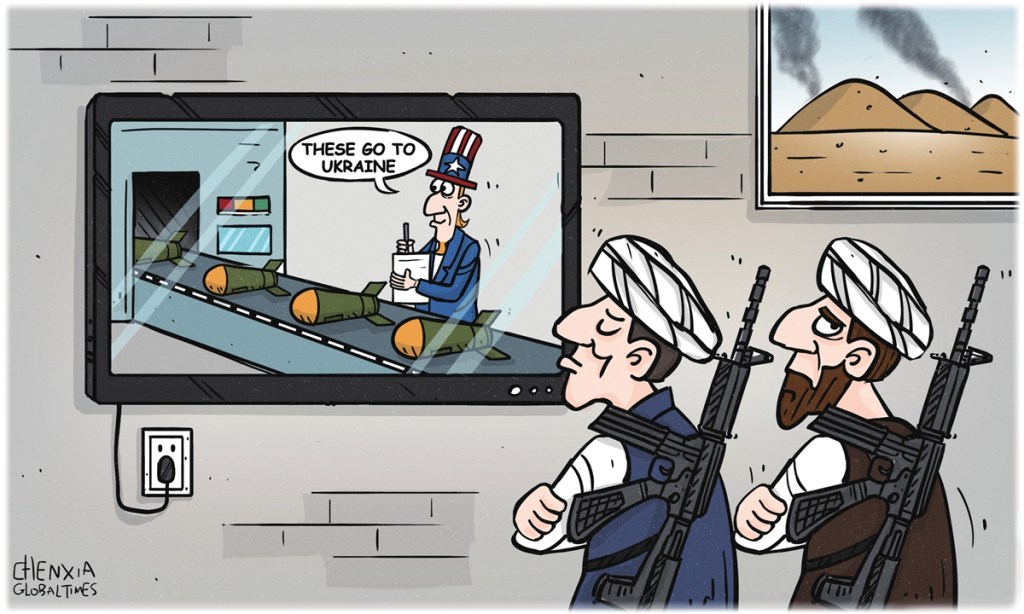
So, prepare yourself for “Slush Fund II” (coming soon to a theater near you). This time the vehicle for padding the Pentagon budget is likely to be the next military aid package for Ukraine, which will likely be put forward as an emergency bill later this year.  Expect that package to include not only aid to help Ukraine fend off Russia’s ongoing brutal invasion but tens of billions of dollars more to — yes, of course! — pump up the Pentagon’s already bloated budget.

Senator Lindsey Graham (R-SC) made just such a point in talking with reporters shortly after the debt-ceiling deal was passed by Congress. “There will be a day before too long,” he told them, “where we’ll have to deal with the Ukrainian situation. And that will create an opportunity for me and others to fill in the deficiencies that exist from this budget deal.”

Senate Majority Leader Chuck Schumer (D-NY) made a similar point in a statement on the Senate floor during the debate over that deal. “The debt ceiling deal,” he said, “does nothing to limit the Senate’s ability to appropriate emergency/supplemental funds to ensure our military capabilities are sufficient to deter China, Russia, and our other adversaries and respond to ongoing and growing national security threats.”

One potential (and surprising) snag in the future plans of those Pentagon budget boosters in both parties may be the position of House Speaker Kevin McCarthy (R-CA). He has, in fact, described efforts to increase Pentagon spending beyond the level set in the recent budget deal as “part of the problem.” For the moment at least, he openly opposes producing an emergency package to increase the Pentagon budget, saying:

“The last five audits the Department of Defense [have] failed. So there’s a lot of places for reform [where] we can have a lot of savings. We’ve plussed it up. This is the most money we’ve ever spent on defense — this is the most money anyone in the world has ever spent on defense. So I don’t think the first answer is to do a supplemental.”

The Massive Overfunding of the Pentagon

The Department of Defense is, of course, already massively overfunded. That $886 billion figure is among the highest ever — hundreds of billions of dollars more than at the peak of the Korean or Vietnam wars or during the most intensely combative years of the Cold War. It’s higher than the combined military budgets of the next 10 countries combined, most of whom are, in any case, U.S. allies. And it’s estimated to be three times what the Chinese military, the Pentagon’s “pacing threat,” receives annually. Consider it an irony that actually “keeping pace” with China would involve a massive cut in military spending, not an increase in the Pentagon’s bloated budget.

It also should go without saying that preparations to effectively defend the United States and its allies could be achieved for so much less than is currently lavished on the Pentagon.  A new approach could easily save significantly more than $100 billion in fiscal year 2024as proposed by Representatives Barbara Lee (D-CA) and Mark Pocan (D-WI) in the People Over Pentagon Act, the preeminent budget-cut proposal in Congress. An illustrative report released by the Congressional Budget Office (CBO) in late 2021 sketched out three scenarios, all involving a less interventionist, more restrained approach to defense that would include greater reliance on allies. Each option would reduce America’s 1.3-million-strong active military force (by up to one-fifth in one scenario). Total savings from the CBO’s proposed changes would, over a decade, be $1 trillion.

And a more comprehensive approach that shifted away from the current “cover the globe” strategy of being able to fight (though, as the history of this century shows, not always win) wars virtually anywhere on Earth on short notice — without allies, if necessary — could save hundreds of billions more over the next decade. Cutting bureaucracy and making other changes in defense policy could also yield yet more savings. To cite just two examples, reducing the Pentagon’s cohort of more than half-a-million private contract employees and scaling back its nuclear weapons “modernization” program would save significantly more than $300 billion extra over a decade.

But none of this is even remotely likely without concerted public pressure to, as a start, keep members of Congress from adding tens of billions of dollars in spending on parochial military projects that channel funding into their states or districts. And it would also mean pushing back against the propaganda of Pentagon contractors who claim they need ever more money to provide adequate tools to defend the country.

Contractors Crying Wolf

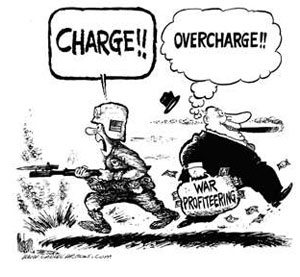
While demanding ever more of our tax dollars, the giant military-industrial corporations are spending all too much of their time simply stuffing the pockets of their shareholders rather than investing in the tools needed to actually defend this country. A recent Department of Defense report found that, from 2010-2019, such companies increased by 73% over the previous decade what they paid their shareholders. Meanwhile, their investment in research, development, and capital assets declined significantly. Still, such corporations claim that, without further Pentagon funding, they can’t afford to invest enough in their businesses to meet future national security challenges, which include ramping up weapons production to provide arms for Ukraine.

In reality, however, the financial data suggests that they simply chose to reward their shareholders over everything and everyone else, even as they experienced steadily improving profit margins and cash generation. In fact, the report pointed out that those companies “generate substantial amounts of cash beyond their needs for operations or capital investment.” So instead of investing further in their businesses, they choose to eat their “seed corn” by prioritizing short-term gains over long-term investments and by “investing” additional profits in their shareholders. And when you eat your seed corn, you have nothing left to plant next year.

Never fear, though, since Congress seems eternally prepared to bail them out. Their businesses, in fact, continue to thrive because Congress authorizes funding for the Pentagon to repeatedly grant them massive contracts, no matter their performance or lack of internal investment. No other industry could get away with such maximalist thinking.

Military contractors outperform similarly sized companies in non-defense industries in eight out of nine key financial metrics — including higher total returns to shareholders (a category where they leave much of the rest of the S&P 500 in the dust). They financially outshine their commercial counterparts for two obvious reasons: first, the government subsidizes so many of their costs; second, the weapons industry is so concentrated that its major firms have little or no competition.

Adding insult to injury, contractors are overcharging the government for the basic weaponry they produce while they rake in cash to enrich their shareholders. In the past 15 years, the Pentagon’s internal watchdog has exposed price gouging by contractors ranging from Boeing and Lockheed Martin to lesser-known companies like TransDigm Group. In 2011, Boeing made about $13 million in excess profits by overcharging the Army for 18 spare parts used in Apache and Chinook helicopters. To put that in perspective, the Army paid $1,678.61 each for a tiny helicopter part that the Pentagon already had in stock at its own warehouse for only $7.71.

The Pentagon found Lockheed Martin and Boeing price gouging together in 2015. They overcharged the military by “hundreds of millions of dollars” for missiles. TransDigm similarly made $16 million by overcharging for spare parts between 2015 and 2017 and even more in the following two years, generating nearly $21 million in excess profits. If you can believe it, there is no legal requirement for such companies to refund the government if they’re exposed for price gouging.

Of course, there’s nothing new about such corporate price gouging, nor is it unique to the arms industry. But it’s especially egregious there, given how heavily the major military contractors depend on the government’s business. Lockheed Martin, the biggest of them, got a staggering 73% of its $66 billion in net sales from the government in 2022. Boeing, which does far more commercial business, still generated 40% of its revenue from the government that year. (Down from 51% in 2020.)

Despite their reliance on government contracts, companies like Boeing seem to be doubling down on practices that often lead to price gouging. According to Bloomberg News, between 2020 and 2021, Boeing refused to provide the Pentagon with certified cost and pricing data for nearly 11,000 spare parts on a single Air Force contract. Senator Elizabeth Warren (D-MA) and Representative John Garamendi (D-CA) have demanded that the Pentagon investigate since, without such information, the department will continue to be hard-pressed to ensure that it’s paying anything like a fair price, whatever its purchases.

Curbing the Special Interest Politics of “Defense”

Reining in rip-offs and corruption on the part of weapons contractors large and small could save the American taxpayer untold billions of dollars. And curbing special-interest politics on the part of the denizens of the military-industrial-congressional complex (MICC) could help open the way towards the development of a truly defensive global military strategy rather than the current interventionist approach that has embroiled the United States in the devastating and counterproductive wars of this century.

One modest step towards reining in the power of the arms lobby would be to revamp the campaign finance system by providing federal matching funds, thereby diluting the influential nature of the tens of millions in campaign contributions the arms industry makes every election cycle. In addition, prohibiting retiring top military officers from going to work for arms-making companies — or, at least, extending the cooling off period to at least four years before they can do so, as proposed by Senator Warren — would also help reduce the undue influence exerted by the MICC.

Last but not least, steps could be taken to prevent the military services from giving Congress their annual wish lists — officially known as “unfunded priorities lists” — of items they want added to the Pentagon budget. After all, those are but another tool allowing members of Congress to add billions more than what the Pentagon has even asked for to that department’s budget.

Whether such reforms alone, if adopted, would be enough to truly roll back excess Pentagon spending remains to be seen. Without them, however, count on one thing: the department’s budget will almost certainly continue to soar, undoubtedly reaching $1 trillion or more annually within just the next few years.  Americans can’t afford to let that happen.

A War Like No Other in Ukraine

By Peter Van Buren

Source: WeMeantWell.com

Joe Biden created for the U.S. a war like no other, one where others die and the U.S. simply sits back and pays the bills on a gargantuan scale. No attempts are made at diplomacy by the Americans, and the diplomatic efforts of others like the Chinese are dismissed as evil attempts to gain influence in the area (similar for Chinese diplomatic work in the Yemen war.) Biden is coming close to achieving 1984‘s goal of perpetual warfare while only putting a handful of American lives at risk. He has learned lessons from the Cold War, and already put them into play. Can we call it the Biden Doctrine yet?

Biden’s strategy is clear enough now after well more than a year of conflict; what he has been sending to Ukraine jumped from helmets and uniforms to F-16s in only 15 months and shows no signs of stopping. The problem is U.S. weapons are never enough for victory and always “just enough” to allow the battle to go on until then next round. If the Ukrainians think they are playing the U.S. for suckers for free arms they best check who is really paying for everything, in blood.

Putin is playing this game himself in a way, careful not to introduce anything too powerful, such as strategic bombers, and upset the balance and offer Biden the chance to intervene in the war directly (one can hear old man Biden on TV now, explaining American airstrikes are needed to prevent a genocide, the go-to excuse he learned at Obama’s knee.) That’s what the current escalation holds, airpower. Ukraine will find even with the promise of the F-16 it can’t acquire aircraft and train up pilots fast enough (minimum training time is 18-24 months), and next will be begging the U.S. to serve as its air force. As it is the planes are likely to be based out of Poland and Romania, suggesting NATO will pick up the high-skilled tasks of maintaining and repairing them. Left unclear is the NATO role in required aerial refueling to keep the planes over the battlefield. F-16s aside, a spin off bonus to all these weapons gifts is that the vast majority of transfers to date have been “presidential drawdowns.” This means the U.S. sends used or older weapons to Ukraine, after which the Pentagon can use the Congressionally-authorized funds to replenish their stocks by purchasing new arms. The irony that war machines once in Iraq are now on the ground in Ukraine can’t be missed.

The U.S. strategy seems based on creating a ghastly tie of sorts, two sides lined up across a field shooting at each other until one side called it quits for the day. Same as in 1865, same as in 1914, but the new factor is today those armies face off across those fields with 21st-century HIMARS artillery, machine guns, and other tools of killing far more effective than a musket. It is unsustainable, literally chewing up men, albeit not Americans. The question meanwhile of how many more Ukrainians have to die is answered privately by Joe Biden as “potentially all of them.” Anything else requires you to cynically believe Biden thinks he can simply purchase victory,

Up until now this has all been the Cold War playbook. Fighting to the last Afghan was a strategy perfected in Soviet-held Afghanistan in the 1980s. Yet what is different is the scale — since Russia invaded Ukraine, the United States sent over $37 billion worth of military aid to support Kiev’s war effort, the single largest arms transfer in U.S. history and one with no signs of stopping. A single F-16 costs up to $350 million a copy if bought with weapons, maintenance equipment, and spare parts kits.

Yet despite the similarities to Cold War Strategy 101, some lessons have been learned over the intervening years. One of America’s fail-points throughout the Cold War and the War on Terror was the use of puppet governments largely imposed or direly supported by American money and muscle. Because these governments lacked the support of the people (see Vietnam, Iraq, and Afghanistan) they were non-starters with the lifespan of fruit flies. Ukraine is different; the puppet government is the government, beholden to the U.S. for its very survival but more or less supported directly by the people for now.

The other lesson learned has to do with nation building, or rebuilding or reconstruction, whatever the vast post-war expenditures will be called in this conflict. No more straight-up governmental efforts as in Vietnam, Iraq, and Afghanistan. This time it will be all private enterprise. “It is obvious that American business can become the locomotive that will once again push forward global economic growth,” President Zelensky said, boasting that BlackRock, JP Morgan, and Goldman Sachs, and others “have already become part of our Ukrainian way.”

The NYT calls Ukraine “the world’s largest construction site” and predicts projects there in the multi-billions, as high in some estimates as $750 billion. It will be, says the Times, a “gold rush: the reconstruction of Ukraine once the war is over. Russia is stepping up its offensive heading into the second year of the war, but already the staggering rebuilding task is evident. Hundreds of thousands of homes, schools, hospitals and factories have been obliterated along with critical energy facilities and miles of roads, rail tracks and seaports. The profound human tragedy is unavoidably also a huge economic opportunity.” Earlier this year JP Morgan and Zelensky signed a memorandum of understanding stipulating Morgan would assist Ukraine in its reconstruction.

And maybe those large American companies have learned the lessons of Iraq and Afghanistan. Of the billions spent, much money was wasted on dead ends and much was siphoned off due to corruption. But success or failure, the contractors always got paid in our Wars of Terror. With that in mind, more than 300 companies from 22 countries signed up for a Rebuild Ukraine exhibition and conference in Warsaw. At the World Economic Forum in Davos, Switzerland, a standing-room-only crowd packed Ukraine House to discuss investment opportunities.

The eventual gold rush in rebuilding makes for an interesting addendum to the Biden strategy of fighting to the last Ukrainian. The more that is destroyed the more that needs to be rebuilt, and the potential for more money to pour into U.S. companies smart enough to wait by the trough for the killing to subside. But why wait? Drones operated by Danish companies have already mapped every bombed-out structure in the Mykolaiv Oblast region, with an eye toward using the data to help decide what reconstruction contracts should be issued.

So let’s put some lipstick on this pig of a strategy and call it the Biden Doctrine. Part I is to limit direct U.S. combat involvement while fanning the flames for others. Part II is to provide massive amounts of arms to enable a fight to the last local person. Part III is to transform the home government into a puppet instead of creating an unpopular one afresh. Part IV is to turn the reconstruction process into a profit center for American companies. How long the war lasts and how many die are cynically not part of the strategy. The off ramp in Ukraine, a diplomatic outcome that resets the map to pre-invasion 2022 levels, is clear enough to Washington. The Biden administration seems content, shamefully, not to call forcefully for diplomatic efforts but instead to bleed out the Russians as if this was Afghanistan 1980, albeit in the heart of Europe.

The patriotism of killing and being killed

Why are patriotism and war so intertwined in U.S. media and politics?

By Norman Solomon

Source: Nation of Change

The Fourth of July—the ultimate patriotic holiday—is approaching again. Politicians orate, American Flags proliferate and, even more than usual, many windows on the world are tinted red, white and blue. But an important question remains unasked: Why are patriotism and war so intertwined in U.S. media and politics?

The highest accolades often go to those who died for their country. But when a war is based on deception with horrific results, as became clear during the massive bloodshed in Vietnam, realism and cynicism are apt to undermine credulity. “War’s good business so give your son,” said a Jefferson Airplane song in 1967. “And I’d rather have my country die for me.”

Government leaders often assert that participating in war is the most laudable of patriotic services rendered. And even if the fighters don’t know what they’re fighting for, the pretense from leadership is that they do. When President Lyndon Johnson delivered a speech to U.S. troops at Cam Ranh Bay in South Vietnam, he proclaimed that “you know what you are doing, and you know why you are doing it—and you are doing it.”

Five decades later, long after sending U.S. troops to invade Panama in 1989 and fight the 1991 Gulf War, former President George H.W. Bush tweeted that he was “forever grateful not only to those patriots who made the ultimate sacrifice for our Nation—but also the Gold Star families whose heritage is imbued with their honor and heroism.” Such lofty rhetoric is routine.

Official flattery elevates the warriors and the war, no matter how terrible the consequences. In March 2010, making his first presidential visit to Afghanistan, Barack Obama told the assembled troops at Bagram Air Base that they “represent the virtues and the values that America so desperately needs right now: sacrifice and selflessness, honor and decency.”

From there, Obama went on to a theme of patriotic glory in death: “I’ve been humbled by your sacrifice in the solemn homecoming of flag-draped coffins at Dover, to the headstones in section 60 at Arlington, where the fallen from this war rest in peace alongside the fellow heroes of America’s story.” Implicit in such oratory is the assumption that “America’s story” is most heroic and patriotic on military battlefields.

A notable lack of civic imagination seems to assume that there is no higher calling for patriotism than to kill and be killed. It would be an extremely dubious notion even if U.S. wars from Vietnam to Afghanistan and Iraq had not been based on deception—underscoring just how destructive the conflation of patriotism and war can be.

From Vietnam to Iraq and beyond, the patriotism of U.S. troops—and their loved ones as well as the general public back home—has been exploited and manipulated by what outgoing President Dwight Eisenhower called the “military-industrial complex.” Whether illuminated by the Pentagon Papers in 1971 or the absence of the proclaimed Iraqi weapons of mass destruction three decades later, the falsehoods provided by the White House, State Department and Pentagon have been lethal forms of bait-and-switch.

Often lured by genuine love of country and eagerness to defend the United States of America, many young people have been drawn into oiling the gears of a war machine—vastly profitable for Pentagon contractors and vastly harmful to human beings trapped in warfare.

Yet, according to top officials in Washington and compliant media, fighting and dying in U.S. wars are the utmost proof of great patriotism.

We’re encouraged to closely associate America’s wars with American patriotism in large part because of elite interest in glorifying militarism as central to U.S. foreign policy. Given the destructiveness of that militarism, a strong argument can be made that true patriotism involves preventing and stopping wars instead of starting and continuing them.

If such patriotism can ever prevail, the Fourth of July will truly be a holiday to celebrate.

Ukraine is America’s Afghanistan More Than Russia’s

By Peter Van Buren

Source: We Meant Well

The thinking in Washington goes like this: for the “low cost” of Ukrainian lives and some American dollars, the West can end Putin’s strategic threat to the United States. No Americans are dying. It’s not like Iraq or Afghanistan ’01-’21. This is post-modern, something new, a clean great power war, Jackson Pollack for war. Getting a lot of foreign policy mojo at little cost. It’s almost as if we should have though of this sooner.

Um, we did. It didn’t work out past the short run and there’s the message. Welcome to Afghanistan 1980’s edition with the U.S. playing both the American and the Soviet roles.

At first glance it seems all that familiar. Russia invades a neighboring country who was more or less just minding its own business. Russia’s goals are the same, to push out its borders in the face of what it perceives as Western encroachment on the one hand, and world domination on the other. The early Russian battlefield successes break down, and the U.S. sees an opportunity to bleed the Russians at someone else’s bodily expense. “We’ll fight to the last Afghani” is the slogan of the day.

The CIA, via our snake-like “ally” in Pakistan, floods Afghanistan with money and weapons. The tools are different but the effect is the same: supply just enough firepower to keep the bear tied down and bleeding but not enough to kill him and God forbid, end the war which is so profitable — lots of dead Russkies and zero Americans killed (OK, maybe a few, but they are the use-and-forget types of foreign policy, CIA paramilitary and Special Forces, so no fair counting them.) And ironic historical bonus: in both Afghanistan 1980s and Ukraine, some of the money spent is Saudi. See the bothersome thread yet?

Leaving aside some big differences that enabled initial successes in Afghanistan, chief among which is the long supply lines versus Ukraine’s border situation, let’s look at what followed early days.

Though NATO countries and others sent small numbers of troops and material to Afghanistan, the U.S. has gone out of its way to make Ukraine look like a NATO show when it is not. Washington supposedly declared support for Ukraine to preserve and empower NATO (despite the fact that Ukraine was not a member.) Yet, to keep Germany on sides in the Russian-Ukraine war, Washington (allegedly) conducted a covert attack on Germany’s critical civilian infrastructure that will have lasting, negative consequences for the German economy. Seymour Hersh reported the Nord Stream pipeline connecting cheap Russian natural gas to Europe via Germany was sabotaged by the United States. An act of war. The destruction of an ally’s critical infrastructure, and no doubt a brush back pitch carefully communicated to the Germans alongside a stern warning to stay put on sanctions against energy trade with Russia. It’s a helluva thing, blowing up the pipeline to force Germany to color inside the lines NATO (actually the U.S.) laid out. This, in addition to the U.S. treating NATO countries as convenient supply dumps and little more, shows that NATO will emerge from Ukraine broken. One does also wonder if the future of Europe is at stake why the greatest concern is expressed in Washington and not Bonn or Paris.

As with Afghanistan, there are questions if we Americans will ever be able to leave, about whether Colin Powell’s “Pottery Barn” rules applies — you break it, you bought it. President Zelensky, portrayed in the West as a cross between Churchill and Bono, in actuality was a comedian and TV producer who won the 2019 Ukrainian presidential election. Zelensky’s popularity was due in part to his anti-establishment image and promises to fight corruption and improve the economy. He was also aided by his portrayal of a fictional president in a popular TV show, which helped to increase his name recognition and appeal to young voters.

Zelensky was preceded by the Ukrainian Revolution, also known as the Euromaidan Revolution, which began in late 2013 as a series of protests in response to then-President Viktor Yanukovych’s decision to reject an association agreement with the European Union and instead pursue closer ties with Russia. The protests grew in size and intensity, with demonstrators occupying the central Maidan Nezalezhnosti square in Kiev, demanding Yanukovych’s resignation and new elections. In February 2014, the situation escalated when Yanukovych’s security forces cracked down on protesters, resulting in violent clashes that left dozens dead. This led to Yanukovych fleeing the country and a new government being formed in Ukraine. The revolution also sparked tensions with Russia, which subsequently annexed Crimea and supported separatists in eastern Ukraine. None of those problems goes away even if the Russia army retreats to its pre-invasion borders. The notion that there is nothing going on here except a rough land grab by a power-made Putin is shallow and incomplete.

What’s left are concerns about the level of corruption in Ukraine, and the U.S.’s role in addressing it. Despite the U.S. providing significant financial aid to Ukraine, there have been reports of corruption and mismanagement of funds. Some have argued that the U.S. has not done enough to address these issues, and has instead turned a blind eye in order to maintain its strategic interests in the region. America’s history with pouring nearly unlimited arms and money into a developing nation and corruption is not a good one (see either Afghanistan, 1980s or ’01 onward.) Corruption can only get worse.

A great fear in Afghanistan was arms proliferation, weapons moving off the battlefield into the wrong hands. Whether that be a container of rifles or the latest anti-aircraft systems, an awful lot of weapons are loose in Ukraine. In the case of Afghanistan, the real fear was for Stinger missiles, capable of shooting down modern aircraft, ending up in terrorist hands. The U.S. has been chasing these missiles through the world’s arms bazaars ever since, right into the Consulate in Benghazi. It is worse in Ukraine. America’s top-of-the-line air defense tools are being employed against Russian and Iranian air assets. What would those countries pay for the telemetry data of a shoot down, never mind actual hardware to reverse engineer and program against? There are no doubt Russian, Chinese, Iranian and other intelligence agencies on the ground in Ukraine with suitcases full of money trying to buy up what they can. Another cost of war.

It is also hard to see the end game as the demise of Putin. This would mean the strategy is not fight until the last Afghani/Ukrainian but to fight until the last Russian. The plan is for that final straw to break, that last Russian death, to trigger some sort of overthrow of Putin. But by whom? Trading Putin for a Russian-military lead government seems a small gain. Look what happened the last time Russia went through a radical change of government — we got Putin. In Afghanistan, it was the Taliban x 2.

History suggests the U.S. will lose in a variety of ways in Ukraine, with the added question of who will follow Putin and what might make that guy a more copacetic leader towards the United States. As one pundit put it, it is like watching someone play Risk drunk.

Dictators Bent on Building Military Empires: The Cost of the Nation’s Endless Wars

By John & Nisha Whitehead

Source: The Rutherford Institute

“Autocrats only understand one word: no, no, no. No you will not take my country, no you will not take my freedom, no you will not take my future… A dictator bent on rebuilding an empire will never be able to ease the people’s love of liberty. Brutality will never grind down the will of the free.”—President Biden

Oh, the hypocrisy.

To hear President Biden talk about the Russia’s aggression against Ukraine, you might imagine that Putin is the only dictator bent on expanding his military empire through the use of occupation, aggression and oppression.

Yet the United States is no better, having spent much of the past half-century policing the globe, occupying other countries, and waging endless wars.

What most Americans fail to recognize is that these ongoing wars have little to do with keeping the country safe and everything to do with propping up a military industrial complex that has its sights set on world domination.

War has become a huge money-making venture, and the U.S. government, with its vast military empire, is one of its best buyers and sellers.

America’s part in the showdown between Russia and the Ukraine has already cost taxpayers more than $112 billion and shows no signs of abating.

Clearly, it’s time for the U.S. government to stop policing the globe.

The U.S. military reportedly has more than 1.3 million men and women on active duty, with more than 200,000 of them stationed overseas in nearly every country in the world.

American troops are stationed in Somalia, Iraq and Syria. In Germany, South Korea and Japan. In Saudi Arabia, Jordan and Oman. In Niger, Chad and Mali. In Turkey, the Philippines, and northern Australia.

Those numbers are likely significantly higher in keeping with the Pentagon’s policy of not fully disclosing where and how many troops are deployed for the sake of “operational security and denying the enemy any advantage.” As investigative journalist David Vine explains, “Although few Americans realize it, the United States likely has more bases in foreign lands than any other people, nation, or empire in history.”

Incredibly, America’s military forces aren’t being deployed abroad to protect our freedoms here at home. Rather, they’re being used to guard oil fields, build foreign infrastructure and protect the financial interests of the corporate elite. In fact, the United States military spends about $81 billion a year just to protect oil supplies around the world.

The reach of America’s military empire includes close to 800 bases in as many as 160 countries, operated at a cost of more than $156 billion annually. As Vine reports, “Even US military resorts and recreation areas in places like the Bavarian Alps and Seoul, South Korea, are bases of a kind. Worldwide, the military runs more than 170 golf courses.”

This is how a military empire occupies the globe.

After 20 years of propping up Afghanistan to the tune of trillions of dollars and thousands of lives lost, the U.S. military may have finally been forced out, but those troops represent just a fraction of our military presence worldwide.

In an ongoing effort to police the globe, American military servicepeople continue to be deployed to far-flung places in the Middle East and elsewhere.

This is how the military industrial complex, aided and abetted by the likes of Joe Biden, Donald Trump, Barack Obama, George W. Bush, Bill Clinton and others, continues to get rich at taxpayer expense.

Yet while the rationale may keep changing for why American military forces are policing the globe, these wars abroad aren’t making America—or the rest of the world—any safer, are certainly not making America great again, and are undeniably digging the U.S. deeper into debt.

War spending is bankrupting America.

Although the U.S. constitutes only 5% of the world’s population, America boasts almost 50% of the world’s total military expenditure, spending more on the military than the next 19 biggest spending nations combined.

In fact, the Pentagon spends more on war than all 50 states combined spend on health, education, welfare, and safety.

The American military-industrial complex has erected an empire unsurpassed in history in its breadth and scope, one dedicated to conducting perpetual warfare throughout the earth.

Since 2001, the U.S. government has spent more than $4.7 trillion waging its endless wars.

Having been co-opted by greedy defense contractors, corrupt politicians and incompetent government officials, America’s expanding military empire is bleeding the country dry at a rate of more than $32 million per hour.

In fact, the U.S. government has spent more money every five seconds in Iraq than the average American earns in a year.

Future wars and military exercises waged around the globe are expected to push the total bill upwards of $12 trillion by 2053.

Talk about fiscally irresponsible: the U.S. government is spending money it doesn’t have on a military empire it can’t afford.

Unfortunately, even if we were to put an end to all of the government’s military meddling and bring all of the troops home today, it would take decades to pay down the price of these wars and get the government’s creditors off our backs.

As investigative journalist Uri Friedman puts it, for more than 15 years now, the United States has been fighting terrorism with a credit card, “essentially bankrolling the wars with debt, in the form of purchases of U.S. Treasury bonds by U.S.-based entities like pension funds and state and local governments, and by countries like China and Japan.”

War is not cheap, but it becomes outrageously costly when you factor in government incompetence, fraud, and greedy contractors. Indeed, a leading accounting firm concluded that one of the Pentagon’s largest agencies “can’t account for hundreds of millions of dollars’ worth of spending.”

Unfortunately, the outlook isn’t much better for the spending that can be tracked.

A government audit found that defense contractor Boeing has been massively overcharging taxpayers for mundane parts, resulting in tens of millions of dollars in overspending. As the report noted, the American taxpayer paid:

$71 for a metal pin that should cost just 4 cents; $644.75 for a small gear smaller than a dime that sells for $12.51: more than a 5,100 percent increase in price. $1,678.61 for another tiny part, also smaller than a dime, that could have been bought within DoD for $7.71: a 21,000 percent increase. $71.01 for a straight, thin metal pin that DoD had on hand, unused by the tens of thousands, for 4 cents: an increase of over 177,000 percent.

That price gouging has become an accepted form of corruption within the American military empire is a sad statement on how little control “we the people” have over our runaway government.

Mind you, this isn’t just corrupt behavior. It’s deadly, downright immoral behavior.

Americans have thus far allowed themselves to be spoon-fed a steady diet of pro-war propaganda that keeps them content to wave flags with patriotic fervor and less inclined to look too closely at the mounting body counts, the ruined lives, the ravaged countries, the blowback arising from ill-advised targeted-drone killings and bombing campaigns in foreign lands, or the transformation of our own homeland into a warzone.

That needs to change.

The U.S. government is not making the world any safer. It’s making the world more dangerous. It is estimated that the U.S. military drops a bomb somewhere in the world every 12 minutes. Since 9/11, the United States government has directly contributed to the deaths of around 500,000 human beings. Every one of those deaths was paid for with taxpayer funds.

The U.S. government is not making America any safer. It’s exposing American citizens to alarming levels of blowback, a CIA term referring to the unintended consequences of the U.S. government’s international activities. Chalmers Johnson, a former CIA consultant, repeatedly warned that America’s use of its military to gain power over the global economy would result in devastating blowback.

The 9/11 attacks were blowback. The Boston Marathon Bombing was blowback. The attempted Times Square bomber was blowback. The Fort Hood shooter, a major in the U.S. Army, was blowback.

The U.S. military’s ongoing drone strikes will, I fear, spur yet more blowback against the American people.

The war hawks’ militarization of America—bringing home the spoils of war (the military tanks, grenade launchers, Kevlar helmets, assault rifles, gas masks, ammunition, battering rams, night vision binoculars, etc.) and handing them over to local police, thereby turning America into a battlefield—is also blowback.

James Madison was right: “No nation could preserve its freedom in the midst of continual warfare.” As Madison explained, “Of all the enemies to public liberty war is, perhaps, the most to be dreaded because it comprises and develops the germ of every other. War is the parent of armies; from these proceed debts and taxes… known instruments for bringing the many under the domination of the few.”

We are seeing this play out before our eyes.

The government is destabilizing the economy, destroying the national infrastructure through neglect and a lack of resources, and turning taxpayer dollars into blood money with its endless wars, drone strikes and mounting death tolls.

Clearly, our national priorities are in desperate need of an overhauling.

At the height of its power, even the mighty Roman Empire could not stare down a collapsing economy and a burgeoning military. Prolonged periods of war and false economic prosperity largely led to its demise. As historian Chalmers Johnson predicts:

The fate of previous democratic empires suggests that such a conflict is unsustainable and will be resolved in one of two ways. Rome attempted to keep its empire and lost its democracy. Britain chose to remain democratic and in the process let go its empire. Intentionally or not, the people of the United States already are well embarked upon the course of non-democratic empire.

This is the “unwarranted influence, whether sought or unsought, by the military-industrial complex” that President Dwight Eisenhower warned us more than 50 years ago not to let endanger our liberties or democratic processes.

Eisenhower, who served as Supreme Commander of the Allied forces in Europe during World War II, was alarmed by the rise of the profit-driven war machine that emerged following the war—one that, in order to perpetuate itself, would have to keep waging war.

We failed to heed his warning.

As I make clear in my book Battlefield America: The War on the American People and in its fictional counterpart The Erik Blair Diaries, war is the enemy of freedom.

As long as America’s politicians continue to involve us in wars that bankrupt the nation, jeopardize our servicemen and women, increase the chances of terrorism and blowback domestically, and push the nation that much closer to eventual collapse, “we the people” will find ourselves in a perpetual state of tyranny.