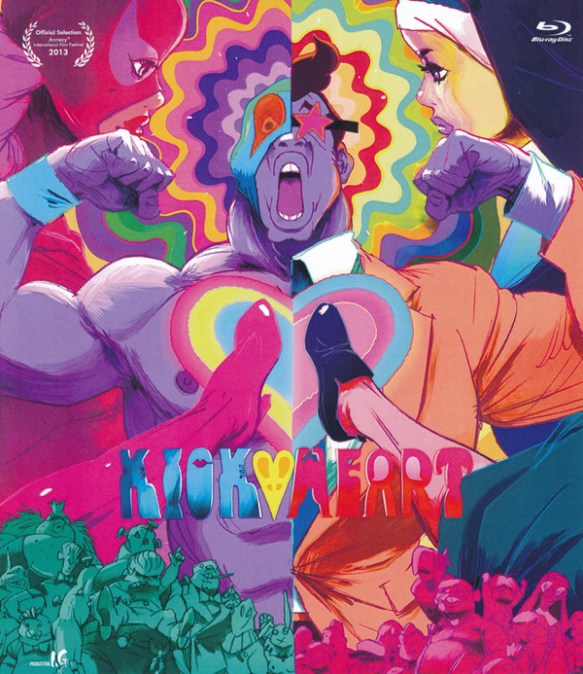
Production I.G’s Kick-heart directed by Masaaki Yuasa.
A love story between two people that each have a secret to hide. One a pro-wrestler, the other a Nun. Losing never felt so good.
Watch the full film here.

Production I.G’s Kick-heart directed by Masaaki Yuasa.
A love story between two people that each have a secret to hide. One a pro-wrestler, the other a Nun. Losing never felt so good.
Watch the full film here.
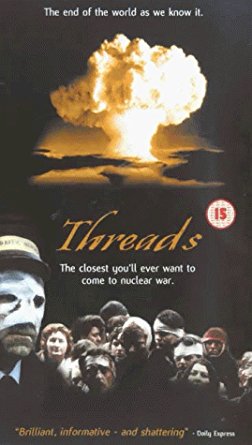
“Threads” (1984) is an apocalyptic cautionary tale written by Barry Hines, directed by Mick Jackson, and originally aired on BBC 2. It’s a docudrama depiction of nuclear war and its devastating effect on society and in particular two families in Sheffield England. Various news media reports describe the events leading up to the war (precipitated by aggressive US movements against Iran). With unflinching realism, the film depicts the sudden nuclear attack and devastating aftermath including medical, economic, social and environmental consequences. Should be required viewing for all chickenhawk neoliberals, though some may be too psychopathic to rethink their pro-war convictions.

Review by Underground Film Journal
Horns and Halos, which opened the 9th New York Underground Film Festival, is a documentary by married filmmakers Suki Hawley and Michael Galinsky about the intrigue surrounding the publication of the controversial book Fortunate Son, a biography of George W. Bush. The book was originally published by St. Martin’s Press in 1999, subsequently pulled off the bookstore shelves by them after controversy arose over a passage accusing Bush of being a convicted drug user and then re-published by a little artsy boutique outfit in New York City called Soft Skull Press.
What makes Horns and Halos a successful documentary is that the filmmakers did an excellent job of remaining amazingly unbiased towards the subject matter. While watching the movie, I got the impression that Bush supporters would dismiss everyone involved in the book’s publication as a complete wacko and reject any criticisms made against the president in the film; and that anti-Bush activists would find the issues brought up by the book to be damning evidence against him. Personally, I think the truth lies, as the saying goes, somewhere in-between.
The author of Fortunate Son is Arkansas author J.H. Hatfield who, despite appearing slightly off-kilter, seems like an intensely earnest man who just wanted to be taken as a serious author. Previous to his infamous work, Hatfield was the writer of unauthorized biographies of Ewan McGregor and Patrick Stewart, as well as guides to TV shows like Star Trek, Lost in Space and The X-Files.
The main focus of the film, however, is Sander Hicks, the garrulous and determined CEO of Soft Skull Press and re-publisher of “Fortunate Son.” It makes sense that Horns and Halos would spotlight Sander over Hatfield, though, since the movie seems like a very low-budget affair and Hawley, Galinsky and Hicks are all NYC residents while Hatfield lived all the way in Arkansas.
But what’s interesting about all four participants — the filmmakers and their subjects — is that they all seem to be people who have stumbled onto a subject that’s bigger than themselves. There’s a lot of information presented in and lurking around the fringes of Horns and Halos that I really think would have been better served by someone with a bigger budget, for example Michael Moore who can afford a team of researchers; travel freely around the country and also possibly have the balls to charge the White House and demand interviews with Bush and Karl Rove, whose name figures prominently in Hatfield’s research but whom the filmmakers don’t go into much detail on.
But that doesn’t mean that this film shouldn’t be seen and that Galinsky and Hawley’s approach isn’t entirely successful. The real winner of the movie, even though he isn’t in the film as much as I would have liked, is Hatfield. I think the film, at the very least, redeems his character, which got so maligned in the public forum that it eventually led him to commit suicide in 2001.
It is true that Hatfield was an ex-felon. He served five years in prison after being convicted of conspiracy to murder in 1988. But he also may have been a victim of a greedy publisher who forced him to include in his book the unsubstantiated rumor that Bush was convicted of cocaine possession in 1972.
The drug charge story is a complicated one and rather than me recount it here, a good overview of it is included in a new preface by Sander Hicks in Fortunate Son, which is also available to read on Soft Skull Press’s website. While the preface is interesting, it does make one or two slips, especially in not footnoting key passages, e.g. the statement, “[Bush] blurted out at a press conference that he hadn’t done drugs since 1974.” Little details like that can bug me and prevent me from agreeing with a story 100%. (Alas, since the writing of this review, Hicks’ preface is no longer available, but there is a new forward by Mark Crispin Miller.)
The same goes for all of Horns and Halos. I do think having a little bit more of Hatfield in the flick would have made things a lot more clearer, especially considering the scope of the subject. After the NYUFF screening of the film, Hicks and Galinsky did a brief Q&A session together (Hawley was absent as she had just given birth to a daughter) and I thought it really sad that Hatfield couldn’t be there to see the finished film and accept the applause from the audience that would have greeted him. I think he would have been the hit of the festival.
Most library system members can watch the full film on Kanopy.
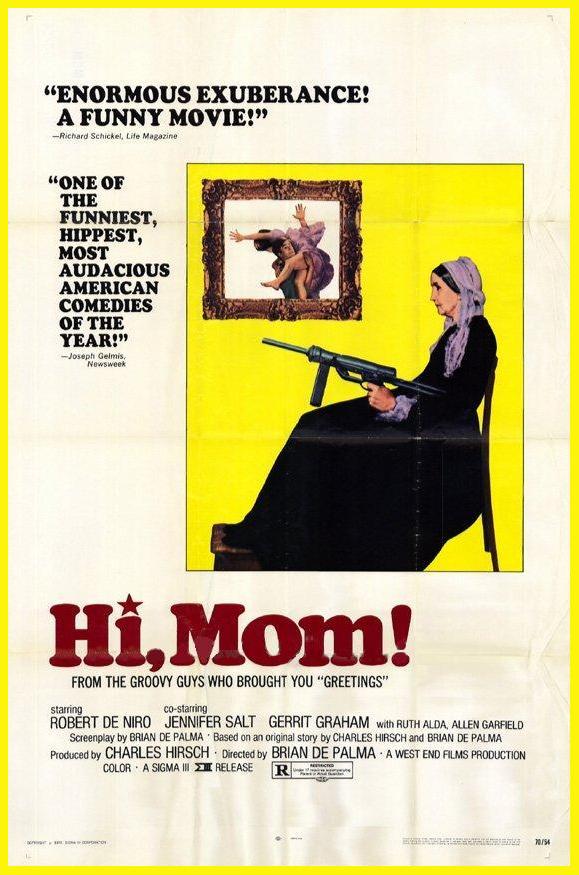
“Hi, Mom!” (1970) is a dark comedy directed by Brian De Palma and stars Robert De Niro. It’s a sequel to Greetings (1968) in which De Nero reprises his role of John Rubin who is now a voyeuristic filmmaker. John later falls in with a group of militant black activists leading to the film’s most memorable scene in which he participates in an experimental theater performance. The show is called “Be Black, Baby” and requires its white audience to don blackface and be subjected to an escalating series of abuses by black actors in whiteface until John arrives as a seemingly real NYPD officer and proceeds to put the white audience members under arrest. De Palma and De Niro’s next collaboration would be 17 years later for The Untouchables.
INDIAN COUNTRY NEWS
"It is the duty of every man, as far as his ability extends, to detect and expose delusion and error"..Thomas Paine
Human in Algorithms
From the Roof Top
I See This
blog of the post capitalist transition.. Read or download the novel here + latest relevant posts
अध्ययन-अनुसन्धानको सार
 After the Crash