
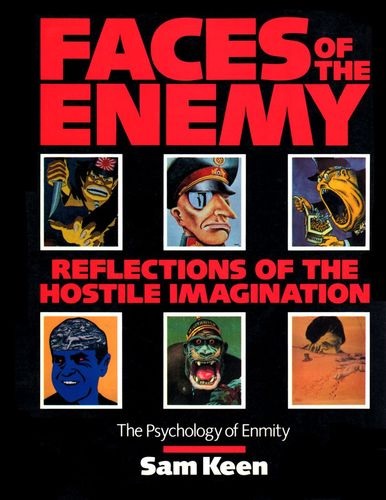
Description from California Newsreel:
As relevant today as when it was first released, Faces of the Enemy follows social psychologist Sam Keen as he unmasks how individuals and nations dehumanize their enemies to justify the inhumanity of war.
Using archival news footage, public service announcements, and editorial cartoons, Keen unveils the same frightening pattern in conflict after conflict – World War II, the Vietnam War, the Cold War, Islamic and Christian Fundamentalism – and prefigures the current War on Terrorism. First we identify ourselves as victims. Then we blame, demonize and finally dehumanize our adversaries, rationalizing our murder of other human beings.
Faces of the Enemy contends that before a drop of blood is spilled we must ‘think each other to death.’ It is a story replayed on the nightly news, in Islamic Fundamentalists’ characterization of the West as the ‘Great Satan’ and our own stereotyping of Muslims as terrorists. In a revealing examination of the images and iconography of war Keen interviews the nation’s leading editorial cartoonists. They discuss how they use an almost universal language of stereotypes and prejudices to tap into readers’ most visceral emotions.
In a chilling example of the psychological roots of enmity, we meet David Rice, an unemployed welder now an inmate on Death Row. Influenced by far-right propaganda, Rice decided communism was responsible for his personal problems. He bludgeoned to death a family of four whom he (mistakenly) thought were communists. He remains without remorse regarding them as ‘collateral damage’ in a war against the Evil Empire. The Christian Fundamentalist leaders who inspired Rice are only too happy to explain that they are in a holy war against communists and any non-believers.
By contrast, William Broyles, a Viet Nam veteran and author, returned after the war to personalize the individuals who had been his enemies’ to humanize the abstractions. He explains how racist terms and images can be used to turn human beings into monsters. These epithets and images extend the circumstances of war into terrible brutality. But he also explains how we can move beyond these dehumanizing thoughts and seek out the humanity of others.
Psychologists Robert Lifton and Steven Kull explain how war and artificial enemies provide people with the moral and mental certainties they crave, giving them a sense of purpose in a sometimes-ambiguous world. Mythologist Joseph Campbell, providing a note of hope, suggests that underneath the mask of the enemy we ultimately recognize ourselves. This, Campbell further contends, may be the origin of compassion, brotherhood and altruism, in other words the inverse of war.
Watch the full film on Kanopy.

Director Jennifer Abbott and Mark Achbar’s “The Corporation” (2003) is a comprehensively researched film exploring the history of corporations, how they operate and how they’ve come to attain so much political power. Related topics include the 1933 attempted corporate coup exposed by General Smedley Butler, the Fox news coverup of the dangers of Monsanto’s Bovine Growth Hormone, and the mass protests in Bolivia sparked by the attempted privatization of their water supply in 2000.
By Tom Keiser
Source: WFMU
“It makes no sense. I mean, how can people just vanish off the face of the Earth in this day and age?”
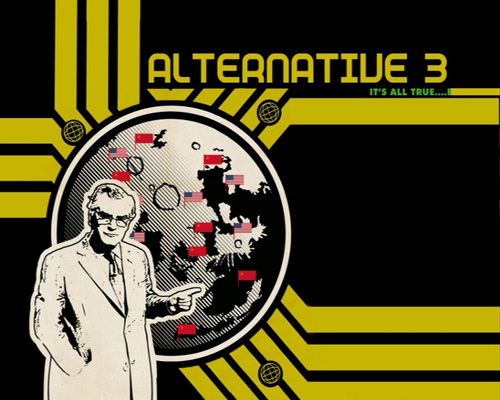
In 1977, a conspiracy was hatched involving writers, actors, politicians, scientists, and Brian Eno. The British television series Science Report was about to be cancelled, and its scheduled April 1 finale gave the creators an opportunity to prank those who believed everything they saw on television, and those so skeptical of everything as to see conspiracies all over the place. The resulting program, Alternative 3, is a classic in fake news programming; The War Of The Worlds by way of the BBC’s 1957 spaghetti harvest hoax.
Alternative 3 is presented as an investigation, with an aborted episode of Science Report as the frame. Twenty-four people interviewed for a Science Report episode on Britain’s “brain drain” have gone missing, including three profiled before the introduction. Over the next hour, further pieces of the puzzle are put into place, connecting the disappearances to the death of a prestigious astronomer, the drunk ravings of a former astronaut, and the theories of an early proponent of the climate change hypothesis, Dr. Carl Gerstein. Contemporary news events, such as the Tangshan earthquake and United Kingdom heatwave and drought in 1976, and the North American mega-blizzard of early 1977, hint at a more destructive event than even the producers of The Day After Tomorrow could have imagined.
Gerstein finally unveils Alternative 3, one of a trio of ways for the human race to survive what he sees as an irreversible and cataclysmic return to the ice age. Compared to the “drastic reduction of the human population” (Alternative 1), and a plan to build underground bases to ride the catastrophe out (Alternative 2), Alternative 3 sounds just as good or bad. But since Alternative 3 is the name of the program, one can guess which is being implemented, and when it’s revealed, it’s a real doozy.
The program’s host, Tim Brinton, was a respected presenter and eventually became a Conservative MP, lending credibility to Alternative 3. Director Christopher Miles worked on feature films and television before and after the program’s release, and writer David Ambrose would go on to write screenplays for The Final Countdown and D.A.R.Y.L., among other films.
Labor issues delayed Alternative 3’s release until June 20, 1977, removing its April Fool’s context entirely — aside from a title card at the end placing the episode at it’s intended release date. The episode’s production values are very similar to British TV documentaries past and present, although it almost resembles self-parody at spots. The segues and dramatizations anticipate Look Around You by 25 years.
The otherworldly tone of the space sequences can be chalked up to Brian Eno’s score, later released under the track “Alternative 3” in his 1978 album Music For Films. Eno would return to lunar exploration later in his career. His 1983 album Apollo: Atmospheres and Soundtracks was later reworked as the soundtrack to the 1989 Apollo program documentary For All Mankind.
There are a few recognizable faces in Alternative 3, at least if you really know your stuff. Shane Rimmer, a self-proclaimed “rent-a-Yank” for British films and the voice of Scott Tracy on the classic TV show Thunderbirds played astronaut Bob Grodin. Richard Marner, who played Dr. Gerstein, became better known in the UK for the show ‘Allo ‘Allo, where he played an inept Nazi colonel. And Norman Chancer, who played science reporter Charles Welbourne, may be best known for his role as Moritz, the unorthodox psychologist in Local Hero.
To this day, many people think Alternative 3 to be disinformation. Viewers at the time believed the disinfo to come from the U.S, British, and Soviet governments, perhaps too busy calling Anglia TV with their outrage to see the cast listing in the credits. A novel based on the TV special also led credence to their worries. The prevaling line of thought these days is that the special was indeed a hoax, but based on factual information. Therefore, Alternative 3 was made to make a real Alternative 3 situation look like such a science fiction fantasy as to remove it from the public’s consciousness. Others still even believe that not only is Alternative 3 real, but is connected to our contact with extraterrestrials. But even a skeptic can love Alternative 3 as an entertaining hour of programming, and it also works as a great counterpoint to 1978’s Capricorn One, about a botched Mars landing being faked to prevent NASA from going under.
No matter what you take from Alternative 3, or what you believe about it, this film will stay with you, just like the sight Bob Grodin saw on the dark side of the moon.
Related Article:
The Truth About Alternative 3 (An archived newsletter excerpt featuring a letter from Leslie Watkins, author of the novelization of the screenplay available here: https://archive.org/details/Alternative3-33rdAnniversaryEdition )

By Bill Gibron
Source: Pop Matters
Film has always been a visual medium. In the days before sound, the image was all we had. It told our story, established our characters, and accentuated the drama or comedy. Visual flair is as old as movies themselves, and yet so few directors today seem to rely on and relish in the imaginative or outrageous. Since the early ’60s, Hollywood and its filmmakers have de-evolved style in a vicious cycle real world recreation for the hyper-stylized universe of the big screen, exploiting small events to find the hidden theatrics. Instead of broad canvases of color or rich, dense imagery, we witness the mundane or maudlin. Even those epic dreamscapes woven by complex computers and deranged art designers usually have one foot firmly planted in the easy to recognize and rationalize. But not The City of Lost Children. It harkens back to a more old-fashioned pictographic mindset. In many significant and indirect ways, the wild world of Marc Caro and Jean-Pierre Jeunet is art come to life. As in their previous film together, 1991’s Delicatessen, it is a fairy tale presentation of pure unbridled, wonderfully wicked imagination. It’s the Brothers Grimm as envisioned by Salvador Dali and filmed by Fritz Lang.
This is a lost classic, a film not often discussed when visionary works of imaginative cinema are mentioned. Part of this may be due to its foreign film roots. Or perhaps, for many, the film is too dark, not your typical sweet Saturday morning matinee. There are very disturbing subtexts to City that do not exist in other flights of fancy. The children here are indeed lost, either captured and tormented by a character known as Krank, or forced into a life of juvenile crime by the manipulative twins who run an orphanage. We do not see mothers or fathers. There are no caregivers or guardians, nor do we see orphans or outcasts longing for them. This lack of unconditional love creates youths who are vastly more mature, discussing subjects like love and fear with ferocious intensity and sly maturity. The strongman known as One is the closest we have to any type of parental figure, and even he is not really the older, bigger brother. “No parents” does not equal “no worries” in City. This is also a film that wallows in the subtle beauty of the grotesque, amplifying ugliness to illustrate unbridled absurdity. From Jean Paul Gautier’s Marquis de Sade meets Moby Dick fashion statements to the walleyed, demon-like faces of the child-napping zealot Cyclops, the film takes the long lost look of the circus sideshow and melds it to a nightmarish world of technological and emotional freaks.
Jean-Pierre and Marc are obviously obsessed with the carnival. The entire color scheme seems lifted from a tattooed man’s body illustrations. Like Fellini’s La Strada, which sought to tell a simple tale of love and the human spirit within the unreal realm of the circus, the filmmakers use the fantastical festival setting as a means of expressing their themes. Within its pandemonium pallet are the purity of youth, the pain of age, the wickedness of greed, and the comfort of love. There are also religious philosophies at play, battles with God both figuratively and literally. Krank and his army of clones fight and argue amongst themselves, all in the hope that, one day, the Creator will return to right his genetic missteps. The twins lord over their orphan charges like devils at the seat of Satan’s cloven hoof, waiting for instruction and brimstone beatitudes. Even the Cyclops proclaim their undying faith by blinding themselves, hoping that God will see that through both their devotion and their evangelism how truly gifted with sight (both internal and external) they are. Just like the wistful notion of running off to join the traveling show, The City of Lost Children is a chance not taken, a place where the oppression of maturity, of the stark reality of mortality and responsibility turn adults into monsters, and children into commodities.
The viewer can see many divergent ideals and inspirations at work here. But the most interesting influence to wind its way throughout the entire film is American cartoonist and inventor Rube Goldberg. Goldberg’s ingenious drawings illustrated incredibly complicated and multi-stepped procedures to achieve the most basic of results. Several set pieces in the film apply his principles and influences, and there is a giddy joy when their cause and effect logic draws to its ultimate conclusion. One sequence, involving the animal kingdom and a call to arms, is as beautiful as it is ridiculously complex. Like all other special, unnerving aspects of this movie, from the twisted fable at the core of its narrative, to the subtle pronouncements on love and family, The City of Lost Children is indeed like one of Goldberg’s wildest inventions. It’s a film that hitches its humor to the stinger of a flea, rides it on the heads of circus strongmen, and brings its heartfelt conclusion to rest in the bubbling tank of a talking, sarcastic brain. Yet the movie never gets lost itself. There is a perverse logic in its over symbolic and stylized storytelling.
No discussion of City would be complete without a word or two about the film’s music and its wonderful performances. As he has done in so many other films for auteurs like David Lynch and Paul Schrader, Angelo Badalamenti creates the perfect score, adding the clarion call of the calliope and the lonesome moan of the strings to underscore the strangeness and the sadness. This is a town under fire from within (the gangs of mercenary urchins) and without (the abductions), and Badalamenti creates a theme and an aural presence for every ideal. Sonically, The City of Lost Children is a near seamless matching of music to moving image. As for the actors, Ron Perlman has always seemed like a stunt waiting to be cast. Usually unrecognizable in face altering or obliterating make-up, he normally essays roles as unreal as the location in this film. But interestingly enough, he is the very human core of the film, a strong, faithful muscleman whose basic needs match his simpleton intellect. His is a perfectly modulated, understated performance. Among the child actors, little Judith Vittet stands out as Miette, a child who carries an incredible amount of adult soul and beauty within her delicate, French bisque features. And as usual, Jeunet regular Dominique Pinon applies his elastic facial features to the creation of six distinct characters, all out of minimal dialogue and elegant pantomime.
A movie like The City of Lost Children doesn’t really want to show us where the secrets of youth are hidden. It buries its message of adulthood and its perils in elaborate sets and visually arresting images. It symbolizes the dead end of avarice, the importance of familial bonds, and the painful loss of innocence through dreams in wonderful, paint box strokes. But it still leaves us wondering if such a place actually exists. For some, the manufactured wonders of Disney World or Universal Studios theme parks offer a glimpse into the sacred village of eternal childhood. Still others find it in the magic of their offspring at play, in their riotous laughter. Many see it in the eyes of their son or daughter as they light up in loving response. And there are those who, no matter how hard they try or how long they look, will never find the City. It will pass them by, or they will look over or through it in pursuit of a more complicated, unimportant goal. Jean-Pierre Jeunet and Marc Caro have at least provided a roadmap to the mythological place in their film La Cité des Enfants Perdus. Just turn right at your dreams, be on the lookout for your heartstrings, and ride your imagination all the way to where the sea meets the sky.
INDIAN COUNTRY NEWS
"It is the duty of every man, as far as his ability extends, to detect and expose delusion and error"..Thomas Paine
Human in Algorithms
100% Accurate Google Sheets + KDP Book Formatting | 24hr Delivery
From the Roof Top
I See This
blog of the post capitalist transition.. Read or download the novel here + latest relevant posts
अध्ययन-अनुसन्धानको सार
 After the Crash