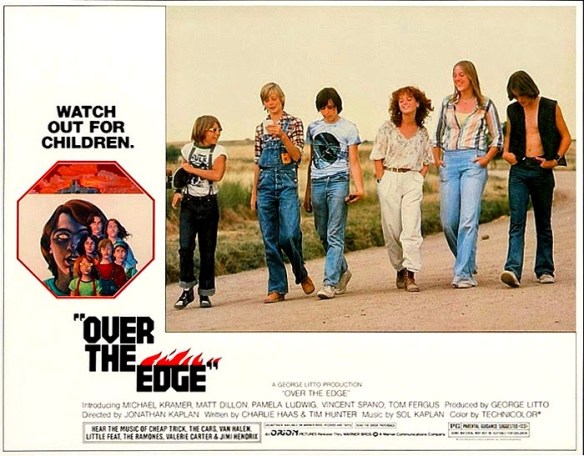
We’ll get to Cheap Trick’s contributions to the soundtrack in a moment, but first let’s take a look back at the film itself. When Over The Edge was released to just a handful of theaters in May 1979, the relatively new Orion movie company’s first poster and marketing campaign for the film — featuring pale kids with empty eyes, looking like zombies — got it very wrong, very wrong, making it look like they were promoting a horror movie.
Orion — the new film finance and production company had been launched in March 1978 — had been formed by five former United Artists film execs, who named their new company after a constellation that contains five clearly visible stars, and despite their confidence, they weren’t too sure-footed as a stand-alone company yet, and like any new movie company, they wanted their first release to be a hit.
Originally, they’d slated another film — director George Roy Hill’s A Little Romance — to be their first release, and Over The Edge was to be their second released in 1979.
Executives at Orion, however, were initially troubled by some of the violence they’d read in the script (there really isn’t much dude-on-dude violence, though) and they wanted the screenwriters to tone it down, and make it into a kind of Romeo & Juliet love story amid a larger story of disenfranchised youth, but the writers held firm to their original concept (originally it was titled On The Edge).
Written by screenwriter Tim Hunter — son of blacklisted screenwriter Ian McClellan Hunter — and Charles Haas, a fellow screenwriter and one of Hunter’s former film history students at UC Santa Cruz, Over The Edge was inspired by a newspaper article about the then-recent uptick in juvenile crime in Foster City, an upper-middle class planned suburb located about halfway between Palo Alto and San Francisco in Northern California, not too far from the San Francisco Airport.
The story — headlined “Mousepacks: Kids on a Crime Spree” — had been published in the November 11, 1973 edition of the San Francisco Examiner, written by reporters Bruce Koon and James Finefrock.
Writer Mike Sacks’s excellent oral history for VICE remains thus far the most definitive essay and oral history about Over The Edge, and we encourage you to check it out, since it contained just about everything you’d want to know about the film itself, and featured interviews with twenty members of the cast and crew.
Sacks quotes from the original newspaper article in his piece for VICE:
“Mousepacks. Gangs of youngsters, some as young as nine, on a rampage through a suburban town. One on a bike pours gasoline from a gallon can and sets it afire. Lead pipe bombs explode in park restrooms. Spray paint and obscenities smear a shopping center wall. Two homes are set ablaze. Antennas by the hundreds are snapped off parked cars in a single night. Liquid cement clogs public sinks and water fountains. Street lights are snuffed out with BB guns so often they are no longer replaced. It sounds like the scenario for an underage Clockwork Orange, a futuristic nightmare fantasy. But all the incidents are true. They happened in Foster City where pre-teenage gangs—mousepacks—constitute one of the city’s major crime problems.”
The original article detailed how teens had gone into a local junior high gymnasium — probably Nathaniel Bowditch Middle School — and destroyed pool tables and ping-pong tables, and the vandalism had led to the cancellation of programs that were sponsored by the Foster City parks department.
This kind of vandalism was directly related to the fact that the city planners who had designed the ideal communities like Foster City had thought of everything for the adults, but they forgot the fact that at least 25% of the population moving into these pre-fab cities were under the age of 25.
They were given pool and ping-pong tables at the gym, and lame recreation centers that closed at 6pm, but everything was so new and fake-looking it inspired the teens to want to destroy it.
And so, the kids of Foster City felt isolated, restless and bored out of their minds, which is what led to them spending their evenings drinking and getting high, breaking and entering, and vandalizing city property.
Hunter’s and Haas’s screenplay reflected this adolescent ennui perfectly, showing how the design and planning of their pre-fab city New Granada (in place of Foster City) actually plays a part, like a character itself, in how these teens felt about where they were living, and what was going on in their lives.
The director of Over The Edge, Jonathan Kaplan, should be and has been given a lot of credit for bringing Hunter’s and Haas’s vision to the screen. The son of film composer Sol Kaplan and actress Frances Heflin, he had gone to NYU film school and where as an undergrad, Martin Scorsese was one of his professors.
He had directed just one major picture, in 1975, White Line Fever, and also directed the infamous Sex Pistols movie called Who Killed Bambi?, prior to getting this job, coming in to replace Russ Meyer for a spell before the film fell apart completely.
Kaplan — just thirty years old at the time — apparently had a real connection with his youthful cast, this despite the stress everyone felt onset, having a 36-day shoot schedule, with most of the film’s night scenes hurriedly going before cameras first, forcing the young cast to sleep days and bond over long hours at night.
The production itself had to be moved from California, due to the state’s rigid child labor laws, to two locations in Colorado — Greeley and Aurora, roughly ten miles from Colombine High.
Before then, however, Kaplan had to find his cast, and due to both budget constraints and wanting to find unknown young actors who were actually fourteen (rather than find experienced 20-year olds who could look 14), he began working on the casting, out of New York, meeting with more professional young actors, while Hunter and Haas began going to schools and asking the principals or drama teachers to recommend students: those kids turned out to be wrong, but they eventually found the right students by meeting kids who had cut class and were found smoking pot behind the school.
One of those students was Matt Dillon, who was found at a middle school in Westchester, New York, cutting class and smoking in the boy’s room. He had a chipped tooth, and he tried to act tough when they began talking to him about his interest in acting.
Kaplan and talent scout Jane Bernstein asked him what his parents did, and Dillon told them his father was “a fucking stockbroker and my mom, she don’t do shit.”
They met with his family and realized he was as middle-class as they come, perfect for the role although he had zero acting experience. After all, Matt Dillon was only 14.
One of the best things about the movie, though, which everyone involved got right — and all credit must be given to the director, and to the young members of his cast — was the film’s soundtrack.
According to what actress Pamela Ludwig told writer Mike Sacks, during filming, the young cast would bring a boombox with them to wherever they were shooting, and they would rock out to whatever they were listening to at the time — including songs by The Cars (“My Best Friend’s Girl” and “Just What I Needed”), Van Halen (“You Really Got Me”), the Ramones (“Teenage Lobotomy”), Joe Walsh, etc. — and she even playing tracks by bands that weren’t quite well known just yet, particularly and most importantly, songs by Rockford, Illinois-based rockers Cheap Trick.
Ludwig is practically credited as a music supervisor because she turned the cast and the crew on to Cheap Trick’s albums (her boyfriend, a roadie, had made her tapes of albums that weren’t yet widely known about, and certainly not being played on the radio), and four of their songs would eventually make their way into the film — “Surrender,” “Speak Now or Forever Hold Your Peace,” “Hello There,” and “Downed” –– and on to the film’s LP soundtrack, which is worth a lot of money today if you can find yourself a copy.
You can get a real sense for how wrong the trailer was for the film (which feels more like a horror movie — more about that in a sec) by watching the first few minutes of the actual film itself, the first image onscreen being a billboard advertising “New Granada: Tomorrow’s city… today” (later, another billboard, this time one that is being dismantled, reads “New Granada: Ideal business environment”), to the churning rock guitars of Cheap Trick’s “Speak Now or Forever Hold Your Peace,” from their self-titled debut.
The lyrics — the song, one of Cheap Trick’s few cover songs, was written and previously recorded by British rocker Terry Reid — are pitch-perfect:
Yesterday feels like running away
Feels like givin’ the child gettin’ lost losin’ my mind
I’m feelin’ low and i got no place to go
Gettin’ all tied up, feelin’ all tied up yeah
The action gets underway as two teens on a highway overpass begin firing on a police car with a BB rifle.
Their nemesis, Sgt. Doberman (Harry Northup), loses the snipers in a chase and instead grabs 14-year-old Carl Willat (Michael Kramer) and his friend Richie White (Matt Dillon) while they’re walking home, but Richie — who is currently on probation for breaking and entering — refuses to cooperate with Doberman’s questions. Carl’s record is clean and his Cadillac salesman father (Andy Romano) wants to keep it that way so his son won’t end up in reform school on “The Hill.”
All Carl wants to do is to listen to Cheap Trick on his headphones, and it’s pretty great to hear their music in this film considering they were a band who were relatively unknown but were just beginning to break in the U.S. at the time the movie was being filmed, in 1978.
By the time of the film’s release, in 1979, Cheap Trick — lead singer Robin Zander, guitarist Rick Nielsen, bassist Tom Petersson and drummer Bun E. Carlos — had released three albums: their 1977 self-titled debut, followed by In Color (also 1977), and Heaven Tonight (1978) — and although all three were critically-acclaimed by the rock media, none of them were selling particularly well at the time and certainly none had cracked the Top 40.
Things were about to change, however, for Cheap Trick, who toured incessantly then as they do now, playing any gig that came their way. Their reputation was that they were a solid opening band — they played shows with Kiss, Queen, Aerosmith, Motley Crüe, and did a co-headlining tour with AC/DC.
Despite still being relatively unknown in America, it turns out that they were huge in Japan in 1978, where all three albums had gone gold. In April 1978, they had even done their first Japanese tour, flying coach and stepping off their plane to find that there were thousands of Japanese fans waiting for them at the airport.
They ended up having to have 24-hour guards posted at their hotel, and decided to record two of their shows, at at Tokyo’s famous Nippon Budokan, for a Japan-only live album, Cheap Trick At Budokan.
However, a funny thing caught their label, Epic Records, off-guard, when import copies of the album (released in Sept. ’78) began flying off the shelves, and radio stations across the country began playing the raucous live versions of “Surrender” and “I Want You to Want Me,” and they very quickly released a domestic version of Cheap Trick At Budokan in the States, which would eventually sell over three million copies and climbing the Billboard album charts to #4.
Of the songs included on the Over The Edge soundtrack, “Surrender” seems to be the one that perhaps captures the best overall vibe of the film’s teen angst, getting the feeling that most teenagers feel about their parents absolutely right: they’re fucking weird.
“Surrender” is the lead-off track on the movie soundtrack, and the unofficial theme song too, accompanying one of the movie’s best scenes, which takes place in an unfinished tract home that the boys have taken to calling “their apartment,” where we see a blissed-out Cory (played by the aforementioned Pamela Ludwig) dancing wildly to the song while waving a gun around, imitating guitarist Rick Nielsen’s onstage antics.
You’ll have to watch the clip (or better yet, the movie) to see what happens.
Another great Cheap Trick tune that makes it into the film, and onto the soundtrack, is “Hello There,” which is the perfect introductory song, kicking off both their In Color album and their live album too. (You can hear some of the song in one of the clips we’ve included here).
“Hello There” lyrically serves many functions as a lead-off song, including as an enticement, a greeting to the audience, and an invitation to join in on the fun (and to perhaps smoke a joint?):
Hello there ladies and gentlemen
Hello there ladies and gents
Are you ready to rock?
Are you ready or not?
Would you like to do a number with me?
However, it’s also interesting to note that it was originally written by the band as a song they could play as the first song in their set (it’s less than two-minutes long, too), effectively serving as a soundcheck when they weren’t given one (many opening acts don’t often get the chance to test the sound systems in most clubs and arenas).
It introduces each instrument, one at a time — drums, guitar, bass, voice — and by the time Zander’s voice kicks in, the band’s sound mix was usually figured out, and they could move quickly into playing the rest of their set.
The last song included on the soundtrack and in the film is “Downed,” and we thought we’d share this write-up by our friend, writer Kim Morgan, who wrote about the song in 2006 for her Sunset Gun blog:
“As of now, I can’t stop listening to one of my favorite songs (of all songs) ‘Downed’ from the brilliant album In Color. It’s such a curiously sad, yet wonderfully fuck-it-all song that, of late it makes my head spin and burn and think and feel and and yearn and feel happy. If you’re going through anything, if you feel a little crazy it’s cathartic beyond reason. This just runs through my brain: “Downed, downed out of my head… I’m going to live in a mountain way down under in Australia. It’s either that or suicide. It’s such a strange strain on you. Oooh, I got a mind.” I got a mind. If a song makes you feel happy and crazy all at once that’s a truly awesome (and awesome, that word, used the correct way). I’m going to listen again because I think it may be one of the top five greatest songs ever recorded. Top three. I got a mind.”
The film was supposed to end with the Who’s “Baba O’Riley” playing as the bus heads off towards the prison, but Kaplan told Sacks that it proved too expensive to license, so the producers went a different direction, replacing the “teenage wasteland” lyrics of the Who with Valerie Carter’s riveting cover of “O-o-h Child,” which had a more optimistic feel to it (“things are going to get easier”).
According to an interview Kaplan did decades later with the Village Voice (August 14, 2001), while the film was still in production, a new L.A. Times article had been published, declaring that the coming trend in motion pictures that year was going to be “gang movies,” and so according to Kaplan, Over The Edge “got lumped in with The Warriors, The Wanderers, Boulevard Nights.”
Kaplan: “The Warriors was a huge hit [it had been released in February 1979], but there was violence in the theaters; two people got killed, and they pulled [the advertisements for] the picture because it was such bad publicity for the studio.”
Indeed, The Warriors was blamed for a shooting death that took place at at a Palm Springs, California drive-in, and for a fatal stabbing that same night in Oxnard, another California city. Three nights later, in Boston, there was another stabbing death by kids who had just seen a screening of the film.
The Orion execs were afraid that the advance press about “another gang movie” was going to hurt their business, and they were also afraid of “copycat violence,” so they screened the film for a few weeks in New York and L.A. and then shelved it.
It did get a nice review in 1979 from Roger Ebert, who describes the film’s setting perfectly:
“The movie’s set on those dry, rolling plains west of Denver, where suburbia creeps toward Boulder, and Boulder creeps back. The name of this suburb is New Granada—an oasis of split-level homes and streets curving gracefully toward their dead-ends at the end of the development. The soft plops of tennis balls tick away the afternoons. Oh, and there are kids here, too. They hang out at a Quonset hut that’s the local youth center, and if you know the right kid you can get a deal on grass, hash, ludes, speed, whatdaya need?”
Over The Edge‘s influence has been very widespread. It first started to show up on cable, on HBO, in the 80s and became a regular featured movie there, rescuing it from relatively obscurity.
Jodie Foster saw Over The Edge and wanted to work with Kaplan, saying “Over The Edge was the only teen movie that made any sense.” She ended up with a starring role in Kaplan’s The Accused, and won an Oscar.
In the early 90s, the music video for Nirvana’s bit hit “Smells Like Teen Spirit,” filmed on a soundstage in Culver City, made to look like the inside the gym at L.A.’s Fairfax High, and it appeared greatly influenced by Over The Edge.
Kurt Cobain had said it was a favorite film, and told writer Michael Azerrad “That movie pretty much defined my whole personality. It was really cool. Total anarchy.” (Come As You Are: The Story of Nirvana).


 After the Crash