
By Mark Sheridan
Source: We Are the Mutants
The 1970s have always occupied a grim place in the British imagination. Sandwiched between Harold Wilson’s utopian “Swinging Sixties” and Thatcher’s anti-social eighties, the decade represents a time of tremendous turbulence and change. With the empire in ruins, anti-colonial backlash came home to roost as Northern Ireland descended into civil war and the IRA began its bombing campaign in Britain. The naked enthusiasm of the post-war consensus dissipated, and the battle between labor and industry heated up. Bombs, blackouts, and shortages recalled war-like conditions during a time of supposed peace. Modern scholarship has pointed to an eerie style in British cultural output from the period. From its cinema to its television to its public information films, there pervades a gothic sensibility commonly identified with Mark Fisher’s concept of “hauntology,” the idea that the present state of cultural paralysis is a function of a collective mourning for futures that never materialized.
The dark and mystic sensibility that emerged from this disruptive and paranoid milieu, now called “folk horror,” manifests a fear of sublimation—the absorption of the individual into the mass, the human into the environment, modernity into the unknown. While the horror of Hammer Films and Roger Corman that had dominated the ‘50s and ‘60s was preoccupied with endless combinations of 19th century gothic, folk horror steps outside time as we understand it, beyond the scope of the human. In the 2010 documentary series A History of Horror, Mark Gatiss outlined a rough canon for this folk horror tradition based on the unholy trilogy of Witchfinder General (1968), The Blood on Satan’s Claw (1971), and The Wicker Man (1973). Intense ideological conflict pervades these stories: Witchfinder General is set in and around the Battle of Naseby, where Cromwell’s revolutionary New Model Army destroyed the veteran feudal forces of King Charles, and tells the story of a soldier who pursues a charlatan witch-hunter across the English countryside. And in The Blood on Satan’s Claw, set around the same time, a secular magistrate must slay a demon summoned from “the forest, from the furrows, from the fields” by the local pagan cult.
These historical tales come at us from the dawn of modern time, in the midst of feudal collapse and the emergence of capitalism. Our heroes are rational, secular agents of the state; our villains the ancient forces of paganistic superstition that batter at the door of our burgeoning technological world. It’s telling that the only film in Gatiss’s trilogy set in contemporary times, The Wicker Man, advances a very different view of the battle between the rational modern and the primordial other. Here, the heroic agent of the state, in this case a police officer, dies alone in the flames of the titular effigy, while the villagers dance in rings around him. Christopher Lee would go on to insist that The Wicker Man was not actually a horror film, an assertion that hints at the sublimation of genre itself, and how this paranoid affect had settled over the British imagination like an eerie fog.
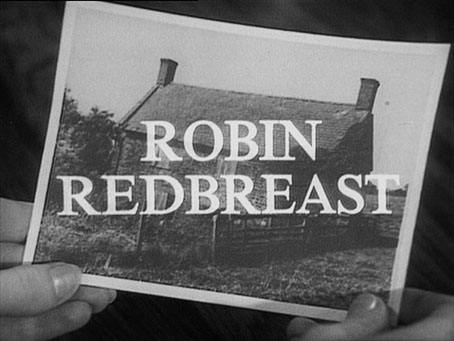
Well before The Wicker Man hit theaters, however, there was the television play Robin Redbreast (1970), which tells a similar story: middle-class metropolitan Norah Palmer (Anna Cropper) ventures into the English countryside only to find herself caught up in the fatal fertility rites of the polytheistic locals. Robin Redbreast is noteworthy for its appearance on Play for Today, a BBC anthology series typically reserved for kitchen-sink realist drama that has been described in posterity as everything from a “national theatre of the air” to an “[exercise] in viewer patronisation” (the latter quote coming from current Conservative Party MP and Boris Johnson ally, Michael Gove). Abrasive, polemical, socially conscious to a fault, its moral messaging embodied the paternalistic spirit of the ‘60s welfare state. If television was the medium of the masses, Play for Today was its conscience.
Set in the present day, Robin Redbreast inverts the conventional relationship between the modern and the un-modern, configuring our world as hopelessly encompassed by a dark architecture of the outside. From the moment Norah arrives in the village, she’s deprived of all agency. Everything she does is preempted, public and private spaces are intermeshed—the villagers always seem to know what she’s doing in advance, repeatedly wander onto her property without invitation, and even orchestrate events so that she ends up sleeping with Rob (Andy Bradford), an awkward local man who she first encounters practicing karate naked in the woods.
Norah can sense she’s being manipulated in some way but remains powerless to stop it. The menacing Mr. Fisher (Bernard Hepton), apparent leader of the community, even explains their sinister designs, albeit in elliptical language, at various junctures. Yet Norah is unable to resist literal and metaphorical seduction by the strange persuasions of the village folk. There’s a dark implication that in some respect Norah wants, or is at least allowing herself, to be trapped. The heightened emotions of country life contrast starkly against the bourgeois detachment of her conversations with city friends. To an extent, we get the impression that Norah’s volatile relationship with the villagers is a reaction to her own suppressed Dionysian impulses.
The shadowed social commentary is compounded when Fisher explains that the villagers are under no pretense of doing justice to the “old ways.” He admits the basis of the robin sacrifice could be Greek, Egyptian, even Mexican in origin. He mentions James George Frazer’s “The Golden Bough,” a largely discredited work of comparative mythology that serves as the basis for most popular representations of paganism. Historical authenticity is immaterial here. What scares us about paganism is what it tells us about ourselves, how it recalls our own innate strangeness.
After the ritual slaughter of Rob (short for Robin), a pregnant Norah flees the village, but her escape will never be complete. She knows that the same cycle will repeat itself when her baby, the new robin, comes of age. As she drives away, she looks back to find that the villagers, still watching from the cottage, have transformed into pagan deities. The fact that the villagers do nothing to stop her from returning to the city amplifies the play’s paranoid pessimism. As Fisher, having taken the form of Herne the Hunter, watches Norah disappear over the hill, the viewer is left with the horrible feeling that nothing Norah can do will have any impact on the ultimate fate of her unborn child. (The narrative is clearly inspired in part by Ira Levin’s Rosemary’s Baby).
Robin Redbreast’s horror is reactive, bird-brained—evoking the feeling of being cornered. The great fear is a lack of control, the feeling of being swept away by strange currents beyond the self. Even in her fleeing, Norah’s fate is ultimately foreclosed by forces that not only surround her but exist elementally within her. If Witchfinder General is set at the dawn of modernity, Robin Redbreast is set at modernity’s dusk, in a world that shrinks from itself as it feels the darkness loom ahead. The postponed reclamation of the robin proves a compelling metaphor for the hopeless uncertainty of a historical moment in which strange futures pounded on the door of the present, threatening to break in at any moment.
The first three years of the 1970s would see five states of emergency, each presided over by Ted Heath’s Conservative government following its surprise election in 1970, and each involving battles between Heath and what Thatcher would later refer to as “the enemy within”—the labor movement. Problems continued to pile up, each new disruption amplifying the last. The stock market crashed in January 1973, sending inflation soaring into double figures; then, in October, OPEC declared an oil embargo that set the western world reeling. Seeing an opportunity, the National Union of Mineworkers voted to go on strike in pursuit of fairer pay. Heath’s government responded by introducing the infamous Three-Day Week, in which consumption of electricity was to be limited to three non-consecutive days per week to conserve coal supplies. For two months, Britain was plunged into a cold, dark winter unlike anything it had seen since wartime.
Described by The Times as a “fight to the death between the government and the miners,” this was the second large-scale confrontation in as many years and one the government couldn’t afford to lose. Heath resolved to call an election to serve as a referendum on the issue of union power, with the Conservatives campaigning on the slogan “Who governs Britain?” The election of February 28, 1974 returned yet another dramatic development: despite the weight of the media and the state behind them, the Conservatives had in fact lost ground and handed the Labour Party a plurality in parliament. A settlement was soon reached in which the strikers secured a 35% pay-increase—the miners had won, at least for now.
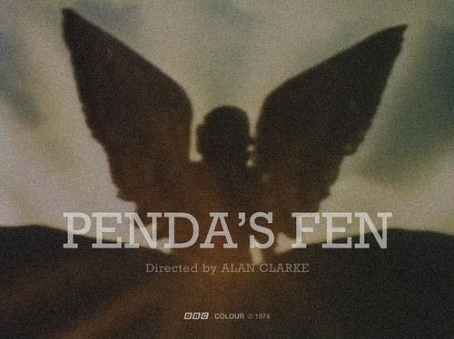
Two weeks after the lifting of restrictions, millions of Britons tuned in to BBC1 to watch the latest installment of Play for Today. That evening’s episode was Penda’s Fen, a fittingly unsettling exploration of unsettling times, the most developed folk horror film to date, and a triumph of public programming in its own right. Writer David Rudkin gives voice to the dark song of the fields with a visionary script about a devout young Christian who must confront both the unseen forces that stir beneath the village where he lives and the “unnatural” desires that emerge contrary to his pious pretensions.
Stephen Franklin (Spencer Banks) is a boy possessed by the “new gods”—he is ordered, anal, orthodox, patriotic, loyal to the structures of church and state. He’s the kind of kid that almost deserves the vicious bullying he gets from his grammar school classmates. As Stephen matures into his eighteenth year, however, things fall apart as he discovers that he’s both gay and adopted. Through the mentorship of his heretical parson father, a politically radical local playwright, and a series of disturbing apparitions, he begins to come to terms with his inner “ungovernableness.”
Director Alan Clarke, Britain’s mirror-holder-in-chief behind such brutal portraits as Elephant (1989) and Made in Britain (1982), presents an image of Britishness that’s wild, diverse, almost ethereal. Clarke, typically known for his uncompromising realism, adopts a more hallucinogenic style to portray the metaphysical turbulence of Stephen’s new understandings. The haunted, shifting landscapes of Worcestershire work as a kind of demonic mutation of Situationist psychogeography. Whereas the students of May 1968 were implored to uncover “the beach beneath the streets,” Clarke and Rudkin invite us to discover the flames beneath the fen.
Penda’s Fen stands apart from other artifacts of the “wyrd” in its overt politicization of strangeness. Almost immediately we meet the playwright Arne (Ian Hogg) as he puts up a one-man defense of the strikers at a town hall debate, while naïve Little Englander Stephen huffs and puffs in the audience. As Stephen begins to lose, or rather relinquish, control of himself, his grades suffer and his mother warns him not to fall foul of “the machine,” the inhuman conveyor belt of modernity and its cult of productivity. Later, the Reverend Franklin (John Atkinson) expounds on Moloch as the sun sets behind him, explaining to Stephen how the new gods of industry and institutions are perversions that have disfigured the message of the “revolutionary” Jesus. The Reverend speculates that the people may “revolt from the monolith and come back to the village,” noting that “pagan” means “of the village,” contrasting with what it means to be “of the city”—”bourgeois.”
The provisional nature of modernity is a key theme. Arne speaks of the urban behemoth swelling to a great city that will “[choke] the globe from pole to pole” but that will also “bear the seed of its own destruction.” We might imagine Hobbes’s Leviathan, bloated and turgid, decomposing back into the earth. Elsewhere, Stephen and his father discuss King Penda, the last pagan ruler of Britain. The Reverend reimagines the heretic as a transcendent symbol of resistance, wondering aloud what secrets he took with him when he fell. “The machine,” like the meaty bodies of its busy multitudes, is imagined as just one combination among an infinite number, an entirely temporary arrangement destined for the dirt.
Landscape is a focal point of the play but, unlike in our other examples, here serves as a vector of elemental truth rather than a source of corruption. Rudkin draws on the Gothic and Romantic traditions to conjure up an English countryside pregnant with ancient histories that lie unknown, hidden or forgotten. It was here, after all, in the 16th century, that the machine first emerged out of the fields and the fens and separated the peasantry from the land—the original trauma that encloses the margins of modern Western history. What lies beyond that temporal boundary is the vanishing realm of nightmare, of un-modernity, where yawns the black abyss of the unknown, the domain of animal and reigning wilderness. But, paradoxically, that abyss is essential to our nature—it’s where billions of lives were lived, where our minds and bodies were wrought and cultivated. Penda’s Fen considers the abyss for all its hidden potentials and reconfigures rupture as opportunity. The horror of recognizing the self in the other, or vice versa, is imagined as a route to emancipation.
In perhaps the most famous scene, Stephen awakes from a homoerotic dream to discover a demonic entity straddling him in his bed, which then takes the shape of the local milkman (Ron Smerczak). What haunts him is not his sexuality but his dedication to the authoritarian norms of middle-class Protestant England. As Arne prophecies in a later scene, the only way to purge ourselves of these demons and reach salvation is by way of “chaos” and “disobedience,” to summon our basest selves.
When we first find Stephen, he’s alone in his room, listening to his favorite composer Edward Elgar’s The Dream of Gerontius and reflecting on the moment when the protagonist meets God. Stephen is isolated from the world, only able to theorize obliquely about transcendent experiences. By contrast, the final sequence sees him meet his maker on an open hillside—not God, per se, but King Penda himself, the half-real spirit of “ungovernableness,” who tells him to go forth and “be strange.”
Much like its predecessors, the play makes no attempt at an authentic depiction of pre-Christian spirituality—we have no idea what the titular King Penda might have believed, what his traditions were, what cosmologies were lost when he was defeated all those years ago. But this is precisely the point. The last pagan king functions as an empty vector of “possibilities” and “unknown elements,” much like Stephen himself. Despite being an apparition of a long-dead historical figure, King Penda represents a haunting from the future, that dark domain of the beyond with which we are in contact every moment of our lives, full of unthinkable potential and inherent strangeness.
Penda’s Fen advances itself as the spiritual resolution to the folk horror cycle, a psychic exorcism of the demons that haunted the ‘70s. Rudkin’s play summons the future from the past, reconstituting the volatility of its day as a rite of passage into a new world. Horror in this sense denotes contact with new terrain, communion between the self and the beyond. To be comfortable is to live in fear of the strange invasions that confront us at every moment and in every thought and experience—to flee from ourselves. In a time when people want change without having to confront the proverbial milkman, the play enjoys continued relevance long after its first life.
Both Robin Redbreast and Penda’s Fen were aired only once more on British television, in 1971 and 1990 respectively, lending these tales the ephemeral quality of weird dreams dreamt long ago—and raising the question of why they’ve now returned to haunt us. The villagers never came to reclaim the robin in the end, yet still we see their shapes in the window and hear strange knocks at the door. Will we ever face up to the horrors that guard the margins of our world? Or are we, like Norah Palmer, doomed to retreat further and further into the city, to delay the inevitable day when the outside closes in? In the closing scene of Rudkin’s play, King Penda prophesies exile as the sun sets behind him: “Night is falling; your land and mine goes down into a darkness now… but the flame still flickers in the fen.” The future promised by that strange flame lies lost somewhere in that expanse of night. Only by embracing the dark might we find it again.
EXP-TV: FREAKTASTIC NEW VIDEO CHANNEL WILL RIP YOUR FACE OFF AND EAT YOUR BRAIN
By Richard Metzger
Source: Dangerous Minds
There are certain things you don’t know you’re missing in life until you’re exposed to them, right? EXP TV just might be one of those things. It’s got an aesthetic that hovers around the same territory as Everything is Terrible! and Vic Berger, it even reminds me of Mike Kelley’s stuff, but that’s only going to get you in the ballpark. Which is good enough, but you just have to click on the link and see for yourself. It’s a barrage of strange imagery and is really quite an inspired—not to say elaborate and work intensive—art project. And just in time for a pandemic. Bored with Netflix? Have enough Amazon Prime? Maxed out on HBO Max? You need to tune in, turn on and drop your jaw to the floor at what’s screening on EXP TV.
EXP TV the brainchild of Tom Fitzgerald, Marcus Herring, Taylor C. Rowley. I asked them a few questions via email.
What is EXP TV? What should someone expect to see when they get there?
EXP TV is a live TV channel broadcasting an endless stream of obscure media and video ephemera from our site at exptv.org. We stream 24/7.
The daytime programming is called “Video Breaks”—a video collage series featuring wild, rare, unpredictable, and ever-changing archival clips touching on every subject imaginable. Similar to how golden era MTV played music videos all day, daytime EXP TV streams non-stop, deep cut video clips filtered through our own distinct POV.
What treasures would reward the loyal Video Breaks viewer? Ventriloquist dummy sales demos, Filipino Pinocchios, LSD trip-induced talking hot dogs, Liberace’s recipe tips, French synth punk, primal scream therapy seminars, Deadhead parking lots, empty parking lots, Israeli sci-fi, scary animatronics, teenage girls’ homemade art films, Belgian hard techno dance instructions, Czech children’s films about UFOs, even Danzig reading from his book collection. And that’s all in just one hour!
We’ve been collecting obscure media for decades, but we’ve sorted through it all and cherry-picked the funny, the bizarre, the relevant, the irrelevant, the visually stunning, the interesting, the infamous, the good, the bad and the fugly. We’ve done all that so the viewers don’t have to. They get to kick back and experience the sweet spot without having to dig for rare stuff themselves or sit through an entire movie waiting for the cool part.
Our Nite Owl programming block features specialty themed video mixes and deep dives on everything under the sun: Bigfoot, underground 80s culture, Italo disco, cults, Halloween hijinks, pre-revolutionary Iranian pop culture, midnight movies, ‘ye ye’ promo films, Soviet sci-fi, reggae rarities, psychedelic animation and local news calamities. On any given night you could watch something like our Incredibly Strange Metal show followed by a conceptual video essay like Pixel Power—our exploration of early CGI art.
Aside from our unique tone and deep crate of video materials, one thing that really sets us apart in 2020 is our format. We are *not* on demand, we are *not* interactive—just like old TV! You can tune in anytime and something cool will be on.
That’s EXP TV in a nutshell. It’s funny, it’s art, it’s music, it’s infotainment, it’s free and it’s 24/7.
It’s 24/7?
Yes.
What does EXP stand for?
EXP stands for…experimental, expanded, experiential, expert, exploration, expressive, expounded, exposed, explained, expeditionary, unexpected, exponents, expatriot, expedited, expectorant, exposure, expelled, expendable, expensive, express, exploded, expired…EXP TV!
We have a little bumper on our Instagram @exp.tv that illustrates this
How much material did you have in the can, ready to go at launch?
We had been quietly working on the channel for over a year so we had quite a bit of material. When the pandemic hit, we decided to launch early as a beta so people could have an alternative to the big streaming channels – something totally different.
In this modern world of all these different streaming platforms, it feels like you spend more time deciding what to watch than you do actually watching something. We wanted to make something you could just turn on and leave on for hours—days even—and you’d be guaranteed to catch something interesting. We basically just made the channel we wanted to watch.
Right now, we have about 60 hours in rotation and we are regularly adding new material—new Video Breaks, new episodes of our ongoing series, and hatching entirely new concepts for shows. Stay tuned for Kung Fu Wizards coming soon!
Do you have themes? What are some of your more elaborate productions on the channel?
Our Nite Owl block has a roster of shows centered around specific themes. A few examples include…
Pixel Power – an homage to the early days of computer graphics.
Witches Brew – a tour through the history of witches on film.
Total News – a completely gonzo take on nightly news past and present.
Bollyweird – a huge compilation of the most “out there” Bollywood musical numbers.
Pomegranates – a survey of pre-revolutionary Iranian cinema, set to Persian psych music.
Underground USA – a continuing series archiving 80s alt culture.
Cosmonaut – our tribute to Soviet sci-fi.
Incredibly Strange Metal – exactly what it sounds like.
They Call Him Bigfoot – a search for Sasquatch in cinema.
Jamaica, No Problem – a crash course in Jamaican music culture.
The David Bowie Mixtape – The Thin White Duke’s glory years captured on film and video.
Our Star Wars Mixtape – Star Wars gone wild, gone weird, and gone wrong.
Cats – an exploration of cats in cinema and beyond.
Wow – a survey of psychedelic animation from around the world.
Mosaic – meditative compilation of short films from the world of fine art.
La Videotheque – French yeye music promo compilation.
Disco Odyssey – our series exploring the wild world of Italo disco and other dance music mutations.
And there’s so much more…
Where do you mostly find stuff? Or maybe, how do you search for it?
We have been collecting video materials for decades. Years of VHS tape-trading, pouring through mom and pop video stores (RIP), even the internet! It makes our day to stumble upon a Bulgarian sci-fi animation title we never heard of. We love our work! Like a hip hop dj/producer is looking for the perfect beat, we’re always searching for that perfect “clip”, that magic moment, that video gem.
What are some of your future plans for EXP TV?
The first priority is continuing to add more cool stuff to the site. We’re looking forward to the time when there’s hundreds of hours of free entertainment.
An unexpected but welcome side effect of our offbeat media expertise is that we’ve been getting work as creative consultants to dig up obscure clips and offer fresh takes on commercials and live events. Last year EXP TV was hired to program the Red Bull Music Film Festival in LA, and we brought in cool guests like Sun Ra Arkestra, Man Parrish, Lady Bunny, and Earth. Our mixtapes were the throughline of the fest. Some of our shows made it down to Austin Film Society and Music Box in Chicago. Having met as programmers at Cinefamily, our background is in public exhibition, but we’re interested in exploring new ways to subject the world to our perspective. We’ve been running the stream on Twitch and Periscope. Someday we want to take a bunch of old CRT TVs and use Raspberry Pi’s to make terrestrial TVs that you flip on and they only play EXP TV. We think that would be a fun gift for local galleries and bars.
We’re currently working on the EXP TV Apple TV app, but we wanna see EXP TV everywhere…we can see opportunities for our particular style of obscure video mixtapes as an HBO series or maybe even its own section on Netflix!
Tune in to EXP TV at http://exptv.org/

“The Monkey King” (2014) is a Hong Kong/Chinese fantasy film directed by Cheang Pou-soi and based on an episode of Journey to the West, a Chinese literary classic written in the Ming Dynasty by Wu Cheng’en. The film focuses on the origin of Sun Wukong (Donnie Yen), the titular protagonist who’s the only one who can prevent the Bull Demon King (Aaron Kwok) from taking over the heavenly kingdom.
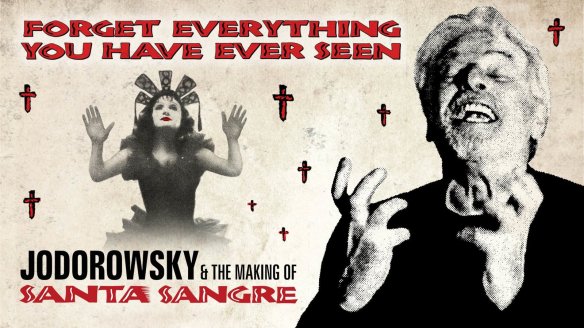
In the 1970s, his legendary films El Topo and The Holy Mountain redefined movies as both art and entertainment while changing the face of cinema forever. In 1989, after his dream project Dune fell apart and a resultant decade-long break from cinema, visionary filmmaker Alejandro Jodorowsky returned with his most triumphant work: SANTA SANGRE. Forget Everything You Have Ever Seen is a feature-length documentary on the making of Santa Sangre featuring interviews with the cast and crew.
Watch for free on Kanopy here: https://www.kanopy.com/product/forget-everything-you-have-ever-seen-world
INDIAN COUNTRY NEWS
"It is the duty of every man, as far as his ability extends, to detect and expose delusion and error"..Thomas Paine
Human in Algorithms
From the Roof Top
I See This
blog of the post capitalist transition.. Read or download the novel here + latest relevant posts
अध्ययन-अनुसन्धानको सार
 After the Crash