

Review by Donald Guarisco
Source: AllMovie.com
Though it rarely gets mentioned in round ups of rock and roll movies, Get Crazy is one of that genre’s best outings. The script offers a savvy satire of the rock business, put forth in an appealing lighthearted style that makes it accessible. Allan Arkush directs the proceedings with flair, keeping the multiple plotlines moving forward while still delivering plenty of music and laughs. Get Crazy further benefits from a fun cast: Daniel Stern makes an appealing average-joe lead, Malcolm McDowell delivers a sly comedic turn as an egotistical Mick Jagger-styled rocker and Ed Begley Jr. is a deadpan delight as an evil mogul trying to steal the concert hall’s real estate. Rock fans will also want to look out for punker Lee Ving and alternative-rock legend Lou Reed in fun cameo roles (Reed in particular has fun satirizing Bob Dylan). In short, Get Crazy is a funny and fast-paced rock and roll flick that deserves a bigger cult following.

By Alexis Garcia
Source: The Cut
Am I alone in thirsting for normalcy when Christmas rounds the corner? No matter how contrarian I fancy myself to be, once local radio stations incessantly drone “Jingle Bells” I become a walking cliché hellbent on conjuring the magic of a Winter Wonderland fantasy. Whether it’s stealing a kiss under the mistletoe, a family dinner that doesn’t end in a full-blown argument, or finally sticking to that Christmas gift budget — invariably, my idea of the perfect Hallmark holiday all goes to hell. And when I can’t go to sleep because of the jolly nightmare of my own making, I’m comforted by the thought of Kate Bush’s blood-splashed Christmas special.
The first thing you should know about her 1979 BBC holiday broadcast is that it’s almost entirely devoid of Christmas. Recorded after the English singer-songwriter’s first (and only) tour, the special is composed of 12 songs gathered from her first three studio albums and features an appearance from former Genesis frontman Peter Gabriel. There’s no coherent theme or message to the show — the only constant is Kate’s stunning ability to shock viewers at every turn. This is most effectively accomplished with her mind-boggling performance of “The Wedding List,” a song based on a French New Wave film about a grieving bride avenging her husband-to-be after he’s slain at the altar.
It all starts innocently. A heavenly pitch fills the room as green cartoon hands and red text animate the screen. Is this the voice of an angel? As the titles fade out and the stage lights come on, we see Kate dangling from the ceiling — not as the Christmas cherub we first envisioned, but as a gothic bat rising from the abyss, clad in black sequins and plush feathers. As the opening salvo of “Violin” comes to a close I begin to wonder if this was actually meant to be a Halloween show. (After all, parts of the taped performance were filmed in a South London cemetery).
The next 40 minutes of Kate’s festive fever dream veer from the chaotic to the surreal to the just downright horny. In one scene, Kate, only 21 at the time, looks everything like the Victorian ideal of the virtuous woman as she plays an emotional andante called “Symphony in Blue” at the piano. Her figure shimmers in a sparkling silver cardigan and emerald-green skirt. But just as we settle into the moment, Kate peers at the camera, a twinkle in her charcoal-lined eyes, and seductively chirps, “The more I think about sex, the better it gets.” Not exactly the family-friendly content you’d expect from a holiday show!
I’ve watched this special dozens of times since I discovered it on YouTube years ago. I had always been a Kate Bush fan. Many of the artists I grew up listening to — like Tori Amos, Fiona Apple, and Big Boi — had cited her as a musical influence. But I didn’t fully start to appreciate her dazzling panache until I entered my 30s. Like many women, I found myself exhausted from trying to “have it all” and stretching myself to meet everyone else’s expectations. And here was Kate, a total unapologetic weirdo, being celebrated and revered for letting her freak flag fly. She’s written songs about menstruation and embarking on a steamy love affair with a snowman (so hot, in fact, that he melts). Her maniacal style of pouring tea, as captured in a 1989 BBC interview, has been made into a meme, as has footage of her rather unappetizing vegetarian cooking. And every year fans across the globe gather in parks dressed in flowing red gowns to recreate dance moves from her iconic “Wuthering Heights” music video. Her authenticity is the reason she’s cultivated such a devoted fan base and why her music still resonates after all these years.
The 1979 Christmas special is also significant because in many ways, it’s Kate’s departing gift to fans — a bow atop a year that would mark the end of her concert career for the next three decades. Like anything with the notoriously private singer, the more information I try to find on this special, the more questions I ultimately end up having. Why, for instance, did Kate think it was appropriate to perform a murder-suicide ballad for a holiday show? Who at the BBC approved this to go on air? How does she pop out of a garbage can so effortlessly in skin-tight leather pants? And does she even know what a Christmas special is? Do we?
But this is why I keep coming back to the Kate Bush Christmas special, year after year. The desire to conform to the cookie-cutter — and completely unattainable — Christmas ideal unleashes my inner control freak, but I never stop to ask myself why I want this version of the holidays in the first place.
Even her one Christmas song is a wink to this idea. In “December Will Be Magic Again,” she sings with childlike yearning for the idyllic Christmas. “The white city, she is so beautiful, upon the black-soot-icicled roofs,” Kate coos. It’s a beautiful image, the dusting of pure white snow, falling like the haze of nostalgia to cover the tarnished memories we’d rather forget. But Kate knows it’s a pipe dream. And she gives us permission to let it all go.
Her Christmas special feels especially relevant this year, as normal has never felt more out of reach. It would be easy to give into a collective sense of despair as we enter an uncertain winter. But when I watch Kate roll around on the floor, fake blood dripping from her lips as she gleefully shoots a hole into the chest of her lover’s murderer, I am embraced by the warm comfort that things will be okay. Even if this holiday isn’t what we envisioned, it doesn’t make it any less special — all we need is to give ourselves the space to get a little weird.
By Daniel S. Levine
Source: Move Mania Madness
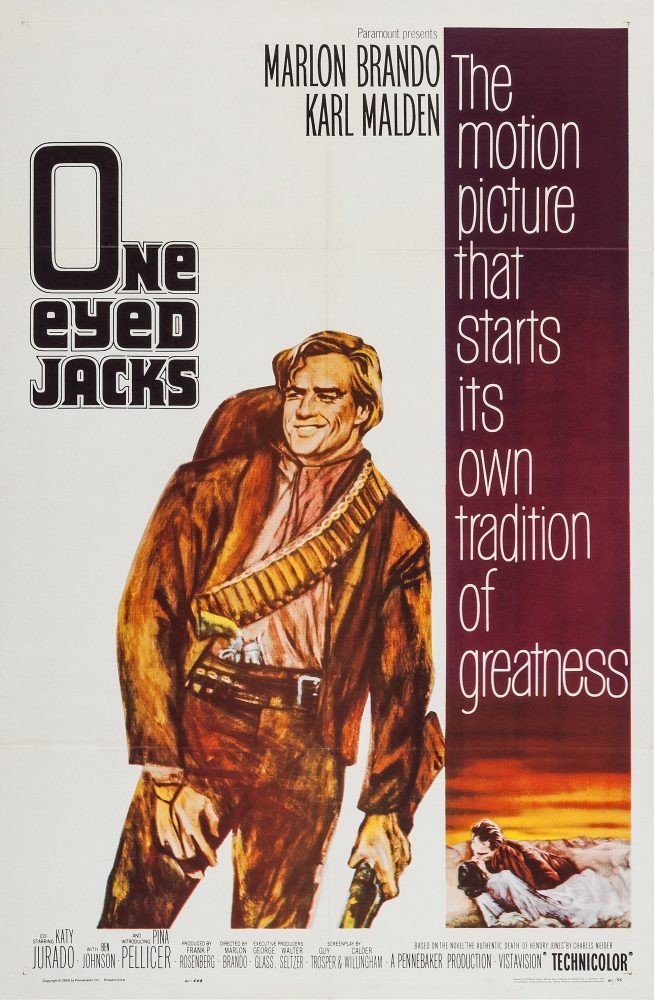
“You may be a one-eyed jack around here, but I’ve seen the other side of your face.”
Marlon Brando’s One-Eyed Jacks (1961), the only film America’s greatest screen actor ever directed, was itself a one-eyed jack for many years. Seen as an example of excess and the dangers of handing a star with a big ego a big budget, we are now seeing the other side of its face. Thanks to the incredible restoration by Martin Scorsese’s The Film Foundation, the film has been saved and we can now see the true wonders hidden by One-Eyed Jacks‘ production issues and public domain status.
Brando stars as Rio “The Kid” and Karl Malden (Brando’s co-star in On The Waterfront and A Streetcar Named Desire) plays “Dad” Longworth. At the start of the film, Rio and Dad pull off a heist in a Mexico town. During the chase, they split up, with Rio left to fight the Mexican authorities himself and Dad going to get new horses. But instead of returning to help Rio, Dad decides to escape. Rio is caught and jailed.
Five years later, we suddenly see Rio escaping prison with his friend Chico (Larry Duran). He picks up Bob Amory (Ben Johnson) and Harvey Johnson (Sam Gilman) while on the trail to find Dad. That trail leads him to Monterey, California, where Dad is now the sheriff. What follows is nearly two hours of pure tension, watching the blood boil between the two as Dad and Rio move their chess pieces ever closer to a final duel that’s over in a flash. Each action the two men take – from Rio romancing Dad’s step-daughter Louisa (Pina Pellicer) to Dad framing Rio for a bank robbery and murder – is meant to move them closer to a crescendo.
One-Eyed Jacks is hardly perfect and one does wonder what a seasoned director like Stanley Kubrick (who was signed on to make the film at first) would have done with it. But it is doubtful anyone but an actor-as-director could have brought out vibrant performances as Brando did. We can see what the characters are thinking, something few movies can achieve without voiceovers. He has full faith in the audience to figure out what’s going on without dialogue, but he also doesn’t go for heavy-handed symbolism. Yes, there’s that beautiful shot of waves crashing behind Brando, but much of the film plays out in the characters’ minds when their words fail them.
It’s hard to see how Westerns after One-Eyed Jacks could exist without it, especially Sergio Leone’s films. If anyone was listening to Brando in 1960, One-Eyed Jacks would have announced the death knell of the Classic American Western long before Sam Peckinpah shot it to hell with The Wild Bunch. Although Peckinpah’s work on One-Eyed Jacks was likely completely gone by the time filming began, there still seems to be a bit of Peckinpah DNA left in the final result.
Based on the novel The Authentic Death of Hendry Jones by Charles Neider, the plot echos themes and plot points that later show up in the “revisionist” Westerns of the late 1960s and ’70s. We have two men scarred by a betrayal, a hero on the wrong side of the law and a corrupt official. Sadistic men roam this world, others are guilty until proven innocent and townspeople are mere casualties in their play.
There are truly few other movies like One-Eyed Jacks, a film that simultaneously breaks from Hollywood tradition while following it. The additions Paramount insisted Brando make don’t completely strip away his vision for a movie. It might not have been a success at the time, but the rebellion against the old system it declared certainly was.

By Sheila O’Malley
Source: RogerEbert.com
Keanu Reeves has a mixture of stilted awkwardness and gangly grace that is uniquely his own, and that makes him an often strange, disaffected presence. This can either work or not work. His line readings are sometimes baffling. But his simple sense of truth and touching trust in the material (whatever it may be) is one of the reasons his career has lasted so long. There isn’t a ton of ego in his work. It’s refreshing.
“Man of Tai Chi”, Reeves’ feature film directorial debut, has the same sometimes-awkward blend that Reeves brings to the table as an actor. The film is super serious (as befitting the martial arts genre, where everything is a matter of life or death), with moments of strange stilted dialogue (also par for the course) and scene after scene of thrilling physical combat, filmed with grace and certainty and no small amount of awe for the athletes involved.
Tiger Chen, a stuntman in the two “Matrix” sequels, plays the eponymous character, also named “Tiger Chen”. He is a devoted practitioner of the ancient art of tai chi, working with a master named Yang (Yu Hai) in a beautiful temple. For his day job, Tiger works as a delivery boy, driving packages around the city, and flirting with a receptionist at one of his regular stop-offs. He lives with his parents. He does not have ambition to “do anything” with tai chi, because the rules underlying his apprenticeship with Master Yang say that those who practice tai chi do not do so for money, glory, or even to win. But during a public competition, his undeniable skill brings him to the attention of a mysterious individual named Donaka Mark (Reeves). Donaka lives in a cold man-cave of a penthouse, furnished in black leather and chrome. He strolls around barefoot on shiny black marble floors, he speaks only in terse commands. He has a security detail working for him that would rival the NSA’s. He reaches out to Tiger, offering him a security job, when in reality it is a recruitment for a deadly underground fighting ring.Tiger is flown to an undisclosed location, put into an empty grey room with a mirror on one wall, as he waits to see what will happen. A female voice commands: “Fight”, and from out of nowhere an opponent grabs Tiger from behind. Tiger is then engaged in a fight for his life in that grey room with the big mirror, and it is an Alice-through-the-looking-glass moment which will bear fruit through the rest of the film: Like Alice, Tiger is catapulted from one strange experience to the next. The normal rules of regular life no longer apply.
Donaka, of course, is watching through that mirror. That first fight is a test. Tiger passes, but it is only the first of many. Donaka’s fight club is run like a cult, where essential information about the nature of the organization is withheld from the participants until they are too deeply embroiled to get out. Tiger finds himself back in that grey room again and again, fighting increasingly vicious and skilled opponents. To what purpose? What is it all for?
The money Donaka offers is substantial. When Master Yang’s temple is slated for demolition unless money can be raised for necessary repairs, Tiger caves. And so the sacred temple is now being financed by someone who has betrayed the underlying principles taught there, a terrible irony. Tiger Chen, a superb athlete (to watch him is to go slack-jawed in wonder and appreciation), is also a terrific actor, going believably from sweet open kid to cold lean killer with a haunted aspect. “Man of Tai Chi” takes place in a deeply moral universe where our choices have spiritual implications.
Tiger Chen, a stuntman in the two “Matrix” sequels, plays the eponymous character, also named “Tiger Chen”. He is a devoted practitioner of the ancient art of tai chi, working with a master named Yang (Yu Hai) in a beautiful temple. For his day job, Tiger works as a delivery boy, driving packages around the city, and flirting with a receptionist at one of his regular stop-offs. He lives with his parents. He does not have ambition to “do anything” with tai chi, because the rules underlying his apprenticeship with Master Yang say that those who practice tai chi do not do so for money, glory, or even to win. But during a public competition, his undeniable skill brings him to the attention of a mysterious individual named Donaka Mark (Reeves). Donaka lives in a cold man-cave of a penthouse, furnished in black leather and chrome. He strolls around barefoot on shiny black marble floors, he speaks only in terse commands. He has a security detail working for him that would rival the NSA’s. He reaches out to Tiger, offering him a security job, when in reality it is a recruitment for a deadly underground fighting ring.Tiger is flown to an undisclosed location, put into an empty grey room with a mirror on one wall, as he waits to see what will happen. A female voice commands: “Fight”, and from out of nowhere an opponent grabs Tiger from behind. Tiger is then engaged in a fight for his life in that grey room with the big mirror, and it is an Alice-through-the-looking-glass moment which will bear fruit through the rest of the film: Like Alice, Tiger is catapulted from one strange experience to the next. The normal rules of regular life no longer apply.Donaka, of course, is watching through that mirror. That first fight is a test. Tiger passes, but it is only the first of many. Donaka’s fight club is run like a cult, where essential information about the nature of the organization is withheld from the participants until they are too deeply embroiled to get out. Tiger finds himself back in that grey room again and again, fighting increasingly vicious and skilled opponents. To what purpose? What is it all for?
The money Donaka offers is substantial. When Master Yang’s temple is slated for demolition unless money can be raised for necessary repairs, Tiger caves. And so the sacred temple is now being financed by someone who has betrayed the underlying principles taught there, a terrible irony. Tiger Chen, a superb athlete (to watch him is to go slack-jawed in wonder and appreciation), is also a terrific actor, going believably from sweet open kid to cold lean killer with a haunted aspect. “Man of Tai Chi” takes place in a deeply moral universe where our choices have spiritual implications.
The fighting ring is illegal. The cops (one in particular) close in on Donaka, who remains elusive and omniscient. Donaka understands that tai chi is not the usual fare in the martial arts underground, and he gets off on the fact that Tiger has sold out. That’s the turn-on, the power trip. Reeves isn’t in the film all that much, and there are a couple of extremely stiff scenes of dialogue, but he does get a very impressive fight scene with Tiger near the end. This is Tiger Chen’s picture all the way. You watch him transform, and you watch his soul go dark.
CinematographercElliot Davis films the fight scenes with thrilling immediacy: lots of long takes, so you realize you are actually seeing these guys actually do this, as opposed to watching something pieced together later in the editing room. The camera circles and rises and pulls back, moving horizontally and vertically with the movements of each fight. The filming is intuitive and visceral. There’s one masterpiece of a scene that takes place in a hidden night club floating in the bowels of a cargo ship in Hong Kong harbor. The setting is surreal: the circular stage painted with psychedelic dizzying swirls and the circular tables surrounding said stage, not to mention the bored elegant silent crowd, is reminiscent of the midnight theatre scene in David Lynch’s “Mulholland Drive” or the freaky tiered nightclub in Josef von Sternberg’s “Shanghai Gesture”. Each fight gets more dangerous. The stakes rise. Death is the only possible outcome. Reeves approaches the genre with respect and passion. “Man of Tai Chi” is hugely entertaining.
INDIAN COUNTRY NEWS
"It is the duty of every man, as far as his ability extends, to detect and expose delusion and error"..Thomas Paine
Human in Algorithms
From the Roof Top
I See This
blog of the post capitalist transition.. Read or download the novel here + latest relevant posts
अध्ययन-अनुसन्धानको सार
 After the Crash