
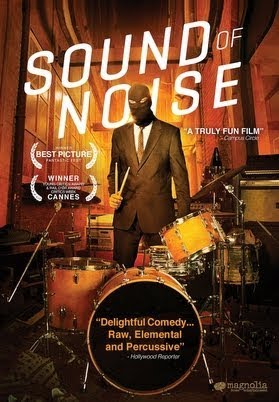
‘Sound Of Noise’ A Clever, Unique & Musical Heist Film
By Gabe Toro
Source: The Playlist
“This is a gig!” screams a gang of masked assailants as they enter a busy Swedish bank. The customers are pushed and prodded, forced into a corner, hiding behind their ruffled suits as the perpetrators begin to activate the shredders, printing cash and destroying it in front of them, an activity that involves the ruffling of dollars, the tapping of keyboards, the clang of coins against glass, and yes, maybe some added percussive activities. It’s music, and it’s only one of many “attacks” from this ambitious group.
A terrorist group by definition, these musicians, who won’t sing or dance, instead perform acts of disruption, seeking no material gain aside from bringing the sound of chaos to everyone’s doorstep. To them, the enemy is convention, and while they arrange their attacks as “movements,” each with its own separate attack point, their weapon of choice are endless looping drums. Essentially, what if “Stomp” had an agenda.
Directed by Ola Simonsson and Johannes Stjärne Nilsson, “Sound Of Noise” is cleverly, strictly defined as a heist film, honoring the conventions of the genre before we even realize nothing is being heisted, exactly. Early on, the two leaders of the gang are even seen scouting and recruiting fellow drummers, reading off dossiers as we watch these musicians struggle in unnatural habitats. This is all straight-faced, of course. Drums are not a joke, they’re a way of life. These guys can’t even flee during a chase scene without picking up some drumsticks.
In hot pursuit is a rogue cop, the only one on the force who seems to understand what this group is doing. Unfortunately, not only is he tone-deaf, but his hearing is dropping out as well. He announces that he will “rid this city of musician scum” but clearly he sees something in this group that he’s been denying about himself for years. Oh, and by the way, his name is Amadeus.
Based around one central gimmick, the otherwise skimpy “Sound Of Noise” doesn’t overstay its welcome, paced in accordance with its musical set-pieces. Not necessarily a musical, it’s moments of downtime still seemingly choreographed by the insistent whir of a Metronome, much like the one our gang leaves at the scene of the crime. As such, it’s terrific fun, building to an unlikely climax involving entire city blocks and a confluence of light and sound more exciting than most climactic blockbuster explosions. Movies have long thrilled in teaching audiences that some problems can be solved with a punch or a finely-tuned monologue or two. Finally, someone has substituted percussion instead.
Watch Sound of Noise on Kanopy here: https://www.kanopy.com/product/sound-noise

Review by Brian Eggert
Source: Deep Focus Review
Harold and Maude is the most positive expression of counter-culturalism to come out of Hal Ashby’s career. Unlike Ashby’s other pictures released during his zenith in the 1970s, it does not concentrate its message against flawed American institutions or oppositional forces such as the military, government power, the Vietnam War, or institutional racism. Instead, the film builds up an audience of outsiders, misfits, disaffected youths, and even senior citizens who grew up on the margins, stifled by a world built on the establishments and conventions of a dominant culture. Through its unorthodox romance between the death-obsessed youth, Harold, and the vivacious, indomitable Maude, who, approaching eighty, preaches the gospel of living life to the fullest, it blithely celebrates nonconformity and independence. “If you want to be free, be free,” sings Maude, quoting the film’s essential songs by Cat Stevens, marking herself as an aged symbol of the how the counterculture movement of the 1960s had, in many ways, grown old by the film’s release in 1971. Nevertheless, Harold and Maude resists becoming an adversarial political statement or dialectical argument designed to reignite a movement. Its strength resides in a philosophy rooted in self-exploration through personal fulfillment, bodily acceptance and exploration, artistic creation, and spontaneity, endearingly represented through its eccentric humor and a love affair for the ages.
Ashby had one of the best careers of any filmmaker in the 1970s. However, everything after Harold and Maude, his second film, became more cynical and confronting, even his comedies. The Last Detail (1973) exposed the senselessness of the Vietnam War and inhumanity of military law, offering a portrait of male bonding and innocence lost. The downfall of Warren Beatty’s womanizing hairdresser in Shampoo takes place against the backdrop of Richard Nixon’s presidential election in 1968, a parallel no viewer of the 1975 film could miss after Nixon’s resignation. Bound for Glory, the director’s Woody Guthrie biopic from 1976, explored the folk musician’s life singing about freedom and humanism in the Dust Bowl, while protesting the exploitation of workers. Ashby’s searing drama Coming Home (1978) considered once more the soul-crushing effect of the military and the human toll of Vietnam, concentrating this time on a paraplegic veteran and the moral awakening of an army wife. His last great film, Being There(1979), condemned American politics, mass media, white elitists, and one-percenters in what might be Ashby’s most outraged and funniest work. And whereas these other films adopt a confrontational and polemical perspective against a well-defined mainstream system, which usually overcomes the individual and remains at odds with the sympathetic view, Harold and Maude offers a rare glimmer of hope and happiness from Ashby.
The pale-faced Harold (Bud Cort), lives in an elaborate estate with his grating, English-accented, conservative mother (Vivian Pickles). They have an unspoken agreement: She ignores him and almost willfully refuses to see him as a person, and he responds in a series of faked, symbolic suicides that seem to say, “You’re killing me.” The film opens as Harold prepares to hang himself, a scene played as tragic until his mother enters the room and, rather than call 911, she arranges her evening’s dinner party. Suspended there on a rope, presumably tied around his torso, Harold’s mouth spews drool and his eyes fill with pressure tears. His mother pays him no mind, leaving her son’s behavior for the psychiatrist (George Wood) to figure out. Harold, who drives a hearse, also attends funerals just for fun, and that’s where he sees Maude (Ruth Gordon), a woman approaching eighty with a vibrant attitude toward life. But she’s also the resident Earth Mother who teaches Harold life’s many joys: she compels him to create music, disobey pointless rules, enjoy olfactory sensations, not feel reserved in his own body, and even steal the occasional car. Maude practices what she preaches—she poses nude for an ice sculpture and lives in an old train car, transitory symbols of impermanence and movement that capture her way of looking at life. And as Harold and Maude spend time together, color seems to return to Harold’s face.
Harold’s mother, who knows nothing about the budding romance between the two, fills out computer-dating forms for her son, though she answers the questions as she would respond. “‘Do you think the sexual revolution has gone too far?’” she reads aloud from the questionnaire. “It certainly seems to have,” she responds to herself. A few feet away, Harold loads a gun and, after pointing it at his mother, he turns it on himself until—BAM!—he’s dead. Except, Harold is some kind of magician, capable of faking his death with a series of tricks, usually accomplished between cuts. His fake suicides are less cries for help than a plea for someone to meet him on his terms. They’re also among the funniest moments in the film, a detail that sets Harold and Maude’s sense of humor on another plane from other, more mainstream films. After he seemingly sets himself ablaze to bring an abrupt end to a date his mother has arranged, Harold turns to the camera and smiles—but not a perceptible grin, just a hint at something comically sinister that the knowing audience will recognize. It’s a playful touch, like a secret between the audience and Harold that demands we take his side. In any case, Harold’s mother’s efforts to marry her son are pointless. From the moment Maude invited Harold to “stroke, caress, explore” the curvy wooden sculpture in her traincar, which looks like a deconstructed vagina, he lusts after her. Before long, their love for one another is consummated. Harold goes from staging his own death to somersaults and singing. Then Maude turns eighty, marking a self-imposed end date that she has been hinting at all along. But the film acknowledges that, despite death’s inevitability, life persists if we embrace it.
Although far warmer and less defeated than Ashby’s other films, Harold and Maude does not aim itself at a particular target; however, its portraits of authority figures such as Harold’s mother have a mocking, sardonic quality to them. Contenting herself with Liberace records and social gatherings, Harold’s mother believes he will find adulthood after she thrusts him into a marriage; to that end, she values the computer dating service for screening out “fat and ugly” candidates, and she gives her son a Jaguar sports car to attract women and replace his less appealing hearse. Elsewhere, Harold’s military-devoted Uncle Victor (Charles Tyner), once the “right-hand man” to General MacArthur, has no right hand—but he has a picture of Nixon hung on the wall behind his desk and remains able to salute the flag thanks to a ridiculous pull string solution. Harold’s mother plans to have him enlisted with the help of Uncle Victor, but Harold and Maude finds humor in a sequence where Harold fakes psychopathy and murder to escape military service. Also, the traffic cop (an uncredited Tom Skerritt) who stops Harold and Maude for speeding is shown to be powerless, while the local priest (Eric Christmas) is bedeviled by notions of sexual idealism. Still, these counter-culture jabs feel more in service of a positive story about nonconformity, anti-establishment, and free-spiritedness—all terms that could be used to describe the soul-searching quality of a director known as “Hashby” for his omnipresent marijuana use. Indeed, Ashby wrote friend Sue Mengers that he had spent “the better part of my life just wondering where I am, or even if I am.” Harold and Maude is a searching film by a searching director.
Perhaps it’s surprising, then, that Ashby was initially uncertain about whether Harold and Maude should be his second feature. He had just released his debut, The Landlord from 1970, starring Beau Bridges as a privileged white man who takes over a tenement building in a predominantly African American neighborhood. Its representation of the culture clash between races aligned with the types of films that interested Ashby at the time. He had spent more than a decade editing pictures in Hollywood for some of the finest directors of the 1950s and 1960s—William Wyler, Franklin J. Schaffner, George Stevens—learning the craft of filmmaking from a dark editing room. But his friend, mentor, and closest collaborator during this period was Norman Jewison, the socially conscious director of In the Heat of the Night (1967), who made civil rights either an outward theme or an undercurrent in his films. Ashby had earned an Oscar for Best Editing on In the Heat of the Night, after which he voiced a desire to direct. Jewison, who was originally slated to direct The Landlord but passed to make Fiddler on the Roof (1971), agreed to produce Ashby’s first feature as a director. The film’s notoriously bad marketing campaign, with its poster of a finger about to ring two doorbells that resemble breasts, confused audiences, resulting in a box-office disappointment. Still, those who saw The Landlord were impressed.
Ashby had started to receive scripts for his next project, and among them was Harold and Maude, which Paramount executive Peter Bart thought would be perfect for the budding director. The material originated as a screenplay by Colin Higgins, written as his Master’s thesis for UCLA that, in 1971, he published as a book. Higgins worked as a pool boy for a producer at Paramount, who got the script in front of Bart and studio head Robert Evans. They had bought the script after agreeing to allow the writer to direct his screenplay, but Higgins’ test footage demonstrated he wasn’t ready to helm a major motion picture. Ashby then read the script and enjoyed it, but he was concerned about whether its laughs would translate to the screen. He also worried about resentment from Higgins, so he asked Paramount to give the screenwriter a shot. Paramount refused, saying it would be Ashby or someone else, but not Higgins. Ashby agreed to direct and overcame the Higgins hurdle by making him a producer, which would allow Higgins to observe and learn. Higgins would eventually get his chance at the director’s chair. After some additional work as a screenwriter on Silver Streak (1976), which proved he could write a hit, Higgins directed the comedies Foul Play (1978), 9 to 5 (1980), and The Best Little Whorehouse in Texas (1982).
Casting Harold and Maude presented a particular challenge for Ashby, given the nature of the story and the images it projected. An offbeat romance between a twentysomething, suicide-obsessed boy who befriends an energetic, uncontainable woman about to turn eighty, certainly would not appeal to marquee names, regardless of its message about the value of unrestrained and unconventional lifestyles. Paramount’s modest budget also prevented any major stars from joining the cast. For Maude, Ashby had a long list of mostly British performers in mind, and he planned a trip to London to meet many of them, even though Paramount pushed for the 75-year-old New York native Ruth Gordon, who had just earned an Oscar for Best Supporting Actress in the studio’s 1968 hit, Rosemary’s Baby. Gordon was the obvious choice, and many of the actors he interviewed suggested Gordon over themselves. But Ashby was notorious for floundering around big decisions and met them with anxiety and self-doubt. He described the decision of casting Maude as “one of the most taxing in my lifetime.” To be sure, Ashby had a tendency to dramatize the stress he felt during the preproduction process. When he couldn’t secure cinematographer Gordon Willis, who had shot The Landlord for him, Ashby wrote Evans and Paramount and threatened to pull out of the production, claiming, “I feel I could make this film about as funny as the Viet Nam war.” Then again, Ashby biographer Nick Dawson suggests that Ashby’s letter was designed to give the director some wiggle room, as Evans convinced him to remain on the picture by increasing the budget from $800,000 to $1.25 million.
For Harold, Higgins had written the part for little-known actor John Rubenstein, but Ashby wanted then-unknowns such as Bob Balaban, Richard Dreyfuss, and John Savage. Bud Cort, who had just appeared in Robert Altman’s Brewster McCloud and MASH, both in 1970, was another option. After casting Gordon, Ashby shot screen tests of his various Harolds, and the baby-faced Cort was the choice. A former stand-up comedian, the young actor had an improvisational style that suited him on the free-wheeling Altman sets, but it clashed with Gordon’s commitment to the screenplay. Gordon was a Hollywood veteran, a “careerist” as she told The New York Times. She had been in the business since the age of four, posing in advertisements before graduating to small roles in silent films and a few supporting roles throughout the 1940s. Much of her career was spent alongside her husband, Garson Kanin, as part of the writing duo responsible for A Double Life (1947), Adam’s Rib (1947), and Pat and Mike (1952)—all of which earned Gordon and Kanin Oscar nominations for Best Screenplay. And so when Cort attempted to improvise on Higgins’ script during the Harold and Maude shoot, Ashby had to support both acting styles while preserving the peace. Cort spoke at Ashby’s memorial service and remembered the experience: “Hal was so sympathetic, so understanding. And I think back on it now, I must have driven him crazy, but he never ever complained.”
Whatever anxieties Ashby had during the preproduction phase usually dissolved by the time cameras were rolling. Harold and Maude shot in a perpetually overcast Northern California over two months, using locations in San Mateo County such as the Rosecourt Mansion, the sprawling mansion that served as Harold’s home. Much to the relief of Ashby, the location shooting meant his crew of hippies and introverts would be left to their creative devices, as their director wanted nothing more than autonomy from Paramount’s executives (Ashby’s brief appearance in the film shows the director at his shaggiest). However, after a month into production, Ashby was behind schedule and had to contend with Bart arriving on set with a ticket back to Los Angeles, along with a warning that he would be replaced if the production was not back on schedule. Despite a few delays due to weather and a motorcycle accident involving a stuntman, Harold and Maude proceeded smoothly, even if Cort occasionally caused a row among the crew for his performative commitment to the role. The young actor wanted to fool the crew with his character’s fake suicides and nearly strangled himself in the process. He also told Leticia Kent of The New York Times that he planned to have actual sex with Gordon—a remark believed to be a stunt until he told Ashby the same thing. Reportedly, Cort and Gordon did not have sex for the film.
Ashby originally wanted Elton John to write the music for Harold and Maude; in fact, the pop star was one of the director’s first choices to play Harold. John couldn’t commit to either, but he recommended Cat Stevens for the music. The director didn’t reach out to Stevens straightaway; instead, he began playing Stevens’ songs over the dailies for the first several weeks of the shoot, using songs from the albums Mona Bone Jakon and Tea for the Tillerman, both released in 1970. Ashby eventually reached out to Stevens and made a deal to use the performer’s music in the film. But after the production had wrapped and Ashby entered the editing phase, Stevens claimed he was too busy to be involved or write any additional songs. Ashby, whose controlling tendencies and experience as an editor led to his taking over control from the editing team of Bill Sawyer and Edward Warschilka, had already shot and had been cutting Harold and Maude to the tempo and tenor of Stevens’ songs. Without Stevens, the film simply wouldn’t work. He resolved to fly to Paris to convince Stevens to use existing songs and write additional music for the film. Stevens eventually agreed to allow the production to use existing music from his albums, including two additional songs, “Don’t Be Shy” and “If You Want to Sing Out, Sing Out”—which have the most imperative lyrics to the film’s themes. Anyone who has seen Harold and Maude knows it is inextricably linked to Stevens’ music, as his solo acoustic performances echo its gentle optimism with an air of solitude that accompanies both of the film’s main characters.
By the time Ashby had prepared Harold and Maude for preview screenings, it had become a stabilizing project in his life. During the production, he had divorced his wife, and his brother died, making Ashby particularly sensitive to the success or failure of his endearing romance. Fortunately, the preview screenings were wildly positive, complete with standing ovations and enthusiastic crowds of youngsters. Everyone was sure they had a hit, and Paramount resolved to release the film around Christmastime. Then the reviews came in. Amid a few positive notices were scathing indictments of the film’s theme and subject matter. In the infamous Variety review, the critic wrote, “Harold and Maude has all the fun and gaiety of a burning orphanage,” then continued to spurn Maude as “an offensive eccentric” who engages in “specious philosophizing.” In his review for The New York Times, Vincent Canby called the characters “creepy and off-putting,” while Roger Ebert compared the experience to attending a funeral: “all the movie lacks is a lot of day-old gardenias and lilies and roses in the lobby.” Harold and Maude opened not long after The French Connection and Fiddler on the Roof, in the same month as A Clockwork Orange, Dirty Harry, The Last Picture Show, and Diamonds Are Forever, and was almost destined to be ignored and misunderstood.
Unlike most critics, Ashby found the single sex scene between Harold and Maude to be a beautiful testament to flesh, both regardless of age and in the juxtaposition between the young and old—something his crowd, the hippies, counterculture groups, and liberal-minded types, would appreciate. Paramount’s executives didn’t agree. Ally MacGraw, then married to Robert Evans, complained after a preview screening that the scene was disgusting and should be cut. Evans backed his wife and demanded that the scene be removed. Ashby got around this by sneakily inserting some of the footage into the film’s original trailer. This was long before the contemporary norm of trailers containing footage, from alternate takes to entire scenes, that never make it into the final film. If the footage was in Harold and Maude’s trailer, it had to be in the film, and so it was—albeit in truncated form. Whereas Ashby shot scenes of Cort and Gordon kissing, the studio demanded that Ashby cut around the actual lovemaking, revealing only a shot of the lovers in bed together the next morning. Paramount’s marketing department also downplayed the nature of the relationship between Harold and Maude after the negative press. The studio released a new poster that gave no allusions to Harold’s penchant for faking suicides or the fact that Harold’s so-called girlfriend was a much older woman. Rather, the new poster was entirely white and comprised only of text, black for the credits, while “Harold” and “Bud Cort” appeared in purple and “Maude” and “Ruth Gordon” appeared in a burgundy. No images, taglines, or accompanying critical praises donned the poster, just the facts, which was guaranteed to generate little interest.
Despite a slowly growing crowd of enthusiasts, Harold and Maude was out of most theaters in a few weeks. The right people had seen it, though, and they assured its future. It started to appear at film societies, midnight screenings, and repertory theaters around the country. Paramount had seen so many rentals of existing prints that they resolved to re-release the film into theaters in 1974 and again 1978, this time with posters that played up the morbid angles of the film. “His hangups are Hilarious,” proclaimed one poster, featuring a cartoon of Bud Cort yanking at his neck with a tie. Higgins grasped onto the phenomenon by adapting his screenplay for the stage in a short-lived Broadway production in 1980; it closed after four performances, but the play has since been revived by many community theaters around the country. As the years continued to pass, the film became a cult object to be monumentalized in underground circles before finally being accepted by both audiences and the film community as a cherished work. In the early 2000s, Harold and Maude appeared on several of the American Film Institute’s “100 Years…” lists, such as its “Laughs,” “Cheers,” and “Passions” lists. Whether people had gotten over the hangups that prevented them from embracing the film in 1971, however, remains in question.
If Paramount executives and the film’s harshest critics took issue with Harold and Maude’s portrait of a May-December romance separated by over fifty years, general sentiments about such relationships and the issues of bodily acceptance they raise have not been resolved since the film’s release. One might argue that the film has become accepted because it feels somewhat anachronistic, a product of a bygone era that seems distant from today’s pressing sociopolitical and cultural imperatives. It has been all but remade with younger, more attractive stars, such as the comparatively tame Anton Yelchin and Kat Dennings vehicle Charlie Bartlett (2008). It has also inspired other romances, as in 1999’s Fight Club, which riffs on the meet-cute of Harold and Maude attending funerals for fun when two interlopers find each other at a testicular cancer group. And it’s worth investigating whether the film’s idiosyncrasies have become just that—something watched as a lark, as opposed to a series of lessons in support of a worldview. Certainly, in American culture and Hollywood cinema, the nude elderly body remains stigmatized and unseen on film outside of grotesque situations, whereas the few exceptions, such as Kathy Bates’ disrobing in About Schmidt (2002), have been a source of laughter and derision. Harold and Maude treats its subject with humor but does not deny its characters humanity in their sexual relationship, which, by the final scenes after Maude has taken the pills that mean her death (“I should be gone by midnight,” she explains with relief, much to Harold’s terror), has emotional consequence for the viewer.
Rather, Harold and Maude forces the viewer to consider the inevitabilities of time’s influence on the body and, ultimately, the body’s death. Instead of feeling revulsion and fear about these points, it views the commonplace attitude toward death as morbid. For all the film’s glimpses at Gordon’s body or hints at the amazing sex had by Harold and Maude, there’s nothing more revolting than the brief sight of a coffin branded “Permaseal”—a sign of our culture’s desperate attempts to prevent natural changes, the withering and decomposition of the body, even after death. Maude considers herself “a general reminder” of how people are “here today and gone tomorrow.” It’s why she steals any car she wants, even the priest’s Volkswagen Beetle, and drives like a bat out of hell, ignoring road signs or toll booths. “What sense in borders and nations and patriotism,” she wonders. Maude has accepted that her time on earn is limited, and much of human culture is comprised of meaningless social constructs. From a critical and analytical perspective, it might be redundant to observe that Maude is a symbol of life, Harold is a symbol of death, and together they represent the circle of life—and moreover, an appreciation of the entire experience within the circle, even if that experience is death.
These are grand and life-affirming ideas, but they come from a film that does not sacrifice its sense of character in the broadcasting of its worldview. Harold and Maude catches the viewer off-guard more than once in its intimate scenes between the two lovers. The source of Harold’s preoccupation with death, for example, could be just another cliché of an angst-ridden young adult, except the origin of his penchant for faking suicides stems from his mother’s shallow reaction when she thought Harold had genuinely died in a chemistry accident. Gordon’s dialogue only slows from its cheery, fast-paced delivery when she gives vague allusions to Maude’s past in moments touched with melancholy and remembrance. Maude hints at her political activism and her attendance at a royal party for a king in Vienna, but then there’s also Maude’s tattoo, a number stenciled on her inner forearm at a concentration camp. All at once, the image, onscreen for just a flash, shows us what must be the source of Maude’s intrepid spirit and urgent reverence of life itself. In some way, only Maude’s philosophy toward life matters; in another way, her background enriches her perspective and boundless humanism. During subsequent viewings, after our imagination has filled in the blank spots of Maude’s past, her consideration of human dimension, regardless of appearances, feels even more meaningful. On a picnic, she observes daisies as she might faces in a crowd: “Some are smaller, some are fatter, some grow to the left, some to the right, some even have lost some petals. All kinds of observable differences.”
Harold and Maude contains a sophistication in its simple ideas about love for one’s fellow human beings. “I feel that much of the world’s sorrow comes from people who are this,” says Maude, pointing to a single daisy, “yet let themselves be treated like that,” gesturing toward a field of dailies. Doubtless, it’s a way of thinking ingrained by Maude’s treatment as subhuman during the Holocaust, and it’s a lesson that she hopes to spread, in her way, to prevent such atrocity from ever happening again. Ashby’s films, which can feel delightful and accessible even when they take aim at a particular target or mourn the cruel realities of our systems, never contain the same quality of Harold and Maude’s tribute to life’s beauty. In his personal life and career in Hollywood, Ashby had found oppositions everywhere, even those of his own making, and he rallied against them in his 1970s output. Harold and Maude was the only film to articulate its message through positive means, whereas most other examples of Ashby’s work lean toward an antithetical mentality that captures the essence of counterculturalism. Maude’s ultimate and most hopeful lesson asks that Harold continue onward and ignore the illusory conflicts, a notion punctuated by her enduring last words: “Go and love som’more.”
Watch Harold and Maude on Pluto TV here: https://pluto.tv/on-demand/movies/harold-and-maude-1971-1-1
By Nathan Rabin
Source: AV Club
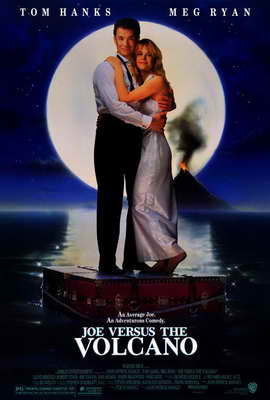
As my colleague Scott Tobias wrote in “Ten Notorious Flops Worth Seeing” John Patrick Shanley’s romantic fantasy Joe Versus The Volcano is about “nothing less than the joy of being alive.” It’s an incandescent trifle that nevertheless speaks to some of mankind’s most profound concerns. What does it mean to be alive? Is it a gift wasted on the living? Does impending death inherently give life more meaning?
That’s a lot for a first-time director to tackle, but Shanley was far from a neophyte. He’d established himself as a playwright, won an Academy Award for his very first screenplay (the swooningly romantic Moonstruck), and, for his directorial debut, roped in Steven Spielberg as Executive Producer and Tom Hanks, arguably our most beloved living movie star and the only apparent heir to James Stewart’s vacated title as America’s idealized everyman, as his star. Joe didn’t skimp on production values, either. It boasts the boundless invention and towering, gorgeous sets of a clever young prodigy who’d just been given the world’s largest toy box and was eager to make the most of it. It’s one of those rare movies where every element seems fussed over to perfection, where every molecule is perfectly in place. So if Joe Versus The Volcano was deemed a flop upon its initial release, that’s partially because expectations for it were so high.
Shanley immediately establishes a tricky fairy-tale tone with a scrawl that opens with “Once Upon a Time” before introducing us to our hapless hero, a miserable sad-sack (Hanks) who trudges drearily to work each day at a gothic factory straight out of Charles Addams or Edward Gorey’s morbid imagination. Hanks works for Dan Hedaya at a company that manufactures medical implements (“Home of the Rectal Probe!,” one woefully ineffective bit of bluster raves), but seems more intent on generating human misery for employees soul-sick from buzzing fluorescent lights and deadening routines.
At the office, Hanks lives a life that, to paraphrase Elvis Costello, is almost like suicide, so it’s pretty much a relief when he learns from doctor Robert Stack that he’s contracted a curious condition called a “Brain Cloud” and has less than a year to live. Hanks has been dying a long, slow, painful death since quitting the fire department years earlier and his impending exit from the land of the living liberates him from the grim concerns of day-to-day life, especially after manic pixie gazillionaire Lloyd Bridges offers to give Hanks a life of luxury on the condition that he eventually sail to a tropical island and jump into a volcano, thereby appeasing the native islanders so Bridges can score their precious, precious natural resources.
At each step in his journey, Hanks becomes involved with a different potential love interest played by Meg Ryan. Now normally the phrase “Meg Ryan in multiple roles” is enough to send shivers down the spine or suggest a fate worse than death. And while it pains me deeply to write this, Meg Ryan is adorable! In Joe Veruss The Volcano, at least. The film fully explores the actress’ remarkable range as she portrays everything from a mousy neurotic with a voice straight out of a ‘30s Warner Brothers melodrama to a flighty, neurotic, screwball L.A heiress to an unusually radiant variation on Ryan’s usual neurotic pixie persona.
Hanks encounters other memorable characters en route as well, especially Ossie Davis as a limo driver who views impeccable dressing as a matter of profound philosophical significance. Davis’ casually authoritative guide to the good life views luxury almost as a manner of life and death: this is poetically apt (Spoiler Alert!) in that when Hanks and Ryan are adrift in the ocean at the end of the film, it is literally Hanks’ choice to splurge on the decadently expensive luggage that saves their lives. Davis’ elegant mentor belongs to the strange cinema sub-strata of Magical Black Men, but the role is conceived and executed with such relaxed charm that he transcends stereotype.
As Hanks sheds his grim fatalism and embraces life, the film’s color palette morphs from cold grey drudgery to ripe, richly satiated jewel-box boldness. The East Coast sequences are a child’s giddy dream of New York while the island segments ooze infectious tropical sensuality. At the island, Hanks is met by Orange soda-loving Jewish Islanders led by the hilariously casual Abe Vigoda, who views Hanks less as a God-like hero than a mensch doing everyone a favor.
As Toys and Elizabethtown illustrate, whimsy is incredibly difficult to pull off. One man’s whimsical delight is another man’s cloying sugar headache. So when you’re trying to entice audiences to enter your magical little world of whimsy and delight, it helps immeasurably if your guide is Tom Hanks rather than, say, Robin Williams or Orlando Bloom.
Joe Versus The Volcano is an odd duck partially because it owes so much to Shanley’s theater background, from its extravagant, impressionist sets to its long takes to its stylized, beautifully wrought dialogue to its highly theatrical use of repetition, symbolism, and metaphor. Take Hedaya’s role for example. Hedaya essentially repeats endless minor variations on the same bit of dialogue for minutes on end. The effect is two-fold: the repetition develops a strangely hypnotic rhythm all its own and it indelibly conveys that Hedaya has probably been having this same maddeningly circular, essentially meaningless conversation for years, if not decades on end. He’s permanently locked in the poisonous, soul-crushing machine from which Hanks so joyfully extricates himself.
It didn’t make much of a splash at the time, but I can see the film’s storybook loveliness and bittersweet, child-like whimsy being a huge influence on Wes Anderson, especially The Life Aquatic, while the workplace absurdism and Bridges’ sprightly oddball turn anticipate Being John Malkovich and Orson Bean’s similarly twinkly performance as a genially warped old buzzard. But the loopy, child-like romanticism and winsome optimism at the heart of Joe belongs wholly and irrevocably to Shanley, who establishes himself as a true auteur here even as he draws extensively on the films of David Lynch, Tim Burton, and Spielberg. If nothing else, Joe Versus The Volcano should have announced the emergence of an audacious and a singular new directorial talent. Instead it was something of a cinematic dead end for a writer who went back to theater after gun-for hire work on We’re Back, Alive, and Congo, though he’s ostensibly directing a film adaptation of his Pulitzer Prize-winning play Doubt with Phillip Seymour Hoffman and Meryl Streep due out next year.
Most movies use the songs on their soundtrack like a bored teenager flipping through his iPod: a little hip-hop flava here, some punk rock aggression there, a little techno moodiness to top it off, and nothing meanders too long or makes much of an impression. But in Joe Versus The Volcano, the smartly selected songs play long enough to brood and sulk and develop a life of their own. Shanley lets Ray Charles’ transcendent take on “Ol’ Man River” linger long enough for its broken-down grace to shine through and implicate Hanks’ miserable existence in the process. Hanks’ evolution from suicidal despair to rapturous joy is reflected by a soundtrack that segues from the withering fatalism of “16 Tons” and “Ol Man River” to the infectious ebullience of “Good Loving.”
My father says Joe Versus The Volcano is held in high regard in the self-help community, which understandably embraces its narrative of a joyless sad-sack who discovers the tools to live out of his wildest fantasies. It’s a fizzy pop fable about the quirkiest possible route to self-actualization that’d probably have been better received by the public at large if it didn’t boast such a precious title or cutesy conceits like Orange-soda-loving, Volcano-fearing Jewish islanders. Which begs the question: Do movies like Ishtar, Gigli, Howard The Duck and Joe Versus The Volcano fail because they have terrible titles or are their titles only viewed as terrible because the films were such pronounced box-office failures? For this film, at least, I’d to think the second explanation holds true.
For such a strangely irresistible, life-affirming movie Joe proved awfully divisive. Shanley gave critics and haters plenty of ammunition (Meg Ryan in three mannered roles, all manner of twee cutesiness spilling around the edges), just as he gave the film’s growing cult plenty to fall in love with. Over and over again.
Watch Joe Versus the Volcano on Hoopla here: https://www.hoopladigital.com/title/13529408

Review by Sofie Monks Kaufman
Source: Little White Lies
Beauty and tragedy abound in Charlie Kaufman and Duke Johnson’s melancholic stop-motion treasure.
Kurt Vonnegut’s 1963 novel ‘Cat’s Cradle’ is about the fictional religion of Bokonism. In it, he invented a new vocabulary for how we evaluate others. The most profound thing you can say about a person is that they belong to your “karass”. This, Vonnegut defines as “a network or group of people who are somehow affiliated or linked spiritually.” Charlie Kaufman wrote Being John Malkovich and Adaptation, and directed Synecdoche, New York, and I am a member of his karass.
We are linked by name and an inward nature, and therefore I naturally accept qualities in his latest film, Anomalisa, that might deter others. Since its premiere at the Telluride Film Festival, the film’s gender politics have been widely discussed. Yet there’s a narrative that is driven by a self-consciously wretched man which both eclipses and consumes this element of the film. The fact that the lead character cannot recognise the depth of others – women and men – is the whole melancholic point.
Michael Stone (David Thewlis) is the loneliest of all of Charlie Kaufman’s lonely men. White, married and joyless, he has grey hair, middle-aged spread and no clear reason for living. Well-meaning conversationalists only grate on his frazzled nerves. Thewlis’ raw Lancashire bark hints at the desperate suffering beneath his auto-politeness. Michael can’t communicate with the people who pass through his life. Their inability to touch him and his inability to perceive them is telegraphed with a bold casting choice that constantly reinforces Michael’s plight while powering a source of hilarity on a par with the ‘Malkovich, Malkovich, Malkovich’ scene in 1999’s Being John Malkovich.
The world that Kaufman has built with the invaluable expertise of co-director and animation whiz, Duke Johnson, is a new sub-genre: social realist stop-motion puppetry. The costly joke is that years of painstaking work has gone into creating sets that are entirely banal. Rather than labouring in the name of fantastical, stylised spectacle like many a proud aesthete, their efforts focus on recreating the architecture of everyday life – like a mini version of the play in Synecdoche, New York. Charlie Kaufman values the intensity that comes from mirroring reality. Watching Anomalisa is like watching a mind trying to escape its own tedious corridors, searching for the sweet release of a meaningful voice next door.
Michael is a guru. His book, ‘How Can I Help You Help Them?’, has established him as a god of the customer service scene. He has flown to Cincinnati to address disciples. The arc is simple. He meets a woman called Lisa (Jennifer Jason Leigh) and thinks that she has changed his life. She is a paragon of insecurity overwhelmed by each drop of tenderness. If his soul is trapped inside, hers spills out in torrents. Their liaison is awkward, touching and driven by his persuasive neediness. Lisa submits at every stage in a way that is not going to win Anomalisa any progressive representation awards, but still has the ring of truth. Some who have gone without intimacy for a long time are just glad to replenish their stocks.
Duke Johnson is unlucky and lucky to co-direct on his debut feature. He’s unlucky because the story is so patently Kaufman-esque (he originally wrote it as a play under the pen name Francis Frejoli) that the credit defaults to the more established artist. But he is lucky because Anomalisa is a hell of a calling card, showing he can deliver a nuanced animation and fulfil an idiosyncratic vision. The most striking aspect of the puppets are their more-human-than-human eyes made from a combination of 3D printed irises, self-repairing silicon and clear resin. “Sadness was a word we used a lot when talking to everybody,” Johnson has said. This is apparent everywhere and particularly in the leaden movements of Michael who drags himself onward like a man in danger of crumpling.
Most of the drama takes place in the soothing but anonymous Frejoli hotel. A steady stream of absurd, perceptive jokes evince Kaufman’s capacity to entertain even while distilling the essence of alienation and the chimeric releases that taunt its sufferers. He is a sad clown. His characters are puppets for solipsistic malaise. Yet he is passionate about humour and the joke count is high.
From unsexy chat-up lines (“Would you like to get a drink, chat about phone system innovation?”) to running gags best left unspoiled to the relish with which the minutiae of hotel life is milked for frustration, Anomalisa is as coloured by external detail as it is fuelled by internal torment. The complexity of the ideas at play is intoxicating both emotionally and intellectually. Kaufman is ahead of his character in delivering the antidote to self-absorption: meaningful communication.
Watch Anomalisa on Kanopy here: https://www.kanopy.com/product/anomalisa-1
INDIAN COUNTRY NEWS
"It is the duty of every man, as far as his ability extends, to detect and expose delusion and error"..Thomas Paine
Human in Algorithms
From the Roof Top
I See This
blog of the post capitalist transition.. Read or download the novel here + latest relevant posts
अध्ययन-अनुसन्धानको सार
 After the Crash