Saturday Matinee: Vermilion Pleasure Night

“Vermilion Pleasure Night” (2000) was a Japanese late night variety show incorporating live-action and animated skits that run the gamut from surreal, sexy, profane, disturbing and satirical. Director Yoshimasa Ishibashi is an acclaimed artist whose installations have been featured at New York’s MOMA and London’s Tate Modern.

This premiere episode provides a sample of the recurring vignettes featured throughout the series including the Fuccon family (a dysfunctional family of smiling mannequins), Starship Residence (chronicling the misadventures of an alien bachelor and his neighbors), One Point English Lessons (a satire of English language learning programs), Midnight Cooking (a macabre musical cooking show), Cathy’s House (a live action skit evoking the setting and aesthetics typical of Barbie dolls), and random short scenes directed in the style of David Lynch films.

Saturday Matinee: Cold Case Hammarskjöld

Review: COLD CASE HAMMARSKJÖLD, Pretzels of Truth and Performance Art

By Kurt Halfyard

Source: Film Anarchy

“This could either be the world’s biggest murder mystery, or the world’s most idiotic conspiracy theory.”

Two years before the JFK assassination, on the 18th of September 1961, the world was shocked by the suspicious death of the second serving Secretary-General of the United Nations. In a plane crash in Ndola, Rhodesia, Dag Hammarskjöld was the only person on board not horribly scorched in the ‘accident.’ Instead he was bloodied, and a playing card was tucked in his shirt collar.

Nearly six decades later, the UN is still (nominally) investigating the details of what was thought first thought to be an accident, then a targeted assassination, of a man who had designs on the political and financial independence of the African continent. In fact, U.S. President John F.  Kennedy himself described the Secretary General as “the greatest statesman of our century.” The assassination theory holds several motive possibilities – various industrial interests active in the region (both then and now) or various clandestine military or mercenary operations taking orders from the US, the UK and Europe who had designs at odd with the ‘activist’ Secretary General.

There are crimes, and then there are crimes. Outside of the small circles of Denmark Television or offbeat cinephiliia, Mads Brügger is criminally unknown. The journalist, comedian, satirist, filmmaker, but above all, provocateur, has been twisting the documentary form into pretzels of truth and performance art for more than a decade.

In 2006, he toured an autistic theatre troupe though North Korea, cascading through a collection of political handlers and bureaucrats, to make a point about propaganda and totalitarian fear imposed on the so-called Democratic Peoples Republic of Korea. As if that stunt, The Red Chapel, was not fraught with enough risk, he then purchased illegal diplomatic credentials from the Central African Republic (CAR) to set up his own personal blood diamond operation (under the front of a match factory whose product would be manufactured by the local Pygmy population). By the time The Ambassador wowed Sundance attendees (and yours truly) in 2011, several of the ‘characters’ in the film, political figures in the CAR, had disappeared or been killed.

The Danish filmmaker takes large risks, some might say indefensible ones. Along with his countryman Lars Von Trier (whose outfit Zentropa produced The Ambassador), Brügger keeps plenty of his own skin in the game of his cinematic endeavours — for the sake of your education, and entertainment. He is a hell of a talented filmmaker.

With Cold Case Hammarskjöld, things go the full Errol Morris (WormwoodA Wilderness of Error) investigation route. With the help of Göran Björkdahl, a Swedish activist/investigator who is in possession of the only part of Hammarskjöld’s plane that was not buried under the soil of the Ndola airport, Brügger uses every trick in the documentary playbook: re-creations, animations, historical footage, official and redacted document scavenging, and a lot of interviews with people who where sidelined, ignored, or simply unknown at the time.

Above all, Brügger recreates, in glossy cinematic terms, himself making the documentary itself. Form as function, as with any good conspiracy theory, things start to fold back on themselves in increasingly avant garde ways.  

But there is purpose in this narrative trickery. By filming himself, twice, it offers Brügger the storyteller the opportunity to rope a Zodiac-level ‘filing cabinet ‘of names, facts, dates, and political organizations, together into a ‘lean in’ yarn of far reaching proportions. Two hundred old Secret Marine Societies, megalomaniac villains dressed in white, biological guerrilla warfare, the fallout of Apartheid, World War II fighter aces, assassins leaving Playing Cards in their victims’ collar, and of course, the fate of both a continent, and a fledgling World Government Body are all tethered together.

To say that the film’s 128 minutes is dense, is an understatement. Via this experimental technique (which of course the filmmaker acknowledges, in somewhat of a mea culpa, at one point) along with some pretty detailed, rational, detective work, makes the whole thing as seductive and addicting as Serial or The Staircase.

At one point, Michael Moore-style, Brügger and Björkdahl arm themselves with a high powered metal detectors, shovels, and a cigar (in the off chance they are successful), and go scouring the back-fields of the Ndola airport looking for the 50+ year old burial site of the plane. The authorities arrive. They are polite, but firm, regarding this activity. You are simply not welcome to do this kind of digging.

Cold Case Hammarskjöld has caused a stir in ‘papers of record’ such as The New York Times and The Guardian, reacting to the film compelling presentation and investigation of SAIMR, the South African Institute for Maritime Research, and its quack doctor, Lord Nelson cosplaying Commodore, Keith Maxwell, the “man in white”, who is said here of not only co-ordinating the murder of Dag Hammarskjöld, but also weaponizing AIDS virus for genocidal purposes, and ostensibly participating in bad amateur theatre.

The former may have been at the behest of the CIA and MI6, the latter was on his own personal time. Maxwell was a surreal combination of L. Ron Hubbard, and Colonel Kurtz, and Brügger condemns, mythologizes, exposes, at several points even mimics, him in the way only larger than life cinema can.

If there is a signature image across several of the films of Mads Brügger, it is that of an impeccably dressed man, wildly out of place, sitting on a skinny boat drifting on the current of a wide, and fast moving body of water. Here it is Göran Björkdahl, no closer to the truth of the matter, but still floating on the river of possibilites. We have learned things, both true and untrue, along the way.

Cold Case Hammarskjöld is the most engaging (and entertaining) documentary of the year.

Watch Cold Case Hammarskjöld on Kanopy here: https://www.kanopy.com/product/cold-case-hammarskjold

Saturday Matinee: Koyaanisqatsi

Source: Koyaanisqatsi.org

KOYAANISQATSI, Reggio’s debut as a film director and producer, is the first film of the QATSI trilogy. The title is a Hopi Indian word meaning “life out of balance.” Created between 1975 and 1982, the film is an apocalyptic vision of the collision of two different worlds — urban life and technology versus the environment. The musical score was composed by Philip Glass.

KOYAANISQATSI attempts to reveal the beauty of the beast! We usually perceive our world, our way of living, as beautiful because there is nothing else to perceive. If one lives in this world, the globalized world of high technology, all one can see is one layer of commodity piled upon another. In our world the “original” is the proliferation of the standardized. Copies are copies of copies. There seems to be no ability to see beyond, to see that we have encased ourselves in an artificial environment that has remarkably replaced the original, nature itself. We do not live with nature any longer; we live above it, off of it as it were. Nature has become the resource to keep this artificial or new nature alive.

That being said, my intention in-other-words, let me describe the bigger picture. KOYAANISQATSI is not so much about something, nor does it have a specific meaning or value. KOYAANISQATSI is, after all, an animated object, an object in moving time, the meaning of which is up to the viewer. Art has no intrinsic meaning. This is its power, its mystery, and hence, its attraction. Art is free. It stimulates the viewer to insert their own meaning, their own value. So while I might have this or that intention in creating this film, I realize fully that any meaning or value KOYAANISQATSI might have comes exclusively from the beholder. The film’s role is to provoke, to raise questions that only the audience can answer. This is the highest value of any work of art, not predetermined meaning, but meaning gleaned from the experience of the encounter. The encounter is my interest, not the meaning. If meaning is the point, then propaganda and advertising is the form. So in the sense of art, the meaning of KOYAANISQATSI is whatever you wish to make of it.

This is its power.

Watch Koyaanisqatsi on Kanopy here: https://www.kanopy.com/product/koyaanisqatsi-0

Saturday Matinee: J.R. “Bob” Dobbs and the Church of the SubGenius

Review By Steve Davis

Source: The Austin Chronicle

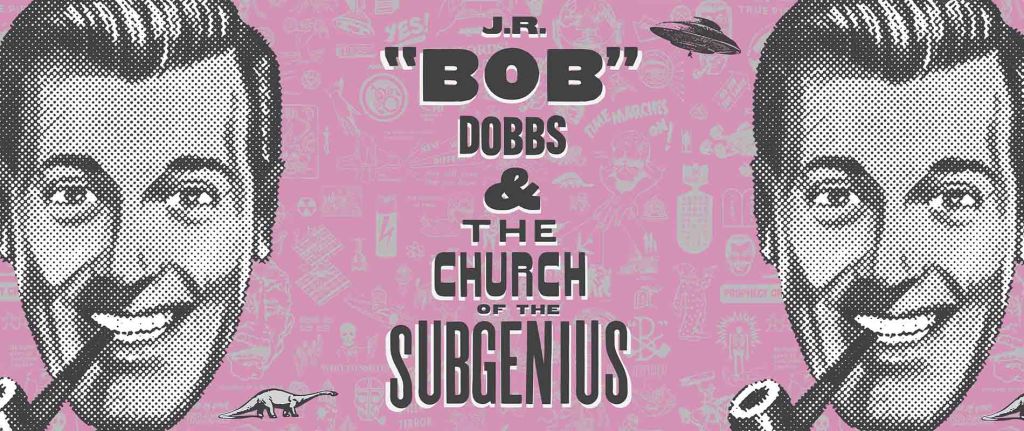
You couldn’t escape his ubiquitous mug back when Austin was truly weird. It appeared on bumper stickers, bulletin boards, telephone poles, streetlights, bathroom walls, and more: A perfectly coiffed and lantern-jawed 1950s dad, his perfectly straight teeth clenching a pipe in an ear-to-ear grin worthy of Ward Cleaver. Although his face archetypically evoked white, middle-class, heterosexual Christian conformity, J.R. ‘Bob’ Dobbs (note the mandatory quotation marks) served as the symbol of something completely different from post-war homogeneity. He was the appointed figurehead of the Church of the SubGenius, a somewhat wacky “religious” (more quotation marks, but subjectively imposed) organization formed to counter the “conspiracy of normalcy” pervading American society. Initially hatched in the playfully demented minds of two Dallas-area merry pranksters, Reverend Ivan Stang and Dr. Philo Drummond (née Douglass St. Clair Smith and Steve Wilcox, respectively), in the late Seventies, the Church was intended as a dogmatic antidote to a re-emergent mediocrity, embracing an aesthetic in confluence with evolving new wave sensibilities and tropes in music, film, and pop culture. It was an in-joke with a half-serious punchline.

The image christened ‘Bob’ first appeared in a 1979 DIY pamphlet that asked readers questions like “Are You Abnormal?” and announced “The World Ends Tomorrow AND YOU MAY DIE!” before soliciting a dollar subscription fee for this new fringe theology masquerading as performance art and satire. (Or was it performance art and satire masquerading as fringe theology?) Afterwards, non-conformists everywhere (including the band Devo, magician Penn Jillette, film director Alex Cox, and actor Paul “Pee-wee Herman” Reubens) began to jump on board and the Church ended up becoming, inexplicably or not, a phenomenon of sorts, making the indefatigable ‘Bob’ the first piece of clip art to lead a world-wide congregation.

The deftly executed documentary J.R. ‘Bob’ Dobbs and the Church of the Subgenius demonstrates great affection for Bob and his acolytes, many of whom enthusiastically relate the Church’s mythology, history and doctrine here with a nostalgic sentimentality usually reserved for reckless-youth silliness. (Full disclosure: the film was executive produced by Chronicle co-founder Louis Black.) Their monikers set the tone – Reverend Susie the Floosie, Nurses Vicki and Kelly, Papa Joe Mama, Dr. Howland Owll, and Reverend Dr. Onan Canobite, among others. Special mention must go to a delighted Arch Doctor Saint Margaret, the late and sorely missed Margaret Moser, Austin Chronicle music columnist and legendary Texas Blonde. These eager talking heads – including the aforementioned Messrs. Stang and Drummond—discuss the early anarchic gatherings of the SubGenius faithful at so-called “devivals”, attempt to explain the undefinable zen of “Slack” that all church members strive for, recount Bob’s infamous assassination onstage at San Francisco’s Victoria Theatre (catlike, he has many lives), and recall the prophecy of the Rupture, when (7 a.m., July 5, 1998, to be exact) Church members would rise up against the norms who’ve robbed them of Slack and ascend to pleasure saucers piloted by alien sex goddesses. (Like most patriarchal sects, the Church skewed towards a boy’s club mentality.) It all sounds fantastic. And it is, in every meaning of the word.

Director Boone and her crew make good use of those interviews, as well as grainy film footage and subliminal imagery, to document the story of Bob and his Church, which still thrive albeit to a much lesser degree, despite challenges that include competition from the internet, cult-related tragedies like the Columbine massacre, and some negative press (deserved and undeserved) over the years. While some question whether there’s any room left for relatively benign organizations like the Church of SubGenius in this hardcore conspiracy-driven world, the documentary ends with the hope there will always be a place for nonthreatening weirdos to worship. To those naysayers who disagree, I quote from the Scripture of Bob: “Fuck ’em if they can’t take a joke.”

Watch J.R. “Bob” Dobbs and the Church of the SubGenius on Kanopy here: https://www.kanopy.com/product/jr-bob-dobbs-and-church-subgenius