Saturday Matinee: All Light, Everywhere

Film Review: “All Light, Everywhere” — Darkness Visible

By Neil Giordano

Source: Arts Fuse

Do you trust what you see? How can you? Our eyes are no longer the primary way that we see; they have been swapped out for the filters of screens and technology. The suspicious mediation between cameras and our perception of ‘reality” has never been more ubiquitous — or more insidious. Perhaps what we don’t see, however, is at least as important as what we do see. But how can we become aware of what we don’t see?

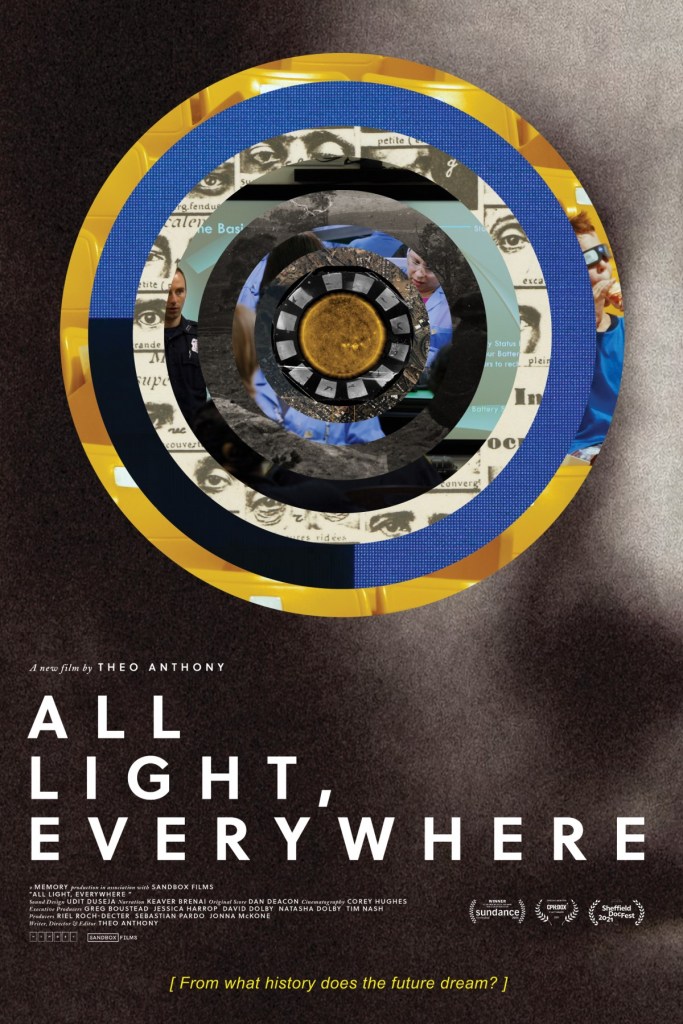
These questions lie at the heart of the fascinating new documentary All Light, Everywhere, an entrancing blend of neuroscience, metaphysics, and technological history that has the smarts to apply some sly, subtle social commentary to its elusive subjects.

At first, the film seems to flitter among semi-connected topics: A marketing campaign that is testing its volunteers’ reactions to visual images; a tour of Axon Industries, the #1 maker of police body cameras, with its corporate spin doctor as our guide; an aerial composite-imaging system that was used secretly by Baltimore police to surveil the city. Interspersed into these “storylines” are narrated forays into the history of early photography along with B-roll of ordinary people preparing to view the 2017 solar eclipse with their own cameras (and eyes). This unrelenting focus on the production and consumption of visual imagery transforms the film into an almost fractal experience. It becomes a bit too much: the sheer ubiquity of people looking, eyes looking, images to be seen and consumed and interpreted, examinations of the various technologies serving up new pictures to be mediated. The unsettling point of this unconventional documentary seems to be to distort rather than clarify the subject at hand — and that may be just what director Theo Anthony wants.

The underlying political relevance of the film is transparent. We live in a surveillance society, consenting (though not always consciously) to being filmed, watched, and recorded by corporations hoping to sell us products based on the data they gather. The government snoops in the name of crime prevention and law enforcement. The value of the latter has been hotly debated in the last few years: George Floyd’s murder being a prime example. Here the police body cameras showed us what we believe to be an “objective” record of events, footage of police brutality and murder. But body camera images have been weaponized by both sides, each seeking to prove something that will help their case. What Axon Industries sells to police forces (and to the general public) is that they are confident their cameras will tell the “truth” about any police action. Accountability is promoted as their product’s best feature. But it is more than that — “behavior will change ” because of the presence of cameras, that they will inhibit bad behavior.

But what do body cameras actually show us? Are these videos an authentic record of reality? The documentary examines, abstractly at first and then far more concretely, how there is always bias. Where is the camera located on the body? Does its wide-angle lens distort our understanding of action? How is this data interpreted and by whom? There are so many levels of interpretation that “objectivity” has turned into a myth.

The film’s looks back into the past are also illuminating, unsettling illustrations of how camera technology has almost always been co-opted for violent and authoritarian uses, whether it be the American military tracking the enemy on the battlefield or in the early experiments in composite imaging used by police to profile criminals. The latter presages the now rampant use of facial recognition technology, its marketed value undercut by its practical limitations as well as ethical muddiness.

The irony is not lost that what we’re looking at is itself a film, another visual entity that requires us to watch and to mediate. The film’s meta-commentary confesses that its stochastic manipulation is by design. Highly kinetic editing leads our brains to make connections in ways that excited Eisenstein at the dawn of film a century ago: the whole is greater than the sum of the parts. The mind demands order, so the juxtaposition and collision of images generates meanings that did not exist in individual images.

Anthony draws on history to help us make sense of a visual world that is increasingly fleeting and fragmented. The film is reminiscent, in style and subject matter, of the works of Errol Morris. This goes for its sometimes desultory exposition, as well as its approach to epistemology. (Morris explores these issues in all of his films, as well as in his essays in his books Believing Is Seeing and The Ashtray.) In the third act of All Light, Everywhere, a well-placed quotation from Frederick Douglass summaries the central issue: “We all feel that there is something more. That the curtain has not yet been lifted. There is a prophet with us forever whispering that behind the seen lies the immeasurable unseen.” The “immeasurable unseen” may not be possible to capture on cameras, no matter how many we use or how hard we strive for an elusive objectivity. Perhaps it is more important for us to understand that urge for “something more” should lead to examining how, why, and for whom the image was made.

Watch All Light, Everywhere at Kanopy here: https://www.kanopy.com/en/product/12333392

Saturday Matinee: Gloria’s Call

Source: GloriasCall.com

From the cafés of Paris to the mountaintops of Samiland, a scholar’s life is foreverchanged through her friendships with the women artists of Surrealism.

In 1971, graduate student Gloria Orenstein received a call from Surrealist artist Leonora Carrington that sparked a lifelong journey into art, ecofeminism and shamanism. The short film, Gloria’s Call, uses art, animation and storytelling to celebrate this wild adventure from the cafes of Paris to the mountaintops of Samiland. The film is produced by artists Cheri Gaulke (director), Cheryl BookoutAnne GauldinSue Maberry and Christine Papalexis .

Gloria’s Call was born in October of 2016 during a presentation by renowned scholar Dr. Gloria Feman Orenstein at the Southern California Women’s Caucus for Art (SCWCA) Surrealist Tea in celebration of their 40th Anniversary.

ABOUT GLORIA

While my life has had its challenging moments and I have traversed many a dark woods in my quest for knowledge, I am fulfilled by the wondrous journeys I have made to the realms of the Marvelous, the Magical, the Great Goddess and the Shamanic Mysteries, and I will be forever grateful to the teachers who inspired me and to the feminist activists on whose strong shoulders we now stand as we welcome new generations of visionaries expanding our feminist legacy into the new millennium.   -Gloria Feman Orenstein

Gloria F. Orenstein is Professor Emerita in Comparative Literature and Gender Studies from the University of Southern California. Her areas of research have ranged from Surrealism, contemporary feminist literature and the arts to Ecofeminism and Shamanism.

Her first book The Theater Of The Marvelous: Surrealism And The Contemporary Stage paved the way for her pioneering work on The Women of Surrealism. Leonora Carrington had been a friend and remained a major source of her inspiration in research and scholarship since 1971. Her book The Reflowering Of The Goddess offers a feminist analysis of the movement in the contemporary arts that reclaimed the Goddess as the symbol of a paradigm shift toward a more gynocentric mythos and ethos as women artists forged a link to the pre-patriarchal civilization of the ancient Goddess cultures, referencing them as their source of spiritual inspiration.

Orenstein is also co-editor of Reweaving The World: The Emergence Of Ecofeminism, a collection of essays that grew out of the conference she created at USC in 1987, Ecofeminist Perspectives: Culture, Nature, Theory. During the 80s she was invited by the Shaman of Samiland (Lapland, N. Norway) to be a student with her in Alta, Norway, an experience that continued intermittently for almost five years. She also created The Woman’s Salon in NYC that lasted for ten years beginning in 1975. More recently, her work in Surrealism, in particular, led to her inclusion of an essay in the book In Wonderland that accompanied the important exhibition of the same name that focused on the Women artists of Surrealism in the Americas, both those who were native to the Americas and those who migrated there during or after WWII. Orenstein was a pioneer in introducing the art of Frida Kahlo to North American feminists early in the 70s. Today, she continues her journey investigating the visionary worlds of revelation and the Marvelous, and will continue this pursuit in her research well into the future.

Saturday Matinee: Blue Thunder

Looking back at Blue Thunder

John Badham’s high-tech helicopter thriller Blue Thunder rode the crest of a decade obsessed with cool cars and aircraft…

By Ryan Lambie

Source: Den of Geek

Back in the 1980s, a company called Sega perfected what it referred to as the Full Body Experience. Less kinky than it sounds, this fusion of CRT television, videogame technology and hydraulic pistons aimed to give amusement arcade visitors a taste of what it might be like to drive a Ferrari Testarossa or motorcycle at breakneck speed or fly a fighter jet through a valley full of enemy aircraft.

For a generation of youths, these machines, with their chunky graphics and even chunkier controls, are the stuff of legend, and the mere mention of their names – Hang On, Out Run, After Burner, Space Harrier, Thunder Blade – is enough to evoke involuntary memories of Proustian proportions.

These half-remembered machines sum up the 80s era of mechanical wish fulfilment. More than any other, the decade catered to youthful fantasies of fast cars and deadly aircraft. Perhaps spurred on by the ongoing success of Star Wars, which placed Luke Skywalker at the helm of one of the coolest fighter craft ever committed to celluloid, the 80s saw a rash of mechanical fantasies appear in cinemas, arcades, and on television.

For examples, look no further than Magnum PI, first broadcast in 1980, in which Tom Selleck got to drive around in someone else’s Ferrari 308 GTS, and took the occasional ride in a friend’s helicopter. Knight Rider, first broadcast in 1982, saw David Hasselhoff drive around in an unspeakably cool talking car. In the movies, small boys got to fly through the skies on bikes (E.T.), in stolen spy planes (D.A.R.Y.L.), and sexy alien space craft (Flight Of The Navigator). Even Hollywood elder statesman Clint Eastwood got in on the act, as he controlled a top-secret Russian fighter jet with the power of his mind in Firefox.

Later on in the decade, Top Gun flew into cinemas, whose lovingly lit fighter jet porn inspired such films as Iron Eagle and its sequel. But before Top Gun, there was Blue Thunder, a 1983 movie that appeared to kick off a brief media love affair with helicopters.

Like Firefox, Blue Thunder had the benefit of some quite serious acting heft behind it. Roy Scheider, best known to wider audiences as the chap who blew up a shark real good in Jaws, turned in some quite brilliant performances in KluteThe French Connection (for which he was nominated for a Best Supporting Actor Oscar) and Marathon Man. Scheider starred alongside Malcolm McDowell, whose biggest successes at the time, either financially or critically speaking, were if…, A Clockwork Orange and Voyage Of The Damned.

Quite why either of them signed up for Blue Thunder isn’t initially clear; Scheider would essentially play second fiddle to the true star of the picture – the high-tech experimental helicopter, so important to the story that it gets title billing. But in a 1983 interview with Movies & Video Magazine (as recorded for posterity by Blue Thunder Online), Scheider explained that the film’s political overtones interested him in getting involved.

“So you see the underlying theme of the movie is that it’s a total invasion of privacy,” Scheider said. “Although this kind of device to control crowd would be very effective it would also be invasion of your personal liberties.  What my character does in the film is to show the community that this kind of device isn’t necessary to be flying over anyone’s life.”

As for McDowell, director John Badham noted in a Starlog interview that the actor was terrified of flying – a setback, considering the character he was supposed to play was an army colonel with a love of hurtling about in helicopters.

The plot, if you were a youth at the time, mattered little – there was a helicopter in the movie, and it got to blow stuff up with a big gatling gun, and that was all you needed to know. Viewed today, it’s surprising how long it takes for director John Badham to get to the explosive bits – which, as it turns out, is no bad thing.

Scheider plays Frank Murphy, a Vietnam veteran turned helicopter pilot for the Los Angeles Police Department. In spite of his troubled past, Murphy’s selected to fly a new, experimental helicopter called Blue Thunder, a kind of flying Swiss-army knife which would allow the police to spy on citizens from the air undetected, and gun down miscreants with the gigantic gatling cannon sticking out of the front.

It’s the twin topics of public freedom and state control which separate Blue Thunder out from most other vehicle-based films of the decade. Although a thriller first and foremost, Dan O’Bannon and Don Jakoby’s script poses some pertinent questions about privacy and surveillance; there are many scenes in Blue Thunder where technology is misused to spy on women in a state of undress, or on private conversations in people’s houses.

Interestingly, Dan O’Bannon, who was inspired to write Blue Thunder with his partner Don Jakoby after growing annoyed at the police helicopters buzzing around LA during the late 70s, wasn’t at all happy with the filmed treament of the script. “The political impact – and there was quite a bit – was toned down,” O’Bannon argued, making the villains of the piece the federal government rather than the LA police department.

Whether Blue Thunder’s political elements were toned down or not, there’s no doubt that, in an era where the British government’s looking to place missiles on the roofs of London buildings as an anti-terrorist measure during the Olympics, and personal privacy is a more current topic than ever before, the idea of a heavily-armed police helicopter scouting the skies doesn’t sound so far fetched.

Anyway, back to the plot. Murphy learns that a group of shady individuals within the military may be thinking of using the helicopter to exterminate troublesome political dissidents. This group is headed up by – surprise – Murphy’s old Nam-era nemesis, Colonel Cochrane, played by McDowell. As Murphy’s wife Kate (Candy Clark) heads off to a news network headquarters with a videotape which proves the military group’s guilt, Murphy steels himself for a final act confrontation with his new-found  military enemies.

And what a confrontation it is. Having carefully racheted up the post-Nixon era paranoia, John Badham lets fly with a closing stretch that pleased the young viewers less interested in the script’s earlier meditations on state control. For all those kids who sat in one of Sega’s Thunder Blade machines in the 80s, I suspect it’s Blue Thunder‘s closing action scene which was playing back in their heads as they prepared to pilot a remarkably familiar looking military helicopter.

At the helm of Blue Thunder, Murphy does battle with ordinary police choppers, a pair of fighter jets, and then Cochrane himself, who’s taken to the skies in an armed helicopter of his own. Without CG and with a mere sprinkling model effects, Badham stages an impressive aerial display above the streets of Los Angeles. To modern eyes, it’s not quite so jaw-dropping, but it’s still well shot, well choreographed and surprisingly intense – and there’s a sublimely comic moment involving a shower of roasted chickens.

On the acting front, Roy Scheider’s the consummate tough, unflappable hero, a young Daniel Stern is good value as his sidekick, while Warren Oates puts in a welcome appearance which would sadly prove to be among the last in his long career. Then there’s McDowell, who remains a cheerfully despicable hate figure, in spite of his terror behind the scenes. His character even gets his own obnoxious catchphrase – a stomach-churning “Catch you later”, complete with finger gun.

(On the topic of acting, Mario Machado, who memorably played a news anchor in the RoboCop movies, Scarface and Rocky III, among many others, also turns up in an identical role in Blue Thunder.)

From a technological standpoint, it’s inevitable that a film that dealt with the cutting-edge gadgetry of 80s America would look particularly outdated to 21st century eyes. In spite of this, Blue Thunder remains an intelligent and well-made thriller with some great action moments. Its box-office success triggered a spin-off ABC TV series of the same name in 1984, while rival network CBS brought out its own helicopter-based series, Airwolf, that same year.

Of all the vehicle-based films and TV shows to appear in the 80s, Blue Thunder is almost certainly among the best. Where most, such as Top Gun, brought with them an air-punching sense of jingoism, Blue Thunder is a bitter, cynical film, and that’s probably why it’s aged so well. It’s also a fact that the helicopter itself still looks extremely cool, even if it isn’t quite as high-tech as it was 30 years ago.

With superhero movies currently at the peak of their popularity, Hollywood movie makers are probably wondering what the next big thing might be. If so, might we suggest a return to the mechanical wish-fulfilment movies of the 80s, as exemplified by arcade games such as Thunder Blade, or the film that inspired it, Blue Thunder? If there’s one thing the current clutch of blockbusters are sorely missing, it’s a sexy helicopter.

Watch Blue Thunder on Crackle here: https://www.crackle.com/watch/520

Saturday Matinee: Z Channel: A Magnificent Obsession

By JPRoscoe

Source: Basement Rejects

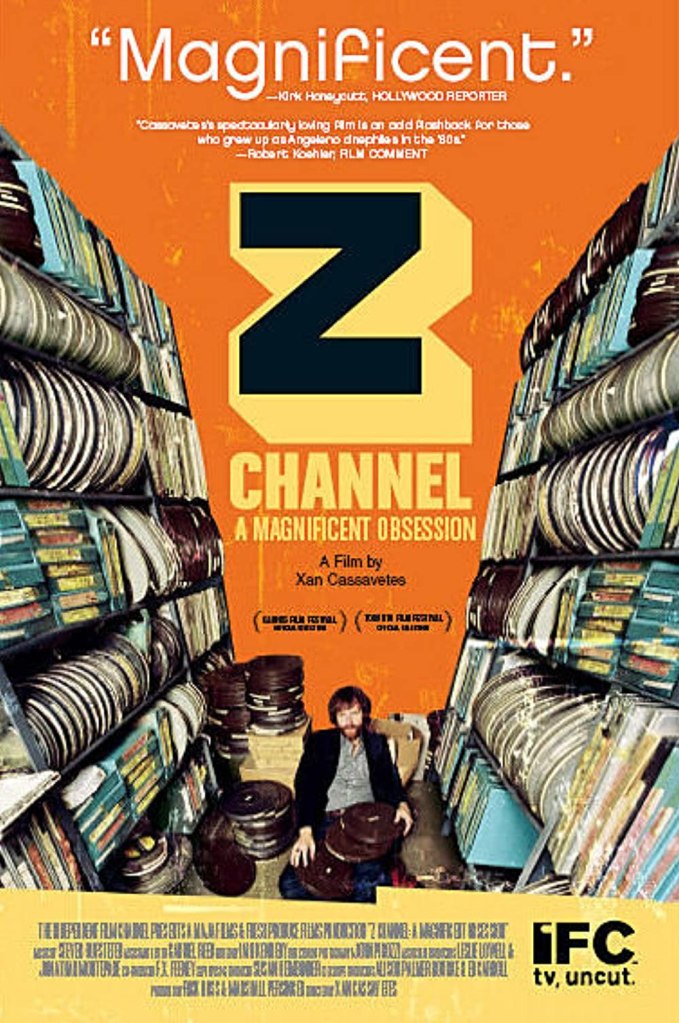
Launching in 1974, the Z Channel became one of the first pay cable channels.  The channel eventually morphed into a movie channel highlighting directors, art films, and championing original visions portrayed on the screen.  One of the people behind this transformation and the decisions made on the channel was the program director Jerry Harvey.  Harvey (with his team) brought many films to the Z Channel that were never seen anywhere in America and created a world for film lovers…but Harvey had his own demons.

Directed by Xan Cassavetes, Z Channel:  A Magnificent Obsession is a documentary about the rise and fall of the California based Z Channel which broadcast from 1974 to 1989.  The documentary premiered at Cannes in 2004 and was released to positive reviews.

I grew up without cable so dreams of HBO were just dreams.  At the time, I wouldn’t have appreciated Z Channel and would have much rather stayed with something like HBO or Cinemax.  Watching the Z Channel:  A Magnificent Obsession, I dream about the Z Channel still being around.

There are a lot of viewing options now.  The difference between something like FilmStruck and the Z Channel is that idea of chance.  You don’t know what you are going to get and you don’t know when you’ll get to see it again.  That is something that current TV watchers (or streamers) forget…you had to wait to see the movies you wanted and a video store might not have them.  The idea of someone so diligently trying to seek out and collect these films for viewers is admirable.

The documentary of course takes a dark turn in that Jerry Harvey really was someone who seemed lost.  The documentary does struggle with the ideas of its three themes at points in trying to decide if it is about Z Channel, Jerry Harvey, or the films…and it is understandable because it is hard to separate the three because they were so bound together.  Like a lot of documentaries, I wish there was a better way to establish more of a timeline of events through the course of the movie.

The documentary features a lot of great performers and great film clips.  Robert Altman, Quentin Tarantino, Jim Jarmusch, James Wood, and Jacqueline Bisset are among some of the people interviewed, but it is the immense outpouring of these people for what Z Channel did for them that shows its importance on modern film.  Harvey’s personal acquaintances provide the most insight to him and what was going on at Z Channel and really help round out the documentary…plus, it becomes a film watcher’s guide for movies that should be sought out.

Z Channel:  A Magnificent Obsession is an interesting documentary, but it also is a documentary that feels like it needed a little tweaking to become a great documentary.  It is a film for film lovers and a specific kind of film lover.  The movies highlighted appeal to a certain viewer and the true crime aspect of the story probably isn’t intense enough for people interested in the true crime genre.  Still, Z Channel:  A Magnificent Obsession is a worthy documentary that should be sought out.

Watch Z Channel: A Magnificent Obsession on Hoopla here: https://www.hoopladigital.com/title/14980839