Two for Tuesday
Reply

By Robert Daniels
Source: RogerEbert.com
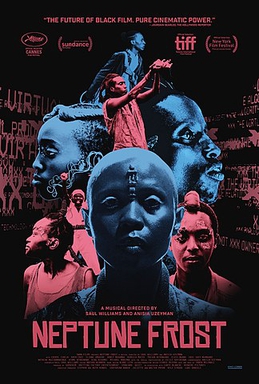
“Neptune Frost,” the dense Afrofuturist film from co-directors Saul Williams and Anisia Uzeyman, holds many resplendent identities at once: It’s a musical; it’s an intersex narrative; it’s a technological allegory espousing anticapitalist and anticolonialist views. It’s a collective dream coated in a blue lacquer dancing on the edge of something unrecognizable, something wholly transcendent. And it arrives with an exceptional display of bravura.
The film’s nimbleness, marked by a brazenness suggesting creators who allow their imaginations to be the moth that reaches for the stars, is apparent from the jump when the camera pans across the graveled gray and orange ridges of a mine. One of the miners, Tekno, beholds a chunk of coltan, the metal used to power our cellphones and other high-tech electronics, only to be summarily struck to death by the butt of a soldier’s gun. His grief-stricken brother Matalusa (Bertrand Ninteretse) cradles him as the other workers, accompanied by drums, with shovels hitting the ground for additional percussion, dance in mourning. This incident causes Matalusa to flee the mine, and a waking dream guides him to another dimension.
A similar, parallel vision, following the death of their aunt and a traumatic experience involving a pastor, pulls Neptune (Elvis “Bobo” Ngabo) away from their Rwandan village through the backroads of a country in upheaval. “I was born in my 23rd year,” explains Neptune in the film’s opening narration. And it’s not until Neptune transforms (this time played by Cheryl Isheja) that we figure out what exactly this ambiguous, yet potent line means.
Neptune is an intersex hacker exploring and disrupting binaries. They arrive in that other dimension, a village fed by a mysterious power source, to find Matalusa. There they discover a band of rebellious Black folks, such as Memory (Eliane Umuhire), Psychology (Trésor Niyongabo), and so forth who want to transform the world away from domineering colonialist powers, away from a totalitarian government known as the Authority, and out from one age into another. “Neptune Frost” demands your attention. Uzeyman’s luminous cinematography caresses black skin under blue and purple lights, allowing this talented group of actors to play to every corner of their innate beauty. The ingenious costumes by Cedric Mizero—a collection of wires, knobs, and hard drives—range from motherboard chic to a lightweight yet richly colored fabric that is elegant. The musical numbers, fusions of singer-songwriter Williams’ Afropunk style with atmospheric drones owing to Sun Ra, spring from the group so organically you immediately become fluent in their dynamic rhythms, moods, and tones.
While the artistry does dazzle, you never forget that “Neptune Frost” is a movie dedicated to the cause of liberation: a liberation of stolen resources and Black folks, and a freedom of the body. I found myself enraptured by the scenes of community building, of Africans bound together by a love for each other and a hope for the future moving toward revolutionary ends. The scenes of dance and happiness in this dimension, hidden away from white eyes (for the time being) is soul filling. In this ecstasy, in spite of an outside war-torn world, Neptune and Matalusa commit not just to the cause but to their shared spirit. Their bliss is idyllic, and therefore short lived. But it’s their willingness to challenge the Authority, through their romance and the acting of hacking, that serves as a battle cry against governments unwilling to serve their people.
While the logic guiding “Neptune Frost” is difficult to follow, this isn’t the kind of work you can sleepwalk through. It pushes the viewer. There are no wasted plot points, no unnecessary pieces of dialogue or needless landscapes. Every texture contains a million little stories. It is humbling to see two filmmakers so curious, and so creatively playful as to invite messiness and brilliance. In all its so muchness, “Neptune Frost” is a reminder of cinema’s infinite storytelling possibilities.
Watch Neptune Frost on Kanopy here: https://www.kanopy.com/en/product/neptune-frost

The Critical Surrealism of Jesus Shows You the Way to the Highway
By Andy Hageman
Source: Film Obsessive
There’s a new film by Miguel Llansó that is sheer originality and brilliance: Jesus Shows You the Way to the Highway.
If you’ve already seen Llansó’s 2015 film Crumbs, you’ve experienced the cinemastery of which he and the teams he assembles are capable. If you’ve not yet seen Crumbs, well, then, this review holds two surprises for you.
The brilliance of Jesus Shows You the Way to the Highway comes from its capacity to combine a radically eclectic selection of cultural aesthetics and tropes with a distinct vision and a theoretical political acumen. It’s a kind of pastiche with depth and texture. It’s cinema from an alternate universe in which David Lynch is an avid reader of Michel Foucault, Fredric Jameson, and Naomi Klein, and where Ethiopia holds a powerful place in the social imaginary.
I think it’s justifiable to claim that Jesus Shows You the Way to the Highway is practically unparalleled in recent cinema for its capacity to synthesize total zaniness with provocations to analyze geopolitical histories, the present, and future. And I say provocations because the film leverages its zaniness to lead spectators into critical avenues concerning espionage, biopolitics, gender dynamics, and technocultures of economics and repressions, all without providing particular answers or positions on these. Like the characters caught up in the increasingly bizarre tangles of worlds in the film, spectators are barraged with mysteries that compel us to work on them yet promise to keep developing and eluding total comprehension and resolution.
This is critical surrealism; hyper-pragmatic absurdism.
The story centers chiefly on CIA Agent D.T. Gagano (Daniel Tadesse)–his mission, which evolves and glitches as the film proceeds, and his relationships. Early in the film Gagano and his colleague, Agent Palmer Eldritch (Augustín Mateo), are tasked with entering a VR world to terminate a computer virus called “Soviet Union.” The virus has been attacking the ad system of a major platform called “Psychobook” with diabolical results such as Chevrolet advertising videos being replaced by videos of Stalin playing chess. When the agents and others are inside the VR world, their avatars are depicted as people with black masks over their heads and ridiculous two-dimensional paper masks with eye-holes in the pupils, and their movements are an unsettling stutter-stop motion as if they’re clunky clockwork bodies.
Agent Gagano’s mask is the face of Richard Pryor, in what I like to imagine is an allusion to David Lynch’s Lost Highway, and in many ways the aesthetic sensibility of the VR world is on a par with Lynch’s Twin Peaks: The Return—but with a Stalin avatar that battles with a hammer in one hand and a sickle in the other. Adjacent to his mission, Gagano navigates his romantic life with Malin, a woman nearly twice his size who dreams of opening a world-class kickboxing academy even as she supports Gagano’s dreams of opening a pizzeria. By the way, there’s something wonderful and intriguing about Gagano’s pizza obsession. What would in most movies be a comedy shtick is, in the hands of Llansó’s direction, an element of political economic and historical critique as well as a detail that reverberates throughout the story arc, as in the key intervention of three kung-fu masters named Spaghetti, Ravioli, and Balthazar.
As the story moves forward, synced with an amazing jazz soundtrack, by the way, Gagano’s consciousness is apparently transferred to a portable tv set, and the figure of Jesus, who is also Roy Mascarone (Guillermo Llansó), reframes the whole mission by claiming that a mysterious green gooey substance known as “The Substance” is the real enemy of all people. It’s here to colonize all people of Earth. Finally, while there’s so much more to try and capture, I feel like I need to mention the persistent presence of the fascist leader, Batfro (Solomon Tashe), who dons a Batman costume that’s a near match to the one Adam West donned in the 1960s Batman tv series. I add this detail here because there’s a crucial juxtaposition late in the film between Jesus’s claim about The Substance and the inclusion in the mise-en-scene of a 1974 Batman-cast Public Service Announcement concerning gender and labor that sparks lines of interpreting Batfro and the film’s critique(s) as a whole.
At this point in time when it’s easy, almost overwhelmingly so, to feel suffocated by the predominance of reboots, extended franchises and universes, and vigorous attempts at post-ideological sanitation of political implications (Yes, I’m thinking of Stranger Things 3 here and its stunning capacity to swerve away from doing anything with its ready-made architecture of a 1980s shopping mall with a secret Soviet Union base in its basement), Jesus Shows You the Way to the Highway is a testament to the resistance and resilience of avant-garde cinema. To the future of political acumen connected to a bonkers sense of humor.
The film is a deeply weird, fun, and original contemporary addition to Chaplin’s City Lights and John Carpenter’s They Live. I can’t recommend strongly enough seeking out a screening near you or streaming it once it becomes available, and let Jesus Shows You the Way to the Highway drive you beyond the current limits of your perspective on living on planet Earth today.
Watch Jesus Shows You the Way to the Highway on Tubi here: https://tubitv.com/movies/612125/jesus-shows-you-the-way-to-the-highway?start=true&tracking=google-feed&utm_source=google-feed

By Nick Allen
Source: RogerEbert.com
Every now and then, a new film surprises you with something that should always be true: movie-making is magic-making. Especially so when its tricks happen in-camera, with instruments as practical as lighting, costumes, sets, and ideas. Ryan Stevens Harris’ “Moon Garden” is one such escape from zeroes and ones overload and general cynicism about where movies may be going. It is a horror/fantasy that puts every bit of its imagination on the screen and constantly impresses with its DIY spectacle.
Written and directed by Harris, “Moon Garden” primarily takes place inside the mind of a little girl named Emma (Haven Lee Harris, Ryan’s daughter). The five-year-old is currently in a coma, having tumbled down some stairs one night after trying to get her parents (Augie Duke and Brionne Davis) to stop fighting. Emma wanders a shadowy, dirty, and mysterious realm as her body lies in a hospital, with her parents sitting beside her. Lights flash, and radio signals echo. The population is unpredictable: strange, freaky characters tear themselves up from the ground; others reflect the woman Emma may become.
Harris’ film holds your attention scene-by-scene, even in a few moments in which the pacing gives way to just admiring the craftsmanship or the emotions are muted by symbolism that doesn’t feel airtight. It’s the type of project that warrants a second viewing, partly to catch its connections but also to savor the textures you might have missed on your first visit.
“Moon Garden” is most emotionally incisive about a child processing what’s around her, namely the growing unhappiness between her parents. And as Emma travels through different parts of this world—like when she climbs a ladder through the clouds—Harris shows us the memory of her doing something similar with her father. It’s one of the happy thoughts, contrasted with another real-world flashback where Emma hides under some sheets with her mother, only for the claw-like hand of her upset father to tear it open. That memory inspires one of this horror story’s simple but effective sets, a tunnel made of bedsheets.
“Moon Garden” is a whole mix of creations, a lovingly scrawled sketchbook come to life by a compulsive creator. One of Harris’ greatest feats is the main villain known as Teeth, who taunts Emma, and ushers in the film’s more overt horror elements. Dressed in a long black coat and cap, it hovers above the air with spindly, long fingers. You can’t see its eyes, but you can constantly hear its chattering chompers, which becomes one of many unsettling atmospheric features from Harris (also the film’s sound designer). Sometimes Teeth places his namesake on the ground, and Harris’ camera, often placed low, studies it, and fears it. As in so many scenes of “Moon Garden,” Emma’s rapt curiosity becomes our own.
Harris’ apparent influences across these fields should help recommend this film alone: there’s a bit of Jan Svankmeijer, Steven Spielberg, Tarsem Singh, Guillermo del Toro, and David Lynch throughout, but not in a thrifting fashion. Just as the film does not over-simplify its dream passages, it also does not pander to film lovers who are primed to champion this gem. (Which was shot on expired 35mm film stock and vintage rehoused lenses!)
As Emma, Haven Lee Harris gives the kind of work a filmmaker would want from a child performer. She is incredibly reactive to this world, holding our attention while sharing the frame with far more intense, adult supporting characters or sets. She is a natural within the film’s changing environments, and in its many wordless passages, doesn’t strike a false note. It’s so rare to see a child actor’s performance that doesn’t take you out of the story in some way; that’s so invested.
“Moon Garden” is not just eloquent with its designs, but filled with plenty of in-camera magic tricks. With time-lapse savviness, fruit decays on the ground at warp speed; nimble, non-showy cuts make characters vanish with their clothes dropping to the ground. We meet another one of Harris’ striking characters, Phillip E. Walker’s Musician, through a sight that is wondrous but also simple: an organ being pieced together, by showing his destruction of it with a large mallet in reverse.
Ever connected to the emotions at play, Harris then builds that scene to a returning but always wrenching motif, Pete Ham and Tom Evans’ inimitable ballad, “Without You.” Emma’s mother sings the first verse and chorus softly into the girl’s ear in the hospital, causing it to play in Emma’s coma wonderland as a radio transmission with gentle accompaniment by Musician’s organ. Emma smiles softly, warmed by the sunlight-orange lighting that shares the frame with the heavy blues that matches her eyes. (Harris is also the movie’s colorist). “Moon Garden” is rife with such hard-worn and graceful touches, from a gifted filmmaker who is primed to share with us more of his dreams.
Watch Moon Garden on Kanopy here: https://www.kanopy.com/en/product/13620761

2021’s “Strawberry Mansion” & The Life-Stealing Future Becoming Real: Film Review
By Caleb R. Newton
Source: Captured Howls
“Strawberry Mansion,” a film both written and directed by Albert Birney and Kentucker Audley that had its world premiere in 2021, delivers a rich, poignant, and gripping perspective on what it actually means to live in a world like we’ve constructed for ourselves in this age.
The movie is set in the near future, but everything seems designed in such a way to highlight a continuity with the present — and the past. Although here, the government imposes taxes on items the mind creates in dreams, the world doesn’t look like a dystopian hellscape. It pretty much just resembles the exact environment in which humanity can be found now — though I’ve yet to see a chicken shake offered for sale anywhere and might recoil if I did.
James Preble, a main character in “Strawberry Mansion” who was portrayed by Audley, dresses in a fashion evocative of past styles. Viewing dreams had by another main character, we often see that other figure — Arabella Isadora, played by Penny Fuller — as a substantially younger version of herself, captured instead by actress Grace Glowicki. (To accommodate the tax regime, dreams are recorded.)
Does Advertising Care About Us?
And then we get to “Buddy.” Linas Phillips’s Buddy, as he’s known, appears time and again in dreams had by Audley’s character, and this initially unexplained figure is often, quite simply, hawking wares. In a later scene in which Preble and the younger Isadora are trying to escape Buddy’s presence in a dream world, which follows a revelation that Buddy is essentially serving as an avatar for the in-dream advertising ambitions of major corporations, he starts multiplying, appearing again and again alongside himself in a scene that actually captures with startling precision what it’s like to live here.
Think about it. How many ads do you see on a daily basis? On the internet, where reliance on such an advertising presence has been made mandatory in some cases for financial survival, or on television, where it’s much the same, these ads persist. Head outside, and you might see a billboard (or five). While New York City has a lot to offer, one of the tourist traps is Times Square, and if you actually look around in that area of Manhattan, it’s ad after ad after ad.
While it would be ignorant to categorically dismiss advertising as immoral, it would also be ignorant to simply gloss over its effects and the possibility for nefarious manipulation. It’s a massive global industry. How does it actually affect us? Actual human desire, meaning the things that might emerge from nothing but individual ambition — is there a danger of that simply being squelched?
It was compelling when, later in the movie, Buddy simply watches as Preble is slowly smothered and faces potential death. The locus of interest for so many of these advertising ambitions is not making you a better person. It’s making money. While this feels straightforward, how many people don’t have quite the same level of media literacy and might be more easily duped by these efforts?
“Strawberry Mansion” doesn’t simply moralize. It’s also a touching story, as Preble and Isadora connect. In dream sequences early in the film, the audience sees the younger Isadora partly with the aid of low-angle shots that give her an almost-angelic air, which connects with how Preble himself will eventually see her (and be helped by her). (She’s also dressed in white.) The physicality with which Audley portrays Preble seems to gradually loosen up as he realizes the truth of the system in which he’s been working and the connection he has with the woman he’s met both in her older and younger versions.
In totality, “Strawberry Mansion” feels inspiring in a very direct sense. Whether it’s in the self-directed dream logic of key plot points or the explicit statements in dialogue about making your own personal choice (rather than what’s being pushed by “Buddy’s” handlers), you can find your own path. After searching for the younger Bella in a dream world, the reunited Preble then sets himself down a similarly epic, sweeping quest to reconnect with his own body and life in general before it’s too late. (There’s a time crunch.) “Strawberry Mansion” highlights the opportunity for a gentle embrace of life amid utter absurdity.
INDIAN COUNTRY NEWS
"It is the duty of every man, as far as his ability extends, to detect and expose delusion and error"..Thomas Paine
Human in Algorithms
From the Roof Top
I See This
blog of the post capitalist transition.. Read or download the novel here + latest relevant posts
अध्ययन-अनुसन्धानको सार
 After the Crash