Baltimoreans Pushed to Their Limits

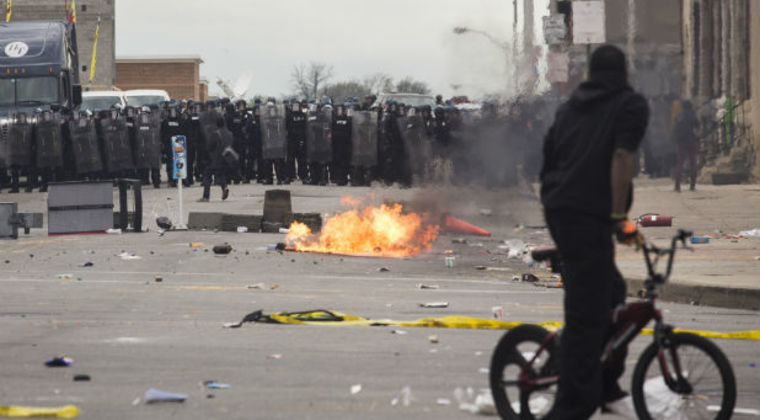
Suspect_Dies_Baltimore.JPEG-01b3c_c0-199-4709-2943_s561x327

By David S. D’Amato

Source: Center for a Stateless Society

We speak of the blowback that results from American foreign policy, the senseless, heinous acts of terror that represent an unfocused and irrational rebellion against American imperialism. We understand that calling it what it is, blowback — pointing out the causal relationship between American foreign policy and terrorism — is not an attempt to exculpate the people who commit these crimes. Looking for a motive that may aid in explaining these horrors is not looking for an excuse.

Similarly, the Baltimore rioters have found themselves on the losing end of a set of government policies that have consolidated wealth and foreclosed economic opportunities for independence and self-sufficiency. While so many Americans have been railing against welfare recipients, worried about the effects of food stamps on the federal budget, top American companies have worked closely with government for generations, guaranteeing the corporate welfare and special privileges that define the U.S. economic system.

The truth is that corporate capitalism has hung these rioting Baltimoreans out to dry, the American Dream being to them no more than a cruelly sarcastic joke, forever out of reach, mocking them. The prevailing story depicts the urban poor largely as the victims of “the free market,” dependent on a helping hand from government, be it education, job training, or just the bare necessities. In this story, government intervenes to file the sharp edges off of unbridled free market competition.

The problem with this story is that is recasts government in a role it has never actually played for poor and working class people — least of all black Americans. In real life, the state has intervened not to protect the economically powerless and penniless, but to serve to the needs of capital, to fence off resources and restrict opportunities in order to subject people to the control of a few giant employers. This coercive, state-driven process has nothing to do with a principled, libertarian free market today, and it never has in the past.

The result has been a permanent underclass, condemned to live in ghettos under quasi-military occupation, surrounded by violent crime that is the direct product of a failed war on drugs. And while the people who live in these communities are demonstrably no more likely to possess contraband than anyone else, they are far more likely to be stopped and frisked, arrested, and even murdered by increasingly militarized police officers.

The problems in Baltimore are historical and systemic. Everyone agrees that rioting, looting, and the wanton destruction of private property are senseless acts that ultimately can’t help anyone or create positive social change. We must nevertheless ask why these people in Baltimore feel so helpless, so abandoned and frustrated by the “proper channels,” that they find it is necessary to lash out and express themselves in this way.

Systematic state violence has left Baltimore communities barren, crying out for justice and opportunity. Anarchists believe that the dormant power of self-organization, cooperation and trade, once truly freed from aggression and meddling, is all the poor need to thrive. Through the anger and sadness coming out of Baltimore, it’s important not to lose sight of the larger, underlying issues.

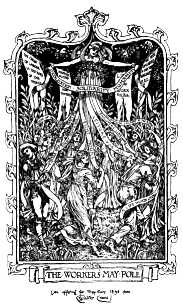
MAY DAY – The International Labor Day

crane13

Source: The Anarchist International

May 1st, International Workers’ Day, commemorates the historic struggle of working people throughout the world, and is recognized in most countries. The United States of America and Canada are among the exceptions. This despite the fact that the holiday began in the 1880s in the USA, linked to the battle for the eight-hour day, and the Chicago anarchists.

The struggle for the eight-hour day began in the 1860s. In 1884, the Federation of Organized Trades and Labor Unions of the United States and Canada, organized in 1881 (and changing its name in 1886 to American Federation of Labor ) passed a resolution which asserted that “eight hours shall constitute a legal day’s work from and after May 1, 1886, and that we recommend to labor organizations throughout this district that they so direct their laws as to conform to this resolution”. The following year the Federation repeated the declaration that an eight-hour system was to go into effect on May 1, 1886. With workers being forced to work ten, twelve, and fourteen hours a day, support for the eight-hour movement grew rapidly. In the months prior to May 1, 1886, thousands of workers, organized and unorganized, members of the organization Knights of Labor and of the federation, were drawn into the struggle. Chicago was the main center of the agitation for a shorter day. The anarchists were in the forefront of the Central Labor Union of Chicago, which consisted of 22 unions in 1886, among them the seven largest in the city.

During the Railroad strikes of 1877, the workers had been violently attacked by the police and the United States Army. A similar tactic of state terrorism was prepared by the bureaucracy to fight the eight-hour movement. The police and National Guard were increased in size and received new and powerful weapons financed by local business leaders. Chicago’s Commercial Club purchased a $2000 machine gun for the Illinois National Guard to be used against strikers. Nevertheless, by May 1st, the movement had already won gains for many Chicago workers. But on May 3, 1886, police fired into a crowd of strikers at the McCormick Harvester Machine Company, killing at least one striker, seriously wounding five or six others, and injuring an undetermined number. Anarchists called for a mass meeting the next day in Haymarket Square to protest the brutality.

The meeting proceeded without incident, and by the time the last speaker was on the platform, the rainy gathering was already breaking up, with only about two hundred people remaining. It was then a police column of 180 men marched into the square and ordered the meeting to disperse. At the end of the meeting a bomb was thrown at the police, killing one instantly, six others died later. About seventy police officers were wounded. Police responded by firing into the crowd. How many civilians were wounded or killed from police bullits never was ascertained exactly. Although it was never determined who threw the bomb, the incident was used as an excuse to attack anarchists and the labor movement in general. Police ransacked the homes and offices of suspected radicals, and hundreds were arrested without charge. A reign of police terror swept over Chicago. Staging “raids” in the working-class districts, the police rounded up all known anarchists and other socialists. “Make the raids first and look up the law afterward!” publicly counseled the state’s attorney.

Anarchists in particular were harassed, and eight of Chicago’s most active were charged with conspiracy to murder in connection with the Haymarket bombing. A kangaroo court found all eight guilty, despite a lack of evidence connecting any of them to the bomb-thrower, and they were sentenced to die. In October 9, 1886, the weekly journal Knights of Labor published in Chicago, carried on page 1 the following announcement: “Next week we begin the publication of the lives of the anarchists advertised in another column.”

The advertisement, carried on page 14, read: The story of the anarchists, told by themselves; Parsons, Spies, Fielden, Schwab, Fischer, Lingg, Engle, Neebe. The only true history of the men who claim that they are condemned to suffer death for exercising the right of Free Speech: Their association with Labor, Socialistic and Anarchistic Societies, their views as to the aims and objects of these organizations, and how they expect to accomplish them; also their connection with the Chicago Haymarket Affair. Each man is the author of his own story, which will appear only in the “Knights of Labor” during the next three months, – the great labor paper of the United States, a 16-page weekly paper, containing all the latest foreign and domestic labor news of the day, stories, household hints, etc. A co-operative paper owned and controlled by members of the Knights of Labor, and furnished for the small sum of $1.00 per annum. Adress all communications to Knights of Labor Publishing Company, 163 Washington St., Chicago, Ill. Later this journal and the paper Alarm published the autobiographies of the Haymarket men.

Albert Parsons, August Spies, Adolf Fischer and George Engel were hanged on November 11, 1887. Louis Lingg committed suicide in prison. The authorities turned over the bodies to friends for burial, and one of the largest funeral processions in Chicago history was held. It was estimated that between 150,000 to 500,000 persons lined the route taken by the funeral cortege of the Haymarket martyrs. A monument to the executed men was unveiled June 25, 1893 at Waldheim Cemetery in Chicago. The remaining three, Samuel Fielden, Oscar Neebe and Michael Schwab, were finally pardoned in 1893.

On June 26, 1893, the governor of Illinois, John Peter Altgeld, issued the pardon message in which he made it clear that he was not granting the pardon because he believed that the men had suffered enough, but because they were innocent of the crime for which they had been tried, and that they and the hanged men had been the victims of hysteria, packed juries and a biased judge. He noted that the defendants were not proven guilty because the state “has never discovered who it was that threw the bomb which killed the policeman, and the evidence does not show any connection whatsoever between the defendants and the man who threw it.”

International Workers’ Day is the commemoration of the Haymarket Event in Chicago in 1886. In 1889, the first congress of the Second International, meeting in Paris for the centennial of the French Revolution and the Exposition Universelle (1889), following an initiative from the American Federation of Labor, called for international demonstrations on the 1890 anniversary of the Chicago protests. These were so successful that May Day was formally recognized as an annual event at the International’s second congress in 1891.

It is not surprising that the state, business leaders, mainstream union officials, and the media would want to hide the true history of May Day. In its attempt to erase the history and significance of May Day, the United States government declared May 1st to be “Law Day”, and gave the workers instead Labor Day, the first Monday of September – a holiday devoid of any historical significance.

Nevertheless, rather than suppressing the labor and anarchist movements, the events of 1886 and the execution of the Chicago anarchists, spokesmen of the movement for the eight-hour day, mobilized many generations of radicals. Emma Goldman, a young immigrant at the time, later pointed to the Haymarket affair as her political birth. Instead of disappearing, the anarchist movement only grew in the wake of Haymarket.

As workers, we must recognize and commemorate May Day not only for it’s historical significance, but also as a time to organize around issues of vital importance of today for the working-class broadly defined, i.e. the grassroots – the people seen as a class in contrast to the superiors in income and/or rank – economically and/or political/administrative.

The May Day Manifestos of the International Workers of the World affiliated to the Anarchist International, from the latest years are published on its Webpage, click here!

Baltimore and the Human Right to Resistance: Rejecting the Framework of the Oppressor

Baltimore-Riots.jpg_23790e32da49a4d09d45db82b7634b69To hear President Obama and Baltimore mayor Rawlings tell it, politeness, nonviolence and respect for law and property are the fundamental obligations of those confronting the brazen and lawless violence of police in Baltimore and beyond. This is a truly upside-down reality.

By Ajamu Baraka

Source: Black Agenda Report

Anti-Black racism, always just beneath the surface of polite racial discourse in the U.S., has exploded in reaction to the resistance of black youth to another brutal murder by the agents of this racist, settler-colonialist state. With the resistance, the focus shifted from the brutal murder of Freddie Gray and the systematic state violence that historically has been deployed to control and contain the black population in the colonized urban zones of North America, to the forms of resistance by African Americans to the trauma of ongoing state violence.

The narrative being advanced by corporate media spokespeople gives the impression that the resistance has no rational basis. The impression being established is that this is just another manifestation of the irrationality of non-European people – in particular, Black people – and how they are prone to violence. This is the classic colonial projection employed by all white supremacist settler states, from the U.S., to South Africa and Israel.

The accompanying narrative is that any kind of resistance that does not fit the narrow definition of “non-violent” resistance is illegitimate violence and, therefore, counter-productive because – “violence doesn’t accomplish anything.”  Not only does this position falsely equate resistance to oppression as being morally equivalent to the violence of the oppressor, it also attempts to erase the role of violence as being fundamental to the U.S. colonial project.

The history of colonial conquest saw the U.S. settler state shoot and murdered its’ way across the land mass of what became the U.S. in the process of stealing indigenous land to expand the racist White republic from “sea to shining sea.”  And the marginalization of the role of violence certainly does not reflect the values of the Obama administration that dutifully implements the bi-partisan dictates of the U.S. strategy of full spectrum dominance that privileges military power and oppressive violence to protect and advance U.S. global supremacy. The destruction of Libya; the reinvasion of Iraq; the civil war in Syria; Obama’s continued war in Afghanistan; the pathological assault by Israel on Palestinians in Gaza and the U.S. supported attack on Yemen by the Saudi dictatorship, are just a few of the horrific consequences of this criminal doctrine.

Race and oppressive violence has always been at the center of the racist colonial project that is the U.S. It is only when the oppressed resist — when we decide, like Malcolm X said, that we must fight for our human rights — that we are counseled  to be like Dr. King, including by war mongers like Barack Obama. However, resistance to oppression is a right that the oppressed claim for themselves. It does not matter if it is sanctioned by the oppressor state, because that state has no legitimacy.

No rational person exalts violence and the loss of life. But violence is structured into the everyday institutional practices of all oppressive societies. It is the deliberate de-humanization of the person in order to turn them into a ‘thing’ — a process Dr. King called “thing-afication.” It is a necessary process for the oppressor in order to more effectively control and exploit. Resistance, informed by the conscious understanding of the equal humanity of all people, reverses this process of de-humanization. Struggle and resistance are the highest expressions of the collective demand for people-centered human rights – human rights defined and in the service of the people and not governments and middle-class lawyers.

That resistance may look chaotic at this point – spontaneous resistance almost always looks like that. But since the internal logic of neoliberal capital is incapable of resolving the contradiction that it created, expect more repression and more resistance that will eventually take a higher form of organization and permanence. In the meantime, we are watching to see who aligns with us or the racist state.

The contradictions of the colonial/capitalist system in its current expression of neoliberalism have obstructed the creation of decent, humane societies in which all people are valued and have democratic and human rights. What we are witnessing in the U.S. is a confirmation that neoliberal capitalism has created what Chris Hedges called “sacrificial zones” in which large numbers of black and Latino people have been confined and written off as disposable by the system. It is in those zones that we find the escalation of repressive violence by the militarized police forces. And it is in those zones where the people are deciding to fight back and take control of their communities and lives.

These are defining times for all those who give verbal support to anti-racist struggles and transformative politics. For many of our young white comrades, people of color and even some black ones who were too young to have lived through the last period of intensified struggle in the 1960s and ‘70s and have not understood the centrality of African American resistance to the historical social struggles in the U.S., it may be a little disconcerting to see the emergence of resistance that is not dependent on and validated by white folks or anyone else.

The repression will continue, and so will the resistance. The fact that the resistance emerged in a so-called black city provides some complications, but those are rich and welcoming because they provide an opportunity to highlight one of the defining elements that will serve as a line of demarcation in the African American community – the issue of class.  We are going to see a vicious ideological assault by the black middle class, probably led by their champion – Barack Obama – over the next few days. Yet the events over the last year are making it more difficult for these middle-class forces to distort and confuse the issue of their class collaboration with the white supremacist capitalist/colonialist patriarchy. The battle lines are being drawn; the only question that people must ask themselves is which side they’ll be on.

Ajamu Baraka is a human rights activist, organizer, geo-political analyst and editor and contributing columnist for the Black Agenda Report. Baraka serves as the Public Intervenor for Human Rights as a member of the Green Shadow Cabinet and coordinates the International Affairs Committee of the Black Left Unity Network. He is also an Associate Fellow at the Institute for Policy Studies (IPS) in Washington, D.C.

Why Mumia Must Live, and US imperialism Must Die: The Link Between Political Prisoners and the War on Terror

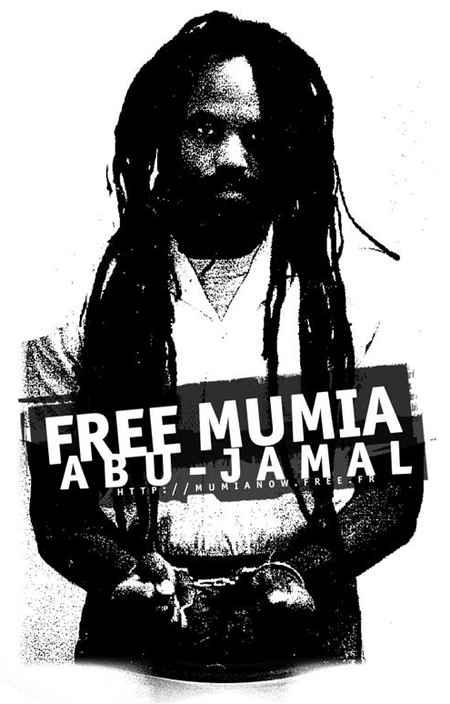
mumia

The so-called War on Terror and the national security state did not emerge full-blown from the rubble of 9/11. Both are products of previous waves of police repression, mainly targeting Black radicals. “The FBI’s counter insurgency war on the Black Panther Party chapters and leaders like Mumia established for local police departments a direct link to Washington’s war and surveillance arsenal.”

By Danny Haiphong

Source: Black Agenda Report

The fear of the Muslim/Arab terrorist rekindles the same fear in white America that the Black liberation movement ignited over four decades ago.”

Political Prisoner and journalist Mumia Abu-Jamal has been subjected to over three decades of torture from the US prison gulag. His political imprisonment has placed his life in serious danger, this time not from state execution but instead from extra-legal medical neglect. The prison state has continuously failed in its efforts to murder Mumia through official means and has thus decided to refuse the former Black Panther adequate medical treatment for diabetes. Meanwhile, Boston residents of all classes await the verdict of whether the alleged “Boston bomber” Dzokhar Tsarnaev will receive the death penalty or life in prison. The event that faithful day remains shrouded in questions , but most of the city has accepted the dominant narrative put forth by the FBI and Boston Police Department. The War on Terror that produced the “Boston Bombing” and Mumia’s struggle against the prison state are intimately connected. For Mumia to live with freedom and dignity, the US imperial order behind the War on Terror must die.

Mumia Abu-Jamal’s existence as a political prisoner has been repressed by the establishment, while the War on Terror is a household name in the US. This is because the War on Terror serves the objectives of imperialism and Mumia does not. Mumia joined the Black Panther Party at fifteen and served as the Philadelphia Chapter’s Ministry of Information. He used his talents in journalism in service of Black people both in the BPP and after. This landed him on J. Edgar Hoover’s COINTEPRO list of Black liberation fighters to watch and suppress. In 1978, Mumia covered the Philadelphia police department’s siege on the MOVE Organization. His critical investigation of the Philly PD’s role in repressing MOVE led to his ouster from the journalism industry. In 1982, Mumia was framed for the murder of police officer Daniel Faulkner and sentenced to death.

He used his talents in journalism in service of Black people both in the BPP and after.”

The context of Mumia’s imprisonment is at the essence of US imperialism’s War on Terror, which could be better named its war of terror. In the film Manufacturing Guilt​ , Mumia’s frame-up is blatantly exposed through court documents and investigations. Yet, Mumia has lived much of his life in prison, mostly in solitary confinement. What explains this injustice and how does it relate to the current War on Terror? In Still Black, Still Strong, Dhoruba Bin-Wahad explains how the FBI’s counter insurgency war on the Black Panther Party chapters and leaders like Mumia established for local police departments a direct link to Washington’s war and surveillance arsenal. Washington’s war on Black liberation fighters precipitated the first SWAT team operation in 1969 and the FBI’s declaration that the Black Panther Party was the “greatest threat to the internal security” of the US. The war on Black freedom that jailed Mumia created the technical capacity for the War on Terror.

The recent bombing of the 2013 marathon, and 9/11 before that, created the conditions for a massive expansion of the surveillance state and police state throughout the US mainland. The hundreds of illegally detained prisoners at Guantanamo Bay, the increased surveillance of Muslims and Black people in the US, and the massive spy program instituted by the Patriot Act and similar legislation are daily reminders of US imperialism’s ever expanding repressive apparatus. Internationally, the US led War on Terror interventions have caused the loss of life of millions of people in the Middle East and Africa alongside the thousands more from US aerial drone strikes and proxy war. All of this has been justified as necessary to “counter” the so-called threat of “terrorism.”

The war on Black freedom that jailed Mumia created the technical capacity for the War on Terror.”

Mumia’s story, one shared by numerous US political prisoners sentenced to die in the cages of the prison state, contains in it the seeds that sprouted the rise of the massive War on Terror. Russell Maroon Shoatz, Oscar Lopez Rivera, Leonard Peltier and scores more faced trumped up charges from the state as part of US imperialism’s counter insurgency war on dissent generally and the Black liberation movement in particular. This war has been expanded to meet the needs of US imperialism, which in its current form has produced a potentially explosive situation domestically and globally. The sharpening contradictions of never-ending war and increasing poverty and privatization wouldn’t last long if the counter insurgency war on Mumia and the Panthers hadn’t provided the blueprints and technical support for the mass expansion of the War on Terror’s primary tools: war and surveillance state.

Mumia Abu-Jamal and the rest of the Empire’s political prisoners are caught in the cross hairs of US imperialism’s war of survival. Not only has the material basis of the counter insurgency war that murdered and imprisoned the Black liberation movement grown, but so too has the racist logic behind the repression. The War on Terror’s racist logic has permeated so deeply into the minds of the US public that the mere questioning of the agenda’s blatant deceit is subject to dismissal or defense by most people living in the US mainland. These conditions have left political prisoners with few fighters on the outside pressuring their release. The War on Terror has attempted to erase the memory of political prisoners by reframing the racist justifications for political imprisonment as common sense in what George Jackson called the “Amerikan mind.”

The War on Terror’s racist logic has permeated so deeply into the minds of the US public that the mere questioning of the agenda’s blatant deceit is subject to dismissal.”

So, even though the justification for each and every War on Terror intervention or policy since 2001 are dubious at best, the fear of the Muslim/Arab terrorist rekindles the same fear in white America that the Black liberation movement ignited over four decades ago. The Black Panther Party and their partners in struggle were deemed criminal in every way and many were falsely charged with the murder of police officers, the highest form of offense in the eyes of white America. The War on Terror built off this strategy by throwing the Muslim community into the racist war on the oppressed as a means to control the dissent of the entire population. That the US imperial machinery is complicit in, and a sponsor of, jihadist terror and proxy war matters as little as the innocence of political prisoners when it comes to preserving the Empire and criminalizing all resistance to its rule.

Mumia Abu-Jamal’s life needs to be saved by any means necessary, but fighting to free him based on his criminal case alone won’t develop the movement we need. One of the primary obstacles to building a concrete movement for the freedom of political prisoners is the privileging of innocence over a movement that links political prisoners to the repression of the imperial state. But Mumia’s innocence teaches us the real purpose of political imprisonment. The War on Terror is a consolidation of the forces that were built by imperialism to suppress the revolutionary ideas of Mumia Abu-Jamal. What we need is a reexamination of those ideas in the service of the freedom of all political prisoners. By studying the War on Terror and the repression of the Black Liberation movement from which it grew, it becomes increasingly clear that imperialism must die for Mumia to truly live.

Danny Haiphong is an organizer for Fight Imperialism Stand Together (FIST) in Boston. He is also a regular contributor to Black Agenda Report. Danny can be reached at wakeupriseup1990@gmail.com and FIST can be reached at bostonfist@gmail.com.

Two Stories the Same Day Show That the U.S. is Rotten to the Core

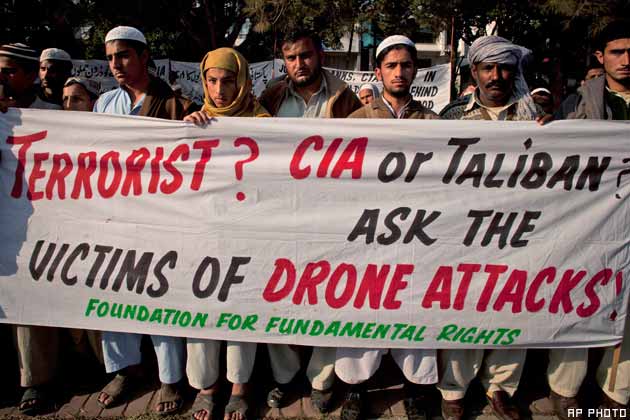
drone_attacks_281210

By Ted Rall

Source: Ted Rall Blog

Still think the United States is governed by decent people? That the system isn’t totally corrupt and obscenely unfair?

Two stories that broke April 23rd ought to wake you up.

Story 1: President Obama admitted that one of his Predator drones killed two aid workers, an American and an Italian, who were being held hostage by Al Qaeda in Pakistan. As The Guardian reports, “The lack of specificity [about the targets] suggests that despite a much-publicized 2013 policy change by Barack Obama restricting drone killings by, among other things, requiring ‘near certainty that the terrorist target is present,’ the U.S. continues to launch lethal operations without the necessity of knowing who specifically it seeks to kill, a practice that has come to be known as a ‘signature strike.’”

“Lack of specificity” is putting it mildly. According to a report by the group Reprieve, the U.S. targeted 41 “terrorists” — actually, enemies of the corrupt Yemeni and Pakistani regimes — with drones during 2014. Thanks to “lack of specificity,” a total of 1,150 people were killed. Which doesn’t even include the 41 targets, many of whom got away clean.

Obama’s hammy pretend grief was Shatner-worthy. Biting his lip in that sorry/not sorry Bill Clinton way, the president summed up mock sadness for an event that happened back in January. Come on, dude. You seriously expect us to believe you’ve been all weepy for the last three months, except for all those speeches and other public appearances in which you were, you know, laughing and cracking jokes?

Including, um, the same exact day when he pretend-sadded, when he yukked it up with the Super Bowl champion New England Patriots? “That whole story got blown a little out of proportion,” he jibed. (Cuz: “deflate-gate.”) While sad. But laughing.

So. Confusing.

I swear, the right-wing racists are right to hate him. But they hate him for totally the wrong reasons.

Anyway, what took so long for the White House to admit they killed one of our best citizens? “It took weeks to correlate [the hostages’] reported deaths with the drone strikes,” The New York Times quoted White House officials. But in his prepared remarks, Obama said “capturing these terrorists was not possible” — thus the drone strike.

How stupid does the Administration think we are?

The fact that it is possible to find out who dies in a drone fact (albeit after the fact) indicates that there is reliable intelligence coming out of the targeted areas, presumably provided by local police and military sources. If there are cops and troops there who are friendly enough to give us information, then it obviously is possible to ask them to capture the targeted individuals.

Bottom line: the U.S. government is blowing up people with drones willy-nilly, without the slightest clue who they’re blowing up. Which, as political assassinations, are illegal. And which they specifically said was what they were no longer doing. Then they have the nerve to pretend to be sad about the completely avoidable consequences of their actions. They’re disgusting and gross and ought to be locked in prison forever.

Story 2: David Petraeus, former hotshot media-darling general of the Bush and early Obama years, received a slap on the wrist — probation plus a $100,000 fine — for improperly passing on classified military documents to unauthorized people and lying about it to federal agents when they questioned him about it.

Here we go again: more proof that, in the American justice system some people fly first-class while the rest of us go coach.

In this back-asswards world, people like Petraeus who ought to be held to the highest standard because they were entrusted with immense power and responsibility, walk free while low-ranking schlubs who committed the same crime get treated like Al Capone. Private Chelsea Manning, who released warlogs documenting U.S. war crimes in Iraq to Wikileaks, rots in prison for 35 years. Edward Snowden, the 31-year-old systems administrator for a private NSA outsourcing firm who revealed that the U.S. government is reading all our emails and listening to all our phone calls, faces life in prison.

Two years probation. Meanwhile, teachers who helped their students cheat on standardized tests got seven years in prison. To Petraeus, who went to work for a hedge fund, $100,000 is a nice tip for the caddy.

Adding insanity to insult is the fact that Petraeus’ motive for endangering national security was venal: he gave the documents to his girlfriend, who wrote his authorized biography. Manning and Snowden, heroes who in a sane society would receive ticker-tape parades and presidential medals of freedom, weren’t after glory. They wanted to inform the American people about atrocities committed in their name, and about wholesale violations of their basic freedoms, including the right to privacy.

Before he was caught and while he was sharing classified info with his gf, Petraeus had the gall to hypocritically pontificate about a CIA officer who disclosed sensitive information. Unlike Petraeus, the CIA guy got coach-class justice: 30 months in prison.

“Oaths do matter,” Petraeus pompously bloviated in 2012, “and there are indeed consequences for those who believe they are above the laws that protect our fellow officers and enable American intelligence agencies to operate with the requisite degree of secrecy.”

If you’re a first-classer, the consequences are very small.

(Ted Rall, syndicated writer and the cartoonist for The Los Angeles Times, is the author of the new critically-acclaimed book “After We Kill You, We Will Welcome You Back As Honored Guests: Unembedded in Afghanistan.” Subscribe to Ted Rall at Beacon.)

HEAD of the FBI’s Anthrax Investigation Says the Whole Thing Was a SHAM

images

Source: Washington’s Blog

Agent In Charge of Amerithrax Investigation Blows the Whistle

The FBI head agent in charge of the anthrax investigation – Richard Lambert – has just filed a federal whistleblower lawsuit calling the entire FBI investigation bullsh!t:

In the fall of 2001, following the 9/11 attacks, a series of anthrax mailings occurred which killed five Americans and sickened 17 others. Four anthrax-laden envelopes were recovered which were addressed to two news media outlets in New York City (the New York Post and Tom Brokaw at NBC) and two senators in Washington D.C. (Patrick Leahy and Tom Daschle). The anthrax letters addressed to New York were mailed on September 18, 2001, just seven days after the 9/11 attacks. The letters addressed to the senators were mailed 21 days later on October 9, 2001. A fifth mailing of anthrax is believed to have been directed to American Media, Inc. (AMI) in Boca Raton, Florida based upon the death of one AMI employee from anthrax poisoning and heavy spore contamination in the building.

Executive management at FBI Headquarters assigned responsibility for the anthrax investigation (code named “AMERITHRAX”) to the Washington Field Office (WFO), dubbing it the single most important case in the FBI at that time. In October 2002, in the wake of surging media criticism, White House impatience with a seeming lack of investigative progress by WFO, and a concerned Congress that was considering revoking the FBI’s charter to investigate terrorism cases, Defendant FBI Director Mueller reassigned Plaintiff from the FBI’s San Diego Field Office to the Inspection Division at FBI Headquarters and placed Plaintiff in charge of the AMERITHRAX case as an “Inspector.” While leading the investigation for the next four years, Plaintiff’s efforts to advance the case met with intransigence from WFO’s executive management, apathy and error from the FBI Laboratory, politically motivated communication embargos from FBI Headquarters, and yet another preceding and equally erroneous legal opinion from Defendant Kelley – all of which greatly obstructed and impeded the investigation.

On July 6, 2006, Plaintiff provided a whistleblower report of mismanagement to the FBI’s Deputy Director pursuant to Title 5, United States Code, Section 2303. Reports of mismanagement conveyed in writing and orally included: (a) WFO’s persistent understaffing of the AMERITHRAX investigation; (b) the threat of WFO’s Agent in charge to retaliate if Plaintiff disclosed the understaffing to FBI Headquarters; (c) WFO’s insistence on staffing the AMERITHRAX investigation principally with new Agents recently graduated from the FBI Academy resulting in an average investigative tenure of 18 months with 12 of 20 Agents assigned to the case having no prior investigative experience at all; (d) WFO’s eviction of the AMERITHRAX Task Force from the WFO building in downtown Washington and its relegation to Tysons Corner, Virginia to free up space for Attorney General Ashcroft’s new pornography squads; (e) FBI Director’s Mueller’s mandate to Plaintiff to “compartmentalize” the AMERITHRAX investigation by stove piping the flow of case information and walling off task force members from those aspects of the case not specifically assigned to them – a move intended to stem the tide of anonymous media leaks by government officials regarding details of the investigation. [Lambert complained about compartmentalizing and stovepiping of the investigation in a 2006 declaration.  See this, this and this]

This sequestration edict decimated morale and proved unnecessary in light of subsequent civil litigation which established that the media leaks were attributable to the United States Attorney for the District of the District of Columbia and to a Supervisory Special Agent in the FBI’s National Press Office, not to investigators on the AMERITHRAX Task Force; (f) WFO’s diversion and transfer of two Ph.D. Microbiologist Special Agents from their key roles in the investigation to fill billets for an 18 month Arabic language training program in Israel; (g) the FBI Laboratory’s deliberate concealment from the Task Force of its discovery of human DNA on the anthrax-laden envelope addressed to Senator Leahy and the Lab’s initial refusal to perform comparison testing; (h) the FBI Laboratory’s refusal to provide timely and adequate scientific analyses and forensic examinations in support of the investigation; (i) Defendant Kelley’s erroneous and subsequently quashed legal opinion that regulations of the Occupational Safety and Health Administration (OSHA) precluded the Task Force’s collection of evidence in overseas venues; (j) the FBI’s fingering of Bruce Ivins as the anthrax mailer; and, (k) the FBI’s subsequent efforts to railroad the prosecution of Ivins in the face of daunting exculpatory evidence.

Following the announcement of its circumstantial case against Ivins, Defendants DOJ and FBI crafted an elaborate perception management campaign to bolster their assertion of Ivins’ guilt. These efforts included press conferences and highly selective evidentiary presentations which were replete with material omissions. Plaintiff further objected to the FBI’s ordering of Plaintiff not to speak with the staff of the CBS television news magazine 60 Minutes or investigative journalist David Willman, after both requested authorization to interview Plaintiff.

In April 2008, some of Plaintiff’s foregoing whistleblower reports were profiled on the CBS television show 60 Minutes. This 60 Minutes segment was critical of FBI executive management’s handling of the AMERITHRAX investigation, resulting in the agency’s embarrassment and the introduction of legislative bills calling for the establishment of congressional inquiries and special commissions to examine these issues – a level of scrutiny the FBI’s Ivins attribution could not withstand.

After leaving the AMERITHRAX investigation in 2006, Plaintiff continued to publicly opine that the quantum of circumstantial evidence against Bruce Ivins was not adequate to satisfy the proof-beyond-a-reasonable doubt threshold required to secure a criminal conviction in federal court. Plaintiff continued to advocate that while Bruce Ivins may have been the anthrax mailer, there is a wealth of exculpatory evidence to the contrary which the FBI continues to conceal from Congress and the American people.

Exonerating Evidence for Ivins

Agent Lambert won’t publicly disclose the exculpatory evidence against Ivins. As the New York Times reports:

[Lambert] declined to be specific, saying that most of the information was protected by the Privacy Act and was unlikely to become public unless Congress carried out its own inquiry.

But there is already plenty of exculpatory evidence in the public record.

For example:

  • Handwriting analysis failed to link the anthrax letters to known writing samples from Ivins
  • No textile fibers were found in Ivins’ office, residence or vehicles matching fibers found on the scotch tape used to seal the envelopes
  • No pens were found matching the ink used to address the envelopes
  • Samples of his hair failed to match hair follicles found inside the Princeton, N.J., mailbox used to mail the letters
  • No souvenirs of the crime, such as newspaper clippings, were found in his possession as commonly seen in serial murder cases
  • The FBI could not place Ivins at the crime scene with evidence, such as gas station or other receipts, at the time the letters were mailed in September and October 2001
  • Lab records show the number of late nights Ivins put in at the lab first spiked in August 2001, weeks before the 9/11 attacks

As noted above, the FBI didn’t want to test the DNA sample found on the anthrax letter to Senator Leahy.  In addition, McClatchy points out:

After locking in on Ivins in 2007, the bureau stopped searching for a match to a unique genetic bacterial strain scientists had found in the anthrax that was mailed to the Post and to NBC News anchor Tom Brokaw, although a senior bureau official had characterized it as the hottest clue to date.

Anthrax vaccine expert Meryl Nass. M.D., notes:

The FBI’s alleged motive is bogus. In 2001, Bioport’s anthrax vaccine could not be (legally) relicensed due to potency failures, and its impending demise provided room for Ivins’ newer anthrax vaccines to fill the gap. Ivins had nothing to do with developing Bioport’s vaccine, although in addition to his duties working on newer vaccines, he was charged with assisting Bioport to get through licensure.

***

The FBI report claims the anthrax letters envelopes were sold in Frederick, Md. Later it admits that millions of indistinguishable envelopes were made, with sales in Maryland and Virginia.

***

FBI emphasizes Ivins’ access to a photocopy machine, but fails to mention it was not the machine from which the notes that accompanied the spores were printed.

FBI Fudged the Science

16 government labs had access to the same strain of anthrax as used in the anthrax letters.

The FBI admitted that up to 400 people had access to flask of anthrax in Dr. Ivins’ lab.  In other words, even if the killer anthrax came from there, 399 other people might have done it.

Moreover, even the FBI’s claim that the killer anthrax came from Ivins’ flask has completely fallen apart. Specifically, both the National Academy of Science and the Government Accountability Office – both extremely prestigious, nonpartisan agencies – found that FBI’s methodology and procedures for purportedly linking the anthrax flask maintained by Dr. Ivins with the anthrax letters was sloppy, inconclusive and full of holes.  They found that the alleged link wasn’t very strong … and that there was no firm link.  Indeed, the National Academy of Sciences found that the anthrax mailed to Congressmen and the media could have come from a different source altogether than the flask maintained by Ivins.

Additionally, the Ft. Detrick facility – where Ivins worked – only handled liquid anthrax.  But the killer anthrax was a hard-to-make dry powder form of anthrax.  Ft. Detrick doesn’t produce dry anthrax; but other government labs – for example Dugway (in Utah) and Batelle (in Ohio) – do.

The anthrax in the letters was also incredibly finely ground; and the FBI’s explanation for how the anthrax became so finely ground doesn’t even pass the smell test.

Further, the killer anthrax in the letters had a very high-tech  anti-static coating so that the anthrax sample “floated off the glass slide and was lost” when scientists tried to examine it.  Specifically, the killer anthrax was coated with polyglass and each anthrax spore given an electrostatic charge, so that it would repel other spores and “float”.   This was very advanced bio-weapons technology to which even Ivins’ bosses said he didn’t have access.

Top anthrax experts like Richard Spertzel say that Ivins didn’t do it. Spertzel also says that only 4 or 5 people in the entire country knew how to make anthrax of the “quality” used in the letters, that Spertzel was one of them, and it would have taken him a year with a full lab and a staff of helpers to do it. As such, the FBI’s claim that Ivins did it alone working a few nights is ludicrous.

Moreover, the killer anthrax contained silicon … but the anthrax in Ivins’ flask did not.  The FBI claimed the silicon present in the anthrax letters was absorbed from its surroundings … but Lawrence Livermore National Laboratories completely debunked that theory. In other words, silicon was intentionally added to the killer anthrax to make it more potent.  Ivins and Ft. Detrick didn’t have that capability … but other government labs did.

Similarly, Sandia National Lab found the presence of iron and tin in the killer anthrax … but NOT in Ivins’ flask of anthrax.

Sandia also found that there was a strain of bacteria in one of the anthrax letters not present in Ivins’ flask. (The bacteria, iron, tin and silicon were all additives which made the anthrax in the letters more deadly.)

The Anthrax Frame Up

Ivins wasn’t the first person framed for the anthrax attacks …

Although the FBI now admits that the 2001 anthrax attacks were carried out by one or more U.S. government scientists, a senior FBI official says that the FBI was actually told to blame the Anthrax attacks on Al Qaeda by White House officials (remember what the anthrax letters looked like). Government officials also confirm that the white House tried to link the anthrax to Iraq as a justification for regime change in that country. And see this.

People don’t remember now, but the “war on terror” and Iraq war were largely based on the claim that Saddam and Muslim extremists were behind the anthrax attacks (and see this and this)

And the anthrax letters pushed a terrified Congress into approving the Patriot Act without even reading it. Coincidentally, the only Congressmen who received anthrax letters were the ones who were likely to oppose the Patriot Act.

And – between the bogus Al Qaeda/Iraq claims and the FBI’s fingering of Ivins as the killer – the FBI was convinced that another U.S. government scientist, Steven Hatfill, did it.  The government had to pay Hatfill $4.6 million to settle his lawsuit for being falsely accused.

Ivins’ Convenient Death

It is convenient for the FBI that Ivins died.

The Wall Street Journal points out:

No autopsy was performed [on Ivins], and there was no suicide note.

Dr. Nass points out:


FBI fails to provide any discussion of why no autopsy was performed, nor why, with Ivins under 24/7 surveillance from the house next door, with even his garbage being combed through, the FBI failed to notice that he overdosed and went into a coma. Nor is there any discussion of why the FBI didn’t immediately identify tylenol as the overdose substance, and notify the hospital, so that a well-known antidote for tylenol toxicity could be given (N-acetyl cysteine, or alternatively glutathione). These omissions support the suggestion that Ivins’ suicide was a convenience for the FBI. It enabled them to conclude the anthrax case, in the absence of evidence that would satisfy the courts.


Indeed, one of Ivins’ colleagues at Ft. Deitrich thinks he was murdered.

Whether murder or suicide, Ivins’ death was very convenient for the FBI, as dead men can’t easily defend themselves.


Deepwater Capitalism

gulf-oil-spill17

Reflections on the Fifth Anniversary of One of the Biggest Oil Spills in History

By Quincy Saul

Source: Counterpunch

In memory of Gabriel García Márquez, March 6, 1927-April 17, 2014.

In September of 2009, the BP corporation dug the deepest oil well in history. The 35,055-foot deep Tiber prospect, 300 miles off the Texas coast, promised six billion barrels: one of the largest oil fields ever discovered in the country. So of course, they kept looking for more: They moved their massive drilling rig named Deepwater Horizon fifty miles south of the Louisiana coastline, to a prospect called Macondo, named after the setting of the famous book 100 Years of Solitude, by Gabriel García Márquez.

On April 20, 2010, as they began to seal the well, something went wrong: a mix of oil and gas escaped, rushing up through earth and water, blowing up the Deepwater Horizon, and killing eleven workers, whose bodies were never recovered. Over the next eighty seven days, the whole world watched as over 200 million gallons of oil erupted from the ocean floor into the Gulf of Mexico.

It was the largest oil spill in history – more than ten times the size of the Exxon Valdez disaster in Alaska. The images of animals covered in oil began to haunt our screens again, and the scale of death was so great it still seems impossible to quantify – estimates of the number of birds killed within the first hundred days ranges between 100,000 and one million. But the real nightmare was offshore, as riptides and hired hands collected thousands of animal carcasses into “death gyres”. Riki Ott explains:

“Hurricane Creekkeeper John Wathen managed to get the only footage of what I came to call the ‘death gyres.’ the rip currents that collected dead animals offshore. The Incident Command – BP and the US Coast Guard – kept the media 1,500 feet up in the air so the press couldn’t really capture the situation there. The animal carcasses were corralled, taken out to sea, and dumped at night, according to fishermen who were involved with so-called ‘Night-time Operations.’ Offshore workers reported ‘thousands of dolphins, birds too numerous to count, sea turtles too numerous to count,’ and even whales in the death gyres.” (Earth at Risk, Building a Resistance Movement to Save the Planetedited by Derrick Jensen and Lierre Keith, p. 49)

Five years later, what can we say? If hindsight is 20-20 then presumably we can learn from our mistakes. How did it happen? Was it BP’s fault? Or is there a bigger picture to blame? Five years later, the common sense of this tragedy has yet to dawn, as if the oil has clogged our hearts and minds along with our oceans and beaches. Like the pioneers of Márquez’s Macondo, searching for a way through the swamp, we seem lost, desperately hacking our way through nature and through our own nature. And the past, like the path, seems to always be disappearing behind us.

“…and the cries of the birds and the uproar of the monkeys became more and more remote, and the world became eternally sad. The men on the expedition felt overwhelmed by their most ancient memories in that paradise of dampness and silence, going back to before original sin, as their boots sank into pools of steaming oil and their machetes destroyed bloody lilies and golden salamanders. . . . They could not return because the strip that they were opening as they went along would soon close up with a new vegetation that almost seemed to grow before their eyes.” (Márquez, p. 11-12)

How did it Happen?

“The main thing is not to lose our bearings.” (Márquez, p. 12)

Whodunit? What was the crime scene, and who are the criminals? What murder weapon spawned gyres of death? Five years later, we must look through the tangled jungle of events which have grown up behind us, and remember how we got here. Michael Klare’s insightful blow-by-blow of the events leading up to the accident is worth revisiting. 

“When BP first deployed the rig at the Macondo prospect in January 2010, it set a target date of March 7 for completion of that well. However, due to a series of geological obstacles and technical mishaps, drilling was not completed until April 19, producing a cost overrun on the project of approximately $58 million. It is not surprising, then, that BP’s site managers felt particular pressure to seal the well and move the Deepwater Horizon, to its next scheduled location. In their rush, the site managers made several last-minute decisions. . . . When preparing for the final cementing that would prevent natural gas from leaking into the wellbore, for instance, they decided to use only six “centralizers” to position the well’s steel casing, whereas the original design had called for twenty-one centralizers. They also went ahead with the sealing of the well even though several ‘negative-pressure’ tests suggested a dangerous buildup of gas in the wellbore. . . . the desire to complete the job swiftly and move the expensive drillship to its next assignment certainly contributed to the disaster.” (The Race for What’s Left, The global scramble for the world’s last resourcesKlare, p. 47-8)

One way to solve this crime is to blame the workers – the crime scene is the workplace, and the murder weapon is the botched job. They failed to follow industry regulations; using less than half of the recommended number of centralizers, and ignoring the test results indicating a dangerous buildup of gas. But this explanation is not sufficient, and hides another suspect. If the workers pulled the trigger, who gave the order?

As Klare explains, the workers were in a rush. It was the BP site managers – their cost overrun, their “pressure to seal the well and move,” and the “desire to complete the job swiftly,” which created the conditions in which the oil workers made their fateful decisions. So is BP the murderer? Is the crime scene the BP board room?


Inside BP

At the dawn of the 21st century, BP had a tabloid affair with alternative energy. John Browne, its CEO from 1995 to 2007 re-branded the company, from “British Petroleum” to “Beyond Petroleum”, and urged its shareholders and broader public “to look beyond oil and gas to fuels which can be produced locally and which do not threaten the sustainability of the world’s climate.” In 2008, Browne was replaced by Tony Hayward, whose more sober vision re-branded the company simply “BP”, and clarified that “the energy of the future will be more than oil, but oil will still be a major part of it.” In 2010 he closed BP’s “alternative energy office.” (Klare, p. 41)

Perhaps the public relations team from that office had all been moved to the Gulf Coast, where it has been working overtime since 2010. This has included classroom visits with “hands-on” experiments, substituting cocoa for oil and dish soap for chemical dispersant, to win young hearts and minds to the efficacy of BP’s cleanup efforts.[1] According to the company, the case is closed. A recently released report from BP concluded: “BP has seen no data to suggest a significant long-term population-level impact to any species.” In fact, “BP is claiming that wildlife in the Gulf is thriving and more abundant since the disaster.” (Jensen and Keith, p. 61) In a recent press conference, BP’s executive vice president for response and environmental restoration in the region Laura Folse said “I personally have no concern about oil washing in from the offshore to the shoreline.”

BP is preparing for the punchline, because currently pending in court is the case which will decide how much money BP has to pay in damages for the disaster. While BP is a giant – listed by Fortune magazine as the fourth largest publicly held company in the world – some on Wall Street have expressed fear that the court’s decision could kill the company. This panic began almost immediately after the spill, and BP began to sell off assets all over the world, in Colombia, Egypt, the US, Canada and Argentina. (Klare, p. 215, 216)

But according to forensic accounting expert Ian Ratner who testified recently on the case, BP “actually, has a better balance sheet today than it had before the spill.” Despite around $40 billion in oil spill liabilities, the company is financially better off than before the disaster. What’s more, they are back at the scene of the crime: “We expect to be back and actively drilling during the second half of the year,” said BP Chief Financial Offcer Byron Grote in April 2011. And he kept his promise: like Colonel Buendía in Márquez’s novel, BP gives orders for execution but is isolated and naive about to the results: “Lost in the solitude of his immense power, he began to lose direction.” (Márquez, p. 171) BP seems both all-powerful and powerless, returning to the scene of the crime like a dog unto its vomit, at the mercy of some god or godlessness which demands more drilling.

There is more than meets the eye in this case. Is BP the only culprit on trial? If the workers pulled the trigger, and BP gave the order, who put the gun in its hand? And who made the gun? There is an African saying that “if you want to get at the root of the murder, you have to look for the blacksmith who made the machete.” (Anthills of the SavannahChinua Achebe, p. 159)

The World System

“That was perhaps the only mystery that was never cleared up in Macondo. . . . A trickle of blood came out under the door, crossed the living room, went out into the street, continued on in a straight line across the uneven terraces, went down steps and climbed over curbs, passed along the Street of the Turks, turned a corner to the right and another to the left, made a right angle at the Buendía house, went in under the closed door, crossed through the parlor, hugging the walls so as not to stain the rugs, went on to the other living room, made a wide curve to avoid the dining-room table, went along the porch with the begonias, and passed without being seen under Amaranta’s chair as she gave an arithmetic lesson to Aureliano José, and went through the pantry and came out in the kitchen, where Úrsula was getting ready to crack thirty-six eggs to make bread.” (Márquez, p. 135)

What was the blacksmith that built and blew the Deepwater Horizon? Like the mystery of Macondo in Márquez’s story, the trail of blood climbs and descends, turns corners and crosses paths, taking us from the work place, to the board room, to the stock exchange, and from there it seems to flow into the ocean of normal every-day modern life. As Lamar McKay, chairman and president of BP America said, “the deepwater is indispensable to the world’s energy future.” (Klare, p. 69) The trail doesn’t go cold, it goes everywhere. Like the war of Colonel Buendía, our search for justice in the death gyres seems to get stuck in a stalemate of business as usual: “’Everything normal, Colonel.’ And normality was precisely the most fearful part of that infinite war.” (Márquez, p. 171)

In the early 2000s, the deep sea drilling industry boomed. All the big oil corporations competed to dig the deepest wells, at depths and conditions that boggle the imagination – deeper than Mt. Everest is tall, under thousands of feet of water (and pressure). These projects out-compete space exploration in the audacity of their engineering and in their cost: Shell built a rig called Mars that was three times more expensive than the Mars Pathfinder mission, with arguably more complex technology. (Klare, p. 44) While their locations are industry secrets – no one knows how many or where they all are – they are everywhere, from the Falkland Islands to the Arctic Circle, from South America to West Africa.

A 2010 report by energy expert Michael Smith estimated that big oil would spend $387 billion on offshore drilling between 2010 and 2014 – 33% more than over the previous five years – building 20,000 offshore wells in ever deeper waters. (Klare, p. 44-45) The Deepwater Horizon explosion, which came nineteen days after President Obama announced plans for more offshore drilling, did little or nothing to change the plan. Three days after the explosion, with Macondo still gushing, a White House spokesperson assured that increase in offshore drilling would continue, promising that it would be done “safely, securely, and without harm to the environment.” (Klare, p. 51)

Before Deepwater Horizon, regulations on the industry had been lax. In the United States, the Interior Department’s Mineral Management Service (MMS) took a hands-off approach to the industry, never, for instance, setting any criteria for minimum-pressure tests, which had such fateful consequences in the Gulf. (Klare, p. 50) After a six month moratorium on drilling in the Gulf after the disaster, oil companies began to lobby the courts to being reissuing permits. A new set of safety rules was established, and by April 2011, one year after the disaster, deep drilling in the Gulf, by BP and others, was back online. (Klare, p. 52) Everything normal, Colonel.

This is the normalcy of the infinite war on mother earth: While the fallout of the disaster continues to inflict irreparable damage to the Gulf, the industry which created the crisis is allowed to resume the activity which created it. And the same agencies that failed to regulate the industry before are being trusted to do it right this time. How can this be?

The answer can be found by following the money, like the trickle of blood in Macondo, from the scene of the crime, and out into the world-system. In an energy analysis report from several years ago, it was predicted that due to declining reserves of conventional oil, offshore oil output would contribute 35 percent of global supplies by 2020. By 2015, the report continued, deep-offshore fields would be “the only source of growth to power the world’s expanding economy. . . . Any energy firm that intends to continue being involved in the production of hydrocarbons must, therefore, establish a significant presence in the major deepwater drilling zones.” (Klare, p. 45)

In other words, the industry is too big to fail – even if does fail. Big oil cannot be too strictly regulated or restricted – or punished. Their alibi is the world-system; the modern way of life. This logic was recently re-asserted by Justice Department attorney Steve O’Rourke in the buildup to the court case that will decide BP’s punishment, who said that the penalty “has to be high enough that companies of this size won’t let a spill like this ever happen again. But, again, not so high as to be ruinous to their operation.” In the great state of Louisiana, individuals who murder get capital punishment, but corporations who murder get rehabilitation. Questioned about whether the company would attempt to drill at Macondo again, BP senior vice president Kent Wells responded that “there is a good reservoir there,” and there was no reason to rule it out, because if BP didn’t, someone else would. (Klare, p. 52)

And so BP and the Gulf and all of us have come full circle, back to the scene of the crime. As death approaches for Márquez’s Ursula Buendía, so does the realization for all of us: “time was not passing. . . . it was turning in a circle.” (Márquez, p409) As big oil races ever faster and ever deeper, time somehow seems to stand still. The rush put on the workers is the rush put on the managers, is the rush put on the CEOs, is the rush put on the shareholders, is the same rush put again upon the workers. And in this “race for what’s left,” as Michael Klare calls it, we are left standing still, watching death approaching, as the drilling rigs, like monster space-age vultures, circle Macondo once again.

We must ask again, and answer again, to keep our bearings, and to clear a path to the truth: Is the crime scene the workplace, or is it the board room? The stock exchange, or the gas station down the street? Like the trickle of blood weaving through the town of Macondo, the evidence leads everywhere; back to normal modern life. The crime scene is everywhere. The murder weapon is the world-system. The criminal and the culprit is deepwater capitalism.

Deepwater capitalism is a terminal stage in the global metastasis of a social cancer we call the economy. Capitalism has gone to deep water, as it has gone to the hearts of mountains and into the depths of the earth. Offshore oil drilling is but one horseman, in a world-wide apocalypse of extreme resource extraction. The others are fracking, tar sands, and mountaintop removal. If imperialism is the highest stage of capitalism, then today’s resource extraction apocalypse reveals the highest stage of imperialism – genocide and extinction.

Captain Ahab from Moby Dick, the insane captain of a whaling ship – distant ancestors of today’s offshore oil rigs – speaks for the system: “all my means are sane, my object and my motive mad.” (Melville, p. 177) With sane means and mad motives, Captain Ahab is both a model and a metaphor for today’s economy, whose command will sink civilization. It is the immense power without direction, the normal infinite war, the gravity at the center of a world-wide death gyre.


Conclusions

At the beginning of the road into the swamp they put up a sign that said ‘Macondo’ and another larger one on the main street that said ‘God exists’.” (Márquez, p. 49)

Five years later we owe it to ourselves and to the world to come to some conclusions. It may take millions of years for the ecosystems of the Gulf to recover, but in the meantime we must recover our hearts and our minds from a modernity in which such disasters are normal aspects of every-day life. We must come to some conclusions about this world-system, and about the generations of people who will live and die on the front lines of an infinite struggle against an infinite war.

Regardless of the severity of the punishment BP receives, the fact that it is back at the scene of the crime, drilling, gives us an indication of the real scale of the problem. If BP is a psychopathic recidivist criminal, it is not alone. The global economy which depends on this kind of extreme resource extraction, which gives corporations like BP orders and alibis, and which bends executive, legislative and judicial power to its needs, is on the move, and it will strike again. Bhopal, Macondo, Fukushima – the beat will go on until we pull the emergency break. Michael Klare writes in conclusion to his comprehensive global survey of our doomsday terrain: “As the race for what’s left gains momentum, this sort of predatory behavior will become more frequent and more brutal. . . . Only if we abandon the race altogether . . . . can we hope to avoid calamity on a global scale.” (Klare, p. 218 and 210)

To abandon the race: This is the conclusion to which we must come. It will, however, require much more of us than the reformist measures Klare proposes – increasing efficiency, developing alternative energies, and supporting “green” versus “brown” capital. These will only buy Captain Ahab more time. It’s time for mutiny. It’s time for the emergency break. It’s time for revolution.

Conclusions on the local level in the Gulf are more difficult. Big picture political conclusions will not bring back the fish and the birds, will not restore livelihoods and dreams swept away by poisoned waters. In a region that the federal government has all but abandoned, the future is wholly in the hands of the common people of the Gulf coast.[2] It is an immense burden for any people, let alone those who are still recovering, ten years later, from Hurricane Katrina, and who live trapped between “cancer alley” and rising ocean levels, with the ground literally sinking under their feet. Thus the struggles of the people of the Gulf symbolize for the entire world a last stand for meaning, in a civilization on the brink of oblivion: “It was the last that remained of a past whose annihilation had not taken place because it was still in a process of annihilation, consuming itself from within, ending at every moment but never ending its ending.” (Márquez, p409) After them, the flood.

Like children, many of us are afraid of the dark. We hide from the creeping annihilation even as it seeps ever closer to home. We close off our hearts to the horror, and mute our minds before the madness, even as it consumes us and enlists our complicity. As John W. Tunnell, witness for BP, recently testified, “The images of those dead birds that were oiled, like pelicans, stick in people’s minds more, and so it’s easy to get emotionally involved in those things. . . . you have to step back and critically and unemotionally, objectively to look at what’s going on.”

While BP’s witnesses, as personifications of capital, would have us immerse ourselves in the infamous “icy waters of egotistical calculation,” some people in the Gulf prefigure a different path to the truth. A documentary titled My Louisiana Love chronicles the story of Monique Verdin, a young Native American woman in search of love and life amidst death and indifference: “I want to keep living on our land, but I’m inheriting a dying delta.” She sets out fearlessly into a landscape of annihilation with an open heart, an open mind, and open hands, and in her story there is a universal story.

It is a story of salvation blossoming next to damnation, a story which promises like Holderin that “where danger threatens, that which saves from it also grows.” Like jewelweed growing next to poison ivy, like women’s liberation in Rojava alongside to the patriarchal crusade of ISIS, like God next to Macondo: There is hope here, perhaps the only kind of hope that is real in a world where everything is at least partly toxic, where dioxin swirls in breast milk, and death gyres spiral in the oceanic cradle of life. It is a story that slumbers in a world consumed with cynicism, a world awash in the icy waters of ego. But like the people of Macondo, we await only the right magnet to re-ignite our wonder. As the gypsy proclaimed, “things have a life of their own. . . . It’s simply a matter of waking up their souls.” (Márquez, p. 2)

Quincy Saul is the author of Truth and Dare: A Comic Book Curriculum for the End and the Beginning of the World, and the co-editor of Maroon the Implacable: The Collected Writings of Russell Maroon Shoatz. He is a musician and a co-founder of Ecosocialist Horizons.

REFERENCES

100 Years of Solitude, by Gabriel García Márquez, Harper Perennial Modern Classics, 2006

The Race for What’s Left, The global scramble for the world’s last resources, by Michael T. Klare, Metopolitan Books, Henry Holt and Company, NY, 2012

Earth at Risk, Building a Resistance Movement to Save the Planet, edited by Derrick Jensen and Lierre Keith, Flashpoint Press, 2012

Anthills of the Savannah, by Chinua Achebe, Anchor Book, 1998

Moby Dick, by Herman Melville, St. Botolph Society, 1892

“Suffering a Sea Change,” by Joel Kovel, Capitalism Nature Socialism, Volume 21, Issue 3, September 2010

Notes.

[1]  “NOAA and BP teamed up to visit eighth-grade classrooms in the Gulf to show children how to safely clean up an oil spill. They spilled cocoa powder in a little aquarium to mimic an oil spill – cocoa powder, right? Yummy. They sprinkled in Dawn dish soap to ‘disperse’ the oil. ‘See children? Dispersant works to clean up the oil, and we’re going to save the world. It’s OK.’ (Riki Ott, in Jensen and Keith, p52) Chemical dispersants can best be described with the poem by Gerard Manley Hopkins, “where we, even where we mean to mend her, we end her”: the toxicity of chemical dispersants – arguably more dangerous than the oil they purport to clean up – has been analyzed and documented by many organizations.

[2]  “It really is all up to us. In the Gulf, it didn’t take people twenty years like with the Exxon Valdez spill to realize the federal government was not in control of the situation; it took them two months.” -Riki Ott (Jensen and Keith, p52)



Hillary Clinton: The International Neocon Warmonger

06

By Webster G. Tarpley

Source: Voltaire.net

Hillary Clinton has announced her candidacy for President of the United States. While the European press showers her with praise without thinking, Webster G. Tarpley recalls her balance sheet: in all circumstances, she supported war and corporate interests.

As the National Journal reported in 2014, even the pathetically weak anti-war left is not ready to reconcile with Hillary given her warmongering as Secretary of State. And with good reason. Scratching just lightly beneath the surface of Hillary Clinton’s career reveals the empirical evidence of her historic support for aggressive interventions around the globe.

Beginning with Africa, Hillary defended the 1998 cruise missile strike on the El Shifa pharmaceutical plant in the Sudanese capital of Khartoum, destroying the largest producer of cheap medications for treating malaria and tuberculosis and provided over 60% of available medicine in Sudan. In 2006 she supported sending United Nations troops to Darfur with logistical and technical support provided by NATO forces. Libyan leader Moammar Qaddafi was outspoken in his condemnation of this intervention, claiming it was not committed out of concern for Sudanese people but “…for oil and for the return of colonialism to the African continent.”

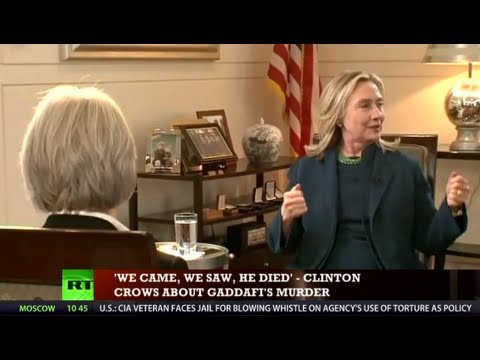
This is the same leader who was murdered in the aftermath of the 2011 NATO bombing of Libya; an attack promoted and facilitated with the eager support of Mrs. Clinton. In an infamous CBS news interview, said regarding this international crime: “We came, we saw, he died.” As Time magazine pointed out in 2011, the administration understood removing Qaddafi from power would allow the terrorist cells active in Libya to run rampant in the vacuum left behind. Just last month the New York Times reported that Libya has indeed become a terrorist safe haven and failed state— conducive for exporting radicals through “ratlines” to the conflict against Assad in Syria.

Hillary made prompt use of the ratlines for conflicts in the Middle East. In the summer of 2012, Clinton privately worked with then CIA director and subversive bonapartist David Petraeus on a proposal for providing arms and training to death squads to be used to topple Syria just as in Libya. This proposal was ultimately struck down by Obama, reported the New York Times in 2013, but constituted one of the earliest attempts at open military support for the Syrian death squads.

Her voting record on intervening in Afghanistan and Iraq is well known and she also has consistently called for attacking Iran. She even told Fareed Zakaria the State Department was involved “behind the scenes” in Iran’s failed 2009 Green Revolution. More recently in Foreign Policy magazine David Rothkopf wrote on the subject of the Lausanne nuclear accord, predicting a “snap-back” in policy by the winner of the 2016 election to the foreign policy in place since the 1980s. The title of this article? “Hillary Clinton is the Real Iran Snap-Back.” This makes Hillary the prime suspect for a return to the madcap Iranian policies that routinely threaten the world with a World War 3 scenario.

Hillary Clinton is not only actively aggressing against Africa and the Middle East. She was one of the loudest proponents against her husband’s hesitancy over the bombing of Kosovo, telling Lucina Frank: “I urged him to bomb,” even if it was a unilateral action.

While no Clinton spokesperson responded to a request by the Washington Free Beacon regarding her stance on Ukraine, in paid speeches she mentioned “putting more financial support into the Ukrainian government”. When Crimea decided to choose the Russian Federation over Poroshenko’s proto-fascist rump state, Hillary anachronistically called President Putin’s actions like “what Hitler did in the ‘30s.” As a leader of the bumbled ”reset” policy towards Russia, Hillary undoubtedly harbors some animus against Putin and will continue the destabilization project ongoing in Ukraine.

Not content with engaging in debacles in Eastern Europe, she has vocally argued for a more aggressive response to what she called the “rollback of democratic development and economic openness in parts of Latin America.” This indicates her willingness to allow the continuation of CIA sponsored efforts at South American destabilization in the countries of Venezuela, Bolivia, Ecuador, Argentina and Brazil.

It is one of the proud prerogatives of the Tax Wall Street Party to push out into the light the Wall Street and foundation-funded Democrats. The final blow to Hillary’s clumsy façade comes directly from arch-neocon Robert Kagan. Kagan worked as a foreign policy advisor to Hillary along with his wife, Ukraine madwoman Victoria Nuland, during Hillary’s term as Secretary of State. He claimed in the New York Times that his view of American foreign policy is best represented in the “mainstream” by the foreign policy of Hillary Clinton; a foreign policy he obviously manipulated or outright crafted. Kagan stated: “If she pursues a policy which we think she will pursue…it’s something that might have been called neocon, but clearly her supporters are not going to call it that; they are going to call it something else.” What further reason could any sane person need to refute Hillary? A vote for Hillary is a vote for the irrational return to war.

The “Giant Sucking Sound”: Clinton Gave US NAFTA and Other Free Trade Sellouts

“There is no success story for workers to be found in North America 20 years after NAFTA,” states AFL-CIO president Richard Trumka. Unlike other failures of his Presidency, Bill Clinton can not run from NAFTA. It was Vice President Al Gore, not a veto-proof Republican congress, who lobbied to remove trade barriers with low-wage Mexico.

The record of free trade is clear. Multinational corporations and Wall Street speculators realize incredible profits, wages remain stagnant in the US, poverty persists in the developing world, and the remaining industrial corporations in America and Canada are increasingly owned by Chinese, Indian and other foreign interests.

America’s free trade policy is upside down. Besides Canada, Australia and Korea, most of our “free” trade partners are low-wage sweatshop paradises like Mexico, Chile, Panama, Guatemala, Bahrain and Oman. The US does in fact apply tariffs on most goods and on most nations of origin – rates are set by the US International Trade Commission (USTIC), a quasi-public federal agency.

Since a German- or Japanese-made automobile would under USITC’s schedule be taxed 10% upon importation, Volkswagen and Toyota can circumvent taxation by simply building their auto assembly plants for the US market in Mexico. In Detroit, an auto assembly worker is paid between $14 and $28/hour, ($29,120-$58,240/yr); hard work for modest pay. In Mexico, the rate varies from $2-5/hour.

In China, all automobile imports regardless of origin are tariffed as high as 25%. This allows the Chinese to attract joint ventures with Volkswagen and Toyota, and to paraphrase Abraham Lincoln, “keep the jobs, the cars and the money.”

NAFTA-related job loss is not a question of productivity, currency manipulation, “fair trade,” environmental standards, etc. While these issues are not trivial, free trade – as Lincoln’s advisor Henry C. Carey proved – is a matter of simple accounting. Can an American family survive on $4,160/year ($2/hr)? If not, cars and their components will be built in Mexico. If we want cars built in the United States, the only solution is a general tariff (import tax) reflecting the difference between those wage standards, like the very tariffs repealed by Bill Clinton.

In the United States the “runaway shop” under NAFTA and CAFTA has sent trade deficits and unemployment soaring while wages drop relative to the cost of living. Yet Mexico and other “partners” receive no benefit either. Many manufacturing sectors in Mexico pay wages lower than the equivalent sector in China. Mexico is now the world leader in illegal narcotics exportation and weapons importation. The poverty level between 1994 and 2009 remained virtually identical. (52.4% – 52.3%). The shipping of raw materials to Mexico comprise the majority of so called American “exports”. The finished products from these exports are assembled and sold back to the United States at slave labor prices.

Don’t expect Hillary to behave differently with the coming “Trans-Pacific Partnership,” which seeks to replace an ascendant China with less-developed Vietnam and Malaysia. Vietnam would overtake India-allied Bangladesh in the global apparel trade, and Malaysia has a high-tech manufacturing sector poised to rival China’s. With America’s manufacturing economy in shambles, the Clinton machine can now be redirected to geopolitical maneuvers.