Saturday Matinee: Catch-22

Classic Film Review: So was “Catch-22” the failure we remember it to be?

By Roger Moore

Source: Movie Nation

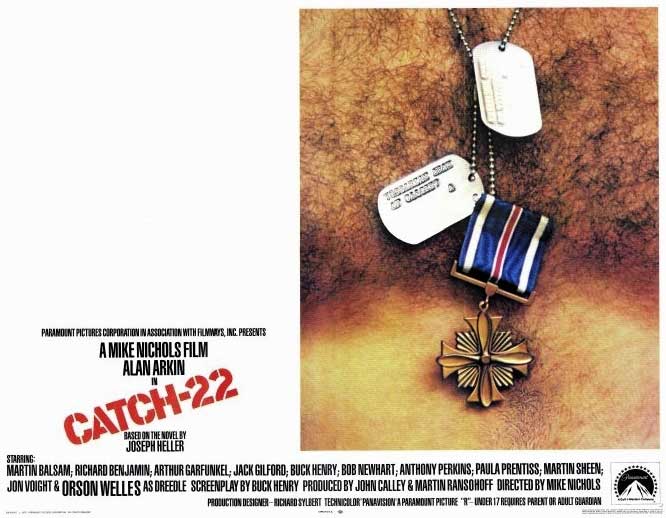
Perhaps it took a humorless, career-crippling George Clooney TV version of Joseph Heller’s novel to make us better appreciate Mike Nichols’ daring, infamously-expensive version of “Catch-22.”

Released at the height of the Vietnam War, suffering in comparison to Robert Altman’s equally anti-war dramedy “M*A*S*H,” seemingly more on a par with with equally cynical action comedy “Kelly’s Heroes,” which has had the benefit of a lot more TV exposure, “Catch” still plays the way it did way back in 1970 — as a pricey, “difficult” satire with a “difficult” shoot as baggage.

But wipe away the “Catch-22 lore,”the people cast and cast-aside, the fact that Nichols wanted the more age-appropriate Al Pacino as Yossarian, the young bombardier/anti-hero, and grapple with the film’s disordered narrative, the nightmarish focus of the story — an active-duty combat airman flying through and ranting through what we now call Post Traumatic Stress Syndrome, coupled with a tinge of guilt.

It’s amazing to see now. And considering how our war movies, from “300” to “Midway,” “Greyhound” to “Flyboys” and even at times, “Dunkirk,” are made now — with digital planes and ships and sometimes tanks — they really don’t make’em like this any more.

Nichols made the most of his coastal Mexican location, showing off all 17 WWII vintage B-25s taking off and landing every chance he got. You couldn’t do that today.

And that cast. Alan Arkin makes a fine, perplexed and outraged Yossarian, a sane man trapped in the insanity of war, an actor who never hits a punchline too hard, never takes the character’s exasperation into parody.

“Let me see if I’ve got this straight. In order to be grounded, I’ve got to be crazy. And I must be crazy to keep flying. But if I ask to be grounded, that means I’m not crazy anymore, and I have to keep flying.”

“You got it,” Doc Daneeka (Jack Gilford) tells him. “That’s Catch-22.

“Whoo… That’s some catch, that Catch-22.”

Orson Welles as a grumpy general, Tony Perkins as a put-upon chaplain, Martin Balsam as the murderously vain Col. Cathcart, Buck Henry as his venal sidekick, Col. Corn (screenwriter Henry was never better, as an actor), baby-faced Bob Balaban as the always-crashing, always-tinkering, even-tempered Orr, it’s a dazzling corps.

Bob Newhart half-stammering through Major Major Major, a very young Martin Sheen raging as the pilot Dobbs, Art Garfunkel as the innocent co-pilot Nately who falls for an Italian hooker, Charles Grodin as an upper-class twit navigator, a smarmy, befuddlingly upbeat Richard Benjamin (cast, with his wife Paula Prentiss as a nurse Yossarian chases), the famous French star who fled to Hollywood Marcel Dalio is the wizened old Italian who figures Italy has already won the war, since it has surrendered and Americans are still fighting and dying. And there’s a sea of actors we’d come to recognize on TV (“The Bob Newhart Show” is over-represented) in the years that followed.

Jon Voight stands out, just enough, as the grinning opportunist Milo Minderbender, a stand-in for every war profiteer you’ve ever read about, working the angles, an impersonal unpatriotic multinational corporation who wins no matter who loses.

Like its two contemporaries, “M*A*S*H” and “Kelly’s Heroes,” it’s a guy’s movie with a dated leering quality about the opposite sex. It’s heavy-handed, here and there, betraying Nichols — feeling his oats after “The Graduate” — indulging in some serious “blank check” filmmaking.

And reading, over the years, of all the people Nichols wanted to cast, or cast and then replaced, you kind of wish he’d moved on from Gilford, a future Oscar nominee who doesn’t bring enough cowardly sniveling to the good doc.

“Catch-22” was popular enough that they did a pilot for a sitcom based on it, as was the case with “M*A*S*H.” Richard Dreyfuss had the lead in that.

Over the years, I’ve interviewed half a dozen actors from that all-star cast, and often, without prompting, they’d bring it up. It took half a year of their lives, most of them, and burned itself into their memories, even if it wasn’t the blockbuster Paramount expected it to be.

Watching it again, outside of the academic settings where it turned up in “film as satire” classes and the like, it feels more cinematic than the scruffy, Altmanesque “M*A*S*H,” a movie marred by that stupid screen-time-chewing football game. It’s less fun than the more-watchable “Patton” and even “Kelly’s Heroes” (which is FAR longer).

But as a darker-than-dark comedy about the futility and insanity of war, it towers above its contemporaries in ways that should have scared-off George Clooney. It’s the best film of a seemingly-unfilmmable classic novel we’re ever going to get.

MPAA Rating: R, graphic violence, blood, nudity, profanity

Cast: Alan Arkin, Martin Balsam, Buck Henry, Tony Perkins, Bob Newhart, Paula Prentiss, Richard Benjamin, Marcel Dalio, Bob Balaban, Art Garfunkel, Martin Sheen, Jack Gilford, Peter Bonerz, Norman Fell, Austin Pendleton, Jon Voight and Orson Welles.

Credits: Directed by Mike Nichols, script by Buck Henry, based on the Joseph Heller novel. A Paramount release.

Running time: 2:02

____________________

Watch Catch-22 on Kanopy here: https://www.kanopy.com/en/product/3216674

Saturday Matinee: Possessor

By Norman Gidney

Source: Film Threat

In just his second feature, Brandon Cronenberg, son of David, has delivered the first great sci-fi horror movie of the decade with Possessor. In the future, corporations use internal agents to inhabit innocent people’s bodies to carry out high-profile assassinations for strategic gains. Tanya Vos (Andrea Riseborough) is one such agent. In fact, she’s the star player at her secretive killing firm. But when the brain implant process takes its toll during an assignment, she begins to lose a grip on her own identity. Exploring self and identity, Cronenberg deftly explores heady material in a sci-fi horror candy coating, delivering a challenging ferocious film.

The action and concept are presented straight away with a bloody assassination in a nightclub. Miles away, Tanya lays on a white leather chaise with her head in a contraption guiding the host body from afar. After the assassination, she is to kill the host body with a shot to the head. Yet with this latest contract, her boss, Girder (Jennifer Jason Leigh), notices that Tanya is losing her grip on her true identity. Hesitant, Tanya accepts one last job in the form of Colin (Christopher Abbott), a coked-out rich boy with access to the CEO of a major tech company. The goal is to inhabit Colin’s body and have it murder Colin’s soon-to-be father in law John Parse (Sean Bean).

After going home to visit her estranged husband and 7-year-old son, Tanya returns to the facility to complete her final assassination. After the transfer, trouble ensues as various glitches in the technology are creating artifacts, hallucinations, and unpredictable behavior. Worse still, Colin’s hijacked personality begins fighting its way back to the surface. Will Tanya get the job done? Will Colin take over and trap Tanya in his body forever?

Cronenberg’s script for Possessor deftly convinces the audience that its world is real. It sprinkles random details of the technology in context rather than laboriously over-explaining all of it. We watch the process and hear just enough technobabble to believe it, and then we are off and running. To this end, Leigh’s understated performance as the calm puppetmaster at the firm is grounded and unsettling.

After kidnapping Colin and implanting the device in his brain, Tanya transfers into Colin’s body and assumes his life. In a brilliant pair of performances, Abbot and Riseborough make us believe that Tanya is inhabiting a very alien male body. Standing before a mirror just after the transfer, Abbot portrays Tanya exploring her new host, lightly feeling the skin, looking at the odd genitalia in the front, and trying to act as normal. The two create a seamless illusion of a single personality.

Possessor explores all of the existential dilemmas this idea can afford to a frightening degree while telling an absorbing tale of corporate espionage. Cronenberg has created a mind-bending trip of a movie with more to say than your average actioner and is supported by spectacular performances and make-up and practical effects that seal the deal. Brace yourself. The film is brilliant.

____________________

Watch Possessor on Kanopy here: https://www.kanopy.com/en/product/13106284

Saturday Matinee: The Green Knight

By Brian Tallerico

Source: RogerEbert.com

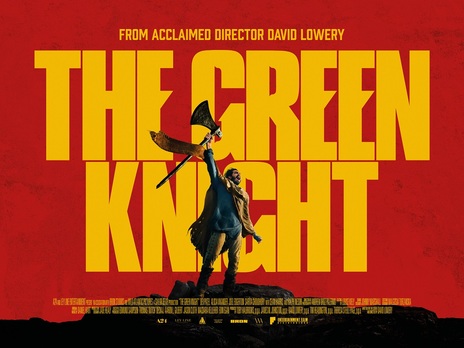
Light snow, misty fog, and falling ash blend in the opening scenes of David Lowery’s magnificent “The Green Knight,” setting a surreal tone for what’s to come. You can feel the chill and smell the air. Immediately, you feel outside yourself, far from daily concerns, set for an experience that’s unlike anything else in nearby theaters. That feeling won’t subside for over two hours.  

Lowery has adapted the 14th century chivalric romance Sir Gawain and the Green Knight into one of the most memorable films of the year, a fascinating swirl of masculinity, temptation, heroism, and religion. Arthurian experts may quibble with some of Lowery’s decisions and it is certainly a film that challenges traditional expectations of stories about heroic knights for modern audiences, but fans will be drawn to this mesmerizing journey guided by Lowery’s incredibly poetic eye, career-best work from Dev Patel, and an artistic sensibility that transports audiences to another world. It’s a film that embeds the concept of storytelling and performance into its narrative—whether it’s a King asking for a heroic tale or children watching a puppet show—while also weaving its own enchanting spell on audiences. More than any movie in a long time, I would have immediately watched it again, but it’s also a film that really strengthens in memory, swirling around your brain like the falling flakes of the opening scenes.

Sir Gawain (Dev Patel) is the nephew of King Arthur (Sean Harris) and Queen Guinevere (Kate Dickie), and the son of Morgan Le Fay (Sarita Choudhury), accused by some in the village of witchcraft. After a brief opening scene with his lover (Alicia Vikander) and mother, Gawain is off to a lavish Christmas banquet with the King and Queen, at which he is surprised to be asked to sit by their side. Arthur speaks to him of taking young Gawain for granted, and immediately Patel conveys depth with his striking eyes, relaying both the emotional pride that comes with finally feeling seen. (He does so much throughout the film in terms of physical performance, using his eyes and body to find emotion without dialogue.) Long, deliberately slow exchanges between Gawain and Arthur set the tone: This is not an action film. Arthur asks to hear a tale.

One unfolds in front of their eyes. The doors to the hall burst open and the Green Knight (Ralph Ineson) enters. Half-man, half-tree, he casts an imposing figure, and he wants to play “The Christmas Game.” He offers a deal. He challenges any of Arthur’s knights to strike him. If they can, the knight will get his imposing weapon in exchange. But there’s a cost. A year hence, the knight must come to the Green Chapel, where the Green Knight will return the exact strike given him a year earlier. Gawain steps forward, and despite being reminded that this is a game by Arthur, beheads the Green Knight. The mythical creature picks up his head, which doesn’t seem too concerned about its detachment, and laughs as it rides off. Gawain is about to have a long year.

This is all really prologue to “The Green Knight,” the bulk of which consists of Sir Gawain’s journey to the Green Chapel to meet his fate. Along the way, he meets a scavenger played by Barry Keoghan, a mysterious young woman played by Erin Kellyman, and a Lord played by Joel Edgerton. Lowery’s script deftly matches the poetic structure of its source, circling back to themes like the rhyming structure of a poem, and unfolding his story in what almost feel like cinematic stanzas that repeat and comment on each other. Gawain’s journey becomes a spiral, feeling more and more like a dream, as if he never really left that banquet with the Green Knight to begin with, and the film gains momentum through a cumulative sense of disorientation. It becomes not so much a story of a physical journey but a mental and emotional one, a series of challenges before a young man faces his ultimate fate.

With its loose storytelling structure, the tech elements of “The Green Knight” become even more essential to its success. Lowery has brought his remarkable team, including regular composer Daniel Hart and cinematographer Andrew Droz Palermo. (He edits the film himself, and reportedly re-cut it dramatically from the version that was supposed to premiere at SXSW in March of 2020.) The fluid cinematography alternates between dreamlike and something deeply connected to Mother Nature. “The Green Knight” is about many things—and some of the best film writing of this year will unpack its themes in more depth—but a sense of man’s relatively minor role in the grand scope of history and nature is essential, and Palermo beautifully captures the lush greens of the world around Gawain, as if the Knight himself is already everywhere. Vikander gets a phenomenal speech about how much we all return to the earth and Gawain is constantly being reminded of his insignificance and fragility. If The Green Knight doesn’t get him, something else will.

While it may be his most ambitious film, Lowery has played with complex themes before in projects like “A Ghost Story,” and this reflects that film’s questioning of meaning in the relatively small window of a human existence. Once again, Lowery leaves just enough open to interpretation and yet never lacks in confidence. That’s the incredibly fine line that great films often walk—when a work can feel both assured in the voices of its creators and yet open enough to spark conversation. “The Green Knight” is one of those films. One never questions that Lowery knows exactly what he’s doing, and yet people will walk away with very different readings of “The Green Knight.” Again, that’s akin to a great poem that means something unique to each person that reads it, and some of those readings may even surprise the original author. 

“The Green Knight” asks a lot of its viewers—to stay engaged with what could be called its slow pace, to consider its themes without them being underlined for easy consumption, to be willing to see a film about famous knight that contains very little in the way of traditional heroism. It is scary, sexy, and strange in ways that American films are rarely allowed to be, culminating in a sequence that cast the whole film in a new light for this viewer. We’re all just sitting in that banquet hall, listening to the story requested by King Arthur, told by a master storyteller.

Saturday Matinee: Acción Mutante

By Steve Harcourt

Source: NerdSpan

Although made in a ’90s ‘B-Movie’ style, Acción Mutante can be either viewed as a schlocky, gore laden, science fiction romp or a politically astute piece of social commentary in an innocuous wrapper. It could also, potentially, be both.

In a dystopian future where the world is ruled by the glamorous and ‘good looking’ people, the disfigured and disabled are marginalised and treated as second class citizens destined for a life of poverty.  Fighting against this tyranny is a disparate band of characters, who call themselves mutants, using the name ‘Acción Mutante’ for their terrorist acts.  For several years since the imprisonment of their leader ‘Ramon’ (Antonio Resines), the group, comprising of conjoined twins ‘Alex’ (Álex Angulo) & ‘Juan’ (Juan Viadas), ‘Quimicefa’ (Saturnino García), ‘Manitas’ (Karra Elejalde), ‘Chepa’ (Ion Gabella), and ‘M.A’ (Alfonso Martínez), have been ineptly continuing the fight, leading to many high profile blunders, especially when they try to kidnap someone.  Upon his release, ‘Ramon’ immediately puts into motion a new plan to kidnap Patricia Orujo (Frédérique Feder), the daughter of the boss of the Orujo business empire (Fernando Guillén), and ransom her for 10,000,000 ‘ecus’ on a distant mining planet.  This plan rapidly spirals out of control…

As a writer, producer and director, Álex de la Iglesia has become more well known for films such as The Oxford MurdersLa Comunidad, and The Last Circus since Acción Mutante, his first directorial feature. This film was a brash introduction to what was he was later to create.  With production being aided by Augustin and Pedro Almodóvar, and with several well known Spanish actors on board, this was by no means an effort made with little talent behind him and it shows what people saw in him, even then.

What he has made is, essentially, an obvious attack on the bourgeoisie and their ilk with commentary on the disabled and the way society treats them, all put together in a ‘Troma-esque’ black comedy. In the amount of gore, and especially the style of the gore, the Troma influence is apparent and it would sit comfortably alongside many Troma films.  There is also an obvious influence in some scenes from Almodóvar, such as the party scene, where you may even notice Rossy De Palma, an Almodóvar regular. There are also some similarities to other European directors’ early work, such as Jean Pierre Jeunet & Marc Caro (Delicatessen), especially in terms of characters, which is not a bad thing.

These characters are a mixed bag, with some being broadly comedic and others being very one dimensional heroes or villains.  What is clear is that a certain amount of hokey fun was had by the cast. They do a good job in hamming it up in the right manner for this kind of B-Movie with some good interplay, some clever idiosyncrasies, and some nice set pieces.  Plot-wise, the pacing and structure are a little flawed. As the second half falls apart a bit, losing some of the good premise along the way, which is a shame. Much more could have been made of this premise and instead it treads a slightly simpler path with a cheaper, trashier angle.  Having said that, it does still tend to work, but just not quite how you thought it was going to.

There are a couple of problematic areas, namely some excessive violence that is unnecessary and some misogynistic elements which are troubling.  When the film originally came out on VHS, the BBFC (British Board of Film Classification) made some cuts, which have been put back in this DVD version, and we probably would have been better off without them as they do not enhance the plot or its coherence at all. I had previously only seen the VHS version and in no way was this better.  As for the misogyny, it is pretty obvious that these elements are there, but I would be interested to hear what Álex de la Iglesia and producer Pedro Almodóvar have to say about it and whether they were making a particular point, as Almodóvar has a history of strong female characters and is often called a feminist.

Overall, I would say that if you’re a fan of the Troma-style of bonkers, splatter, comedy B-Movie, then you will find something to like here. This needs to be taken as a relatively stupid, schlocky comedy with some obvious social and political points to be made. However, I have read that there are some more specific points made for a Spanish audience that may not be immediately apparent for an international audience.  As someone from the UK, I didn’t pick up on anything in particular, but that doesn’t mean it’s not there. Potentially, it could contain further depth.  So, while it is problematic, it does show the signs of better work that was to come from Álex de la Iglesia, and can be enjoyed as an oddball thing of its own.

____________________

Watch Acción Mutante on Hoopla here: https://www.hoopladigital.com/title/15772689

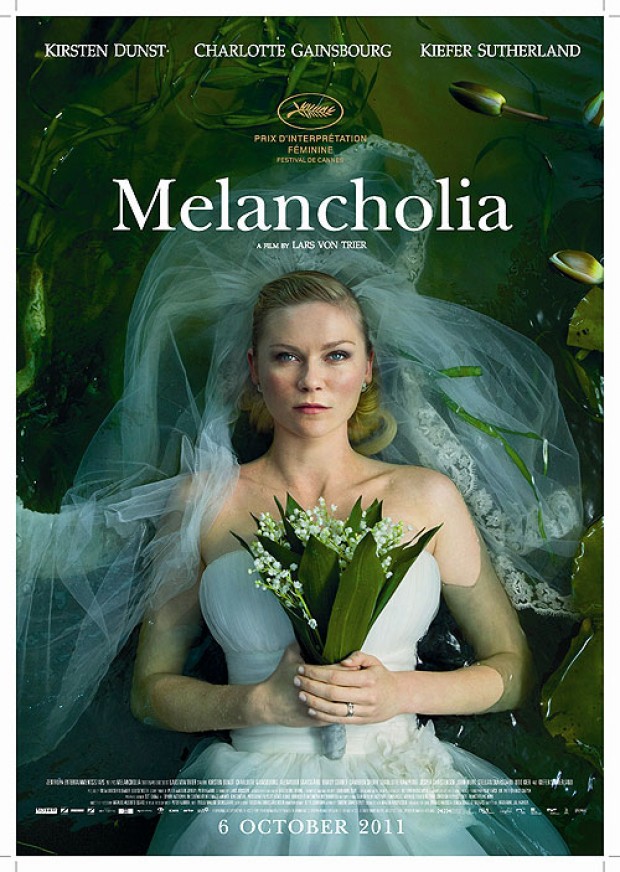
Saturday Matinee: Melancholia

Melancholia Review

By Ewan Gleadow

Source: Cult Following

Uncomfortable productions are the forte of director Lars von Trier. The allusions to and disquieting effect of his features and their focus is something to be realised in the prime of his works. What that area is can be debated and pulled at, but Melancholia appears to be the poetry in motion Trier fans so often praise the director for. Musical accompaniments to still shots of paintings that slowly peel and ripple. It’s a delightful piece for those that love the artisan qualities of a world falling apart and the destruction that comes from character sleights. The immovable nothing that comes from it touches deeper and deeper as Melancholia, the finest Trier work, rages on.

That much comes from the absolute beauty of its structure, of its characters. Shaped and informed by destruction, moving paintings that take place on strange canvases that display torment and passion, family and love. Melancholia has all the time in the world for its visual chemistry and the representations it can bring. There is no tiring effect brought by Trier, who trusts in his lengthy segments of two worlds, quite literally, colliding. Audiences are placed right at the end and know what is to come, what fate the characters meet and how it all comes to a crashing bit of destruction. In identifying the hopelessness, Trier brings himself to the inevitable edge that comes from discussing finality. It feels a bit like what The Fountain tried and failed to comment on, but with much, much more scope than the Hugh Jackman-led piece.

Within Melancholia is the profound beauty of visual meaning. It is a piece that relies more on the slower motions and relationships told in flutters rather than a full-on narrative that demands and desires strict following of the story. There is a fast and loose layer to Trier’s work, where his direction provides beauty and colour with that fear. Kirsten Dunst delivers a phenomenal catalyst for life. It gives the happiest moments of life and the cursed afterthoughts. Trier mixes the palette well, he provides that to the cast and relies on them so frequently to engage with the emotion, rather than dialogue. It is the choreography, and the appeal of his directing style, that makes Melancholia such an intoxicating watch.

Senseless destruction with poetic twists and turns at their finest, Melancholia is a touching and spiritually charged look at the useless tirades and meaninglessness of it all. With Melancholia exposing itself to the raw elements, it does often focus on its imagery more than its characters. Trier’s style, the unfocused extremes of the close-up shot, the shot-reverse-shot simplicity, it all has its place but where that is can come across as unfounded. His fly-on-the-wall appeal has its moments throughout this piece, with a triple threat of Charlotte Rampling, John Hurt and Stellan Skarsgård making the most of that. There is no harm in stacking the cast so high, it adds texture and richness to an already broad-in-scope feature. Melancholia feels right at home biting off more than it can chew, both narratively and emotionally.

____________________

Watch Melancholia on Kanopy here: https://www.kanopy.com/de/product/69665

Saturday Matinee: Lessons of Darkness

By Martin Purvis

Source: The Film Sufi

Werner Herzog’s documentary films lie at an extreme distance from the Anglo-American tradition of documentary filmmaking. Part of that distance can be linked to the distinction between two fundamental stances towards the depiction of reality: “Objectivism” and “Interactionism”, which I have discussed in other essays, for example, Avatar (2009), Close-Up (1990), and SiCKO (2007). American documentarians generally align themselves with Objectivism and hold that they are presenting an objective view of reality. An extreme form of this approach is “direct cinema”, which seeks to create the illusion that the filmmaker is an invisible “fly on the wall” and has no impact on the subjects being filmed, thereby supposedly ensuring scientific objectivity. But even in more conventional American documentaries with explicitly polemical content, there is a presumption that objective reality, independent of any observer, is being presented. Continental European documentary filmmakers, on the other hand, have had a tendency to lean towards Interactionism and have made more personal films in which the filmmaker and his or her point of view is a confessed part of the narrative. Herzog is so much on the Interactionist side of the ledger that his documentary films not only include his personal perspective, but seem primarily to be his own personal essays about the world – he, himself, is an implicit focus of the film, and the “reality” depicted is self-consciously Herzog’s own reality. Lessons of Darkness (Lektionen in Finsternis, 1992), which was shot in Kuwait in the immediate aftermath of the First Gulf War (1990-91) is one such example of Herzog’s style.

Although focussed on the harrowing events and ravages that happened in Iraq and Kuwait during that time, Lessons of Darkness has clear-cut affinities with Herzog’s first documentary Fata Morgana (1971), which was shot in Africa. In that earlier film Herzog edited footage that he had (seemingly randomly) shot in the African Sahel and tried to fashion a dark vision about man’s hopeless ineffectiveness, and consequently likely impermanent existence, on the planet – an ephemeral existence like a mirage. Some twenty years later, with Lessons of Darkness, Herzog again collected footage, this time in Kuwait, and then assembled his photographic essay in post-production, and again his vision is one of dark apocalypse and pessimism concerning man’s prospects for a sustainable future. In fact both Fata Morgana and Lessons of Darkness contain vague commentary that suggests that humankind on Earth is being clinically observed, with amazement and horror, by a visitor from another planet. However, in neither film is there any real narrative or sequence of events that could amount to a story – they are both more or less personal essays of despair. But if we assert that they are both cinematic commentaries, we have also to concede that neither of these two films provides an explicit disquisition or argument, or even has a clearly articulated thesis. What we are really presented with is just a suggestive sequence of images, on which the viewer reflectively fills in many of the blanks and faces a greater-than-usual task of constructing his or her own story or vision. This process of placing much of the narrative burden on the viewer essentially fails with Fata Morgana (which was almost a random collection of lurid images of garish and pathetic human folly), but is more successful with Lessons of Darkness, primarily because the viewer in this case is more likely to bring to the film considerable familiarity with what happened during the “First Gulf War”and use that material for his own imaginative reconstructions.

The greater part of Lessons of Darkness consists of lurid scenes of fires in the Kuwaiti oilfields burning out of control and spewing gargantuan clouds of smoke. These images are interspersed with images of devastation, both at the physical and human level, and with human firefighters seemingly overmatched in their efforts to quell the multiple, raging infernos. The images are apparently meant to be abstractly horrific, and there is almost no spoken dialogue and no explicit reference to the Gulf War, or to specific places, or to any historical context. To set some kind of context, Lessons of Darkness opens with images of wasteland and destruction, and the prologue refers to a planet “in our solar system” which evidently has undergone a catastrophic war. So the viewer sees things simultaneously with respect to two overarching narrative perspectives: the real Gulf War and an abstract metaphorical fable of how bizarre humankind’s self-destructive impulses might be to a detached, external observer. The film is then presented partitioned into thirteen chapters, each identified by apocalyptic, perhaps oracular, intertitles which suggest chapters to some sort of apocryphal Book of Revelations.

  1. “A Capital City”. This section features an opening voiceover narration with images of Kuwait City filmed from a low-flying helicopter, ominously suggesting that this doomed city will soon be utterly destroyed by warfare (it wasn’t, and this footage was filmed after the conflict).
  2. “The War”. Here is shown footage of the aerial bombing of Iraq as seen via night-vision video cameras. Although this section is relatively short and no mention of “Operation of Desert Storm” is made, the context is likely to be familiar to a worldwide audience, since it was widely viewed on CNN.
  3. “After the Battle”. Images of war devastation are presented.
  4. “Torture Chambers”. This thankfully brief section is one of the most memorable, though difficult to bear, sections in the film. First is shown what is apparently the insides of one of the torture chambers run by Saddam Hussein’s government, and it features a mute display of mechanical devices designed to inflict unbearable pain. Then an Arab woman is shown who was been rendered almost permanently speechless by having been forced by the authorities to witness her own sons being tortured to death.
  5. “Satan’s National Park”. Helicopter footage of what seems to be a vast marshland are revealed to be in fact entirely flooded with oil.
  6. “Childhood”. Another Arab mother is shown, this time with a young, disturbed boy who has been rendered speechless by what he has witnessed during the conflict. As with the woman shown earlier, the horror of what happened is not shown, it is only something so unspeakable that one cannot bear to think about it. The viewer’s imagination then fills in the blanks.
  7. “And A Smoke Arose Like The Smoke From A Furnace”. Here, 23 minutes into the film, the raging fires take over the screen. Again, they are filmed from low-flying helicopters.
  8. “A Pilgrimage”. Now the (American) firefighters are shown, sometimes relatively up close and at other times at a distance and dwarfed by the towering flames of the fires that burn endlessly. This section shows the firefighters using explosives to try to put out the fire.
  9. “A Dinosaur’s Feast”. This is more or less a continuation of the previous section showing the firefighters, but now emphasizing some of the huge construction and excavation machines employed in their work. The machinery has monster-like appearances, with arching cranes, serpentine bodies, and huge digging claws.
  10. “Protuberances” – a brief section showing closeups of oil–and-mud swamps bubbling and frothing, and evoking more nightmarish images of Hell.
  11. “The Drying Up of the Wells”. The oil-covered firefighters are shown, often in slow-motion, intensely engaged in the mechanics of their operations. The functional nature of these activities is incomprehensible to the typical viewer, and it all appears perhaps as an abstract Ballet Mécanique from the dark side. The macabre strangeness of it all, and the degree to which these operations seem to be foreign to what we might call normal human intercourse, are worth comparing to Louis Malle’s documentary, Humain, Trop Humain (1974).
  12. “Life Without Fire”. With many of the fires now apparently having been extinguished, the voiceover commentary of the interplanetary visitor expresses wonder as these strange creatures to him (i.e. the firefighters) engage in the baffling act of relighting an extinguished geyser of oil. He comments: “Has life without fire become unbearable for them? . . . . . Others, seized by madness, follow suit. . . . . Now they are content, now there’s something to extinguish again.”
  13. “I am So Weary of Sighing, O Lord, Grant That the Night Cometh”. The final portion returns to the fires, themselves, carrying with it an air of resignation and gloom.

Herzog’s fascination with fire extends to a fascination with its opposite, darkness (hence the title). The demonic forces that lurk inside the hearts of men seem to be beyond civilized understanding or rational control. These issues of cruelty and madness are as elemental as fire, itself, and are not confined to the Middle East [1]. This apparently was Herzog’s project: not to focus on just the particular horror of what happened in one part of the globe, but to fashion a fiction that would portray a more universal damnation. To this end, he opens the film with his own fabricated quotation (“The collapse of the stellar universe will occur, like creation, in grandiose splendor”) which he probably attributes to Blaise Pascal in order to give it the appropriate resonance – Pascal is perhaps not so well-known to English-speaking audiences, but his genius occupies a peculiarly iconic place in the European mind.

The horror that Herzog attempts to convey by his images of man-made Hell is enhanced by its unspeakable nature – it is beyond human articulation. Instead of a deafening roar from the fires drowning out occasional shouts from the firefighters, much of the stoundtrack is filled with funereal, dirge-like orchestral music from Mahler, Prokofieff, Verdi, Wagner, and Arvo Part. The unspeakable nature of this horror is explicitly referenced by the two mothers: one mother is unable to speak comprehensibly, and the child of the other mother has been rendered speechless by rational choice. It is left to our imaginations to fill out these nightmares.

Notes:

  1. For example, consider the use of germ warfare by the Japanese during the Second Sino-Japanese War (1937-45). Here is a quotation from an article on the subject (Judith Miller, “When Germ Warfare Happened”City Journal, (Spring 2010)):

“The methods were brutal. Army trucks dumped gallons of deadly germs alongside roads and railway lines linking Chinese towns so that infections would spread from town to town; planes dropped porcelain bombs containing infected fleas on dozens of villages, causing devastating outbreaks of bubonic plague. The Japanese laced more than 1,000 wells in the area of Harbin with typhoid bacilli. They also inserted typhus into bottles of lemonade that children loved to drink in the summer, Harris reported. In Nanking, they distributed anthrax-filled chocolate and cake to hungry children. The Japanese discovered that packing fountain pens and walking sticks with deadly germs was a particularly effective way of secretly disseminating them. In 1940, Major General Ishii sent a train carrying 70 kilograms of typhus bacterium, 50 kilograms of cholera germs, and 5 kilograms of plague-infected fleas to the city of Hangzhou, a holiday resort favored by Shanghai’s wealthy. From there, the germs were dumped into ponds and reservoirs and spread by aerial spraying, contaminating all life in fields of wheat and millet during the harvest.”

Saturday Matinee: The Bear

Film Review by Frederic and Mary Ann Brussat

Source: Spirituality & Practice

The Bear is an unusually involving story about animals that will give you a fresh perspective on their world. It is not a documentary nor is it the kind of cute children’s fare usually cranked out by Hollywood. This strange and affecting film is directed by Frenchman Jean-Jacques Annaud (Quest for Fire) based on a 1916 novel by James Oliver Curwood set in British Columbia in 1853.

When a young bear’s mother is killed by a rock slide while she is trying to extract honey from a beehive, he wanders off into the wilderness whimpering. After several misadventures, the cub finds a protector in a ferocious grizzly bear who has been shot in the shoulder. The cub licks his wounds and soon the two are partners. The giant bear introduces the little vulnerable one to a wider world — catching fish, tracking down and killing a caribou, and knocking down trees to demonstrate strength in a courtship ritual with a female bear. The cub must then square off against hunters and a menacing mountain lion.

The scramble for survival in this wilderness world is exhausting. The cub manages a few moments of reverie — seeing the moon’s reflection in a pond and swirling around after eating a mushroom. Watching him mimic the elder bear’s activities, it is difficult to remember that this is a story being directed rather than a glimpse of life in the wild. Philippe Rousselot’s photography is magical, and the musical score by Philippe Sarde adds emotional breadth to the story.

The Bear has all the marks of a classic. Lauded by animal rights groups for its respect for the integrity of all species, it manages to speak out eloquently against the senseless hunting of wildlife without having to depict killing to make its point. Instead, it emphasizes the ties that bind the human and animal worlds together.