Saturday Matinee: The Legend of the Stardust Brothers

The Legend of The Stardust Brothers (1985) review.

By P-J Van Haecke

Source: Psycho Cinema

Introduction

In 1985, the young Makoto Tezuka, son of manga godfather Osamu Tezuka, was approached by the famous musician and tv-personality Haruo Chicada with the question to make a movie for the soundtrack he had created for a non-existing movie. Makoto Tezuka, which by then had already directed various experimental narratives, accepted and directed what would become his feature-debut narrative.

Review

One day, Kan (Kan Takagi) and Shingo (Shingo Kubota), both singers of rival bands and both vying for fame and popularity, are given an invitation by a representative of the president of the talent agency Atomic Promotion, Minami (Kiyohiko Ozaki).

The following day, having arrived at the agency, they meet the innocent and charming Marimo (Kyoto Togawa), a girl who has, driven by her desire to force an audition with the president, been caught trespassing several times. Ultimately, in order to make Kan and Shingo agree to Minami’s proposal,she gives up her desire to become a singer, instead settling for a role as president of their fan-club. But as Kan and Shingo become stars, the will soon learn that fame always comes with nasty side effects.

The Legend of the Stardust Brothers is not just another over-the-top narrative about fame and the side-effects that often go together with fame, e.g. jealousy and addiction. The Legend of the Stardust Brothers – and this is amazing – still manages, even though the narrative is envisioned as pure entertainment, to evoke (intended or unintended) a political message against uniformity (Narra-note 1).  This message, which might be more relevant today than at the time of this narrative’s release, is specifically important for Japan as such, as the concept of harmony still dictates much of the social fabric. One can formulate the ultimate message of the narrative as follows: In order to combat the political forces focused on disciplining society into uniformity and obedience, diversity and the freedom of expression – subjectivity as such – are our only weapons.

The Legend of Stardust Brothers – see the visuals framing Minami’s first song – also criticizes the system of agencies as well as the blind desire for fame that drives many young people.  Besides evoking the problematic power agencies have – a problem persisting up until this day – it also underlines the naivety of people who willingly give up their own agency, their own right to decide. Last but not least, The Legend of The Stardust Brothers questions the often problematic connection between mass media and politics, i.e. media as the mouthpiece of politics, entertainment as crowd-control and political influence.

The Legend of The Stardust Brothers truly deserves the signifier ‘legend’. While the main narrative thread may very well be an approximation of “what truly happened” – as is implied by the very end – the framed and presented narrative is nothing other than the exaggerated and at some times rather absurd version of Shingo and Kan. This absurdity at the level of the narrative is supported by cinematographical absurdity and the energy to be found at the level of the acting performances.

The cinematographical ‘absurdity’ is especially sensible at the level of the effects. While the various cheap special-effects betray the limitations of the budget ‐ and may even cause some frowns – these effects have after 33 years also attained a certain charm. We would even say that the cheapness of various effects help emphasizing the craziness and absurdity of the narrative as such. But these so-called cheap effects should not detract the spectator from those effects that blend fluently into the narrative fabric, e.g. the colour divide in the opening song, the fun practical horror effects, the animation sequence, and the instances of stop-motion. As a matter of fact, it has to be applauded that Makoto Tezuka, in full knowledge of the limitations of his budget, realized, in a rather bold fashion, his cinematographical vision without much compromise.

In Makoto’s framing, it is very easy to realize that, at various instances in the narrative, visual composition took preference over cinematographical continuity. In the catchy opening song, there are some compositional choices – choices deliberately braking the continuity – that have no other effect than heighten the fun. In other words, they function successfully as tongue-in-the-cheek visual puns.Furthermore, many of the visual effects – the effects we mentioned above – applied in the later narrative can be seen in the same way, as visual elements focused on fun.

There is a certain youthful energy that supports the entire narrative, an energy that emanates from Shingo Kubota and Kan Takagi and – as mentioned before – gets empowered by the bold way the narrative is framed as such. It is especially this energy, paired with those moments of charming comedic over-acting – over-acting often function of the amateurism of the concerned actors (see for instance Kiyohiko Ozaki’s performance) – that turn The Legend Of The Stardust Brothers into a 100 minutes long crazy roller-coaster of fun and musical entertainment.

The music of The Legend Of The Stardust Brothers is utterly fantastic. Besides creating the fun eighties vibe that persists throughout the narrative, the infectious songs allow the spectator to enjoy a wide range of genres popular in the eighties. It is also evident that the music genres have also dictated the performances as such – ISSAY’s performance for instance brings the style of David Bowie wonderfully to live.

The Legend of the Stardust Brothers is one of those rare narratives that has become better by aging, instead of turning ugly and sour. While the ripeness of the narrative is not able to beautify all its faults, the pure fun oozing from the narrative and the performances secures the enjoyment the spectator can extract from this energetic and truly irresistible legend. In other words, the time for this narrative to become, thanks to the release of the DVD/Blu-ray by Third Windows Films, a cult-classic has finally arrived.

Narra-note 1: This concerns the revelation of Kaoru’s father. For more information, one can read our exclusive report of our meeting with Makoto Tezuka.


Watch The Legend of the Stardust Brothers on Hoopla here: https://www.hoopladigital.com/movie/the-legend-of-the-stardust-brothers-shingo-kubota/17400468

Saturday Matinee: The History of the World Backwards

Source: Wikipedia

The History of the World Backwards is a comedy sketch show written and starring Rob Newman. It is a mock history programme set in an alternative world where time flows forwards whilst history told backwards. In other words, if you were born in 2007, you would be 60 years old in 1947. All the major historical events happen backwards, so for example, Nelson Mandela enters jail a Spice Girls fan, and comes out as a terrorist intent in overthrowing the state. There are several recurring themes, such as the “Technology collapse”, where scientific discoveries are lost, forgotten or made unworkable.

It was shown on BBC Four, starting on 30 October 2007, and later shown on BBC Two. It was Newman’s first television project in 14 years.

Saturday Matinee: My Name is Nobody

By Richard T. Jameson

Source: Parallax View

[Originally published in Movietone News 36, October 1974]

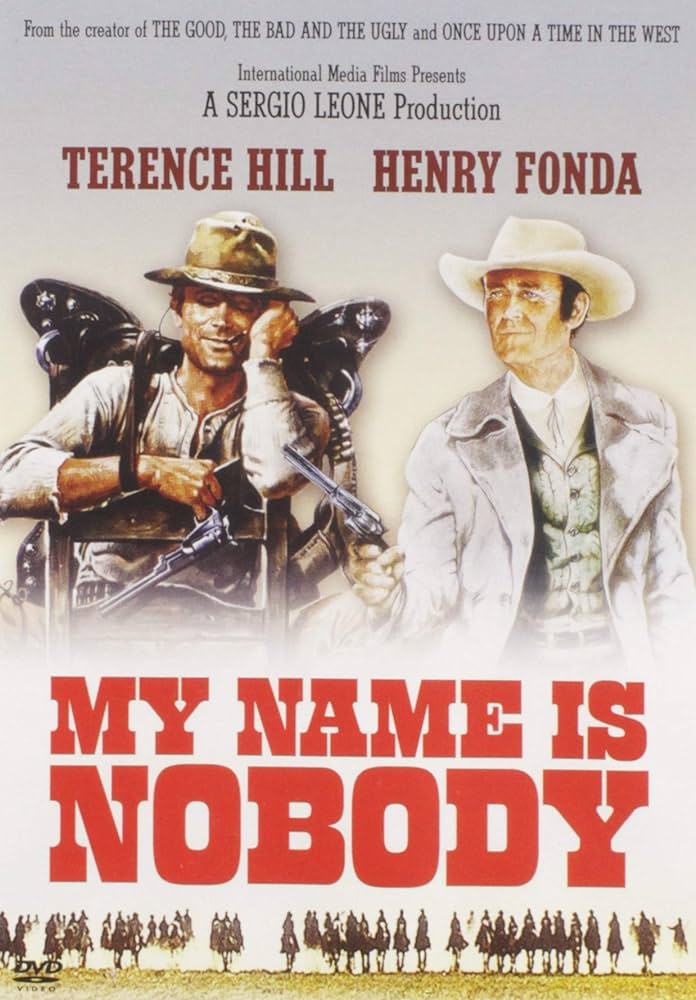
Most people have been writing about My Name Is Nobody as though it were as unequivocally a Sergio Leone film as Once upon a Time in the West, Duck You Sucker, et al.; some reviewers haven’t troubled to mention the existence of Tonino Valerii (who is emphatically given directorial credit twice in the opening titles) while more scrupulous commentators have nodded toward Valerii while acclaiming My Name Is Nobody as “the most producer-directed movie since The Thing.” There’s no mistaking the Leone manner, the Leone themes, and the frequent instances of Leone power and feeling; the protégé has learned the master’s lessons well, and one feels certain he was largely executing Leone’s own detailed plan of the film. I’m sorry I muffed my chance to see Valerii’s own A Reason to Live, a Reason to Die a month or so ago (I loathe drive-ins) because I might have been better prepared to wade in and sort out the fine points of auteurship in the mise-en-scène. There are lapses in the film that mightn’t have occurred—or might have been more decisively compensated for—if Leone’s hand had been at the throttle. But there are also shots, sequences, and literally timeless moments in the movie that do no disservice to the memory of previous Leones—which is to say that My Name Is Nobody contains some of the most extravagantly exciting footage that’s going to appear on movie screens this year.

The greater share of these is concentrated in the opening half hour or so, wherein we encounter Henry Fonda (doing his best and most cinematic work since Once upon a Time in the West) as a legendary gunfighter named Jack Beauregard and Terence Hill as the latest blue-eyed Leone angel with no name whose life-obsession is to see Beauregard top his career with a one-man stand against the Wild Bunch—150 strong. Beauregard, 51 years of age, isn’t interested. He’s engaged in a double-purpose journey: tracking down several men to kill them or save them, we aren’t quite sure for a while—and also aiming himself toward a ship called the Sundowner in New Orleans which will carry him away from his life-and-death career to bookish retirement in Europe. One inevitably becomes aware of career parallels: Ford winding up his cavalry trilogy with Rio Grande—which has the U.S. Cavalry riding out of United States territory to defeat some hostile Indians—and then turning back to the Ould Sod with The Quiet Man; and, of course, Leone himself, who reconstituted the western in the deliriously decadent terms of Italian romanticism and eventually came to America to make his movies, or parts of them: it has been suggested that My Name Is Nobody is his farewell to the genre (it’s at least an arrivederci—he still wants his next picture to be that long-awaited gangster movie Once upon a Time in the United States) and in its verbal explicitness this latest effort is as prosaically academic as Jack Beauregard looks whenever he puts on his wire-templed spectacles.

But if Beauregard/Fonda makes an appropriate “national monument” to build another death-of-the-West-and-western movie around, Terence Hill’s Nobody—despite a splendid introduction—keeps souring the enterprise with his bland blond pretty-boy features and limited, but very insistent, comic repertoire. And, magnificent as some of the visuals are, too many of them lack the elusive but suggestively forceful spatial and spiritual and characterological coordinates of Leone’s own frames. The mesmerizing detail, the comprehensive authority of camera placement and movement in Leone’s own films, inculcates a terrific sense of inevitability, which tends to make a perverse virtue out of his tortuous excuses for plots (all of which—save the one he stole from Kurosawa—boast holes through which the Wild Bunch could ride). When Beauregard refuses to shoot a man whom everyone has expected him to kill, he sardonically apologizes to Nobody for failing to live up to the sterling ideal the younger man believed in: his destiny, he insists, is to quit while he’s still alive. But Nobody says, “Sometimes ya run smack into your destiny on the very road you’re takin’ to get away from it”: Leone/Valerii cuts to a white desertscape through which the Wild Bunch rides like a storm, and we know that, in the space of that cut, Nobody has gone and killed the man Beauregard spared, and the Bunch is riding to avenge him, as dictated by Nobody’s own inscrutable scenario: Jack Beauregard will face those 150 sons-o’-bitches after all.

This had every right to be a throat-clutching moment (and, in fairness, it’s not bad at all), but this happens to be the third time we’ve been treated to such a scene (each set to Morricone’s outrageous version of “The Ride of the Valkyries”) and, unlike the increasingly distinct memory-image that punctuates Once upon a Time or the cumulatively meaningful progression of recollections from Coburn’s past in Duck You Sucker, the effect has diminished through familiarity on our part and a failure on the director’s to make it new again. Similarly, when Beauregard passes a payroll train at sunset a moment later in the film, we recall that a train rather gratuitously wiped a view of Nobody as he attended a western carnival earlier (a scene that is too derivative and too long—the point, indeed, at which the picture breaks down), and this same train will, for no good reason whatsoever, figure in—be present at—Beauregard’s showdown with the Bunch. Such imagistic links have worked beautifully in the past, but here they never resolve into a form with an aesthetic validity in its own right. Indeed, no sequence suffers from failure of formal credibility more crucially than the big shootout, because there is no rational explanation of how Beauregard figures out how to defeat the numerous adversary (not the first time that’s been true in a Leone film—to those films’ glory) and the fatal flaw—the “visual” logic that seeks to stand in for a more conventional rationale—is, in fact, illogical and trivial.

If I’ve gone on too long about some of the shortcomings of My Name Is Nobody, let me assure the reader I’ve deliberately avoided recounting the manifold beauties of those shots and scenes that do work, the breathtaking switches between absurdist comedy and exultant romanticism, the splendors of Morricone’s score (completely integral to the film, as always with Leone-Morricone endeavors) and Ruzzolini’s and Nannuzzi’s cinematography, and the many self-aware allusions to western classics by Leone and others, which possess a resonance that the over-descriptive screenplay occasionally threatens to overwhelm. A hemi-semi-demi-Leone movie is not only better than no Leone movie at all—it’s also better than just about anything else that’s come along lately. Because, after all, who makes films bigger than Sergio Leone’s? Nobody.

____________________

Watch My Name is Nobody on Plex here: https://watch.plex.tv/movie/my-name-is-nobody-1973

Saturday Matinee: Real Genius

By Roger Ebert

Source: RogerEbert.com

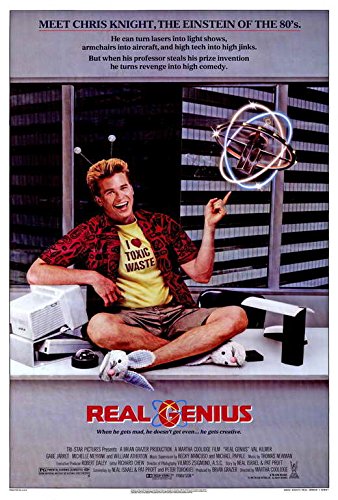
The movie involves the saga of Mitch (Gabe Jarret), a brilliant high school student whose Science Fair project has revised the theory of laser beam technology. He is personally recruited by Professor Hathaway (William Atherton), a famous physics professor who wants the kid to work in his personal laboratory. Once on campus, the kid meets the legendary Chris Knight (Val Kilmer), the most brilliant freshman in history who is now a junior whose mind is beginning to be cluttered by mischief. The two students room together, and there seems to be a third person in the room: a strange, wraith-like bearded figure who disappears into the clothes closet, and doesn’t seem to be there when the door is flung open.

The professor is running a scam. He has a Defense Department contract for a sophisticated laser device so accurate that it could incinerate a single man on Earth from a base in orbit. The professor is using his students as slave labor to do most of the work on the project, while ripping off the government grant to build himself a new house. The students, meanwhile, have no idea they’re working on a weapons system, and are more interested in using laser beams to lead everyone to a “Tanning Invitational” they’ve set up by turning a lecture hall into a swimming pool.

“Real Genius” allows every one of its characters the freedom to be complicated and quirky and individual. That’s especially true of Jordan (Michelle Meyrink), a hyperactive woman student who talks all the time and never sleeps and knits things without even thinking about it, and follows Mitch into the john because she’s so busy explaining something that she doesn’t even notice what he’s doing. I recognize students like this from my own undergraduate days. One of the most familiar types on campus (and one of the rarest in the movies) is the self-styled eccentric, who develops a complex of weird personality traits as a way of clearing space and defining himself.

“Real Genius” was directed by Martha Coolidge, who made “Valley Girl,” one of the best and most perceptive recent teenage movies. What I like best about her is that she gives her characters the freedom to be themselves. They don’t have to be John Belushi clones, or fraternity jocks, or dumb coeds. They can flourish in all of their infinite variety, as young people with a world of possibilities and a lot of strange, beautiful notions. “Real Genius” contains many pleasures, but one of the best is its conviction that the American campus contains life as we know it.

Saturday Matinee: Everything Everywhere All at Once

“Everything Everywhere All at Once” Review — Don’t Forget To Breathe

By Sergiu Inizian

Source: Medium

In 2016, Daniel Scheinert and Daniel Kwan (known collectively as Daniels) premiered their feature debut at the Sundance Film Festival. Swiss Army Man stunned audiences with a bizarre premise and is still one of the oddest films to come out of the prestigious festival.

It is a movie in which the emotional weight gets swallowed by a nevertheless entertaining childish cinematic approach. But it’s also a test run for Everything Everywhere All at Once, a whirlwind of a movie that brings so much more to the screen than downright weirdness.

The Daniels tell the story of Evelyn (Michelle Yeoh), a Chinese-American woman who runs a laundromat with her easy-going husband, Waymond (Ke Huy Quan). She is discouraged by life, has marital problems, and is unable to communicate with her daughter, Joy (Stephanie Hsu). On top of it all, she is at a loss when trying to challenge her father (James Hong) about past trauma or present issues.

Yeoh infuses so much dignity into Evelyn, a struggling mother who quietly looks for answers to her personal problems while trying to put the family business in order. Her two priorities are organizing a Chinese New Year party and successfully dealing with an IRS audit.

But, in the IRS building, a wholly changed Waymond introduces her to the Multiverse, a collection of realities that hosts endless versions of Evelyn. This is revealed to her because she is the one powerful enough to combat an entity that desires to destroy the fabric of reality.

What ensues next is a kaleidoscopic montage of possibility that showcases the protagonist’s alternate lives with gripping vigor. This interdimensional music video entertains through dynamic genre mashups, marvelous colors, and an eclectic Son Lux soundtrack. The directors decorate their psychedelic narrative with an abundance of references that range from arthouse drama to “Avengers-style” heroics and to completely silly antics.

At the center of the polychromatic experience, Evelyn is tasked to make sense of it all. Michelle Yeoh is fearless in her multifaceted role, bringing nuance and honesty to a captivating madhouse of a film. Within the Multiverse, Yeoh’s wide-open eyes pierce through all the outlandish embroidery and stand as the film’s brightest marvels.

Underneath the sci-fi-infused cinematic experience, the Daniels reveal an attentive treatment of sorrow, generational conflict, and reconciliation. The portrayal of familial disconnect especially absorbed me: Evelyn is both a mother and daughter and yet she finds herself in the middle of a discord that spans three generations. In Everything Everywhere All at Once, the fractures of reality pale in comparison to the emotional ruptures that define Evelyn’s family.

While the visual experience of the massive Multiverse can be overwhelming at times, the directors know when to hit the pause button and insert quiet moments, allowing the characters to shine. Ke Huy Quan steals the show in these scenes, especially in the universe in which Evelyn is a famous actress. He brings so much authenticity to the kind, hopeful Waymond and his presence is a fitting companion to Yeoh’s mesmerizing performance.

In Everything Everywhere All at Once, the Daniels create so many layers for the seemingly mundane story of Evelyn. It’s a breathtaking journey that deals with life’s “what-ifs” and entertains through sheer ambition. It also embraces a charming message which showcases the wonder of cinema and the craft of the quirky directorial pair: regardless of how seemingly ordinary a destiny is, it always involves plenty of fantasy, mystery, and hope.

____________________

Watch Everything Everywhere All at Once on Hoopla here: https://www.hoopladigital.com/movie/everything-everywhere-all-at-once-michelle-yeoh/16497128

Saturday Matinee: Greener Grass

By Sheila O’Malley

Source: RogerEbert.com

There’s a scene in “Greener Grass,” written and directed by Jocelyn DeBoer and Dawn Luebbe (who also co-star), where four families in golf carts sit at a four-way intersection. Everyone gestures at everybody else: “You go,” “Oh, no, you go, I insist…” And so they sit at the intersection forever, smiles frozen on their faces, in a standoff of psychotic politeness. If you’re at a four-way intersection, someone has to go first, someone has to allow themselves to be waved on through. In “Greener Grass,” nobody dares.

DeBoer and Luebbe have created a psychotic suburban world where surface conformity is all, where everyone strives to look and be the same. The smiling faces perch on top of roiling emotions, not even necessarily anti-social emotions, just regular ones, like need, loss, pain. “Keeping up with the Joneses” is pushed to its most surreal extreme. Everyone in the town has braces. Everyone dresses the same, in pinks and light blues and light purples. Everyone drives golf carts. It’s like they live in a mini village placed on a country club golf course somewhere. 

The golf cart scene is an excellent example of what “Greener Grass” is attacking, and it’s a sharp and subversive critique: it would be great to live in a more civil world, but too much civility leads to golf carts stalled at a four-way intersection. In another scene, when two meals end up on the ground after a collision between two waiters, the patrons hasten to eat the food off the floor. To say, “Please bring me another meal” would just not be done. Every single interaction in “Greener Grass” is “competitive,” but it’s competition tamped down by friendly beaming smiles. These people live in an agony of one-upmanship.

“Greener Grass” starts out strong and strange in the first scene. Lisa (Luebbe) and Jill (DeBoer) sit in a group of parents on a blazing sunny day, watching their kids play soccer. Both women are immaculately dressed and made up, braces on their teeth. Jill holds a newborn baby and Lisa compliments the baby on being “cute.” Jill immediately hands the baby over to Lisa. Nobody seems to find this strange, not even Jill’s husband (Beck Bennett). Lisa wanted the baby, and so it’s polite to hand it over, it would be selfish to hang onto it. Later on, a neighbor (Mary Holland) expresses resentment that Jill didn’t give the baby to her. Jill clearly has mixed feelings about what she has done, and yet “mixed feelings” are not allowed in the world of “Greener Grass.” Jill’s remaining son (Julian Hilliard) is a handful, a bedwetter and a perceptive observer. His surprising transformation is matched by Jill’s total personality-disintegration.

Both DeBoer and Luebbe have performed with the improv comedy troupe Upright Citizens Brigade for over a decade. They bring that experience to their creation of this alternate universe, an unholy mix of “Blue Velvet,” “Invasion of the Body Snatchers,” and “The Stepford Wives.” The characters in “Greener Grass” watch a lot of television and DeBoer and Luebbe have a lot of fun creating these alternate-history shows, fake commercials, fake reality shows and soap operas. “Greener Grass” displays its sketch comedy origins, and sometimes the “bits” stand out as not fitting altogether properly, maybe not as fleshed out as they should be. This is a very unsettling film, with a color palette that manages to be blazing-vivid and dreary-muted at the same time, as though it’s all a regurgitated idea of an already-regurgitated idea. (That idea of regurgitation is made explicit in one of the fake television commercials.)

There are very funny details throughout. Pay close attention to the production design. The houses all look like toy houses, with interchangeable decor. People are just “playing house,” they don’t actually live there. In the grocery store, a sign is placed in a prominent position: “Not responsible for stolen lives.” In one surreal moment, Jill and Lisa make out with each others’ husbands, not even realizing their mistake. “Greener Grass” feels a little bit like a comedy sketch drawn out past its capabilities, but the film’s target is always clear.

Like all good satires, “Greener Grass” trucks in exaggeration. Anyone “getting ahead” of anyone else is looked on with suspicion. Personal relationships have a generic quality because if you say you’re “best friends” with someone, someone else might feel left out. Being “unselfish” can be a competition, especially when done performatively. In the leveling world of “Greener Grass,” “standing out” is terrifying. It’s Tall Poppy Syndrome on amphetamines. Even as Jill deteriorates, there’s no sense here of a possible escape to another place where things are different. In “Greener Grass,” Sylvia Plath’s suffocating “bell jar” covers the whole world.