The Fed Has Triggered A Stagflationary Disaster That Will Hit Hard This Year

By Brandon Smith

Source: Alt-Market.US

I don’t think I can overstate the danger that the U.S. economy is in right now as we enter 2022. While most people are caught up in the ongoing drama of Covid-19, a REAL threat looms over the nation in the form of a stagflationary tidal wave. The mainstream media is attempting to place the blame on “supply chain disruptions,” but this is a misrepresentation of the issue.

The two factors are indeed intertwined, but the reality is that inflation is the cause of supply chain disruptions, not the result of supply chain disruptions. If we look at the underlying stats for price rises in essential products we can get a clearer picture.

Before I get into my argument, I really want to stress that this is a precarious time and I suggest that people prepare accordingly. In just the past few months I have seen personal expenses rise at least 20% overall, and I’m sure it’s the same or worse for most of you. Stocking necessities and safe-haven investments with intrinsic value like physical precious metals are a good choice for protecting whatever buying power your dollars have left…

Higher prices everywhere

The Consumer Price Index (CPI) is officially at the highest levels in 40 years. CPI measurements often diminish the scale of the problem because they do not include things like food, energy and housing which are core expenses for the public. CPI calculations have also been “adjusted” over the past few decades by the government to express a more positive view on inflation. If we look at the inflation numbers at Shadowstats, calculated according to the same methods they used in the 1980’s, we see a dramatic increase in CPI which paints a more dire (but more accurate) picture.

U.S. food prices have spiked to levels not seen since 2008 at the onset of the credit and derivatives collapse that brought about tens of trillions of dollars in Federal Reserve bailouts.

If we look beyond the 2008 crisis, food costs do not see a similar jump until the 1980s. Rising food prices in the US are often obscured by creative accounting and “shrinkflation” (shrinking packages and rising prices), but if we look at global food prices the average is a 30% jump in the past year.

Rental and home prices have also gone into the stratosphere. Rental costs went up around 18% in 2021, and this is an extension of a trend that has been prevalent for the past decade. Prices have been rising for a while, it’s just that now the avalanche has accelerated.

Home prices are currently out of the range of most new potential home buyers. Values jumped 16% in the past year alone, with the average property costing $408,000. Home sales continue to remain elevated compared to two years ago despite inflating prices for one reason and one reason only – the mass migration of Americans away from the draconian mandates and bureaucracy of blue states into more conservative states.

I live in Montana, a primary destination for people relocating, and from my experience the majority of these people are conservatives seeking to escape the vaccine and lockdown mandates in places like California, New York and Illinois. They see the writing on the wall and they are trying to get ahead of the economic and social calamity that will surely befall such states.

I would also note that home sales have finally begun to flatten in the past six months but prices are not dropping, which is a trend that I think needs to be explored further because it illustrates the larger issue of stagflation.

When inflation becomes stagflation

Understand that prices are not just rising because of increased demand (demand is starting to fall in many sectors), prices are rising because of increased money supply and dollar devaluation which is not yet being reflected in the Dollar Index.

Take a look at U.S. GDP and you will see that for the past several years it has tracked in tandem with price inflation. Obviously, if prices inflate then this means people are spending more, which then leads to higher U.S. GDP; it’s like magic, right? In other words, inflation makes it seem as though U.S. GDP is always improving.

However, this has not been the case in the past couple of years.

Official GDP has flattened despite the fact that U.S. money supply and inflation have rocketed higher. What does this mean? I believe it is a sign of stagflation and a reckoning in 2022. If we examine inflation adjusted GDP numbers from Shadowstats we see that GDP has declined rather aggressively in the past couple of years.

We can also see odd tendencies in oil and gasoline prices. While it’s true that gas prices have been higher in the past, this does not address the full context of the situation. U.S. travel spending has declined 12% since 2019 and airline travel has dropped at least 21% in the past year. Average gasoline usage dropped after 2019 and still has not recovered. Yet, gas prices continue to rise? In other words, travel demand is stagnant but prices are INCREASING – this is another signal of inflationary pressures and dollar devaluation. Oil is priced in dollars globally, and therefore any inflation in the dollar will be readily visible in oil. This would help explain why pandemic paranoia and reduced travel have not caused gas prices to drop.

If the current momentum continues the majority of necessities in the U.S. will not be affordable for most people by next year. We are looking at a fast-moving decline in production along with a swift explosion in prices. In other words, a stagflationary disaster.

This is the Federal Reserve’s fault

I and many other alternative economists have been warning about the inevitable inflation/stagflation crisis for years, but the most important factor to understand is WHO is responsible this event?

The mainstream financial media is going to protect the government and the Federal Reserve at all costs during this breakdown. They are going to blame Covid, the lockdowns here and overseas as well as the supply chain bottleneck.

The Fed is the true culprit, though.

While there have been many American Presidents and other politicians that have supported the Fed in its inflationary activities, the central bank itself needs to be held accountable for the downturn that is about to occur. This is a process that started back at the founding of the Fed, but spread like cancer after the crash of 2008 and the introduction of 12+ years of stimulus and bailout measures along with near-zero interest rates.

The inflationary end-game

The pandemic is the perfect cover for the inflationary end game. In 2008 the response to the crisis was to print and pump dollars into banks and corporations in the U.S. and around the globe. This money supply was held in corporate coffers and in central banks overseas, which slowed the effects of inflation. This set the precedent for subversive stimulus policies by giving the Fed a blank check to do whatever it wanted.

In 2020, the Fed created trillions more but this time the money was injected directly into the U.S. economy through Covid stimulus checks, PPP loans and other measures. In the alternative economic field we call this “helicopter money.” These dollars triggered a massive retail buying spree in 2020, but with more dollars in the economy chasing less goods prices are now spiking much higher.

The big discussion today is whether or not the Fed will taper their asset purchases, reduce their balance sheet and raise interest rates to counter inflation?

The fact is it won’t matter; inflation/stagflation will continue or even accelerate as the Fed tapers. With a taper comes the threat of a flattening yield curve in Treasury bonds as well as the danger of bonds and dollars being dumped by foreign investors and central banks. If the trillions upon trillions of dollars being held overseas come flooding back into the U.S., inflation will continue at its current pace or erupt even higher. In fact, the world’s ownership of dollars reached a 26-year low recently. The global transition away from the dollar, toward inflation-resistant investments, has already begun.

This is not a policy error

I explained this Catch-22 threat in my recent article The Fed’s Catch-22 Taper Is a Weapon, Not a Policy Error. In that essay I outline the Fed’s documented history of creating economic disasters that conveniently end up benefiting their friends in the international banks.

I also explained (with evidence) how the Federal Reserve actually takes its marching orders from the Bank for International Settlements, a globalist institution which along with the International Monetary Fund and World Economic Forum is openly seeking a one-world economic system and one-world currency system.

I do not believe that the Fed’s actions are a product of ignorance or stupidity or basic greed. I do not believe the Fed is scrambling to keep the U.S. economy afloat. I believe according to the evidence that the Fed knows exactly what it is doing. The pandemic offers a perfect scapegoat for an engineered crash of the U.S. economy which the Fed is trying to facilitate.

Why? Because the more desperate people are financially, the easier they are to buy off with false promises and a loaf of bread. They are easier to control. On top of that, with the U.S. economy reduced to second- or third-world status, it is easier to sell the public on the predetermined solution – total global centralization and far less freedom.

As the stagflationary crash plays out, never forget who was really the cause of the public’s suffering. In the fog of national crisis it is easy for the establishment to shift blame and responsibility and to cloud the truth. The inflation calamity is about to get much worse, and as it does we need to rally newly awakened people to take action against the central bankers and globalists behind it.

Another Housing Crisis in America Is Coming

By Tim Kirby

Source: Covert Geopolitics

There is now an unprecedented spike in housing costs while COVID-19 has driven down the wealth of the average American.

Let’s begin our discussion of the next Housing Crisis with a relevant personal anecdote, that is a microcosm of what is happening all over the United States right now.

Some of my relatives made the wise decision to live within their means and build a smaller (by American standards) house in the early 2000s. They live in the Midwest which means there is generally plenty of space for a big house even within city limits. Mortgages and loans were super easy to get for even fantastically large sums of money at that time. So my kin were definitely in the minority in terms of choosing something smaller and affordable rather than a giant debt pit with a huge kitchen. In a region of America known for having a shockingly low average income of $20,000-$30,000 per year in the 2020s, the banks two decades ago were just throwing $300,000 worth of credit for McMansions to all-comers with seemingly little discretion.

When the 2008 Financial Crisis hit it was the McMansions that got seized first and foremost, whereas my relatives got through it relatively unscathed. It looks like across America some 10,000,000 homes were lost (or perhaps it would be better to say “transferred” to the banks) due to this crisis. Again, because of choosing to have low square footage my family members did just fine with their more reasonable payments, however something recently happened that should sound some alarm bells that a second crisis is nigh.

Image: It costs over a quarter of a million dollars to live in a relatively small stick-frame house in the absolutely most dangerous neighborhood in a city with no significant employment opportunities. Something is not right here.

My relatives were given an offer from a neighbor to buy their home at its value (the last time it was appraised before the Covid Pandemic) plus more than $100,000 on top of that. The explanation was that the offering party wanted to have their son or daughter move closer to them and they were willing to pay big bucks for any house on that particular street. My family members thought they had won the lottery. They ecstatically looked for smaller homes to buy, so they could sell theirs, pay off their current mortgage early and keep a hefty percentage of this seemingly massive overpayment living the rest of their lives debt free.

But to their surprise, besides double-wide trailers they couldn’t find anything to buy. Now even the price of a home, smaller than their already modest home, in the impoverished Rust Belt, now sells for the prices that the McMansions demanded before the 2008 Crisis. To be clear, a house at Pre-Covid value + $100,000 in that region, now cannot even buy a sanitary home that is one half its size.

Again, for foreign readers, the house in question is not a piece of real estate in Silicon Valley or Manhattan where insane sounding prices could be justified by elite salaries and the presence of successful entrepreneurs. No, this is in the part of America where making $15 an hour to sling pizzas is considered a “good” job, but this price hike is not isolated to my state of birth, this madness is happening across all of America, just take a look at the graph below.

It does not take an elite degree in economics to see that there is now an unprecedented spike in housing costs while at the same time, paradoxically, COVID-19 has driven down the wealth of the average American. It is true that building materials have become artificially expensive and that would reflect on housing prices, but in a nation that has so many homes, including abandoned ones, it is hard to believe that America is in a desperate shortage of housing, furiously building to catch up like the Soviets after WWII, who had all their villages bombed into the dirt by the Germans.

Panic is driving housing prices up in a few different ways. Americans are flipping out because of the supposed…

  • Lack of building materials, which means there must be a housing “shortage” because construction is mostly off the table, so they must buy now or be left outdoors.
  • Prices, that are just going to keep going up so they must buy now before the affordability train leaves the station forever.
  • “Historically low mortgage rates”, which are probably the most dangerous aspect of this situation that will turn it into the next economic fiasco.

One of the key reasons that the 2008 Financial Crisis happened was because of the low interest rates on mortgages and inflated values of homes in connection with a lack of regulation over the financial world as a whole – and these exact same things are happening again right now in front of our faces. Just look at these interest rates.

It is not hyperbolic to say that they are “historically low”, because they are. The only difference is that in the past people were suckered into a McMansion while making $20,000 a year, now they will be suckered into a tiny house, trailer or grungy hellhole for the same price, that they will probably end up losing anyways when the crisis hits. Ranch-style homes in Texas far from major cities are starting to reach the $600,000-$700,000 mark which is simply unsustainable unless there are vastly more cattle and oil tycoons down there than we are aware of.

It simply does not require a genius financial mind or the word “Harvard” on your resume to see where this is going. We are again heading towards a housing crisis, only this time the bar is lower as the average American is getting less house and is paying more for it. Of course, the banks will “win” because whenever homes are lost they do not vanish out of existence, but get transferred to them the real lords of the realm so this won’t be bad for everyone, just almost everyone. The normies are doomed.

In a political context this repeating madness seems only to underline my belief that the arguments for small government are correct, but the problem is when government is both small and weak. This situation would not happen if those we elect were completely in charge of how America works systemically as a reflection of the will of the masses. The power that banks have may at times be overexaggerated by the conspiratorial types, but as we can see the nation is again being pushed down the wrong path and no one can stop it, meaning the benefactors of the coming crisis, the bankers, must have vastly more influence and power over Washington than anyone else, who would not benefit from this housing catastrophe.

America’s Bottom 50% Have Nowhere To Go But Down

By Charles Hugh Smith

Source: Of Two Minds

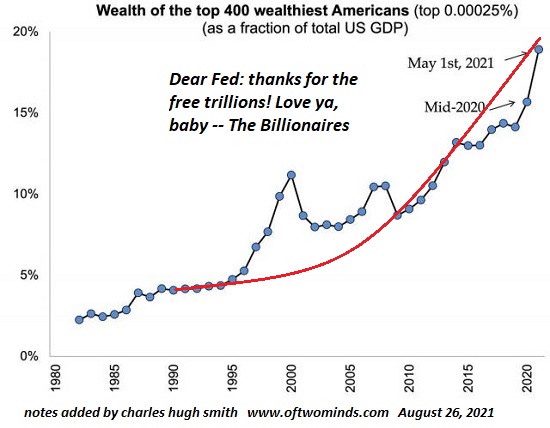
One might anticipate that the bottom 50%’s meager share of the nation’s exploding wealth would have increased as smartly as the wealth of the billionaires, but alas, no.

America’s economy has changed in ways few of the winners seem to notice, as they’re too busy cheerleading their own brilliance and success. In the view of the winners, who just so happen to occupy all the seats at the media-punditry-Federal Reserve, etc. table–the rising tide of stock, bond and real estate bubbles are raising all boats. What’s left unsaid is except for the 50% of boats with gaping holes below the waterline, i.e. stagnant wages and a fast-rising cost of living.

The truth the self-satisfied winners don’t include in their self-congratulatory rah-rah is there’s no place for the bottom 50% of American households to go but down. All the winnings flow to those who already owned assets back when they were affordable– the already-wealthy–whose wealth has soared as assets have shot to the moon while the the burdens of inflation and debt service hit the bottom 50% the hardest.

Meanwhile, the Federal Reserve is whining that inflation isn’t high enough yet for their refined tastes. Boo-hoo, how sad for the Fed–inflation isn’t yet high enough. Oh wait–didn’t they each mint millions by front-running their own policies? No wonder they’re not worried about inflation.

The reality few acknowledge is that globalization and financialization have stripped the American economy of low-skilled jobs that don’t demand much of the employee. The reality is that a great many people don’t have what it takes to learn high-level skills and work at a demanding pace under constant pressure–the description of the average job in America.

There were once millions of low-skill, low-pay jobs for people who for whatever mix of reasons were unable to muster the wherewithal to fulfill the fantasy of working extra hard, going to night school, soaking up high-level skills, moving quickly up the ladder to higher pay, buying the starter home and then moving up the food chain to middle class security from there.

The cost of living was low enough that those working these low-skill, low-pay jobs could still have an independent life. There were still low-cost rentals, often derided by the wealthy, in nooks and crannies of even the costliest cities. (I once lived in a room stuffed with old tax records in a poolside shack in an upscale neighborhood. The room had been cleared for a single bed and a path to the decrepit bathroom. Its most important attribute was that I could afford it on my low earnings.)

Affordable housing has vanished, eliminated by the financialization of America’s economy. Once landlords pay double the price for the property, rents have to double to pay their higher expenses. The apartment didn’t double in size or amenities–the rent doubled without any increase in utility to the renter. You get nothing more for double the price–nice.

Yes, people could make better choices, and some do. The point here is the game is rigged against those in the lower tier of the economy who can no longer afford a house or other stake in the only winning game in town–speculative asset bubbles. Go ahead and work a second job and go to night school–you’ll still be left behind the already-rich.

Globalization opened every job in America to global competition via offshoring or the influx of undocumented workers so desperate to support their families back home that no pay was too low and no working condition too wretched to refuse.

Many overindulged pundits who never worked an honest day in their lives sneer about burger flippers without realizing how hard those burger flippers have to work. I doubt the well-dressed pundits, snobbish about their university degrees and general brilliance, could manage to work a single day in a demanding fast-food job.

As the price of housing and other assets have soared, enriching the already rich, they’re out of reach for the bottom 50% who struggle to pay their bills as wages have stagnated and the costs of essentials have skyrocketed.

The rising cost of parking tickets, junk fees, user fees, utilities and food don’t impact the well-paid top 5% technocrat class, whose stake in the Everything Bubble keeps expanding by tens or hundreds of thousands of dollars. But for the bottom 50%, those incremental increases are, when added to higher rents, absolutely crushing.

As for getting high-quality healthcare that includes mental health support–those are reserved for the rich. But no worries, self-medication is always a “choice.”

Getting a boost in pay from $12 an hour to $15 an hour is welcome, but that doesn’t put the worker any closer to affording a house or equivalent stake in the Everything Bubble.

The new feudalism is masked by the glossy SillyCon Valley PR of a gig economy where (per the PR fantasy) bright, shiny and totally independent workers freely choose to serve the winners in the rigged sweepstakes for low pay and zero benefits.

In the SillyCon Valley PR, serfs freely choose to serve their noble masters for nothing but survival because they love the “freedom” and “choice” of kissing the nobility’s plump derrieres. (After all, there were “choices” even back in the good old days of feudalism–one could join the brigands in the forest, or enlist in a poorly paid mercenary army where the odds of dying were high–you know, “choices” of “gigs.”)

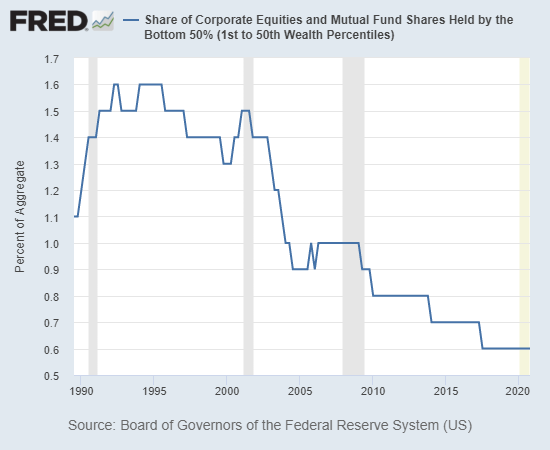
One might anticipate that the bottom 50%’s meager share of the nation’s exploding wealth would have increased as smartly as the wealth of the billionaires, but alas, no–the bottom 50%’s share of stocks (equities) actually plummeted in the the glorious decades of Federal Reserve free money for financiers, stock buy-backs and asset bubbles.

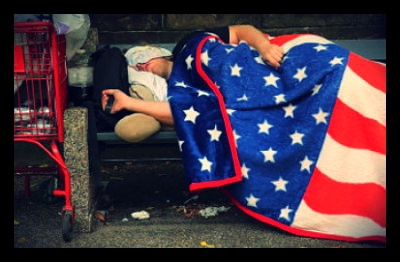
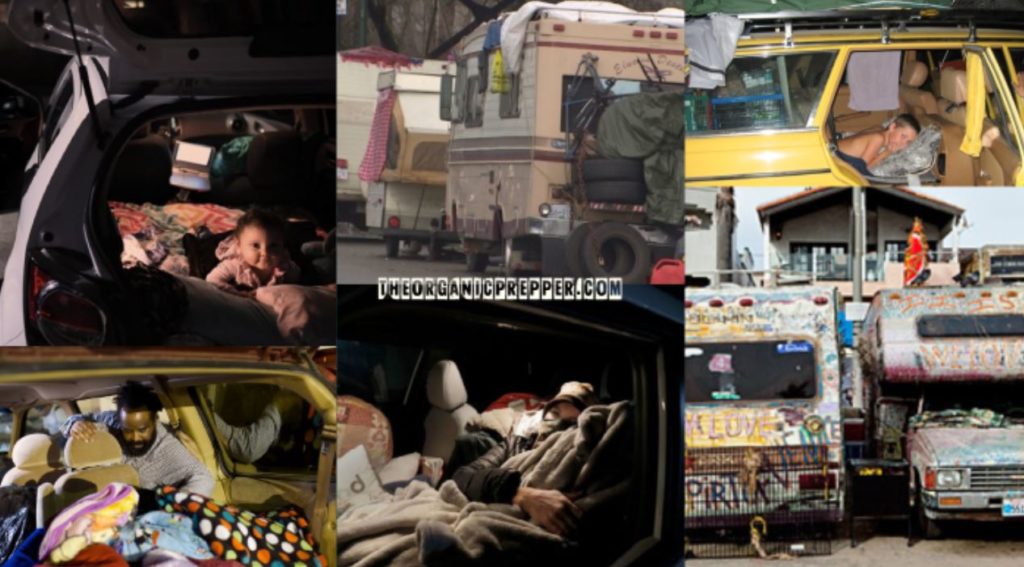
All this suits the billionaires and those collecting the crumbs of the Everything Bubble just fine. So what if the bottom 50% have nowhere to go but down? There’s plenty of room in the homeless encampment for another broken down station wagon or an old camper. There’s lots of “choices.”

And no consequences for the winners, of course, because The Fed has our backs.

What’s REALLY behind the war on home ownership?

Becoming a “Nation of Renters” is clearly a big part of the New Normal.

By Kit Knightly

Source: Off-Guardian

The incipient “Great Reset” is a multi-faceted beast. We talk a lot about vaccine passports and lockdowns and the Covid-realated aspects – and we should – but there’s more to it than that.

Remember, they want you to “own nothing and be happy”. And right at the top of the list of things you definitely shouldn’t own, is your own home.

The headlines about this have been steady for the last few years, but it has picked up pace in the wake of the “pandemic” (as has so much else). An agenda hidden on back pages, behind by Covid’s meaningless big red numbers, but perhaps no less sinister.

You can find articles all over the net talking up renting over owning.

Last month, for example, Bloomberg ran an article headlined:

America Should Become a Nation of Renters”

Which praises what they call “the liquefaction of the housing market” and gleefully expounds on the idea that “The very features that made home buying an affordable and stable investment are coming to an end.”

The Atlantic published “Why Its Better To Rent Than Own” in March.

Financial pages from Business Insider to Forbes to Yahoo and Bloomberg again are filled with lists titled “9 Ways Renting is Better Than Buying”or similar.

Other publications go more personal with it, with anecdotal columns about ignoring financial advice and refusing to buy your home. Vox, never one to sell their agenda with any kind of subtlety, have a piece titled:

Homeownership can bring out the worst in you

Which literally argues that buying a house can make you a bad person:

It’s the biggest thing you might ever buy. And it could be turning you into a bad person.

So what exactly is the narrative here? What’s the story behind the story?

The short answer is fairly simple: It’s about greed, and it’s about control.

It almost always is, in the end.

The longer answer is rather more complicated. Major investment firms such as Vanguard and Blackrock, along with rental companies such as American Homes 4 Rent, are buying up single-family homes in record numbers – sometimes entire neighbourhoods at a time.

They pay well over market value, pricing families who want to own those homes out of the market, which forces the housing market up whilst the Lockdown-created recession is lowering wages and creating millions of newly unemployed.

Of course, this is motivating people to sell the houses they already own.

People all across America have been saddled with houses worth less than they bought them for since the 2008 economic crash, and are eager to take the cash from private investment firms paying 10-20% over market value. Combine an economic recession with a created housing boom and you have a huge population of motivated sellers.

Of course, many of these sellers don’t realise, until it’s too late, that even if they attempt to downsize or move to a cheaper area, they may be priced out of the market completely, and forced to rent.

As such, in the last year, the private investment share of single-family home purchases is estimated to have increased ten-fold, going from 2% in 2018 to over 20% this year.

As more and more people are forced to rent, of course, rental properties will be in higher and higher demand. This in turn will drive the cost of renting up.

Market Watch has already reported that, in the last year, rent has increased over 3x faster than the government predicted.

This problem is likely to get worse in the near future.

Last night [7/30/21], Congress “accidentally failed” to extend the Covid-related eviction ban.

Which means, this weekend, while Senators adjourn to the summer homes they probably don’t rent, the ban will officially end and a lot of people are likely to have their houses foreclosed or their landlords kick them out.

The newly empty buildings will be a feeding frenzy for the massive corporate landlords. Who will descend on the banks like starving hyenas to snap up the foreclosed properties for pennies on the dollar. Just like they did in 2008.

None of this is any secret, it’s been covered in the mainstream. Tucker Carlson even did a segment on it in early June.

The Wall Street Journal headlined, back in April, “If You Sell a House These Days, the Buyer Might Be a Pension Fund”, and reported:

Yield-chasing investors are snapping up single-family homes, competing with ordinary Americans and driving up prices

However, since then, something has clearly changed. The propaganda machine has kicked into gear to defend Wall Street from any backlash.

No better example of this shift can be found than The Atlantic, which ran this story in 2019:

WHEN WALL STREET IS YOUR LANDLORD
With help from the federal government, institutional investors became major players in the rental market. They promised to return profits to their investors and convenience to their tenants. Investors are happy. Tenants are not.

…and this story last month:

BLACKROCK IS NOT RUINING THE US HOUSING MARKET
The real villain isn’t a faceless Wall Street Goliath; it’s your neighbors and local governments stopping the construction of new units.

Going back to the Vox well we have:

Wall Street isn’t to blame for the chaotic housing market

Which ran just a few days after the Atlantic article, and is practically identical.

Both these (oddly similar) articles argue that Wall Street and private equity firms can’t be blamed for buying up houses, and that the real problem is the lack of supply to meet demand.

You see, all the “selfish” people who already own homes (they did say it makes you a bad person) are blocking the construction of new houses, and thus driving up the cost of property through scarcity.

This has been a logically flawed argument around the housing market for decades.

That there aren’t enough houses for people to buy is patently absurd when the US census data says that there are over 15 million houses currently standing empty. That’s enough to house all of America’s roughly 500,000 homeless people 30x over.

There’s plenty of houses, there’s just not enough money to buy them.

The reason for that is the same reason the California has massive “homeless camps” in its major cities, and that so many people are having to become renters instead of owners: wage stagnation.

For decades now, wage increases have lagged behind increases in the cost of living. In the 1960s one full-time job could afford a decent standard of living for a family of four or more. These days both parents work, sometimes multiple jobs each.

It was huge amounts of financial de-regulation which created this situation. So, whether you believe Vox’s BlackRock apologia or not, one way or another Wall Street very definitely is to blame.

But this isn’t just about money. It never is. Just as the war on cash isn’t just about efficiency, and the environmental push isn’t just about climate change. Ditto veganism. It’s about control. Just like vaccines, lockdowns and masks.

It always comes down to control.

It’s an oft-used cliche, but no less true for that, that homeowning “gives people a stake in society”. A family-owned house is a source of security for the future and something to leave your children. It is also sovereignty and privacy. Your own space that no one else can control or take away.

In short: A homeowner is independent. A renter is not. A renter can be controlled. A homeowner can not.

It’s the same reasoning behind the way working people were encouraged to take out loans and become debt slaves. If you limit people’s options, if you make them rely on you for a roof over their heads, you have control over them.

There’s a great article about this situation called “Your New Feudal Overlords”.

Under Feudalism, land wasn’t owned by the working class, but provided to them by landed barons, hence the term “Land Lord”. If you disrespected your Lord, or broke his rules, or he perceived another peasant/farm animal/crop would be a better use of the land, he could take it back.

Essentially, the behaviour of serfs was kept in check by their reliance on the nobility for a place to live. That’s very much the dynamic they’re going for here.

Rental agreements can be full of any terms and conditions the landlord wants, and the more desperate people get the more of their consumer rights they will sign over.

Maybe you’ll agree to smart meters which monitor your internet or power-usage habits, and then sell the data to behavioural modellers and viral marketers.

Maybe you’ll have to agree to certain power limitations or water shortages in order to “fight climate change”.

Maybe it will get worse than that.

Maybe they’ll go full Black Mirror style corporate dystopia. Maybe, through affiliation programs, the mega-equity firm which owns your rental house has ties to McDonald’s, and as such will require you to not eat at any competing fast-food franchises, or demand you observe at least ninety seconds of Disney advertisements per day.

Maybe it will be as simple as including vaccine status in the tenancy agreement, making it impossible for the unvaxxed to find a home.

Maybe they just want to make poor people miserable.

After all, the super-wealthy have got all the money they could ever need, and all the luxury they could ever use. Their living standards are as high as physically possible. So maybe the only way they can keep “winning”, is to start driving the living standards of us proles down.

No air travel. No vacations. No going out at all. Live in a tiny house, or a pod. Eat bugs. Get rid of your car. Rent your clothes. Or your furniture. Pay taxes on sugar. And alcohol. And red meat.

They’ve been very clear about this. They’ve told you about the Great Reset and the Internet of Things. That’s the plan.

You won’t own a house. And you’ll be happy…or else the mega-corporation you’re forced to rent from will kick you out.

Is Inflation “Transitory”? Here’s Your Simple Test

By Charles Hugh Smith

Source: Of Two Minds

Is inflation “transitory” in your household budget? Really? Where?

The Federal Reserve has been bleating that inflation is “transitory”–but what about the real world that we live in, as opposed to the abstract funhouse of rigged statistics? Here’s a simple test to help you decide if inflation is “transitory” in the real world.

Let’s start with some simple stipulations: price is price, there are no tricks like hedonics or substitution. Nobody cares if the truck stereo is better than it was 40 years ago, the price of the truck is the price we pay today, and that’s all that matters.

(Funny, the funhouse statistical adjustments never consider that appliances that used to last 30 years now break down and are junked after 3 years–if we adjusted for that, the $500 washer would be tagged at $5,000 today because it has lost 90% of its durability over the past 30 years.)

Second, inflation must be weighted to “big ticket” nondiscretionary items. The funhouse statistical trickery counts a $10 drop in the price of a TV (which you buy every few years at best) as equal to a $100 rise in childcare, which you pay monthly. No, no, no: a 10% rise in rent, healthcare insurance and childcare is $400 a month or roughly $5,000 a year. A 10% decline in a TV you buy every three years is $50. Even a 50% drop in the price of a TV ($250) is $83 per year–absolutely trivial, absolutely meaningless compared to $5,000 in higher big-ticket expenses.

You can forego the new TV but not the rent, childcare or healthcare. That’s the difference between “big ticket” nondiscretionary and discretionary (meals out, 3rd TV, etc.).

Third, we jettison the painfully obvious manipulation of “owners equivalent rent” for housing costs. Housing costs are the prices we pay for rent, owning a home and paying property taxes, insurance and maintenance costs to own the home. (Have you priced having a new roof put on your house by a licensed, reputable contractor? No? Well, it’s become a lot more expensive than it was a few years ago. Where is that enormous price leap in “owners equivalent rent”? Just how stupid does the Fed reckon we are?)

OK, here’s the test: let’s say markets finally take a deflationary dive from overvalued heights. Housing, stocks and other risk assets fall 30%. Trillions of dollars in “wealth” (that didn’t exist prior to the Everything Bubble inflating) has vanished, generating a reverse wealth effect as all the owners of these assets feel poorer and less inclined to borrow and spend. This is classically considered highly deflationary: demand drops, prices drop.

The three billionaires who own more assets than the bottom 50% of Americans (165 million Americans) will be crying, but how does life change for the 165 million Americans who own a vanishingly thin slice of these assets? Does their rent drop? No, for the reasons I explained in The Fed Is Wrong: Inflation Is Sticky: the big corporate landlords have to keep rents high to placate their lenders. (And let’s not forget greed: the greedy never want to lower prices, preferring to cling to the Fed’s fantasy of “transitory” trouble.)

Now let’s ask about the higher-income 150 million Americans who own homes and pay property taxes, who pay healthcare insurance, college tuition and fees, childcare and elderly care. Even if there is a deflationary crash in stocks and housing, what are the odds the overall costs of owning and maintaining your home will drop significantly?

What are the odds that local government will let property taxes drop with valuations? Shall we be honest and say zero? If real estate valuations plummet, then property tax rates will rise to compensate. Or other “creative” fees will be imposed to make up the shortfall in tax revenues.

What about childcare? What are the odds that childcare costs will drop 30%? Shall we be honest and say zero? The costs paid by childcare providers only go up, and so those who don’t charge enough (marginal providers) will close down, generating a shortage of supply that elevates prices.

What about elderly care? Will assisted living facilities suddenly drop 30% just because asset bubbles pop? No. The costs of assisted living march higher regardless of what asset valuations and interest rates do.

What about healthcare? Will all those costs drop 30% because assets declined? No. Everyone exposed to real-world pricing of healthcare will be paying more.

But what about the roofing contractor? Won’t they charge 30% less? The biggest expenses for the contractor are workers compensation insurance, liability insurance, disability insurance, FICA (Social Security and Medicare) and healthcare insurance, and none of those will drop a single dollar even if stocks drop 30%.

Just as 85% of local government expenses are labor-related, most of the expenses of the roofing contractor are labor-related. The roofing materials dropping a few bucks might lower the cost by a few percentage points, but the material costs are based on the costs of the manufacturers, distributors, truckers, etc., and these are also based on labor-related expenses, taxes, insurance and healthcare–none of which will drop a dime, regardless of what asset prices do.

Economist Michael Spence elucidated the difference between tradable and untradable goods and services. If you want your washer repaired, that service in untradable, as shipping your broken washer to China for repair is not financially viable. As labor costs rise in China and other offshore economies, that raises costs even for tradable goods.

The majority of essential services are untradable and the costs are dependent on “big ticket” expenses which cannot go down without imploding the economy and government: taxes, insurance, healthcare, childcare, elderly care, etc. cannot drop 30% because they’re based on labor costs, highly profitable systemic friction (Big Pharma, the Higher Education Cartel, Big Ag, healthcare and other quasi-monopolies) and the need for ever-higher tax revenues to provide services which the public demands.

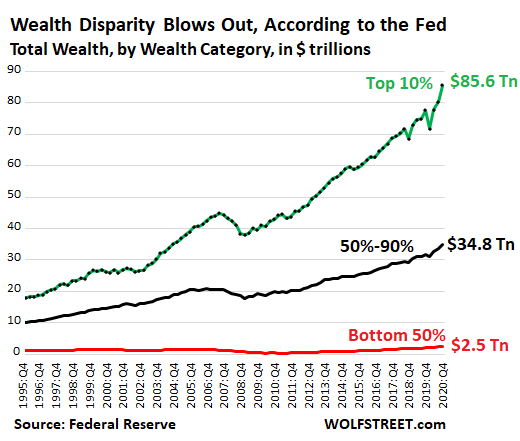
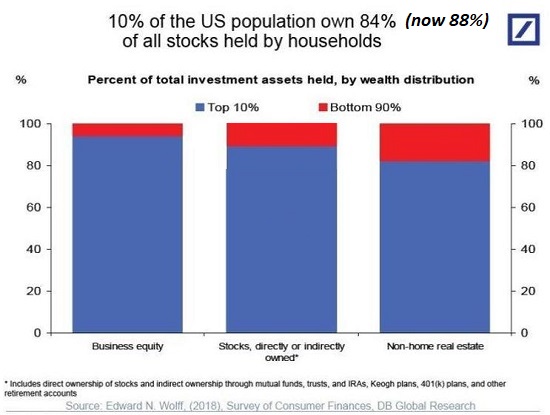
Let’s also ponder the consequences of the extreme concentration of wealth and income in the top 5% of U.S. households. The top 10% own roughly 85% of all wealth, and the top 1% own more than half the financial wealth.

Any significant drop in financial assets will have almost no effect on the bottom 90% because they don’t own enough of these assets to be consequential. So the deflationary effect of the reverse wealth effect will be concentrated in the discretionary spending of the top 10%: the luxury imported vehicles, the $100 per plate dinners (those $60 bottles of wine add up), the $500/day resort vacation, the $2,500/week AirBnB rental, etc.

The declines in the cost of these discretionary luxuries may well be noteworthy, but there are thresholds below which prices cannot drop. The high-end restaurant has equally high-end expenses, and so marginal providers will close, leaving only those few who can maintain profitability as demand for luxury dining craters.

The resort has high expenses as well, and once profitability has been lost, resorts will close just like other marginal providers. Supply shrinks along with demand, and the survivors keep prices high enough or they too will close.

So the essential “big ticket” costs will keep rising and the discretionary luxuries only the top 10% can afford will drop–but not by much as all those luxury providers have the same high fixed costs.

So to recap the test: what are the odds of these “big ticket” expenses dropping 30% if asset prices drop 30%?

Taxes: zero.

Healthcare: zero.

Childcare: zero.

Elderly care: zero.

Costs of doing business: zero.

As for housing: the mortgage doesn’t drop if the market value of the house drops 30%, and any declines in insurance will be modest. The costs of maintenance won’t drop much, either, and might actually increase as the supply of skilled workers declines. (Nothing is more expensive than the “cheap” repair that has to be redone correctly.)

Rents may drop in areas nobody wants to live anymore, but rents will rise in places people do want to live.

The larger point here is the long economic cycles have turned. The 40-year decline in interest rates has turned, whether we admit it or not. The 40-year decline in the prices of goods due to financialization (lower interest rates, higher speculative assets) and globalization has turned. The 40-year expansion of the workforce has turned. The 40-year decline of oil/fuel/resources prices has turned. The 40-year fantasy that we can depend on other nations for our essential resources and components is drawing to a close.

Untradable goods and services, cost thresholds, resource security, the end of financialization / globalization and declining interest rates matter. The fantasy that the top 10% can prop up the economy by borrowing and spending the phantom wealth of insanely overvalued asset bubbles is drawing to a close.

Is inflation “transitory” in your household budget? Really? Where?

The Future is Hawaii

By Peter Van Buren

Source: We Meant Well

I have seen the future. It looks a lot like Hawaii. What I saw there (absent the beautiful beaches, confused tourists, and incredible nature) was a glimpse of the future for much of America.

COVID paved the way for internal travel restrictions — Americans moving around inside their own country — never before thought possible, or even constitutional. Hawaii, an American state, had to decide if they accepted American me, much as a foreign country controls its borders and decides which outsiders may enter.

Hawaii required a very specific COVID test, from a “trusted partner” company they contract with, at the cost of $119 (no insurance accepted.) To drive home the Orwellian aspects of this all, after receiving the test kit I had to spit into the test tube during a Zoom call, some large head onscreen peeping into my bedroom watching to ensure it was indeed my spit. And now of course, after clicking Accept several times, my DNA information is in Hawaiian government hands along with whoever else’s name was buried in pages of Terms of Service. I was rewarded with the Scooby snack of an QR code on my phone.

Hawaii used to offer the option of skipping the test and doing quarantine on-island. However, they now pre-screen at major airports and so no QR code, no boarding. And for those who don’t think good, today it’s a COVID test, tomorrow other criteria may be applied. Aloha!

I will add that all the extra health screening at the airport made me a little nostalgic when I finally got to the bombs and weapons detecting set up by TSA. Just like the good old days when we worried about Muslim terrorists instead of each other turning our planes into flying death tubes, I was checked to make sure I was not carrying more than 3 ounces of shampoo. It felt… quaint to remove my shoes alongside everyone else, millions of pairs a day, all because some knucklehead failed to explode his shoe bomb and was subdued by other passengers 12 freaking years ago. For old times’ sake I prepared mentally to subdue my fellow cabin mates. The nostalgia was driven home as the TSA screener made everyone remove their mask for a moment to verify the face matched the ID picture except Muslim women, ensuring every non-Muslim woman passenger got to exhale a couple of COVID-era breaths into the crowd. Viva!

The future in Hawaii strikes you as soon as you clear the airport into that beautiful Pacific air. It smells good in patches, but in fact there are growing masses of homeless people everywhere; the unsheltered homeless population is up 12 percent on Oahu. Coming from NYC I am certainly not surprised by the zombie armies, but these people live outside. You can’t escape them by surrendering control of the subway system, or by creating shelters in someone else’s neighborhood. The homeless here live in tents, some in gleefully third world shacks made of found materials, others in government-paid shanties creatively called “tiny houses.”

Some make solo camp sites alone on the sidewalk, some create mini-Burning Man encampments in public parks. I’d like to say the latter resemble the migratory camps in Grapes of Wrath, but the Joad family could still afford an old jalopy and these people cannot. The Joads were also headed to find work; these people have burrowed in, with laundry hanging out, dogs running among the trash, rats and bugs happily exploring the host-parasite relationship. These folks stake out areas once full of tourists on Waikiki, and in public spaces once enjoyed more by locals. Drugs are a major problem and whether a homeless person will hassle you depends on which drug he favors, the kind that makes him aggressive or the kind that makes him sleep standing up at the bus stop.

The future is built around the homeless, literally. My business was in the Kakaako area, once a warehouse district between Waikiki and downtown Honolulu, now home to a dozen or more 40 story condos. They are all built like fortresses against the homeless. Each tower sits on a pedestal with parking inside, such that the street view of most places is a four story wall. There is an entrance (with security) but in fact the “first floor” for us is already four floors above ground. Once you’re up there, the top of the pedestal usually features a pool, a garden, BBQ, kiddie play area, dog walking space, all safely out of reach from whatever ugly is going on down below.

If you look out the windows from the upper, most expensive floors, you can see the ocean and sand but not the now tiny homeless people. They become invisible if you’re rich enough. Don’t be offended or shocked — what did you think runaway economic inequality was gonna end up doing to us? Macroeconomics isn’t a morality play. But for most of the wealthy the issue isn’t confronting the reality of inequality, it is navigating the society it has created. Never mind stuff like those bars on park benches that make it impossible to lay down. The architects in Kakaako have stepped it up.

These heavily defended apartments can run lots of millions of dollars, with most owners either coming from the mainland U.S. or Asia. They will live a nice life. Most of them work elsewhere, or own businesses elsewhere, which is good, because the future in Hawaii does not look good for the 99 percent below. It’s inevitable in a society that is constantly adding to its homeless population while simultaneously lacking any comprehensive way to provide medical treatment, all the while smoothing over the bumps on the street with plentiful supplies of alcohol and opioids.

Hawaii’s economy may be the future. Very little is made here. As making steel and cars left the Midwest in the late 2oth century, so did Hawaii’s old economy based on agriculture. It was cheaper to grow food elsewhere and import it to the mainland. The bulk of pineapple consumed in the United States now comes from Mexican, Central and South American growers same as steel now comes from China, and the few pineapple fields in Hawaii are for tourists. Hawaii now depends on two industries: tourism and defense spending. And both are controlled by government.

Tourism accounts directly for 24 percent of the state’s economy, more if one factors in secondary spending. The industry currently does not exist in viable form, with arrivals down some 75 percent. Unemployment Hawaii-wide is 24 percent, much more if you add in those who long ago gave up looking or are underemployed frying burgers. Much is driven by COVID. Will those ever recede? No one knows. When might things get better? No one knows. The decisions which control lives are made largely in secret, by the governor or “scientists,” and are not subject to public debate or a state congressional vote. One imagines a Dickensonian kid in hula skirt asking “Please sir, may we have jobs?”

Everyone knows Pearl Harbor, not only once a major tourist destination but also a part of direct Pentagon spending which pumps $7.2 billion into Hawaii’s economy, about 7.7 percent of the state’s GDP. Hawaii is second in the United States for the highest defense spending as a share of state GDP, and that’s just the overt stuff. Rumor has it the NSA has multiple facilities strewn around western Oahu with thousands of employees. All those government personnel, uniformed or covert, do a lot of personal spending in the local economy, much as they do in the shanty towns which ring American bases abroad. Everyone relies on local utilities like water, power, and sewers, and those bases need engineers, plumbers, electricians and others. Many are local residents either directly employed by DoD or working through contracts with private companies. The point is even more then tourism, this large sector of the economy is controlled by the government. At least they’re still working.

Another important sector of the Hawaiian economy is also government controlled, those who live entirely on public benefits. Benefits in Hawaii are the highest in the nation, an average of $49,175 and untaxed. For the last 9 years Hawaii spent more on public welfare benefits, about 20 percent of the state budget, then it did on education. More than one out ten people in Hawaii get food stamps (SNAP), though the number is higher if you include free lunches at school and for the elderly. Fewer working people means fewer tax paying people, so this is unsustainable into the future.

Who owns the future? The government in Hawaii owns the land. The Federal government owns about 20 percent of everything, and the state of Hawaii owns some 50 percent of the rest. Do Not Enter – U.S. Government Property signs are everywhere if you take a drive out of town. There are also plenty of private roads and gated communities to separate the rich from the poor, but the prize goes to Oracle owner Larry Ellison who owns almost the entire island of Lanai, serving as a gatekeeper inside another gatekeeper’s turf. For the rest of the people, homeownership rates in Hawaii are some of the lowest in the nation.

The good news (for some…) is in the future whites will be a minority race in all of America. They already are in Hawaii. Asians not including Native Hawaiians make up 37 percent of the population, with whites tagging in at 25 percent. Local government, some 55 percent of the jobs, is dominated by people of Japanese heritage. Japanese heritage people also have the highest percentage of homeownership, 70 percent. Almost all have a high school diploma, and about a third have a four-year college degree.

The well-loved mainland concept of “people of color” fades quickly in Hawaii, where Japanese color people are a majority over everyone else. And unlike in some minds, people in Hawaii are very aware that the concept of “Asian” is racist as hell, and know the differences among Japanese, Korean, Chinese, and Vietnamese. Things are such that local Caucasian and Hawaii Democratic Congressman Ed Case said he was an “Asian trapped in a white body” and meant it as, and was understood in Hawaii as, a good thing and was echoed by Case’s Japanese-American wife.

White supremacy has clearly been defeated here, though I am not sure BLM would be happy with how that actually worked out without them. On a personal note, I will say as a white-identifying minority I was well-treated by the police and others. I was not forced to wear one of those goofy shirts or add an apostrophe to words while in Hawai’i against my cultural mores, so there may be hope yet in the future I saw.

Desperate Americans Who Can’t Afford Housing Are Becoming “Modern-Day Nomads” …But Not By Choice

By Robert Wheeler

Source: The Organic Prepper

A recent story floating around mainstream media regarding “modern-day nomads” reads like a contemporary article on Henry David Thoreau. It shares stories of people looking to downsize their life and live simply and stories of people who have fallen on hard times, unable to afford rent. 

However, what is lacking is the exposure of the dark underbelly of the “modern-day nomad” culture. In other words, they neglect to mention the fact that the enormous growth of the “modern-day nomad” is rooted in the fact that the world economy has all but collapsed, now mired in a global economic depression of unemployment, low wages, and personal financial catastrophes.

While it sounds romantic, it’s often rooted in desperation.

Nevertheless, some of the stories begin in the following way:

If you look closely on city streets, campgrounds, and stretches of desert run by the Bureau of Land Management, you’ll see more Americans living in vehicles than ever before. It was never their plan.

“I wasn’t prepared when I had to move into my SUV. The transmission was going. I had no money saved. I was really scared,” said April Craren, 52, bundled in blankets atop a cot inside her new minivan, a 2003 Toyota Sienna.

She flipped the camera on her phone to show me the camp stove she uses to make coffee and her view of the sun rising over the Colorado River. She has no toilet, shower, or refrigeration.

After separating from her husband, April found herself homeless in June 2020, exacerbating the depressive disorder for which she receives $1,100 a month in disability benefits.

“I could have gotten an apartment but in a crappy unsafe place with no money to do anything at all,” she explained.

Last year, where April lived in Nixa, Missouri, the average rent for an apartment was $762, slightly less than the national average. Like nearly half of American renters, she would have been crippled by the cost.

It’s not surprising, then, that job loss, divorce, or, say, the sudden onset of global health or financial crisis can push so many over the edge.

Many Americans have found themselves trapped in a spiral of poverty from which they simply can’t recover.

It doesn’t sound so bad to those of us with minimalist persuasions

At 52, April Craren didn’t choose this life. It was thrust upon her by unfortunate life circumstances. Craren couldn’t afford the exorbitant rent that is now average across the country on a fixed income. (Partly due to inflation but mostly due to the housing crash in 2008.)

The coordination of lockdowns and COVID restrictions have plunged the world into a deep depression of which we are only beginning to see. Even Wall Street couldn’t have caused this much damage. 

“If the Great Recession was a crack in the system, Covid and climate change will be the chasm,” says Bob Wells, the nomad who plays himself in the film Nomadland. Thankfully, Wells was able to help Craren adopt her lifestyle so she can now survive as a “nomad” through his Home On Wheels Alliance.

Wells’s lifestyle was a choice. But the newfound interest in the nomadic lifestyle is not a choice for many.

From Yahoo:

Realizing he had something valuable to share, he bought the domain name Cheap RV Living in 2005. He posted tips and tricks about better vehicle-dwelling, but what he was really offering was a road map to a better life.

Four years later, when close to 10 million Americans were displaced after the Great Recession, traffic to his site exploded. Finding himself at the center of a growing online community, he decided to create a meet-up in Quartzsite, Arizona. He dubbed it the Rubber Tramp Rendezvous (RTR), and in January 2011, 45 vehicles showed up. Eight years later, an estimated 10,000 vehicles convened for what was said to be the largest nomad gathering in the world.

The event’s explosive growth is undoubtedly a reflection of America’s increasing interest in van life as an answer to the affordable housing crisis, an idea made accessible by Bob on his YouTube channel, also named Cheap RV Living, created in 2015.

The “increasing interest in van life” that Yahoo News refers to is not some petit-bourgeois fantasy being realized by privileged middle-class white kids, able to go home at any time. It is the necessity of formerly middle class, working-class, and poor people all across America who are out of work or are working but cannot afford housing.

Minimalism is a legitimate lifestyle for some; others have no choice

For many, this culture of minimalism is genuinely how they wish to live. Nomads have a genuine desire to see empty overconsumption come to an end. However, we can not ignore that minimalism is being promoted to prepare the Western population who are used to high living standards to accept those that are much lower.

Why do you think we continually see articles promoting insects as a legitimate dining option? Why are The Great Reset promoters at the World Economic Forum telling the public that they will soon own nothing and learn to love it?

Being a nomad doesn’t mean you can’t be prepared.

For those who are already nomads, whether by choice or forced by economic circumstance, it might be helpful to know that there are many prepping options available to you. There is no need to be left to the mercy of wherever you are right now. 

I highly encourage you to access Daisy Luther’s article, “There’s Another Option Besides Hunkering Down and Bugging Out: Nomadic Living.” It will give you the perspective of someone who has voluntarily experienced and lived the nomadic lifestyle while also the mindset of remaining prepared for anything and everything. 

At the rate the Great Reset is taking shape, many of us may find ourselves embracing the nomadic lifestyle, willingly or not.

Have you considered nomadic living?

The Top 10% Is Doing Just Fine, The Middle Class Is Dying on the Vine

By Charles Hugh Smith

Source: Of Two Minds

Please study these charts as a means of understanding the inevitability of economic stagnation and a revolt of the decapitalized middle class.

I’ve been covering the decline of America’s middle class for over a decade with charts, data and commentary on the social depression that has accompanied the decline.

While there are many mutually reinforcing dynamics in this 45-year decline–demographics, global energy costs, financialization and globalization, to name a few– one term describes the accelerating erosion of America’s middle class: decapitalization.

To understand decapitalization, we need to start with the fundamentals of any economy between labor (wages) and capital and between investment and speculation. Although it’s tempting to oversimplify and demonize one or the other of these basics (speculators bad! etc.), they each provide an essential role in a healthy economy, one which is in dynamic equilibrium, a state analogous to a healthy ecosystem with constantly changing interactions of numerous species, individuals and inputs (weather, etc.). This variability enables the order of fluctuations (to use Ilya Prigogine’s profound phrase), a dynamic stability / equilibrium.

If labor’s share of the economy drops too low, the workforce cannot consume enough to support their households and the economy as a whole. If capital can no longer earn an attractive return, investment dries up and production stagnates. If speculators are not allowed to take on risk, liquidity dries up and risk crushes investment. But if speculation becomes the foundation of the economy’s “growth,” then the inevitable collapse of speculative bubbles will crash the economy.

In modern social-capitalist systems, the core stabilizer of the system is the wage-earning middle class which provides the stable workforce driving production and the stable pool of consumers needed to borrow money and consume enough to soak up the production of goods and services at a profit to producers.

Without a stable, dominant middle class, capital has few opportunities to invest in productive capacity. Without a stable, dominant middle class, the economy stagnates and is prone to collapse as it is far from equilibrium.

The process of middle class decline is best explained as decapitalization because the middle class is fundamentally a means of transforming labor into capital via savings and investment. The traditional ladder of social mobility from the working class to the middle class is one of capitalizing work: time and savings are invested in higher education, in effect capitalizing future labor by increasing productivity.

Capital isn’t limited to cash, land or tools; in an information economy, knowledge and skills are also capital, as is the social capital of social networking and relationships formed with mentors, suppliers, lenders, colleagues, investors, etc.

The second way to capitalize work is to save earnings and invest the savings in assets that produce income or gain value: a house, land, rental property, small business and income-producing financial assets such as bonds or dividend-paying stocks.

Thrift, investing, long-term planning and deferred consumption are all essential to capitalizing work by turning that labor into income-producing assets. As the household’s ownership of these assets that yield unearned income rises, so does their income and wealth. These increase the financial security of the household and build a nestegg which can be passed down to the next generation, improving their security via inheritance of income-producing assets.

As long as productivity is increasing the value of their labor, the middle class can leverage future earnings into assets by borrowing money to invest in assets: to buy a house, a mortgage is borrowed against future earnings. As long as the mortgage is a fixed-interest loan and income can be expected to rise with productivity, then this is a win-win situation: capital earns a predictable, low-risk return from the mortgage and the middle class household has stake in a family home, an asset which acts as a savings mechanism as the mortgage slowly pays down the debt and increases the household’s home equity–a form of savings.

The processes of decapitalization have upended this entire structure. In the systems context outlined above, our economy is out of balance and far from equilibrium and thus prone to collapse.

For the bottom 90%, which of course includes the middle class however you define it, it’s increasingly difficult to capitalize labor into capital. There are a number of factors driving this decapitalization:

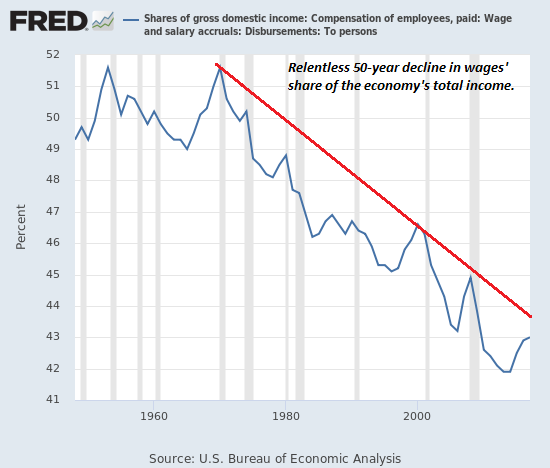
1. Wages’ share of the national income has continued a five-decade downtrend. (See chart below) National income since 1973 has shifted from labor (wages) to capital and more specifically, to debt and speculative gaming of the system, a.k.a. financialization.

Total household income in the U.S. in 2018 was $17.6 trillion. The decline in wages’ share of the national income from 1973 to 2018 is about 8.5%, which equals $1.5 trillion, the sum shifted from labor to capital every year. (See chart below)(source: https://www.statista.com/statistics/216756/us-personal-income/)

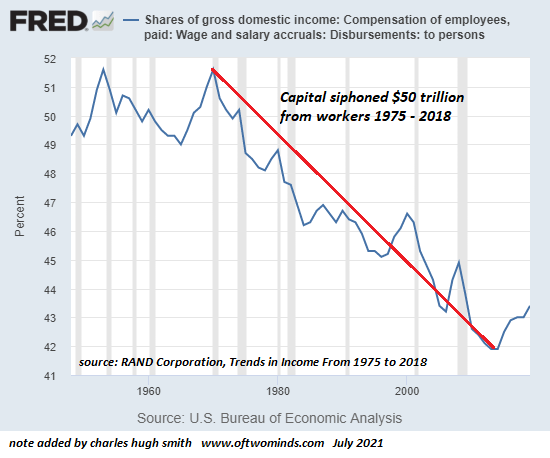
No, this is not a typo. As this RAND report documents, $50 trillion has been siphoned from labor (the lower 90% of the workforce) to the Financial Aristocracy and their technocrat lackeys (the top 10%) who own the vast majority of the capital (see charts below): Trends in Income From 1975 to 2018.

2. Within the workforce, wages have shifted to the top 10% who now earn 50% of all taxable income. (See RAND chart below) Financialization and globalization have decapitalized the skills of entire sectors of the workforce as automation and offshoring reduced the human capital of workers’ skills and experience and the value of their social capital. When the entire industry is offshored, skills and professional relationships lose their market value.

In a fully globalized economy, every worker producing tradable goods/services is competing with the entire global workforce, a reality that reduces wages in high-cost developed nations such as the U.S.

Financialization has heavily rewarded workers with specialized gaming the financial system skills and devalued every other skill as only the skills of financialization are highly profitable in a globalized, financialized economy.

3. As the high-wage jobs and capital shifted to coastal urban centers, middle class owners of homes and capital elsewhere saw the value of their assets decline. If a home valued at $100,000 in the late 1990s is now worth $150,000, the owners lost ground even with “official” inflation. In terms of real-world purchasing power, their home actually lost significant value in the past 23 years.

Meanwhile, middle class owners who bought their home in a coastal hot-spot for $100,000 23 years ago are now enjoying home valuations close to $1 million. Homes, along with every other asset, have been shifted into a casino where almost everyone is sorted into winners and losers, less often by skill and more often by luck.

For those who were too young to buy in 1997, sorry–the opportunity to buy a home for three times average middle class income is gone. The lucky generation who bought in the late 1990s in booming coastal magnets for global capital joined the top 10% and their colleagues in less desirable regions lost ground.

4. As capital siphoned off income and appreciation from labor (human and social capital), the gains accruing to capital accelerated. Those who already owned income-producing assets reaped both income and asset appreciation gains as yields on savings collapsed to near-zero as the Federal Reserve and other central banks dropped yields to near-zero in 2009 and kept them low for the following 13 years.

This had two devastating effects on the middle class: hundreds of billions of dollars that once flowed to savers and money markets disappeared, swallowed by the banks as a direct (and intentional) effect of the Fed’s ZIRP (zero-interest rate policy).

Since the Fed destroyed low-risk yields, anyone seeking any real yield (i.e. above inflation) would have to enter the casino and compete with hedge funds, insiders and the Financial Aristocracy. Very few middle class workers have the skills and experience to beat the pros in the casino, and so income and wealth accrued to those who already owned capital.

This is a key reason why the rich got richer and the poor got poorer. Those with capital accrued the majority of gains in income and wealth, leaving the bottom 90% in the dust.

A recent Foreign Affairs essay Monopoly Versus Democracy included these stunning statistics:

Ten percent of Americans now control 97 percent of all capital income in the country. Nearly half of the new income generated since the global financial crisis of 2008 has gone to the wealthiest one percent of U.S. citizens. The richest three Americans collectively have more wealth than the poorest 160 million Americans. (emphasis added.)

The 3% of income from capital collected by the bottom 90%–which includes the middle class– is basically signal noise: the middle class collects inconsequential crumbs of income from capital.

Prior to the Fed’s ZIRP and financialization of the economy, the middle class could both collect income from capital they owned and they could afford to acquire assets that yielded low-risk solid returns. Now they can do neither. Even worse, the puchasing power of their labor continues to decline, leaving them less able to save and buy assets.

This is why The Top 10% Is Doing Just Fine, The Middle Class Is Dying on the Vine. Please study these charts as a means of understanding the inevitability of economic stagnation and a revolt of the decapitalized middle class.