The ISIS Truth We Hide From

Isis fighters, pictured on a militant website verified by AP.

By Bob Hennelly

Source: WhoWhatWhy

Identifying Terrorist Enemy No. 1—the Islamic State militants—is easy now, after a spate of horrific videos of beheadings and burnings.

But what’s hard for Western governments and the mainstream media is figuring out the popularity of this terror group among young western Muslims. Why do these people choose to leave the relative comforts of home and take up arms with IS militants? It’s as if these young people are from another planet.

Even after President Obama’s three-day White House Summit on Violent Extremism, few establishment “experts” and commentators seem ready to consider one possible answer: that it is the extreme militarism of the U.S. and its allies that helped spawn IS, and al Qaeda before that.

On the PBS NewsHour segment covering the White house confab, panelists were asked “why people are drawn to the kind of extremism we are seeing today?” The assembled pundits identified “local grievances” like “access to education and job opportunities” and faulted recruiting for “extreme ideology through books and social media.”

Yet there was no mention of U.S. drone strikes, prisoner rendition, torture, and the thousands of dead and wounded Muslim civilians. All of those factors have been exploited by ISIS and other violent groups to make their case that the U.S. is waging a war on Islam.

After several decades of self-proclaimed “nation building” and “exporting democracy” in the Middle East and its environs, the results are all too clear. There are shattered nations in Iraq and Afghanistan, failed states in Yemen, Libya and Syria, and more than a dozen African nations that the U.S. State Department concedes are under constant threat of attack by well-armed and organized terrorists.

Is it possible that what the U.S. has actually been doing in these hot spots is “terrorism building” and “exporting chaos”? Is this the awful truth the United States cannot bring itself to admit?

Massaging History

It would seem so, since instead of changing course, the U.S. is in the process of doubling down on its mistakes. How else to explain that the new GOP presidential hopeful, Jeb Bush, nonchalantly told the Chicago Council on Global Affairs that “mistakes were made” in Iraq. He then proceeded to lay out his own plan for becoming the new global sheriff in town.

Here’s a jaw-dropping statement from that speech:

There were mistakes made in Iraq, for sure. Using the intelligence capability that everybody embraced about weapons of mass destruction was not—turns out not to be accurate.

Watching his brother’s back, Jeb wove out of thin air a phony consensus that “everybody” signed on for the rationale for the Iraq war. That’s despite a vote in Congress in which 23 U.S. Senators and 133 House members opposed it.

You see, if “everybody” was wrong, then nobody was right. It should come as no surprise that Jeb’s team of policy wise men includes many Bush II veterans, among them the unrepentant Iraq war architect Paul Wolfowitz.

His Own Man, With an Old Plan

As much as Jeb Bush insists he is his own man, the audience in Chicago could hear echoes of his brother George’s cowboy-like approach. When Jeb was asked about how he would handle IS, he said he would develop a “global strategy” that would “tighten the noose” so he and the posse could “take them out.”

During Bush’s remarks, he took aim at the Obama administration for being too quick to disengage from the world and Iraq. He blamed Obama for creating a power vacuum that set the stage for the rise of IS and Iranian influence.

Yet an examination of President Obama’s new National Security Strategy, his proposed military budget and his request for his own War Powers re-authorization all indicate an administration that is prosecuting a global war on terror with unfettered latitude as to where and whom it targets.

Could it be that this “global war on terror,” whether it be the Bush 1.0 or Obama 2.0 version, may actually be what is proliferating the very thing it was aimed to eradicate?

One policy expert who dares to look deeper is Graham Fuller, a career CIA agent and analyst who was vice-chairman of the CIA’s National Intelligence Council. Fuller says it was the U.S. invasion of Iraq in 2003 that set the stage for IS. By creating an endemically corrupt central government in Baghdad, notes Fuller, the American occupation provided a focal point to unite disparate opposition groups. As for the high-profile effort to train a new Iraqi army, that “security” force collapsed the moment its U.S. handlers left. (In an odd twist to an already bizarre security meta-narrative, Fuller’s former son-in-law is the uncle of accused Boston Marathon Bombers Tamerlan and Dzhokhar Tsarnaev.)

***

In linking Washington’s Middle Eastern policies to the rise of terrorist groups in the region, MIT professor Noam Chomsky takes it even further back. He says the roots start with the U.S. support of Iraq in its brutal war with Iran in the 1980s, and include the draconian economic sanctions that followed Saddam Hussein’s 1990 invasion of Kuwait. In Chomsky’s view, these sanctions punished Iraqi civilians while reinforcing Saddam’s dictatorial control.

In his 2006 book Devil’s Game: How the U.S. Helped Unleash Fundamentalist Islam, longtime Nation correspondent Robert Dreyfuss documents how the U.S., as early as the 1950s, backed the Muslim Brotherhood in exchange for help fighting communism.

Peace’s Deadliest Year

One way to justify failed policies is to pretend that they have worked as advertised. Nowhere was this disconnect between rhetoric and reality more on display than in President Obama’s updating this month of his National Security Strategy.

In presenting this new security game-plan, the president exhibited excessive confidence in declaring that the United States was heading “home” and “moving beyond” ground wars in Iraq and Afghanistan. In his mini-version of Bush’s infamous ‘Mission Accomplished’ statement, he asserted that “the threat of catastrophic attacks” against the U.S. had “diminished.”

But even as the president describes a winding-down of combat operations, anything but peace is taking hold in those places.

The sectarian violence has resulted in record numbers of civilian deaths and injuries. The UN reported last month that more than 12,000 civilians were killed in Iraq in 2014, the deadliest year for noncombatants since 2008. In Afghanistan, the UN Assistance Mission counted close to 3,200 civilians killed and more than 6,400 wounded, the deadliest year since America’s longest war started.

Providing a sharp contrast to the president’s own assertion that peace is almost at hand, he has sent troops back into Iraq. And just a few days ago, his new Secretary of Defense, Ashton Carter, said the U.S. might end up sticking around in Afghanistan after all.

What the Administration and a cheerleading media refuse to acknowledge is that the two U.S. wars in Afghanistan and Iraq, aimed at ending terrorist threats in the region, have done the exact opposite. They not only caused tens of thousands of civilian casualties but hardened the resolve of yet another generation to seek revenge against their perceived Western oppressors.

Bottom Line

While details of how the president plans to use his refreshed war powers are still vague, the price tag is not.

In the name of defending the country and fighting terrorism, the president’s proposed 2016 budget calls for adding $38 billion in regular defense spending and another $58 billion for so-called “Overseas Contingency Operations.” These expanded outlays would come on top of the more than half a trillion dollars the U.S. is already spending on the military.

Even under the sequester restrictions, says one specialist, U.S. military spending was already quite robust and shamefully under-scrutinized.

“If you can’t protect the nation with $500 billion dollars,” then something is amiss, according to Veronique deRugy of George Mason University’s Mercatus Center. She notes that even under the sequester restrictions, U.S. military spending was already quite robust and shamefully under-scrutinized.

The failures are especially pronounced, says deRugy, when one takes into account that in the years since 9/11, Washington’s extra expenditures, labeled “emergency” war funding, have topped Pentagon budgets by tens of billions annually.

And so under presidents from both parties, who were supposedly ‘conservative’  and ‘liberal’,  the “emergency” continues to spread.

Against All Bosses: Government AND Corporate

bill-lumbergh-office-space-boss

By Kevin Carson

Source: Center for a Stateless Society

I keep resolving not to comment on any more of Alternet‘s by-the-numbers anti-libertarian puff pieces, but a recent one from David Masciotra (“You’re Not the Boss of Me: Why Libertarianism is a Childish Sham,” February 26) is in its own category of wretchedness.

Masciotra’s commentary includes two seemingly contradictory lines of argument. In the first, he dismisses anti-authoritarianism, as such, as the ethos of a spoiled toddler:

the protest of children who scream through tears, “You’re not the boss of me.” The rejection of all rules and regulations, and the belief that everyone should have the ability to do whatever they want, is not rebellion or dissent. It is infantile naïveté.

He associates this infantile rejection of all authority with selfishness and anti-sociality. In fact it “does not even rise to the most elementary level of politics,” which Aristotle defined as “the things concerning the polis,” or the community. Confucius associated politics with an ethics of “communal service with a moral system based on empathy.” This, in contrast to libertarianism, which “eliminates empathy, and denies the collective,” and opposes “any concept of the common good” or organizing communities “in the interest of solidarity.”

And of course because this is an Alternet attack on libertarianism, he can’t get through it without mentioning Ayn Rand — “the rebel queen of their icy kingdom.” Oddly enough, he didn’t manage to drag in the Koch brothers.

Just in passing, it’s a bit odd that none of Alternet‘s stable of center-left critics of libertarianism seem to have any idea that the movement might have ideological roots older than last Tuesday. American libertarianism as an organized political movement — the movement that later gave birth to the Libertarian Party — has its origins more or less in the radicals who dropped out of Young Americans for Freedom in 1968. But radical free market thought didn’t start with them, or with Ayn Rand, or even with Ludwig von Mises. It goes back to the classical liberalism of two hundred and more years ago.

And classical liberalism was a very diverse and varied movement, including some quite left-leaning strands, who considered themselves socialists as well as free market libertarians. This shouldn’t be surprising, given that the origins of classical liberalism, socialism and anarchism are so closely intertwined in the culture of the Enlightenment, and overlapped so heavily in their formative period of the 1820s through 1840s.

Two of my strongest ideological influences were the free market libertarians Thomas Hodgskin in England and Benjamin Tucker in the U.S., both of whom were socialists and saw the state’s primary role as intervening in the market on behalf of landlords and capitalists to enforce rents on the artificial scarcity of land and capital. And left-wing strands (like the thought of Henry George) persisted in American classical liberalism afterwards, and have continued to exist even in the modern libertarian movement.

Although contemporary American libertarianism is generally right-leaning and much of it is corporate-influenced, it still contains leftward-oriented strands — many of them quite anti-corporate, or (like me) even anti-capitalist. At his most left-friendly phase in the late ’60s, for example, prominent libertarian Murray Rothbard collaborated with New Left scholars like Ronald Radosh and the Studies on the Left group. During this period Rothbard described the main function of “our corporate state” as subsidizing the operating costs of big business and the accumulation of capital.

After all this, though, Masciotra dismisses libertarians as not being rebellious enough. Their rebellion disguises “their subservience to — for all their protests against the ‘political elite’ — the real elite.”

Who then are the libertarians rebelling against? The most powerful sector of the society is corporate America, and it profits and benefits most from the deregulatory and anti-tax measures libertarians champion. That sector of society also happens to own the federal government. Through large campaign donations and aggressive lobbying — the very corruption that libertarians help enable by defending Citizens United and opposing campaign finance reform — they have institutionalized bribery, transforming the legislative process into an auction. Libertarians proclaim an anti-government position, but they are only opposing the last measures of protection that remain in place to prevent the government from full mutation into an aristocracy.

Masciotra might be surprised to know I actually agree with most of this, and I’m a libertarian. My understanding of government as something that serves the interest of propertied classes, protects big business from competition, and funnels rents on artificial scarcity and artificial property upward from the producing classes to the plutocracy is one of the reasons I became a libertarian and an anarchist.

And one of the primary targets of my writing has been the right-leaning sort of libertarian who ignores the extent to which Corporate America owns the federal government. These people pass over the primary function of government — intervening in the market to facilitate rent extraction by the propertied ruling classes — and focus entirely on eliminating the secondary functions like partially restricting abuses of those ruling classes’ power and stabilizing the worst side-effects of corporate power.

My hatred of bosses is at the root of my identification, not only as a libertarian — but as a Leftist. My instinctive affinity for the “you’re not the boss of me” sentiment, which Masciotra dismisses contemptuously, is the reason I so strongly support labor struggle and radical unions like the I.W.W.

I believe that institutional hierarchies of all kinds are bad — corporate, government, university, etc. — because they suppress the free flow of information and feedback that those in authority don’t want to hear. They create conflicts of interest in which those at the top appropriate the gains from contributions to productivity from those below, and shift costs and blame downward — basically kind of stuff anyone who’s worked under a boss, or reads Dilbert, knows instinctively.

And my belief in free markets doesn’t mean that I lionize “rugged individualism,” or believe that the cash nexus should dominate most aspects of social life. It just means I don’t think the state should interfere with voluntary exchange where it exists. In fact I strongly support a solidaritarian society build on the kinds of self-organized working class institutions for mutual aid that Pyotr Kropotkin and E.P. Thompson described in their writing. I’m strongly influenced by Elinor Ostrom’s views on the governance of common pool resources. And I think that most economic activity in a free society would take place through forms of voluntary interaction other than money exchange — the social and gift economy and commons-based peer production, among them.

If Masciotra took a break from constructing his libertarian strawmen for a minute and checked out the diverse array of real people within our movement, he might find he actually has stuff in common with some of us.


The (Not-So) Secret History of Saint Patrick’s Day

saintpatrickBy Christopher Knowles

Source: The Secret Sun

March 17 is the day generally believed to be the death of St. Patrick, the British-born missionary who is credited with converting Ireland to Christianity. And as I wrote in one of my first posts on this blog:

In Egyptian mythology, Osiris was killed on the 17th day of Athyr, the third month of the ancient calendar.
3/17 is also the date of a Masonically-created holiday, St. Patrick’s Day. The story has it that the holiday was established by high level Freemason, George Washington, allegedly to reward Irish soldiers in the Continental Army. But “St. Paddy’s” has traditionally been a very minor Saint’s day in Ireland. Considering that the day has become America’s defacto Bacchanal (which takes us back to Osiris) it’s worth noting some of the parallels of this day with Solar mythology.

• Osiris was believed to be the source of barley, which was used for brewing beer in Egypt.

• It’s customary to wear green on St. Patrick’s Day and Osiris was known as the “Green Man”

• The root word of Patrick is pater, the Latin word meaning father. Osiris is the father in the Egyptian Trinity.

Since then, I’ve been looking into the curious origin of this holiday and have found out some very interesting facts…

• This one’s a shocker- St. Patrick’s Day was originally celebrated by Protestant Loyalists in the British Army:

Their first meeting and dinner to honor St. Patrick was an expression of their Protestant faith as well as their intention to bond with fellow Irish émigrés. Their 1775 meeting included British soldiers of Irish extraction. All proceeded, or marched, to the King’s Chapel to hear a sermon devoted to the occasion, and then continued on to a dinner in King Street. British soldiers were still the big show of the first St. Patrick’s Day parade in New York City in 1762.

The first celebration in New York City was in 1756, at the Crown and Thistle tavern. Philadelphia held its first St. Patrick’s Day parade in 1771. General George Washington issued a proclamation during the Revolutionary War, declaring March 17, 1780 a holiday for the Continental Army, then stationed in Morristown, New Jersey, in honor of the many soldiers of Irish ancestry and those born in Ireland. It was reported that this was the first holiday granted the troops in two years. Washington’s remark that the proclamation was “as an act of solidarity with the Irish in their fight for independence,” was possibly the origins of St. Patrick’s Day in America as an expression of Irish nationalism as much as Irish heritage or of honoring a Christian saint.

Since many lodges in Revolutionary-era America were chartered under the Grand Lodge of Ireland, I’m willing to bet those Irish soldiers were predominantly Freemasons (remember this is pre-Morgan Affair, when Freemasons were hardcore). To show how much a Masonic enterprise the American Revolution was, here’s a list of the Freemasonic Generals in the Continental Army:

• Up until very recently, St. Patrick’s Day was not a big deal in Ireland itself:

In modern-day Ireland, St. Patrick’s Day has traditionally been a religious occasion. In fact, up until the 1970s, Irish laws mandated that pubs be closed on March 17. Beginning in 1995, however, the Irish government began a national campaign to use St. Patrick’s Day as an opportunity to drive tourism and showcase Ireland to the rest of the world. Last year, close to one million people took part in Ireland ‘s St. Patrick’s Festival in Dublin, a multi-day celebration featuring parades, concerts, outdoor theater productions, and fireworks shows.

• Modern Saint Patrick’s Day shares both a date and a mandate with a far, far older holiday:

St. Patrick’s Day is also frequently a time for drinking. It used to be that this tradition was strung out for at least five days, the so-called seachtain na Gaeilage or “Irish week.”

That may stem from Roman times, when March 17 started the festival of the Bacchanalia, a celebration to the deity Bacchus, to whom wine was sacred. In olden years long gone by, the Irish drank mead, made from fermented honey. You might do better today with a stout Guinness, preferably dyed green.

• The Bacchanalia are well-documented in the historical record:

The bacchanalia were wild and mystic festivals of the Roman and Greek god Bacchus. Introduced into Rome from lower Italy by way of Etruria (c. 200 BC), the bacchanalia were originally held in secret and only attended by women. The festivals occurred on three days of the year in the grove of Simila near the Aventine Hill, on March 16 and March 17. Later, admission to the rites was extended to men and celebrations took place five times a month. According to Livy, the extension happened in an era when the leader of the Bacchus cult was Paculla Annia – though it is now believed that some men had participated before that.

• Of course, Bacchus/Dionysus is just the Greco-Roman reinterpretation of Osiris. And drinking of beer was sacred to the followers of Osiris, the Green Man:

In Egypt, beer was regarded as food. In fact, the old Egyptian hieroglyph for “meal” was a compound of those for “bread” and “beer”. This “bread-beer meal” plus a few onions and some dried fish was the standard diet of the common people along the Nile at the time. Beer came in eight different types in Egypt. Most were made from barley, some from emmer, and many were flavored with ginger or honey. The best beers were brewed to a color as red as human blood. The Egyptians distinguished between the different beers by their alcoholic strength and dominant flavor.None other than the god of the dead, Osiris, was hailed as the guardian of beer, because to him grain – both emmer and barley – were sacred. The Egyptians believed that grain had sprung spontaneously from Osiris’ mummy, as a gift to mankind and as a symbol of life after death. This was sufficient justification for the god-like pharaohs to turn brewing into a state monopoly and strictly license brewing rights to entrepreneurs and priests. Many temples eventually opened their own breweries and pubs, all in the service of the gods. The port of Pelusium at the mouth of the Nile became a large brewing center, and trading in beer became big business.

• This admixture of Egyptian festivities, Irish nationalism and Freemasonry might seem outrageous to some, but in fact it was part and parcel of Celtic culture before the rise of the Roman Church. Namely in the…

… religion of the Druids, as before said, was the same as the religion of the ancient Egyptians. The priests of Egypt were the professors and teachers of science, and were styled priests of Heliopolis, that is, of the City of the Sun. The Druids in Europe, who were the same order of men, have their name from the Teutonic or ancient German language; the German being anciently called Teutones. The word Druid signifies a wise man. In Persia they were called Magi, which signifies the same thing.

St. Patrick himself was believed to have driven the Druids of out of Ireland, but in fact druidry was merely incorporated into Celtic Christianity, which was distinct from other varieties and would remain so until forcibly changed on orders from Rome.

• And it seems that the festival of the death of Osiris shares much in common with another holiday that the Irish brought to America:

This universal illumination of the houses on one night of the year suggests that the festival may have been a commemoration not merely of the dead Osiris but of the dead in general, in other words, that it may have been a night of All Souls. For it is a widespread belief that the souls of the dead revisit their old homes on one night of the year; and on that solemn occasion people prepare for the reception of the ghosts by laying out food for them to eat, and lighting lamps to guide them on their dark road from and to the grave. Herodotus, who briefly describes the festival, omits to mention its date, but we can determine it with some probability from other sources. Thus Plutarch tells us that Osiris was murdered on the seventeenth of the month Athyr, and that the Egyptians accordingly observed mournful rites for four days from the seventeenth of Athyr.

And what of the corned beef and cabbage? In late antiquity the Apis bull was identified with Osiris. The Apis bull would be sacrificed and eaten in ritual feasts. Cabbage is grown in the winter months in Egypt and was used to control intoxication at feasts.

So it’s official: all of our modern holidays in America are simply covert repackagings of ancient pagan festivals and the increasingly popular St. Patrick’s Day is no different.

The Church took the Bacchanalia away from the Irish and replaced it with a boring religious holiday and the old-school Freemasons used that to bring the Bacchanalia back, which we now understand traces back to Osiris. And Osiris brings us back to the ancient astronauts, which the later adaptations like Bacchus do not.

Welcome to the New Atlantis.

Podcast Roundup

3/11: Srini Rao has an interesting conversation with animal rights activist Peter Young covering community activism, communication, survival tips, and his former life as a fugitive on the “Unmistakable Creative” podcast.

https://sitebuilderio.s3.amazonaws.com/unmistakablecreative/audios/012b5fac-3695-42b3-9a2d-ffd7d4d7f213/lessons-in-communication-from-a-fugitive-peter-young.mp3

3/11: On the latest “Guns and Butter”, Bonnie Faulkner interviews John Whitehead of  the Rutherford Institute. They discuss aspects of  “Police State America” including the Corporate State, American Legislative Exchange Council (ALEC), Offices of Inspector General (OIG), SWAT Teams, No-Knock Raids, the Schoolhouse to Jailhouse Track, the New York Prototype, MRAPs, Operation Vigilant Eagle, Atlas Four Androids, TSA and VIPR Teams, the Google/NSA connection and Fusion Centers.

http://archives.kpfa.org/data/20150311-Wed1300.mp3

3/11: Host Dave Lindorff discusses the recent coup plan disrupted by police in Venezuela with veteran journalist Alfredo Lopez — a story largely blacked out or mocked as bogus by the US corporate media despite solid evidence of a plot, and of US involvement in that plot on “This Can’t Be Happening”. Lindorff and Lopez, who are colleagues on the news site thiscantbehappening.net, also talk about why President Obama on Tuesday declared Venezuela an “unusual and extraordinary national security threat” to the US, and what that declaration means to Venezuela and Latin America.

http://s36.podbean.com/pb/0c1337348a3a2a92b0bdb73308121756/5503328c/data1/blogs18/661545/uploads/ThisCantBeHappening_031115.mp3

3/12: On the first of their recent “Media Roots” podcasts, Robbie and Abby Martin discuss the ending of the RT program “Breaking the Set”, the establishment’s Cold War resurrection, and the splintering of the left over Obama’s military policies. The second program features an interview with Mark Weisbrot, co-director of the Center for Economic and Policy Research, on current U.S. government actions against Venezuela.

US War on ISIS a Trojan Horse

obama-isis-cia

In America’s coming war, don’t be surprised if everything in Syria is destroyed except ISIS.

By Ulson Gunnar

Source: Land Destroyer Report

In August of 2013, even as the words came out of US President Barack Obama’s mouth regarding an “impending” US military strike against the Syrian state, the impotence of American foreign policy loomed over him and those who wrote his speech for him like an insurmountable wall.  So absurd was America’s attempt to once again use the canard of “weapons of mass destruction” to justify yet another military intervention, that many believed America’s proxy war in Syria had finally reached its end.

The counterstroke by Russia included Syria’s immediate and unconditional surrendering of its chemical weapons arsenal, and with that, so evaporated America’s casus belli.

Few would believe if one told them then, that in 2015, that same discredited US would be routinely bombing Syrian territory and poised to justify the raising of an entire army of terrorists to wage war within Syria’s borders, yet that is precisely what is happening. President Obama has announced plans to formally increase military force in Iraq and Syria “against ISIS,” but of course includes building up huge armies of “rebels” who by all other accounts are as bad as ISIS itself (not to mention prone to joining ISIS’ ranks by the thousands).

All it took for this miraculous turn in fortune was the creation of “ISIS,” and serial provocations committed by these Hollywood-style villains seemingly engineered to reinvigorate America’s justification to militarily intervene more directly in a war it itself started in Syria beginning in 2011.

ISIS could not be a more effective part of America’s plans to overthrow the Syrian government and destroy the Syrian state if it had an office at the Pentagon.

Having failed to achieve any of its objectives in Syria, it inexplicably “invaded” Iraq, affording the US military a means of “easing into” the conflict by first confronting ISIS in Iraq, then following them back across the border into Syria. When this scheme began to lose its impact on public perception, ISIS first started executing Western hostages including several Americans. When the US needed the French on board, ISIS executed a Frenchman. When the US needed greater support in Asia, two Japanese were beheaded. And just ahead of President Obama’s recent attempt to formally authorize the use of military force against “ISIS,” a Jordanian pilot was apparently burned to death in a cage in an unprecedented act of barbarity that shocked even the most apathetic.

The theatrics of ISIS parallel those seen in a Hollywood production. This doesn’t mean ISIS didn’t really burn to death a Jordanian pilot or behead scores of hostages. But it does mean that a tremendous amount of resources and planning were put into each murder, except apparently, the effect it would have of rallying the world behind the US and its otherwise hopelessly stalled efforts to overturn the government of Syria.

Could ISIS have built a set specifically to capture dramatic shots like a flame trail passing the camera on its way to the doomed Jordanian pilot, planned crane shots, provided matching uniforms for all the extras on their diabolical movie set, but failed to consider the target audience and how they would react to their production? Could they have, just by coincidence, given exactly what the United States needed to continue its war on Syria in 2015 when it otherwise had effectively failed in 2013?

The answer is obviously no. ISIS’s theatrics were designed specifically to accomplish this. ISIS itself is a fictional creation. In reality the legions of terrorists fighting across the Arab World under the flag of “ISIS” are the same Al Qaeda militants the US, Saudi Arabia and others in an utterly unholy axis have been backing, arming and exploiting in a variety of ways for decades.

Just as the “Islamic State” in Iraq was exposed as a fictional cover for what was also essentially Al Qaeda (as reported by the NYT in their article, “Leader of Al Qaeda group in Iraq was fictional, U.S. military says“), ISIS too is just the latest and greatest re-visioning yet.

The fighters are real. Their atrocities are real. The notion that they’ve sprung out of the dunes of Syria and Iraq, picked their weapons from local date trees and have managed to wage war regionally against several collective armies is entirely fantasy. Required to maintain ISIS’ ranks would be billions in constant support. These are billions ISIS simply cannot account for from hostage ransoms and black market oil alone. The only source that could prop ISIS up for as long as it has allegedly existed and to the extent it allegedly exists, is a state or collection of states intentionally sponsoring the terrorist enterprise.

Those states are of course the chief benefactors of ISIS’ atrocities, and we can clearly see those benefactors are the US and its partners both in Europe and in the Middle East. The US would claim that the threat of ISIS necessitates them to intervene militarily in Syria (when lies about WMDs were flatly rejected by the American and international public). Of course, before the serial headline atrocities ISIS committed, the US attempted to sell this same lie but without affect. Now that sufficient blood has been split and the public sufficiently riled, the US is once again trying to move forward its agenda.

Don’t be surprised, if the US manages to succeed, that everything in Syria is left destroyed except for ISIS. A Hollywood villain this popular and effective is surely destined for a sequel in neighboring Iran or southern Russia, coincidentally where the US would like to create strife and carnage the most.

Ulson Gunnar, a New York-based geopolitical analyst and writer especially for the online magazine “New Eastern Outlook”.

From White Sheets to Spreadsheets

DieboldKeys

By Greg Palast

Source: GregPalast.com

I hate to spoil a happy ending.

The movie “Selma,” like this week’s commemorations of Martin Luther King Jr.’s march from Selma, Ala., 50 years ago, celebrates America’s giant leap from apartheid.

Half a century ago Alabama state troopers and a mob of racist thugs beat African-Americans and others as they marched across the Edmund Pettus Bridge, demanding no more than the right to vote. By the time King led 25,000 demonstrators singing “We Shall Overcome” into Montgomery, the state capital, on March 24, the president of the United States had introduced the Voting Rights Act. Free at last—to vote. Roll credits.

Yet, just a few months ago, Martin Luther King asked me, “How long until African-American citizens of Alabama—and Mississippi and Georgia—get the unimpeded right to vote?”

Obviously I was not speaking with King Jr.—a bullet stole him from us in 1968. The question was posed by his son, Martin Luther King III. I spent an afternoon at his home in Atlanta, where we pored over the latest evidence that Americans of color were blocked at the doors to the polls in the 2014 midterm elections—by the hundreds of thousands.

As King’s 6-year-old daughter serenaded us with her toy drum set, we dived into a massive, secretive database used by elections officials—almost all of them Republicans—in 28 states. The scheme, called “Interstate Crosscheck,” threatens to disqualify the ballots of over a million voters, overwhelmingly citizens of color.

It took six months for my investigations team, in coordination with Al-Jazeera America, to get its hands on the names of those tagged for the voting rights slaughter.

According to the GOP officials, these citizens had voted twice in the same election, in two different states—a federal crime. As punishment, their mail-in ballots would be junked and their registrations annulled. But no reporters had seen (or, for that matter, asked for) the lists. State officials, the modern-day equivalents of Bull Connor, refused our requests on grounds that these Americans were all suspects in a criminal investigation and therefore the files were confidential.

Nevertheless, we managed to get hunks of the lists—2.1 million names of a total 3.5 million “suspected double voters.”

Who are these criminal voters? A typical example: Kevin Antonio Hayes of Durham, N.C., allegedly voted a second time in Virginia as Kevin Thomas Hayes. The Durham Hayes, however, swears to me that he has never used the alias Thomas or set foot in Virginia. Another: James Elmer Barnes Jr. of Georgia allegedly voted a second time as James Cross Barnes III of Arlington, VA.

The lists go on like that: huge numbers accused solely on the basis of sharing a first and last name with a voter in another state.

It is clear what attracts Republican Katherine Harris wannabes to this absurd method of identifying fraudulent voters. The prevalence of name-sharing among black Americans is a legacy of slavery. The “Crosscheck” name-match game is also a darn good way of knocking off Hispanic voters. (According to the national census, at least 91.5 percent of Americans named Aguirre are Hispanic and, according to Gallup, two out of three vote Democratic).

I was suspicious—if Kevin Hayes really voted twice, authorities should have arrested him. They should have arrested 589,393 “criminal double voters” in North Carolina alone. But they busted none. Nevertheless, the officials got what they wanted: For example, enough voters of color were blocked, purged and disqualified to help knock a Democrat out of the U.S. Senate this past November.

This situation deeply concerns Martin Luther King III, founder of the Realizing the Dream Foundation. Fifty years after Bloody Sunday and the Voting Rights Act, he said, “The irony is that when you look at Mississippi, Georgia, Alabama, North Carolina, South Carolina, where you have significant African-American populations—Mississippi close to 50 percent—those states still have leadership that is totally Republican.”

The black vote should have turned those states solid Democratic blue. What happened?

Meet the New Jim Crow. Fifty years ago, African-Americans were kept from the polls by the threat of beatings and lynchings. Today, Jim Crow has traded in his white sheets for spreadsheets. He’s Dr. James Crow, systems analyst. His method is lynching by laptop.

At the end of the film “Selma” we are told that the brutal, racist county sheriff was tossed out of office by newly enfranchised black voters. True. But today, Dr. James Crow has a magic machine that can reverse the Voting Rights Act.

Here’s one example uncovered by Robert F. Kennedy Jr.: On the night of Nov. 5, 2002, it appeared that Democrat Gov. Don Siegelman, the favorite of the African-American voters, had won re-election. But at 11 p.m., the white, Republican elections officials of Baldwin County declared they needed to recount the ballots. The county courthouse doors were locked. No press (or black Democrats) were allowed inside. By dawn, the white officials announced they had corrected a “glitch” in the count. Upon recounting, the tally for Siegelman dropped miraculously by 6,334 votes, handing the race to his opponent.

Could we see the ballots? Of course not; they were simply tallies on computer files. The files had been “corrected”—and Siegelman, the choice of the black voter, was gone.

(Siegelman was warned not to complain. He did—and before long he was imprisoned on corruption charges that Kennedy dismisses as “laughable, ginned up by a cast of crooked GOP attorneys.”)

Purging phantasmagorical “double voters” and finding thousands of votes in magical computer systems are but two of the methods at Dr. James Crow’s disposal. Working with Kennedy, I’ve counted nine sophisticated, racially dubious methods for blocking the black vote, costing—by a conservative estimate—5.9 million Americans their voting rights.

Despite the glorious story of the Selma march, the truth is that the USA and Old Dixie in particular are marching backward over the bridge. Disenfranchisement—a fancy word for ballot-box apartheid—is worsening, especially since June 2013 when the U.S. Supreme Court nullified key provisions of the Voting Rights Act.

It would be wrong and demeaning to the memories of those who gave their lives to this cause—including the fathers of King and Kennedy—to say that we’ve won no voting rights victories. This weekend we can congratulate ourselves on America’s great strides against racism at the ballot box. But let’s remember that Dr. King had to lead a dangerous march from Selma for voting rights that were supposedly guaranteed a century earlier by the 15th Amendment to the Constitution—rights won after 600,000 Americans fought to their deaths between Bull Run and Gettysburg.

The struggle for civil and human rights did not begin 50 years ago, and it will not end in another 50. It is a centuries-long story of advance and retreat.

And that’s the lesson. The movie’s over, but not The Movement. It is left to us to march over the bridge again. And again. And again.

*   *   *   *   *

Greg Palast is the author of the New York Times bestsellers Billionaires & Ballot Bandits, The Best Democracy Money Can Buy, Armed Madhouse and Vultures’ Picnic. Palast’s writings on racially-biased vote suppression tactics received the December 2014 Sidney Hillman award for investigative reporting.

Support Palast’s renewed investigation into the return of Jim Crow voting tactics.


ISIS 101: What’s really terrifying about this threat

ISIS-and-the-false-flag-frame-up

By John Chuckman

Source: RINF

ISIS certainly is not what a great many people think that it is, if you judge what they think by what our corporate press proclaims incessantly.

Judging by what ISIS actually does and whom its acts benefit, its clandestine associates, and the testimony of some witnesses, ISIS is a complex intelligence operation. Its complexity reflects at least in part the fact that it serves the interests of several countries and that it has more than one objective. Its complexity reflects also the large effort to reinforce a false image with disinformation and staged events such as a video of a beheading which could not have been a beheading unless they’ve discovered a bloodless method until now unknown to science.

The subject of ISIS is not without brief glimmers of humor. The image of bands of men, swathed in Arabic robes and bumping their way around the desert in Japanese pick-up trucks with Kalashnikovs raised in the air for every picture has elements of Monty Python. The idea of modern, trained and well-armed military units turning and running from them resembles a war scene in a Laurel and Hardy comedy such as the one with Hardy stuck upside down in a WWI tank turret kicking his legs the whole time Laurel drives towards the German positions managing accidentally to round-up a whole trench-full of prisoners with some wire fencing that becomes snagged on the tank.

Despite the tiresome stupidities we see and hear about it, ISIS unquestionably does kill people and destroy things, that being its purpose, and there is no humor in that.

ISIS appears to have served several tasks so far. First, it frightened Iraq’s Prime Minister, Nouri al-Maliki, out of office in Iraq, a man America and Israel grew very much to dislike owing simply to his good relations with Iran, one of the unintended consequences of America’s invasion of Iraq being expanded Iranian influence in the region. No doubt al-Maliki was terrified not so much by ISIS approaching in their pick-up trucks as he was by his own military’s tendency, as if on cue, to turn and run from ISIS, often leaving weapons behind. The message was clear: you won’t be protected.

Second, America’s highly selective “air war” against ISIS somehow manages to attack infrastructure targets inside Syria with the feeble excuse that they are facilities helping ISIS. We’ve seen what American bombing can do when it’s undertaken seriously, and somehow I have a hard time imaging the men in Japanese pick-ups lasting long when faced with what hit the Taleban in Afghanistan or Gadhafi’s forces in Libya. The air strikes are partly a show for the world – after all, how can America be seen not to be fighting such extremely well-advertised, super-violent terrorists, guys putting out videos regularly from a studio trailer they must haul around with one of their pick-up trucks?  The air strikes’ main purpose appears to be a way of hurting Assad and assisting those fighting Syria’s army without coming into conflict with Russia, as they would with a large, direct campaign. They likely also punish elements of ISIS which have exceeded their brief and serve as a reminder to the rest of what could happen to them if they stray too far from their subsidized purpose once the war comes to an end.

Three, in some of the ground fighting in Iraq where we’ve read of Iraqi units fighting ISIS, the units are often Kurdish, and sometimes the press uses expressions like “Iraqi and Kurdish troops.” But the Kurdish region is still part of Iraq legally, although it has been given a good deal of autonomy by the central government. The Kurdish region of Iraq is the country’s prime oil-producing area, and in the estimation of many observers, an area both the United States and Israel would very much like to see severed from Iraq in the way Kosovo was severed from Serbia after America’s devastating air war there. This would not only permanently assure Iraq’s weakness, it would create a rather grateful and more willing oil supplier.

Where does ISIS get its technical equipment and the know-how to produce videos and run Internet sites? These are not qualities commonly found among fanatical fundamentalists anywhere; indeed most true radical fundamentalists tend to eschew technology. A supply of advice, technical assistance, and equipment comes from somewhere. Where does ISIS get the money for food, gasoline, clothes, ammunition, and Japanese pick-up trucks? And I wonder, did one of those wild-looking jihadi types just show up one day at an Iraqi car dealership and order a fleet of Japanese pick-ups? Were they delivered out on the desert or did a gang of jihadists march in, waving their Kalashnikovs, to drive them away?

The effort to destroy the Syrian government, whether by means of ISIS or anyone else, is warmly and generously supported by Saudi Arabia and its buddy Qatar – another oil-rich, absolute monarchy where political parties are banned – both these counties’ primary interest being the defence of their immensely privileged situations against creeping threats of all progressive developments such as equal human rights or democracy or indeed against revolt led by external forces. The payments we now know the Saudi royal family long made to Osama bin Laden before 9/11 were simply bribes to keep him and his anti-establishment work out of the country. They really didn’t care a lot about what the money bought elsewhere, but since 9/11 and its many Saudi connections – 15 of the perpetrators plus the past financing plus the many members of the royal family and bin Laden family secretly flown out by American officials at the time – the Saudi authorities were genuinely fearful of how America might respond and have become far more responsive to what America wants in the Middle East and now apply their money to such projects. What America wants in the Middle East is, invariably, what Israel wants, so there is now extensive, secret cooperation where once there was complete official hostility.

We have reports from plane-spotters in the region of daily flights of mysterious planes from Israel to Qatar. We have several eye-witness reports and photographs of supply bundles dropped from unknown planes into ISIS territory. Maybe ISIS has its own air force now? We know Turkey has served both as an entry point for countless terrorists into Syria and as a place of retreat and refuge when fighting with the Syrian army becomes too hot for them, the volumes of such activity having been too great to keep secret. We have reports of Turkish supply flights. A Jordanian official recently told a reporter that ISIS members were trained in 2012 by American instructors working at a secret base in Jordan.

If ISIS is what our corporate news pretends that it is – a fanatical Muslim extremist group that sprang suddenly from the desert sands much like Jack’s bean stalk – one blindingly obvious question is, why does it not attack Israel or Israeli interest? Isn’t that what one would expect from such a cast of characters? But it has not done so, undoubtedly because Israel is an important covert benefactor and supplier.

We might equally ask why ISIS has not attacked Saudi Arabia or its interests, for although the Saudi royal family officially professes a strict and conservative form of Islam, Wahhabism, in fact many of them are very worldly people who spend a good deal of time and money at the world’s great pleasure palaces. Perhaps even more damning for a genuine fanatical fundamentalist, the Saudis now often secretly cooperate and make plans with Israel where mutual interests exist.

No, there is something highly suspicious about Islamic fundamentalist terrorists who avoid such interests while managing to brutally kill poor Syrian soldiers just doing their jobs along with the odd foreign journalist or aid worker who may just have seen something they shouldn’t have seen. Of course, we have Edward Snowden himself having described ISIS as an operation intended to protect Israel. Despite the fact that some news sources have said the interview in which this was revealed never took place, my instincts tell me it likely did. Snowden has never refuted it, and the news sources saying it did not are highly suspect on such a subject.

The way ISIS serves Israeli and American interests is by providing a focus point for extremists, attracting them from various parts of the world so that they can be recorded and kept track of. Also the tracks back to the various countries from which they come provide security services with leads to places where there might be some festering problems. In the meantime, ISIS serves the interest of helping to bring down President Assad, a goal dear to the hearts of Israelis. Please remember that black operations, even the ones about which we know, show little consideration for lives or property. Just think of Israel’s attack on an American spy ship in the Mediterranean during the Six Day War, its pilots knowingly shooting up and bombing for two hours the well-marked ship of its ally and benefactor, no explanation worth hearing ever having been offered.

Just read conservative mainline sources (pretty much a redundant pair of adjectives) about the harm Snowden has done: claims of everything from his revelations about American intelligence having served to help ISIS avoid detection (!) to his revelations having set up the United States for another 9/11! You might think intelligent people would be ashamed of making such asinine public statements, but, no, there are almost no limits to trying to discredit those revealing murderous, dark operations.

We’ve had many reports of officials in various countries, including Canada as I write, concerned about the odd individual or small group running off to join ISIS. Now why should that be a concern? A few flaky people going abroad just removes them from your country, something I should have thought was a complete gain from a security point of view. Even if they were ever to return in future, you would know exactly who they are. Where is the basis for serious concern? But the psychological advantages of noise and hype to scare people about obscure dangers and “lone wolves” and “home-grown terrorists” outweigh completely good sense and intelligence.

Finally, there are numerous reports that Abu Bakr al-Baghdadi (a nom de guerre, not his real name), the leader of ISIS, is a Western intelligence asset. What little we can learn about him makes that entirely plausible. The Supreme Leader of Iran, Ali Khamenei, has said that the man is a Mossad agent, a claim supported supposedly by documents revealed by Edward Snowden. Abu Bakr al-Baghdadi is by all accounts a secretive man who speaks directly with few people, and even his birth place, given as Samarra, Iraq, is not sure. Records of his past, as those from his period of American captivity (always a great opportunity to “turn” someone to serving two interests), are not available. He was once reported killed but is still alive. He is said to have received intensive training from Mossad and the CIA, and some sources give his real name as Simon Elliot (or, Elliot Shimon), but few details can ever be certain in such dark operations.

The truly terrifying aspect of ISIS and other forces fighting with it in Syria is that the United States and Israel have approved and supported such wanton destruction in so beautiful and formerly-peaceful a place as Syria. Millions of lives destroyed and countless historic places damaged as though they were all nothing more than a few pieces moved on a geopolitical chessboard. I think it fair to describe that as the work of psychopaths.

Domestic Fear Is the Price of Empire

waristerrorism

By Sheldon Richmond

Source: The Future of Freedom Foundation

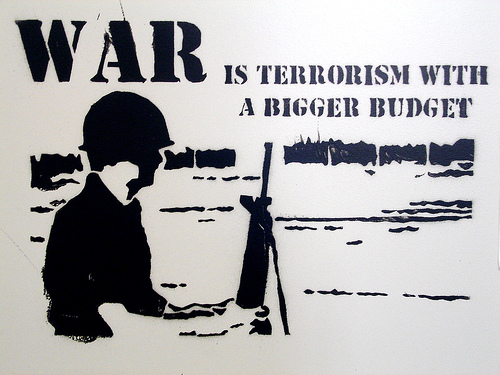
If you find no other argument against American intervention abroad persuasive, how about this one? When the U.S. government invades and occupies other countries, or when it underwrites other governments’ invasions or oppression, the people in the victimized societies become angry enough to want and even to exact revenge — against Americans.

Is the American empire worth that price?

We should ask ourselves this question in the wake of the weekend news that al-Shabaab, the militant Islamist organization that rules parts of Somalia ISIS-style, appeared to encourage attacks at American (and Canadian) shopping malls.

Maybe the Shabaab video was just a prank to scare us. Maybe it was an attempt to plant violent thoughts in the minds of Somalis living in the United States. No one believes that the organization itself is capable of attacking Americans where they live, but that doesn’t mean Shabaab-inspired violence is impossible.

At any rate, it’s unsettling to be advised to watch out for terrorism when we shop at the mall.

Here’s the thing: We don’t have to live this way. The empire is just not worth it. We must understand that people in the Middle East, Africa, and Central Asia who subscribe to fringe militant interpretations of Islam would not be wishing us harm except for the violence the U.S. government has inflicted or helped to inflict on Muslim societies for many decades. In fact, those militant interpretations wouldn’t be nearly so attractive without the American empire and its ally Israel.

Why won’t the media describe this context? It’s because their job, despite what they say, is to be the government’s megaphone, not its adversary.

Let’s look at Somalia, where the latest threat originated.

U.S. intervention goes back to 1992, when President George H.W. Bush sent the military into a civil war there. Among the military’s activities was the suppression of the Somalis’ use of the intoxicant khat, which has been part of their culture for millennia.

That’s right. The U.S. government imposed a war on the Somali drug of choice.

President Bill Clinton withdrew the forces after two Blackhawk helicopters were shot down, but that was not the end of U.S. intervention. After the September 11 attacks, Somali warlords seeking American largess played on the George W. Bush administration’s concerns about al-Qaeda. The CIA obliged the warlords with suitcases of cash. As a result, everyday life became intolerably violent. So when the Islamic Courts Union (ICU) — a relatively moderate coalition of Sharia courts in the capital, Mogadishu —drove out the warlords and produced a measure of peace and stability, the Somali people were relieved.

That should have been deemed satisfactory, except that the warlords and their American backers were unhappy with the new situation, as Jeremy Scahill reported in 2011. “Most of the entities that made up the Islamic Courts Union did not have anything resembling a global jihadist agenda,” Scahill wrote. “Nor did they take their orders from Al Qaeda.”

Nevertheless, the U.S. government was determined to oust the ICU. To achieve that goal the Bush administration in 2006 backed a military invasion by Ethiopia, Somalia’s long-time Christian adversary, which overthrew the ICU.

“The Ethiopian invasion was marked by indiscriminate brutality against Somali civilians,” Scahill wrote.

Ethiopian and Somali government soldiers secured Mogadishu’s neighborhoods by force, raiding houses in search of ICU combatants, looting civilian property and beating or shooting anyone suspected of collaboration with antigovernment forces.… If Somalia was already a playground for Islamic militants, the Ethiopian invasion blew open the gates of Mogadishu for Al Qaeda. Within some US counterterrorism circles, the rise of the Shabab in Somalia was predictable and preventable.

To make things worse, the U.S. government has waged a drone war, with civilian casualties, and special operations against the Somalis. According to Scahill, the CIA also operates a secret prison and other facilities there.

So the U.S.-sponsored intervention sowed the ground for the most militant group in Somalia, al-Shabaab. Had the ICU been left to govern, we might never have heard of these young Islamists, whom the Obama administration now uses to scare American shoppers.

We can live without the fear of terrorism — but only if the U.S. government stops antagonizing foreign populations that have never threatened us.

Sheldon Richman is vice president of The Future of Freedom Foundation and editor of FFF’s monthly journal, Future of Freedom. For 15 years he was editor of The Freeman, published by the Foundation for Economic Education in Irvington, New York. He is the author of FFF’s award-winning book Separating School & State: How to Liberate America’s Families; Your Money or Your Life: Why We Must Abolish the Income Tax; and Tethered Citizens: Time to Repeal the Welfare State. Calling for the abolition, not the reform, of public schooling. Separating School & State has become a landmark book in both libertarian and educational circles. In his column in the Financial Times, Michael Prowse wrote: “I recommend a subversive tract, Separating School & State by Sheldon Richman of the Cato Institute, a Washington think tank… . I also think that Mr. Richman is right to fear that state education undermines personal responsibility…” Sheldon’s articles on economic policy, education, civil liberties, American history, foreign policy, and the Middle East have appeared in the Washington Post, Wall Street Journal, American Scholar, Chicago Tribune, USA Today, Washington Times, The American Conservative, Insight, Cato Policy Report, Journal of Economic Development, The Freeman, The World & I, Reason, Washington Report on Middle East Affairs, Middle East Policy, Liberty magazine, and other publications. He is a contributor to the The Concise Encyclopedia of Economics. A former newspaper reporter and senior editor at the Cato Institute and the Institute for Humane Studies, Sheldon is a graduate of Temple University in Philadelphia. He blogs at Free Association. Send him e-mail.