How Money Printing Made Supply Chain Disruptions Even Worse

By Nicholas Baum

Source: Activist Post

Over the last few years, an unwelcome phrase has grown to plague American consumers and producers alike: supply chain issues. The recurring term is frequently offered by mainstream economists as the go-to explanation for record inflation, while the Biden Administration has seemingly twisted it into a sign of economic recovery. Commerce Secretary Gina Raimondo states,

“What we have here is a demand issue. The economy is doing better… People have money in their pocket. They’re spending that money. Demand is through the roof… Supply has to catch up.”

Although Raimondo said this back in October 2021, inflation has only worsened from an annual rate of 6.2 percent to 7.7 percent more than twelve months later, leading one to wonder if the Secretary is right that inflation is a matter of supply chains adjusting to an increase in wealth. Yet as it turns out, in the words of the Mises Institute’s Ryan McMaken, “the administration’s defenders are right about consumer demand and spending – even if for the wrong reasons.”

That is, although we’re indeed witnessing a large spike in demand (which is perhaps best quantified by changes in nominal GDP), this increase in demand is a symptom of a larger problem: the massive expansion of the money supply under the watch of the Federal Reserve and the White House. The implications of this unprecedented expansion are two-fold, not only stirring this increase in “demand” but contributing to supply chain issues through the distortion of price signals.

With state governments responding to the rise of Covid-19 by imposing lockdowns and forcibly closing “non-essential businesses,” both the Fed and the Trump and Biden Administrations stepped in with an extraordinarily expansive monetary and fiscal policy, respectively.

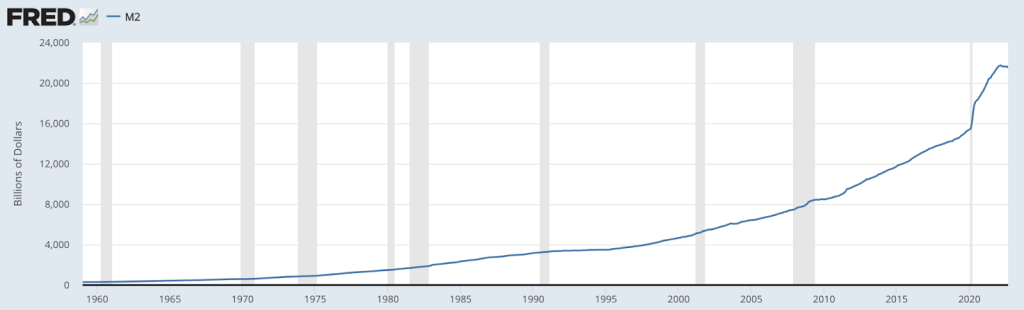
M2 is a figure for the money supply, which surged by more than $6.2 trillion, a 40 percent increase, between February 2020 and February 2022. This is the result of a variety of initiatives, from the Fed’s quantitative easing and purchase of over $2 trillion in assets to new federal programs such as stimulus checks, PPP loans, and the $1.9 trillion American Rescue Plan Act.

Through these ventures that flooded the economy with new cash, Americans indeed had more money in their pockets. The problem is, obviously, that such money soon became worth a lot less. That’s because an increase in the money supply, without a corresponding increase in economic output, means an increase in prices, with more money chasing roughly the same quantity of goods.

This is where Raimondo serves to mislead viewers in her comments; just because Americans have more money, doesn’t mean they’re any wealthier. There certainly is a large spike in demand, but that doesn’t represent an increase in the real wealth of Americans, but an increase in the amount of money they have access to thanks to an unprecedented monetary expansion.

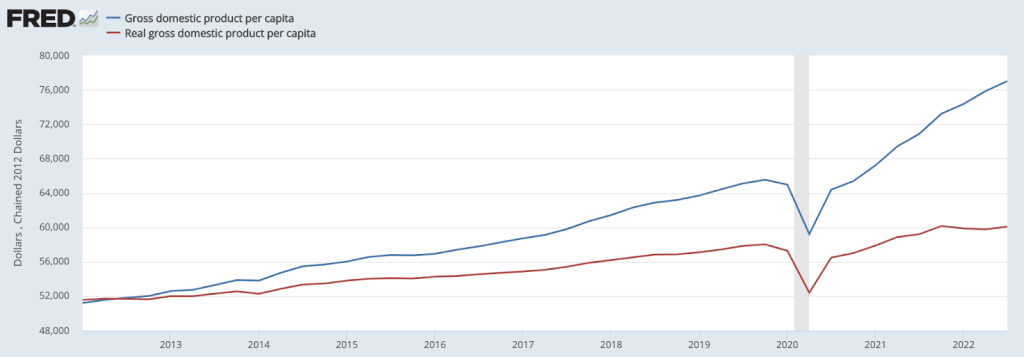
This is perhaps best represented by comparing nominal to real GDP per capita, which is a rough proxy for standard of living:

If you were to look only at nominal GDP per capita (the blue line) you would think that the average American’s wealth has increased greatly since the pandemic. This, however, is incredibly misleading, because it doesn’t take into account inflation and the decreasing value of the dollar.

The large demand increase noted by Raimondo and other economists does not reflect a growing economy and an increase in wealth but an increase in the money supply which has created upward pressure on prices. Yet just as the Biden Administration declares that “supply has to catch up,” the ability for producers to do so has been greatly strained by inflation (not to mention the aforementioned lockdowns).

That’s because of the role prices—which economist Alex Tabarrok refers to as “a signal wrapped up in an incentive” —play in coordinating economic activity. Changes in prices usually convey changes in the scarcity and demand for different goods, products, and resources. When the price of something in a company’s supply chain increases, this hurts the company’s profitability and incentivizes it to economize and find a more efficient alternative.

On a macro scale, economic growth (or recovery) comes through thousands, if not millions, of businesses and firms finding new ways to innovate and maximize profits, which is the result of comparing the prices of alternative inputs and production methods. Inflation, by raising the general price level of the economy and often affecting the price of each good differently, can cause economic discoordination and confusion because prices no longer reflect changing efficiencies and scarcities.

Even if inflation impacted all prices equally, we still wouldn’t know to what extent a rise in the price of a certain resource reflects actually important information about it, given that the rate of inflation is always changing and can only be measured in hindsight.

In the context of the last few years, this has meant that firms have essentially been blindfolded, piecing back together supply chains forcibly closed during the pandemic without the ability for prices to convey the efficiency of competing alternatives. This is exactly why “supply chain issues” has continued to be a lingering excuse for inflation and shortages, with Volkswagen chief executive Oliver Blume going so far as to say that, “Challenges to our supply chains will become the rule, not the exception.”

Nor is this a relatively recent phenomenon. Paul Volcker, the late Fed Chairman notable for remedying the United States’ last encounter with runaway inflation in the late 1970s and early 1980s, observed that, “The inflationary process itself brought so many dislocations, and stresses and strains that you were going to have a recession sooner or later.”

Given the fact that the United States technically entered a recession during the first half of 2022—at least according to a common definition of recession—Volcker’s words proved prescient. Not only has an unprecedented monetary expansion under the purview of the Fed and White House triggered a dangerous period of inflation; the inflation has also caused disruptions to the supply chain, which agencies (ironically) use as a scapegoat for inflation.

Now, with economic growth stagnant and inflation persisting at high levels, the fate of supply, demand, and the price signals that they convey rests in the hands of the problems’ culprits.

Crisis Update – FTX, High Connections And Dark Pools

By Moneycircus

Source: The Wall Will Fall

Crypto is finally interesting with the collapse of FTX exposing a political network.
These were no seaside Millennials building sand-castles with other people’s money.
The justly-named Sam Bankman-Fried was the second biggest donor in the midterms.

The firm crashed last week when depositors tried to withdraw $6 billion.
As the money’s been used to fund derivative bets, it may have a knock-on effect.
This is no simple Ponzi or trading fraud as the press is pretending.

The setup is spooky from its connections, timings and complexity, to the firms’ logos.
It bears an uncanny resemblance to the upscale Theranos viral testing fraud.
A crypto pioneer warns of an intelligence sex trafficking ring and promptly drowns.

Individual parts of the story, while suggestive of corruption or wrongdoing, do not tell of the sheer extent of collusion, or the span of this network. For that you need a lofty perspective.

To begin in a spirit of caution, let’s start with a post on one of the Reddit crypto threads: “So much of this FTX meltdown has been connected to various braindead conspiracy theory bullshit at this point. I don’t like the WEF, but this is neither surprising nor consequential to me and I’m highly suspicious of anyone who is suddenly shouting, I knew it! This goes all the way to the top!”

The individual, one g_squidman, says there is no reason to assume Ukrainian officials were siphoning aid money into black money markets; that FTX being located in a tax haven is a “Panama Papers type of conspiracy”; that the crisis serves as a pretext to destroy crypto; that the media lionized FTX out of nowhere; or that its connection to top financial watchdogs might mean it was somehow a deep state project.

“There’s no global deepstate that appointed FTX with the responsibility to make you eat bugs.”

There you have the classic conflation of issues intended to ridicule anyone asking questions. Often there’s a mention of the Moon landings, though not this time.

It was just one greedy billionaire stealing other people’s money — nothing to see. That is what the state corporate media said about Jeffrey Epstein: that it was just one greedy billionaire feeding his sex addiction.

Behind the screen

However this Reditor’s tone of the “only adult in the room” betrays a poor appreciation for how the media or politics works. Neither grants easy access. It is rationed — that is the source of its power. You do not gain publicity or political connections overnight as did Sam Bankman-Fried. By the way, I will hereinafter call him Sam, for the SBF acronym is too reminiscent of Saudi Arabia’s MBS, who has genuine wealth and power.

Look at his family connections plastered across Twitter. Did Sam’s sudden prominence generate those connections or is it the other way around — those connections were behind his rise?

We have watched for three years as events and personages emerge, as from behind a screen, taking their place in ongoing events, like an actor opening the next scene. Much of this cast enriches a narrative or an operation that’s already underway, and they advance rather than hinder its objectives.

As somone once said, if events were random, wouldn’t the little guy win just once in a while?

It does go to show how tiny a world it is — money going to Ukraine’s government, which employs FTX, a new broker loudly promoted by the corporate media and the World Economic Forum, that same broker donating to the Democratic Party and that funds research to bash Ivermectin and promote pandemics; a broker launched by two recent graduates, whose parents work with key government regulators — but it’s not a world that you or I could enter with ease. [1]

People follow celebrities so closely that they mistake them for friends: those on the screen slap each other on the back and share coffee; we imagine ourselves joining in.

Likewise followers of the crypto space — in which Sam is a celebrity if only for his notoriety — can fall for the illusion. His trademark tousled hair and cargo shorts add to the familiarity. Yet that should be a warning (not proof, of course) that he was cast for the role.

Every time a tech entrepreneur dons a black tennis shirt it seems they’re trying to sell something — because they are! They are the sales jocks pushed to the front. The world stage has only just seen the back of tousled Boris Johnson. Tousled Trudeau is still smarming his charm.

The team

To cut to the chase, Mark Wetjen has been FTX head of policy and regulatory strategy since Nov 2021. He served as Commodity Futures Trading Commissioner under President Barack Obama from 2011. He was deputy to the Gary Gensler, until the latter became Securities and Exchange Commisioner.

If the penny hasn’t dropped: how could the government not have known that FTX was a fraud for at least a year?

Sam met Gensler at the SEC several times over regulatory issues — perhaps linked to FTX’s acquisition of U.S.-based crypto lender BlockFi, which already had the regulatory approval, to see if this could be extended as an umbrella to cover FTX.

No evidence has emerged that Gensler did anything wrong — actually he has a reputation for slow-walking a regulatory framework that would encourage the crypto industry.

The U.S. is inconsistent in its regulation of crypto exchanges, banning in particular those it considers anonymous. While authorities do not recognize crypto as legal tender, they regard it as a value transaction and thus subject to tax.

Then, in early 2022, Sam met the chairman of the Federal Reserve.

A FOIA request shows that around midday on Feb 1, 2022, Federal Reserve Chairman Jerome Powell was scheduled to meet with: Sam Bankman-Fried, CEO and founder, Brett Harrison, president, Ryne Miller, general counsel, and Mark Wetjen, head of policy and regulatory strategy, FTX US and Zach Dexter, CEO, FTX US Derivatives. [2]

The World Economic Forum (WEF) helped promote FTX. Sam was a speaker at Davos last year, on a panel with Google financial chief Ruth Porat and Bill Winters, CEO of the London-based financial giant Standard Chartered. The WEF has since deleted a web page that listed FTX as a partner. [3]

Sam’s aunt Linda Fried is a Columbia University epidemiologist. The WEF funded her study into brain aging in 2012 and she sits on the WEF’s Council for Human Enhancement. Her husband is an expert in AIDS.

Brother Gabriel works for Sen Chuck Schumer and runs an organisation, Guarding Against Pandemics. FTX funded a trial that dismissed Ivermectin as a pandemic treatment. Sam’s foundation also gave $5 m to ProPublica to investigate “biosecurity and public health preparedness.”

Their mother, Barbara, runs Mind The Gap, that uses statistical models to calculate how Democratic donors can have the “greatest marginal impact.” It was launched two weeks after then Sen Joe Biden announced his presidential run. FTX head of ventures Amy Wu used to worked for the Clinton Foundation. Sam himself was the biggest donor to the Democratic Party in 2021-22 after George Soros.

Father, Joseph Bankman, is a Stanford University law professor who has advised Sen Elizabeth Warren on the drafting of legislation.

This past April Sam sat on a panel with President Bill Clinton and former British prime minister Tony Blair at an event in the Bahamas.

Trade organizations the Chamber of Progress and the Association of Digital Asset Markets on which FTX representatives sat, have deleted references.

The attempt is underway to rewrite history.

Nobody wants to admit

Gary Gensler’s relationship goes deeper. Gensler was, and still is, an economics professor at MIT where his boss was the father of Caroline Ellison, head of FTX sister company Alameda. U.S. Representative Tom Emmer is questioning his relationship with Sam’s parents. Gensler was finance chair for Hillary Clinton’s presidential campaign.

Comment from the investment world: the New York Post quotes an investor close to FTX as saying, “This is like a Madoff situation… almost everyone in tech and Hollywood invested in this thing, Now no one wants to admit to it.”

But the most predictable response comes from The New York Times. It published 2,200 words without mentioning Sam’s funding the Democratic Party as its second biggest donor, or anything about SEC head Gensler or his connections with the parents of Sam and Caroline Ellison, nothing about the WEF or the political associations of other employees, nor, of course, about Ukraine.

The NYT spoke to Sam, but got little new information. It rehashed the story of the crypto trading company Alameda, founded in 2017, FTX in 2019 as a place to store crypto purchases, and a cryptocurrency token FTT to trade on the platform.

Alameda took loans to invest in other ventures but when the market slid and creditors recalled their loans, Alameda used customer deposits at FTX to cover its debts. CoinDesk revealed that Alameda had a large amount of FTT, sparking a collapse in the price of the token. [4]

Yet these two companies, FTX and Alameda, have more than 70 subsidiaries and may have invested in 160 other companies.

The deputy head of crypto for Ukraine, Alex Bornyakov, deputy minister of digital transformation, denied the country had converted any U.S. aid on FTX, though it had used the platform to convert crypto donations into fiat money. [5]

Is there any other way to say, this goes right to the top?

Pushy saviours

The investment firm Sequoia Capital, which has lost money on its FTX investment, had an article on its website: “Sam Bankman-Fried has a Saviour Complex — and Maybe You Should Too.”

Though it’s since removed the article, the choice of words is telling, for there’s a lot of saviour complex around, from Greta Thunberg, King Charles and Bono, to Bill Gates, Klaus Schwab, Al Gore and Yuval Harari.

Perhaps the latter is currently the most prominent. An article from March fact checks Yuval Harari and shows where his key themes fall apart.

It turns out he makes claims for genes that are simply not true: the idea that you can edit health or cognitive abilites completely ignores the environmental variables that play a parallel role.

He says under-the-skin surveillance will monitor our emotions but this is physiognomical nonsense; people vary hugely in their emotional responses.

His claim that scientists perceive the universe as a flow of data — meaning that AI machines will inevitably rule us — is likewise bunk. Scientists do not hold such a view.

Why, therefore is Harari pushing this? It aligns with the commercial interest of Silicon Valley and tech companies in a way that Shoshana Zuboff, who coined the phrase surveillance capitalism, does not. [6]

The clue is that Harari’s book is being forced on all generations as if it were public information messaging, aka, propaganda.

“In October of 2021, Harari released Volume 2 of the graphic adaptation of Sapiens. Coming up next are a Sapiens children’s book, Sapiens Live, an immersive experience, and a multi-season TV show inspired by Sapiens. Our Populist Prophet is relentless in his search for new followers—and with them new heights of fame and influence.”

Darshana Narayanan writes that he is a science populist. He is worse than that. Harari, whether he knows it or not, is a marketing man for the surveillance capitalists of Silicon Valley. There is nothing organic about Yuval Harari.

One last daquiri

Which brings us back to Sam.

As FTX sank with the sun last Friday its executives claimed that hackers had stolen the last remaining $600-900 million.

At least half of it was reportedly transferred to a company that Sam held privately. Yet it’s far from clear that any amount of money can get him off the hook, as the boats return to the shore laden with marlin.

The question is whether Sam used his parents’ political ties to launch his own financial vehicle, or whether he was manipulated — the fall guy in an operation he could not fathom, for it was deep.

Could it be that Sam and his squeeze, Caroline Ellison, were just the Harry Potter cast that was put in place to deceive the Millenial crypto speculators? The world is a polluted pool where only the poisoned thrive.

The private equity manager Alex Krainer has drawn comparisons between the FTX affair and that of Theranos and privileged-brat founder Elizabeth Holmes who is currently being sentenced for fraud. [7]

The difference seems to be that Theranos blood test was supposed to be ready for the pandemic. The board was stacked with deep state perennials: Kissinger, Shultz, Perry, Nunn. When Holmes’ fraud was exposed, the PCR test had to be coopted instead. Its inventor Kary Mullis died conveniently and the German “virologist” Christian Drosten declared PCR a test for Covid.

While we have told the bald facts of political connection we cannot finish our poolside daquiri without one additional, speculative shot.

Two weeks ago a 29 year-old crypto pioneer, the co-founder of stablecoin platform MakerDAO, was discovered drowned off the beach in Puerto Rico.

Nikolai Mushegian, raised in Kansas by immigrants from Russia, was found hours after his final Tweet on Oct 28, 2022:

“CIA and Mossad and pedo elite are running some kind of sex trafficking entrapment blackmail ring out of Puerto Rico and caribbean islands. They are going to frame me with a laptop planted by my ex gf who was a spy. They will torture me to death.” [8]

Feel free to explore the similarity of the FBI’s publication of pedo symbols with the FTX and Alameda logos.

And recall Sam’s meeting with two compromised former national leaders in the photograph at the top of this newsletter.

Tie it in with the U.S. southern border policy that is allowing gangs to traffick unaccompanied children, which the administration flies by plane, often at night, to cities across the U.S..

Finally, ask if the financing of such an operation could be allowed to happen through traceable financial accounts.

But maybe the $32 billion company really did emerge from the daydream of two star crossed lovers on a tropical beach, an intense experience — and over too soon.

***

[1] FTX funded study — Ivermectin trial was exposed as fruadulent

[2] FOIA, Feb 2022 — Federal Reserve meeting (PDF)

[3] Wayback Machine — WEF page celebrating ties to FTX

[4] NYT, Nov 14, 2022 — How Sam Bankman-Fried’s Crypto Empire Collapsed

[5] CoinDesk, Nov 14, 2022 — Ukrainian Official Refutes FTX-Ukraine Money Laundering Rumors

[6] Darshana Narayanan, Current Affairs, Mar 2022 — The Dangerous Populist Science of Yuval Noah Harari

[7] Alex Krainer , Nov 12, 2022 — The FTX, Theranos fraud template

[8] Daily Mail, Nov 10, 202 — ‘Paranoid’ crypto millionaire drowns in Puerto Rico after tweeting that CIA and Mossad were after him

FTX and the Corruption of America

By Charles Hugh Smith

Source: Of Two Minds

Thanks to the FTX swindle, we now know the cost of a get out of jail free card in America: $40 million, paid to political elites. It seems even get out of jail free cards have suffered from inflation.

With hefty “donations” (heh) to elites, all wrong-doing is swept under a very capacious carpet. Jeffrey Epstein sprinkled a few million on the elites of Harvard, and he was ushered into this elite circle as an intimate pal. The fact that he was a rapacious predator of children was of no concern. A few million showered on the right people and causes makes evil and criminality disappear.

If a financier looter showers $40 million on “the right people,” mouths the “correct” phrases and issues empty promises to give away his looted billions, he becomes an instant golden boy of the right elites who have the power to protect him from consequences.

This is how America works now: in-your-face corruption is not just accepted, it’s glorified. Let’s score America’s wealth and power elites, regardless of party or political persuasion:

Integrity: zero.

Austerity: zero.

Restraint: zero.

Humility: zero.

Responsibility: zero.

Accountability: zero.

Sacrifice for the common good: zero.

Thrift: zero.

A society whose elites are so self-serving, corrupt, unaccountable and devoid of any sense of good and evil is doomed.
 Consider the bleatings of America’s power elite on the FTX swindle. Let’s have congressional hearings on this remarkable “financial event” that caught everyone by surprise, etc.

Translation: let’s stage some political theater to cloak the fact that the looters are being protected from consequences. We all know what happens if you’re caught selling a nickel bag on the street: you get a tenner in a hellhole prison.

But if you bribed the right people, you can swindle billions of dollars and walk free as an insincerely apologetic victim of your own success. Golly gee, I don’t understand what happened to all that money, even though I’m not exactly shy about declaring my own genius.

For reasons lost on the rest of us, investigations by the Securities and Exchange Commission (SEC) and the U.S. Department of Justice (DOJ) always come up empty. Gee, the looting was complicated and we can’t figure out who might have broken the laws against fraud, collusion, embezzlement, malfeasance, etc., so we’re letting everyone off the hook.

Or some sleazy, unaccountable intelligence agency is referenced in whispers that the looters are “assets” and therefore untouchable. Where exactly is the rule of law in a society where bribes, political pressure and having knowledge of elites’ skeletons in the closet melt away accountability and consequences?

The rule of law in America is an illusion, a useful myth promoted by PR hacks to cover the tracks of their employers. Corporate wrong-doing–swindles, collusion, fraud, embezzlement, malfeasance–is off the charts, but nobody is responsible. The criminal corporations are duly fined, a tiny clawback of their looting that’s written off as a cost of doing business.

Consider this data base of 6,300 major corporate fines and settlements from the early 1990s to 2015 compiled by Jon Morse. Nobody paid any personal fines or served any prison time for any of these thousands of violations.

There are two systems of “justice” in America: one which grants elites freedom from consequences of their toxic criminality and another one for the rest of us that imprisons hundreds of thousands in the War on Drugs Gulag.

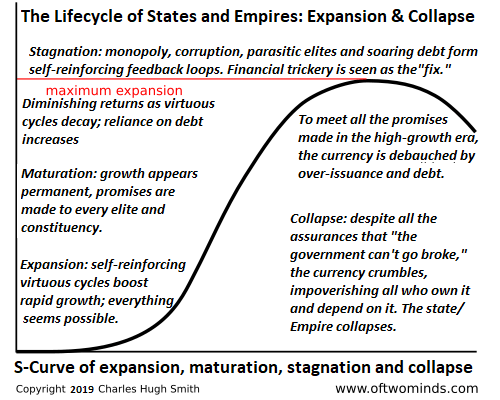
What all the entrenched insiders in America’s parasitic, predatory elites and institutions don’t dare admit is that to protect themselves from consequence, we’ve had to sacrifice everything else. Having stripped the nation of the essential foundation of a just, enduring social order–accountability, consequence, rule of law and a grasp of the difference between good and evil–there’s nothing left but sound and fury, as if they’re hoping the endless political circuses and trails of bread crumbs will forever distract us from their plunder and the injustices of the irredeemably corrupt America they’ve fashioned to protect their wealth and power.

To paraphrase Lao Tzu, if one insists on an extreme of corruption and injustice, that extreme will not dwell long.

FTX: The Dominoes of Financial Fraud Have Yet to Fall

By Charles Hugh Smith

Source: Of Two Minds

If you haven’t plowed through dozens of post-collapse commentaries on FTX, I’m saving you the trouble: here’s a distillation of what matters going forward. If you’re seeking a forensic accounting of FTX, others have done this work already. If you’re seeking an ideological diatribe, you won’t find that here, either.

What you will find is insight into the real innovation of FTX: FTX compressed the entire playbook and history of financial fraud into one brief cycle of the credulous bamboozled, Charles Ponzi bested and creative accounting being revealed for what it really is, fraud.

All financial frauds share the same set of tools. The toolbox of financial fraud, whether it is traditional or crypto-based, contains variations of these basic mechanisms:

1. Using clients’ capital (without full disclosure) to increase the private gain of the Owners of the Con (OOTC).

2. Using the clients’ capital to arbitrage yield differentials in duration, risk and other asymmetries to the benefit not of the clients but to the Owners of the Con (OOTC)..

3. Overstate assets by listing illiquid, insider-controlled, non-marked-to-market assets at valuations completely disconnected from reality, i.e. what they would fetch on the open market in size. Rely on assets issued by the firm or its subsidiaries for the bulk of the firm’s assets, i.e. its claim of solvency.

4. Attracting new capital investments and client funds with “too good to be true” (but borderline plausible, given the fantastic growth and track record of high returns) returns, goals and promises to cover the normal churn of redemptions, so the fraud goes undetected. (Ponzi Scheme)

5. Play fast and loose with leverage, the full extent of which isn’t disclosed to clients or regulators.

6. Issue securities (i.e. “money”–tokens, bonds, shares of stock, etc.) whose value is based on the firm’s fraudulently listed assets and mouth-watering growth.

7. Persuade investors and clients that you’re doing them a favor by letting them get a piece of the action. In other words, exploit their near-infinite greed.

8. Present a facade of prudent, audited, transparent, regulated stability which cloaks the interlocking network of fraud, bogus accounting, illiquid assets, etc. and insider looting.

I have often recommended Herman Melville’s novel The Confidence-Man for its masterful depiction of how The Confidence-Man persuades the skeptic that not only is The Confidence-Man trustworthy, but he is doing the mark a favor in taking his money.

Note that there are quasi-legal versions of some of these tools. The full exposure to the risks inherent in extreme leverage and illiquidity can be cloaked, buried in off-balance sheet assets and liabilities, etc., while pages of mind-numbing disclosures were duly signed by blinded-by-greed marks.

These quasi-legal versions are just as prone to unraveling and collapse as the blatantly fraudulent varieties. Properly disclosed leverage and illiquidity are just as prone to unraveling as undisclosed leverage and illiquidity.

Mismatches of duration, liquidity and risk are just as toxic to full-disclosure firms as they are to fraudulent firms.

This is why we can predict the dominoes of FTX’s financial fraud have yet to fall. When there are mismatches in counterparty asset durations and liquidity, assets that theoretically cover loans that are called can’t be sold or can only be sold at ruinous discounts.

Leverage works both ways, and so the 100-to-1 leverage that’s so glorious when the $1 yields $100 in gains also triggers the mass liquidation of illiquid assets when small losses unwind all that leverage.

Everyone caught short by losses, redemptions and counterparty claims will be desperate to hide their exposure to insolvency. But humans are herd animals, and once the herd gets spooked, trust in assurances quickly plummets and all eyes are on counterparty risks and the actual market for lightly traded assets.

Once assets are revealed as worth far less than claimed, insolvency is the inevitable result. How far will the lines of toppling dominoes extend? Quite possibly much farther than the credulous believe possible.

A Smoldering Fuse

By James Howard Kunstler

Source: Kunstler.com

We have pretty much burned our bridges at this point. Unless you’re prepared to mindfuck yourself, and gaslight yourself, and confess, and convert, there’s no going back to “normal” society (which we couldn’t go back to anyway, on account of how it doesn’t exist anymore) — CJ Hopkins

Thirty-seven billion more dollars for Ukraine? (That’s thirty-seven thousand millions of dollars, by the way.) Bringing the total this year to a click-or-two over ninety billion (ninety-thousand millions), on top of whatever Sam Bankman-Fried’s FTX company funneled through that sad-sack international money laundromat — soon to be the darkest backwater of a European failed state since Field Marshal Melchior von Hatzfeldt of Westphalia left Bohemia a corpse-strewn wasteland after the Battle of Jankau (1645).

    It really doesn’t matter how much more money we pound down that rat-hole, you understand, because by the time various parties — the weapons-makers, Volodymyr Zelensky, sundry members of the US House of Representatives, The Biden family, the World Economic Forum — are finished creaming off their fair shares, poor Ukraine won’t have enough cash-on-hand to replace six fuse-boxes in Zaporizhzhia.

    Against this backdrop, the USA enters a holiday season near-death spiral as unspooling scandals battle a collapsing economy for supremacy of the alt news sites. Case-in-point: the aforementioned FTX monkey business, a metastasizing tumor of the body politic. This complex fraud will smolder for a few weeks before it explodes into an extinction-grade event for the Democratic Party. The usual suspects among the mainstream media are trying to ignore it for the moment, but the shreds of this exploding money-borg are already sticking to guilty parties far and wide across the political landscape.

      FTX commander-in-chief Sam Bankman-Fried remains at large after steering the crypto-currency trading platform into a bankruptcy so hideously tangled that the assigned liquidator in court proceedings, one John Ray III, who oversaw the Enron aftermath years ago, was boggled by what he’s found so far (and it’s early in the game): Namely, a company run by a handful of twenty-something drug freaks with no idea what they were doing, no record-keeping, and a slime trail of misappropriated investor’s funds leading to Kiev and Geneva through various crooked American political action committees, and the halls of Congress — with echos in ballot harvesting shenanigans which shaped the outcome of this month’s US elections.

     Mr. Bankman-Fried is still scheduled as a main speaker for Accenture’s Nov. 30 DealBook Conference in New York ($2,499 for a ticket), along with Ukrainian President Volodymyr Zelensky and US Treasury Secretary Janet Yellen. Odds on him showing up? Or even being alive elsewhere on this planet then?

     The extended family Bankman-Fried is the quintessence of Woke aristocracy. Dad Joe Bankman and mom Barbara Fried are both law professors at Stanford. She also acted as a money-bundler for the Democratic Party and ran two non-profit “voter registration” orgs (against the IRS laws which only permit non-partisan organized voter registration). Brother Gabe Bankman-Fried headed a non-profit named Guarding Against Pandemics (funded by Sam), which lobbies Congress to construct new platforms for medical tyranny. Aunt Linda Fried is Dean of the Columbia U’s Public Health school, and is associated with Johns Hopkins, which ran the October 2019 Event 201 pandemic drill (sponsored by the Gates Foundation) months before the Covid-19 outbreak.

Sam’s girlfriend, Caroline Ellison, ran the Alameda Investments arm of the FTX empire (that is, FTX’s own money laundromat). Her dad, Glenn Ellison is chair of MIT’s Econ School. His former colleague on the MIT Econ faculty, Gary Gensler, who specialized in blockchains there, is now head of the Securities and Exchange Commission, an agency that Sam Bankman Fried was attempting to rope into a regulation scheme to eliminate FTX’s crypto-currency competitors. Caroline’s mom, Sara Fisher Ellison is an MIT econ prof specializing in the pharmaceutical industry (fancy that!). Caroline Ellison is currently on-the-run.

     The sum total of all this professional and academic accomplishment is also the quintessence of Woke-Jacobin turpitude in service to a political faction that seeks maximum moneygrubbing while acting to overthrow every norm of behavior in the conduct of elections, and perhaps in American life generally. That’s some accomplishment. It’s also a lesson in why the managerial elite of our country are no longer trustworthy. They have gotten away with crimes against the nation for years, which has only made them bolder and more reckless.

     Wait for the FTX bankruptcy to unwind, along with all the political ramifications it entails, not to mention the financial afterburn in the whole crypto market, very likely extending into and befouling the rest of the banking system. This is going to be a clusterfuck for the ages, and will propel the USA into a depression with no visible horizon.

How “Food Shortages” & Economic Collapse Protects the Status Quo

Engineered Food & Poverty Crises Secure Continued US Dominance

By Colin Todhunter

Source: Off-Guardian

In March 2022, UN Secretary-General Antonio Guterres warned of a “hurricane of hunger and a meltdown of the global food system” in the wake of the crisis in Ukraine.

Guterres said food, fuel and fertiliser prices were skyrocketing with supply chains being disrupted and added this is hitting the poorest the hardest and planting the seeds for political instability and unrest around the globe.

According to the International Panel of Experts on Sustainable Food Systems, there is currently sufficient food and no risk of global food supply shortages.

We see an abundance of food but skyrocketing prices. The issue is not food shortage but speculation on food commodities and the manipulation of an inherently flawed global food system that serves the interests of corporate agribusiness traders and suppliers of inputs at the expense of people’s needs and genuine food security.

The war in Ukraine is a geopolitical trade and energy conflict. It is largely about the US engaging in a proxy war against Russia and Europe by attempting to separate Europe from Russia and imposing sanctions on Russia to harm Europe and make it further dependent on the US.

Economist Professor Michael Hudson recently stated that ultimately the war is against Europe and Germany. The purpose of the sanctions is to prevent Europe and other allies from increasing their trade and investment with Russia and China.

Neoliberal policies since the 1980s have hollowed out the US economy. With its productive base severely weakened, the only way for the US to maintain hegemony is to undermine China and Russia and weaken Europe.

Hudson says that, beginning a year ago, Biden and the US neocons attempted to block Nord Stream 2 and all (energy) trade with Russia so that the US could monopolise it itself.

Despite the ‘green agenda’ currently being pushed, the US still relies on fossil fuel-based energy to project its power abroad. Even as Russia and China move away from the dollar, the control and pricing of oil and gas (and resulting debt) in dollars remains key to US attempts to retain hegemony.

The US knew beforehand how sanctions on Russia would play out. They would serve to divide the world into two blocks and fuel a new cold war with the US and Europe on one side with China and Russia being the two main countries on the other.

US policymakers knew Europe would be devastated by higher energy and food prices and food importing countries in the Global South would suffer due to rising costs.

It is not the first time the US has engineered a major crisis to maintain global hegemony and a spike in key commodity prices that effectively trap countries into dependency and debt.

In 2009, Andrew Gavin Marshall described how in 1973 – not long after coming off the gold standard – Henry Kissinger was integral to manipulating events in the Middle East (the Arab-Israeli war and the ‘energy crisis’). This served to continue global hegemony for the US, which had virtually bankrupted itself due to its war in Vietnam and had been threatened by the economic rise of Germany and Japan.

Kissinger helped secure huge OPEC oil price rises and thus sufficient profits for Anglo-American oil companies that had over-leveraged themselves in North Sea oil. He also cemented the petrodollar system with the Saudis and subsequently placed African nations, which had embarked on a path of (oil-based) industrialisation, on a treadmill of dependency and debt due to the spike in oil prices.

It is widely believed that the high-priced oil policy was aimed at hurting Europe, Japan and the developing world.

Today, the US is again waging a war on vast swathes of humanity, whose impoverishment is intended to ensure they remain dependent on the US and the financial institutions it uses to create dependency and indebtedness – the World Bank and IMF.

Hundreds of millions will experience (are experiencing) poverty and hunger due to US policy. These people (the ones that the US and Pfizer et al supposedly cared so much about and wanted to get a jab into each of their arms) are regarded with contempt and collateral damage in the great geopolitical game.

Contrary to what many believe, the US has not miscalculated the outcome of the sanctions placed on Russia. Michael Hudson notes energy prices are increasing, benefiting US oil companies and US balance of payments as an energy exporter. Moreover, by sanctioning Russia, the aim is to curtail Russian exports (of wheat and gas used for fertiliser production) and for agricultural commodity prices to therefore increase. This too will also benefit the US as an agricultural exporter.

This is how the US seeks to maintain dominance over other countries.

Current policies are designed to create a food and debt crisis for poorer nations especially. The US can use this debt crisis to force countries to continue privatising and selling off their public assets in order to service the debts to pay for the higher oil and food imports.

This imperialist strategy comes on the back of ‘COVID relief’ loans which have served a similar purpose. In 2021, an Oxfam review of IMF COVID-19 loans showed that 33 African countries were encouraged to pursue austerity policies. The world’s poorest countries are due to pay $43 billion in debt repayments in 2022, which could otherwise cover the costs of their food imports.

Oxfam and Development Finance International have also revealed that 43 out of 55 African Union member states face public expenditure cuts totalling $183 billion over the next five years.

The closure of the world economy in March 2020 (‘lockdown’) served to trigger an unprecedented process of global indebtedness.

Conditionalities mean national governments will have to capitulate to the demands of Western financial institutions. These debts are largely dollar-denominated, helping to strengthen the US dollar and US leverage over countries.

The US is creating a new world order and needs to ensure much of the Global South remains in its orbit of influence rather than ending up in the Russian and especially Chinese camp and its belt road initiative for economic prosperity.

Post-COVID, this is what the war in Ukraine, sanctions on Russia and the engineered food and energy crisis are really about.

Back in 2014, Michael Hudson stated that the US has been able to dominate most of the Global South through agriculture and control of the food supply. The World Bank’s geopolitical lending strategy has transformed countries into food deficit areas by convincing them to grow cash crops – plantation export crops – not to feed themselves with their own food crops.

The oil sector and agribusiness have been joined at the hip as part of US geopolitical strategy.

The dominant notion of ‘food security’ promoted by global agribusiness players like Cargill, Archer Daniel Midland, Bunge and Louis Dreyfus and supported by the World Bank is based on the ability of people and nations to purchase food. It has nothing to do with self-sufficiency and everything to do with global markets and supply chains controlled by giant agribusiness players.

Along with oil, the control of global agriculture has been a linchpin of US geopolitical strategy for many decades. The Green Revolution was exported courtesy of oil-rich interests and poorer nations adopted agri-capital’s chemical- and oil-dependent model of agriculture that required loans for inputs and related infrastructure development.

It entailed trapping nations into a globalised food system that relies on export commodity mono-cropping to earn foreign exchange linked to sovereign dollar-denominated debt repayment and World Bank/IMF ‘structural adjustment’ directives. What we have seen has been the transformation of many countries from food self-sufficiency into food deficit areas.

And what we have also seen is countries being placed on commodity crop production treadmills. The need for foreign currency (US dollars) to buy oil and food entrenches the need to increase cash crop production for exports.

The World Trade Organization’s Agreement on Agriculture (AoA) set out the trade regime necessary for this type of corporate dependency that masquerades as ‘global food security’.

This is explained in a July 2022 report by Navdanya International – Sowing Hunger, Reaping Profits – A Food Crisis by Design – which notes international trade laws and trade liberalisation has benefited large agribusiness and continue to piggyback off the implementation of the Green Revolution.

The report states that US lobby and trade negotiations were headed by former Cargill Investors Service CEO and Goldman Sachs executive – Dan Amstutz – who in 1988 was appointed chief negotiator for the Uruguay round of GATT by Ronald Reagan. This helped to enshrine the interests of US agribusiness into the new rules that would govern the global trade of commodities and subsequent waves of industrial agriculture expansion.

The AoA removed protection of farmers from global market prices and fluctuations. At the same time, exceptions were made for the US and the EU to continue subsidising their agriculture to the advantage of large agribusiness.

Navdanya notes:

“With the removal of state tariff protections and subsidies, small farmers were left destitute. The result has been a disparity in what farmers earn for what they produce, versus what consumers pay, with farmers earning less and consumers paying more as agribusiness middlemen take the biggest cut.”

‘Food security’ has led to the dismantling of food sovereignty and food self-sufficiency for the sake of global market integration and corporate power.

We need look no further than India to see this in action. The now repealed recent farm legislation in India was aimed at giving the country the ‘shock therapy’ of neoliberalism that other countries have experienced.

The ‘liberalising’ legislation was in part aimed at benefiting US agribusiness interests and trapping India into food insecurity by compelling the country to eradicate its food buffer stocks – so vital to the nation’s food security – and then bid for food on a volatile global market from agribusiness traders with its foreign reserves.

The Indian government was only prevented from following this route by the massive, year-long farmer protest that occurred.

The current crisis is also being fuelled by speculation. Navdanya cites an investigation by Lighthouse Reports and The Wire to show how speculation by investment firms, banks and hedge funds on agricultural commodities are profiting off rising food prices. Commodity future prices are no longer linked to actual supply and demand in the market but are based purely on speculation.

Archer Daniels Midland, Bunge, Cargill and Louis Dreyfus and investment funds like Black Rock and Vanguard continue to make huge financial killings, resulting in the price of bread almost doubling in some poorer countries.

The cynical ‘solution’ promoted by global agribusiness to the current food crisis is to urge farmers to produce more and seek better yields as if the crisis is that of underproduction. It means more chemical inputs, more genetic engineering techniques and suchlike, placing more farmers in debt and trapped in dependency.

It is the same old industry lie that the world will starve without its products and requires more of them. The reality is that the world is facing hunger and rising food prices because of the system big agribusiness has instituted.

And it is the same old story – pushing out new technologies in search of a problem and then using crises as justification for their rollout while ignoring the underlying reasons for such crises.

Navdanya sets out possible solutions to the current situation based on principles of agroecology, short supply lines, food sovereignty and economic democracy – policies that have been described at length in many articles and official reports over the years.

As for fighting back against the onslaught on ordinary people’s living standards, support is gathering among the labour movement in places like the UK. Rail union leader Mick Lynch is calling for a working class movement based on solidarity and class consciousness to fight back against a billionaire class that is acutely aware of its own class interests.

For too long, ‘class’ has been absent from mainstream political discourse. It is only through organised, united protest that ordinary people will have any chance of meaningful impact against the new world order of tyrannical authoritarianism and the devastating attacks on ordinary people’s rights, livelihoods and standards of living that we are witnessing.

Peering Into the Crystal Ball, We See… Instability Leading to Collapse

By Charles Hugh Smith

Source: Of Two Minds

We can only choose one: open, dynamic stability (evolution) or autocracy (instability and collapse).

When the fundamentals of life change, every organism must evolve or die. This is equally true of human organizations, societies and economies.

Evolution requires conserving what still works and experimenting until something comes along that works better. We call the fundamentals changing selective pressure and the process of experimenting with mutations / variations natural selection.

In genetic and epigenetics, this process is automatic. In human organizations, those in power influence the choice of what is conserved or replaced and what it’s replaced with. Those who benefit from the current arrangement will fight to conserve it as is, while those being weakened by selective pressure and those hoping to gain advantages with a new arrangement will fight for replacing the old with the new.

Longtime correspondent Ron G. recently shared an insightful economic characterization of this dynamic: wealth defense vs wealth creation. Those holding the system’s wealth have few incentives to risk changing the system, as those changes could undermine or erode their wealth. They have incentives to limit evolutionary forces that threaten their wealth as a means of defending their wealth.

Those who have lost wealth and those with little wealth have incentives to change the system to favor wealth creation.

We can describe the first as orthodoxy–evolution threatens the stability of the status quo, so limit evolution to the margins–and heretics being the second option that tosses out the status quo in favor of a more advantageous variation.

This isn’t either / or, of course. As Ron points out, corporations have incentives to both conserve stability and embrace variations that increase revenues and profits by expanding the markets for the company’s products. In Ron’s words: “The function of orthodoxy or corporate policy / rigor is to mitigate variations that would decrease stability.”

In other words, there’s a danger of throwing the baby out with the bath water. Dynamic equilibrium is based on a constant flux of variations and experiments–that is, low-level instability–continually modifying the system to maintain core stability.

Without this constant flux of low-level instability, sources of instability pile up, unnoticed and uncorrected, until they become consequential enough to destabilize the entire system. The system implodes, crashes, unravels, etc.

We can understand this flux of variations and experiments as evolutionary churn, and this churn requires two things: a steady flow of mutations / variations to feed the process of experimentation, and transparency so advantageous variations aren’t suppressed. In a transparent evolutionary system, data and information about each variation and experiment flows freely between all nodes in the system.

You see the problem. Those benefiting from the status quo are threatened by variations that could replace whatever is defending their wealth. Those in power benefit from the status quo, so their Job One is to suppress evolution by limiting transparency and variations, which include dissent.

Theoretically, those in power favor evolutionary advances that enhance their power and wealth, but anything that powerful is generally a two-edged sword: modified slightly, it could disrupt the entire status quo and fatally undermine their power.

So the safe bet is to suppress all evolutionary churn except those improvements which can be used to further cement their power. These are by definition autocratic.

You see the delicious irony: autocrats suppress evolutionary churn and transparency as threats, but evolutionary churn and transparency are the essential forces maintaining the system’s dynamic equilibrium. Once the system’s dynamic equilibrium decays, systemic instability builds up and eventually brings the entire system crashing down.

Because this process is obscured by authoritarian suppression of transparency, “nobody saw it coming.”

As those in power adopt ever stronger authoritarian measures to limit the potential threats of evolutionary churn and transparency, they accelerate the fatal instabilities building up within their self-serving, kleptocratic social, political and economic systems.

By suppressing the evolutionary churn and transparency that maintain the system’s dynamic equilibrium, they doom their regime to collapse.

The crystal ball isn’t cloudy, it’s crystal-clear: rising instability leading to collapse. “Nobody saw it coming” except those who understand evolution requires evolutionary churn and transparency.

Collapse is a perfectly good evolutionary solution. Stability is either dynamic or it’s not actually stable; it’s merely a simulacrum of stability sliding toward instability and ruin.

The better option is to embrace evolutionary churn and transparency and accept the trade-off: we can only choose one: open, dynamic stability (evolution) or autocracy (instability and collapse). Choose wisely, for once systems collapse there’s no turning back the clock.

It’s A Fact That Needs Repeating: The Federal Reserve Is A Suicide Bomber

By Brandon Smith

Source: Alt-Market.us

For many years now I have been examining the policies and behaviors of the Federal Reserve because they are in fact the most powerful institution in the US, with far more influence over the fate of America than any single president or branch of government. They have the power to end the economic life of our country in a matter of moments. They hold their finger on the button of multiple financial nuclear bombs, and to this day there are people that still pretend as if they are a mere moderating presence subservient to the White House or Congress.

This is a fallacy proven by history and the admissions from central bankers own mouths. The Fed answers to no one in our government. They answer to a different set of masters, and the blame for the consequences of their policies falls to them and their cohorts.

Last year I published an article titled ‘The Fed’s Catch-22 Taper Is A Weapon, Not A Policy Error.’ In that article I predicted that the Fed would embark on a hiking spree on interest rates in response to inflationary/stagflationary events. I noted that:

We are now at that stage again where price inflation tied to money printing is clashing with the stock market’s complete reliance on stimulus to stay afloat. There are some that continue to claim the Fed will never sacrifice the markets by tapering. I say the Fed does not actually care, it is only waiting for the right time to pull the plug on the US economy.”

At the time I received a lot of resistance to the idea. The usual argument was: “The fed will never raise rates and put stock markets at risk. Why would they destroy the golden goose?”

This position showcases a common misconception about the central bank and its purpose. You see, a lot of people think the Fed exists to keep the US economy afloat, and specifically to keep stock markets afloat. This is incorrect. Every single policy of the Fed since its inception has been a long train of abuses designed to slowly and scientifically whittle down the US economy and bring it to the point of extinction.

The next most common argument is: “Wouldn’t the fed sabotaging the economy eventually destroy them as well?”

The answer is YES, and they don’t care. If you have read my previous work on this issue then you know that the Fed is inexorably tied to the Bank for International Settlements (the “central bank of central banks”) and that they call the shots in terms of coordinated global banking initiatives. The BIS is a globalist institution, not an American one, and its agenda is ideologically globalist in nature. The Fed is a servant of globalism; and if the US economy or our currency need to be brought down through a controlled demolition in order to make the globalist dream of a one world socialist “Utopia” come true, that is exactly what the Fed will do.

I was able to predict that the Fed would continue onward with its interest rate hikes and hawkish position only because I acknowledge what the Fed really is: A suicide bomber. And, they have decided the time is ripe to hike interest rates into economic weakness, just like they did at the onset of the Great Depression.

At the beginning of the Depression the Fed increased interest rates after years of artificially stimulating markets with low cost debt. This prolonged the deflationary crash for many years after. It was not until decades later when former Fed chair Ben Bernanke gave a speech celebrating economist Milton Friedman’s 90th birthday that a central bank official finally admitted that the organization was culpable for the Depression debacle.

In short, according to Friedman and Schwartz, because of institutional changes and misguided doctrines, the banking panics of the Great Contraction were much more severe and widespread than would have normally occurred during a downturn.

Let me end my talk by abusing slightly my status as an official representative of the Federal Reserve. I would like to say to Milton and Anna: Regarding the Great Depression. You’re right, we did it. We’re very sorry. But thanks to you, we won’t do it again.” – Ben Bernanke, 2002

What Ben Bernanke did not admit to was that the engineered deflationary crisis greatly benefited the allies of the Fed – The international corporate bankers. Companies like JP Morgan and Chase National were suddenly in a prime position to seize unlimited power in the US.

So, they’ve done it before, why wouldn’t they do it again?

The next argument that I hear constantly is that the Fed is “ignorant” and they don’t know what they are doing. This is nonsense. Jerome Powell knows EXACTLY what he is doing, and here is the proof – In October of 2012 the Fed held a meeting in which Powell warned that markets and corporations had become addicted to the Fed’s easy money policies. If they decided to taper their stimulus measures and raise rates, there would be potentially disastrous blowback. Powell argued that:

“…I think we are actually at a point of encouraging risk-taking, and that should give us pause. Investors really do understand now that we will be there to prevent serious losses. It is not that it is easy for them to make money but that they have every incentive to take more risk, and they are doing so. Meanwhile, we look like we are blowing a fixed-income duration bubble right across the credit spectrum that will result in big losses when rates come up down the road. You can almost say that that is our strategy.” – Jerome Powell

As he admitted, it is indeed their strategy. Powell was not the Fed chairman at the time, so he may not have been aware of the full agenda, but he is certainly aware now. Why would Powell undertake the exact policy action he once warned would result in a full spectrum implosion of the credit bubble? Probably because he was told to.

Powell knows the history of the Great Depression and he knows what will happen when the Fed raises rates into economic weakness and he is doing it anyway. He already tried a test run of rate hikes back in 2018 and the results were not hard to figure out; markets began to tank. We should never forget that the central banks are fully cognizant of the effects of their endeavors. As I stated back in February:

The rate hikes of 2018 were a test run for a more aggressive and deliberately engineered crisis down the road. The Fed has its own agenda, it does not care about protecting U.S. markets, nor does it even care about protecting the U.S. economy in general.

I hold that the Fed is a weapon for social and political change within America and part of its job is to greatly reduce the standard of living of the population while making it appear as if this decline is a “natural” consequence of the U.S. System.”

This leads us to the final question – What happens next?

That’s easy to answer: The fed continues to hike rates well into next year and will not reverse course or capitulate and return to stimulus. The dovish predictions were wrong. The people that said the Fed would not raise rates were wrong. The people that said the Fed would never remove support from stock markets were wrong. This process is ongoing and the effects will grow as the months pass, but those that were hoping for a manic return to the days of bailouts and QE are going to be deeply disappointed.

This is a stagflationary crash, and as such we are going to experience the worst of both deflationary and inflationary worlds. Prices will remain high while GDP goes negative. Sales will decline and jobs will decline as we enter into the end of this year. There is no way around this. The Fed will have all kinds of theories and misdirections on why these things are happening, and they will try to distract the public as much as possible in the meantime.

What the Fed will never do is admit that a crash is happening until it is too late for people to act. They will never warn the populace of the dangers and they will never tell people to prepare. Watch as they tap dance and tell the public that all the pain is “transitory.” Then, watch as the dust settles and they tell people that “no one could have seen this coming.” It’s all very predictable, because it’s all been done before.