‘$2.5 TRILLION THEFT’ – STUDY SHOWS RICHEST 1% OF AMERICANS HAVE TAKEN $50 TRILLION FROM BOTTOM 90% IN RECENT DECADES


The median U.S. worker salary would be around twice as high today if wages kept pace with economic output since World War II, new research revealed.

By Brett Wilkins

Source: Common Dreams

New research published Monday found that the top 1% of U.S. income earners have taken $50 trillion from the bottom 90% over the past several decades, and that the median worker salary would be around twice as high today as it was in 1945 if pay had kept pace with economic output over that period.

The study’s authors, Carter C. Price and Kathryn Edwards of the RAND Corporation, examined income distribution and economic growth in the United States from 1945 to the present. The researchers found stark differences between income distribution from 1945 to 1974 and 1975 to 2018.

According to the study—which was funded by the Seattle-based Fair Work Center—the median salary of a full-time U.S. worker is currently about $50,000. Adjusted for inflation using the consumer price index, workers at or below the current median income now earn less than half of what they would have if incomes had kept pace with economic growth. This means that if salaries had kept pace with economic output, the median worker pay would be between $92,000 and $102,000 today, depending on how inflation is calculated.

Had the more equitable distribution of the roughly 30-year postwar period continued apace, the total annual income of the bottom 90% of American workers would have been $2.5 trillion higher in 2018, or an amount equal to about 12% of GDP.  In other words, the upward redistribution of income has enriched the 1% by some $47 trillion—which would now be more than $50 trillion—at the expense of American workers.

David Rolf, a Seattle labor organizer, president of the Fair Work Center, and founder of Service Employees International Union (SEIU) Local 775, is more blunt. He calls this “the $2.5 trillion theft.”

“From the standpoint of people who have worked hard and played by the rules and yet are participating far less in economic growth than Americans did a generation ago, whether you call it ‘reverse distribution’ or ‘theft,’ it demands to be called something,” Rolf, who helped lead the fight for a $15 hourly minimum wage in Seattle and beyond, told Fast Company.

Remarkably, the study found that workers at all income levels would be better off today if income kept pace with output. Full-time, prime-age workers in the 25th percentile, for example, would be earning $61,000 instead of $33,000. Workers in the 75th percentile, who in 2018 earned $81,000, would be making $126,000. Even 90th-percentile workers, who earn $133,000, would be making $168,000 under the more equitable distribution.

On the other hand, had the economic pie been divided more equitably, the income of the top 1% would fall from around $1.2 million to a still-affluent $549,000.

“We were shocked by the numbers,” said Nick Hanauer, a venture capitalist and self-described “zillionaire” who, along with Rolf, came up with the idea for the study. “It explains almost everything,” Hanauer told Fast Company. “It explains why people are so pissed off. It explains why they are so economically precarious.”

Sen. Bernie Sanders (I-Vt.), who made correcting economic inequality a pillar of both of his presidential bids, lamented the “h-u-g-e redistribution of income in America” in a Monday tweet.

The researchers’ findings, which come amid a deadly coronavirus/Covid-19 pandemic, shine light on the injustice of an economy—by far the wealthiest in the history of civilization—in which essential workers struggle mightily, and often in vain, to survive while the richest people grow ever richer at their expense.

According to Americans for Tax Fairness, the total wealth of U.S. billionaires increased by $792 billion, or 27%, during the first five months of the Covid-19 pandemic. During this period, Amazon CEO Jeff Bezos, the world’s wealthiest person, has become the world’s first multi-centibillionaire, with a net worth now surpassing $200 billion. Meanwhile, his employees struggle to make ends meet, and Amazon workers who speak out against poor pay and hazardous working conditions during the pandemic have been fired and derided by company executives.

Compared to other most-developed nations, the U.S. has done a relatively poor job of taking care of its people during the pandemic. In addition to the U.S. being the only developed nation without universal healthcare, its workers have received less in direct payments and government support than people in many comparable countries.

The gap between the richest and poorest U.S. households is now wider than it has ever been in the past 50 years, according to the most recently available data from the U.S. Census Bureau. The pandemic has only exacerbated the situation, as around half of lower-income American households have reported a job or wage loss due to Covid-19.

Internationally, the U.S. ranks 39th out of over 150 nations in income inequality, according to Gini coefficient data compiled by the CIA, placing it roughly on par with nations like Peru and Cameroon. Among Organization for Economic Cooperation and Development (OECD) nations, the U.S. has the seventh-highest level of income inequality.

The U.S. has the highest poverty rate among the world’s most-developed nations, and the fourth-highest poverty rate among OECD nations after South Africa, Costa Rica, and Romania. According to UNICEF, the U.S. also has the second-highest rate of childhood poverty in the developed world behind Romania, with more than one in five U.S. children—and over one in four Latinx children, and nearly one in three Black and Native American children—living in poverty.

This year, more than 54 million Americans, or roughly one in every six people—including 18 million children—may experience food insecurity, according to the nonprofit group Feeding America.

New Pentagon-Google Partnership Suggests AI Will Soon Be Used to Diagnose Covid-19

Google recently teamed up with the Pentagon as part of the new, AI-driven “Predictive Health” program. Though only focused on “predictive cancer diagnoses” for now, Google and the military have apparent plans to expand the AI model for automating and predicting Covid-19 diagnoses.

By Whitney Webb

Source: Unlimited Hangout

At the beginning of September, Google Cloud announced that it had won a project from the Pentagon’s relatively new Defense Innovation Unit (DIU) to “prototype an AI-enabled digital pathology solution at select DoD [Department of Defense] facilities.” This prototype, per a Google Cloud press release, combines “augmented reality telescopes” with “AI-enabled” cancer detection tools that will allegedly improve the accuracy of “predictive cancer diagnoses.” It is the second DIU contract Google has won this year, with the first being related to combatting “cyber threats.”

The initial implementation of this Pentagon-funded, Google-created “digital pathology solution” will take place “at select Defense Health Agency (DHA) treatment facilities and Veterans Affairs hospitals in the United States,” and the program includes “future plans to expand across the broader U.S. Military Health System,” according to Google.

The initiative is part of a larger DIU-led program called “Predictive Health” that is also partnered with the joint AI effort of the US military and US intelligence community, the Joint Artificial Intelligence Center, and JAIC’s “Warfighter Health” initiative. The JAIC, which is currently led by a former Silicon Valley executive, is providing much of the funding for Predictive Health, while its related “Warfighter Health” initiative more broadly seeks “to field AI solutions that are aimed at transforming military health care.”

In addition to its stated goal of improving the accuracy of cancer diagnoses, the implementation of this Google-DIU AI-driven medical diagnosis tool aims to show “frontline health practitioners” that such tools “can improve the lives” of US troops, according to Google executives. As Mike Daniels, vice president of Global Public Sector at Google Cloud, noted in a statement, Google is “partnering with DIU to provide our machine learning and artificial intelligence technology to help frontline healthcare practitioners learn about capabilities that can improve the lives of our military men and women and their families.” Google also stated that the use of their tool at military health facilities would also “lower overall healthcare costs.”

The Google-DIU effort to outsource human doctor decision-making to a tailor-made artificial intelligence algorithm is, for now, only focused on the diagnosis of cancers. However, last Thursday, less than two weeks after winning the DIU contract, Google announced that it was donating $8.5 million to several organizations to advance the development and use of AI  “for monitoring and forecasting” Covid-19. That money is part of a larger $100 million donation from Google for financing “solutions” to Covid-19 that was announced in May.

Further evidence that Google soon plans to offer AI-driven “predictive diagnoses” for Covid-19 came in August, when Google Cloud partnered with Harvard’s Global Health Institute to provide “Covid-19 Public Forecasts,” which “provide a projection of Covid-19 cases, deaths, and other metrics over the next 14 days for US counties and states.” The announcement of the Google-Harvard collaboration coincided with an announcement from the National Institutes of Health (NIH) would begin “harness[ing] AI for COVID-19 diagnosis, treatment, and monitoring.”

Notably, other tech companies that have produced “predictive diagnosis” AI models for Covid-19 also began first by offering AI-created “forecasts” of “likely” Covid-19 outbreaks. For instance, the Israeli intelligence–linked Diagnostic Robotics initially offered AI-driven predictive “forecasts” of cities and districts to guide lockdown policy in Israel and the US state of Rhode Island before then teaming up with the US-based company Salesforce to develop a platform that uses AI to “predict” which individuals are likely to be diagnosed with Covid-19 and then uses AI to monitor and even “treat” those individuals.

Furthermore, in partnership with researchers at Mount Sinai healthcare centers in New York, tech giant Microsoft has already aided the development of an AI algorithm that “rapidly diagnoses” Covid-19. Mount Sinai’s AI model, supported by a recent grant from Microsoft’s “AI for Health” initiative, “was as accurate as an experienced radiologist in diagnosing the disease,” according to one of the lead researchers behind the model’s development. While its development was aided by Microsoft, the core of the Mount Sinai AI model is TensorFlow, which was developed by Google and is Google AI’s second-generation system for machine learning.

In addition, both Google and Microsoft are part of a Europe-based effort aimed at “automating diagnoses” for Covid-19 via an AI algorithm that analyzes CT scans, which is similar in several ways to the Mount Sinai AI model. Thus, it seems highly likely that Google’s efforts to offer AI-powered “predictive diagnoses” will soon expand to include tools that use algorithms to diagnose Covid-19, not just cancer.

The Merging of the Pentagon, the CIA, and Silicon Valley

Established in 2015, the Defense Innovation Unit of the Department of Defense officially exists to transfer “leading-edge commercial capabilities to the military faster and more cost-effectively than traditional defense acquisition methods” and to accelerate “the adoption of commercial technology throughout the military and [grow] the national security innovation base.” As the DIU makes clear on its website, the “national security innovation base” it seeks to “grow” consists of private tech companies, namely those based in Silicon Valley, that provide “advanced commercial solutions” to “national security challenges.” This, of course, includes the tech companies that already double as contractors for the national security state, such as Google, Microsoft, and Amazon, among numerous others.

The DIU boasts offices in Silicon Valley, Boston, Austin, and at the Pentagon itself and is largely led, not by career military men, but by former Silicon Valley executives. For instance, its current director—Michael Brown—is the former CEO of cybersecurity giant Symantec and, prior to that, led the Quantum corporation. In another example, the leader of the DIU’s artificial intelligence portfolio is Jeff Klugman, a former top executive at TiVo, the Quantum corporation, and Hewlett-Packard.

A year after the DIU was created, it was followed by the Defense Innovation Board (DIB), which is composed of “leaders from across the national security innovation base” and provides recommendations that “have been used to inform DoD leadership strategy and action, as well as congressional legislation.” Like the DIU, Silicon Valley is well represented on the DIB, as its members include former Google CEO Eric Schmidt and LinkedIn founder Reid Hoffman as well as top executives from Google, Microsoft, and Facebook.

Notably, just months before the DIU-led Predictive Health program was launched, the DIB noted in March 2020 that the Pentagon “owns the largest repository of disease- and cancer-related medical data in the world,” asserting further that “if the entire repository were leveraged to its fullest potential, it would advance diagnosis and treatment for thousands of illnesses, saving lives across DoD and the global population.” The DIB then specifically suggested that “artificial intelligence and machine learning models may help pathologists sort through this massive dataset more quickly and effectively to provide better care for patients in and out of the military,” adding that these troves of medical data should be used “to support DoD reform and modernization efforts in the field of AI/ML [Artificial Intelligence / Machine Learning].”

In other words, the Silicon Valley–dominated DIB called for what is now the Predictive Health program just months before the Silicon Valley–dominated DIU formally announced it. Also noteworthy is that Google—whose former CEO, current vice president, and several other Google-tied researchers and businessmen serve on the DIB—is the very company that won the DIU contract to have its AI models serve as the foundation for the Predictive Health program. This, of course, means that Google’s AI models will benefit immensely from the Pentagon’s “unique” and massive medical datasets, which the DIB previously stated was something that the Pentagon “must treat . . . as a strategic asset.”

It is also important to point out the considerable overlap between the Pentagon’s Defense Innovation Board and the National Security Commission on Artificial Intelligence. The NSCAI is chaired by Eric Schmidt (also on the DIB) and includes representatives from Google, Microsoft, Facebook, and Amazon as well as the current and former leaders of the CIA’s In-Q-Tel.

The official purpose of the NSCAI is “to consider the methods and means necessary to advance the development of artificial intelligence, machine learning, and associated technologies to comprehensively address the national security and defense needs of the United States.” As I previously reported for The Last American Vagabond, the vice-chair of NSCAI, Robert Work—former Deputy Secretary of Defense and senior fellow at the hawkish Center for a New American Security (CNAS)described the commission’s purpose as determining “how the U.S. national security apparatus should approach artificial intelligence, including a focus on how the government can work with industry to compete with China’s ‘civil-military fusion’ concept [my emphasis].”

For this reason, the NSCAI unites the US intelligence community and the military, which is already collaborating on AI initiatives via the Joint Artificial Intelligence Center and Silicon Valley companies. Notably, many of those Silicon Valley companies—like Google, for instance—are not only contractors to US intelligence, the military, or both but were initially created with funding from the CIA’s In-Q-Tel, which also has a considerable presence on the NSCAI. Thus, while the line between Silicon Valley and the US national-security state has always been murky, now that line is essentially nonexistent as entities like the NSCAI, DIB, and DIU, among several others, clearly show. Whereas China, as Robert Work noted, has the “civil-military fusion” model at its disposal, the NSCAI and the US government respond to that model by further fusing the US technology industry with the national-security state.

It is also certainly interesting that, just like the DIB, the NSCAI called for what would become the DIU’s Predictive Health program a few months before it was formally announced. In a NSCAI paper from June 2020 titled “The Role of AI Technology in Pandemic Response and Preparedness: Recommended Investments and Initiatives,” the commission recommends investments and initiatives aimed at using AI for diagnosing illnesses, including Covid-19. This seems to suggest that the Silicon Valley–led but Pentagon-housed DIU is the body that actually creates the government-industry partnerships and initiatives that are first planned out by the DIB and the NSCAI.

It’s All About the Data

While Google has stated that one of their main goals in participating in the Predictive Health program is showing health-care practitioners how AI can “improve lives,” the DIU was decidedly more direct regarding their intent in implementing this “predictive diagnosis” program. For instance, an article on the Google-DIU pilot program at DefenseOne, citing military officials, notes that the “enormous amount of healthcare data, unique to the Department of Defense, also presents a rare opportunity for the Department to train new machine learning tools.” It then adds that “there are 9.6 million beneficiaries in the Defense Health System, which means a lot of data to improve the accuracy of [AI] models.”

DIU’s chief medical officer, Niels Olsen, who created the Predictive Health program, recently stated that massive quantities of data planned to be obtained by the program and used for developing improved AI algorithms was a critical component of the project. In a Pentagon press release, Olsen stated that “the more data a tool has available to it, the more effective it is. That’s kind of what makes DOD unique. We have a larger pool of information [i. e., medical data] to draw from, so that you can select more diverse cases.”

Thus, the implementation of the Predictive Health program is expected to amass troves upon troves of medical data that offer both the DIU and its partners in Silicon Valley the “rare opportunity” for training new, improved AI models that can then be marketed commercially. This may explain part of the interest in partnering this initiative with the Defense Health Agency (DHA), which “owns the largest repository of disease- and cancer-related medical data in the world” through its management of the Joint Pathology Center, which was noted by the DIB in its March 2020 publication. In addition, as previously mentioned, Google will now be able to access that trove of sensitive data to refine its AI “health-focused” algorithms, thanks to it having won the DIU contract earlier this month.

Notably, the relatively new Predictive Health program builds on past DIU initiatives, such as an AI algorithm that predicts illnesses “48 hours before symptoms show.” That algorithm was developed by the Defense Threat Reduction Agency, the DIU, and the health IT company Royal Phillips. The Phillips team that developed that algorithm is now “refin[ing] the model at military hospitals and clinics managed by the Veterans Affairs Department.” According to the DTRA’s Edward Argenta, the focus of the program is to eventually use the AI algorithm to analyze data from devices that remotely monitor individual health, specifically “a wearable device that might sit on your body—like a watch-based one or a chest strap one.”

While various “innovation-focused” agencies at the Pentagon have been busy developing their own algorithms after harvesting mass amounts of medical data from military members and their families, a web of intelligence-linked tech companies, including those represented on the DIB and NSCAI, have gained access to the jackpot of medical data through partnering with the “Covid-19 Healthcare Coalition.”

According to its website, the Covid-19 Healthcare Coalition was established as “a coordinated public-interest, private-sector response to the Covid-19 pandemic, convening healthcare organizations, technology firms, nonprofits, academia, and startups.” The coalition, which was launched by the intelligence and defense contractor MITREalso includes tech giants like Google, Microsoft, Palantir, Salesforce, and Amazon and allows its member organizations to “collaborate, collect, analyze, visualize, and share data and insights.” With access to the data from partnered health-care institutions, such as the Mayo Clinic and the Cedars-Sinai Health System, these tech companies are “helping” the coalition “unlock large-scale analytics for Covid-19.” Institutions tied to the US government, and the NSCAI in particular, such as the CIA’s In-Q-Tel, are also members of the Covid-19 Healthcare Coalition.

Notably, the recent advances in US-based efforts to “predict” or “automate” Covid-19 diagnoses are all tied to this very coalition. Indeed, all of the companies and institutions mentioned thus far in this report have engaged in developing these tools, as Diagnostic Robotics, Salesforce, Google, Microsoft, Amazon, and Mount Sinai Medical Center are all coalition members.

Google, in the press release regarding its recent partnership with the DIU, noted that the prototype of the AI model set to make “predictive cancer diagnoses” had been “developed from [unspecified] public and private datasets,” making it possible—if not likely—that the private datasets were obtained through Google’s membership in this massive, yet relatively unknown, coalition of health-care institutions, tech companies, and US intelligence–linked entities like MITRE and In-Q-Tel.

This apparent obsession with medical data may explain the dramatic uptick in hacks of hospitals in the United States, which have been considerable in recent months and have largely targeted patient data. It is worth pointing out that the increase in these attacks seeking patient data coincides with the DIB-NSCAI policy recommendations regarding training AI algorithms on troves of medical data for automated and predictive diagnoses, among other applications.

Notably, the “solutions” offered to many of the health-care institutions that have been hacked have come from government-promoted yet opaque groups that are deeply tied to US and allied intelligence agencies as well as Silicon Valley. These “volunteer groups,” such as “the CTI League” and “the Cyber Alliance to Defend Our Healthcare,” offer their services for free but, notably, gain access to the patient data they are tasked with guarding. Are such groups, given their deep ties to Silicon Valley and intelligence agencies, helping acquire even more data to satisfy the Silicon Valley and national-security state’s endless hunger for more and more data?

The Economy Continues To Unravel Despite All Stimulus Measures

By Brandon Smith

Source: Alt-Market.com

Since the pandemic lockdowns were first implemented in the US I have been more concerned with the government and central bank response than the virus itself. As I have noted in past articles, the pandemic restrictions and subsequent economic and social crisis events they help to create will cause far more deaths than Covid-19 ever will. Not only that, but the actions of the Federal Reserve continue to con the American public into believing that there is some kind of “plan” to stop the crash that THEY engineered.

The only agenda of the Fed is to increase the pain in the long term; they have no intention of actually preventing any disaster.

This is evidenced in comments by voting members of the Fed, including Neel Kashkari who recently argued for the enforcement of hard lockdowns for at least six weeks in the US, all because the US savings rate was going up. Meaning, because Americans are saving more in order to protect themselves from economic fallout, Kashkari thinks we should be punished with an economic shutdown that would force us to spend whatever we have been able to save.

Do you see how that works?

Fed members and government officials demand hard lockdowns, depleting public savings and destroying small businesses. Then, the public has to beg the Fed and the government for more and more stimulus measures so that they can survive. The people and the system become dependent on a single point of support – fiat money creation and welfare. Yet, the evidence suggests that this strategy is failing to do much of anything except stall the inevitable for a very short time.

If the goal was really to reduce the pain of the pandemic as much as possible, then the strategy should be to keep the economy as open as possible and let the virus run its course.  By initiating lockdowns, all we are doing is extending the economic damage over the span of years instead of months.  We can deal with the comparatively minimal deaths associated with the virus; we cannot handle the disaster that is about to befall the financial system.

The small business sector appears to be the most fragile element of the economy right now. The PPP loans that were supposed to shore up small businesses failed miserably, with data showing only 13% to 19% of applicants getting a loan of any kind. Over 64% of small businesses that received a loan are also worried about being approved for loan forgiveness. In other words, of the few small business owners that got a PPP loan more than half do not have the ability to pay the loan back if they end up not qualifying for exemption.

This problem does not seem to be affecting the corporate sector, however. International companies are enjoying incredible cash infusions from the Fed through overnight loans as well as Fed stimulus propping up stock markets (at least for now). Tech companies in particular are enjoying a rush of investment as the assumption in the daytrading world is that the central bank will not allow these companies to fail.

Maybe they are right, but stock markets today DO NOT reflect the health of our system in any way. Stock tickers are a placebo, a Pavlovian trigger for the public, a tool to make people believe that the situation is improving merely because share values are going up. This is not the case.

Small businesses in the US account for around 50% of all employment and job creation. They are a vital part of the economy. Yet, government and central bank measures seem to have left them out in the cold to die.

To be sure, the $600 weekly unemployment enhancement created through the CARES Act passed in March did boost consumer spending, primarily on durable goods such as computers, TVs, cellphones, etc. Spending on services declined though, which is where the majority of small businesses make their money. And, considering the fact that most durable goods are manufactured overseas, this means that the majority of stimulus dollars that went to consumers did not go into the US economy, but foreign exporters like China.

Now, the unemployment enhancement has ended and its return is in question. It will be interesting to see if the boost to purchases of goods will continue without that extra $600 weekly stimulus. Consumer spending rose in July by 1.9%, but this was already a weak print compared to the increases during the previous two months.

Unemployment numbers have declined due to soft reopenings in numerous states, and at the very least some part time jobs appear to be returning, but nowhere near the level needed to erase the millions of jobs lost since February after the initial lockdowns began. If you count U-6 measurements and unemployed people who have been removed from the rolls for being jobless for too long, the REAL unemployment rate is closer to 30% of working age Americans. This is essentially Great Depression levels of joblessness.

US GDP has continued to decline by 32% according to the Bureau of Economic Analysis (despite statistical rigging by the Fed and government agencies), and while it’s possible that stimulus slowed the effects of GDP loss, there is no indication what the trillions of dollars created by the Fed have actually bought other than a few months of time and a massive bubble in the stock market.

The economy cannot survive extreme lockdown conditions for any length of time, let alone almost two more months. And, if you want to know what it means when elites in government and central banking call for a “hard lockdowns”, just look at Level 4 restrictions in places like Australia and New Zealand, where only one person can leave home at any given time, can only travel 3 miles from home and only for food and supplies, and anyone caught not wearing a mask is subject to arrest or a $10,000 fine.

This mother in Melbourne, Australia was arrested because of a Facebook post calling for protests over the lockdown restrictions.  She later had to take the post down and offered an apology, saying she did not know it was illegal to post such statements on social media:

Yeah, this kind of Orwellian response will do wonders for any economic recovery, and this is what Kashkari is calling for in the US.  It’s almost as if the Fed and certain politicians WANT a financial collapse in America…

The REAL solution is to stop the lockdown restrictions altogether. If the goal is truly to protect as many American lives as possible for the “greater good”, then the pandemic response must stop. Luckily, it seems that more and more people are beginning to see through the facade and are rejecting the restrictions. Even in Europe and Australia there have been some signs of protest and rebellion. The problem is that, at least in terms of the economy, it may be too late.

We have to consider the fact that once a large portion of the business sector (like small businesses) takes a massive hit like the one they have suffered over the past several months, many such businesses and jobs will simply not come back. There are many reasons for this, but primarily it’s a matter of debt. The average small business owner carries almost $200,000 in debt for 3-5 years before he reaches profitability or breaks even. This is assuming that there are no major economic catastrophes in that time.

With the pandemic, the riots, the restrictions, etc., businesses will have to take on much more debt with little guarantee of recovery in the next few years let alone the next few months.  Chapter 11 business bankruptcies in the US rose over 26% in the first half of 2020 alone.

Even if lockdown restrictions were completely eradicated tomorrow, a large number of businesses would go bankrupt anyway.  The “Retail Apocalypse” has been growing over the past decade, LONG before the coronavirus was on issue.  Thousands of businesses shut down last year and tens of thousands more are slated to close this year.   The virus and lockdowns simply accelerated the existing decline.

This is why large banks are cutting off loans to business owners and consumers right now; they know exactly where all this is headed.

Banks act as middlemen for the PPP loans financed by the Fed, yet those loans are not getting to most businesses. Banks have also cut credit card lending in the past few months, and general lending has crashed. All of this despite low interest rates for banks receiving stimulus injections from the Fed. Where is all of the money going? They are keeping it for themselves, buying up hard assets as well as propping up the stock market. As noted above, the elites have NO INTENTION of saving the economy, only themselves.

If the stimulus is not getting to the main-street economy then the only purpose it serves is to give the public a false sense of comfort.  The people who gain the most from the ongoing pandemic chaos are establishment elites that want severe restrictions on personal liberty.  Not to mention, the virus and lockdowns offer a convenient scapegoat for the financial crisis that was already brewing due to central bank mismanagement of stimulus, inflation and interest rates. The bottom line is, the banks do not want the crisis to end.  Why would they?  The longer the panic continues, the more they benefit.

Global billionaire wealth tops $10 trillion as COVID-19 deaths mount

By Jacob Crosse

Source: WSWS.org

The collective wealth of the world’s 2,189 billionaires has risen to $10.2 trillion, an increase of nearly $1.3 trillion in the past three years, according to a new report by the Swiss bank UBS and PricewaterhouseCoopers. The unprecedented surge in wealth takes place amidst a global pandemic that has killed more than one million people worldwide, including more than 215,000 in the United States alone.

The report, “Riding the Storm,” is based on data from 43 markets, including interviews with 60 billionaires, accounting for around 98 percent of global billionaire wealth. It sums up the results: “Most of the decade was a time of exceptional prosperity for billionaires regardless of sector…”

The US continues to have the largest concentration of billionaire wealth, accounting for 36 percent of the world’s total, or $3.6 trillion. China ranked second with $1.6 trillion and saw the largest growth over the decade, by 1,146 percent.

Third was Germany, where billionaire wealth totaled $594.9 billion, an increase of 175 percent from 2009’s $216.1 billion. While fourth in terms of billionaire wealth at $467.6 billion, Russia saw the smallest growth by percentage, 80 percent, from $260.2 billion in 2009 to $467.6 billion in 2020.

The $10.2 trillion amassed by less than .0003 percent of the global population is more than the estimated 2020 Gross Domestic Product of every country on the planet except for the US and China. The staggering total hoarded by less than 2,200 people, or about the number of COVID-19 deaths in the US within the last 72 hours, surpasses the previous high of $8.9 trillion recorded in 2017.

For a household earning the average US median income, it would take over 16 million years to accumulate $1 trillion, not even enough to cover what has been collectively usurped from global society in less than three years. Joel Berg, CEO of Hunger Free America, has calculated the cost of ending hunger in the US at $25 billion, which could be done 400 times over with $1 trillion.

The billionaires who have increased their wealth the most, according to the authors, are in the “technology, healthcare and industrial sectors,” including Amazon CEO Jeff Bezos, Tesla CEO Elon Musk, and Facebook CEO Mark Zuckerberg. The report states: “During 2018, 2019 and the first seven months of 2020, technology billionaires’ total wealth rose by 42.5% to USD 1.8 trillion, supported by the surge in tech shares.”

The surge in technology and medical shares was buoyed by unlimited cash from the Federal Reserve, included as part of the $2.2 trillion CARES Act passed at the end of March in a near-unanimous vote by both Democrats and Republicans.

This financial bailout made a “big difference” in the fortunes of billionaires, with the authors writing: “Billionaire wealth is loosely correlated with equity markets, due to holdings in listed companies, and a few weeks makes a big difference. From the end of March, governments’ huge fiscal and quantitative easing packages drove a recovery in financial markets. By the end of July 2020, billionaire wealth was back above its 2019 level.”

Particularly obscene is the surge in wealth of billionaires in the health care industry, in the midst of a deadly global pandemic. The authors write, “Healthcare billionaires’ total wealth increased by 50.3% to $658.6 billion, boosted by a new age of drug discovery and innovations in diagnostics and medical technology, as well as latterly COVID-19 treatments and equipment.”

The report adds: “The number of tech billionaires grew from 68 in 2009 to 234 in 2020, while the number of healthcare billionaires grew from 48 to 167. Tech and healthcare billionaires’ total wealth both multiplied by four times – from $321.3 billion to $1.3 trillion for tech and from $120.8 billion to $482.9 billion for healthcare.”

And what are these “pandemic profiteers” spending their fortunes on? To get some idea, Christie’s auction house in New York held its latest online auction, “20th Century Evening Sale” live-streamed from the Rockefeller Center in New York on October 6. In one night, the world’s wealthiest spent over $340 million on 59 different 20th and 21st century art pieces. The auction also featured the most expensive dinosaur skeleton ever sold, a fossilized Tyrannosaurus rex, for $27.5 million.

The massive concentration of wealth is a decades’ long and bipartisan policy of redistribution to the rich. The Institute for Policy Studies measured the tax obligations of America’s billionaires as a percentage of their wealth between 1980 and 2018 and found that it had decreased 79 percent. Over the last 20 years, the growth in US billionaire wealth has been 200 times greater than the growth in median wealth.

While the billionaires are richer than ever, the response of the ruling class to the pandemic has produced a massive social catastrophe for the working class. In the United States, tens of millions are unemployed and being cut off of all benefits, facing poverty, homelessness and hunger.

Earlier reports found that the 643 wealthiest Americans increased their wealth by a staggering $845 billion between March 18 and September 15. During that same time, over 62 million people in the US applied for unemployment benefits. An estimated 10.5 million jobs were eliminated, with major companies such as Disney, United Airlines, and Cineworld announcing tens of thousands additional layoffs in the last week.

Inflation Is Stealth Austerity

By Charles Hugh Smith

Source: Of Two Minds

Rather than decry austerity, which demands an open political discussion of trade-offs, we should decry inflation’s stealthy reduction of purchasing power.

Austerity–bad. Inflation–good. Oh wait–they’re the same thing: both are a reduction in purchasing power. The only difference is a reduction via austerity is upfront while inflation is a stealth reduction, obfuscated by “official” distortions and Federal Reserve mumbo-jumbo.

Consider $1,200 in wages, unemployment, stimulus, Social Security payment, etc. If this payment gets cut by 10%–$120–as a result of austerity, pay cut, reduction in hours worked, etc., recipients scream bloody murder.

But if inflation reduces the purchasing power of the $1,200 by 10%, nobody does anything but grumble that “prices keep rising while my income stays the same.” This is the classic boiled frog syndrome: inflation is like the heat being turned up so gradually that the poor frog doesn’t realize he’s about to expire.

Inflation is stealthy because the loss of purchasing power is difficult to monitor. Your $1,200 only buys what $1,080 bought in the recent past; 10% inflation reduced your income exactly the same as if austerity had subtracted the $120 upfront.

Governments and central banks love inflation because the theft goes unnoticed. The public tolerates inflation because it’s easy to passively accept this erosion in their standard of living and difficult to generate the political heat that an outright cut would spark.

Though it’s being openly engineered by the Federal Reserve, inflation appears to be a force nobody controls–unlike austerity which is so clearly a political decision. If Inflation robbed 10% of everyone’s income overnight, people might be roused from their passivity to protest.

But since the theft occurs slowly–what’s 1% a month?–and unevenly across a spectrum of goods and services, this theft doesn’t rouse the same political storm as upfront austerity.

Inflation is a form of sacrifice that few recognize as sacrifice. It seems like everyone’s income is eroded equally, but this isn’t true: the wealthy closest to the Fed’s money spigots are earning multiples of inflation from asset inflation, stock buybacks, etc. Inflation is a pinprick to the wealthy and a stilletto in the kidneys of the bottom 95%.

To the political Aristocracy, inflation is wonderful because they don’t need to ask anyone to sacrifice 10% of their income as they do with austerity; they just steal the 10% a dribble at a time and throw up their hands as if inflation is some mystery force completely beyond their control.

Ironically, austerity–an honest, upfront political decision and sacrifice–is decried, while the dishonest, stealth cut of inflation is passively accepted, even as the Federal Reserve has made a cloaked political decision to reduce the purchasing power of everyone’s income except for the New Nobility (the top 0.1%) that the Fed slavishly serves.

Rather than decry austerity, which demands an open political discussion of trade-offs, we should decry inflation’s stealthy reduction of purchasing power, a Fed policy that benefits the few at the expense of the many.

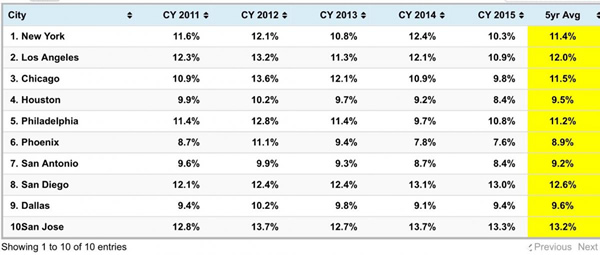
Here is the Chapwood Index of inflation, which carefully measures “apples to apples” costs of essential goods and services in each city:

As inflation erodes purchasing power, workers’ share of the economy has declined dramatically– a double-whammy of declining purchasing power and standard of living.


Sacrifice for Thee But None For Me

By Charles Hugh Smith

Source: Of Two Minds

The banquet of consequences for the Fed, the elites and their armies of parasitic flunkies and factotums is being laid out, and there won’t be much choice in the seating.

Words can be debased just like currencies. Take the word sacrifice. The value of the original has been debased by trite, weepy overuse to the point of cliche. Like other manifestations of derealization and denormalization, this debasement is invisible, profound and ultimately devastating.

Consider the overworked slogan of implied shared sacrifice: we’re all in this together. Pardon my cynicism, but doesn’t this sound like what the first class passengers in the lifeboats shouted to the doomed steerage passengers on the sinking Titanic?

Here is the ice-cold reality of America in 2020: Sacrifice for Thee But None For Me. This isn’t a new trend, of course. Any measurable sacrifices shared by all the socio-economic classes ended with World War II in 1945, and since then it’s been one long slide to Sacrifice for Thee But None For Me.

We’ve seen this slide to decay and collapse many times in history. The elites who once gained social status and political power by making real sacrifices on behalf of the nation / empire become entirely self-serving, accumulating ever greater wealth and power by transferring all the sacrifices and risks onto the lower classes.

Peter Turchin, author of War and Peace and War: The Rise and Fall of Empires, describes how civic virtue is gradually replaced by personal greed and self-interest.

This excerpt perfectly captures the current zeitgeist:

“Virtus included the ability to distinguish between good and evil and to act in ways that promoted good, and especially the common good. Unlike Greeks, Romans did not stress individual prowess, as exhibited by Homeric heroes or Olympic champions. The ideal of hero was one whose courage, wisdom, and self-sacrifice saved his country in time of peril.

Unlike the selfish elites of the later periods, the aristocracy of the early Republic did not spare its blood or treasure in the service of the common interest. When 50,000 Romans, a staggering one fifth of Rome’s total manpower, perished in the battle of Cannae, as mentioned previously, the senate lost almost one third of its membership. This suggests that the senatorial aristocracy was more likely to be killed in wars than the average citizen….

The wealthy classes were also the first to volunteer extra taxes when they were needed… A graduated scale was used in which the senators paid the most, followed by the knights, and then other citizens. In addition, officers and centurions (but not common soldiers!) served without pay, saving the state 20 percent of the legion’s payroll….

The richest 1 percent of the Romans during the early Republic was only 10 to 20 times as wealthy as an average Roman citizen.”

Now compare that to the situation in Late Antiquity when

“An average Roman noble of senatorial class had property valued in the neighborhood of 20,000 Roman pounds of gold. There was no ‘middle class’ comparable to the small landholders of the third century B.C.; the huge majority of the population was made up of landless peasants working land that belonged to nobles. These peasants had hardly any property at all, but if we estimate it (very generously) at one tenth of a pound of gold, the wealth differential would be 200,000! Inequality grew both as a result of the rich getting richer (late imperial senators were 100 times wealthier than their Republican predecessors) and those of the middling wealth becoming poor.”

Compare this to the America of World War II and the America of today. Wealthy, politically influential families such as the Kennedys could only retain their influence if their sons served in positions of combat leadership, and Joe Kennedy was killed in the European theater after volunteering for a highly risky air mission. John F. Kennedy very nearly lost his life in the South Pacific.

And how do our era’s crop of presidents and presidential contenders fare by comparison? The idea that flesh and blood should ever be at risk in defense of the nation /empire–perish the thought.

As Turchin sagely observed, it’s not just the limitless greed and avoidance of sacrifice of the elite that generates destabilizing inequality–it’s the eradication of the middle class as all the risks and sacrifices were shifted from the self-serving top to the middle and lower classes.

As I’ve often noted, risk cannot be made to disappear, it can only be transferred to others. In the grand scheme of things, the inherent risks of globalization and financialization have all been transferred to the middle and working classes (however you define them). The elite class enjoys the near-infinite support of the Federal Reserve and it’s ability to print near-infinite sums of currency to bail out the greediest, most self-serving scum of parasites and speculators.

Meanwhile, all the sacrifices required to support this unfair, corrupt, predatory system have been transferred to the middle and working classes via sleight of hand. The sacrifices weren’t transparent and up front; they were cloaked in the decline of job security, in ever-higher costs, in the decline of social mobility and the erosion of the purchasing power of wages.

The elites’ economist flunkies and factotums claimed that bailing out the freeloaders, parasites and speculators would benefit “the little people” because the grand trade-off delivered by the Federal Reserve (as correspondent R.J. pointed out to me) was: no more financial panics, which caused much misery in the working class due to business failures causing layoffs and unemployment.

But globalization, financialization and the rise of cartel-state monopolies have eviscerated the middle and working classes far more effectively and permanently than any brief financial panic, while greatly enriching the elite class–a rise in wealth that is backstopped by the Federal Reserve: profits are the elites to keep while their losses are socialized, i.e. transferred to the lower classes.

Job security, the purchasing power of wages and social mobility–nothing vital to the middle or working classes is backstopped by the Fed; the Fed’s one and only job is backstopping the wealth of our parasitic, predatory elite.

Sacrifice for Thee But None For Me. The banquet of consequences for the Fed, the elites and their armies of parasitic flunkies and factotums is being laid out, and there won’t be much choice in the seating.

The Fed Has Loaned $1.2 Billion from its TALF Bailout Program to a Tiny Company with Four Employees

By Pam Martens and Russ Martens

Source: Wall Street on Parade

Every Wall Street bailout program that the Fed has created since September 17 of last year has, according to the Fed, been ostensibly created to somehow help the average American.

According to the Fed’s Term Sheet for the Term Asset-Backed Securities Loan Facility (TALF), it’s going to “help meet the credit needs of consumers and businesses by facilitating the issuance of asset-backed securities.” Not to put too fine a point on it, but asset-backed securities and related derivatives are what blew up Wall Street in 2008, creating the worst economic downturn, at that point, since the Great Depression.

According to the Fed’s most recent H.4.1 filing, it has loaned a total $11.1 billion from TALF. Eleven percent of that money, $1.2 billion, went to a company that has 4 employees (outside of clerical workers) according to its filing with the SEC.

Read the rest of the article.

COVID-19: Trigger for a New World Order. Economic Stagnation and Social Destruction

By Patrick Henningsen

Source: Global Research

I can remember them saying that ‘everything changed after 9/11’. It did, but certainly not for the better. I think we can all agree on that.  I remember how everyone surrendered their rights and key aspects of democracy, all in the name of ‘keeping us safe’.

Back then, world-changing decisions were made in reaction to an exaggerated threat, with sweeping ‘emergency measures’ and laws enacted. Usually, nothing good follows from a government that is making decisions and formulating permanent policy, suspending constitutions and rights – imposing all of this on a population operating from a position of fear. That much we did learn. Some of us did anyway.

In January, like a leviathan sprung forth from the titans Oceanus and Ceto in ancient Greece, the global coronavirus pandemic was born. Like 9/11, it was a disruptive event, but this time on a scale unimaginable. Whether or not one believes this was naturally-occurring or a biologically-engineered pathogen (there is every reason to believe it could be), it is beyond argument that this ‘crisis’ is and will be used to advance a multi-pronged globalist agenda, likely to feature more wars between the great powers.

Modern man is now entering realms of dystopia only imagined before by the likes of Aldous Huxley and George Orwell, with more than a hint of Philip K. Dick. What makes all of this difficult for so many is that the sudden transition has been almost instantaneous, leaving people in a near callow state of bewilderment, wondering what just happened to their old life.

No matter which way this situation goes, it’s almost certain life will never be the same.

COVID Crisis

By now we should be familiar with the story: a novel coronavirus, scientifically known as SARS-CoV-2, or COVID-19, has made its way across the planet, infecting millions of people and registering over 100,000 deaths (as of the time of writing) across 180 countries. The victims of this outbreak are overwhelming elderly persons over the age of 70 and those in palliative care, most of who have severe and chronic underlying medical conditions.

Make no mistake about it – this is a disruptive event on a scale the modern world has never seen before. The shock and awe began from the moment the story broke from the Chinese city of Wuhan in Hubei Province. Global audiences were inundated with images of Chinese authorities putting hundreds of people into biological suits, hosing down the outside of buildings, before quarantining themselves in their apartments. Then began a state-sanctioned medieval-style program that western media and politicians enthusiastically dubbed a “lockdown,” a term aptly borrowed from the prison industrial complex.

Wuhan was an unforgettable spectacle which really impacted the western psyche, such that when the coronavirus made it to European and North American shores, the public was already conditioned to expect a Chinese-style response from their own governments. Not surprisingly, this is exactly what they got and, in fact, it was what they demanded.

On 12 March, British Prime Minister Boris Johnson called an emergency press conference where he took to the podium, flanked by his two leading science advisors, Sir Patrick Vallace and Chris Whitty, who proceeded to explain the government plan of action which was centred around the commonly known epidemiological concept of “herd immunity.” Their strategy was a familiar one because it has been the orthodoxy in modern epidemiology – allow a virus to go through approximately 60-80% of the population in order to achieve herd immunity, naturally extinguishing the virus in a single season.

But Johnson made the fatal error of grossly overestimating the death rate at 1% of the total infected, an estimate that would have left the country with some 52 million infected and 500,000 fatalities. Of course, in hindsight, these numbers were pure fiction, but at the time everyone was so enveloped in fear that they believed the ‘experts’. Nonetheless, the herd immunity approach was more or less identical to the ‘no lockdown’ approach taken by European countries Sweden and Iceland, as well as Belarus, Mexico, and Japan. This would entail standard random sample testing nationally and for those exhibiting COVID-19 symptoms. The elderly and vulnerable people would be told to self-isolate for a period of time while studies were conducted.

‘Plan A’ didn’t last long. On 24 March, Johnson appeared on national TV, this time without his science team, to announce a nationwide lockdown – an effective shutdown of society and most of the country’s economy. The UK was now following fellow NATO member states France, Italy, Spain and others, which had already imposed draconian national lockdowns, including strict new ‘social distancing’ guidelines preventing people from being together.

It appeared that Johnson’s sudden 180º degree turn was prompted in part by an alarmist report generated by one of the government ‘expert’ teams at Imperial College London, led by controversial computer modeler Neil Ferguson who was previously responsible for the 2001 ‘Foot and Mouth’ crisis, a debacle which ended in the unnecessary culling of some six million livestock in Britain.

This time, Ferguson and his team worked their modelling magic to come up with an estimated half a million coronavirus deaths if the government did not implement “very intense social distancing and other interventions now in place.”

While the figure was completely fictional, the media seized on it, as did government officials, which fuelled fear and panic across Britain’s government-media complex. Frightened and unsure, the public accepted the authoritarian measures, but the government never gave an end date to the quarantine; it was left open-ended at the discretion of the government’s scientific coterie.

Once that bubble of fear had been sufficiently inflated, a medieval-style lockdown was a fait accompli in numerous countries including Australia and New Zealand. The impact of a full national quarantine is yet unknown, but it’s already becoming clear that it will be nothing short of cataclysmic for those countries who agreed to the voluntary self-destruction of their economies and the indefinite suspension of democracy.

It’s worth noting this isn’t the first time the United Nations, the World Health Organization (WHO), and Imperial College tried conjuring a global panic over a flu virus. Back in 2005, the “range of deaths,” the UN warned of bird flu virus H5N1, “could be anything between five and 150 million.” Officials even drafted in Imperial’s most reliable doomsayer, Neil Ferguson, to help come up with another completely fictional death toll of 200 million people. His high school level math equation was breathtaking in its over-simplicity:

“Around 40 million people died in the 1918 Spanish flu outbreak,” said Prof. Ferguson. “There are six times more people on the planet now so you could scale it up to around 200 million people probably.”

That doomsday prediction led to the culling of tens of millions of birds in Southeast Asia, but the pandemic never really materialised. In the end, human fatalities numbered in the hundreds worldwide. It was a non event.

Similar unremarkable numbers followed the global hype over the H1N1 swine flu in 2009. Thanks to the work of investigative journalist Sharyl Attkisson, the Center for Disease Control (CDC) in the US was caught over-inflating the number of cases – a fraudulent move that had grave implications for government policy and stoking unfounded public fear.

With COVID-19, the globalist medical industrial complex, led by WHO, hoped to repeat the previous public relations campaigns by hyping the novel coronavirus as the next Spanish Flu. This time they were given an extraordinary opportunity thanks to China which put on an incredible media performance and ‘show of strength’ in the month of January by ‘locking down’ Wuhan – inspiring western and other leaders to try the same big government approach.

However, the results would turn out economically disastrous for western ‘lockdown’ countries.

Economic Collapse

All of this is certain to trigger a protracted global recession marked by at least 12 months of negative growth, with economic and social displacement the likes of which the world has never seen before. The decision by countries like the UK, France, Italy, Canada, Australia, New Zealand and the US to voluntarily implode their economies and place most of their populations under house arrest will have a lasting impact not only on national economies but also the global economy for years to come.

In terms of scale, the damage caused to markets and industry has already surpassed the 2008 financial crisis by orders of magnitude, and there’s no end in sight.

To ‘fight the coronavirus’ governments have imploded their real economies and replaced them with nationalised pools of finance earmarked for each section of the economy. This emergency transformation is the same as a wartime mobilisation of an economy, with a heavy focus on the medical and pharmaceutical industrial complex, the military, and selected corporate partners hand-picked by the state. This hard fusion of state and corporate interests is classic corporatism or fascism. In this brutal and constrained environment, these are some of the only institutions strong enough to remain viable.

The net effect of immediately putting millions of workers onto government welfare rolls and pushing hundreds of thousands of small-to-medium-sized businesses (SMEs) into bankruptcy will be the largest consolidation and transfer of wealth in modern history. Those with enough capital to ride out the crisis will be able to buy-up companies, and even whole industries, for literally pennies on the dollar. Monopolies like Amazon, Google and telecoms giants will consolidate and solidify their market shares as competitors gradually die off and are swallowed-up in receivership. Formerly independent contractors will now be reliant on government assistance, as will any business qualifying for government ‘relief’ grants and loans. Large corporations will now have governments covering the cost of their payrolls for the duration of the crisis.

There is no semblance of any discernible sound economic model to describe what is now happening with government printing up record amounts of money to cover the enormous cost of the shutdown. For a wealthy country like the US, the Federal Reserve Bank will simply go into overdrive, creating trillions of dollars to be released through various ‘stimulus plans’ and bailouts. The New York Fed is now pumping trillions of new dollars into banks, with the Fed also issuing ‘bridge’ loans directly to businesses. This never happened before in history. The US is also buying up unprecedented amounts of corporate stock in order to keep Wall Street afloat. With these levels of quantitative easing, there are risks of hyperinflation and other systemic problems. This may be coupled with higher food prices due to supply shortages, and stagnant wages due to a glut in the labour market after the government’s domestic scorched earth economic policies. The end result of all these bailouts (if they ever end) will be exactly as with any war in history: a rapid wholesale transfer of power, control and ownership into centralised government and the central banking cartel.

For individuals and families, this means your savings are wiped-out, your property collapses in value, and your future prospects are dim, at least in the short to midterm, and you will have no choice but to load up on personal and family debt to survive.

Before this crisis, we saw the largest wealth gap in modern history since the Gilded Age (1870–1900), with the richest 1% now owning more than half of the world’s wealth. After the first phase of this crisis, that gap may double or even triple. With SMEs wiped out, the only jobs available will be with the government or with a handful of mega-corporations.

As is often the case after any war, developed and developing countries are likely to become dependent on credit lines from either the International Monetary Fund (IMF) or from the United States itself which will have plenty of dollars and US Treasury bonds for sale or loan at near zero percent interest rates. Plenty of funny money to go around, mostly for the elites.

The shutting down of the world’s airlines – along with biosecurity and financial stagnation hitting certain sections of global trade – will severely injure the dominant system of globalisation. This will no doubt encourage already existing regional trading blocs, like ASEAN in Southeast Asia, and the African Union, leveraging their interests to create more regionalised and resilient trading networks. As physical trade and relations are codified regionally, globalisation will increase in the online digital sphere and with international e-commerce, online learning and social networking.

Now, with massive economic recession, marked by record levels of mass unemployment and debt, the balkanisation of formerly open globalisation routes, combined with a new global veil over scarcity of resources, all under a broad cloak of biological insecurity – the soil is fertile for more dismantling of democracy and a rise in fascist regimes, particularly in the West. The trend was already moving in this direction before the crisis, but now it will only accelerate.

Historically speaking, the scene is now set for another world war in which the winner sets the agenda for a ‘new world order’ going into the 21st century.

Full Spectrum Dominance: World War Footing

Just as in 1914 and the onset of World War I, the year 2020 will be a major pivot point for the early 21st century and should be seen as a tangible prelude to a new world war. There are a number of reasons why this is likely.

It is true that you can implement more change in two years of war than you can in twenty years of peace. In the case of the corona crisis, that two years was reduced to two months. Presently, events are being framed by western powers as the “global fight against an invisible enemy,” but the corona crisis has created a number of new paradigms some of which are classic precursors for war. The first and most obvious is the fact that virtually overnight, the western countries, especially NATO member states the United States, United Kingdom and France, have effectively mobilised all aspects of their country’s economy and restructured society to reflect both a wartime economy and a state of martial law. The western bloc countries are now prepared to bunker down for a long war if need be.

The threat of a biological agent presents some serious problems for a globally-embedded military as America’s. Already the US had to cancel major NATO drills in Europe, and pull some of its naval fleet into dock because of the coronavirus and fears of infecting large numbers of military personnel. Other countries may have similar issues. In this sense, the disease has severely slowed fighting across the world – one of the more unexpected, albeit welcome, tertiary benefits of the crisis.

The western powers first obvious choice for instigating either a hot or cold war is China, along with its allies. When US President Donald Trump refers to COVID-19 as “the Chinese virus,” he is signalling to his base and to the war hawks in the Republican Party that the White House is preparing a confrontation. Anti-Chinese rhetoric and media propaganda has increased substantially in the US since the onset of the corona crisis, with many Americans, particularly the right-wing, now blaming the Chinese for releasing this pestilence into the world.

After a few more months of economic destruction, social malaise and an increasing death toll in the US, the new ranks of unemployed will be demanding a scapegoat for their terrible suffering, at which time a war with China could become more viable for Washington. This could take the form of an on-off, hot-cold war which lasts for 30 or 40 years, and pulls in other major powers using proxy battlegrounds in third party countries.

For the US empire, one primary objective in confronting China would be to disrupt and possibly derail Beijing’s historic infrastructure and economic development known as the Belt and Road Initiative, designed to link Europe with Asia along various routes over land and sea. If successful, the global centre of gravity would shift away from the US and back towards Eurasia. In the event of a global depression post-corona, the US is geopolitically well-placed to weather the storm as it commands the control of both the Atlantic and Pacific oceans. China’s Belt and Road would effectively upend Washington’s plans for Fortress America lording it over all global markets during this new tumultuous epoch.

In some ways, the crisis has disrupted the emergence of a new multipolar world, but the imperative for multipolarism may also be propelled by the economic balkanisation and the fact that the US will continue withdrawing its military assets from stalwart outposts like the Middle East. Any US withdrawal from the world stage will be filled by other emerging powers like Russia, India, Turkey and possibly Japan. Many of these emerging powers require resources and materials, so the scramble to establish trading routes in Africa will be a post-corona feature.

The corona crisis also provides a convenient cover for the aggressive roll-out of 5G networks around the world. These look to be the backbone of a new global surveillance state able to track and record everything in real-time. Along with millions of masts in towns and cities, the network will also feature an array of new satellites with the potential to flood our atmosphere and communities with even more untested high-frequency radiation.

One World Health & Medical Martial Law

The current ‘state of war’ extends internationally with blanket travel restrictions already in place. There looks to be a rapid drive to institute a streamlined global system of mandatory digital tracking and tracing, implemented under the auspices of ‘global health’ and spearheaded by the World Health Organization (WHO). They are joined by participating governments and the transnational corporations that will roll out these new ‘health surveillance’ systems.

The real question that remains unanswered is what will happen once all the ‘lockdown’ measures are relaxed, and international air travel opens up again?

There are already noises coming from governments and organisations about requiring citizens to pass some form of ‘immunity test’ for COVID-19 to be granted freedom of movement within society by carrying an ‘immunity passport’ or digital certificate stored on a microchip or smartphone.

This dovetails with the rapid drive for a cashless society as a result of the corona scare. Due to corona contagion fears, paper money and coins are being stigmatised as ‘dirty’ with many retail outlets refusing to accept cash. Once this system is adopted domestically, it follows that these same restrictions will be extended to international travellers. Needless to say, this has grave implications for personal liberty and privacy. At present, this juggernaut seems difficult to stop.

If allowed, this new bio regime will become the de facto governance for the world’s population. Microsoft founder Bill Gates (net worth $97.8 billion) has called for a national vaccine tracking system in the US, funded in part by an estimated $100 million he and his wife Melinda’s Gates Foundation have donated to fight the coronavirus to discover ‘a fix’ as quickly as possible. Gates is already heavily invested in vaccine research, development and production and, with his wife, they are a primary driver in the proliferation of vaccines globally. Gates says he will front the investment for seven new vaccine factories around the globe, and as he told Daily Show host Trevor Noah during an interview on 2 April, “until we get the world vaccinated.”

Clearly, he has a vision for vaccinating every person on the planet, presumably for the coronavirus, or until the next big ‘outbreak’. “The only thing that really lets us go back completely to normal and feel good about sitting in stadiums with lots of other people is to create a vaccine and not just take care of our country but take that vaccine out to the global population,” said Gates.

From oligarchs like Gates, the transnational pharmaceutical corporations, and the government officials in their pocket, the warning is clear: you will not be permitted to resume ‘normal life’ until you accept the latest vaccine. And do not expect the list of newly required vaccinations to end with the novel coronavirus. Once this first precedent is set, countries dependent on international travel and trade will be forced to adopt the regulatory framework of this new ‘one world health’ security complex. The trail is then blazed for a constant stream of vaccine requirements to ‘fight’ various and sundry outbreaks and ‘biothreats’, be they real, exaggerated or completely fabricated. This could be another disruptive force going forward.

Combine this with naked authoritarian statements made by other self-appointed corona tsars like Dr Michael Ryan, Executive Director of WHO, who recently remarked that members of families may need to be removed from their homes by force. “Most of the transmission actually happening in many countries now, is happening in the household at family level…. In some sense, transmission has been taken off the streets and pushed back into family units. Now, we need to go and look at families to find those people who may be sick and remove them, and isolate them in a safe and dignified manner,” said Ryan.

The obvious danger here is that this new state-corporate regime will discriminate against and marginalise citizens based on their immunity records, requiring them to take a new vaccine to receive rights and privileges. This would be a complete abrogation of personal liberty and human rights, effectively turning the clock back hundreds of years – all based on what many leading doctors and epidemiologists agree is no more of a significant public health threat, in terms of infections and fatalities, than seasonal influenza.

A COVID Green New Deal?

One of the clear main political beneficiaries of a COVID-19 global shutdown has been the climate change lobby.

By forcibly shutting down millions of businesses and pulling tens of millions of cars off the road and grounding world commercial airlines, the crisis has delivered young Greta Thunberg the evidence she and her supporters need to demonstrate the virtues of a net zero carbon world in a real-life simulation.

This will also accelerate the adoption of a so-called ‘Green New Deal’ internationally, which may have less to do with saving the environment or ‘changing the climate’, and more to do with the creation of new global financial bubble based on the commodification and financialisation of Earth’s ecosphere. This is essentially a new ‘green-backed’ and fully tradeable monetary credit, bond and derivatives market.

Greta didn’t appear out of nowhere in 2018. She and her handlers have been tasked with a mission, and now in just three weeks they are very close to realising large pieces of their agenda, which also dovetails with UN Agenda 2030 sustainability goals.

Who’s Winning: Globalism or Nationalism?

Another unexpected byproduct of this crisis has been a number of European Union member states kicking Brussels to the curb, either for not reacting fast enough to help, or simply for not releasing enough funds for struggling public institutions and businesses. As a result, countries like Italy and Poland are exerting their nationalist power over Brussels’ relatively weak and ineffectual response to requested assistance from members states.

At the same time, this new global control grid lends itself towards the implementation of a world government structure to be used to fund an international regime that regulates and adjudicates problems, as well as manage future ‘outbreaks’. In late March, former British PM and Chancellor, Gordon Brown, called for world leaders to create a provisional global government body in order to tackle the coronavirus pandemic and manage the global economic collapse.

Whatever geopolitical and social engineering agendas were already in motion before the crisis, you can be sure that the coronavirus has accelerated many of them.

In terms of power-grabs, this is the embodiment of “never let a good crisis go to waste.”

Oh, and don’t forget –it’s really all about saving lives. 


*

Note to readers: please click the share buttons above or below. Forward this article to your email lists. Crosspost on your blog site, internet forums. etc.

Patrick Henningsen is the founder and editor of the news and analysis website 21st Century Wire, and is an independent foreign and political affairs analyst for RT International. He is also the host of the SUNDAY WIRE radio program which airs live every Sunday on the Alternate Current Radio Network. Learn more about this author at: http://www.patrickhenningsen.com

Notes

1. Professor who predicted 500,000 Britons could die from coronavirus and prompted Boris Johnson to order lockdown accused of having ‘patchy record of modelling pandemics’, http://www.dailymail.co.uk/news/article-8164121/Professor-predicted-500-000-Britons-die-coronavirus-accused-having-patchy-record.html

2. Return of the oppressed, aeon.co/essays/history-tells-us-where-the-wealth-gap-leads

3. Is an ‘immunity certificate’ the way to get out of coronavirus lockdown?, edition.cnn.com/2020/04/03/health/immunity-passport-coronavirus-lockdown-intl/index.html

4. The first steps after lockdown ends: How will Spain return to normal life?, english.elpais.com/society/2020-04-05/the-first-steps-after-lockdown-ends-how-will-spain-return-to-normal-life.html

5. Bill Gates Calls For National Tracking System For Coronavirus During Reddit AMA, www.forbes.com/sites/mattperez/2020/03/18/bill-gates-calls-for-national-tracking-system-for-coronavirus-during-reddit-ama/

6. Bill Gates on Fighting Coronavirus – The Daily Social Distancing Show (YouTube), www.youtube.com/watch?v=iyFT8qXcOrM

7. The coronavirus is washing over the U.S. These factors will determine how bad it gets in each community, www.statnews.com/2020/04/01/coronavirus-how-bad-it-gets-different-communities/

8. Gordon Brown calls for global government to tackle coronavirus, www.theguardian.com/politics/2020/mar/26/gordon-brown-calls-for-global-government-to-tackle-coronavirus