The Chords UK
Two for Tuesday
Reply

The Chords UK

Buck and the Preacher review – Poitier and Belafonte are glorious in overlooked western
Sidney Poitier’s first directorial effort makes for a wild ride, packed with memorable turns and smart filmmaking
By Fedor Tot
Source: We Love Cinema
Sidney Poitier and Harry Belafonte, two icons of the Civil Rights movement, sit at the centre of Buck and the Preacher. The two occupy a totemic space in the cultural imagination that has to some extent calcified their images. Part of the brilliance of this much-overlooked western is how it plays against this calcification – Belafonte, as the Preacher of the title, is introduced bathing stark naked, a rambunctious character with the gift of the gab, grimy teeth and scratchy beard. It’s a far cry from Belafonte’s more clean-cut roles, and a glorious against-type performance devoid of ego.
Poitier for his part, ostensibly plays another stoic good man, the type he built his career around. But here, too, there are wrinkles, perhaps unsurprisingly given that this was Poitier’s first directorial effort, taking over the shoot having had the initial director Joseph Sargent fired over creative differences regarding the depiction of race. Poitier’s Buck may be a lawful man, but he’s taciturn and cautious, pushed to lawlessness mostly by the threat of white violence.
The two titular characters meet out west. Buck is a professional wagon master aiding Black folk looking for safe passage away from the post-slavery South, with former masters hiring “labour recruiters” (as they call themselves) to force them back to the cotton field. The Preacher is more chaotic, a lifelong con-man primarily motivated by money. The clash of these two characters against a wider environment of white hostility provides the film with much of its dramatic tension.
As with many actors-turned-directors, Poitier’s direction could be accused of being a little staid at times: this is certainly a handsome western, but parts do lack a bit of flair, such as an opening raid that’s simply dull. And yet on occassion Poitier-as-director hits upon a rich seam of inspiration.
Two scenes late on in the film are a case in point, a brilliant marriage of action and theme. The first is the quietest bank robbery ever committed to film, told almost entirely in whispers, our protagonists pushed fully outside of the law as a means of survival. The second, their final stand, stranded on a rocky, claustrophobic outcrop, surrounded on all sides, having to remain hidden under cover. Poitier is using both aural and geographical textures to comment on Blackness – survival in a racist society requiring both silence and invisibility – expressed purely in filmic terms.
It’s remarkably smart and astute directing in these sections, yet the central charm of this film remains Belafonte. His Preacher is a delicious, smart-talking and charismatic creation, a shifty anti-hero that plays nicely against Poitier’s righteousness. Buck and the Preacher might not have the rawness or nihilism of the predominantly revisionist westerns produced concurrently, such as those by Sam Peckinpah (The Wild Bunch) and Robert Altman (McCabe and Mrs. Miller), but it remains a smart and entertaining film.

By Peter Sobczynski
Source: RogerEbert.com
The new Portuguese/French/Brazilian co-production “Diamantino” could technically be described as a political satire but anyone going into it expecting the hard-edged humor of a “Dr. Strangelove” or “Wag the Dog” will soon realize that it’s not quite like those earlier works—probably around the time that the gigantic fluffy puppy dogs first make an appearance. Instead, it takes a far more whimsical approach that suggests a weird hybrid of “Being There” and “All the World’s a Stooge,” the 1941 Three Stooges short in which Moe, Larry and Curly are taken in by a rich woman who is inexplicably convinced that they are child war refugees, as presented by Michel Gondry at his absolute Gondriest. The results are uneven—how could they not be?—but the sheer weirdness of the whole enterprise has a charm to it and it certainly is never boring. Bewildering, maybe, but never boring.
Let us go back to those fluffy dogs for a minute. They are manifestations in the mind of Diamantino (Carloto Cotta), the star striker for Portugal’s soccer team, that allow him to filter out all distractions and hit the shots that have made him an idol on the level of real-life Portuguese soccer player Cristiano Ronaldo. Alas, one day, the power of the fluffy dogs fails Diamantino and he misses a crucial shot that prevents his team from advancing to the World Cup final and he becomes a pariah in his home country and a laughing stock around the world. This would be hard enough for most people to bear but we soon realize that Diamantino is basically a big kid himself who is innocent in most of the ways of the world—not only do the sheets on his bed have his face and logo emblazoned on them, it is evident that he has never had anyone into his room to share them with him.
In an attempt to do some good and honor his recently deceased father, Diamantino decides to take in a refugee to live at his palatial estate, much to the consternation of his cruel and abusive twin sisters (Anabella and Margarida Moreira), who mistreat him even as they are robbing him blind. The “refugee” turns out to be Aisha (Cleo Tavares), a lesbian Secret Service agent working undercover as a teenage boy from Mozambique to investigate suspicions that Diamantino is involved with a money-laundering scheme. That, not surprisingly, is the work of his sisters and if that were not enough, the two have embroiled their uncomprehending brother into a plot by Portuguese nationalists to leave the EU. Such a scheme includes an elaborate ad campaign focused on Diamantino as the epitome of Portuguese manhood, as well as machinations from a mad scientist determined to harvest the source of his greatness that winds up calling certain aspects of his manhood into question.
So yeah, “Diamantino” is strange as can be and then some, but the problem that it’s not as outrageous as it clearly wants to be in terms of the details. The material involving the shifting nature of the relationship between Diamantino and Aisha, whose true identity as an adult woman he remains blissfully unaware of for much of the narrative, would seem to be tailor-made for the kind of cheerfully transgressive humor that the writing/directing duo of Gabriel Abrantes and Daniel Schmidt are clearly aiming for but never quite achieve. Likewise, the more overtly political material involving the nationalists duping Diamantino into participating in their anti-EU campaign leans a little more towards the innocuous than the incisive. The stuff involving the mad scientist and the unexpected results of her experiments on Diamantino are absurd enough but enter the proceedings in such an arbitrary manner that it fails to land the impact that it might have had with a more focused screenplay.
And yet, even though “Diamantino” never quite digs beneath its aggressively goofy, candy-colored surfaces to deliver truly penetrating satire, it still manages to hold one’s interest for the most part. As a comedic collision between the not entirely dissimilar worlds of political and popular culture and the mayhem that can ensue when the two intertwine, the film has a likable oddball energy that is further boosted by an outlandish visual style that’s reminiscent of what the legendarily over-the-top 1967 version of “Casino Royale” is like at its best moments. “Diamantino” is also blessed with a number of random bits of strange humor that wind up hitting more than they miss, ranging from the aforementioned bed linen to several hilarious needle drops on the soundtrack. Best of all, it has a performance by Cotta as Diamantino that is perfectly calibrated so that he comes across less as a moron, which is what might have resulted in the hands of lesser actors, than as a genuine innocent—a Candide of the soccer pitch—who we find ourselves laughing with instead of at. Admittedly, a film like this may not be to all tastes, but those with a taste for the silly and the strange should get a kick out of it.
Watch Diamantino on Hoopla here: https://www.hoopladigital.com/movie/diamantino-carloto-cotta/17616054
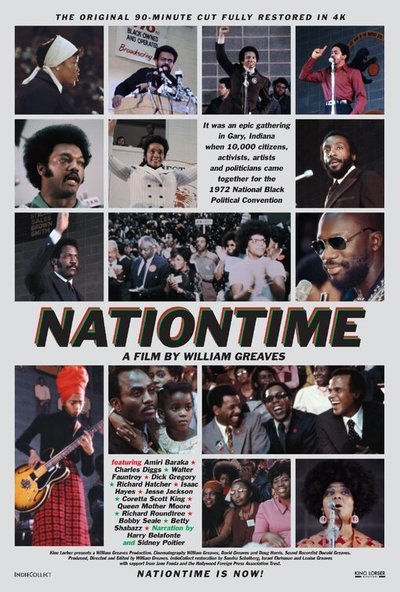
Documentarian William Greaves’s Restored Civil Rights Political Documentary asks, “What Time is it?”
By Jim Tudor
Source: ZekeFilm
In 1972, the mayor of Gary, Indiana Richard Hatcher welcomed a tremendous gathering of African American leaders, intellectuals, activists and speakers to hold the twentieth century’s first and only National Black Political Convention. Luminaries such as Amiri Baraka, Charles Diggs, Walter Fauntroy, Dick Gregory, Isaac Hayes, Bobby Seale, Harry Belafonte, Coretta Scott King, Queen Mother Moore and Jesse Jackson took the stage in a crowded sports gymnasium in the fired-up interest of promoting “an independent national black agenda”. With over 10,000 in attendance, the gathering seeked to bring together differing factions in the cause of Black advancement in America. More to the point, their goal for the three-day Convention was “unity without uniformity”.
The National Black Political Convention of 1972 was a turning point in the struggle for self determination and equal rights.”
“ The convention adjourned without reaching consensus, and some deemed it a failure.”
“But the cry of ‘Nationtime’ reverberates as America continues to wrestle with its legacy of slavery.
So goes the entirely of the opening text viewed at the start of this newly salvaged presentation of documentarian William Greaves’s Nationtime. Tasked with documenting the convention, Greaves and his crew do just that; the final version of this 1972 film a sort of fly-on-the-wall highlights reel of the event. Those who know Greaves primarily for his 1968 meta-experimental Symbiopsychotaxiplasm: Take One now have this chance to view one of the filmmaker’s works which falls more into his bread-and-butter wheelhouse of African American-issues documentary filmmaking.
It is apparent that Greaves had no additional access to back-room goings-on and behind the scenes drama of the convention, which there apparently was no shortage of. Rather, he and his handful of cameramen are relegated to the same level of observation as anyone in ordinary attendance. As a result, the height of tension- a mass exodus of the contingency from Michigan- occurs with little contextualization. (Greaves’s friend, actor Sidney Poitier, provides occasional narration where needed).
In October of 2020, Kino Marquee released to virtual theaters a black and white version of the newly rediscovered and 4K-restored Nationtime. At least, it was a black and white version that critics were given access to, thereby resulting in some incorrect statements that the film was shot monochrome. We know from this subsequent Blu-ray release that that was not the case. The black and white version is not included on the Blu-ray; Kino Classics instead opting to showcase IndieCollect’s extensive color restoration. The valiant result remains quite visibly imperfect, though this is no doubt the very best it can ever look.
Nevertheless, a film that’s mostly podium-bound political and social speeches can only have so much traction as cinema. Roger Ebert famously said that a film isn’t about what it’s about, but rather how it’s about it. If that’s the case, a film like Nationtime cannot fare tremendously well. Yet, there’s no denying the historical importance of the event documented, particularly in today’s tragic post-George Floyd world. Nationtime (originally called “Nationtime – Gary”, for the town it takes place in) is a major, black-organized event as documented by a black filmmaker. That alone secures it all the credentials it needs in this day and age to rightly present as important.
But “important” and “cinematically compelling” are two different things. Though the speakers at the podium are dynamic in their passion, there’s rudimentary catch-as-catch-can quality to Greaves’s film. It’s an unfortunate showing of seams that often renders the film challenging to stick with.
An informal count reveals that Greaves had no more than five cameras in play, each shooting color film stock. According to a notation at the end of the film, Nationtime was restored in both color and black and white. The latter was apparently an attempt to conceal the irregularities in the footage from one camera to the next. The amateur-esque variations in film stock, lighting, and perhaps exposure are apparent throughout, and unlikely successfully concealed simply by removing color. (Per David Greaves’s audio commentary recollection, he was given some bad advice from Kodak to use a red filter on his own camera, likely contributing to why the finished film was deemed something of a lost cause at the time. Thankfully, today’s color correction technologies have undone that specific gaffe).
The end result is what it is: an ultra-low budget effort financed by Greaves himself. Greaves’s son David, who worked closely with his father and was also there, recalls that outside financing was never secured, though the filmmaker had no intention to not document the event. According to one story on the new bonus features, William Greaves continued manning his camera during Jesse Jackson’s dynamic speech even when he had run out of film, so enraptured he was in that moment.
Indeed, the raw enthusiasm of being there and capturing “the happening” of it all shines through the vast imperfections of the film. Greaves’s knack for knowing and grabbing quality b-roll when he sees it is absolutely apparent. Through the rough-hewn assembly of it all, apt cutaways of engaged faces and fist-waving crowd enthusiasm are the flourishes that shine.
Through it all, in the face of all the racial progress in America that’s yet to be made, Reverend Jesse Jackson’s impassioned call and response of “What time is it?” “Nationtime!” resonates anew for a country still in great need of working things out in terms of equality and corrective justice.
Watch Nationtime on Hoopla here: https://www.hoopladigital.com/movie/nationtime-sidney-poitier/17616062
By Sheila O’Malley
Source: RogerEbert.com
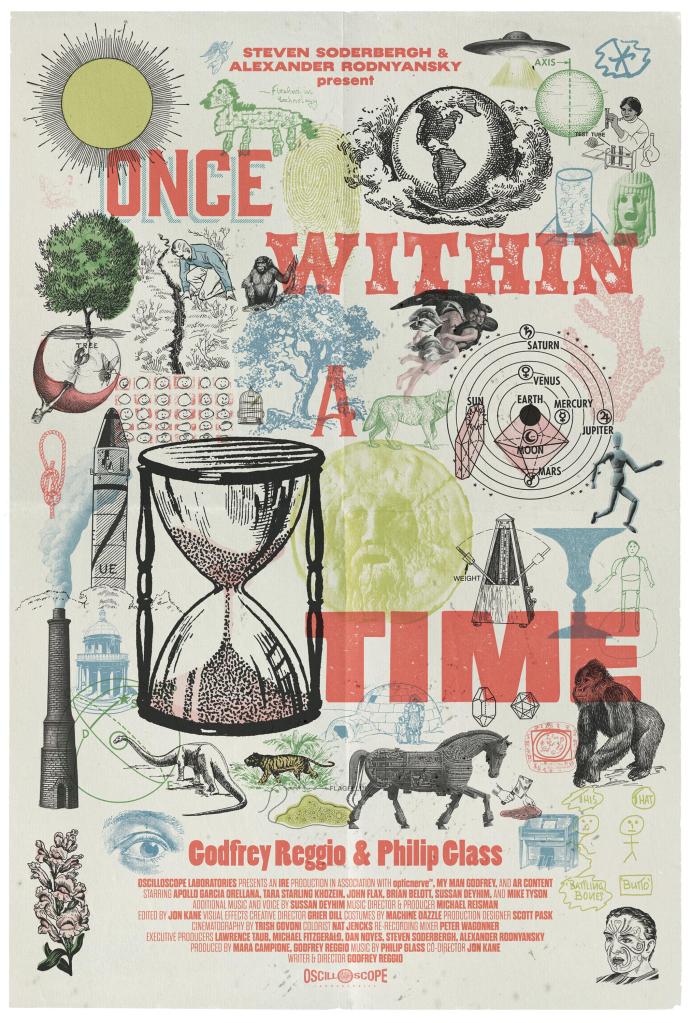
Beatrice Loayza’s fascinating New York Times article “When Did the Plot Become the Only Way to Judge a Movie?” examines films that eschew linear storytelling, films more interested in mood and emotional tones than plot points, breaking free from the “tyranny of story.” The article was fresh in my mind when I watched Godfrey Reggio’s whimsical-terrifying doomsday-fable “Once Within a Time.” Clocking in at 51 minutes, the film is all mood, all rhythm, with a kaleidoscope structure and undulating ever-shifting visuals in a constant state of flux. It’s not a “story” so much as a tone-poem collage about technology, knowledge, innocence/experience, and the potential end of the world. Maybe something new will be born from the ashes, although considering the evidence that something may very well be a monster.
It all started in the Garden of Eden, when curious Eve ate the apple, and “Once Within a Time” starts there, too, in the gentle framing device that opens it. An audience sits in a darkened theatre, a red velvet curtain rises, and the “show”—i.e., human life on the spinning planet—begins. Adam and Eve, holding hands, wander underneath a white cotton-ball tree with red hanging apples. Around them, children play and cavort. The same six or seven children are used throughout: we get to know their faces and their expressions. Behind them, a grand visual drama unfolds, made up of stop-motion animation figures, real humans, found footage, and eerie created images: solar systems, a giant hourglass in the desert, black and white newsreel footage of bomb blasts, spindly trees bending backward. The children look on with wonder, humor, interest, and sometimes concern. They are trying to understand. The apple is a portal to another world, another time. The apple is also directly linked to another 20th-century apple, the Mac apple. The garden path Adam and Eve walk down is made up of iPhone cobble stones. The meaning is obvious.
Technology is a blessing and a curse, yes, but more than that, it’s inevitable. It can’t be stopped. Nineteen-year-old Mary Shelley wrote one of the most prescient books of all time, her imagination stretching forward 200 years, its warning message still and always relevant. The obsessed maniac Frankenstein doesn’t know when to stop with his experiment. He has to see it through, even if it destroys his mind, his life, and the world as we know it. Mary Shelley saw it all. “Once Within a Time” has almost as bleak an outlook.
Reggio’s celebrated “Koyaanisqatsi,” the first of the Qatsi Trilogy, features a similar cascade of images placed in fluid shifting juxtaposition: power plants and rain forests, rush-hour highways and crashing ocean, pollution and clouds, modernity and its ruins. The images are often beautiful, but the overall effect is anxiety-provoking, sometimes even despairing. What have we done to our beautiful world? Music holds it all together. Philip Glass composed the main score, with additional music by Iranian composer Sussan Deyhim (who also plays a “muse” type character, half-woman, half-tree).
Reggio’s vision has three central figures, symbolic and archetypal, but with shifting meanings. An opera maestro declaims his incomprehensible song to the masses, his figure a towering monolith, his eyes wild and fanatical. Behind him looms the walls of a Coliseum, and his figure is threatening, a demi-god dictator, gesturing and bending the masses to his will. There’s a female figure, a living half-human Yggdrasill (Sussan Deyhim), whose song helps create—or at least sustain—the living world. In the final segment, a “mentor” appears (Mike Tyson, of all people!), who encourages the cowed lost children, acting as a sort of Pied Piper.
Once you leave Eden, of course, you can’t get back in. That’s the deal. At the end of the film, a question is asked in multiple languages: “Which age is this: the sunset or the dawn?” In the atom-bomb-haunted “Rebel Without a Cause,” Plato (Sal Mineo) asks Jim (James Dean) if he thinks the end of the world will come at night. Jim says, “No. At dawn.” Either way, it’s the end.
Watch Once Within a Time on Hoopla here: https://www.hoopladigital.com/movie/once-within-a-time-mike-tyson/17458850
INDIAN COUNTRY NEWS
"It is the duty of every man, as far as his ability extends, to detect and expose delusion and error"..Thomas Paine
Human in Algorithms
From the Roof Top
I See This
blog of the post capitalist transition.. Read or download the novel here + latest relevant posts
अध्ययन-अनुसन्धानको सार
 After the Crash