There are No Easy Solutions for White Terrorism


White Christians are not termed terrorists by media

By Jason Lee Byas

Source: Center for a Stateless Society

On June 17th, a white man named Dylann Roof murdered nine black members of the Emanuel African Methodist Episcopal Church (EAME). I mention race because it was not a coincidence – this was an act of terrorism in the service of white supremacy.

Understandably, people are scrambling for an easy solution, and most proposals involve some show of state force. Unfortunately, the reality is that there are no easy solutions, and most suggestions would only make things worse.

For example, many have used the shooting to push for stronger gun control measures. This is a non-starter.

Roof’s bloodbath was less than ten miles away from where white police officer Michael Slager shot Walter Scott, a black man who was running away. Slager’s case is unique in that we actually know about it, and that he was actually charged. Police kill countless Americans every year, and blacks are most likely to be their victims.

Black people — not just in Charleston, but throughout the United States — experience the police as occupiers, not protectors. Centralizing firearm ownership in the hands of the police will not protect people of color, because the police are the exact group most likely to terrorize people of color.

Furthermore, the actual effect of gun control laws has been to incarcerate black Americansat a rate more disproportionate than any other federal statute, including drug-related offenses. It is not just that gun control leaves disadvantaged communities dependent upon those most likely to terrorize them. Gun control itself is often the pretext of that terrorism.

Many who resist calls for gun control instead point to “doing something” about mental illness. This convenient narrative forgets that people deemed mentally ill are far more likely to be victims of violence, not perpetrators.

It also forgets that Roof’s problems were ideological, not psychological. Instead of just shrugging and saying “you can’t fix crazy,” we should confront Roof’s actual motive, white supremacy.

Finally, there is one almost universally endorsed response to Roof’s crime: his punishment. Some have also urged South Carolina to enact hate crime legislation, so that future Dylann Roofs can be punished even more harshly.

This, too, will only make things worse. No one will be made better off by Roof’s punishment, and the punitive focus of our legal system will rob survivors and victims’ loved ones of what restitution and restoration could have been made instead.

In Roof’s case, survivors and victims’ loved ones have publicly forgiven him, pleading that he repent. That is their desire. Our legal system’s desire, by contrast, is the satisfaction of public bloodlust.

If we are truly interested in fighting racism and violence against marginalized populations, punishment — and its expansion through hate crime legislation — is extremely counterproductive. The same groups “protected” by these statutes are the ones most likely to be harmed.

This is why the Sylvia Rivera Law Project (which specializes in protecting transgender and gender non-conforming people) staunchly opposes hate crime laws. As their powerful statement explains:

[H]ate crime laws … expand and increase the power of the … criminal punishment system. Evidence demonstrates that hate crime legislation, like other criminal punishment legislation, is used unequally and improperly against communities that are already marginalized in our society. These laws increase the already staggering incarceration rates of people of color, poor people, queer people and transgender people based on a system that is inherently and deeply corrupt.

By saying that there are no easy solutions, I am not saying that there are no solutions. The point isn’t “do nothing,” and it isn’t “wait around until we have a justice system based on restitution and restoration.”

What we should do instead is develop solutions from below, and step out of the way so those solutions can take effect. EAME, and other black churches like it, have historically been one such solution. They facilitated black self-empowerment, and in 1822, EAME’s founder even plotted a slave revolt.

The response of the white community was to burn down EAME. EAME’s response was to rebuild.

Now, the black community must rebuild again. White Americans must now work to ensure they don’t burn down those rebuilding efforts.

Many black Americans, such as the Huey P. Newton Gun Club, have begun to arm themselves for protection. When our white-dominated government seeks to burn that down by disarming them, it must be stopped.

Beyond just getting out of the way, white Americans must also work to question their own racism and the racism of their white peers.

None of these solutions are quick, and none of them are easy. But they are also the ones that will actually work.

Kick Open the Doorway to Liberty: What Are We Waiting For?

0823e935c920bdf2c31447b67612bfc6

By John W. Whitehead

Source: The Rutherford Institute

“The greatness of America lies in the right to protest for right.”—Martin Luther King Jr.

Everything this nation once stood for is being turned on its head.

Free speech, religious expression, privacy, due process, bodily integrity, the sanctity of human life, the sovereignty of the family, individuality, the right to self-defense, protection against police abuses, representative government, private property, human rights—the very ideals that once made this nation great—have become casualties of a politically correct, misguided, materialistic, amoral, militaristic culture.

Indeed, I’m having a hard time reconciling the America I know and love with the America being depicted in the daily news headlines, where corruption, cronyism and abuse have taken precedence over the rights of the citizenry and the rule of law.

What kind of country do we live in where it’s acceptable for police to shoot unarmed citizens, for homeowners to be jailed for having overgrown lawns (a Texas homeowner was actually sentenced to 17 days in jail and fined $1700 for having an overgrown lawn), for kids to be tasered and pepper sprayed for acting like kids at school (many are left with health problems ranging from comas and asthma to cardiac arrest), and for local governments to rake in hefty profits under the guise of traffic safety (NPR reports that police departments across the country continue to require quotas for arrests and tickets, a practice that is illegal but in effect)?

Why should we Americans have to put up with the government listening in on our phone calls, spying on our emails, subjecting us to roadside strip searches, and generally holding our freedoms hostage in exchange for some phantom promises of security?

As I document in my new book Battlefield America: The War on the American People, it doesn’t matter where you live—big city or small town—it’s the same scenario being played out over and over again in which government agents ride roughshod over the rights of the citizenry.

In such an environment, it’s not just our Fourth Amendment rights—which protect us against police abuses—that are being trampled. It’s also our First Amendment rights to even voice concern over these practices that are being muzzled. Just consider some of the First Amendment battles that have taken place in recent years, and you too will find yourself wondering what country you’re living in:

  • Harold Hodge was arrested for standing silently in front of the U.S. Supreme Court building, holding a sign in protest of police tactics.
  • Marine Brandon Raub was arrested for criticizing the government on Facebook.
  • Pastor Michael Salman was arrested for holding Bible studies in his home.
  • Steven Howards was arrested for being too close to a government official when he voiced his disapproval of the war in Iraq.
  • Kenneth Webber was fired from his job as a schoolbus driver for displaying a Confederate flag on the truck he uses to drive from home to school and back.
  • Fred Marlow was arrested for filming a SWAT team raid that took place across from his apartment.

And then there were the three California high school public school students who were ordered to turn their American flag t-shirts inside out on May 5 (Cinco de Mayo) because school officials were afraid it might cause a disruption and/or offend Hispanic students. Incredibly, the U.S. Supreme Court actually sided with the school and the Ninth Circuit Court of Appeals, affirming that it might be disruptive for American students to wear the American flag to an American public school.

While there are all kinds of labels being put on so-called “unacceptable” speech today, from calling it politically incorrect and hate speech to offensive and dangerous speech, the real message being conveyed is that Americans don’t have a right to express themselves if what they are saying is unpopular, controversial or at odds with what the government determines to be acceptable.

Whether it’s through the use of so-called “free speech zones,” the requirement of speech permits, the policing of online forums, or a litany of laws and policies that criminalize expressive activities, what we’re seeing is the caging of free speech and the asphyxiation of the First Amendment.

Long before the menace of the police state, with its roadside strip searches, surveillance drones, and SWAT team raids, it was our First Amendment rights that were being battered by political correctness, hate crime legislation, the war on terror and every other thinly veiled rationale used to justify censoring our free speech rights.

By suppressing free speech, the government is contributing to a growing underclass of Americans who are being told that they can’t take part in American public life unless they “fit in.” Mind you, it won’t be long before anyone who believes in holding the government accountable to respecting our rights and abiding by the rule of law is labeled an “extremist” and is relegated to an underclass that doesn’t fit in and must be watched all the time.

It doesn’t matter how much money you make, what politics you subscribe to, or what God you worship: we are all potential suspects, terrorists and lawbreakers in the eyes of the government.

In other words, if and when this nation falls to tyranny, we will all suffer the same fate: we will fall together. However, if it is possible to avert such an outcome, it will rest in us remembering that we are also all descendants of those early American revolutionaries who pushed back against the abuses of the British government. These people were neither career politicians nor government bureaucrats. Instead, they were mechanics, merchants, artisans and the like—ordinary people groaning under the weight of Britain’s oppressive rule—who, having reached a breaking point, had decided that enough was enough.

The colonists’ treatment at the hands of the British was not much different from the abuses meted out to the American people today: they too were taxed on everything from food to labor without any real say in the matter, in addition to which they had their homes invaded by armed government agents, their property seized and searched, their families terrorized, their communications, associations and activities monitored, and their attempts to defend themselves and challenge the government’s abuses dismissed as belligerence, treachery, and sedition.

Unlike most Americans today, who remain ignorant of the government’s abuses, cheerfully distracted by the entertainment spectacles trotted out before them by a complicit media, readily persuaded that the government has their best interests at heart, and easily cowed by the slightest show of force, the colonists responded to the government’s abuses with outrage, activism and rebellion. They staged boycotts of British goods and organized public protests, mass meetings, parades, bonfires and other demonstrations, culminating with their most famous act of resistance, the Boston Tea Party.

On the night of December 16, 1773, a group of men dressed as Indians boarded three ships that were carrying tea. Cheered on by a crowd along the shore, they threw 342 chests of tea overboard in protest of a tax on the tea. Many American merchants were aghast at the wanton destruction of property. A town meeting in Bristol, Massachusetts, condemned the action. Ben Franklin even called on his native city to pay for the tea and apologize. But as historian Pauline Maier notes, the Boston Tea Party was a last resort for a group of people who had stated their peaceful demands but were rebuffed by the British: “The tea resistance constituted a model of justified forceful resistance upon traditional criteria.”

The rest, as they say, is history. Yet it’s a history we cannot afford to forget or allow to be rewritten.

The colonists suffered under the weight of countless tyrannies before they finally were emboldened to stand their ground. They attempted to reason with the British crown, to plea their cause, even to negotiate. It was only when these means proved futile that they resorted to outright resistance, civil disobedience and eventually rebellion.

More than 200 years later, we are once again suffering under a long train of abuses and usurpations. What Americans today must decide is how committed they are to the cause of freedom and how far they’re willing to go to restore what has been lost.

Nat Hentoff, one of my dearest friends and a formidable champion of the Constitution, has long advocated for the resurgence of grassroots activism. As Nat noted:

This resistance to arrant tyranny first became part of our heritage when Samuel Adams and the Sons of Liberty formed the original Committees of Correspondence, a unifying source of news of British tyranny throughout the colonies that became a precipitating cause of the American Revolution. Where are the Sons of Liberty, the Committees of Correspondence and the insistently courageous city councils now, when they are crucially needed to bring back the Bill of Rights that protect every American against government tyranny worse than King George III’s? Where are the citizens demanding that these doorways to liberty be opened … What are we waiting for?

What are we waiting for, indeed?

The Transformer: Sabotage for Peace

514_230x230_NoPeel

By William T. Hathaway

Source: Dissident Voice

A former student of mine works as a janitor. After graduating from college he worked as a market researcher and an advertising salesperson, but both jobs soured him on the corporate world. He hated being a junior suit, and the thought of becoming a senior suit was even worse.

He finds being a janitor a much better job. He’s left alone, it’s low pressure, and what he does improves the world rather than worsens it. The pay’s lousy but that’s standard these days. He loves music, so he loads up his MP3 and grooves to the sounds. Although the work is routine, it’s brightened by occasional bits of human interest: used condoms in executive wastebaskets, marijuana butts in the emergency stairwell, a twenty-dollar bill under a desk. His shift is from 6 p.m. to 2 a.m., and afterwards he hits the late-night clubs, where he can enjoy the scene with the advantage of being sober. He works for a janitorial service company, and one of their clients is a defense contractor — not secret weapons, just ordinary supplies.

The man is a pacifist. Originally he felt that rallies, petitions, marches, and picketing would help turn public opinion against the war, and when the majority of Americans opposed it, our political representatives would vote to stop it. That’s what democracy means. The first part turned out to be true. Polls showed a clear majority of Americans wanted the war ended and our troops brought home. In 2006 they elected Democratic majorities in the House and Senate who said they would do this. But rather than bringing the soldiers home, “our” representatives voted more money for the war so more soldiers could be sent to Iraq, a surge of troops for another attempt to crush the resistance there. Several months later they voted additional billions for a US troop surge to Afghanistan.

In 2008 the people elected Barack Obama on a pledge to bring peace. But the war still continues with thousands dying, despite the will of the voters to end it.

He began to realize the politicians aren’t representing us but what he calls the corpses, short for corporations. The majority of those want the war to continue. It’s the corporate majority that rules, not the citizens. That’s the democracy we have. When business leaders turn against the war, then it will end.

What would make them turn against it? When they stop making a profit from it, he concluded.

Finally feeling glad to be part of the corporate world, he decided to stage a surge for peace. He bought a 10-amp step-up transformer at an electronics flea market, the kind used to increase voltage from 110 to 220. Next time he was scheduled to work at the defense contractor and the weatherman predicted a thunder storm, he brought the transformer along in his dinner box. At the first flash of lightning, he took it to the data processing center. First he unplugged all the computers and auxiliaries from the surge protectors and zapped them with 220. Then he plugged them back in and zapped the surge protectors. A clear case of surge-protector failure: the damned things must’ve let the surge through before they shut down.

The stench of sizzled electronics gave him a headache, but other than that he felt fine. He figured the lost work and ruined equipment put a hefty dent in profits. The company will try to pass those costs on to the government, but with budget deficits and taxes already cripplingly high, congress will finally have to admit they don’t have enough money to conquer Iraq and Afghanistan.

The lost work also cuts into the military supply line. If supplies are reduced, war operations have to be reduced. Soldiers can’t fight without logistics. Both economically and tactically, destroying war supplies helps to end war.

He’s aware that direct action like this is unpopular. Many people are afraid of government repression that will make their already difficult situation even more unpleasant. But he’s convinced that their difficult situation — working long hours for low pay, living in a deteriorating society, raising children amid fear and hostility — is caused by the same forces that drove us to war. Capitalism manifests now as invasion in Iraq and Afghanistan, as privatization and impoverishment in Latin America, and as the destruction of the middle class in the industrial nations. It’s the same system operating in different environments.

Rather than sheepishly obeying in hopes of avoiding more punishment, he feels we must actively rebel and seize the power that has been usurped from us. This struggle won’t be comfortable, but it will be meaningful. By taking charge of our history, we’ll earn the gratitude of future generations. Otherwise our and their lives will be continually constricted by the rule of capital. He’s convinced the time is ripe for change, and it needs to be fundamental, not superficial.

He grew up in a small town where his family owned the local hardware store. When he was in high school, Wal-Mart moved to town. Their family store couldn’t compete with Wal-Mart and went broke. His father became a clerk in the Wal-Mart hardware department at a wage less that what he had paid his lowest employee. Soon he was joined there by the former owners of the local clothing, appliance, sporting goods, and toy stores, all of which had gone broke. Despite their expertise, none was hired as a department manager, all clerks, because they might harbor resentment. The managers were long-term Wal-Mart employees brought in from outside.

But it wasn’t just Wal-Mart that used economics of scale to destroy home-grown businesses. Many farmers in the area had to sell out to corporate agriculture. Local restaurants were replaced by cheaper chains. The real estate office was driven out by a discount franchise. And all the workers were making much less than before. The whole town, except for a few big new houses, became bleak.

His parents had enough money saved so he could go to college with the help of student loans and part-time jobs. But his younger brother and sister couldn’t. The brother went into the navy, where he wouldn’t have to actually fight, and the sister worked at Wal-Mart.

What’s happening to small businesses in the USA is happening to small countries overseas. Their economies are getting taken over, sucked into the maw of transnational corporations. The World Bank and International Monetary Fund are economic weapons in this conquest. Countries that resist face other weapons, from CIA subversion to outright invasion. Feudalism has been revived and globalized. The nobility are the corporate rulers, the yeomen are their declining ranks of employees, and the serfs are the rest of us worldwide — the huge majority.

He’s certain that we’re not going to change this system without a fight, and we’d better start now while we still have some freedoms. Hoping to make basic changes through liberal reform is a delusion. We cling to that hope because we’ve been raised with the comforting myth that we live in a democracy. But behind the “we, the people” rhetoric lies entrenched power determined to maintain itself. The rulers are willing to change only in ways that make more profit, such as expanding the labor pool to include women and blacks, thus enabling them to reduce wages.

The “have a nice life” days are over in the USA. Conditions are getting inexorably worse. Americans are beginning to get the same treatment as people in the client states. As protest to this grows, the power elite will try to crush it. They’ll scapegoat the radicals, blaming them for the problems, trying to make them the target of rising populist anger. But dissidents aren’t causing these conditions, they’re resisting them. The conditions are caused by the predatory nature of capitalism.

In opposing this process, he’s a pacifist but not a passivist. He fights, but only in ways that don’t injure living creatures. Currently his transformer is stowed away, awaiting the next weather report when he can transform more war computers into peaceful scrap.


William T. Hathaway is an adjunct professor of American studies at the University of Oldenburg in Germany. “The Transformer” is a chapter from Radical Peace: People Refusing War, which presents the experiences of peace activists who have moved beyond protest into direct action: helping soldiers to desert, destroying computer systems, trashing recruiting offices, burning military equipment, and sabotaging defense contractors. Chapters are posted at Trineday. William T. Hathaway’s new book, Lila, the Revolutionary, is a fable for adults about an eight-year-old girl who sparks a world revolution for social justice. Chapters are posted here and a selection of his writing is available at his website. Read other articles by William.

Baltimoreans Pushed to Their Limits

Suspect_Dies_Baltimore.JPEG-01b3c_c0-199-4709-2943_s561x327

By David S. D’Amato

Source: Center for a Stateless Society

We speak of the blowback that results from American foreign policy, the senseless, heinous acts of terror that represent an unfocused and irrational rebellion against American imperialism. We understand that calling it what it is, blowback — pointing out the causal relationship between American foreign policy and terrorism — is not an attempt to exculpate the people who commit these crimes. Looking for a motive that may aid in explaining these horrors is not looking for an excuse.

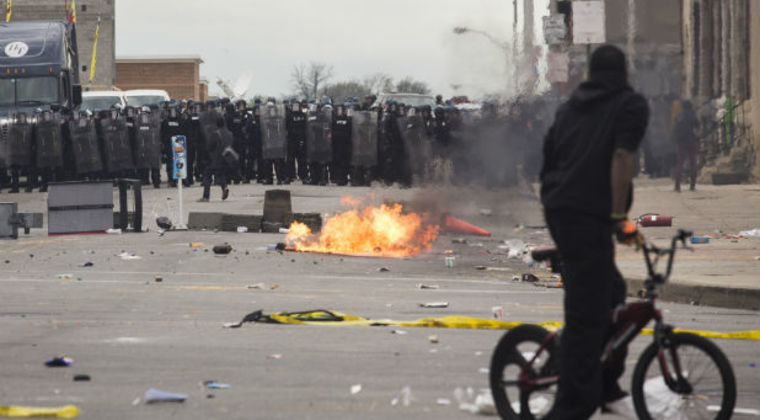
Similarly, the Baltimore rioters have found themselves on the losing end of a set of government policies that have consolidated wealth and foreclosed economic opportunities for independence and self-sufficiency. While so many Americans have been railing against welfare recipients, worried about the effects of food stamps on the federal budget, top American companies have worked closely with government for generations, guaranteeing the corporate welfare and special privileges that define the U.S. economic system.

The truth is that corporate capitalism has hung these rioting Baltimoreans out to dry, the American Dream being to them no more than a cruelly sarcastic joke, forever out of reach, mocking them. The prevailing story depicts the urban poor largely as the victims of “the free market,” dependent on a helping hand from government, be it education, job training, or just the bare necessities. In this story, government intervenes to file the sharp edges off of unbridled free market competition.

The problem with this story is that is recasts government in a role it has never actually played for poor and working class people — least of all black Americans. In real life, the state has intervened not to protect the economically powerless and penniless, but to serve to the needs of capital, to fence off resources and restrict opportunities in order to subject people to the control of a few giant employers. This coercive, state-driven process has nothing to do with a principled, libertarian free market today, and it never has in the past.

The result has been a permanent underclass, condemned to live in ghettos under quasi-military occupation, surrounded by violent crime that is the direct product of a failed war on drugs. And while the people who live in these communities are demonstrably no more likely to possess contraband than anyone else, they are far more likely to be stopped and frisked, arrested, and even murdered by increasingly militarized police officers.

The problems in Baltimore are historical and systemic. Everyone agrees that rioting, looting, and the wanton destruction of private property are senseless acts that ultimately can’t help anyone or create positive social change. We must nevertheless ask why these people in Baltimore feel so helpless, so abandoned and frustrated by the “proper channels,” that they find it is necessary to lash out and express themselves in this way.

Systematic state violence has left Baltimore communities barren, crying out for justice and opportunity. Anarchists believe that the dormant power of self-organization, cooperation and trade, once truly freed from aggression and meddling, is all the poor need to thrive. Through the anger and sadness coming out of Baltimore, it’s important not to lose sight of the larger, underlying issues.

MAY DAY – The International Labor Day

crane13

Source: The Anarchist International

May 1st, International Workers’ Day, commemorates the historic struggle of working people throughout the world, and is recognized in most countries. The United States of America and Canada are among the exceptions. This despite the fact that the holiday began in the 1880s in the USA, linked to the battle for the eight-hour day, and the Chicago anarchists.

The struggle for the eight-hour day began in the 1860s. In 1884, the Federation of Organized Trades and Labor Unions of the United States and Canada, organized in 1881 (and changing its name in 1886 to American Federation of Labor ) passed a resolution which asserted that “eight hours shall constitute a legal day’s work from and after May 1, 1886, and that we recommend to labor organizations throughout this district that they so direct their laws as to conform to this resolution”. The following year the Federation repeated the declaration that an eight-hour system was to go into effect on May 1, 1886. With workers being forced to work ten, twelve, and fourteen hours a day, support for the eight-hour movement grew rapidly. In the months prior to May 1, 1886, thousands of workers, organized and unorganized, members of the organization Knights of Labor and of the federation, were drawn into the struggle. Chicago was the main center of the agitation for a shorter day. The anarchists were in the forefront of the Central Labor Union of Chicago, which consisted of 22 unions in 1886, among them the seven largest in the city.

During the Railroad strikes of 1877, the workers had been violently attacked by the police and the United States Army. A similar tactic of state terrorism was prepared by the bureaucracy to fight the eight-hour movement. The police and National Guard were increased in size and received new and powerful weapons financed by local business leaders. Chicago’s Commercial Club purchased a $2000 machine gun for the Illinois National Guard to be used against strikers. Nevertheless, by May 1st, the movement had already won gains for many Chicago workers. But on May 3, 1886, police fired into a crowd of strikers at the McCormick Harvester Machine Company, killing at least one striker, seriously wounding five or six others, and injuring an undetermined number. Anarchists called for a mass meeting the next day in Haymarket Square to protest the brutality.

The meeting proceeded without incident, and by the time the last speaker was on the platform, the rainy gathering was already breaking up, with only about two hundred people remaining. It was then a police column of 180 men marched into the square and ordered the meeting to disperse. At the end of the meeting a bomb was thrown at the police, killing one instantly, six others died later. About seventy police officers were wounded. Police responded by firing into the crowd. How many civilians were wounded or killed from police bullits never was ascertained exactly. Although it was never determined who threw the bomb, the incident was used as an excuse to attack anarchists and the labor movement in general. Police ransacked the homes and offices of suspected radicals, and hundreds were arrested without charge. A reign of police terror swept over Chicago. Staging “raids” in the working-class districts, the police rounded up all known anarchists and other socialists. “Make the raids first and look up the law afterward!” publicly counseled the state’s attorney.

Anarchists in particular were harassed, and eight of Chicago’s most active were charged with conspiracy to murder in connection with the Haymarket bombing. A kangaroo court found all eight guilty, despite a lack of evidence connecting any of them to the bomb-thrower, and they were sentenced to die. In October 9, 1886, the weekly journal Knights of Labor published in Chicago, carried on page 1 the following announcement: “Next week we begin the publication of the lives of the anarchists advertised in another column.”

The advertisement, carried on page 14, read: The story of the anarchists, told by themselves; Parsons, Spies, Fielden, Schwab, Fischer, Lingg, Engle, Neebe. The only true history of the men who claim that they are condemned to suffer death for exercising the right of Free Speech: Their association with Labor, Socialistic and Anarchistic Societies, their views as to the aims and objects of these organizations, and how they expect to accomplish them; also their connection with the Chicago Haymarket Affair. Each man is the author of his own story, which will appear only in the “Knights of Labor” during the next three months, – the great labor paper of the United States, a 16-page weekly paper, containing all the latest foreign and domestic labor news of the day, stories, household hints, etc. A co-operative paper owned and controlled by members of the Knights of Labor, and furnished for the small sum of $1.00 per annum. Adress all communications to Knights of Labor Publishing Company, 163 Washington St., Chicago, Ill. Later this journal and the paper Alarm published the autobiographies of the Haymarket men.

Albert Parsons, August Spies, Adolf Fischer and George Engel were hanged on November 11, 1887. Louis Lingg committed suicide in prison. The authorities turned over the bodies to friends for burial, and one of the largest funeral processions in Chicago history was held. It was estimated that between 150,000 to 500,000 persons lined the route taken by the funeral cortege of the Haymarket martyrs. A monument to the executed men was unveiled June 25, 1893 at Waldheim Cemetery in Chicago. The remaining three, Samuel Fielden, Oscar Neebe and Michael Schwab, were finally pardoned in 1893.

On June 26, 1893, the governor of Illinois, John Peter Altgeld, issued the pardon message in which he made it clear that he was not granting the pardon because he believed that the men had suffered enough, but because they were innocent of the crime for which they had been tried, and that they and the hanged men had been the victims of hysteria, packed juries and a biased judge. He noted that the defendants were not proven guilty because the state “has never discovered who it was that threw the bomb which killed the policeman, and the evidence does not show any connection whatsoever between the defendants and the man who threw it.”

International Workers’ Day is the commemoration of the Haymarket Event in Chicago in 1886. In 1889, the first congress of the Second International, meeting in Paris for the centennial of the French Revolution and the Exposition Universelle (1889), following an initiative from the American Federation of Labor, called for international demonstrations on the 1890 anniversary of the Chicago protests. These were so successful that May Day was formally recognized as an annual event at the International’s second congress in 1891.

It is not surprising that the state, business leaders, mainstream union officials, and the media would want to hide the true history of May Day. In its attempt to erase the history and significance of May Day, the United States government declared May 1st to be “Law Day”, and gave the workers instead Labor Day, the first Monday of September – a holiday devoid of any historical significance.

Nevertheless, rather than suppressing the labor and anarchist movements, the events of 1886 and the execution of the Chicago anarchists, spokesmen of the movement for the eight-hour day, mobilized many generations of radicals. Emma Goldman, a young immigrant at the time, later pointed to the Haymarket affair as her political birth. Instead of disappearing, the anarchist movement only grew in the wake of Haymarket.

As workers, we must recognize and commemorate May Day not only for it’s historical significance, but also as a time to organize around issues of vital importance of today for the working-class broadly defined, i.e. the grassroots – the people seen as a class in contrast to the superiors in income and/or rank – economically and/or political/administrative.

The May Day Manifestos of the International Workers of the World affiliated to the Anarchist International, from the latest years are published on its Webpage, click here!

Baltimore and the Human Right to Resistance: Rejecting the Framework of the Oppressor

Baltimore-Riots.jpg_23790e32da49a4d09d45db82b7634b69To hear President Obama and Baltimore mayor Rawlings tell it, politeness, nonviolence and respect for law and property are the fundamental obligations of those confronting the brazen and lawless violence of police in Baltimore and beyond. This is a truly upside-down reality.

By Ajamu Baraka

Source: Black Agenda Report

Anti-Black racism, always just beneath the surface of polite racial discourse in the U.S., has exploded in reaction to the resistance of black youth to another brutal murder by the agents of this racist, settler-colonialist state. With the resistance, the focus shifted from the brutal murder of Freddie Gray and the systematic state violence that historically has been deployed to control and contain the black population in the colonized urban zones of North America, to the forms of resistance by African Americans to the trauma of ongoing state violence.

The narrative being advanced by corporate media spokespeople gives the impression that the resistance has no rational basis. The impression being established is that this is just another manifestation of the irrationality of non-European people – in particular, Black people – and how they are prone to violence. This is the classic colonial projection employed by all white supremacist settler states, from the U.S., to South Africa and Israel.

The accompanying narrative is that any kind of resistance that does not fit the narrow definition of “non-violent” resistance is illegitimate violence and, therefore, counter-productive because – “violence doesn’t accomplish anything.”  Not only does this position falsely equate resistance to oppression as being morally equivalent to the violence of the oppressor, it also attempts to erase the role of violence as being fundamental to the U.S. colonial project.

The history of colonial conquest saw the U.S. settler state shoot and murdered its’ way across the land mass of what became the U.S. in the process of stealing indigenous land to expand the racist White republic from “sea to shining sea.”  And the marginalization of the role of violence certainly does not reflect the values of the Obama administration that dutifully implements the bi-partisan dictates of the U.S. strategy of full spectrum dominance that privileges military power and oppressive violence to protect and advance U.S. global supremacy. The destruction of Libya; the reinvasion of Iraq; the civil war in Syria; Obama’s continued war in Afghanistan; the pathological assault by Israel on Palestinians in Gaza and the U.S. supported attack on Yemen by the Saudi dictatorship, are just a few of the horrific consequences of this criminal doctrine.

Race and oppressive violence has always been at the center of the racist colonial project that is the U.S. It is only when the oppressed resist — when we decide, like Malcolm X said, that we must fight for our human rights — that we are counseled  to be like Dr. King, including by war mongers like Barack Obama. However, resistance to oppression is a right that the oppressed claim for themselves. It does not matter if it is sanctioned by the oppressor state, because that state has no legitimacy.

No rational person exalts violence and the loss of life. But violence is structured into the everyday institutional practices of all oppressive societies. It is the deliberate de-humanization of the person in order to turn them into a ‘thing’ — a process Dr. King called “thing-afication.” It is a necessary process for the oppressor in order to more effectively control and exploit. Resistance, informed by the conscious understanding of the equal humanity of all people, reverses this process of de-humanization. Struggle and resistance are the highest expressions of the collective demand for people-centered human rights – human rights defined and in the service of the people and not governments and middle-class lawyers.

That resistance may look chaotic at this point – spontaneous resistance almost always looks like that. But since the internal logic of neoliberal capital is incapable of resolving the contradiction that it created, expect more repression and more resistance that will eventually take a higher form of organization and permanence. In the meantime, we are watching to see who aligns with us or the racist state.

The contradictions of the colonial/capitalist system in its current expression of neoliberalism have obstructed the creation of decent, humane societies in which all people are valued and have democratic and human rights. What we are witnessing in the U.S. is a confirmation that neoliberal capitalism has created what Chris Hedges called “sacrificial zones” in which large numbers of black and Latino people have been confined and written off as disposable by the system. It is in those zones that we find the escalation of repressive violence by the militarized police forces. And it is in those zones where the people are deciding to fight back and take control of their communities and lives.

These are defining times for all those who give verbal support to anti-racist struggles and transformative politics. For many of our young white comrades, people of color and even some black ones who were too young to have lived through the last period of intensified struggle in the 1960s and ‘70s and have not understood the centrality of African American resistance to the historical social struggles in the U.S., it may be a little disconcerting to see the emergence of resistance that is not dependent on and validated by white folks or anyone else.

The repression will continue, and so will the resistance. The fact that the resistance emerged in a so-called black city provides some complications, but those are rich and welcoming because they provide an opportunity to highlight one of the defining elements that will serve as a line of demarcation in the African American community – the issue of class.  We are going to see a vicious ideological assault by the black middle class, probably led by their champion – Barack Obama – over the next few days. Yet the events over the last year are making it more difficult for these middle-class forces to distort and confuse the issue of their class collaboration with the white supremacist capitalist/colonialist patriarchy. The battle lines are being drawn; the only question that people must ask themselves is which side they’ll be on.

Ajamu Baraka is a human rights activist, organizer, geo-political analyst and editor and contributing columnist for the Black Agenda Report. Baraka serves as the Public Intervenor for Human Rights as a member of the Green Shadow Cabinet and coordinates the International Affairs Committee of the Black Left Unity Network. He is also an Associate Fellow at the Institute for Policy Studies (IPS) in Washington, D.C.

FAA investigating Florida mailman’s landing of gyrocopter on U.S. Capitol lawn

1dfb9_1956

By Ben Montgomery

Source: Tampa Bay Times

Doug Hughes, a 61-year-old mailman from Ruskin, told his friends he was going to do it. He was going to fly a gyrocopter through protected airspace and put it down on the lawn of the U.S. Capitol, then try to deliver 535 letters of protest to 535 members of Congress.

The stunt seemed so outlandish that not even his closest friend thought he would pull it off.

“My biggest fear was he was going to get killed,” said Mike Shanahan, 65, of Apollo Beach, who works with Hughes for the Postal Service.

After 21/2 years of planning, Hughes came hovering low over the buildings of northeast D.C. about 1:20 p.m., like a distant bird. He rounded the Washington Monument a few minutes later, flew straight up the expanse of the National Mall and brought his small craft down right in front of the Capitol, where he was quickly surrounded by police and surrendered without incident.

The flight stunned police, Secret Service and witnesses. Authorities briefly shut down the Capitol as a security measure. The incident brought out dozens of reporters and cameras from national media outlets — exactly what Hughes had hoped for. Hughes, who sees himself as a sort of showman patriot, a mix of Paul Revere and P.T. Barnum, wanted to do something so big and brazen that it would hijack the news cycle and turn America’s attention toward his pet issue: campaign finance reform.

“No sane person would do what I’m doing,” Hughes told the Tampa Bay Times in the weeks before he took flight. He was doing it, he said, because the United States is “heading full-throttle toward a breakdown.”

“There’s no question that we need government, but we don’t have to accept that it’s a corrupt government that sells out to the highest bidder,” Hughes said.

It’s hard to say whether the message got through.

“I don’t think anyone noticed it,” said Sophia Brown, visiting Washington from England. “We noticed it, but nobody made a big deal about it.”

Richard Burns, 27, a worker at a marijuana lobby group in Washington, stood by the Capitol in wonder and solidarity.

“I don’t know whatever it was he was doing, but I support him,” Burns said.

Gil Wheeler, 53, a pilot from Las Vegas, said the biggest problem was how the letter carrier reached restricted airspace in the first place.

“This is just another question for Homeland Security,” Wheeler said. “We still have a lot of questions to ask.”

Late Wednesday, U.S. Capitol Police said Hughes had been arrested, charged under Title 49 of U.S. Code and processed at their headquarters. He was then transferred to the central cellblock in Washington. The FAA was investigating.

News reports said Secret Service agents were investigating at Gettysburg Airport, a small airport in Pennsylvania, where they believe Hughes took off.

Hughes didn’t know whether he would even make it. He imagined being shot down, blown down. Almost every scenario he could imagine involved some type of resistance. Barring that, he said: “They will put the cuffs on me. And they will try to establish who is behind this. . . . The authorities are going to be out to get me.”

His wife could not be reached for comment.

Hughes contacted a Tampa Bay Times reporter last year, saying he wanted to tell someone about his plan and motivation. He said he had no intention of hurting anybody and that he didn’t want to be hurt. By that time, he had already been visited twice by the Secret Service, he said.

The first visit, Hughes told the Times, came one night last spring at about 1 a.m. The agent was accompanied by a Hillsborough County sheriff’s deputy. In a statement issued to media outlets Wednesday, the Secret Service said it interviewed Hughes on Oct. 5, 2013, and that a “complete and thorough investigation was conducted.”

The Secret Service agent asked him questions about his plan, Hughes said, and he said he was honest in his replies, if not totally forthcoming with details. Yes, he did own a gyrocopter. Yes, he kept it in a hangar at the small airport in Wauchula. Yes, he had talked of doing something big to bring attention to the issue of campaign finance reform. No, he was not planning to crash into any buildings or monuments in Washington, D.C.

I’m not a violent person, Hughes remembers saying. All I want to do is draw attention.

Someone inside his circle of secrecy had reported him, telling the Secret Service that Hughes was talking about committing a daring act of civil disobedience that also happened to be a federal crime.

Two days later, Hughes said, the same agent showed up at the post office where Hughes works and asked more questions. One of Hughes’ colleagues told the Tampa Bay Times that he, too, answered questions from the Secret Service.

And then, for months, nothing. That was it, Hughes said. No other questions. No other contact. Hughes put his plan into action.

He bought a burner cell phone and a videocamera and tested a livestream video feed from his gyrocopter. He built a website offline that explained why he was doing this. He bought $250 worth of stamps and stuffed envelopes with his letter:

“I’m demanding reform and declaring a voter’s rebellion in a manner consistent with Jefferson’s description of rights in the Declaration of Independence,” he wrote in his letters. “As a member of Congress, you have three options. 1. You may pretend corruption does not exist. 2. You may pretend to oppose corruption while you sabotage reform. 3. You may actively participate in real reform.”

Late last week, he loaded the gyrocopter onto a trailer and headed for an undisclosed location outside the nation’s capital.

His livestream showed that he took off about 12:10 p.m. Wednesday. He intended to fly about 300 feet high, at 45 mph and wound up landing on the west lawn of the Capitol shortly before 1:30 p.m.

Hughes knew there was a risk he could be shot out of the sky, though he hoped it wouldn’t come to that.

“I don’t believe that the authorities are going to shoot down a 61-year-old mailman in a flying bicycle,” he said. “I don’t have any defense, okay, but I don’t believe that anybody wants to personally take responsibility for the fallout.”

In the end, his flight occurred without incident or escorts. The Times published a story about Hughes’ plans on its website, tampabay.com, shortly after noon when it was clear he had actually taken off and was attempting his flight. His livestream cut in and out but showed his progress. A Times reporter called the Secret Service in Washington, D.C., shortly before 1 p.m. to see if officials were aware of a man in a gyrocopter flying toward the capital. Public information officers there who did not give their names said they had not heard of the protest. They referred a reporter to Capitol Police. A public information officer did not immediately answer.

Sgt. Trina Hamilton in the watch commander’s office said: “He hasn’t notified anybody. We have no information.”

Hughes’ friend, Mike Shanahan, after receiving a call from Hughes early Wednesday, said he contacted a Secret Service agent and left a message but never heard back. Hughes had told his friend he was in Washington, Shanahan recalled. But when Shanahan tried to access the live-streaming website, he could not find it and was unsure if Hughes was really going to take flight.

Before his flight, Hughes said he knew what was at stake. He figured he’ll lose his job of 11 years. And he could lose his tidy little house across from a pond with a fountain. He knew he would lose his freedom. That means losing, at least temporarily, his Russian-born wife and his polite 12-year-old daughter who plays the piano and wins awards at the science fair. He kept them in the dark, he said, for fear they’d be implicated.

Hughes is a slender, soft-spoken, pedantic man, with thinning gray hair and hearing aids. He has no criminal record and it’s rare to hear him curse. But he said he needed the show, the very dramatic public act of civil disobedience, to focus the nation’s attention on campaign finance reform, a topic that in most quarters makes eyes glaze over. Money, he says, has corrupted the democracy.

At the root of Hughes’ disdain is the Supreme Court’s 2010 decision in Citizens United vs. Federal Election Commission, in which the court decided campaign contributions were a form of “political speech” and struck down limits on how much corporations and unions could give to political contenders. The decision changed the game. Campaign spending went through the roof. In Hughes’ mind, there was a parallel spike in favor-dealing and the government is now practically owned by the rich. Hughes likes to point out that nearly half the retiring members of Congress from 1998 to 2004 got jobs as lobbyists earning some 14 times their congressional salaries.

But nobody seems to care.

Hughes thinks the answers are out there, and they’re nonpartisan. He points to reform thinkers like political activist Cenk Uygar and Harvard legal theorist Lawrence Lessig, who launched a political action committee to end political action committees. The motto: “Embrace the irony.”

“I’m not promoting myself,” Hughes said a few weeks ago. “I’m trying to direct millions of people to information, to a menu of organizations that are working together to fix Congress.”

His idea began to blossom 2½ years ago, after his son, John Joseph Hughes, 24, committed suicide by driving his car head-on into another man, killing them both. “Police: Suicidal driver caused deadly crash,” read the headline in the Leesburg newspaper. He was crushed by grief, and disappointed that his son had killed himself — and someone else — to make a stupid, worthless point.

“Something changed in me,” Hughes said. With mourning came a realization. The years Hughes spent thinking about and writing about mundane political issues were for naught if he didn’t have a way to make a point. His political frustrations and grief merged. He doesn’t condone what his son did, but it offered a lesson.

“He paid far too high a price for an unimportant issue,” Hughes said. “But if you’re willing to take a risk, the ultimate risk, to draw attention to something that does have significance, it’s worth doing.”

He has always wanted to fly. Growing up in Santa Cruz, Calif., he used to ride his bike to Sky Park and watch the planes come and go, and read books about the Wright brothers and Kitty Hawk.

At first he thought about using an ultralight fixed-wing plane, but that felt too threatening. He finally found the gyrocopter, which has unpowered helicopter blades on top for lift but gets its thrust from a propeller on the back. The cockpit, if you can call it that, is wide open. “This is as transparent a vehicle that I could come up with,” Hughes said. “You can literally see through it.” He can land the craft in a space the size of half a basketball court.

Hughes told the Times he planned to set up a delayed email blast to alert as many TV and newspaper breaking news desks as he could find, as well as the Secret Service.

The Secret Service statement said it did not receive notification of the flight. Several reporters told the Times they received the email. The Times reported about Hughes’ flight on Twitter and Facebook as it was happening, but most media attention came after his landing at the Capitol. His website went up as scheduled, which broadcast a choppy livestream of his trip.

His biggest fear all along, he said, was losing his nerve.

“I have thought about walking away from this whole thing because it’s crazy,” he said. “But I have also thought about being 80 years old and watching the collapse of this country and thinking that I had an idea once that might have arrested the fall and I didn’t do it.

“And I will tell you completely honestly: I’d rather die in the flight than live to be 80 years old and see this country fall.”

Times staff writers Zachary T. Sampson and Lauren Carroll and researcher Caryn Baird contributed to this report.


This is the text of the letter that Doug Hughes wants to deliver to members of Congress:

Dear ___________,

Consider the following statement by John Kerry in his farewell speech to the Senate —

“The unending chase for money I believe threatens to steal our democracy itself. They know it. They know we know it. And yet, Nothing Happens!” — John Kerry, 2-13

In a July 2012 Gallup poll, 87% tagged corruption in the federal government as extremely important or very important, placing this issue just barely behind job creation. According to Gallup, public faith in Congress is at a 41-year record low, 7%. (June 2014) Kerry is correct. The popular perception outside the DC beltway is that the federal government is corrupt and the US Congress is the major problem. As a voter, I’m a member of the only political body with authority over Congress. I’m demanding reform and declaring a voter’s rebellion in a manner consistent with Jefferson’s description of rights in the Declaration of Independence. As a member of Congress, you have three options.

1. You may pretend corruption does not exist.

2. You may pretend to oppose corruption while you sabotage reform.

3. You may actively participate in real reform.

If you’re considering option 1, you may wonder if voters really know what the ‘chase for money’ is. Your dismal and declining popularity documented by Gallup suggests we know, but allow a few examples, by no means a complete list. That these practices are legal does not make them right! Obviously, it is Congress who writes the laws that make corruption legal.

1. Dozens of major and very profitable corporations pay nothing in taxes. Voters know how this is done. Corporations pay millions to lobbyists for special legislation. Many companies on the list of freeloaders are household names — GE, Boeing, Exxon Mobil, Verizon, Citigroup, Dow …

2. Almost half of the retiring members of Congress from 1998 to 2004 got jobs as lobbyists earning on average fourteen times their Congressional salary. (50% of the Senate, 42% of the House)

3. The new democratic freshmen to the US House in 2012 were ‘advised’ by the party to schedule 4 hours per day on the phones fund raising at party headquarters (because fund raising is illegal from gov’t offices.) It is the donors with deep pockets who get the calls, but seldom do the priorities of the rich donor help the average citizen.

4. The relevant (rich) donors who command the attention of Congress are only .05% of the public (5 people in a thousand) but these aristocrats of both parties are who Congress really works for. As a member of the US Congress, you should work only for The People.

1. Not yourself.

2. Not your political party.

3. Not the richest donors to your campaign.

4. Not the lobbyist company who will hire you after your leave Congress.

There are several credible groups working to reform Congress. Their evaluations of the problem are remarkably in agreement though the leadership (and membership) may lean conservative or liberal. They see the corrupting effect of money — how the current rules empower special interests through lobbyists and PACs — robbing the average American of any representation on any issue where the connected have a stake. This is not democracy even if the ritual of elections is maintained.

The various mechanisms which funnel money to candidates and congress-persons are complex. It happens before they are elected, while they are in office and after they leave Congress. Fortunately, a solution to corruption is not complicated. All the proposals are built around either reform legislation or a Constitutional Amendment. Actually, we need both — a constitutional amendment and legislation.

There will be discussion about the structure and details of reform. As I see it, campaign finance reform is the cornerstone of building an honest Congress. Erect a wall of separation between our elected officials and big money. This you must do — or your replacement will do. A corporation is not ‘people’ and no individual should be allowed to spend hundreds of millions to ‘influence’ an election. That much money is a megaphone which drowns out the voices of ‘We the People.’ Next, a retired member of Congress has a lifelong obligation to avoid the appearance of impropriety. That almost half the retired members of Congress work as lobbyists and make millions of dollars per year smells like bribery, however legal. It must end. Pass real campaign finance reform and prohibit even the appearance of payola after retirement and you will be part of a Congress I can respect.

The states have the power to pass a Constitutional Amendment without Congress — and we will. You in Congress will likely embrace the change just to survive, because liberals and conservatives won’t settle for less than democracy. The leadership and organization to coordinate a voters revolution exist now! New groups will add their voices because the vast majority of Americans believe in the real democracy we once had, which Congress over time has eroded to the corrupt, dysfunctional plutocracy we have.

The question is where YOU individually stand. You have three options and you must choose.

Sincerely,

Douglas M. Hughes

http://www.TheDemocracyClub.org

Ferguson and the Logic of Neoliberalism

Ferguson-RiotA Political Economy Premised on Exploitation and Social Repression

By Rob Urie

Source: Counterpunch.org

While the U.S. Department of Justice report on racist policing practices in Ferguson, Missouri provides direct evidence for skeptical Whites that institutional racism is fact, limiting the investigation to Ferguson implausibly delimits the scope of race based repression in the U.S. Additionally, from slavery to convict leasing to funding the Ferguson city budget with fines and penalties overwhelmingly extracted from poor and middle class Blacks, the economic basis of police repression is isolated in an improbable present. And in fact, the ‘tricks and traps’ used by the Ferguson police for economic extraction closely resembles corporate practices of using contract law, state institutions and monopoly power to take economic resources from those who lack the social power to resist.

A cognitive challenge for White Americans (and ‘conservative’ Blacks) is the distance between facts like police repression in Ferguson and the mythology of capitalist democracy that we live by. Use of the police for economic extraction in Ferguson, for funding the town budget through racial repression, ties state power to economic power within the particular circumstances of American racial and economic history. In a most basic sense this integration reframes state-market relations claimed to relate capitalism to democracy. More broadly, the TPP and TIPP ‘trade’ deals being pushed by President Obama are a variation on the racist shakedown in Ferguson. Their intent is to replace state power with corporate power while leaving Western states intact to provide state services for the benefit of corporations and the illusion of democratic control.

Discovery of a police ‘black site’ in Chicago, the prevalence of racist violence by the police across the U.S., the return of debtor’s prisons and ‘civil forfeiture’ laws that allow the police to take belongings without evidence of a crime illustrate the growing lawlessness of the police. When tied to illegal surveillance carried out by the NSA, DEA and FBI against citizens and non-citizens alike and the extra-judicial powers claimed by Mr. Obama a picture of widespread state lawlessness emerges. When considered in the context of no criminal prosecutions for war crimes against the (George W) Bush administration or against prominent bankers in the financial and economic debacle of the last decade a picture of widespread elite lawlessness emerges. Clearly the state, including local police departments, exists for purposes other than enforcing fealty to the law.

Based on supporting economic theories it is superficially ironic that the resurgence of neo-liberalism since the 1970s is coincident with this growing integration of state and ‘private’ power. Premised on clearly delineated state and market roles, neo-liberalism was / is in theory the economic realm unhindered by state restrictions. This state-market delineation facilitates the facade that capitalism is related to democracy— political freedom in the realm of the political and economic freedom in the realm of the economic. As fact and metaphor the role of the Ferguson police using asymmetrical social power to take economic wealth from vulnerable citizens demonstrates the implausibility of this theorized differentiation in the realm of the political. And new debtor’s prisons (link above) have police and the prison system acting as collection agents for Payday Lenders.

The TPP and TTIP trade deals being pushed by Mr. Obama are designed with analogous levers for extorting wealth. The investor resolution clauses in TTIP have a supranational judiciary ruling on ‘investor’ lawsuits against governments for hypothetical lost profits and taxpayers on the hook for adverse rulings. The relative absence of remaining trade restrictions and tariffs is well covered territory. What remains to be accomplished with these ‘agreements’ is the consolidation of economic power as the power to extract wealth. As with proposals for tradable carbon credits, the ‘product’ of the agreements combines the right to extort by putting forward projects never intended to be built with guarantees against adverse economic developments.

The police in Ferguson used a particular social lever, the residual of slavery, for gratuitous racial repression and for economic extraction. Slavery is a social institution, but it most particularly is an economic institution. It is a social mechanism for accruing the product of slave labor to the slave master. And slavery in the U.S. was ‘legal’ until it wasn’t. Convict leasing was explicit use of ‘the law’ and the judicial system to force poor Blacks to work for little or no pay. ‘The law’ was used as an instrument of economic exploitation and extraction. The push back from Whites and conservative Blacks that the murdered Mike Brown was a criminal because he likely stole a box of cigars takes this same law at face value. This view of the law depends on a similarly improbable separation of political and economic realms as neo-liberal theory.

As political theory might have it, if all of the citizens of Ferguson were intended to benefit from city resources while poor and middle class Blacks were disproportionately forced to pay for them that represents economic taking by some citizens for the benefit of others. The racial character of this taking places it in history. The history of Western colonialism, neo-colonialism and imperialism places it in broader internal and external context. And this history is evidence that distinct realms of the economic and the political never described existing circumstance. The practical relevance is that it places the actions of the police in Ferguson, past and pending ‘trade’ agreements and global economic relations in the space where economic and political power act in an integrated social dimension.

The effect is to reframe ‘the law’ in terms of who is committing particular acts rather than the acts being committed. The police in Ferguson can murder with impunity and shake down citizens at their discretion to fund the city budget (and their paychecks) while poor and middle class Blacks are disproportionately murdered and sent to prison for similar acts. What is legal and what isn’t is determined by who has social power, not by the acts themselves. In a racist and classist society the law is codification of class and race interests. If a black citizen of Ferguson puts a gun to someone’s head and demands their valuables they are a criminal but if the same act is committed by a cop it is within the law. Here events in Ferguson are fact and metaphor— overwhelming evidence (links above) suggests that similar social relations exist across much of the country.

This view of the law has precedence in Richard Nixon’s contention that “when the President does it that means that it is not illegal.” Earlier precedence can be found in Nazi law and in the laws of fascist Italy in the 1930s and 1940s. This isn’t to call anyone who isn’t a self-proclaimed Nazi a Nazi. The precedence lies in the view that the law is the will of a leadership class, be it the Nazi leadership in Germany or city government in Ferguson. One problem with this theory is that it makes the law capricious and ultimately impossible to follow. Race based law enforcement criminalizes race, not nominally proscribed acts. Stories of the Chicago police department’s black site (link above) have political protesters and poor Blacks accused of no crimes taken there. If people can be arrested without evidence that a crime was committed then what is the difference in outcomes between committing and not committing crimes?

A relation of neo-liberalism to fascism can be made through replacement of civil governance with corporate governance that subordinates the rights and privileges of civil society to corporate interests. The investor-state dispute mechanisms (link above) being broadened and formally codified in the TTIP trade deal will be used to demand compensation for environmental regulations that keep drinking water safe and limit greenhouse gas emissions, the metaphorical equivalent of threatening to end the planet if we don’t pay up. Civil forfeiture has the police taking valuables they might want at the point of a gun if necessary. The Ferguson police shake down poor Blacks using the law as a weapon. At the same time a ruling elite has immunity from prosecution for well documented crimes.

Much of what is written here was well understood in the 1950s, 1960s and 1970s. It hardly seems an accident that this collective memory was lost to narrow ideological dogma. Across the country property taxes are being cut with partial differences made up through regressive fees and penalties. This fits the neo-liberal preference for property over labor incomes. And neo-liberal theory has no place for history because all acts within it take place in a temporally isolated present. This dissociates racist policing in Ferguson, Chicago, New York, Detroit and Philadelphia from the roles of the legislature, judiciary, police and prisons in reconstituting the economic exploitation of slavery under the guise of free choice in capitalist democracy. Race is the particular case in America; class is the broader expression of economic power.

The tension between the DOJ report (link above) on racist policing in Ferguson and the Obama administration’s broad support for neo-liberal policies will likely produce a tight circle drawn around events in Ferguson. Already supporters of police repression are raising the argument that the words “hands up, don’t shoot” never transpired. What bearing does precise wording have on a Black child being murdered by the police? And why wouldn’t Black youth have a right to be hostile to police who, as the DOJ reports concludes, are running a racist shakedown operation to force poor and middle class Blacks to fund city government? How would White readers react to being harassed, intimidated, disproportionately jailed and forced to pay for the privilege? Ultimately the problem is larger than Ferguson and social accountability should address political economy premised in exploitation and social repression.

Rob Urie is an artist and political economist. His book Zen Economics is written and awaiting publication.