Neocons and Neolibs: How Dead Ideas Kill

hillary-aipac

By Robert Parry

Source: Consortium News

For centuries hereditary monarchy was the dominant way to select national leaders, evolving into an intricate system that sustained itself through power and propaganda even as its ideological roots shriveled amid the Age of Reason. Yet, as monarchy became a dead idea, it still killed millions in its death throes.

Today, the dangerous “dead ideas” are neoconservatism and its close ally, neoliberalism. These are concepts that have organized American foreign policy and economics, respectively, over the past several decades – and they have failed miserably, at least from the perspective of average Americans and people of the nations on the receiving end of these ideologies.

Neither approach has benefited mankind; both have led to untold death and destruction; yet the twin “neos” have built such a powerful propaganda and political apparatus, especially in Official Washington, that they will surely continue to wreak havoc for years to come. They are zombie ideas and they kill.

Yet, the Democratic Party is poised to nominate an adherent to both “neos” in the person of Hillary Clinton. Rather than move forward from President Barack Obama’s unease with what he calls the Washington “playbook,” the Democrats are retreating into its perceived safety.

After all, the Washington Establishment remains enthralled to both “neos,” favoring the “regime change” interventionism of neoconservatism and the “free trade” globalism of neoliberalism. So, Clinton has emerged as the clear favorite of the elites, at least since the field of alternatives has narrowed to populist billionaire Donald Trump and democratic socialist Bernie Sanders.

Democratic Party insiders appear to be counting on the mainstream news media and prominent opinion-leaders to marginalize Trump, the presumptive Republican nominee, and to finish off Sanders, who faces long odds against Clinton’s delegate lead for the Democratic nomination, especially among the party regulars known as “super-delegates.”

But the Democratic hierarchy is placing this bet on Clinton in a year when much of the American electorate has risen up against the twin “neos,” exhausted by the perpetual wars demanded by the neoconservatives and impoverished by the export of decent-paying manufacturing jobs driven by the neoliberals.

Though much of the popular resistance to the “neos” remains poorly defined in the minds of rebellious voters, the common denominator of the contrasting appeals of Trump and Sanders is that millions of Americans are rejecting the “neos” and repudiating the establishment institutions that insist on sustaining these ideologies.

The Pressing Question

Thus, the pressing question for Campaign 2016 is whether America will escape from the zombies of the twin “neos” or spend the next four years surrounded by these undead ideas as the world lurches closer to an existential crisis.

The main thing that the zombie “neos” have going for them is that the vast majority of Very Important People in Official Washington have embraced these concepts and have achieved money and fame as a result. These VIPs are no more likely to renounce their fat salaries and overblown influence than the favored courtiers of a King or Queen would side with the unwashed rabble.

The “neo” adherents are also very skilled at framing issues to their benefit, made easier by the fact that they face almost no opposition or resistance from the mainstream media or the major think tanks.

The neoconservatives have become Washington’s foreign policy establishment, driving the old-time “realists” who favored more judicious use of American power to the sidelines.

Meanwhile, the neoliberals dominate economic policy debates, treating the “markets” as some new-age god and “privatization” of public assets as scripture. They have pushed aside the old New Dealers who called for a robust government role to protect the people from the excesses of capitalism and to build public infrastructure to benefit the nation as a whole.

The absence of any strong resistance to the now dominant “neo” ideologies is why we saw the catastrophic “group think” over Iraq’s WMD in 2003 and why for many years no one of great significance dared question the benefits of “free trade.”

After all, both strategies benefited the elites. Neoconservative warmongering diverted trillions of dollars into the Military-Industrial Complex and neoliberal job outsourcing has made billions of dollars for individual corporate executives and stock investors on Wall Street.

Those interests have, in turn, kicked back a share of the proceeds to fund Washington think tanks, to finance news outlets, and to lavish campaign donations and speaking fees on friendly politicians. So, for the insiders, this game has been a case of win-win.

The Losers

Not so much for the “losers,” those average citizens who have seen the Great American Middle Class hollowed out over the past few decades, watched America’s public infrastructure decay, and worried about their sons and daughters being sent off to fight unnecessary, perpetual and futile wars.

But inundated with clever propaganda – and scrambling to make ends meet – most Americans see the reality as if through a glass darkly. Many of them, as Barack Obama indelicately said during the 2008 campaign, “cling to guns or religion.” They have little else – and many are killing themselves with opiates that dull their pain or with those guns that they see as their last link to “freedom.”

What is clear, however, is that large numbers don’t trust – and don’t want – Hillary Clinton, who had a net 24-point unfavorable rating in one recent poll. It turns out that another indelicate Obama comment from Campaign 2008 may not have been true, when he vouched that “you’re likable enough, Hillary.” For many Americans, that’s not the case (although Trump trumped Clinton with a 41-point net negative).

If the Democrats do nominate Hillary Clinton, they will be hoping that the neocon/neolib establishment can so demonize Donald Trump that a plurality of Americans will vote for the former Secretary of State out of abject fear over what crazy things the narcissistic billionaire might do in the White House.

Trump’s policy prescriptions have been all over the place – and it is hard to know what reflects his actual thinking (or his genuine ignorance) as opposed to what constitutes his skillful showmanship that made him the “survivor” in the real-life reality TV competition for the Republican nomination.

Does Trump really believe that global warming is a hoax or is he just pandering to the know-nothing element of the Republican Party? Does he actually consider Obama’s Iran nuclear deal to be a disaster or is he just playing to the hate-Obama crowd on the Right?

Opposing the ‘Neos’

But Trump is not a fan of the “neos.” He forthrightly takes on the neocons over the Iraq War and excoriates ex-Secretary of State Clinton for her key role in another “regime change” disaster in Libya. Further, Trump calls for cooperation with Russia and China rather than the neocon-preferred escalation of tensions.

In his April 27 foreign policy speech, Trump called for “a new foreign policy direction for our country – one that replaces randomness with purpose, ideology with strategy, and chaos with peace. …It’s time to invite new voices and new visions into the fold. …

“My foreign policy will always put the interests of the American people, and American security, above all else. That will be the foundation of every decision that I will make. America First will be the major and overriding theme of my administration.”

Such comments – suggesting that “new voices” are needed and that “ideology” should be cast aside – were fighting words for the neocons, since it is their voices that have drowned out all others and their ideology that has dominated U.S. foreign policy in recent years.

To make matters worse, Trump outlined an “America First” strategy in contrast to neocon demands that the U.S. military be dispatched abroad to advance the interests of Israel and other “allies.” Trump is not interested in staging “regime changes” to eliminate leaders who are deemed troublesome to Israel.

The real estate tycoon also has made criticism of “free trade” deals a centerpiece of his campaign, arguing that those agreements have sold out American workers by forcing them to compete with foreign workers receiving a fraction of the pay.

Sen. Sanders has struck similar themes in his insurgent Democratic campaign, criticizing Hillary Clinton’s longtime support for “free trade” and her enthusiasm for “regime change” wars, such as those in Iraq and Libya.

Examining her long record in public life, there can be little doubt that Clinton is a neocon on foreign policy and a neolib on economic strategies. She stands firmly with the consensus of Official Washington’s establishment, which is why she has enjoyed its warm embrace.

She has followed Wall Street’s beloved neoliberal attitude toward “free trade,” which has been very good for multinational corporations as they shipped millions of U.S. manufacturing jobs to low-wage countries. (She has only cooled her ardor for trade deals to stanch the flow of Democratic voters to Bernie Sanders.)

Wars and More Wars

On foreign policy, Clinton has consistently supported neoconservative wars, although she might shy from the neocon label per se, preferring its less noxious synonym “liberal interventionist.”

But as arch-neocon Robert Kagan, who has recast himself as a “liberal interventionist,” told The New York Times in 2014, “I feel comfortable with her on foreign policy. If she pursues a policy which we think she will pursue it’s something that might have been called neocon, but clearly her supporters are not going to call it that; they are going to call it something else.”

Summing up the feeling of thinkers like Kagan, the Times reported that Clinton “remains the vessel into which many interventionists are pouring their hopes.”

In February 2016, distraught over the rise of Trump, Kagan, whose Project for the New American Century wrote the blueprint for George W. Bush’s Iraq War, openly threw his support to Clinton, announcing his decision in a Washington Post op-ed.

And Kagan is not mistaken when he views Hillary Clinton as a fellow-traveler. She has often marched in lock step with the neocons as they have implemented their aggressive “regime change” schemes against governments and political movements that don’t toe Washington’s line or that deviate from Israel’s goals in the Middle East.

She has backed coups, such as in Honduras (2009) and Ukraine (2014); invasions, such as Iraq (2003) and Libya (2011); and subversions such as Syria (from 2011 to the present) all with various degrees of disastrous results. [For more details, see Consortiumnews.com’s “Yes, Hillary Clinton Is a Neocon” and “Would a Clinton Win Mean More Wars?”]

Seeking ‘Coercion’

A glimpse of what a Clinton-45 presidency might do could be seen in a recent Politico commentary by Dennis Ross, a former special adviser to Secretary of State Clinton now working at the staunchly pro-Israel Washington Institute for Near East Policy.

In the article, Ross painted a surreal world in which the problems of the Middle East have been caused by President Obama’s hesitancy to engage militarily more aggressively across the region, not by the neocon-driven decision to invade Iraq in 2003 and the similar schemes to overthrow secular governments in Libya and Syria in 2011, leaving those two countries in ruin.

Channeling the desires of right-wing Israeli Prime Minister Benjamin Netanyahu, Ross called for the United States to yoke itself to the regional interests of Israel, Saudi Arabia and other members of the Gulf Cooperation Council (GCC) in their rivalry against Shiite-led Iran.

Ross wrote: “Obama believes in the use of force only in circumstances where our security and homeland might be directly threatened. His mindset justifies pre-emptive action against terrorists and doing more to fight the Islamic State. But it frames U.S. interests and the use of force to support them in very narrow terms. …

“The Saudis acted in [invading] Yemen in no small part because they feared the United States would impose no limits on Iranian expansion in the area, and they felt the need to draw their own lines.”

To counter Obama’s hesitancy to apply military force, Ross calls for a reassertion of a muscular U.S. policy in the Middle East, much along the lines that the neocon establishment and Hillary Clinton also favor, including:

–Threatening Iran with “blunt, explicit language on employing force, not sanctions” if Iran deviates from the Obama-negotiated agreement to constrain its nuclear program (the bomb-bomb-bomb-Iran zombie lives!);

–“Contingency planning with GCC states and Israel … to generate specific options for countering Iran’s growing use of Shiite militias to undermine regimes in the region”;

–A readiness to arm Sunni tribes in Iraq if Iraq’s prime minister doesn’t;

–Establish “safe havens with no-fly zones” inside Syria if Russian President Vladimir Putin does not force Syrian President Bashar al-Assad to step down.

Employing the classic tough talk of the neocons, Ross concludes, “Putin and Middle Eastern leaders understand the logic of coercion. It is time for us to reapply it.”

One might note the many logical inconsistencies of Ross’s arguments, including his failure to note that much of Iran’s supposed meddling in the Middle East has involved aiding the Syrian and Iraqi governments in their battle against the Islamic State and Al Qaeda. Or that Russia’s intervention in Syria also has been to support the internationally recognized government in its fight against Sunni extremists and terrorists.

But the significance of Ross’s prescription to “reapply” U.S. “coercion” across the region is that he is outlining what the world can expect from a Clinton-45 presidency.

Clinton made many of the same points in her speech before the American Israel Public Affairs Committee and in debates with Bernie Sanders. If she stays on that track as president, there would be at least a partial U.S. military invasion of Syria, a very strong likelihood of war with Iran, and an escalation of tensions (and possible war) with nuclear-armed Russia.

The logic of how all that is supposed to improve matters is lost amid the classic neocon growling about showing toughness or reapplying “coercion.”

So, the Democratic Party seems to be betting that Hillary Clinton’s flood of ugly TV ads against Trump can frighten the American people enough to give the neocons and the neolibs one more lease on the White House – and four more years to wreak their zombie havoc on the world.


Investigative reporter Robert Parry broke many of the Iran-Contra stories for The Associated Press and Newsweek in the 1980s. You can buy his latest book, America’s Stolen Narrative, either in print here or as an e-book (from Amazon and barnesandnoble.com).

Pugnacious Parasites and the Provocation

insane_people

By Zen Gardner

Source: ZenGardner.com

Everyone knows the unscrupulously manipulative always accuse others of what they themselves are guilty of. It’s an age old trick to obfuscate the obvious and buy time to accomplish their purposes.

Lying is their pathological language.

Such behavior, especially in high profile public figures, is unthinkable, yet for some inexplicable reason it is not just tolerated, but ironically readily expected.

People still buy into it. And the reaction always remains the same. Complacency on the most part, and a rising sense of anger in others. No doubt a byproduct of cognitive dissonance and range of other deliberately triggered mechanisms, but surreal just the same.

A Bald Faced Lie is a Punch in the Face

This is essentially what transpires when someone knowingly lies to your face. It jars your mind and pushes you back on the defensive and you’re left to try and understand why your heart and head are not matching up with what you just heard.

Everyone, except these willingly possessed psychopaths, has a conscience. And it’s faithful to speak to us. This is why humanity has been conditioned to not respond to it, and also why fear is so essential to their game. When our signals are scrambled, our gut reaction belittled and intuition denied we’re left in a daze.

This is exactly what they want to happen. It gives them time to keep executing their programs, especially when a complicit media candies and bandies it about as if it’s true and nothing to question.

This is the whirled we’re in and up against. Again, another reason to stay fully conscious and circumspect and thoroughly educated as to their techniques and true nature. Not pretty stuff to look at, but understand it we must.

Abject bullies like Israel are relatively easy to spot – if we grasp their obvious odious nature and where they’re coming from. The bully in the playground works by pure intimidation and force and will resort to any form of expression they can – loud mouthed intimidation, brandishing weapons, and all bathed in swaggering bravado right up to and including physical force to get their point across.

Send a signal is their MO. And those who don’t cower, teach them a lesson. Again, just look at the abject genocidal insanity of the Israeli occupiers. Now that they’ve gained control of most of the world’s media, especially in the west, what they say goes. And if the media or governments don’t toe their line well enough they’ll hear from these vociferous, self serving elitist beasts.

The Provocation

Another aspect of bullying is provoking your supposed enemy. The US is at this big time, deliberately firing up the conservative right and constitutionalists. It’s full on deliberate. The opulent extravagance of the Obamas, the clearly deliberate crashing of the economy, the flagrant trashing of patriotism and removal of individual rights are all carefully planned. Threatening to disarm fiercely independent Americans is an essential part of this agenda.

The mass migration agenda is the same. While the US gets inundated with needy Central Americans with clear governmental manipulation, Europe is similarly being swept with an influx that threatens their economies and cultural identities.

What’s most amazing about this is anyone can read this agenda for themselves from UN statements and documents and the Agenda 21 or 2030 programs. That so many can’t be bothered to look into much of this is outright frightening.

Israel again is a master example of aggressive agendas designed to push back common sense and reason as well as true empathy for the plight of others. A clearly apartheid state while claiming they were the victims of such treatment is completely nonsensical. It flies in the face of simple reason and logic. Yet they get away with it. How? They’ve taken over the media and political structures through the same tactics of intimidation and potential consequence by their massive Mossad/CIA/MI6 black hand of control.

Strategy of Tension and Not Just Provoking, but Demonizing Your Subjects

What’s amazing is the thoroughness of psychopathic social engineers. This is where we need to wake up and get smart.

They operate according to something called the Strategy of Tension, keeping peoples and nations nervous and afraid and more inclined to rely on government and enforcement to protect them. It also homogenizes cultures in a form of group think and a state of malleability due to this state of fear.

The extension of their influence is far and wide. Mass shootings, weird mass “accidents” at certain interims, and most of all false flags, never mind assassinations and the like. This has been the weapon of choice for every totalitarian regime for eons and a real favorite of this latest push for world dominion by these psychopaths.

The end result, ironically, is not entirely to direct everyone’s attention to a foreign enemy. That’s just a ruse and excuse for genocide and expansion. The enemy to them is within – us. We must be contained like animals and malleable to their every whim.

So-called domestic terrorism has been a meme on the rise. The deliberate migration of “potential muslim extremists” is a key part of this, as any and every incident they stage can more and more be justified and conveniently blamed on outside influences. The end result is the same: clampdown on the populace.

Just look at this propaganda piece brought to you by the Rothschild/Rockefeller owned and CIA/Mossad/MI6 et all run Reuters news agency:

U.S. eyes ways to toughen fight against domestic extremists

The U.S. Justice Department is considering legal changes to combat what it sees as a rising threat from domestic anti-government extremists, senior officials told Reuters, even as it steps up efforts to stop Islamic State-inspired attacks at home.

Extremist groups motivated by a range of U.S.-born philosophies present a “clear and present danger,” John Carlin, the Justice Department’s chief of national security, told Reuters in an interview. “Based on recent reports and the cases we are seeing, it seems like we’re in a heightened environment.” (source)

The agenda is obvious. If we’re looking. The language as well is a giveaway, the smooth talking and use of buzz phrases like “clear and present danger”, “national security” and the like are rife.

The Subtler Techniques of Deceit

This may seem a bit tangential to the main point I’m making here but is nonetheless essential information if we’re to more fully understand how these tactics are carried out on subtler levels.

You’ll see the following logical fallacy tactics in use continually, but unfortunately most people fall for them for lack of discernment as well as awareness of just what deceitful people are capable of doing.

This is a big subject well worth researching on your own but here are a few to get you started:

1. The Strawman Argument – Misrepresenting someone’s argument to make it easier to attack.

Example: After Will said that we should put more money into health and education, Warren responded by saying that he was surprised that Will hates our country so much that he wants to leave it defenseless by cutting military spending.

You’ll see this in use continually especially in the political and government arenas. It’s very clever really, side-stepping the real issue and misdirecting the argument to a false issue having nothing to do with the original question or discussion.

2. The False Choice Dilemma – Giving an extremely narrow range of choice to an issue or situation that is much wider than is being portrayed with virtually unlimited possibilites.

Baby Bush’s carefully framed post 9/11 statement is the classic geopolitical example: “You’re either with us, or you’re with the terrorists.”

You have to admit that’s pretty damn galvanizing. But in what way? Now you can’t question what the “good guys” are doing or you might be with “axis of evil”? That’s what it’s since come down to. Again, cleverly staged propaganda by these very intelligent psychopaths. Keeping the public drugged and dumbed down would sure work in their favor, wouldn’t it?

3. Correlation versus Causation. You can apply this across the board. It’s so easy to assume what we’re told is true in this context. Beware.

The easiest example is when two events occur at the same time, or in close apparent relation with each other. One is then seen as the cause of the other. An increase in robberies occurs at the same time that jobs cuts are announced, for example. There is no evidence to support the claim that the expected job losses caused the increase in robberies.

This is best seen in false flag events when the enemy or culprit is named before any investigation whatsoever. If someone “claims” responsibility it’s case closed, as they go after their pre-selected patsy to confirm this or already executed this planted persona on the spot. Done deal.

4. Overgeneralization or Oversimplification.

This is another framework for logical fallacies. Generalizing from too small of a population, or reducing complex social issues to only one choice or the other, and leaving out the complex issues that do not support the claim are examples of fallacies that stem from overgeneralization and oversimplification. (source of last two citations)

These are just a few examples. It’s a field well worth exploring and getting a handle on. When you dissect and analyze these mechanisms it is extremely empowering.

All That To Say…

Be on the look out. Stay alert and awake and aware. What we see around us is not what we get, unless we fall for it and thereby make it our reality. Personal empowerment in such an environment as we’re living in is essential.

But you have to do the work.

Psychopaths are running the external world. It’s more evident by the day to more and more people. Those not fully on board even at higher and middle levels are being bullied into it within the power structure. They can see who the apparent heirs are to the coming positions of power so they’re buckling under the pressure in an effort to save their hides.

Others at many levels of society are waking up and looking for ways to expose this nefarious agenda and help humanity push back in whatever way it can. We need to keep our voices loud and clear and distinctly truthful and helpful.

There may be many vectors by which they’re coming at us, be they geoengineering, manipulated food, societal crackdowns, media programming and the like, but we’re clearly up to the challenge.

After all, we’re here! We’re thriving just fine in spite of all they do, and we’re growing stronger by the day.

Never forget that, let down your guard, nor grow weary in well doing.

This is our day – not theirs. Let’s fulfill our mission, and use the massive spiritual weapons at our disposal – love, truth, our connection to Source and essential eternal nature which can never be taken away.

Stay true.

Love always, Zen

The MOVE Bombing – When Philly Police Plotted to Exterminate a Family

050412_move_hmed_3a-hmedium

(Source: Media Roots)

On May 13, 1985, one of the most shameful, horrific attacks by US police ever took place in West Philadelphia. 11 people, including five children, were killed in a deliberate massacre.

A racist and political attack on a radical community group known as the MOVE Organization, city and police officials were revealed to have intentionally set their home ablaze, let the fire rage, and violently kept escaping men, women and children trapped inside.

Featuring a harrowing first-hand account with the only adult survivor of the atrocity, Ramona Africa, Abby Martin documents an indispensable, but largely unheard of, moment in American history. From MOVE’s formation, to the arrest of the MOVE 9 political prisoners, to the build-up to the infamous bombing, The Empire Files chronicles an act that cannot be forgotten.

There Will Be No Lesser Evil

a1e0lul3thq1zmgdlw7q

By Jack Balkwill

Source: Dissident Voice

Damned by a corrupt system, it appears voters will be given a choice between Hillary Clinton and her friend Donald Trump this year, with no realistic alternative allowed by corporate media and their establishment patrons.

I say “friend” because the Clintons and Trumps have a relationship going back for years.

Seeing Trump as their enemy, many liberals are opining that Hillary is the lesser evil, saying they will vote for her.

I am not so sure Hilary’s the lesser evil.  I told friends years ago that I thought she would be the next president.  Long before she announced she would run again, corporate media repeatedly suggested her inevitability, tipping off that the establishment is firmly behind her by pushing her candidacy.

The establishment wants her badly, as she may be counted on to sell out the environment, enrich defense cheats and give the banksters direct access to the treasury among other corrupt things indicated by the Clinton past.  After her husband sold out the poor and working classes during his presidency, Bill and Hillary got rich from corporate speeches, the preferred delayed bribe for official corruption in The Land of the Free, in this case amounting to over a hundred million dollars for the pair.

Even Republicans are saying they will vote for her instead of Trump.  Because she is to the right of Richard Nixon, this will not be difficult for them (compare what Bill Clinton signed into law to Nixon’s bills, and there is no contest – all the while Hillary claiming the American people got two for the price of one).

As for The Donald, he’s often boasted that he rented Hillary’s vote when she was a New York senator, through several campaign donations (his son also contributed).  Trump also donated to her 2008 presidential campaign when she ran against Obama.  He calls her “Crooked Hillary,” and you can bet he will campaign hard against her with that slogan.

Not that they’ve been enemies.

On the Daily Show last year, Bill Clinton said of Trump, “He thought Hillary was a good senator for New York after 9/11 and he has actually, he’s one of the many Republicans who supported our foundation before they got the memo.”

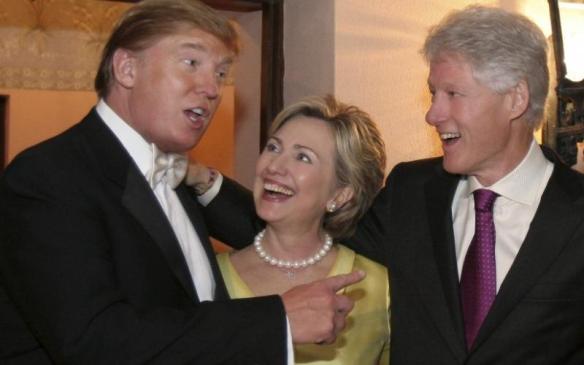
A picture search shows Bill Clinton with his golf buddy Trump, Bill and Hillary posing beside Donald and his wife Melania, and even daughters Chelsea and Ivanka as close friends, although, like their parents, they are not socializing during the campaign, as part of the insider scam to convince voters that the Democrats and Republicans are somehow not connected.

National archives released last month show that when President, Bill Clinton posed with Trump at Trump Towers for a photo shoot, and Trump made several visits to the White House though we may never know what was on the table.  Trump would perform a magnificent public service if he disclosed what deals were made, but one wonders if he’d go to prison with the Clintons were such disclosures made.

One is reminded that, during the 2008 presidential campaign, Bill Clinton, thinking his wife was going to win the Democratic nomination, remarked that he didn’t know how she was going to run against her close friend John McCain.  It’s happening again, with corporate media playing their usual role of not noticing that both candidates are vying to see who gets to sell out the working class on behalf of a stifling plutocratic oligarchy.

Corporate media pretends like the Democrats and Republicans are at each other’s throats, but it should be obvious to anyone who digs a bit beyond the propaganda, that they are in bed with each other and represent the same interests – selling out the American people, primarily for money.

Rupert Murdoch’s New York Post has endorsed Trump, but the right wing billionaire gave a big fundraiser for Hillary Clinton when she ran in 2008, so it’s all one happy family.  The billionaires and transnational corporations make sure both sides are obligated in what corporate media play up as “free and fair elections.”

The polls reveal that Hillary and The Donald are two of the most unpopular candidates imaginable, with most Americans despising both. The two have appeared on television more than all other candidates combined, so they’ve been largely catapulted to the top by the corporate media, who pretend to be objective journalists.

Has anyone seen Jill Stein at all on television?  Polling shows she is for bringing the troops home and shutting down the wars, just like what the American people say they want in polling.  Corporate media is making certain she is hidden behind the curtain, as they whine that they just don’t understand how such unpopular candidates as Clinton and Trump have become finalists.

Will Trumps and Clintons go back to being friends after the election?  Probably not, as it looks like this battle will be the biggest mud fight in US presidential history, the only certainty that someone extremely unpopular will win the right to sell us out.


Jack Balkwill is an activist in Virginia. He can be reached at libertyuv@hotmail.com Read other articles by Jack.

Always Attack the Wrong Country

8lfjisz6

By Dmitry Orlov

Source: Club Orlov

There are numerous tactics available to those who aim to make problems worse while pretending to solve them, but misdirection is always a favorite. The reason to want to make problems worse is that problems are profitable—for someone. And the reason to pretend to be solving them is that causing problems, then making them worse, makes those who profit from them look bad.

In the international arena, this type of misdirection tends to take on a farcical aspect. The ones profiting from the world’s problems are the members of the US foreign policy and military establishments, the defense contractors and the politicians around the world, and especially in the EU, who have been bought off by them. Their tactic of misdirection is conditioned by a certain quirk of the American public, which is that it doesn’t concern itself too much with the rest of the world. The average member of the American public has no idea where various countries are, can’t tell Sweden from Switzerland, thinks that Iran is full of Arabs and can’t distinguish any of the countries that end in -stan. And so a handy trick has evolved, which amounts to the following dictum: “Always attack the wrong country.”

Need some examples? After 9/11, which, according to the official story (which is probably nonsense) was carried out by “suicide bombers” (some of them, amusingly, still alive today) who were mostly from Saudi Arabia, the US chose to retaliate by attacking Saudi ArabiaAfghanistan and Iraq.

When Arab Spring erupted (because a heat wave in Russia drove up wheat prices) the obvious place to concentrate efforts, to avoid a seriously bad outcome for the region, was Egypt—the most populous Arab country and an anchor for the entire region. And so the US and NATO decided to attack EgyptLibya.

When things went south in the Ukraine, whose vacillating government couldn’t make up its mind whether it wanted to remain within the Customs Union with Russia, its traditional trading partner, or to gamble on signing an agreement with the EU based on vague (and since then broken) promises of economic cooperation, the obvious place to go and try to fix things was the Ukraine. And so the US and the EU decided fix the UkraineRussia, even though Russia is not particularly broken. Russia was not amused; nor is it a country to be trifled with, and so in response the Russians inflicted some serious pain on the Washington establishmentfarmers within the EU.

Who was at fault exceedingly clear once the Ukrainians that managed to get into power (including some very nasty neo-Nazis) started to violate the rights of Ukraine’s Russian-speaking majority, including staging some massacres, in turn causing a large chunk of it to hold referendums and vote to secede. (Perhaps you didn’t know this, but the majority of the people in the Ukraine are Russian-speakers, and there is just one city of any size—Lvov—that is mostly Ukrainian-speaking. Mind you, I find Ukrainian to be very cute and it makes me smile whenever I hear it. I don’t bother speaking it, though, because any Ukrainian with an IQ above bathwater temperature understands Russian.) And so the US and the EU decided to fix things by continuing to put pressure on the UkraineRussia.

When Russia started insisting on a political rather than a military resolution to the crisis in the Ukraine, and helped negotiate the Minsk agreements together with the Ukraine, France and Germany, a similar thing happened. These agreements obligated the Ukrainian government to pass constitutional reforms to grant autonomy to its Russian regions in the east. The Ukrainian government refused to abide by these agreements. As a result, the US and the EU decided to put pressure on the UkrainianRussian government.

When a nasty terrorist group calling itself ISIS and composed of Islamic Salafi/Takfiri extremists started to seize power in large parts of Iraq, and then spread to Syria, something had to be done about it. These extremists were being financed by Turkey (which is still buying oil from them and sheltering them on its territory) and Saudi Arabia. And so the US and NATO decided to put some pressure on Turkey and Saudi ArabiaSyria.

In response to all this foolishness, Russia up and decided to actually go and fix something that was broken: Syria. And now Syria is on the mend, and members the misdirectorate in Washington are left scratching their heads.

So far so good. But this method of pretending to be solving problems by making them worse has some definite downsides.

For one thing, eventually even the dimmest, most geographically challenged bulbs in the general population start to get a clue, and then they start refusing to vote for the establishment candidates. Then it becomes hard to continue with the misdirecting because the people doing the misdirecting are voted out, and (horror of horrors!) somebody who might actually try to fix a problem or two might get voted in.

For another, continually making problems worse by attacking the wrong country tends to eventually make the sheer number problems get completely out of hand. Take the recent massive terror attack in Brussels, down the road from NATO headquarters, for which ISIS took credit. Recently, Europe has been experiencing a large-scale influx of people from the Middle East and North Africa, who have been forced to flee their native lands because of all the previous acts of misdirection, and a fair number of these people are ISIS terrorists. And so, to protect itself, NATO is planning to fight ISIS in EuropeSyria. Also, it is well known that the influx into Europe has been orchestrated by Turkey. In response, the EU has decided to put pressure ongive billions of euros to Turkey and tell Turkey that it is welcome to join the EU.

Lastly, this pattern has an overall momentum that, over time, becomes harder and harder to break. It starts out as just one group of plutocrats doing incredibly vile, underhanded but profitable things; later on, an even bigger group of plutocrats is doing equally vile but now completely idiotic, self-defeating, embarrassing things; and right near the end a really huge group of plutocrats is doing things that are absolutely suicidal—but they can’t stop themselves. You should be able to decide for yourselves when that point in time arrives, but I doubt that it is too far in the future.

Hillary Clinton’s Business of Corporate Shilling & War Making

download

Source: Media Roots

As the circus of the 2016 presidential election grinds on, Hillary Clinton has posited herself as the candidate of the people. But not many “candidates of the people” have vacation homes in the Hamptons that cost $200,000 per month, or hang out with the world’s billionaires.

It’s hard to know who she is really–while once being a proponent of Donald Trump type positions, like building a wall at the Mexican border, supporting torture, and opposing same-sex marriage until 2013, today she presents herself as the anti-Trump, anti-Republican candidate.

There’s been a lot of outrage about the impression that the establishment has already anointed her as the Democratic nominee, and has carved out her path to the presidency.

But like in 2008, her guaranteed seat on the throne is being derailed by the unpredictable moods of the masses, and millions of young progressive voters. She continues to play her shape shifting game, morphing her positions to try to capture the support for her opponent, but the real Hillary is still inside.

In fact, every layer of Hillary’s career shows why, far from being a candidate of the people, she’s the top pick by corporations to do the real job of any US president: CEO of the Empire.

Digging deep into Hillary’s connections to Wall Street, Abby Martin reveals how the Clinton’s multi-million-dollar political machine operates. This episode of The Empire Files chronicles the Clinton’s rise to power in the 90s on a right-wing agenda, the Clinton Foundation’s revolving door with Gulf state monarchies, corporations and the world’s biggest financial institutions, and the establishment of the hyper-aggressive “Hillary Doctrine” while Secretary of State.

How Do You Know When Your Society Is In The Midst Of Collapse?

boot

By Brandon Smith

Source: Activist Post

As economic turmoil worldwide becomes increasingly apparent, I have been receiving messages from readers expressing some concerns on the public “perception” of collapse. That is to say, there are questions on the average person’s concept of collapse versus the reality of collapse. This is a vital issue that I have discussed briefly in the past, but it deserves a more in-depth analysis.

What is collapse? How do we define it? And, are some of the notions of collapse in the public consciousness completely wrong?

It’s funny, because skeptics opposed to the idea of a U.S. collapse in particular will most often retort with a question they think I cannot or will not answer – “So, Mr. Smith, when specifically is this supposed collapse going to take place? What day and time?”

My response has always been – “We’re in the middle of a collapse right now; you really can’t see it right in front of your sneering face?”

The reason these people are incapable of grasping this kind of answer is in large part due to the popular mainstream conceptions of systemic collapse. These are conceptions that are for the most part delusional and not in line with the facts. The public idea of collapse comes predominantly from Hollywood, and not from personal experience. For the masses (and some preppers, unfortunately), a collapse is an “event” that happens visibly and usually swiftly. You wake up one morning and behold; the television and phones don’t work anymore and zombies are at your doorstep! Yes, it’s childish and cartoonish, but anything less than a Walking Dead/Mad Max scenario and many people act as if all other threats are benign.

This is the driving reason why many Americans are absolutely oblivious to the economic instability that is rampant and blatant within our system the past few months. They might see the same signals that alternative analysts see, but these signals do not register in their brains as dangers.

Look at it this way; say you told a person their whole life that a tiger is a 10-foot tall behemoth with four heads that breathes fire while urinating flesh-rending acid. Say you make movies and TV shows about it and they never have any experience to the contrary. When they finally come across a real tiger, they might try to pet the damn thing instead of running in terror or searching for a means of defense.

To use another vicious animal analogy, when I encounter skeptics with false assumptions of what a collapse actually is, I am often reminded of that woman in Anchorage, Alaska who jumped an enclosure fence at the zoo to get a closer picture of Binky the polar bear. These people have been made so inept when it comes to identifying threats that they will continue arguing with you as the animal takes a football-sized bite out of their meaty thigh.

So what is the root of the problem beyond Hollywood fantasies? Well, the problem is that social and economic collapse is not a singular event, it is a PROCESS. Collapse is a series of events that sometimes span years. Each event increases in volatility over the last event, but as time goes on these events tend to condition the masses. The public develops a normalcy bias towards crisis (like the old “frog in a boiling pot” analogy). They lose all sense of what a healthy system looks like.

It is not uncommon for a society to wade through almost a decade or more of violent decline before finally acknowledging the system is imploding on a fundamental level. It is also not uncommon for societies to endure years of abuse by corrupt governments before either organizing effectively to rebel, or caving in and submitting to totalitarianism.

But how does one recognize a failing system? How does a person know if they are in the middle of a collapse rather than on the “verge” of collapse? Here are some signals I have derived from research of various breakdowns in modern nations and why they indicate we are experiencing collapse right now…

The Criminals Openly Admit To Their Crimes

The surest way to know if your society is in the midst of disintegration is to see if the criminals who created the instability in the first place are openly discussing a collapse scenario or warning that one is imminent.

A year ago, central bankers presented little more than a chorus of recovery propaganda. Today, not so much. The Royal Bank of Scotland is now warning investors to “sell everything” ahead of a “cataclysmic” year in markets.

The Federal Reserve’s Richard Fisher has admitted that the Fed “frontloaded” (manipulated) stock markets into a bubble and that payment is about to come due in the form of severe economic volatility (up to 20% crash in equities).

The Bank for International Settlements, the central bank of central banks, has a track record of warning the public about collapse conditions – right before they happen, leaving little or no time for people to prepare. They have followed their habit by warning in September and December that a Fed rate hike would “shatter” the uneasy calm in markets.

The former Chief Economist of the BIS now says the economy is in worse shape than it was in 2008 and is headed for a larger fall.

What happened between last year and this year and why are these internationalists suddenly so forthcoming about our economic reality? The fact that central bankers are the cause of our current collapse leads me to believe that such admissions are designed to deflect guilt. If they put out a few warnings now, they can then later claim they are prognosticators rather than culprits, and that they were trying to “help us.” Beyond that, the reality is that our situation was just as dire in 2014/2015 as it is today; the difference is that now we are about to enter a new phase in the ongoing collapse, a much more detrimental phase, but still a phase of a breakdown that has been progressing since at least 2008.

The Fundamentals Break Through The Manipulation Barrier

Governments and central banks do not have the capacity to artificially create demand for goods or a supply of well-paying jobs in a crashing economy. What they can do, though, is hide the visible problems in supply and demand with false numbers.

I examined such false economic statistics in great detail last year in a six-part series titled “One Last Look At The Real Economy Before It Implodes.” I will not cover them all again here. I would only point out that recently the fundamentals of supply and demand have begun to break through the deceit of manipulated numbers, and this is a sign that the collapse is about to move from one stage to the next.

With global shipping and trucking freight in steep decline, with retail inventories in stasis and current oil consumption falling to levels not seen since 1997 despite a larger population, the mainstream can no longer deny that consumer demand is crumbling. If demand is falling dramatically, then the financial system is in the middle of falling dramatically; there is simply no way around this truth.

Stocks And Commodities Become Violently Erratic

Let’s be clear, if stock markets represent anything at all, they are merely lagging indicators of economic instability.  Stock markets are NOT predictive indicators of anything useful.  Therefore, any person who does nothing but track equities each day is going to be completely oblivious to the bigger picture behind the economy until it is too late.  They will be so mesmerized by the green numbers and red numbers and lines on minute-to-minute graphs that they will lose all sense of reality.

Violent swings in stocks are a sign of a financial system that is at the middle or end of the collapse process, not the beginning.

It is also important to note that extreme shifts in stocks and commodity values to the upside are just as much a signal of instability as shifts to the downside.  For instance, if you witnessed the recent 9% explosion in oil markets and thought to yourself “Ah, the markets are being stabilized again and nothing is different this time…”, then you are an idiot.

Of course, the next day oil markets lost almost all of the gains they made the day before.  And this is how markets behave when they are about to die; they expand and implode chaotically each day on nothing more that meaningless news headlines rather than hard data.  This heart attack in equities inevitably trends downwards as the weeks and months pass.  Keep in mind, equities are down nearly 10% from their recent highs, and oil is down approximately 50% in the past six months.  Every time there is a dead cat bounce in stocks skeptics come out of the woodwork to call alternative analysts “doomers”, yet they are nowhere to be found when markets come crashing back down.  They are not looking at the overall trend because their short attention spans hinder them.  Again, extreme swings in markets, whether up or down, are a sign of progressing collapse.

Deterioration Of Cultural Values, Heritage And Identity

I have written extensively over the years about the Cloward-Piven strategy; a strategy used by collectivists to destabilize social systems by dumping overt numbers of foreign immigrants into the population without demand for integration. This process has been obvious in the U.S. and Europe for quite some time, but only now is it peaking to the point that collapse is seen as an inevitable result by the public. Europe is worse off than the U.S. in this regard as millions upon millions of Muslim immigrants are injected into the EU’s already dying body; immigrants that intend to transplant their culture from their own failed societies rather than adopting the values and principles of the societies that have invited them in.

Natural-born Americans and legal immigrants with aspiration of integration appear to be fighting back against the Cloward-Piven strategy with some success by holding onto traditional American values despite being labeled “barbarians” and “racists.” Illegal immigration, though, is still completely unchecked.

In the EU, the long campaign of cultural Marxism has made natural-born Europeans perhaps the most self-hating people on the planet as well as the most passive and weak. Organized opposition to massive immigration programs in the EU should have taken place years ago. Now it is far too late, and the European system is finishing a social implosion which should have already been obvious to average citizens.

Open Discussion Of Totalitarian Measures

When corrupt leadership moves from quiet totalitarianism to more open totalitarianism, your society is in the FINAL stages of collapse, not the beginning of a collapse. The U.S. in particular has been slowly strangled with subversive legal directives and political policies ever since the so called “War on Terror” began. However, there are now multiple signals of a much deeper and open tyranny in the works.

A few recent examples stand out, including Barack Obama’s insistence that the office of the president has the legal authority to issues executive orders that affect constitutional protections such as the 2nd Amendment. As many liberty movement activists are aware, there is absolutely no constitutional precedent for the use of executive orders and such powers are not mentioned anywhere in the document. They were simply created out of thin air to be used by the federal government and sometimes state governments to supersede normal checks and balances.

While numerous presidents have issued executive orders, including some that were outright tyrannical, like Franklin Delano Roosevelt’s unconstitutional internment of Japanese Americans into concentration camps, George W. Bush and Barack Obama have been the most subversive in their bypassing of the Constitution. Obama, in particular, has tried to hide the number of executive actions he has taken by issuing hundreds of “presidential memorandums,” which are basically the same dirty play by another name.

These actions have been progressively setting the stage for the removal of checks and balances entirely in the name of crisis management. They are so broad in their nature and vague in their definitions and applications that they could be interpreted by federal authorities to mean just about anything in any given situation.

If executive actions are not scary enough, corrupt politicians are now becoming blunt in their demands for dominance. Two Republican Senators, Mitch McConnel and Lindsay Graham, are calling for unlimited AUMF-style (authorization of use of military force) war powers to be given to the president. Such powers would allow the president to project U.S. military forces anywhere in the world for any reason without review or time limits. This includes the use of military forces on U.S. soil.

The rationale for this is, of course, the threat of ISIS. The same group of terrorists the U.S. government helped to create.

And finally, if you want perhaps the most nonchalant admission of future tyranny in recent days, check out former General Wesley Clark’s call for “disloyal” Americans to be placed in internment camps through the duration of the war on terror, a war that could ostensibly go on forever.

One could argue that all of these measures are meant only to deter “Islamic extremism.” I would point out that government officials could have stemmed that tide at any time by enforcing existing immigration laws, or, by stopping all immigration for a period of years until the problem is handled. Instead, they have allowed open borders to remain, and have even imported potential terrorists while focusing Department of Homeland Security efforts more on evil white guys with guns.

If we accept the violation of the constitutional rights of any group of citizens, if we allow the concept of “thought crime” to become commonplace, then we leave the door open to the violation of our own rights someday. And that is how tyrants trick populations through incremental collapse; by applying despotism to a claimed dangerous minority, then expanding it to everyone else.

America is sitting near the end of the spectrum in terms of economic collapse and in the middle of the spectrum in terms of social collapse.  While more violent events are certainly gestating and are likely to be triggered in the near term, we should not overlook the reality that collapse is happening in stages all around us.  This process gives us at least some time.  All is not lost yet, and the steps we take to organize and prepare today will affect how the collapse process unfolds tomorrow. People who continue to ignore the outright evidence of collapse based on false assumptions of what collapse should look like are only preventing themselves from taking proper action until it is too late. Make no mistake, our system is dying. We cannot allow our false perceptions of this death to cloud the reality of it, or our response to it.


You can read more from Brandon Smith at his site Alt-Market.com. If you would like to support the publishing of articles like the one you have just read, visit our donations page here.  We greatly appreciate your patronage. You can contact Brandon Smith at: brandon@alt-market.com

Thomas Frank on How Democrats Went From Being the ‘Party of the People’ to the Party of Rich Elites

download

Democrats have gone from the party of the New Deal to a party that is defending mass inequality.

By Tobita Chow

Source: In These Times

The Democratic Party was once the party of the New Deal and the ally of organized labor. But by the time of Bill Clinton’s presidency, it had become the enemy of New Deal programs like welfare and Social Security and the champion of free trade deals. What explains this apparent reversal? Thomas Frank—best known for his analysis of the Republican Party base in What’s the Matter with Kansas?attempts to answer this question in his latest book, Listen Liberal: Or, What Ever Happened to the Party of the People?

According to Frank, popular explanations which blame corporate lobby groups and the growing power of money in politics are insufficient. Frank instead points to a decision by Democratic Party elites in the 1970s to marginalize labor unions and transform from the party of the working class to the party of the professional class. In so doing, the Democratic Party radically changed the way it understood social problems and how to solve them, trading in the principle of solidarity for the principle of competitive individualism and meritocracy. The end result is that the party which created the New Deal and helped create the middle class has now become “the party of mass inequality.” In These Times spoke with Frank recently about the book via telephone.

The book is about how the Democratic Party turned its back on working people and now pursues policies that actually increase inequality. What are the policies or ideological commitments in the Democratic Party that make you think this?

The first piece of evidence is what’s happened since the financial crisis. This is the great story of our time. Inequality has actually gotten worse since then, which is a remarkable thing. This is under a Democratic president who we were assured (or warned) was the most liberal or radical president we would ever see.  Yet inequality has gotten worse, and the gains since the financial crisis, since the recovery began, have gone entirely to the top 10 percent of the income distribution.

This is not only because of those evil Republicans, but because Obama played it the way he wanted to. Even when he had a majority in both houses of Congress and could choose whoever he wanted to be in his administration, he consistently made policies that favored the top 10 percent over everybody else. He helped out Wall Street in an enormous way when they were entirely at his mercy.

He could have done anything he wanted with them, in the way that Franklin Roosevelt did in the ‘30s. But he chose not to.

Why is that? This is supposed to be the Democratic Party, the party that’s interested in working people, average Americans. Why would they react to a financial crisis in this way? Once you start digging into this story, it goes very deep. You find that there was a transition in the Democratic Party in the ‘70s, 80’s and ‘90s where they convinced themselves that they needed to abandon working people in order to serve a different constituency: a constituency essentially of white-collar professionals.

That’s the most important group in their coalition. That’s who they won over in the ’70s, ’80s and ’90s. That’s who they serve, and that’s where they draw from. The leaders of the Democratic Party are always from this particular stratum of society.

A lot of progressives that I talk to are pretty familiar with the idea that the Democratic Party is no longer protecting the interests of workers, but it’s pretty common for us to blame it on mainly the power of money in politics. But you start the book in chapter one by arguing there’s actually something much deeper going on. Can you say something about that?

Money in politics is a big part of the story, but social class goes deeper than that. The Democrats have basically made their commitment [to white-collar professionals] already before money and politics became such a big deal. It worked out well for them because of money in politics. So when they chose essentially the top 10 percent of the income distribution as their most important constituents, that is the story of money.

It wasn’t apparent at the time in the ‘70s and ‘80s when they made that choice. But over the years, it has become clear that that was a smart choice in terms of their ability to raise money. Organized labor, of course, is no slouch in terms of money. They have a lot of clout in dollar terms. However, they contribute and contribute to the Democrats and they almost never get their way—they don’t get, say, the Employee Free Choice Act, or Bill Clinton passes NAFTA. They do have a lot of money, but their money doesn’t count.

All of this happened because of the civil war within the Democratic Party. They fought with each other all the time in the ‘70s and the ‘80s. One side hadn’t completely captured the party until Bill Clinton came along in the ‘90s. That was a moment of victory for them.

Bill Clinton’s presidency is what progressives usually cite as the time when things went bad. But there’s a trend that goes back to the ’70s, right?

Historians always cite the ’68 election as the turning point. The party was torn apart by the controversy over the Vietnam war, protesters were in the streets in Chicago and the Democratic candidate Hubert Humphrey went on to lose. Democrats thought this was terrible, and it was. So they set up a commission to reorganize the party, the McGovern Commission.

The McGovern Commission basically set up our modern system of primaries. Before the commission, we didn’t have these long primary contests in state after state after state. Primaries are a good thing, as were most things the McGovern Commission did.

But they also removed organized labor from its structural position of power in the Democratic Party. There was a lot of resentment towards labor during the Vietnam War. A lot of unions took President Johnson’s side on Vietnam. There was also this sense—which I think was correct at the time—that labor was a dinosaur, that it was out of touch and undemocratic and very white.

There were a lot of reasonable objections to organized labor at the time. The problem is, when you get rid of labor in your party, you also get rid of issues that matter to working people. That’s the basic mistake that Democrats made in the ’70s. Of course, labor still is a big part of the Democratic coalition—it gives them their money, it helps out at election time in a huge way. But unions no longer have the presence in party councils that they used to. That disappeared.

One of the most shocking quotes in the book is from Alfred Kahn, an advisor to Jimmy Carter, who said, “I’d love the Teamsters to be worse off. I’d love the automobile workers to be worse off.” He then basically says that unionized workers are exploiting other workers.

Isn’t that amazing? He’s describing a situation in the 1970s. There was all this controversy in the 1970s about labor versus management—this was the last decade where those fights were front and center in our national politics. And he’s coming down squarely on the side of management in those fights.

And remember, Kahn was a very important figure in the Carter administration. The way that he describes unions is incorrect—he’s actually describing professionals. Professionals are a protected class that you can’t do anything about—they’re protected by the laws of every state that dictate who can practice in these fields. It’s funny that he projects that onto organized labor and holds them responsible for the sins of another group.

This is a Democrat in an administration that is actually not very liberal. This is the administration that carried out the first of the big deregulations. This is the administration that had the great big capital gains tax cuts, that carried out the austerity plan that saw the Federal Reserve jack its interest rates sky high. They clubbed the economy to the ground in order to stop “wage inflation,” in which workers, if they have enough power, can keep demanding higher wages. It was incredible.

What’s the content of the ideology of the professional class and how does it hurt working people? What are their guiding principles?

The first commandment of the professional class is the idea of meritocracy, which allows people to think that those on top are there because they deserve to be. With the professional class, it’s always associated with education. They deserve to be there because they worked really hard and went to a good college and to a good graduate school. They’re high achievers. Democrats are really given to credentialism in a way that Republicans aren’t.

If you look at the last few Democratic presidents, Bill Clinton and Obama, and Hillary Clinton as well, their lives are a tale of educational achievement. This is what opened up the doors of the world to them. It’s a party of who people who have gotten where they are by dint of educational accomplishment.

This produces a set of related ideas. When the Democrats, the party of the professionals, look at the economic problems of working-class people, they always see an educational problem, because they look at working class people and say, “Those people didn’t do what I did”: go and get advanced degrees, go to the right college, get the high SAT scores and study STEM or whatever.

There’s another interesting part of this ideology: this endless search for consensus. Washington is a city of professionals with advanced degrees, and Democrats look around them there and say, “We’re all intelligent people. We all went to good schools. We know what the problems are and we know what the answers are, and politics just get in the way.”

This is a very typical way of thinking for the professional class: reaching for consensus, because politics is this ugly thing that you don’t really need. You see this in Obama’s endless efforts to negotiate a grand bargain with Republicans because everybody in Washington knows the answers to the problems—we just have to get together, sit down and make an agreement. The same with Obamacare: He spent so many months trying to get Republicans to sign on, even just one or two, so that he could say it was bipartisan. It was an act of consensus. And the Republicans really played him, because they knew that’s what he’d do.

To go back to your point about education: At one point you quote Arne Duncan, who was Obama’s secretary of education, saying that the only way to end poverty is through education. Why can’t that work?

The big overarching problem of our time is inequality. If you look at historical charts of productivity and wage growth, these two things went hand in hand for decades after World War II, which we think of as a prosperous, middle-class time when even people with a high school degree, blue-collar workers, could lead a middle class life. And then everything went wrong in the 1970s. Productivity continued to go up and wage growth stopped. Wage growth has basically been flat ever since then. But productivity goes up by leaps and bounds all the time. We have all of these wonderful technological advances. Workers are more productive than ever but they haven’t benefited from it. That’s the core problem of inequality.

Now, if the problem was that workers weren’t educated enough, weren’t smart enough, productivity would not be going up. But that productivity line is still going up. So we can see that education is not the issue.

It’s important that people get an education, of course. I spent 25 years of my life getting an education. It’s basic to me. It’s a fundamental human right that people should have the right to pursue whatever they want to the maximum extent of their individual potential. But the idea that this is what is holding them back is simply incorrect as a matter of fact. What’s holding them back is that they don’t have the power to demand higher wages.

If we talk about the problem as one of education rather than power, then the blame goes back to these workers. They just didn’t go out and work hard and do their homework and get a gold star from their teacher. If you take the education explanation for inequality, ultimately you’re blaming the victims themselves.

Unfortunately, that is the Democratic view. That’s why Democrats have essentially become the party of mass inequality. They don’t really have a problem with it.

So really, the solution would have to be solidarity and organized power.

That was an essential point that I try to make in Listen Liberal: that there is no solidarity in a meritocracy. A meritocracy really is every man for himself.

Don’t get me wrong. People at the top of the meritocracy, professionals, obviously have enormous respect for one another. That is the nature of professional meritocracy. They have enormous respect for the people at the top, but they feel very little solidarity for people beneath them who don’t rise in the meritocracy.

Look at the white-collar workplace. If some professional gets fired, the other professionals don’t rally around and go on strike or protest or something like that. They just don’t do that. They feel no solidarity because everything goes back to you and whether or not you’ve made the grade. If somebody gets fired, they must’ve deserved it somehow.

I have my own personal experience. Look at academia over the last 20 years. They’re cranking out these Ph.D.s in the humanities who can’t get jobs on tenure track and instead have to work as adjuncts for very low pay, no benefits. One of the fascinating parts about this is that, with a few exceptions, the people who do have tenure-track jobs and are at the top of their fields, do very little about what’s happened to their colleagues who work as adjuncts. Essentially this is the Uberizing of higher education. The professionals who are in a position of authority have done almost nothing about it. There are academics here and there who feel bad about what’s happened to adjuncts and do say things about it, but by and large, overall, there is no solidarity in that meritocracy. They just don’t care.

Do you think there’s a connection between the fact that the Democratic Party has turned against workers and the rise of Donald Trump?

Yes. Because if you look at the polling, Trump is winning the votes of a lot of people who used to be Democrats. These white, working-class people are his main base of support. As a group, these people were once Democrats all over the country. These are Franklin Roosevelt’s people. These are the people that the Democrats essentially decided to turn their backs on back in the 1970s. They call them the legatees of the New Deal. They were done with these guys, and now look what’s happened—they’ve gone with Donald Trump. That’s frightening and horrifying.

But Trump talks about their issues in a way that they find compelling, especially the trade issue. When he talks about trade, they believe him. Ironically, he’s saying the same things that Hillary Clinton and Bernie Sanders are saying about trade, but for whatever reason people find him more believable on this subject than they do Hillary Clinton.

Do you think that the rise of the Bernie campaign could herald a new era in the history of the Democratic Party?

I hope so. Both Trump and Bernie are turning their respective parties upside down. What Bernie is doing is very impressive. I interviewed him a few years ago and have always admired him. I think he’s a great man. To think that he could beat a Clinton in a Democratic primary anywhere in this country, let alone many primaries, was unthinkable a short time ago. And he’s done it without any Wall Street or big-business backing. That is extraordinary. It shows the kind of desperation that’s out there.

He has shown the way, and whether he gets the nomination or not (he probably won’t), there’ll be another Bernie four years from now. And there’ll also be another Trump. The Republican Party is being turned on its head much more violently than the Democrats. Hillary will probably get the nomination. I live in Washington, D.C., and I spend time around Hillary-style Democrats. They really think that they’ve got this thing in the bag. And I don’t just mean her versus Bernie. I mean the Democratic Party winning the presidency for the rest of our lives. From here to eternity. They can choose whoever they want. They could nominate anybody and they would win. They think they’re in charge.

One of your villains from the ’70s is Frederick Dutton, who wrote a book about how the Democratic Party needed to realign itself. You have a quote from him saying, “Every major realignment in U.S. political history has been accompanied by the coming of a large new group into the electorate.” You’re very critical of how he uses that idea in the ‘70s. But if you look at the newer voters attached to the Bernie campaign, it looks like the Democratic Party is experiencing something like that now.

Yes, in both cases you’re talking about a generational shift. That’s what he meant in 1971. He was talking about the counterculture and the “Now Generation” and the idea that they would come into the electorate and demand a different kind of politics—specifically his kind of politics.

Everybody always sees this new group that’s coming in as supporting what they want. That’s what he thought. I have a certain amount of contempt for that. Many years ago I wrote a book about the counterculture and how it was used for this purpose—specifically by the advertising industry. But Bernie’s doing the same thing. He’s using it for his own purposes.

Millenials’ take on the world is fascinating. Just a few years ago, people thought of them as very different. But now they’re coming out of college with enormous student debt, and they’re discovering that the job market is casualized and Uberized. The work that they do is completely casual. The idea of having a middle-class lifestyle in that situation is completely off the table for them.

Every time I think about these people, it burns me up. It makes me so angry what we’ve done to them as a society. It really gives the lie to Democratic Party platitudes about the world an education will open up for you. That path just doesn’t work anymore. Millenials can see that in their own lives very plainly.

So I’m very excited that they’re pro-Bernie. They really are the future.


Tobita Chow is chair of The People’s Lobby, an independent political organization based in Chicago, and co-author of “The Movement We Need,” a pamphlet on analysis and strategy for the progressive movement. He has been involved in faith-based community organizing on the South Side of Chicago since 2009, and is a leader in the “Moral Mondays Illinois” campaign against state budget cuts. He is an MDiv student at the Lutheran School of Theology at Chicago.