
Saturday Matinee: Identikit (aka The Driver’s Seat)

ELIZABETH TAYLOR’S CRAZIEST ROLE: ‘THE DRIVER’S SEAT’ AKA ‘IDENTIKIT’

By Richard Metzger

Source: Dangerous Minds

The Driver’s Seat AKA Identikit stars Elizabeth Taylor in one of her single most berserk performances and since no one can bring the crazy like La Lizthat is really saying something. This 1974 Italian film is based on a novella by Muriel Spark about a disturbed woman in a foreign country who seeks a man who will tie her up and stab her to death. There is ridiculous (mostly shouted, even screamed) dialogue like: “I sense a lack of absence” and “I feel homesick for my own loneliness.” How about “You look like Red Riding Hood’s grandmother. Do you want to eat me?” She holds up her purse in an airport security check and exclaims “This may look like a purse but it is actually a bomb!?” The best line is this, however: “When I diet, I diet and when I orgasm, I orgasm! I don’t believe in mixing the two cultures!”

The director, Giuseppe Patroni Griffi, seems to have had no control over Taylor whatsoever and it appearss like she is making up her own Dada dialogue on the spot much of the time. Andy Warhol has a cameo in the film playing a British “your Lordship” who has a cryptic encounter with Liz in an airport and they meet again later in the film. His voice is overdubbed with an English voice, which is disconcerting but kind of interesting, too. Why isn’t this cuckoo-pops crazy film better known?

Here is what the AllMovie Guide has to say about The Driver’s Seat:

A beautiful but mysterious woman goes on a journey that has dangerous consequences for her and those around her in this offbeat, arty drama from Italian filmmaker Giuseppe Patroni Griffi. Lise (Elizabeth Taylor) is a woman edging into middle age who is nearing the end of her emotional rope. Needing some time away from her job and responsibilities, Lise flies to Rome, and on the flight she meets Bill (Ian Bannen), an eccentric health food enthusiast who makes it clear he wishes to seduce her, and Pierre (Maxence Mailfort), a curious man who is wary of Lise and goes out of his way to avoid her. Lise informs anyone she speaks with that she’s come to Rome to meet her boyfriend, but it soon becomes clear she has no specific plans nor anyone to see. Lise whiles away the afternoon shopping with Mrs. Fiedke (Mona Washbourne), a chatty older woman from Nova Scotia, and in time crosses paths with Bill again, but it’s not until she meets up with Pierre that her real reason for coming to Italy, as well as the depth of her madness, becomes clear. As Lise wanders through Rome, a team of police detectives is seen investigating a crime that seems to involve her. Also released as Identikit and PsychoticThe Driver’s Seat features a brief appearance from Andy Warhol as a British nobleman.

The film premiered at the Cannes Film Festival to stunned silence and it has been suggested that Liz at one point tried to buy up the rights and all prints of the movie. The filming began one day after she filed for divorce from Richard Burton and she reportedly said to director, Griffi, “It takes one day to die, another to be reborn.”
 
The Driver’s Seat is not out on a proper DVD release, but you can often find bootlegs at a “99 Cents Only” store.

Watch Identikit (aka The Driver’s Seat) on Hoopla here: https://www.hoopladigital.com/title/15460706

Saturday Matinee: The Wobblies

Classic Film Review: One of the Great Labor Documentaries is restored — “The Wobblies (1979)

By Roger Moore

Source: Movie Nation

“The One Big Union,” they called it, an organization that would represent every worker laboring for “The Man.” Unlike the “skilled labor” guilds of the earlier American Federation of Labor, it would take in everyone, including the the extreme exertion “unskilled” jobs — farm labor, lumberjacks, longshoremen and miners. It would be a union whose work actions and strikes were meant to not just exercise some control over their work days, their wages and their safety It would struggle to gain outright ownership of the industries where the workers toiled.

The One Big Union would rattle “ownership” in America’s rapacious “gilded age” and threaten capitalism itself if it succeeded.

“The Wobblies” is a classic labor documentary from 1979, a film that gets back to the core meaning of the film genre — “to document,” to have history recounted by those who actually lived it. Filmmakers Deborah Shaffer and Stewart Bird interviewed the dying out members and eyewitnesses to the actions and struggles of the Industrial Workers of the World, “The Wobblies,” and let these old men and women speak of the idealism, desperation and determination that drove America’s most radical labor movement, which came to life in 1905 and then disappeared, after 20 years of strife, scapegoating and bloody attacks from America’s defenders of the status quo.

The newly-restored film is a reminder of the varied styles and formats of documentaries before PBS an Ken Burns codified and formalized these films into academics and “experts” and actors reading letters or performing speeches of the figures represented.

What that looks and sounds like is a tapestry of testimonials, on and off camera, recreating an era of child labor and the murderously callous reign of America’s first oligarchs — Rockefeller and Ford, Carnegie and J.P. Morgan.

“I can hire one half of the working class to kill the other half,” financier Jay Gould sneered.

And so he could. In an era where workplace safety was deemed an unnecessary bother, when giant lumber companies could strip America’s forests with a remote workforce they could underfeed and house under deplorable conditions, when mining disasters were a simple “cost of doing business” worth no one’s attention, when hired cops and militia could be relied on to mow down longshoremen striking for an eight hour day, capitalists and capitalism were literally killing much of America, and getting anybody to care was a near impossible struggle.

“The Wobblies” uses archival silent films, still photographs, posters and performed recitations to recreate the labor ferment that boiled over from the late 1800s into the early 20th century. Interviews then hammer home what the Wobblies — their nickname may have come from Asian workers’ inability to say “I.W.W.” — represented, an impatience with the pace of reform and change.

“Work, good wages and respect” was their credo, witnesses recount.

“Free speech” battles erupted as the right to organize and protest was assaulted from Minot, North Dakota and Butte, Montana to Everett, Washington and Lawrence, Massachusetts, site of an early Wobbly unionizing success.

A hostile press and a political system bent towards the whims of the celebrated robber barons, who would quickly call for and receive lethal assistance in attacking and imprisoning labor organizers and shooting strikers was what the Wobblies were up against.

“Shakedowns” from railroaders hired to transport farm workers and lumbermen from site to work site via boxcar were common, abuse on the job and across industries was common. The Wobblies vowed that they wouldn’t just take a punch waiting for a passive public and blind-eyed government to act. They’d punch back.

The lack of experts interviewed here leaves the film with an implicit, sympathetic bias, but also deprives it of academically underscored proof of the context all this struggle took place in. World War I and the first “Red Scare,” the birth of the Soviet Union,” took place just as as the Wobblies were on the rise. A refusal to condemn or support the war, or to call off strikes during the conflict, added to heated pushback, attacks and image tarring by the press and government.

The “bomb throwers” label slapped on every labor movement since the Haymarket Square Riot was unjustly attached to the Wobblies from their birth and on into the age of animated film.

Clips from Ford-sponsored silent cinema cartoons depicting IWW organizers as rats and even an early Walt Disney (he hated unions) effort, “Alice’s Egg Plant” remind us how quick conservatives were to tie labor to the brand new boogeyman — communism — and smear workers’ rights organizations with that.

“The Wobblies” is a bracing, enthusiastic film, with many an old Wobbly recalling mottos, chants and even songs.

One remembrance ends with words he recalled his sympathetic father passing on to him. A worthy cause with worthy goals, the old Wobbly remembers his old man saying. “But it’s just a dream. It’ll never happen.”

Watch The Wobblies on Kanopy here: https://www.kanopy.com/en/product/12764581

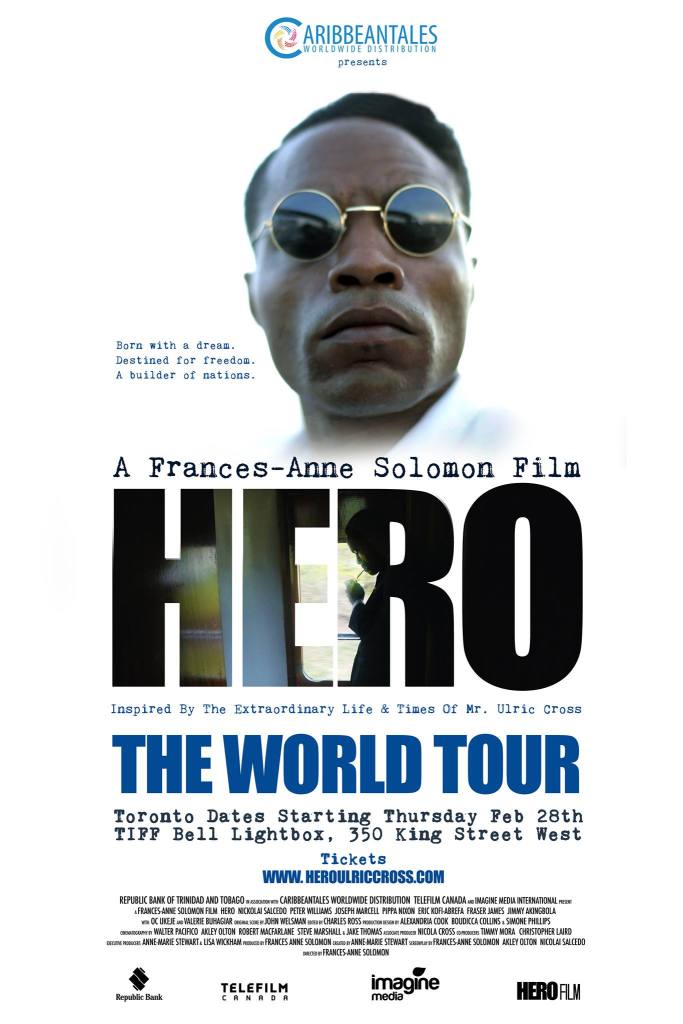
Saturday Matinee: Hero – The Extraordinary Life of Mr. Ulric Cross

Hero – the extraordinary life and times of Ulric Cross

By Stephen Spark

Source: Soca News

Hero has landed. Frances-Anne Solomon’s film about the life of Ulric Cross – eight years in the making ‑ has finally reached London, though only for a few screenings. If the audience reaction at the premiere at Brixton’s Ritzy cinema was anything to go by, this film, like its subject, is destined for great things.

In conventional terms, Cross was indeed a hero. He was born in Belmont, Trinidad, and after school and some inconsequential jobs, he joined the Royal Air Force when war broke out. He became a navigator for an RAF pathfinder squadron, flying low-level missions over enemy territory to mark targets for the bombers to hit. This was not a job guaranteed to increase your life expectancy, and his near-suicidal decision to fly 80 missions without a break as Cross did was something that even he couldn’t really explain. He was, famously, the most-decorated Caribbean serviceman, gaining both a DFC and DSO for his cool-headed courage.

Like many West Indian servicemen and women, he learnt that an exemplary war record counted for little when it came to finding a peacetime job in ‘civvy street’. Despite training as a lawyer, he ended up at the BBC, but the plug was pulled on him when his interviews were deemed “too political”. And at this point the story really begins.

The title ‘hero’ is a little misleading, for his war service was only one aspect of his life and, according to Solomon, among family and friends “no one saw him as a hero”. Instead, what we have is a film about a heroic life. Cross played an important part in the African independence and pan-Africanist movements in Ghana, Cameroon and Tanzania, along with fellow Trinidadians George Padmore and C L R James. The film highlights how exciting, uncertain, energising and downright dangerous it was to be an intelligent, idealistic champion of Black empowerment and unity in Africa.

It would be impossible in anything less than a full-length dissertation to do justice to all the intersecting themes Hero contains. After the screening, almost everyone this reviewer spoke to said they needed to see it multiple times.

Hero is intellectually and emotionally absorbing, and visually exciting. Solomon has made extensive use of archive footage and melded it seamlessly with newly shot elements. At the post-film Q&A session, Solomon said that she used and adapted archive footage because the budget was too tight to allow the big set-piece scenes to be shot. It’s a restriction she turned to great advantage, as it’s resulted in a film that looks distinctive and stylish, combining newsreel immediacy with feature film gloss.

Nickolai Salcedo is mesmerising and entirely believable as Ulric Cross, and there’s a fine chemistry with Pippa Nixon as his wife, Ann – clearly a strong character in her own right. Peter Williams deserves a mention for his portrayal of the plausible, but deceptive, ‘Pony’ Macfarlane, while Fraser James brings a restless energy to the fascinating and enigmatic George Padmore.

In short: thoroughly recommended – go and see it as soon as you can.

Watch Hero on Hoopla here: https://www.hoopladigital.com/title/15317967

Saturday Matinee: The Tenant

By Bence Janek

Source: Kafkadesk

The Tenant by Roman Polanski, considered the last chapter of the Polish-French director’s notorious “apartment trilogy” (after Repulsion and Rosemary’s Baby), sketches a masterful adaptation of Roland Topor’s psychological horror novel on the screen and leads the unsuspicious viewer into the darkest corners of a paranoid person’s mind struggling with a myriad of social and community stereotypes in 1970’s Paris.

There’s no place like home

Polanski not only directed The Tenant but took on the main character’s costume to play the anxious character of Trelkovsky, a middle-aged Polish-born French-naturalized bureaucrat, who is planning to rent a tiny condo in a far from ordinary apartment house in Paris.

The former tenant committed suicide, the landlord is a grumpy old man, and the residential community is full of xenophobic prejudices. All the conditions are set for a surrealistic and dramatic experience.

Whether it is owned or rented, a house is arguably the most private place in anyone’s life, a space where individuals are entitled to live their undisturbed, non-public existence as they see fit.

In Trelkovsky’s case, there is no place for such privacy: instead, he becomes a constant victim of contemptuous comments from his neighbors targeting his Polish origins, his lifestyle and at some point is even asked to sign a petition to kick out other tenants from the apartment house.

In this sense, the residential community portrayed in The Tenant is a clear representation of a resentful and hypocritical society full of stigma and prejudices, where the individual is cornered with no place to thrive.

Polanski and the anti-hero

Trelkovsky can hardly cope with such a harsh environment and becomes convinced that his neighbors want to drive him to suicide, just as they allegedly did with the previous tenant.

Given the protagonist’s evident paranoid behavior and the tyrannical policy of the residential community, this duality and continuous tension bring out the hidden bisexuality, trans-sexuality, and paranoid fear that pave the way for the complete mental and sexual transformation of Trelkovsky.

What makes this film absolutely unique is the portrayal of an utterly vulnerable character with no courage to stand up against any type of abnormality in his life, even forced to lie in the most trivial cases. Trelkovsky’s character is founded on the lack of the most basic norms of personality, an anti-hero whose identity can easily be shaped and transformed by his environment and surroundings.

The majestic peak of Polanski’s horror psychological drama is how it brings up the ruthless question of whether it is possible for an already paranoid and disturbed person to merge into a community, and what happens if he or she can’t.

And most importantly, how a group of bullies can light up latent psychological problems in an individual’s mind and bring these mental and social challenges to the surface in an irredeemable way.