Two for Tuesday
Reply


By Triskel Christchurch
Source: The Journal of Music
A complex and fascinating experimental exploration of time and identity, ANTI-CLOCK is a film of authentic, startling originality. Brilliantly mixing film and video techniques, Arden and Bond’s paranoid, psychological surveillance study of a career gambler turned clairvoyant unstuck in time captures onscreen the anxieties that have infiltrated the consciousness of so many in Western society.
Jane Arden was a leading figure in experimental British theatre and cinema, and an important radical feminist voice of the 1960s and ‘70s. With her work increasingly informed by her politics, the beginning of a personal and professional relationship with director Jack Bond facilitated the move to cinema, and the creation of a small but remarkable body of film work which is becoming increasingly celebrated. Following her tragic and sudden death in 1982, Bond withdrew these often strongly autobiographical films from circulation, only relenting decades later. Arden’s work is raw, perceptive, disturbing, vital, and beautiful.
Watch Anti-Clock on tubi here: https://tubitv.com/movies/100029255/anti-clock
By Seth Harris
Source: Pop Cult
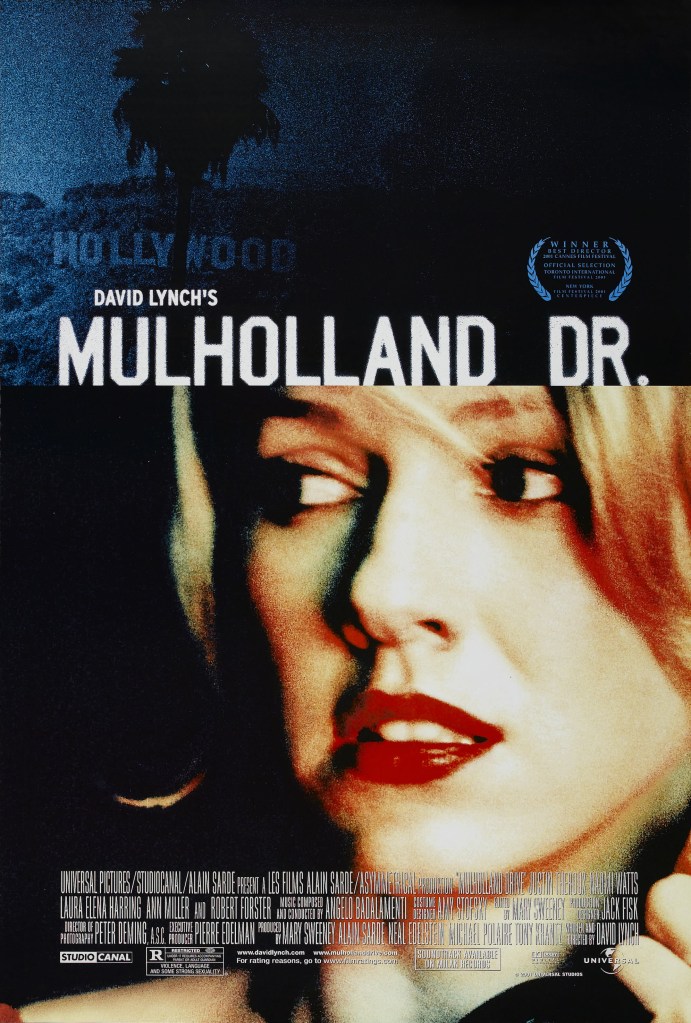
I’ve mentioned on the blog before how I discovered David Lynch as an eight-year-old who was somehow allowed to watch Twin Peaks. For a long time, I knew him as “the guy who made Twin Peaks.” Even in college, as I began to explore his greater body of work, I was like most people; I just didn’t understand the abstractness of it all. What shifted my understanding was reading Lynch on Lynch, a book of interviews with the director focusing on his work in chronological order up to Mulholland Drive. Through this text, I came to understand the source of Lynch’s creativity – from deep inside his subconscious and expressed through images without any implied context – and how intuitive his work is. This happened around the same time I was taking Literary Theory & Criticism, which was probably the most influential academic experience I’ve ever had.
Mulholland Drive begins with a woman (Laura Harring) being driven to a party on the titular road. However, she was never going to arrive at the party. Her driver turns on her, and before they can assassinate the woman, the limousine is hit by a car of rowdy young people. The woman stumbles down a hillside and eventually hides in an apartment whose owner has a department for a long trip. This is the home of Betty’s (Naomi Watts) aunt, where the young woman has come to stay while she auditions in the hopes of becoming a movie star. She immediately feels empathy for the amnesiac woman and vows to help her. Her unexpected guest takes the name Rita after seeing a movie poster of Rita Hayworth in the apartment.
The two women begin investigating the few threads they have about Rita’s past. Meanwhile, a film production grinds to a halt as its lead actress has been let go. The director, Adam Kesher (Justin Theroux), is put through the gauntlet, having the worst day of his life as recasting her, and is placed in the hands of more powerful people. He arrives home to find his wife cheating on him with the pool boy. And then, while bedding down at a flea-bitten motel, Adam discovers his assets have been frozen. How does this relate to Betty and Rita? Well, they weave in and out of his story along with other elements that seem detached. By the end, the truth comes out in a strange place called Club Silencio, which holds the key to understanding it all.
I am going to talk about Mulholland Drive in more depth now, so if you haven’t seen the film I wouldn’t recommend reading any further.
The story of Betty & Rita is a dream. Lynch often has his character’s waking mind and dreaming subconscious collide, and it is very literal here. Betty is, in reality, Diane, a waitress at a coffee shop with aspirations of being an actress. She even has a small part in a production, which is where she met Camilla. Camilla is bisexual and did enjoy her time with Diane. However, the director of the picture, Adam, has taken a liking to his star. She’s more than happy to go along with it, but that leaves Diane reeling as she comes to understand her love was not reciprocated.
A plan is hatched. Diane pays a guy she knows to have Camilla killed, but the guilt of what she has done causes Diane’s mind to splinter. A dream forms, which is where the film begins, and it sees Camilla escaping her fate. And who does her hero end up being? Well, it’s Diane’s dream self of Betty. Diane imagines herself as far more innocent, caring, and talented than in real life. She also imagines that Camilla, as Rita, is wholly dependent on her. In her dream, Adam gets sent through the wringer, too. But the truth begins seeping in, little details here and there. It culminates at Club Silencio, where Diane’s conscious mind reminds her that what is playing out before her eyes is an illusion. This, in turn, forces her to wake up, and we finally see the horrifying truth of Diane’s life.
Lynch delivers a noir film that captures every element you would expect from such a story while still feeling wholly original and fitting into his body of work. It has the dream logic of a Lynch film, yet it is his most accessible picture. The pieces are all there on screen; he’s just not going to spoon-feed you. To engage with the work, consider what is said and the connections between images. Remember, Lynch is first a visual artist before a storyteller, so you can understand what is happening. This was the film that brought Roger Ebert around to finally appreciating Lynch after two decades of turning his nose up at the work.
But even more significant than Diane’s story is a reflection by Lynch on the nature of Hollywood as an American institution. He is an artist who didn’t start out interested in making movies. He wanted to paint. His experience on Eraserhead caused him to both love making movies and hate them at the same time. It would be Dune that helped calcify the idea of making the films he wanted to make without interest in whether they were going to be financially successful for his backers. He’s never made a movie he didn’t want to since then.
Twin Peaks is what made him famous on a whole other level, and once again, he was forced to walk amongst the Hollywood machine again. It should be noted that Mulholland Drive originated as a TV series about Audrey Horne going off to become a movie star and getting embroiled in noir storylines. It seems evident that this idea centered around how young women are especially forced to compromise and do things that give up their power to a man to make it. This makes sense and continues Lynch’s exploration of the abuse of women in the United States, which is the thematic centerpiece of Twin Peaks. He’s not a direct storyteller, so you’re expected to find these ideas; he trusts your intelligence to do that.
Club Silencio is a comment not just on Diane’s dream over her actions but on the dreams of so many to come to Hollywood and be “discovered.” Years ago, I read Hollywood Babylon, a collection of sordid industry gossip by former child star Kenneth Anger. It was quite a harrowing read. Things like the Fatty Arbuckle trial are relatively well-known, but there was so much more. There are hundreds of people you’ll probably never hear about who were murdered or committed murder or helped cover it up within the film industry. It didn’t necessarily involve big stars but people who worked in various capacities. There was a lot of money changing hands, and people were desperate to escape poverty. These circumstances often cause people to do terrible things.
Lynch’s work always seems focused on dismantling mythologies. Blue Velvet was about the myth of the friendly, quiet small town. Twin Peaks continued that but focused even more on the myth of the happy nuclear family with a mountain of abuse hidden just beneath the surface. It makes sense because the director is fascinated with the subconscious mind. He is a big proponent of transcendental meditation, which is all about engaging with those layers of our consciousness that we mostly avoid or ignore. Lynch doesn’t see dreams as a well of chaos but as a place where profound coherence can be discovered. The language of dreams is not the same as the waking world and it is in our inability to translate that our problems arise.
It should also be pointed out that Mulholland Drive’s construction acts as a Mobius strip. There is no beginning or end, just one continuous loop. Betty and Rita find Diane’s body rotting away in her apartment in the dream. The old couple that terrorizes Diane is the same couple that ushers Betty into the fantasy version of Hollywood. They have brought her there. What we are experiencing is a sort of Hell where Betty/Diane is forced to relive the torment of delusion & revelation over and over and over and over… In this way, I consider it one of Lynch’s most horrific films.
Watch Mulholland Drive on tubi here: https://tubitv.com/movies/385509/mulholland-drive
By Roger Ebert
Source: RogerEbert.com
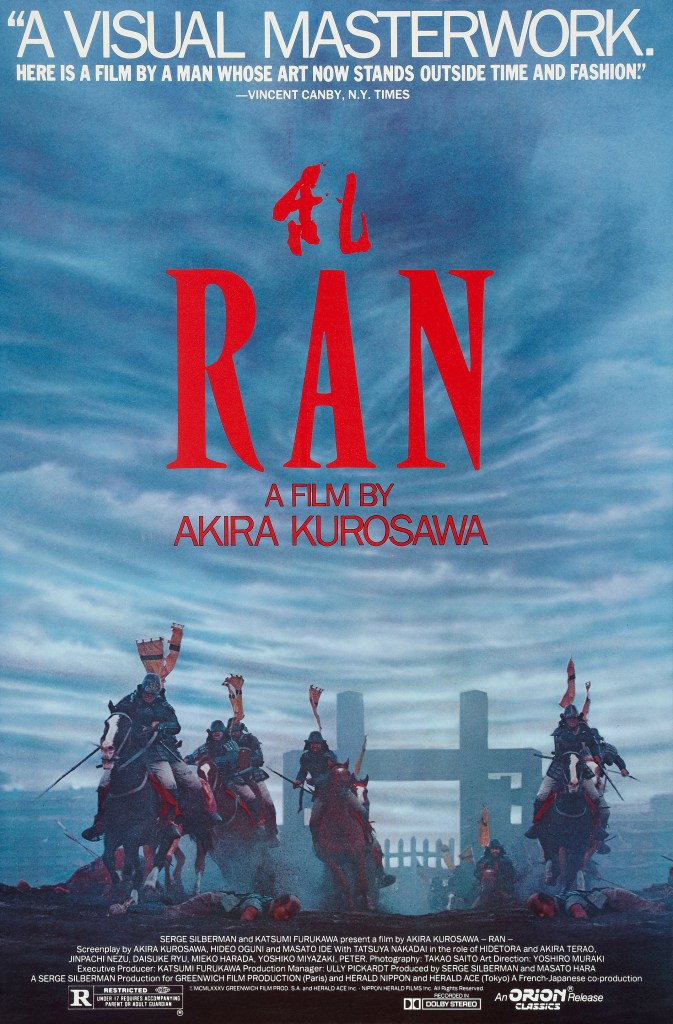
One of the early reviews of Akira Kurosawa’s “Ran” said that he could not possibly have directed it at an earlier age. My first impulse was to question that act of critical omnipotence. Who is to say Kurosawa couldn’t have made this film at 50 or 60, instead of at 75, as he has?
But then I thought longer about “Ran,” which is based on Shakespeare’s “King Lear” and on a similar medieval samurai legend. And I thought about Laurence Oliver’s “Lear” on TV last year, and about the “Lear” I saw starring Douglas Campbell a few weeks ago here in Chicago, and I realized that age probably is a prerequisite to fully understand this character. Dustin Hoffman might be able to play Willy Loman by aging himself with makeup, but he will have to wait another 20 years to play Lear.
The character contains great paradoxes, but they are not the paradoxes of youth; they spring from long habit. Lear has the arrogance of great power, long held. He has wide knowledge of the world. Yet he is curiously innocent when it comes to his own children; he thinks they can do no wrong, can be trusted to carry out his plans. At the end, when his dreams have been broken, the character has the touching quality of a childlike innocence that can see breath on lips that are forever sealed, and can dream of an existence beyond the cruelties of man. Playing Lear is not a technical exercise. I wonder if a man can do it who has not had great disappointments and long dark nights of the soul.
Kurosawa has lived through those bad times. Here is one of the greatest directors of all time, out of fashion in his own country, suffering from depression, nearly blind. He prepared this film for 10 years, drawing hundreds of sketches showing every shot, hardly expecting that the money ever would be found to allow him to make the film. But a deal was finally put together by Serge Silberman, the old French producer who backed the later films of Luis Bunuel (who also could have given us a distinctive Lear). Silberman risked his own money; this is the most expensive Japanese film ever made, and, yes, perhaps Kurosawa could not have made it until he was 75.
The story is familiar. An old lord decides to retire from daily control of his kingdom, yet still keep all the trappings of his power. He will divide his kingdom in three parts among his children. In “Ran” they are sons, not daughters. First, he requires a ritual statement of love. The youngest son cannot abide the hypocrisy, and stays silent. And so on. The Japanese legend Kurosawa draws upon contains a famous illustration in which the old lord takes three arrows and demonstrates that when they are bundled, they cannot be broken, but taken one at a time, they are weak. He wishes his sons to remain allies, so they will be strong, but of course they begin to fight, and civil war breaks out as the old lord begins his forlorn journey from one castle to another, gradually being stripped of his soldiers, his pride, his sanity. Nobody can film an epic battle scene like Kurosawa. He already has demonstrated that abundantly in “The Seven Samurai,” in “Yojimbo,” in “Kagemusha.” In “Ran,” the great bloody battles are counterpointed with scenes of a chamber quality, as deep hatreds and lusts are seen to grow behind the castle walls.
“King Lear” is a play that centers obsessively around words expressing negatives. “Nothing? Nothing will come to nothing!” “Never, never, never.” “No, no, no, no, no.” They express in deep anguish the king’s realization that what has been taken apart never will be put together again, that his beloved child is dead and will breathe no more, that his pride and folly have put an end to his happiness. Kurosawa’s film expresses that despair perhaps more deeply than a Western film might; the samurai costumes, the makeup inspired by Noh drama, give the story a freshness that removes it from all our earlier associations.
“Ran” is a great, glorious achievement. Kurosawa often must have associated himself with the old lord as he tried to put this film together, but in the end he has triumphed, and the image I have of him, at 75, is of three arrows bundled together.
Watch Ran on Kanopy here: https://www.kanopy.com/en/kcls/video/11677948
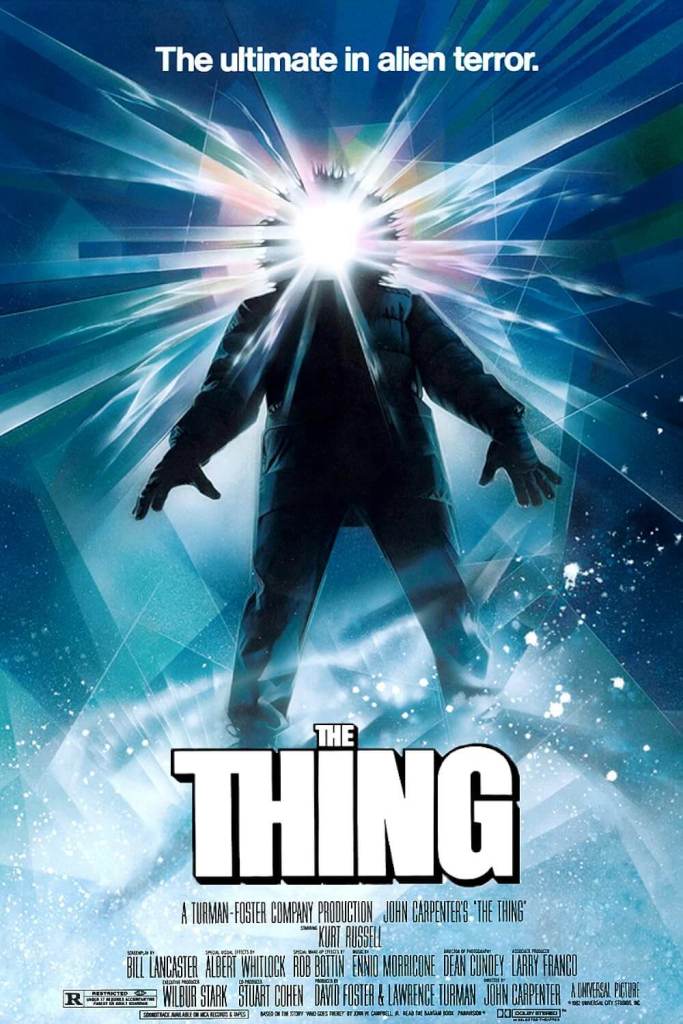
John Carpenter’s The Thing received terrible reviews when it was released in 1982. Critics were wrong about this frozen horror masterpiece.
By Ryan Lambie
Source: Den of Geek
It’s the summer of 1982, and director John Carpenter is on the cusp of releasing his latest movie, The Thing. For the 34-year-old filmmaker, the release marks the end of a major undertaking: the culmination of months of shooting on freezing cold sets and snowy British Columbia locations, not to mention the execution of complex and time-consuming practical effects scenes.
Carpenter was understandably proud of the results: after such independent hits as Assault On Precinct 13, Halloween, and Escape From New York, this was his first studio movie (for Universal) and also his most expensive to date, with a budget of around $15m. And while The Thing had appeared in cinemas before (in the guise of Howard Hawks and Christian Nyby’s 1951 sci-fi shocker, The Thing From Another World) Carpenter’s movie was a fresh adaptation of John W. Campbell’s novella, Who Goes There? – a story Carpenter had long prized.
The Nyby-Hawks adaptation took the skeleton of Campbell’s story, about scientists discovering an alien life form in Antarctica, and made it into a monster movie chiller with James Arness as the hulking creature from outer space. Carpenter’s The Thing, on the other hand, went back to the original story’s most compelling idea: that of a creature which can transform itself into perfect imitations of the people around it.
With the help of Rob Bottin’s groundbreaking effects work, Carpenter’s movie would bring this creature “out into the light” and he was understandably satisfied with the unholy amalgam of suspense and outright horror he’d brought to the screen.
THE ICY CRITICAL RECEPTION
Yet when The Thing opened in US cinemas on the 25th June 1982, the critical reception was almost as aggressive and seething as the movie’s title monster.
Writing for The New York Times, noted movie critic Vincent Canby described the movie as “foolish, depressing” with its actors “used merely as props to be hacked, slashed, disembowelled and decapitated, finally to be eaten and then regurgitated […] it is too phony to be disgusting. It qualifies only as instant junk.”
Time magazine dismissed The Thing as “an exercise in abstract art,” while Roger Ebert, in a slightly less aggressive review, described it as “a great barf-bag movie”, but maintained that, “the men are just setups for an attack by The Thing.”
Even reviewers outside the mainstream were hostile towards The Thing. The magazine Cinefantastique ran a cover which asked, “Is this the most hated movie of all time?”
In science fiction magazine Starlog, critic Alan Spencer wrote, “John Carpenter’s The Thing smells, and smells pretty bad. It has no pace, sloppy continuity, zero humor, bland characters on top of being totally devoid of either warmth or humanity […] It’s my contention that John Carpenter was never meant to direct a science-fiction horror movie. Here’s some things he’d be better suited to direct: traffic accidents, train wrecks and public floggings.”
Carpenter was left reeling from the critical reaction. “I was pretty stunned by it,” he later said. “I made a really gruelling, dark movie, but I [thought] audiences in 1982 wanted to see that.”
In terms of its theatrical performance, Carpenter’s dark vision didn’t exactly go down as either he or Universal had perhaps expected. A major summer release, The Thing scraped in at number eight at the US box office, and while it was by no means a flop – its lifetime gross amounted to just under $20 million according to Box Office Mojo – neither was it considered a hit.
THE CRUEL SUMMER
The issue of Starlog in which Alan Spencer’s review of The Thing appeared provides several clues as to why the critical reaction to the movie was so extreme. First, there’s the cover: published in November 1982, issue 64 of Starlog features the benevolent, childlike face of E.T.
Steven Spielberg’s family blockbuster E.T.: The Extra-Terrestrial had, unfortunately for Carpenter, appeared in American cinemas just two weeks before The Thing came out on the 25th June, and that movie’s warm, gentle view of extraterrestrial life was diametrically opposed to the nightmarish excess of Carpenter’s, and moviegoers were still eagerly lining up to see it 14 days later. The Thing, it seemed, simply ran counter to the mood of the times. Neither critics nor audiences were prepared for the intensity or chilly nihilism of The Thing, particularly in the heat of the summer season.
The actor Kenneth Tobey, who played Captain Hendry in The Thing From Another World, summed up the general consensus after a screening of Carpenter’s movie. “The effects were so explicit that they actually destroyed how you were supposed to feel about the characters,” Tobey said. “They became almost a movie in themselves, and were a little too horrifying.”
Its gory excess when compared to the sheer cuddliness of E.T. wasn’t The Thing‘s only problem, either. As that November issue of Starlog proves, 1982 was a crowded year for science fiction, fantasy and horror. Star Trek II: The Wrath Of Khan, and Poltergeist opened on the same day – the 4th June. Disney’s hugely expensive sci-fi adventure Tron came out a little over a month later, on the 9th July.
Then there was Blade Runner, 20th Century Fox’s expensive sci-fi gamble, which, like The Thing, opened on the 25th June and was initially regarded as a financial and critical disappointment.
The Thing was therefore unfortunate to appear in a bumper summer for genre films, and it was doubly hobbled by its R-rating; had its release date been moved to the winter and away from its more family-friendly competitors (even Poltergeist somehow garnered a PG certificate), it’s possible that it could have found a wider audience in cinemas, despite all those savage reviews.
THE AFTERMATH
Bruised by the reaction to The Thing, Carpenter continued to make movies (he made Christine in 1983 and Starman the year after) but lost considerable confidence from the experience, and took some time before he’d talk openly about the earlier movie’s box office disappointment. Perhaps ironically, one of the outlets Carpenter first opened up to was Starlog.
“I was called ‘a pornographer of violence’,” Carpenter said in 1985. “I had no idea it would be received that way […] The Thing was just too strong for that time. I knew it was going to be strong, but I didn’t think it would be too strong […] I didn’t take the public’s taste into consideration.”
It was on video – and later television – that the perception of The Thing began to change. The initial shock and repulsion which greeted it in the summer of 1982 began to ebb, as the full extent of what Carpenter, and his filmmakers – among them writer Bill Lancaster, cinematographer Dean Cundey, composer Ennio Morricone and effects artist Rob Bottin (aided in certain scenes by Stan Winston) had managed to achieve.
With the growing passage of time, it becomes easier to see the criticisms aimed at The Thing as being among its most positive attributes. The characters aren’t “merely props” but distinct individuals whose traits are introduced subtly and cleverly – a brief line here, a quirky facial expression there.
That Kurt Russell’s MacReady is slow and even reluctant to emerge as the group’s leader adds to the movie’s unpredictability. The terse dialogue and frosty tone heightens the sense of paranoia and suspicion – this is a cold war horror about the very human emotions of fear and distrust, where the Thing could lurk anywhere, perhaps even within MacReady himself.
The Thing‘s apocalyptic tone was such that, when it came to filming the conclusion, even Carpenter wondered whether he’d gone a little too far. But editor Todd Ramsay coaxed him on, encouraging to remain true to his own bleak vision. “You have to embrace the darkness,” Ramsay told Carpenter. “That’s where this movie is. In the darkness.”
THE ENDURING CLASSIC
It has been more than 30 years since The Thing first appeared in that crowded summer of 1982, and it has long since shaken off its “instant junk” stigma. Repeat viewings have exposed the rich depths beneath Rob Bottin’s spectacular mutations: to this day, there are fan sites, such as Outpost 31, dedicated to detailing the minutiae of the movie’s production and story details.
Speculation still rages over exactly when Blair (played by Wilford Brimley) was first imitated by the shape-shifting monster, or whether the victims of the Thing know whether they’ve been replaced, or whether the two survivors at the end of the movie are even human anymore. It’s the ambiguity of Carpenter’s filmmaking, as well as its obvious technical brilliance, that has allowed The Thing to endure, despite the slings and arrows of its critics.
Back in 1982, Roger Ebert wrote, “there’s no need to see this version unless you are interested in what the Thing might look like while starting from anonymous greasy organs extruding giant crab legs and transmuting itself into a dog. Amazingly, I’ll bet that thousands, if not millions, of moviegoers are interested in seeing just that.”
On that latter point, Ebert was precisely right: thousands, even millions of movie fans are interested in The Thing. It’s just taken them a little while to realize that fact.
INDIAN COUNTRY NEWS
"It is the duty of every man, as far as his ability extends, to detect and expose delusion and error"..Thomas Paine
Human in Algorithms
From the Roof Top
I See This
blog of the post capitalist transition.. Read or download the novel here + latest relevant posts
अध्ययन-अनुसन्धानको सार
 After the Crash