Eric Dubay and Amish Space Station
Two for Tuesday
Reply


By Simon Abrams
Source: RogerEbert.com
Swedish comedy “A Pigeon Sat on a Branch Reflecting On Existence” has a very particular style of deadpan humor and an equally specific morbid sense of empathy. As in his previous two films, writer/director Roy Andersson (“Songs from the Second Floor,” “You, The Living”) presents several thematically-united sketches of life as it’s experienced by the meek, and the suffering, two groups of people who are (according to Andersson’s films) doomed to inherit nothing. “A Pigeon Sat on a Branch Reflecting on Existence” is, in that sense, a kind of alarmist comedy. It’s a series of comedic sketches about people who are too self-involved to empathize with each other. It’s also a plaintively blunt wake-up call, and an effective demand for viewers’ vigilant sensitivity.
I’m writing this review as a series of direct free-associations because that’s essentially how “A Pigeon Sat on a Branch Reflecting On Existence” presents itself. Like Andersson’s other recent films, “Pigeon” is a movie that’s so viscerally effective that it doesn’t really matter how hard individual scenes clobber you over the head with Andersson’s humanist message: by choosing to isolate ourselves from each other, we die a thousand little absurd deaths every day without ever really moving on.
“A Pigeon Sat On a Branch Reflecting on Existence” doesn’t really have a plot, but it does feature two recurring characters: Jonathan (Holger Andersson) and Sam (Nils Westblom) sell novelty items, but aren’t very good at it. They’re shy and tactless, as we see in any scene where they try to pitch people who could clearly care less about plastic vampire fangs, and rubber Halloween masks. But Jonathan, who is repeatedly teased for being over-sensitive, also suffers from a vague sinking feeling that something is wrong with his life, and that leads to problems with Sam later on.
To be fair, Jonathan’s not completely blameless. In one scene, we see him bullying a store-owner who is too anxious and depressed to address Jonathan and Sam when they demand payment for novelty items that were bought on credit. It’s an awkwardly heated argument since Jonathan and Sam have to argue with their client through a third party: the store-owner’s wife. Jonathan and Sam’s seeming lack of empathy is what unites them with the various other people in “A Pigeon Sat On a Branch Reflecting on Existence.” Several characters receive phone calls that lead them to miss whatever situation is happening right in front of their eyes, like the callous scientist who ignores a monkey she’s performing electroshock therapy on or the desperate barber who doesn’t see his reluctant (and only) client leaving his barber shop. Each time this happens, the person on the phone ironically says “I’m glad that you’re doing fine,” reminding viewers that the opposite is actually true, and that a state of un-fine-ness is actually what passes for normalcy in Andersson’s film.
Andersson is not however a pessimist nor is “A Pigeon Sat On A Branch Reflecting on Existence” a cynical film. On the contrary, “Pigeon” leads viewers through a series of comically bleak vignettes towards a hopefully open-ended conclusion. In a 2009 interview published in MuBI by former “At the Movies” co-host Ignatiy Vishnevetsky, Andersson describes his simultaneously unsparing but ennobling sensibility as “a light without mercy.” Vishenvetsky correctly adds that “There’s a difference between being ‘without mercy’ and being cruel.” You can see exactly what Vishnevetsky means in the most confrontational scene in “Pigeon:” a dream sequence wherein white blue bloods set a giant container full of black slaves on fire, and watch as the container revolves slowly and makes music. The painfully deliberate pacing of this scene makes it surprisingly shocking. You realize what’s happening well before the scene is over, but by the time the scene ends, you’ll also realize that you’ve just seen the most serious scene in “Pigeon.” It’s a howl of inflexible indignation that informs the rest of the film’s slippery pre-apocalyptic comedy.
Andersson is able to essentially lecture his audience into laughing at his funhouse reflections of human insensitivity because he has a very exact style, one that he’s honed after directing hundreds of equally surreal commercials. Andersson takes his time behind the camera. He typically reshoots scenes that feature only a handful of dialogue over and over again, sometimes several dozen times. He doesn’t agonize over shots, according to line producer John Carlsson, but rather just chooses them at his own pace. That sensitivity shows in “Pigeon”‘s sets: life-like models and fixtures that make you feel like you’re looking at street scenes when in fact you’re looking at vividly detailed interior sets that also retain a magical kind of artificiality. The film’s interiors are similarly shot like tableaux vivants that just barely come alive whenever a zombie-like protagonist trudges through. The world of “A Pigeon Sat on a Branch Reflecting on Existence” is, in that sense, fragile, but not really moribund. Andersson’s hysterically impotent characters may, in other words, be perpetually on the verge of a spiritual breakdown, but they never completely fall apart. That kind of mulishly stubborn resilience is very human, and also very funny.

“Everybody Wants Some!” — Richard Linklater’s Remembrance of Teams Past
By Gerald Peary
Source: The Arts Fuse
Richard Linklater has branded Everybody Wants Some! a “spiritual sequel” to his earlier Dazed and Confused (1993), with Dazed and Confused’s pack of 1970s high school boys, after a summer break and with new identities, off, in fall 1980, to freshman year at college. Critics have piped in that Boyhood (2014) ends with teenager, Mason, at the moment of entering university, so that Everybody Wants Some! is also some kind of Boyhood sequel. Not only is Everyone Wants Some! deeply personal in Linklater’s oeuvre, it’s also nakedly autobiographical. Floppy-haired Blake Jenner, cast as Jake Bradford, the film’s protagonist, is a look-alike for young Rick Linklater. Like his character, Jake, Rick is a native Texan who attended a small Texas college, Sam Houston State, on a baseball scholarship.
(Lucky for us, Linklater suffered a blowout injury, which stopped short a wished-for trip into the minor leagues for a talented second baseman. He dropped out of college, worked for a short time on an off-shore oil rig, and then, back on land, chose a different career path.)
There’s more than autobiography in Everybody Wants Some! We should not forget to factor into the movie what seems the film’s real “spiritual father,” that infamous anti-PC guilty pleasure, National Lampoon’s Animal House (1978). In both films, a university’s Apollonian claim to be an epicenter of learning and intellectual development is a total sham. Dionysus reigns. Everyone is at college for the party-going. Period. In Animal House, the university administrators we meet are all hapless grotesques. In Everybody Wants Some!, the sole college teacher we see, in mismatched jacket and pants, appears only in long shot in the last scene of the movie. Far off and powerless. “Who the hell is that?” asks a student, unable to grasp what that old guy by the blackboard has to do with higher education.
Higher education? Getting high, on weed or beer. Getting laid. Perhaps the most arresting “student” in Everybody Wants Some! is Finnigan (Glen Powell), a charming rogue—pipe smoking, Kerouac-reading — who uses his verbal dexterity as his major tool in getting coeds into the sack. He’s the cocky heir of the smooth-talking frat rodents of Animal House who sounded, at their smug wittiest, like the amoral rakes from a Restoration stage comedy.
I am a lifetime baseball fan but I’m also a Northeastern intellectual, a friend to feminism, a left liberal. And I’m old. For a long time, I couldn’t get into the philistine, Southern swagger of those we hang out with in Everybody Wants Some!: the budding guys on the baseball team, who share a house and don’t need to belong to a fraternity to act like heathen brothers. It’s four days before the college semester begins, and those days are taken up with drinking, doping, playing, in lieu of baseball, lots of ridiculous competitive games and, above all, scoring with anonymous, ever-willing young ladies. Am I just being paranoid? I imagined these almost-all white boys later in life, living high off the hog in rural Texas, good ole’ men in their late 50s, voting one and all for Rick Perry and Ted Cruz.
It’s hard to separate the unapologetic sexism of the baseball players, for whom Linklater has an obvious affection, from chauvinism in Linklater’s point-of-view. Should he be tougher on his macho crew, or, as he does, forgive their cave boy attitudes as part of his utopian stance on college life 1980? I suggest a reading of an excellent review by new MTV critic Amy Nicholson, in which, disappointed by his new film, she scolds Linklater for having “a lame midlife crisis.”
Me? I was finally won over in the last act, when Everybody Wants Some! turns a little emotional, a little “girly.” After three days of male carousing, Thursday-Saturday, Jake settles down on Sunday with Beverly (Zoey Deutsch) a smart, sassy, ambitious, artsy dance and drama major. The other guys can’t believe it: he “likes” her. Jake wants to see Zoey as more than a midnight bounce on a bed. What can I say? Both young actors are winning and sweet, and I put behind me Jake’s earlier moments of piggy behavior. (Hey, I’ve been there! Oink, oink,) Jake has learned something meaningful in three days: women are more than sexual objects. And now it’s time, Monday, to actually start college.
If Jake is Richard Linklater’s alter ego in his movie, where do we see in Jake the seed of the person who would become a pioneer indie filmmaker? Pointedly, there’s not one movie reference anywhere in Everybody Wants Some! But around Jake there are some who are sensitive to the arts, starting with his new girlfriend and his Beat-reading baseball cohort, Finnigan. Most importantly, there’s the odd guy who is somehow on the baseball team: Willoughby (Wyatt Russell), a bearded, weathered, Californian hippy. He quotes from Carl Sagan’s Cosmos, he owns a roomful of Twilight Zone VHS tapes. He blames the crowd’s love of the band Van Halen on the power of corporations to form mass taste. Best of all, he delivers long, winding soliloquys on whatever. And that’s a key to Linklater’s sensibility: his devotion to disquisition. It’s the road to the moviemaker’s first hit film, Slacker (1991), a roundelay of alternative people walking about and holding forth. In weird Austin, a Democratic oasis in Texas, where Linklater landed and stayed.
____________________
Watch Everybody Wants Some!! on Hoopla here: https://www.hoopladigital.com/title/15776471
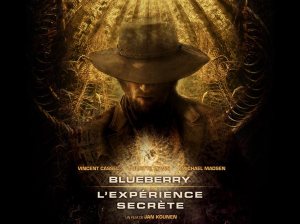
“Blueberry” (2004) is an acid western directed by Jan Kounen and based on the graphic novel by Jean Giraud (Moebius) and Jean-Michel Charlier. Unlike most acid westerns, the film has a relatively conventional narrative following the journey of Mike Donovan (Vincent Cassel) who, after losing his first love to Blount (Michael Madsen), is adopted by a native tribe and becomes a U.S. Marshall. What qualifies it as an acid western is the final showdown which depicts a spiritual battle via spectacularly psychedelic CGI and sound effects. Blueberry is also notable for its international roster of great character actors including Juliette Lewis, Temuera Morrison, Ernest Borgnine, Djimon Hounsou, Tchéky Karyo, Eddie Izzard and Colm Meaney.
Watch Renegade on Hoopla here: https://www.hoopladigital.com/title/16104849

REVISITING THE LAST OF SHEILA (1973)
By Craig Leask
Source: Foote & Friends on Film
The Last of Sheila is a brilliantly clever thriller which tries (and succeeds) beautifully in combining the best of a bitchy Hollywood self-satire, mixed with a traditional whodunit. Ultimately the film is tongue in cheek homage to both the murder mystery genre and the cutthroat world of movie making. It’s about playing a game, both as a diversion as well as means of controlling, manipulating, and undermining desperate people, their self-esteem, and their careers. The film is very well structured and as such, it is not a movie for those who like their plots to be obvious – the writing requires the viewer to pay close attention to each clue, plot twist, nuance, and strategically placed red herring – and trust me, there are many. Virtually every line of dialogue and visual reference, including the most blatant which is revealed later into the film, is designed to assist the viewer in playing detective.
The screenplay came from the unexpected collaboration of actor Anthony Perkins (Psycho) and composer Stephen Sondheim (of Broadway fame), who had based the film on their penchant for elaborate scavenger hunt parties the pair hosted for their show business friends in New York City in the 1960’s and 70’s. A guest to one of their parties was producer and director Herbert Ross (The Goodbye Girl, California Suite) who encouraged them to write a script based on the party and its roster of famous guests. Ultimately this conversation led to the development of the The Last of Sheila. Although there is a very clear Agatha Christie vibe to the premise, the writers wanted to differentiate their murder mystery with any others: they wanted no detective. The participants were to be isolated, and they alone were to solve the crime. This was the only film script written by either Anthony Perkins or Stephen Sondheim. Herbert Ross stepped in to direct.
The plot centers around movie producer and game-aficionado Clinton Greene (James Coburn) who invites a diverse group of business contacts and associates for a one-week cruise aboard his yacht off the southern coast of France on the one-year anniversary of the death of his wife, gossip columnist Sheila Greene (Yvonne Romain in her final acting role). Once the ship is under way, Clinton announces to the passengers that they will all partake in “The Sheila Greene Memorial Gossip Game” in which each of the six guests will be assigned “a pretend piece of gossip” on an index card, to be kept hidden from the other passengers. The object of the game is simple: discover everyone else’s “gossip” through a series of carefully planned events and clues, while protecting one’s own secret. Each night a planned event on shore will reveal the holder of one of the secrets. Following the conclusion of the first night’s activity, cumulating with revealing of the first card, “You are a SHOPLIFTER”, realization begins within the group that each guest’s card may not be a “pretend” piece of gossip as initially stated, but instead an actual, embarrassing secret about each participant.
To further tease and flaunt his dominance over the Hollywood B-List invitees, Clinton announces he is about to begin a new film project and is offering each guest the opportunity to participate in the project – with the better billing awarded to those who score higher in his game. It is no secret that being involved in a Clinton film project is precisely the lure each of the guests need to repair their damaged careers and restore their tattered reputations.
As the game progresses, the evenings begin to evolve into a macabre game of clue, with guests each sparring over who owns each dirty little secret as they compete for top billing in the elusive film project. In the midst of a particularly eerie session of the game, set in an abandoned monastery, someone protecting their own damaging secret rewrites the rules resulting in the death of one of the participants, leaving the surviving guests to play murderous musical chairs in a proverbial floating drawing room.
It is interesting to note that this really is a game to each of the guests; collectively they do not waste time grieving over another’s death, they merely clean up the blood and write off one more loser against their desperate yearning for a win.
The cast of guests / suspects and their players have been carefully and well selected for the film, including: attention starved secretary-cum-talent agent Christine (Dyan Cannon in a role based closely upon talent agent Sue Mengers); starlet Alice Wood (Raquel Welch) and her talent-manager husband Tony (Ian McShane) who holds leafy aspirations of becoming an associate producer; pessimistic “has-been” film director Philip Dexter (James Mason); Tom Parkman (Richard Benjamin), a screenwriter frustrated with only doing rewrites of others’ work and Lee, Tom’s wife, who is basically just bored and rich. These characters have been developed to represent a cross section of Hollywood personalities: people who are proud and narcissistic, who maintain their status and dominance through developing and spreading rumors about the faults of their competition. They each portray a surface air of stability and contentment, while diligently working on their social status, desperately seeking to connive their way back on top in the eyes of the Hollywood power establishment. This is what actually differentiates this film from your basic “bring a group of people together, isolate them and make one a murderer” plot, is the writers are concerned as much with who the characters are and how they interact as they are with murder itself.
Although the character conflicts and the backstory to whom-does-what-to-whom doesn’t always seem justified, the performances as demonstrated in the ever-competitive personality game, are clever, sharp-edged, quick and very entertaining. I did however find Rachael Welch as the starlet “Alice” to be quite unremarkable. She added little to nothing to the plot and in my opinion her and her character didn’t need to be in the film at all. James Mason did, howeve,r famously refer to working with her on the film, stating she was “the most selfish, ill-mannered, inconsiderate actress that I have ever had the displeasure of working with.”
Ironically, the film ends to Bette Midler’s song “Friends,” playing over its closing credits.
In 2012 New Line Cinema, division of Warner Brothers Pictures, announced a remake of The Last of Sheila was in the works, helmed by producer Beau Flynn. The project appears to have fizzled out shortly after this announcement as no further mention of the remake has been made.
INDIAN COUNTRY NEWS
"It is the duty of every man, as far as his ability extends, to detect and expose delusion and error"..Thomas Paine
Human in Algorithms
From the Roof Top
I See This
blog of the post capitalist transition.. Read or download the novel here + latest relevant posts
अध्ययन-अनुसन्धानको सार
 After the Crash