

By Ron Unz
Source: The Unz Review
A year or two ago, I saw the much-touted science fiction film Interstellar, and although the plot wasn’t any good, one early scene was quite amusing. For various reasons, the American government of the future claimed that our Moon Landings of the late 1960s had been faked, a trick aimed at winning the Cold War by bankrupting Russia into fruitless space efforts of its own. This inversion of historical reality was accepted as true by nearly everyone, and those few people who claimed that Neil Armstrong had indeed set foot on the Moon were universally ridiculed as “crazy conspiracy theorists.” This seems a realistic portrayal of human nature to me.
Obviously, a large fraction of everything described by our government leaders or presented in the pages of our most respectable newspapers—from the 9/11 attacks to the most insignificant local case of petty urban corruption—could objectively be categorized as a “conspiracy theory” but such words are never applied. Instead, use of that highly loaded phrase is reserved for those theories, whether plausible or fanciful, that do not possess the endorsement stamp of establishmentarian approval.
Put another way, there are good “conspiracy theories” and bad “conspiracy theories,” with the former being the ones promoted by pundits on mainstream television shows and hence never described as such. I’ve sometimes joked with people that if ownership and control of our television stations and other major media outlets suddenly changed, the new information regime would require only a few weeks of concerted effort to totally invert all of our most famous “conspiracy theories” in the minds of the gullible American public. The notion that nineteen Arabs armed with box-cutters hijacked several jetliners, easily evaded our NORAD air defenses, and reduced several landmark buildings to rubble would soon be universally ridiculed as the most preposterous “conspiracy theory” ever to have gone straight from the comic books into the minds of the mentally ill, easily surpassing the absurd “lone gunman” theory of the JFK assassination.
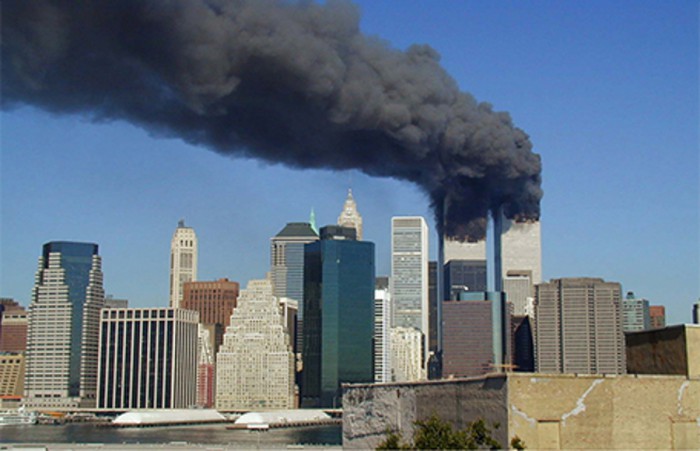
Even without such changes in media control, huge shifts in American public beliefs have frequently occurred in the recent past, merely on the basis of implied association. In the initial weeks and months following the 2001 attacks, every American media organ was enlisted to denounce and vilify Osama Bin Laden, the purported Islamicist master-mind, as our greatest national enemy, with his bearded visage endlessly appearing on television and in print, soon becoming one of the most recognizable faces in the world. But as the Bush Administration and its key media allies prepared a war against Iraq, the images of the Burning Towers were instead regularly juxtaposed with mustachioed photos of dictator Saddam Hussein, Bin Laden’s arch-enemy. As a consequence, by the time we attacked Iraq in 2003, polls revealed that some 70% of the American public believed that Saddam was personally involved in the destruction of our World Trade Center. By that date I don’t doubt that many millions of patriotic but low-information Americans would have angrily denounced and vilified as a “crazy conspiracy theorist” anyone with the temerity to suggest that Saddam hadnot been behind 9/11, despite almost no one in authority having ever explicitly made such a fallacious claim.
These factors of media manipulation were very much in my mind a couple of years ago when I stumbled across a short but fascinating book published by the University of Texas academic press. The author of Conspiracy Theory in America was Prof. Lance deHaven-Smith, a former president of the Florida Political Science Association.
Based on an important FOIA disclosure, the book’s headline revelation was that the CIA was very likely responsible for the widespread introduction of “conspiracy theory” as a term of political abuse, having orchestrated that development as a deliberate means of influencing public opinion.
During the mid-1960s there had been increasing public skepticism about the Warren Commission findings that a lone gunman, Lee Harvey Oswald, had been solely responsible for President Kennedy’s assassination, and growing suspicions that top-ranking American leaders had also been involved. So as a means of damage control, the CIA distributed a secret memo to all its field offices requesting that they enlist their media assets in efforts to ridicule and attack such critics as irrational supporters of “conspiracy theories.” Soon afterward, there suddenly appeared statements in the media making those exact points, with some of the wording, arguments, and patterns of usage closely matching those CIA guidelines. The result was a huge spike in the pejorative use of the phrase, which spread throughout the American media, with the residual impact continueing right down to the present day. Thus, there is considerable evidence in support of this particular “conspiracy theory” explaining the widespread appearance of attacks on “conspiracy theories” in the public media.
But although the CIA appears to have effectively manipulated public opinion in order to transform the phrase “conspiracy theory” into a powerful weapon of ideological combat, the author also describes how the necessary philosophical ground had actually been prepared a couple of decades earlier. Around the time of the Second World War, an important shift in political theory caused a huge decline in the respectability of any “conspiratorial” explanation of historical events.
For decades prior to that conflict, one of our most prominent scholars and public intellectuals had been historian Charles Beard, whose influential writings had heavily focused on the harmful role of various elite conspiracies in shaping American policy for the benefit of the few at the expense of the many, with his examples ranging from the earliest history of the United States down to the nation’s entry into WWI. Obviously, researchers never claimed that all major historical events had hidden causes, but it was widely accepted that some of them did, and attempting to investigate those possibilities was deemed a perfectly acceptable academic enterprise.
However, Beard was a strong opponent of American entry into the Second World War, and he was marginalized in the years that followed, even prior to his death in 1948. Many younger public intellectuals of a similar bent also suffered the same fate, or were even purged from respectability and denied any access to the mainstream media. At the same time, the totally contrary perspectives of two European political philosophers, Karl Popper and Leo Strauss, gradually gained ascendancy in American intellectual circles, and their ideas became dominant in public life.
Popper, the more widely influential, presented broad, largely theoretical objections to the very possibility of important conspiracies ever existing, suggesting that these would be implausibly difficult to implement given the fallibility of human agents; what might appear a conspiracy actually amounted to individual actors pursuing their narrow aims. Even more importantly, he regarded “conspiratorial beliefs” as an extremely dangerous social malady, a major contributing factor to the rise of Nazism and other deadly totalitarian ideologies. His own background as an individual of Jewish ancestry who had fled Austria in 1937 surely contributed to the depth of his feelings on these philosophical matters.
Meanwhile, Strauss, a founding figure in modern neo-conservative thought, was equally harsh in his attacks upon conspiracy analysis, but for polar-opposite reasons. In his mind, elite conspiracies were absolutely necessary and beneficial, a crucial social defense against anarchy or totalitarianism, but their effectiveness obviously depended upon keeping them hidden from the prying eyes of the ignorant masses. His main problem with “conspiracy theories” was not that they were always false, but they might often be true, and therefore their spread was potentially disruptive to the smooth functioning of society. So as a matter of self-defense, elites needed to actively suppress or otherwise undercut the unauthorized investigation of suspected conspiracies.
Even for most educated Americans, theorists such as Beard, Popper, and Strauss are probably no more than vague names mentioned in textbooks, and that was certainly true in my own case. But while the influence of Beard seems to have largely disappeared in elite circles, the same is hardly true of his rivals. Popper probably ranks as one of the founders of modern liberal thought, with an individual as politically influential as left-liberal financier George Soros claiming to be his intellectual disciple. Meanwhile, the neo-conservative thinkers who have totally dominated the Republican Party and the Conservative Movement for the last couple of decades often proudly trace their ideas back to Strauss.
So, through a mixture of Popperian and Straussian thinking, the traditional American tendency to regard elite conspiracies as a real but harmful aspect of our society was gradually stigmatized as either paranoid or politically dangerous, laying the conditions for its exclusion from respectable discourse.
By 1964, this intellectual revolution had largely been completed, as indicated by the overwhelmingly positive reaction to the famous article by political scientist Richard Hofstadter critiquing the so-called “paranoid style” in American politics, which he denounced as the underlying cause of widespread popular belief in implausible conspiracy theories. To a considerable extent, he seemed to be attacking straw men, recounting and ridiculing the most outlandish conspiratorial beliefs, while seeming to ignore the ones that had been proven correct. For example, he described how some of the more hysterical anti-Communists claimed that tens of thousands of Red Chinese troops were hidden in Mexico, preparing an attack on San Diego, while he failed to even acknowledge that for years Communist spies had indeed served near the very top of the U.S. government. Not even the most conspiratorially minded individual suggests that all conspiracies are true, merely that some of them might be.
Most of these shifts in public sentiment occurred before I was born or when I was a very young child, and my own views were shaped by the rather conventional media narratives that I absorbed. Hence, for nearly my entire life, I always automatically dismissed all of the so-called “conspiracy theories” as ridiculous, never once even considering that any of them might possibly be true.
To the extent that I ever thought about the matter, my reasoning was simple and based on what seemed like good, solid common sense. Any conspiracy responsible for some important public event must surely have many separate “moving parts” to it, whether actors or actions taken, let us say numbering at least 100 or more. Now given the imperfect nature of all attempts at concealment, it would surely be impossible for all of these to be kept entirely hidden. So even if a conspiracy were initially 95% successful in remaining undetected, five major clues would still be left in plain sight for investigators to find. And once the buzzing cloud of journalists noticed these, such blatant evidence of conspiracy would certainly attract an additional swarm of energetic investigators, tracing those items back to their origins, with more pieces gradually being uncovered until the entire cover-up likely collapsed. Even if not all the crucial facts were ever determined, at least the simple conclusion that there had indeed been some sort of conspiracy would quickly become established.
However, there was a tacit assumption in my reasoning, one that I have since decided was entirely false. Obviously, many potential conspiracies either involve powerful governmental officials or situations in which their disclosure would represent a source of considerable embarrassment to such individuals. But I had always assumed that even if government failed in its investigatory role, the dedicated bloodhounds of the Fourth Estate would invariably come through, tirelessly seeking truth, ratings, and Pulitzers. However, once I gradually began realizing that the media was merely “Our American Pravda” and perhaps had been so for decades, I suddenly recognized the flaw in my logic. If those five—or ten or twenty or fifty—initial clues were simply ignored by the media, whether through laziness, incompetence, or much less venal sins, then there would be absolutely nothing to prevent successful conspiracies from taking place and remaining undetected, perhaps even the most blatant and careless ones.
In fact, I would extend this notion to a general principle. Substantial control of the media is almost always an absolute prerequisite for any successful conspiracy, the greater the degree of control the better. So when weighing the plausibility of any conspiracy, the first matter to investigate is who controls the local media and to what extent.
Let us consider a simple thought-experiment. For various reasons these days, the entire American media is extraordinarily hostile to Russia, certainly much more so than it ever was toward the Communist Soviet Union during the 1970s and 1980s. Hence I would argue that the likelihood of any large-scale Russian conspiracy taking place within the operative zone of those media organs is virtually nil. Indeed, we are constantly bombarded with stories of alleged Russian conspiracies that appear to be “false positives,” dire allegations seemingly having little factual basis or actually being totally ridiculous. Meanwhile, even the crudest sort of anti-Russian conspiracy might easily occur without receiving any serious mainstream media notice or investigation.
This argument may be more than purely hypothetical. A crucial turning point in America’s renewed Cold War against Russia was the passage of the 2012 Magnitsky Act by Congress, punitively targeting various supposedly corrupt Russian officials for their alleged involvement in the illegal persecution and death of an employee of Bill Browder, an American hedge-fund manager with large Russian holdings. However, there’s actually quite a bit of evidence that it was Browder himself who was actually the mastermind and beneficiary of the gigantic corruption scheme, while his employee was planning to testify against him and was therefore fearful of his life for that reason. Naturally, the American media has provided scarcely a single mention of these remarkable revelations regarding what might amount to a gigantic Magnitsky Hoaxof geopolitical significance.
To some extent the creation of the Internet and the vast proliferation of alternative media outlets, including my own small webzine, have somewhat altered this depressing picture. So it is hardly surprising that a very substantial fraction of the discussion dominating these Samizdat-like publications concerns exactly those subjects regularly condemned as “crazy conspiracy theories” by our mainstream media organs. Such unfiltered speculation must surely be a source of considerable irritation and worry to government officials who have long relied upon the complicity of their tame media organs to allow their serious misdeeds to pass unnoticed and unpunished. Indeed, several years ago a senior Obama Administration official argued that the free discussion of various “conspiracy theories” on the Internet was so potentially harmful that government agents should be recruited to “cognitively infiltrate” and disrupt them, essentially proposing a high-tech version of the highly controversial Cointelpro operations undertaken by J. Edgar Hoover’s FBI.
Until just a few years ago I’d scarcely even heard of Charles Beard, once ranked among the towering figures of 20th century American intellectual life. But the more I’ve discovered the number of serious crimes and disasters that have completely escaped substantial media scrutiny, the more I wonder what other matters may still remain hidden. So perhaps Beard was correct all along in recognizing the respectability of “conspiracy theories,” and we should return to his traditional American way of thinking, notwithstanding endless conspiratorial propaganda campaigns by the CIA and others to persuade us that we should dismiss such notions without any serious consideration.

“Buffalo Soldiers” (2001) is a dark satire directed by Gregor Jordan based on the 1993 novel by Robert O’Conner. The story centers on U.S. Army soldier Ray Elwood (Joaquin Phoenix), whose drug and black market schemes are disrupted when his company gets assigned a new First Sergeant, Robert E. Lee (Scott Glenn). The battle between Elwood and Lee rapidly escalates leading to a fiery showdown. The film’s original theatrical run was delayed by two years due to fears that its unflattering depiction of the military would offend the sensibilities of the culture which was still caught up in a (partly real, partly media-induced) post-9/11 patriotic fervor.
Watch the full film here.
By Kevin Ryan
Source: Washington’s Blog
People sometimes wonder why is it important to investigate the alleged hijackers and others officially accused of committing the 9/11 crimes. After all, the accused 19 hijackers could not have accomplished most of what happened. The answer is that the official accounts are important because they are part of the crimes. Identifying and examining the people who created the official 9/11 myth helps to reveal the ones who were responsible overall.
The people who actually committed the crimes of September 11th didn’t intend to just hijack planes and take down the buildings—they intended to blame others. To accomplish that plan the real criminals needed to create a false account of what happened and undoubtedly that need was considered well in advance. In this light, the official reports can be seen to provide a link between the “blaming others” part of the crimes and the physical parts.
Pushing the concept of “Islamic Terrorism” was the beginning of the effort to blame others, although the exact 9/11 plan might not have been worked out at the time. This concept was largely a conversion of the existing Soviet threat, which by 1989 was rapidly losing its ability to frighten the public, into something that would serve more current policy needs. Paul Bremer and Brian Jenkins were at the forefront of this conversion of the Soviet threat into the threat of Islamic terrorism. Both Bremer and Jenkins were also intimately connected to the events at the World Trade Center.
The concerted effort to propagandize about Al Qaeda and Osama bin Laden (OBL) seems to have begun in earnest in 1998. That’s when the African embassy bombings were attributed to OBL and the as-yet unreported group called Al Qaeda. The U.S. government responded with bombings of Sudan and Afghanistan and, with help from the New York Times, began to drum up an intense myth about the new enemy.
“This is, unfortunately, the war of the future,” Secretary of State Madeleine Albright said. “The Osama bin Laden organization has basically declared war on Americans and has made very clear that these are all Americans, anywhere.”
In retrospect, it is surprising that this was the first reference to Al Qaeda in the New York Times, coming only three years before 9/11. More surprising is that The Washington Post did not report on Al Qaeda until June 1999, and its reporting was highly speculative about the power behind this new threat.
“But for all its claims about a worldwide conspiracy to murder Americans, the government’s case is, at present, largely circumstantial. The indictment never explains how bin Laden runs al Qaeda or how he may have masterminded the embassy bombings.”
Despite this skepticism from The Post, the reports about Al Qaeda continued in an odd mixture of propaganda and doubt. For example, The Times reported on the trial of the men accused of the African embassy attacks in May 2001. That article contradicted itself saying that “prosecutors never introduced evidence directly showing that Mr. bin Laden ordered the embassy attacks” and yet that a “former advisor” to Bin Laden, one Ali Mohamed, claimed that Bin Laden “pointed to where a truck could go as a suicide bomber.” The fact that Mohamed had worked for the U.S. Army, the FBI, and the CIA was not mentioned.
Other facts were ignored as well. That OBL had worked with the CIA and that Al Qaeda was basically a creation of CIA programs like Operation Cyclone were realities that began to fade into the background. By the time 9/11 happened, those facts were apparently forgotten by a majority of U.S. leaders and media sources. Also overlooked were the histories of people like Frank Carlucci and Richard Armitage, who played major roles in Operation Cyclone and who remained powerful players at the time of the 9/11 attacks.
In the two years before 9/11, the alleged hijackers were very active within the United States. They traveled extensively and often seemed to be making an effort to be noticed. When they were not trying to be noticed, they engaged in distinctly non-Muslim behavior. Mohamed Atta’s actions were erratic, in ways that were similar to those of Lee Harvey Oswald, and Atta appeared to be protected by U.S. authorities.
Meanwhile, leading U.S. terrorism experts seemed to be facilitating Al Qaeda terrorism. Evidence suggests that U.S. intelligence agency leaders Louis Freeh and George Tenet facilitated and covered-up acts of terrorism in the years before 9/11. Both of their agencies, the CIA and FBI, later took extraordinary measures to hide evidence related to the 9/11 attacks. And both agencies have made a mockery of the trial of those officially accused of helping OBL and the alleged hijackers.
Counter-terrorism leader Richard Clarke inexplicably helped OBL stay out of trouble, protecting him on at least two occasions. Clarke blatantly failed to follow-up on known Al Qaeda cells operating within the United States. After 9/11, Clarke was among those who falsely pointed to Abu Zubaydah as a top leader of Al Qaeda. Zubaydah’s torture testimony was then used as the basis for the 9/11 Commission Report.
Former CIA operative Porter Goss created the first official account of what happened on 9/11, along with his mentor Bob Graham. This was the report of the Joint Congressional Inquiry, produced by the intelligence oversight committees of the U.S. Congress. It was greatly influenced by people who should have been prime suspects. For example, Richard Clarke was the one in charge of the secure video conference at the White House that failed miserably to connect leaders and respond to the attacks. In the Joint Inquiry’s report, Clarke was cited as an authoritative reference 46 times. CIA director George Tenet was cited 77 times, and Louis Freeh was cited 31 times.
Therefore it is imperative that the people who worked to create the background story behind OBL and the accused hijackers be investigated for their roles in the 9/11 crimes. This includes not only those who were figureheads behind the official reports, but more importantly the ones who provided the evidence and testimony upon which those reports were built. The alleged hijackers and their associates should also be of considerable interest to 9/11 investigators. That’s because what we know about them was provided by people who we can assume were connected to the crimes and what we don’t yet know about them can reveal more of the truth.

By David Ray Griffin
Source: GlobalResearch.ca
There have been several good films and videos about 9/11. But the film by award-winning film-maker Massimo Mazzucco Released in 2013 is in a class by itself.
For those of us who have been working on 9/11 for a long time, this is the film we have been waiting for.
Whereas there are excellent films treating the falsity of particular parts of the official account, such as the Twin Towers or WTC 7, Mazzucco has given us a comprehensive documentary treatment of 9/11, dealing with virtually all of the issues.
There have, of course, been films that treated the fictional official story as true. And there are films that use fictional stories to portray people’s struggles after starting to suspect the official story to be false.
But there is no fiction in Mazzucco’s film – except in the sense that it clearly and relentlessly exposes every part of the official account as fictional.
Because of his intent at completeness, Mazzucco has given us a 5-hour film. It is so fascinating and fast-paced that many will want to watch it in one sitting. But this is not necessary, as the film, which fills 3 DVDs, consists of 7 parts, each of which is divided into many short chapters.
These 7 parts treat Air Defence, The Hijackers, The Airplanes, The Pentagon, Flight 93, The Twin Towers, and Building 7. In each part, after presenting facts that contradict the official story, Mazzucco deals with the claims of the debunkers (meaning those who try to debunk the evidence provided by the 9/11 research community).
The Introduction, reflecting the film’s title, deals with 12 uncanny parallels between Pearl Harbor and September 11.
The film can educate people who know nothing about 9/11 (beyond the official story), those with a moderate amount of knowledge about the various problems with the official story, and even by experts. (I myself learned many things.)
Mazzucco points out that his film covers 12 years of public debate about 9/11. People who have been promoting 9/11 truth for many of these years will see that their labors have been well-rewarded: There is now a high-quality, carefully-documented film that dramatically shows the official story about 9/11 to be a fabrication through and through.
This is truly the film we have been waiting for.
Part I
Part II
Part III

By Kade Crockford
Source: The Baffler
“If you’re submitting budget proposals for a law enforcement agency, for an intelligence agency, you’re not going to submit the proposal that ‘We won the war on terror and everything’s great,’ cuz the first thing that’s gonna happen is your budget’s gonna be cut in half. You know, it’s my opposite of Jesse Jackson’s ‘Keep Hope Alive’—it’s ‘Keep Fear Alive.’ Keep it alive.”
—Thomas Fuentes, former assistant director, FBI Office of International Operations
Can we imagine a free and peaceful country? A civil society that recognizes rights and security as complementary forces, rather than polar opposites? Terrorist attacks frighten us, as they are designed to. But when terrorism strikes the United States, we’re never urged to ponder the most enduring fallout from any such attack: our own government’s prosecution of the Terror Wars.
This failure generates all sorts of accompanying moral confusion. We cast ourselves as good, but our actions show that we are not. We rack up a numbing litany of decidedly uncivil abuses of basic human rights: global kidnapping and torture operations, gulags in which teenagers have grown into adulthood under “indefinite detention,” the overthrow of the Iraqi and Libyan governments, borderless execution-by-drone campaigns, discriminatory domestic police practices, dragnet surveillance, and countless other acts of state impunity.
The way we process the potential cognitive dissonance between our professed ideals and our actual behavior under the banner of freedom’s supposed defense is simply to ignore things as they really are. They hate us for our freedom, screech the bald-eagle memes, and so we must solemnly fight on. But what, beneath the official rhetoric of permanent fear, explains the collective inability of the national security overlords to imagine a future of peace?
Incentives, for one thing. In a perverse but now familiar pattern, what we have come to call “intelligence failures” produce zero humility, and no promise of future remedies, among those charged with guarding us. Instead, a new array of national security demands circulate, which are always rapidly met. In America, the gray-haired representatives of the permanent security state say their number one responsibility is to protect us, but when they fail to do so, they go on television and growl. To take but one recent example, former defense secretary Donald Rumsfeld appeared before the morally bankrupt pundit panel on MSNBC’s Morning Joe to explain that intractable ethnic, tribal, and religious conflict has riven the Middle East for more than a century—the United States, and the West at large, were mere hapless bystanders in this long-running saga of civilizational decay. This sniveling performance came, mind you, just days after Politico reported that, while choreographing the run-up to the 2003 invasion of Iraq, Rumsfeld had quietly buried a report from the Joint Chiefs of Staff indicating that military intelligence officials had almost no persuasive evidence that Saddam Hussein was maintaining a serious WMD program. Even after being forced to resign in embarrassment over the botched Iraq invasion a decade ago, Rumsfeld continues to cast himself as an earnestly outmanned casualty of Oriental cunning and backbiting while an indulgent clutch of cable talking heads nods just as earnestly along.
And the same refrain echoes throughout the echelons of the national security state. Self-assured and aloof as the affluenza boy, the FBI, CIA, and NSA fuck up, and then immediately apply for a frenzied transfer of ever more money, power, and data in order to do more of what they’re already doing. Nearly fifteen years after the “Global War on Terror” began, the national security state is a trillion-dollar business. And with the latest, greatest, worst-ever terrorist threat always on the horizon, business is sure to keep booming.
The paradox produces a deep-state ouroboros: Successful terrorist attacks against the West do not provoke accountability reviews or congressional investigations designed to truly understand or correct the errors of the secret state. On the contrary, arrogant spies and fearful politicians exploit the attacks to cement and expand their authority. This permits them, in turn, to continue encroaching on the liberties they profess to defend. We hear solemn pledges to collect yet more information, to develop “back doors” to decrypt private communications, to keep better track of Muslims on visas, send more weapons to unnamed “rebel groups,” drop more cluster bombs. Habeas corpus, due process, equal protection, freedom of speech, and human rights be damned. And nearly all the leaders in both major political parties play along, like obliging extras on a Morning Joe panel. The only real disagreement between Republican and Democratic politicians on the national stage is how quickly we should dispose of our civil liberties. Do we torch the Bill of Rights à la Donald Trump and Dick Cheney, or apply a scalpel, Obama-style?
Safety Last
Both Democrats and Republicans justify Terror War abuses by telling the public, either directly or indirectly, that our national security hangs in the balance. But national security is not the same as public safety. And more: the things the government has done in the name of preserving national security—from invading Iraq to putting every man named Mohammed on a special list—actually undermine our public safety.
That’s because, as David Talbot demonstrates in The Devil’s Chessboard, his revelatory Allen Dulles biography and devastating portrait of a CIA run amok, national security centers on “national interests,” which translates, in the brand of Cold War realpolitik that Dulles pioneered, into the preferred policy agendas of powerful corporations.
Public safety, on the other hand, is concerned with whether you live or die, and how. Any serious effort at public safety requires a harm-reduction approach acknowledging straight out that no government program can foreclose the possibility of terroristic violence. The national security apparatus, by contrast, grows powerful in direct proportion to the perceived strength of the terrorist (or in yesterday’s language, the Communist) threat—and requires that you fear this threat so hysterically that you release your grip on reason. Reason tells you government cannot protect us from every bad thing that happens. But the endlessly repeated national security meme pretends otherwise, though the world consistently proves it wrong.
When it comes to state action, the most important distinction between what’s good for public safety (i.e., your health) and what’s good for national security (i.e., the health of the empire, markets, and prominent corporations) resides in the concept of the criminal predicate. This means, simply, that an agent of the government must have some reasonable cause to believe you are involved with a crime before launching an investigation into your life. When the criminal predicate forms the basis for state action, police and spies are required to focus on people they have reason to believe are up to no good. Without the criminal predicate, police and spies are free to monitor whomever they want. Police action that bypasses criminal predicates focuses on threats to people and communities that threaten power—regardless of whether those threats to power are fully legal and legitimate.
Nearly fifteen years after the “Global War on Terror” began, the national security state is a trillion-dollar business.
We can see the results of this neglect everywhere the national security state has set up shop. Across the United States right now, government actors and private contractors paid with public funds are monitoring the activities of dissidents organizing to end police brutality and the war on drugs, Israeli apartheid and colonization in Palestine, U.S. wars in the Middle East, and Big Oil’s assault on our physical environment. In the name of fighting terrorism, Congress created the Department of Homeland Security, which gave state and local law enforcement billions of dollars to integrate police departments into the national intelligence architecture. As a result, we now have nearly a million cops acting as surrogates for the FBI. But as countless studies have shown, the “fusion centers” and intelligence operations that have metastasized under post-9/11 authorities do nothing to avert the terror threat. Instead, they’ve targeted dissidents for surveillance, obsessive documentation, and even covert infiltration. When government actors charged with protecting us use their substantial power and resources to track and disrupt Black Lives Matter and Earth First! activists, they are not securing our liberties; they’re putting them in mortal peril.
Things weren’t always like this. Once upon a time, America’s power structure was stripped naked. When the nation saw the grotesque security cancer that had besieged the body politic in the decades after World War II (just as Harry Truman had warned it would) the country’s elected leadership reasserted control, placing handcuffs on the wrists of the security agencies. This democratic counterattack on the national security state not only erected a set of explicit protocols to shield Americans from unconstitutional domestic political policing, but also advanced public safety.
Mission Creeps
As late as the 1970s, the FBI was still universally thought to be a reputable organization in mainstream America. The dominant narrative held that J. Edgar Hoover’s capable agents, who had to meet his strict height, weight, and dress code requirements, were clean-cut, straight-laced men who followed the rules. Of course, anyone involved with the social movements of that age—anti-war, Communist, Black Power, American Indian, Puerto Rican Independence—knew a very different FBI, but they had no evidence to prove what they could see and feel all around them. And since this was the madcap 1970s, the disparity between the FBI’s glossy reputation as honest crusaders and its actual dirty fixation on criminalizing the exercise of domestic liberties drove a Pennsylvania college physics professor and anti-war activist named William Davidon to take an extraordinary action. On the night of the Muhammad Ali vs. Joe Frazier fight of March 8, 1971, Davidon and some friends broke into an FBI office in Media, Pennsylvania. They stole every paper file they could get their hands on. In communiqués to the press, to which they attached some of the most explosive of the Hoover files, they called themselves the Citizens’ Commission to Investigate the FBI.
Not one of the costly post-9/11 surveillance programs based on suspicionless, warrantless monitoring stopped Tsarnaev from blowing up the marathon.
When Davidon and his merry band of robbers broke into the FBI office, they blew the lid off of decades of secret—and sometimes deadly—police activity that targeted Black and Brown liberation organizers in the name of fighting the Soviet red menace. According to Noam Chomsky, the Citizens’ Commission concluded that the vast majority of the files at the FBI’s Media, Pennsylvania, office concerned political spying rather than criminal matters. Of the investigative files, only 16 percent dealt with crimes. The rest described FBI surveillance of political organizations and activists—overwhelmingly of the left-leaning variety—and Vietnam War draft resisters. As Chomsky wrote, “in the case of a secret terrorist organization such as the FBI,” it was impossible to know whether these Pennsylvania figures were representative of the FBI’s national mandate. But for Bill Davidon and millions of Americans—including many in Congress who were none too pleased with the disclosures—these files shattered Hoover’s image as a just-the-facts G-man. They proved that the FBI was not a decent organization dedicated to upholding the rule of law and protecting the United States from foreign communist threats, but rather a domestic political police primarily concerned with preserving the racist, sexist, imperialist status quo.
In a cascade of subsequent transparency efforts, journalists, activists, and members of Congress all probed the darker areas of the national security state, uncovering assassination plots against foreign leaders, dragnet surveillance programs, and political espionage targeting American dissidents under the secret counterintelligence program known as COINTELPRO. Not since the birth of the U.S. deep state, with the 1947 passage of the National Security Act, had the activities of the CIA, FBI, or NSA been so publicly or thoroughly examined and contested.
Subsequent reforms included the implementation of new attorney general’s guidelines for domestic investigations, which, for the first time in U.S. history, required FBI agents to suspect someone of a crime before investigating them. Under the 1976 Levi guidelines, named for their author, Nixon attorney general Edward Levi, the FBI could open a full domestic security investigation against someone only if its agents had “specific and articulable facts giving reason to believe that an individual or group is or may be engaged in activities which involve the use of force or violence.” The criminal predicate was now engraved in the foundations of the American security state—and the Levi rules prompted a democratic revolution in law enforcement and intelligence circles. It would take decades and three thousand dead Americans for the spies to win back their old Hoover-era sense of indomitable mission—and their investigative MO of boundless impunity.
False Flags
In the years following the 9/11 attacks, the Bush administration began Hoovering up our private records in powerful, secret dragnets. When we finally learned about the warrantless wiretapping program in 2005, it was a national scandal. But just as important, and much less discussed, was the abolition of Levi’s assertion of the criminal predicate. So-called domestic terrorism investigations would be treated principally as intelligence or espionage cases—not criminal ones. This shift has had profound, if almost universally ignored, implications.
Michael German, an FBI agent for sixteen years working undercover in white supremacist organizations to identify and arrest terrorists, saw firsthand what the undoing of the 1970s intelligence reforms meant for the FBI. And German argues, persuasively, that the eradication of the criminal predicate didn’t just put Americans at risk of COINTELPRO 2.0. It also threatened public safety. The First and Fourth Amendments, which protect, respectively, our rights to speech and association and our right to privacy, don’t just create the conditions for political freedom; they also help law enforcement focus, laser-like, on people who have the intent, the means, and the plans to harm the rest of us.
Think of it like this, German told me: You’re an FBI agent tasked with infiltrating a radical organization that promotes violence as a means of achieving its political goals—the Ku Klux Klan, for example. KKK members say horrible and disgusting things. But saying disgusting things isn’t against the law; nor, as numerous studies have shown, is it a reliable predictor of whether the speaker will commit an act of political violence. When surrounded by white supremacists constantly spouting hate speech, a law enforcement officer has to block it out. If he investigates people based on their rhetoric, his investigations will lead nowhere. After all, almost no white supremacist seriously intending to carry out a terrorist attack is all that likely to broadcast that intent in public. (Besides, have you noticed how many Americans routinely say disgusting things?)
Today, more than a decade after it shrugged off the Levi guidelines, the FBI conducts mass surveillance directed at the domestic population. But dragnet surveillance, however much it protects “national security,” doesn’t increase public safety, as two blue-ribbon presidential studies have in recent years concluded. Indeed, the Boston bombings, the Paris attacks, and the San Bernardino and Planned Parenthood shootings have all made the same basic point in the cold language of death. The national security state has an eye on everyone, including the people FBI director James Comey refers to as “the bad guys.” But despite its seeming omniscience, the Bureau does not stop those people from killing the rest of us in places where we are vulnerable.
The curious case of Boston Marathon bomber Tamerlan Tsarnaev demonstrates the strange consequences of sidelining criminal investigations for national security needs. In 2011, about eighteen months before the bombings, Tsarnaev’s best friend and two other men were murdered in a grisly suburban scene in Waltham, Massachusetts—their throats slashed, marijuana sprinkled on their mutilated corpses. These murders were never solved. But days after the marathon bombings, law enforcement leaked that they had forensic and cellphone location evidence tying Tamerlan Tsarnaev to those unsolved crimes. Not one of the costly post-9/11 surveillance programs based on suspicionless, warrantless monitoring stopped Tsarnaev from blowing up the marathon. But if the police leaks were correct in assigning him responsibility for the 2011 murders, plain old detective work likely would have.
If security agencies truly want to stop terrorism, they should eliminate all domestic monitoring that targets people who are not suspected of crimes. This would allow agents to redirect space and resources now devoted to targeting Muslims and dissidents into serious investigations of people actually known to be dangerous. It’s the only reasonable answer to the befuddling question: Why is it that so many of these terrorists succeed in killing people even though their names are on government lists of dangerous men?
After the terrorist attacks in November, the French government obtained greater emergency powers in the name of protecting a fearful public. Besides using those powers to round up hundreds of Muslims without evidence or judicial oversight, French authorities also put at least twenty-four climate activists on house arrest ahead of the Paris Climate Change Conference—an approach to squashing dissent that didn’t exactly scream liberté, and had nothing to do with political violence. As with the Boston Marathon and countless other attacks on Western targets, the men who attacked the Bataclan were known to intelligence agencies. In May 2015, months before the attacks in Paris, French authorities gained sweeping new surveillance powers authorizing them to monitor the private communications of suspected terrorists without judicial approval. The expanded surveillance didn’t protect the people of Paris. In France, as in the United States, the devolution of democratic law enforcement practice has opened up space that’s filled with political spying and methods of dragnet monitoring that enable social and political control. This is not only a boondoggle for unaccountable administrators of mass surveillance; it also obstructs the kind of painstaking detective work that might have prevented the attacks on the Bataclan and the marathon.
Our imperial government won’t ever admit this, but we must recognize that the best method for stopping terrorism before it strikes is to stop engaging in it on a grand scale. Terrorist attacks are the price we pay for maintaining a global empire—for killing a million Iraqis in a war based on lies, for which we have never apologized or made reparations, and for continuing to flood the Middle East with weapons. No biometrics program, no database, no algorithm, no airport security system will protect us from ourselves.
INDIAN COUNTRY NEWS
"It is the duty of every man, as far as his ability extends, to detect and expose delusion and error"..Thomas Paine
Human in Algorithms
From the Roof Top
I See This
blog of the post capitalist transition.. Read or download the novel here + latest relevant posts
अध्ययन-अनुसन्धानको सार
 After the Crash