Though I was in neuro ICU for less than a month it felt much longer partly because of the number of post-injury “firsts” such as new protocols learned and significant milestones reached. “Firsts” are in quotes because I’m not completely certain whether I experienced certain things previously such as while at trauma ICU.
As far as I’m aware, “firsts” included the use of a sling and lift, being seated on a wheelchair, and visits from physical and occupational therapists. The physical therapist demonstrated a sequence of foot and leg stretches designed to preserve the range of motion of limbs. The occupational therapist did the same for hands and arms. At first I didn’t understand the value of the exercises since it seemingly had no impact on how I felt except for mild pain and discomfort and was a poor substitute for work outs I once did on my own. Only later would I understand the benefits such as preserving good circulation and joint flexibility, reducing spasms and muscle tightness, and increasing the chances of future emergent movement.
One example of a milestone would be being allowed to drink water and chew on ice. Since first waking up on a ventilator, my mouth felt continually dehydrated. When I expressed a need for water, nurses explained there was still a risk of liquids accidentally getting to my lungs and I would keep sufficiently hydrated with the saline IV drip. After about a week at neuro ICU and having taken various diagnostic tests, it was determined I could safely drink water. At first it was a great relief but was reminded of the downside which was a pain in my throat every time I swallowed caused by the medicine feed tube.
Another milestone was being able to speak again. With the breathing tube in my throat and the ventilator on I was unable to speak and at the time it was still unclear whether my lungs were strong enough to go without it. With the encouragement of a pulmonologist I started trying short amounts of time with the trach tube balloon cuff deflated. This was a key step in weaning off the ventilator and being able to speak again. At first it was painful but eventually I built up enough stamina to have short conversations before being put back on breathing assist.
Along with the milestones there were setbacks such as infections and suspected blood clots. These required pharmaceutical treatments, constant blood draws and a longer stay at the ICU. As important as it was to be under constant monitoring and in close proximity to nurses and medical specialists, neuro ICU was a sometimes chaotic environment with a constant flow of neighboring patients separated only by curtains. Some seemed calm and reasonable but others were disturbingly erratic and loud making it difficult to sleep. For this reason I made it a goal to transfer to the rehab unit as soon as possible. Unfortunately that wouldn’t be possible until I was in a more stable condition.
More than 30 years after his first film, Sono Sion has established himself as a brilliant, prolific and chameleonic director.
In the past decade alone, you can find some of his best work: a hilarious tribute to guerrilla filmmaking and 35mm, with yakuzas, samurais and martial arts, Why Don’t You Play in Hell?; brutally violent and sordid films, Cold Fish and Guilty of Romance; dramas alluding to the nuclear disaster in Fukushima, Himizu and The Land of Hope; a crazy hip hop musical, Tokyo Tribe; and an emotional kaiju and Christmas film with catchy rock songs, Love & Peace.
On the other hand, Nicolas Cage became one of the most prolific Hollywood actors, finding in recent years memorable roles in genre cinema that, beyond subversive, are absolutely delirious. Mandy and Color Out of Space are enough to forget his abundant jobs-for-hire.
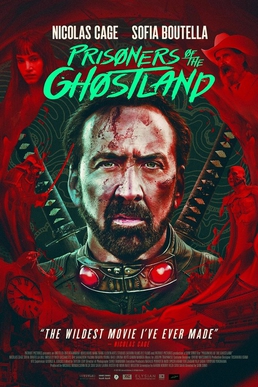
Considering that, Prisoners of the Ghostland, Sono’s highly anticipated English-language debut starring Cage, is insane. Truly insane.
Sono has excelled in building his own worlds. When I interviewed him in 2015 about Tokyo Tribe, he revealed that he wasn’t interested in using real locations in that city, because he wanted to “make up a whole fake world.” Prisoners of the Ghostland, one of his productions with the biggest budget, isn’t contained in that regard. Its two main universes – or rather, prisons – come to life and are wonderful madness.
Prisoners of the Ghostland is Sono’s Western and his return to samurai cinema, two genres that he feels affection for like his contemporaries: Miike Takashi (Sukiyaki Western Django) and Quentin Tarantino (Kill Bill, Django Unchained). A group that shares influences: Sergio Leone, Ennio Morricone, Sergio Corbucci, Bruce Lee, Fukasaku Kinji, Fujita Toshiya, among many others.
In Sono’s “Old West”, West and East coexist, the mystique of the cowboy and the samurai. In fact, it’s set in “Samurai Town.” The iconic sheriff is an obese, long-haired Japanese cowboy, an Elvis Presley fan. The town’s true “boss”, the Governor (Bill Moseley, in a performance to remember), is a “gringo” with a Southern accent who runs a geisha place. He’s accompanied by his favorite heavy: the skilled samurai Yasujiro, played by Sakaguchi Tak himself, “Bruce Lee” in Why Don’t You Play in Hell? and more recently the protagonist of Crazy Samurai Musashi, the exciting and bloody one-take sequence based on an idea by Sono.
The hybrid and extravagant iconography extends to the town, practically an alternate universe where all kinds of people live together regardless of age (there’s a good number of children). It’s a clash between the traditional and the modern: a classic Western/Oriental town adorned with electronic signs, with interiors worthy of a stylized futuristic movie. Well, the Governor travels in a modern car! It’s the cinema of cool at its most striking expression.
Who better to lead the cast than an actor with a perfect understanding of this type of cinema? Is there a better vehicle for Cage than a film where his character is described as “so cool, so badass”?
The actor has been enjoying himself big time. “Personally I find his stylish performances extremely enternaining,” said Richard Stanley when I interviewed him about the Lovecraftian Color Out of Space, “they say it’s campy and over-the-top, that how can you make a serious but pretty fun movie. That’s just what I love about Nic, he’s capable of being funny and serious at the same time.”
Cage maintains that style in Prisoners of the Ghostland, bringing the classic unnamed antihero to life, although unlike those almost silent figures in the Spaghetti Western – Kurosawa Akira’s samurais were a big influence for Leone– Nic held nothing back. The movie is full of hilariously absurd dialogue and moments. It’s a territory that Sono dominates: just remember the hilarious yakuza leader secretly in love with the daughter of his rival, famous for a jingle that the criminal continues to dance, in Why Don’t You Play in Hell?
The plot of Prisoners of the Ghostland is quite simple: the Governor’s “granddaughter”, Bernice (Sofia Boutella), has disappeared; she’s actually a prostitute who managed to escape from her “prison.” The man with no name is imprisoned in Samurai Town and could regain his freedom if he fulfills the mission of bringing Bernice back.
The sequence that exposes the conflict is an extremely enjoyable display of the iconography around Cage’s character. The best example? The high-tech suit that threatens to blow the antihero to pieces if he treats Bernice badly (a comment from Sono about the supposed “misogyny” of his cinema?), or if he doesn’t fulfill the mission in the allotted time by the Governor.
Ok, maybe that doesn’t sound that crazy, how about adding a couple of explosives to the protagonist’s testicles? And we know that Sono wouldn’t add that detail if it wasn’t going to… explode at any moment!
Prisoners of the Ghostland is Sono’s Mad Maxian post-apocalyptic film. A world in ruins with old mannequins everywhere, a recurring figure in Sono’s filmography, as in Exte: Hair Extensions and in that twisted crime scene in Guilty of Romance. At the center of the stage is a crumbling tower topped by an immense clock, owned by a defunct nuclear empire.
After the Fukishima nuclear disaster in 2011, Sono hasn’t stopped showing concern about it in his cinema. There’s Himizu with its characters who lost everything and went on to live in destitute circumstances. In The Land of Hope, the director imagines that an earthquake and a tsunami cause a new nuclear catastrophe in another area of Japan. It’s a harsh criticism of the actions of the government and of the population with little memory, who forget the pain of ordinary people whose life will never be the same again.
In The Land of Hope, Sono thought of the threat of radiation as inherent in his country. Then, in Love & Peace, he used the frenzy for the imminent Tokyo 2020 Olympics (which haven’t happened yet, of course) as a reflection of a country that has forgotten Hiroshima, Nagasaki and Fukushima. Not for nothing the filmmaker continues to insist: the mythology of Prisoners of the Ghostland, explained in a stylized dreamlike sequence, is another comment on this topic.
Prisoners of the Ghostland is made up of a lot of elements. This post-apocalyptic world, and its background, is a hybrid. To avoid exploding into pieces, Cage’s character must enter a mythical land of ghosts, inhabited by figures distinguished by their distinctive samurai armor; they wander among men dressed in prison clothes, whose leader is a monstrous type, antagonist halfway between horror and exploitation.
The fate of those who cross the road of ghosts is the nuclear ruins. There’s no way out of this place, where an extravagant but well-meaning tribe lives. Some of these characters –like the charismatic Rat Man, a fanatic of vehicles and fuel-gatherer– might very well inhabit a fantastic adventure in a galaxy far, far away. In Prisoners of the Ghostland, Sono again turns his attention to the outcast; to children who have grown up without water or clean air, to ghosts that end up representing the aftermath of worldly horror, nuclear horror.
Prisoners of the Ghostland was filmed in Japan because Sono suffered a heart attack during its pre-production and, although the Japanese auteur doesn’t appear among the writers, the theme of reincarnation and redemption drives the film. Cage’s character is initially painted as a criminal of the worst kind, worthy of the Wild West of Corbucci. One of the ghosts that haunt him is an innocent Japanese boy, who had the misfortune of witnessing a disastrous bank robbery in which many of the characters and elements present in the story participated.
Prisoners of the Ghostland follows the man with no name until he earns the right to appear as a “hero” in the end credits. It’s an always insane absurdly entertaining redemption. Cage doesn’t stop, not even when he has to give the motivational speech as the “chosen one” that will make the impossible possible.
This is a quite violent film, although without reaching the most brutal, horrifying and controversial Sono of Cold Fish; there are stylized duels, sword thrusts, bullets and, of course, blood spurts. Prisoners of the Ghostland is absolutely bonkers and one of the most satisfying efforts by the great Sono Sion.
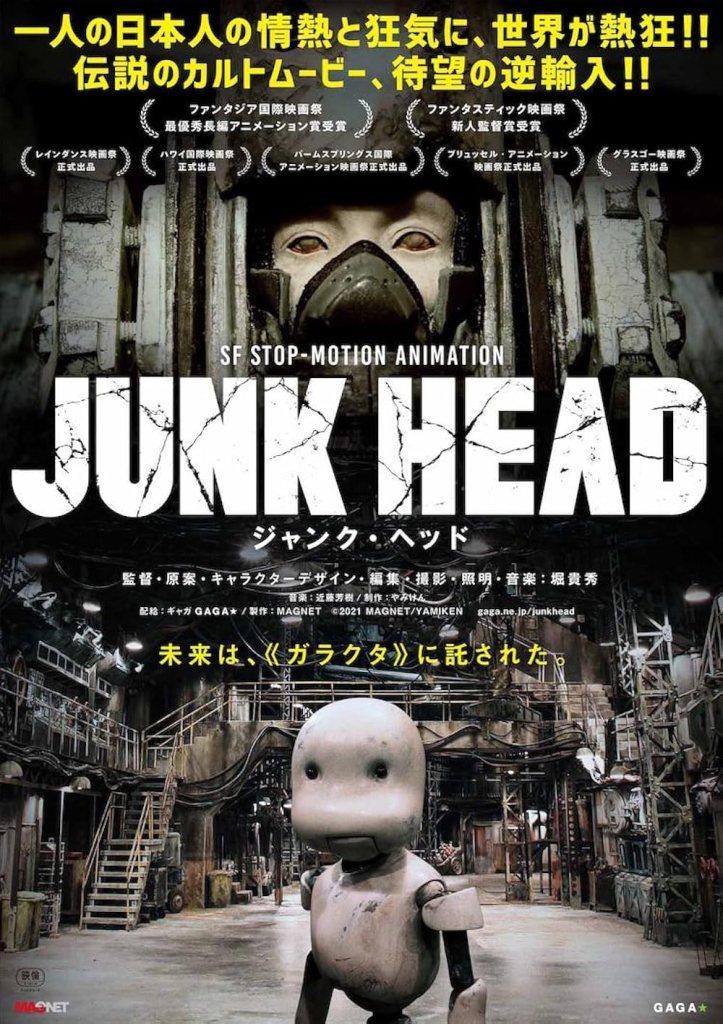
It must’ve been two or three years ago when I first heard about Takahide Tori’s Junk Head [Janku Heddo]. I didn’t need more than a single screenshot to know this was a film that was going to be right up my ally. Several years and countless geo-locked film festivals later, I was finally able to watch it. Junk Head is one of those rare films that actually managed to surpass my initial expectations, Tori’s passion project is an absolute wet dream for fans of stop-motion and sci-fi, with gleaming bonus appeal for those who have an appetite for the weird and creative.
To brand this film a passion project is in fact a gross understatement. Takahide Tori is an interior decorator by profession, who started this project in 2009 without any of the formal training needed to tackle a project like this. What’s more is that he started this journey all on his own. It took him about 4 years and an endless amount of YouTube tutorials to create a 30-minute short. After garnering the vocal support of some big industry names (Guillermo del Toro being one of them), additional funding and a little outside help pushed him to make a 115-minute version, which was later trimmed down to the 101-minute cut that is currently making the rounds.
Reviewers have cited many influences when writing about Junk Head, the most prominent (and interesting) one for me is Tsutomu Nihei’s Blame (coincidentally Nihei is an architect turned mangaka). But where Nihei’s first masterpiece is all about rising through a superstructure, Junk Head’s hero is descending into an underground one. And sure enough, the creature design borrows happily from H.R. Giger, Tsukamoto’s cyberpunk roots peek around every corner and names like Lynch or Cronenberg make for sane analogies, but when all is said and done, there’s nothing really quite like Junk Head out there.
The plot is set in a distant future. Mankind has lost its ability to procreate, a human-created species has revolted and developed a separate society underground. When a virus wreaks havoc on the surface, an expedition is launched to study how this newly developed species procreate, in an ultimate but somewhat desperate attempt to save humankind. The human delegate immediately finds himself in a pickle and as he travels deeper and deeper underground, his chances to complete his mission diminish with every step taken. Instead, his journey becomes an ultimate struggle for survival.
It’s difficult to overstate the visual grandeur present in Junk Head. Looking at the lushly decorated, detailed and expansive sets, Hori surely benefitted from his experience as an interior decorator, but even then it’s hard to believe what he accomplished here. The camera work is insane, the art design superb, the stop-motion animation on point. It’s crazy to think most of it was done by a single guy, but even without taking that into account Junk Head still looks mighty impressive. Not counting some CG work that was added at a later stage, this is true craftsmanship from start to finish. The style is extremely coherent though, which is great if you love this kind of gritty and ugly bleakness, those hoping for a more colorful and jolly universe better stay clear.
Though Hori’s visual accomplishments may be the obvious standout, it’s worth noting that he also took almost all the sound work upon himself. From the actual score, to the sound effects and character dubs (which aren’t in a decipherable language, but do feature distinct voices), it’s all done by Hori himself. And while this may have been out of necessity, the quality of his work is once again exemplary. The electronic score is very fitting, adding oodles of atmosphere, the voice acting is fun and distinctive and the sound effects are spot on. Together with the visuals it creates a tight and immersive experience, the kind you can only get when an entire team is entirely in sync, or when one guy does everything by himself.
Junk Head is an expansive sci-fi adventure, where the audience is forced to discover a strange and alien underground world together with the main character. Hori does take a little time to explain the broader lore of this universe, but doesn’t get into too much detail. It keeps his world wrapped in a veil of mystery, which probably won’t be to everybody’s liking. Personally, I welcome the mystery and adventure, following the events as they are experienced by the main character. Those who need more grounded explanations for what they see on screen may feel a bit disoriented at times.
As for any additional themes, the broader story offers some food for thought if needed. The premise isn’t all that original though, with humanity’s usual flaws sending us to the brink of extinction, having to resort to desperate measures to find a way out of the mess we created for ourselves. I’m not even certain whether Hori takes any of this too seriously, it could just as well be a convenient excuse for the gritty and uninhabitable world he wanted to depict, but at least it’s there for those who care about such things. The fact that there’s not really a clear-cut ending or an easy way out of this mess certainly helps too.
Every fan of Japanese cyberpunk will tell you not nearly enough films are being produced in this niche. That alone makes Junk Head a notable film. The (admittedly slim) bright side of this is that filmmakers who do try their hand at it are usually very spirited and driven to do the genre justice. With Junk Head, Hori delivers a sprawling sci-fi adventure, meticulously styled, set in a dark and perilous universe that harbors neat surprises around every corner. It’s a living testament that one person can still deliver a professional film, even if it costs him 7 years of his life. An absolute must-see this one, make sure you catch it if the opportunity arises.
It’s hard, after sitting through the sunshined-draped “The Beach Bum,” not to wonder that something substantial and substantially life-altering has happened to writer-director Harmony Korine in the seven years since his dark escapist drama “Spring Breakers.”
While that movie was an exercise in causticity and bringing to life some strange, morbid fantasy involving bikini-clad Disney products trading in their Mickey Mouse ears for Uzis, “The Beach Bum” – here referring to a blissful, good vibes-distributing Matthew McConaughey who has never Matthew McConaughey’d harder – uses that same degree of impulsivity as a force for inebriated l-i-v-i-n livin’. The movie is equally about abiding by one’s own rules and flourishing by our self-made excuses for success, but “Spring Breakers’s” coldness made sure that success came at the expense of ostensible innocence. In “Beach Bum,” it comes by way of a colorful drink in a cocktail glass garnished with a mini umbrella.
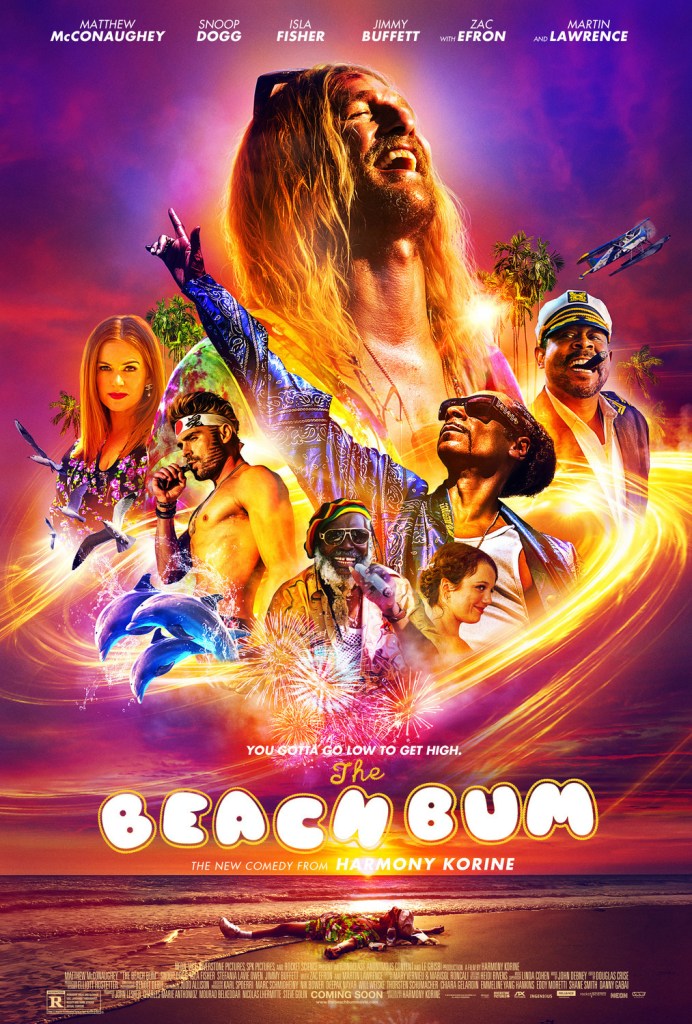
Korine once again shows he’s a sucker for spontaneity – both on the parts of himself as filmmakers and his characters – to a near-surreal degree. In telling the story of McConaughey’s coastal hillbilly author Moon Dog (a name as conspicuous as it is appropriate) drinking, smoking or typewriting the days away, he stitches a hypnotic yarn that is more a collection of experiences than a traditional movie, and perhaps one that doesn’t have anything to teach or tell so much as suggest.
Moon Dog is seemingly living on the lowest rung of society’s ladder, but over “Beach Bum’s” 90ish minutes, the creeping feeling may rear its head that his ceaselessly-smiling attitude towards everything that comes his way is something to be envious of. While we continue searching for some grand truth to life, Moon Dog has found it, and he’s drinking it through a martini glass. Think Jack Sparrow with margaritas replacing the rum, escapades much lower in stakes and an androgynous sense of fashion. He’s a gloriously cheery character in a gloriously cheery comedy, one that wishes goodwill through storms of marijuana smoke even as it gently pushes us off a pier. It doesn’t run off after doing so; it rumbles in good-natured laughter as if to say, “It looks like you were getting hot and could use a dip.”
Hell, maybe what Korine did since “Spring Breakers” to access a much more optimistic view of life was don the blunt for himself. Moon Dog is cut from the same cloth as James Franco’s violence-prone, chickie-hunting Alien, but the former feels like he slept next to a shrine made to Jimmy Buffer, the latter to Scarface. Moon Dog is the yin go Alien’s yang; a cosmic contradiction with two halves that live life two seconds at a time.
Moon Dog’s world reflects his good-times-should-be-had-by-all template to life, even if his circumstances don’t. He may be content passing the days away slumped over in a rowboat miles away from shore, but he’s got responsibilities too, as well as a reputation that he curates about as carefully as a chainsaw to a tree. He has a past as a renowned author of poetry, you see, but you wouldn’t mistake his vernacular for someone who comparably looks like he takes a bath every one in a while; it’s as profanely low-bar as he is, and it’s also struck an unexpected chord in Korine’s strangely unwieldy world. The more “The Beach Bum” breezes along, the more we see those who inhabit it are more in lockstep with Moon Dog’s sensibilities than we might expect.
That penchant for the outrageous is evident in the people Moon Dog associates himself with, from his stunning wife (a just-as-here-for-the-good-vibes-and-good-times Isla Fisher) to others who range from associates to drinking buddies to part-time employers. Embodying them is an illustrious supporting cast that looks like they’re having the time of their lives: Jonah Hill, Snoop Dogg, Martin Lawrence, even Zac Efron are here to facilitate Moon Dog’s life choices, and to take part in the belligerence.
Where “The Beach Bum” moves beyond us simply watching disciples of easy living endlessly getting high, getting drunk and getting into ill-advised situations is in Korine’s challenging us to question whether it’s right to label those choices as questionable. Or whether we even have the right. The sense of ambition that drives Moon Dog and Co. is emphatically one of a much different caliber than probably any of us can relate to (perhaps south Floridians can tell me otherwise), but does mean we can criticize it?
Unlike “Spring Breakers,” Korine does good work in ensuring that question remains one of deliberation instead of emphatically and blatantly answering it for us by film’s end, although “The Beach Bum” does provide a visual coda much more explicit than most of what has come before. It’s both jarring and also as appropriate as ending as you could expect for Moon Dog, one not out of place with everything we’ve witnessed prior.
If you’re not interested in such thematic minutiae, “The Beach Bum” is still a source for plenty of laughs, improv seemingly as much a tool for its characters as self-deprecation. It doesn’t outstay its welcome and never particularly lingers, moving from hilarious anecdote to hilarious (and sometimes gruesome) anecdote with a trance-life geniality, like bar-hopping with a bucket hat-wearing old-timer recounting stories of past adventures that just keep getting more and more incredulous, either as a result of alcohol intake or creative liberty on the storyteller’s part.
Who’s to say what Moon Dog – the haggard man’s Hemingway who carries around his typewriter in a pillowsack while searching strangers’ coolers for Pabst – would refer to it as, but from our perspective, spontaneity is a founding father of his world. It’s almost a superpower, actually, his capacity to instinctively accomplish something on his own terms, which sometimes means avoiding it at all costs, eventually morphing from habit to uncannily consistent skill. Moon Dog seems to never know where he’ll be five minutes from any given minute—and it might just be his best-kept secret.
“The Beach Bum” is essentially a Korine-led seminar on blissful existentialism. The filmmaker isn’t giving the middle finger to the establishment so much as he is nodding to those for whom practicing stringency means trapping yourself in an uncomfortably rigid life of routines dictated by everyone else but you. That is to say, it’s best to avoid practicing it all costs.
The movie and its characters and their self-created, self-governing laws pursue buoyancy. And “The Beach Bum” is groggily, profanely, deliriously buoyant in that pursuit.
“” is rated R for pervasive drug and alcohol use, language throughout, nudity and some strong sexual content
Starring: Matthew McConaughey, Snoop Dogg, Isla Fisher, Stefania LaVie Owen

 After the Crash