Saturday Matinee: Fantastic Planet

Surrealism and political critique in the animated medium: Fantastic Planet (1973)

By Dan Stalcup

Source: The Goods Firm Reviews

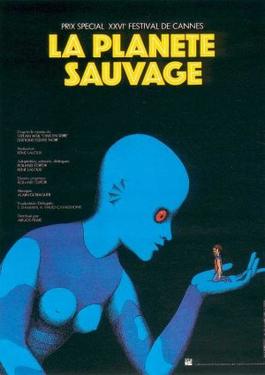
Coming from the “Panic Movement” surrealist art collective is one of the most bizarre animated films of all time: Fantastic Planet, a French-Czech production by director/co-writer René Laloux and co-writer/production designer Roland Topor.

With its title, Fantastic Planet sounds like it should be a cheesy sci-fi flick, and in some ways, it is. (The French title, La Planète sauvage, is much more pleasing.) But this is something much more insular and experimental than most genre films of the era. Thanks to its distinctive pencil-sketched, cutout animation technique (also seen in Monty Python interludes), the film has the look of a history or biology book come to life. The grotesqueries depicted have a diagrammatic, almost clinical look to them, making every alien and bit of worldbuilding feel all the more strange.

Fantastic Planet chronicles a far future when humans have been transplanted to the distant planet Ygam by giant blue aliens with red bug eyes called Draags (or, in some translations, Traags). There, humans serve the role of something resembling a rodent or small dog: occasionally domesticated by Draags, occasionally living in wild colonies as feral creatures. The humans on Ygam are called “Oms” by the Draags. They’re mostly viewed as harmless by the aliens, but often casually exploited and exterminated when convenient.

The story follows Terr, an orphaned human/Om, who is adopted by a Draag, but escapes before organizing an resistance to the giant aliens. Terr’s life has a vaguely mythological arc to it, further enhancing the sense the we’re witnessing some passed-down story. The entire telling is detached and emotionless — when Terr’s mother or compatriots die, there is no mourning or reaction, just a progression to the next item of the story. It’s disquieting.

What really makes Fantastic Planet so bizarre and unforgettable is the depiction of the alien life and planet: flora and fauna that look like something out of a fever dream or acid trip. The ground shifts into squirming intestines; a hookah bar causes the inhabitants to meld into a blur; twirling headless statues perform a mating ritual. It’s baroque and occasionally whimsical; half Dr. Seuss, half Salvador Dali.

Despite the strangeness of the imagery, the film avoids slipping into an all-out dissociated psychedelic trip thanks to its linear and straightforward narrative. This, paradoxically, makes everything feel even more alien: The story takes logical, coherent leaps, but the images and details within are so nonchalantly unearthly. It’s a dizzying juxtaposition.

The story is clearly allegorical: Animal rights is an obvious interpretation given the way that humans are chattelized. It’s not hard to squint and see anti-racism or anti-imperialism in its parable, either — any scenario where the majority or oppressors are negligent, systemic participators rather than active aggressors would fit.

There’s also a lot of coming of age imagery in the film, blown out into absurdism. The semi-comprehending way the humans perceive the Draag world is not too detached from the way kids see the adult world: full of obtuse rituals and norms. Plenty of the designs are charged with phallic and sexual imagery (not to mention casual nudity), but it’s secondary to the overall sweep of the visual invention of the film.

In the half century since its release, Fantastic Planet has become a cult legend, even inducted into the Criterion Collection — one of only a few animated films with the honor. According to Letterboxd, it’s among the most popular films of 1973. I can’t say I blame cinephiles out there. Even at 72 minutes, Fantastic Planet is a bit exhausting, but it’s such a unique and evocative experience that it is essential viewing. At least for weirdos like me.

The First Day Continued

When Danielle and Florence first visited me in the Neuro ICU, it felt like the first time I saw them since before the crash. On further reflection I recalled the hazy dream-like hospital room that was actually the Trauma ICU. My memories of it even at that time seemed faded and fragmented whether because of the heavy medication or a side-effect of physical and/or mental trauma.

Regardless, how could I not realize I was quadriplegic through that period which was at least a week? I tried hard to recall what people actually said to me but could only remember portions of my mother explaining how my family scrambled to get to Seattle and my brother Daryl explaining something about a computer.

Part of the missing information could be attributed to impaired hearing, since I noticed sounds coming through my left ear had a slightly distant or muffled quality. But I think the main factor was my fragile mental state compounded by heavy medication causing faulty memory. It could also be that “selective forgetting” was a way to protect myself from uncomfortable information my mind was incapable of accepting.

One example was at some point that day I felt the urge to urinate and thought I’d need to call the nurse for a bedpan. This alarmed my visitors because they witnessed the same scenario at the trauma ICU not long before. They explained for a second time that I had been catheterized shortly after being admitted to Harborview.

Perhaps suspecting there’s other important details I hadn’t retained, Danielle provided a detailed description of my injury. Though I had deduced what what was going on with my body, it didn’t hit home until she described it as the same injury suffered by Christopher Reeve. She then asked if I knew how I was injured and after I gestured “no” she recounted what she knew about the crash from police and first responder reports. Even though I had no prior memory of such details, it didn’t come as a complete surprise since a bike crash was always the most likely explanation. She described surgery scars along my neck and spine that resembled tattoos and puncture wounds on my head from having it bolted down to keep it from moving. I couldn’t feel them at the time but did later on.

Also new to me (though likely recounted before) was the timeline of my stay at Harborview. To me it felt like it could have been anywhere between a few days and a month. In actuality it had been about two weeks. Even more surprising was learning I had flatlined for a few seconds on at least two occasions. Danielle became teary-eyed as if reliving those moments and seemed almost as re-traumatized recounting repeated unsuccessful attempts to get information from my employer’s impenetrable HR department.

Although I retained a partial memory of it, my mother described how she, my father and older brother arrived at the hospital just two days after my crash. My dad and brother had to go back home after about a week but my mom planned to stay for three months. I was appreciative for their visit because my parents had been reluctant to travel by plane since the start of Covid in 2020.

Throughout the day we were frequently interrupted by nurses taking vitals and refilling the IV with saline, liquid food and medications, staff members changing my bed position and cleaning the room, and phlebotomists drawing blood samples. An odd side-effect of my lowered metabolism (or slowed-down state of mind) was that everyone’s movements seemed “sped-up”. The entire day seemed to go by rapidly as well and before long it was evening.

Saturday Matinee: The History of the World Backwards

Source: Wikipedia

The History of the World Backwards is a comedy sketch show written and starring Rob Newman. It is a mock history programme set in an alternative world where time flows forwards whilst history told backwards. In other words, if you were born in 2007, you would be 60 years old in 1947. All the major historical events happen backwards, so for example, Nelson Mandela enters jail a Spice Girls fan, and comes out as a terrorist intent in overthrowing the state. There are several recurring themes, such as the “Technology collapse”, where scientific discoveries are lost, forgotten or made unworkable.

It was shown on BBC Four, starting on 30 October 2007, and later shown on BBC Two. It was Newman’s first television project in 14 years.