
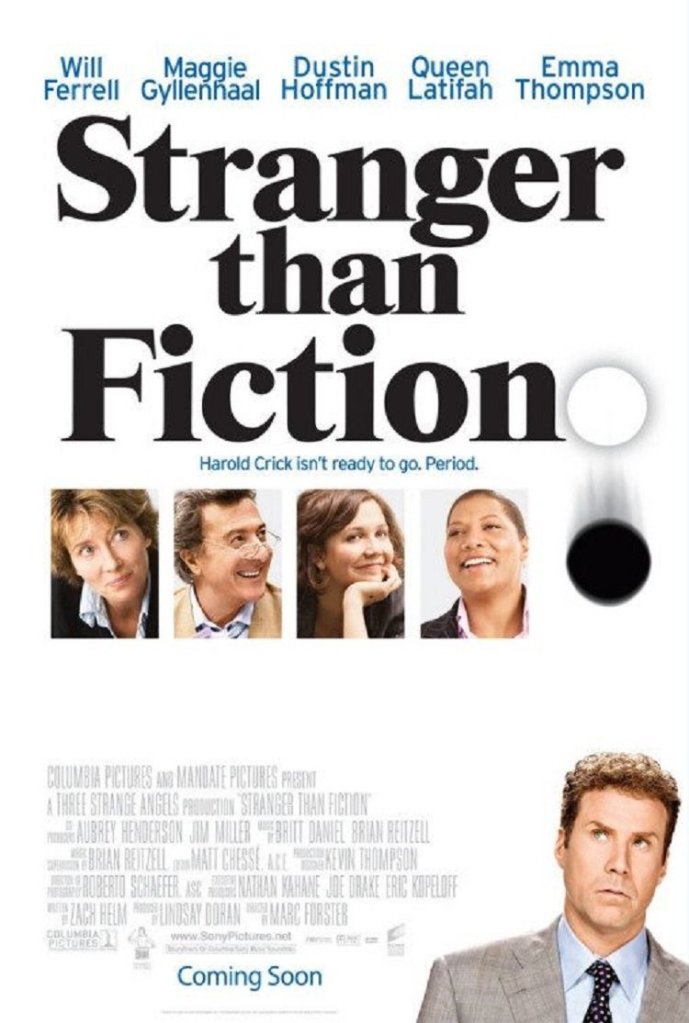
Saturday Matinee: Stranger Than Fiction

Who’s telling your life story?

By Roger Ebert

Source: RogerEbert.com

What a thoughtful film this is, and how thought-stirring. Marc Forster‘s “Stranger Than Fiction” comes advertised as a romance, a comedy, a fantasy, and it is a little of all three, but it’s really a fable, a “moral tale” like Eric Rohmer tells.

Will Ferrell stars, in another role showing that like Steve Martin and Robin Williams he has dramatic gifts to equal his comedic talent. He plays IRS agent Harold Crick, who for years has led a sedate and ordered life. He lives in an apartment that looks like it was furnished on a 15-minute visit to Crate and Barrel. His wristwatch eventually tires of this existence and mystically decides to shake things up.

Harold begins to hear a voice in his head, one that is describing his own life — not in advance, but as a narrative that has just happened. He seeks counsel from a shrink (Linda Hunt) and convinced he is hearing his own life narrative, seeks counsel from Jules Hilbert, a literature professor (Dustin Hoffman). Hilbert methodically checks off genres and archetypes and comes up with a list of living authors who could plausibly be writing the “narration.” He misses, however, Kay Eiffel (Emma Thompson), because he decides Harold’s story is a comedy, and all of her novels end in death. However, Eiffel is indeed writing the story of Harold’s life. What Hilbert failed to foresee is that it ends in Harold’s death. And that is the engine for the moral tale.

Meanwhile, an astonishing thing happens. Harold goes to audit the tax return of Ana Pascal, a sprightly, tattooed bakery shop owner (Maggie Gyllenhaal) and begins to think about her. Can’t stop thinking. Love has never earlier played a role in his life. Nor does she much approve of IRS accountants. How rare, to find a pensive film about the responsibilities we have to art. If Kay Eiffel’s novel would be a masterpiece with Harold’s death, does he have a right to live? On the other hand, does she have the right to kill him for her work? “You have to die. It’s a masterpiece.” But life was just getting interesting for Harold. The shy, tentative way his relationship with Ana develops is quirky and sideways and well-suited to Gyllenhaal’s delicate way of kidding a role. He doesn’t want to die. On the other hand, after years of dutifully following authority, he is uncertain of his duty — and he is so meekly nice, he hates to disappoint Eíffel. Harold himself has never done anything so grand as write a masterpiece. Although the obvious cross-reference here is a self-referential Charlie Kaufman screenplay like “Adaptation,” I was reminded of another possible parallel, Melville’s famous short story “Bartleby the Scrivener,” made into the 2001 movie with Crispin Glover and David Paymer. Bartleby is an office drudge who one day simply turns down a request from his boss, saying, “I would prefer not to.” Harold Crick, like Bartleby, labors in a vast office shuffling papers that mean nothing to him, and one day he begins a series of gentle but implacable decisions. Harold would prefer not to audit any more tax returns. And he would prefer not to die. But he is such a gentle and good soul that this second decision requires a lot of soul-searching, and it’s fascinating to watch how Hilbert and Ana participate indirectly in it, not least through some very good cookies. And what is Eiffel’s preference when she finds what power she has? Her publisher has assigned her an “assistant” (Queen Latifah) to force her through her writer’s block, so there is pressure there, too. She chain-smokes and considers suicide.

The director, Marc Forster, whose work includes the somber (“Monster’s Ball“) and the fantastical (“Finding Neverland“), here splits the difference. He shoots in a never-identified Chicago, often choosing spare and cold Mies van der Rohe buildings, and he adds quirky little graphics that show how Harold compulsively counts and sees spatial relationships. His work with the actors seeks a low-key earnestness, and Ferrell becomes a puzzled but hopeful seeker after the right thing. Gyllenhaal and Hoffman never push him too hard. And I like the dry detachment with which both Hoffman and Thompson consider literature, which is conceived in such passion and received with such academic reserve. Alas, Forster never finds the right note for Latifah’s character, who may not be necessary.

“Stranger Than Fiction” is a meditation on life, art and romance, and on the kinds of responsibility we have. Such an uncommonly intelligent film does not often get made. It could have pumped up its emotion to blockbuster level, but that would be false to the premise, which requires us to enter the lives of these specific quiet, sweet, worthy people. The ending is a compromise — but it isn’t the movie’s compromise, it belongs entirely to the characters and is their decision. And that made me smile.


Watch Stranger Than Fiction on Hoopla here: https://www.hoopladigital.com/movie/stranger-than-fiction-will-ferrell/18085460

Saturday Matinee: Tim & Eric’s Billion Dollar Movie

Review by Jim Tudor

Source: Screen Anarchy

Having never seen the comedic TV work of Tim Heidecker and Eric Wareheim (“Tim & Eric Awesome Show, Great Job!”), I went into their feature-length variation, “Tim and Eric’s Billion Dollar Movie”, braced for a merciless expansion of inside jokes that I would be terminally outside of. Mercifully, I was able to navigate these strange waters successfully enough to understand and even enjoy the film, even as it came apart in places.

Aesthetically speaking, it’s got about as much going for it as an early Kevin Smith film. Comically speaking, it’s a downhill ride that starts out promising but then fizzles out.
Heidecker and Wareheim play fictionalized versions of themselves, occasionally wandering beyond the forth wall to further muddy the meta-waters. The laughs are the most solid in terms of the plot itself. When “Tim & Eric’s Billion Dollar Movie” opens, we come to learn that that’s exactly what Tim & Eric have made – a movie, with a billion dollar budget. And it sucks in every possible way. Because they are morons, in every possible way. And the Hollywood execs who green lit their billion-dollar movie are bigger morons for letting it happen. They want their billion dollars back, but having pissed it all away on flamboyant houses, clothing, and a guru/mooch played by Zach Galifianakis, they have no choice but to take a job reviving the world’s deadest shopping mall, owned by a tyrannically delusional Will Ferrell. (And I do mean dead – the place looks like George Romero just got done shooting “Dawn of the Dead” in there four times over. It’s wolf-plagued and everything!) Huh? Don’t worry, it all actually makes an absurd bit of sense, and legitimate satire abounds… for a while. It’s semi-intelligent fun, until Tim & Eric as actual filmmakers (as opposed to the meta ones they are portraying on screen) (which makes this whole thing ultra-confusing to write about; great job on that, Tim & Eric) lose control of the whole operation, and simply opt to let it careen, because hey, who doesn’t love a wreck?

That said, there was a lot I didn’t get, and I’m not talking about the graphic shrim crapping sequence or appearances by “Awesome Show, Great Job!” stock actors that brought instant chuckles to the initiated viewers. What I didn’t get is why a promising comedy would willingly and irrevocably veer into the realm of the pseudo-sadistic, beyond the confines of dark humor. By taking full advantage of the freedoms of their R rating, Tim & Eric end up attempting to mine laughs by wallowing and attacking rather than through the time-tested methods of careful craft and construction. Maybe I sound like an old school curmudgeon when I say that they’re taking the easy way out, as they increasingly abandon what makes their film clever as the running time wears on. I get that Tim and Eric are absurdist comedians who’ve made their mark by seizing upon and distorting the familiar TV tropes we take for granted. But in this movie, what begins as a sly riff on consumption, advertising, and self-obsession becomes a manufactured midnight movie; a subpar comedic Jodorowsky film (of all things).

As would-be auteurs and stars of their own big-screen ego-trip, Heidecker and Wareheim make every attempt to turn their filmmaking shortcomings (budgetary, experience, etc.) to their advantage. (It’s clearly not really a billion dollar movie. Maybe not even a million.) 1980s corporate video aesthetic is embraced, and that much works. There are moments when it even looks and sounds like synth-fueled Video Toaster-generated cheese. Jeff Goldblum, Michael Gross, Robert Loggia, William Atherton, Will Forte, and Erica Durance, among others, all turn up in amusing roles. John C. Reilly indulges his shameless comedic side with a larger role as yet another moron, although he manages to steal every scene he’s in. So there are redeeming qualities. But Tim & Eric’s unwavering on-screen attempts to be as unlikable, despicable and morally bankrupt as the bloodthirsty Hollywood moguls they screwed over drowns everything by the end. Tim & Eric become the failed, new Butch & Sundance in a hail of ridiculous grindhouse-level violence for it’s own sake and it’s own sake only. This sort of thing could’ve been very smart and memorable, but in light of the utter lack of comedic build permeating this movie, it’s just whack-a-mole sound and fury, signifying only other signifiers.

Whether this obvious attempt to forge a deliberate cult classic out of their TV program will work or not, time will tell. Hailing from Will Ferrell’s Funny Or Die comedy farm, “Tim & Eric’s Billion Dollar Movie” manages to both be funny and die. It’s the dying that’s easy, which this film proves. Even if it is funny for a while.


Watch the film on Kanopy here: https://www.kanopy.com/product/tim-erics-billion-dollar-movie

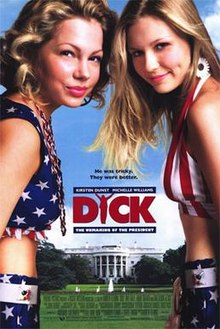
Saturday Matinee: Dick

“Dick” (1999) is a cult comedy co-written (with Sheryl Longin) and directed by Andrew Fleming. It’s an absurdist retelling of the events surrounding the Watergate scandal which led to the resignation of Richard “Tricky Dick” Nixon (played in the film by Dan Hedaya). Kirsten Dunst and Michelle Williams star as Betsy and Arlene, two fun-loving and ditzy best friends, who, through a random chain of events, become the legendary “Deep Throat” figure ultimately responsible for bringing down the Nixon presidency. Will Ferrell and Bruce McCulloch star as this film’s version of Woodward and Bernstein. A roster of comedic actors including Teri Garr, Dave Foley, Harry Shearer, Jim Breuer and Ryan Reynolds also make appearances.

Watch the full film here.