House Passes $886 Billion National Defense Authorization Act

The bill narrowly passed in a vote of 219-210 due to a partisan divide over amendments included by Republicans

By Dave DeCamp

Source: AntiWar.com

The House on Friday passed its version 2024 National Defense Authorization Act in a vote of 219-210, which largely fell along partisan lines due to amendments added by Republicans relating to social policies in the military.

The Republican amendments covered abortion, transgender surgery, and diversity initiatives. Only four Democrats voted in favor of the bill, and four Republicans voted against it. The four Republicans who opposed the NDAA are Reps. Thomas Massie (KY), Eli Crane (AZ), Andy Biggs (AZ), and Ken Buck (CO).

The Senate still needs to pass its version of the NDAA, then the two chambers will negotiate the final version that will go to President Biden’s desk. The Republican amendments packed into the House version will set up a fight between the two chambers as Senate Majority Leader Chuck Schumer (D-NY) and other Democrats will reject them.

The 2024 NDAA is for a record $886 billion, the same amount President Biden requested. The debt ceiling deal reached between House Republicans in the White House did not limit military spending and put no caps on emergency supplemental funds, which is how the US has been spending on the war in Ukraine.

As the House was debating the NDAA, several amendments introduced by Republicans looking to rein in US support for Ukraine were voted down. One amendment sponsored by Rep. Warren Davidson (R-OH) would have required the Biden administration to develop a strategy for the war in Ukraine. It was rejected in a vote of 129-301, with only Republicans supporting it.

One amendment introduced by Rep. Marjorie Taylor Greene would have cut $300 million in military aid for Ukraine that’s packed into the NDAA, but it failed in a vote of 89-341. Rep. Matt Gaetz (R-FL) put forward an amendment to cut off all military assistance for Ukraine, which failed in a vote of 70-358. Only Republicans supported the two amendments.

Greene sponsored another amendment that would have prohibited the transfer of cluster munitions to Ukraine, although US cluster bombs have already arrived in the country. The effort failed in a vote of 147-276. It received support from 98 Republicans and 49 Democrats.

The Ultimate All-American Slush Fund

How A New Budget Loophole Could Send Pentagon Spending Soaring Even Higher

By Julia Gledhill and William D. Hartung

Source: TomDispatch

On June 3rd, President Joe Biden signed a bill into law that lifted the government’s debt ceiling and capped some categories of government spending. The big winner was — surprise, surprise! — the Pentagon.

Congress spared military-related programs any cuts while freezing all other categories of discretionary spending at the fiscal year 2023 level (except support for veterans). Indeed, lawmakers set the budget for the Pentagon and for other national security programs like nuclear-related work developing nuclear warheads at the Department of Energy at the level requested in the administration’s Fiscal Year 2024 budget proposal — a 3.3% increase in military spending to a whopping total of $886 billion. Consider that preferential treatment of the first order and, mind you, for the only government agency that’s failed to pass a single financial audit! 

Even so, that $886 billion hike in Pentagon and related spending is likely to prove just a floor, not a ceiling, on what will be allocated for “national defense” next year. An analysis of the deal by the Wall Street Journal found that spending on the Pentagon and veterans’ care — neither of which is frozen in the agreement — is likely to pass $1 trillion next year.

Compare that to the $637 billion left for the rest of the government’s discretionary budget. In other words, public health, environmental protection, housing, transportation, and almost everything else the government undertakes will have to make do with not even 45% of the federal government’s discretionary budget, less than what would be needed to keep up with inflation. (Forget addressing unmet needs in this country.)

And count on one thing: national security spending is likely to increase even more, thanks to a huge (if little-noticed) loophole in that budget deal, one that hawks in Congress are already salivating over how best to exploit. Yes, that loophole is easy to miss, given the bureaucratese used to explain it, but its potential impact on soaring military budgets couldn’t be clearer. In its analysis of the budget deal, the Congressional Budget Office noted that “funding designated as an emergency requirement or for overseas contingency operations would not be constrained” by anything the senators and House congressional representatives had agreed to.

As we should have learned from the 20 years of all-American wars in Afghanistan and Iraq, the term “overseas contingency” can be stretched to cover almost anything the Pentagon wants to spend your tax dollars on. In fact, there was even an “Overseas Contingency Operations” (OCO) account supposedly reserved for funding this country’s seemingly never-ending post-9/11 wars. And it certainly was used to fund them, but hundreds of billions of dollars of Pentagon projects that had nothing to do with the conflicts in Iraq or Afghanistan were funded that way as well. The critics of Pentagon overspending quickly dubbed it that department’s “slush fund.”

So, prepare yourself for “Slush Fund II” (coming soon to a theater near you). This time the vehicle for padding the Pentagon budget is likely to be the next military aid package for Ukraine, which will likely be put forward as an emergency bill later this year.  Expect that package to include not only aid to help Ukraine fend off Russia’s ongoing brutal invasion but tens of billions of dollars more to — yes, of course! — pump up the Pentagon’s already bloated budget.

Senator Lindsey Graham (R-SC) made just such a point in talking with reporters shortly after the debt-ceiling deal was passed by Congress. “There will be a day before too long,” he told them, “where we’ll have to deal with the Ukrainian situation. And that will create an opportunity for me and others to fill in the deficiencies that exist from this budget deal.”

Senate Majority Leader Chuck Schumer (D-NY) made a similar point in a statement on the Senate floor during the debate over that deal. “The debt ceiling deal,” he said, “does nothing to limit the Senate’s ability to appropriate emergency/supplemental funds to ensure our military capabilities are sufficient to deter China, Russia, and our other adversaries and respond to ongoing and growing national security threats.”

One potential (and surprising) snag in the future plans of those Pentagon budget boosters in both parties may be the position of House Speaker Kevin McCarthy (R-CA). He has, in fact, described efforts to increase Pentagon spending beyond the level set in the recent budget deal as “part of the problem.” For the moment at least, he openly opposes producing an emergency package to increase the Pentagon budget, saying:

“The last five audits the Department of Defense [have] failed. So there’s a lot of places for reform [where] we can have a lot of savings. We’ve plussed it up. This is the most money we’ve ever spent on defense — this is the most money anyone in the world has ever spent on defense. So I don’t think the first answer is to do a supplemental.”

The Massive Overfunding of the Pentagon

The Department of Defense is, of course, already massively overfunded. That $886 billion figure is among the highest ever — hundreds of billions of dollars more than at the peak of the Korean or Vietnam wars or during the most intensely combative years of the Cold War. It’s higher than the combined military budgets of the next 10 countries combined, most of whom are, in any case, U.S. allies. And it’s estimated to be three times what the Chinese military, the Pentagon’s “pacing threat,” receives annually. Consider it an irony that actually “keeping pace” with China would involve a massive cut in military spending, not an increase in the Pentagon’s bloated budget.

It also should go without saying that preparations to effectively defend the United States and its allies could be achieved for so much less than is currently lavished on the Pentagon.  A new approach could easily save significantly more than $100 billion in fiscal year 2024as proposed by Representatives Barbara Lee (D-CA) and Mark Pocan (D-WI) in the People Over Pentagon Act, the preeminent budget-cut proposal in Congress. An illustrative report released by the Congressional Budget Office (CBO) in late 2021 sketched out three scenarios, all involving a less interventionist, more restrained approach to defense that would include greater reliance on allies. Each option would reduce America’s 1.3-million-strong active military force (by up to one-fifth in one scenario). Total savings from the CBO’s proposed changes would, over a decade, be $1 trillion.

And a more comprehensive approach that shifted away from the current “cover the globe” strategy of being able to fight (though, as the history of this century shows, not always win) wars virtually anywhere on Earth on short notice — without allies, if necessary — could save hundreds of billions more over the next decade. Cutting bureaucracy and making other changes in defense policy could also yield yet more savings. To cite just two examples, reducing the Pentagon’s cohort of more than half-a-million private contract employees and scaling back its nuclear weapons “modernization” program would save significantly more than $300 billion extra over a decade.

But none of this is even remotely likely without concerted public pressure to, as a start, keep members of Congress from adding tens of billions of dollars in spending on parochial military projects that channel funding into their states or districts. And it would also mean pushing back against the propaganda of Pentagon contractors who claim they need ever more money to provide adequate tools to defend the country.

Contractors Crying Wolf

While demanding ever more of our tax dollars, the giant military-industrial corporations are spending all too much of their time simply stuffing the pockets of their shareholders rather than investing in the tools needed to actually defend this country. A recent Department of Defense report found that, from 2010-2019, such companies increased by 73% over the previous decade what they paid their shareholders. Meanwhile, their investment in research, development, and capital assets declined significantly. Still, such corporations claim that, without further Pentagon funding, they can’t afford to invest enough in their businesses to meet future national security challenges, which include ramping up weapons production to provide arms for Ukraine.

In reality, however, the financial data suggests that they simply chose to reward their shareholders over everything and everyone else, even as they experienced steadily improving profit margins and cash generation. In fact, the report pointed out that those companies “generate substantial amounts of cash beyond their needs for operations or capital investment.” So instead of investing further in their businesses, they choose to eat their “seed corn” by prioritizing short-term gains over long-term investments and by “investing” additional profits in their shareholders. And when you eat your seed corn, you have nothing left to plant next year.

Never fear, though, since Congress seems eternally prepared to bail them out. Their businesses, in fact, continue to thrive because Congress authorizes funding for the Pentagon to repeatedly grant them massive contracts, no matter their performance or lack of internal investment. No other industry could get away with such maximalist thinking.

Military contractors outperform similarly sized companies in non-defense industries in eight out of nine key financial metrics — including higher total returns to shareholders (a category where they leave much of the rest of the S&P 500 in the dust). They financially outshine their commercial counterparts for two obvious reasons: first, the government subsidizes so many of their costs; second, the weapons industry is so concentrated that its major firms have little or no competition.

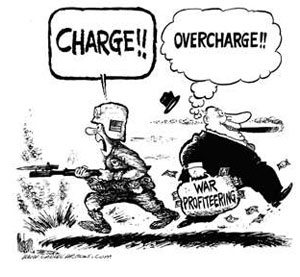
Adding insult to injury, contractors are overcharging the government for the basic weaponry they produce while they rake in cash to enrich their shareholders. In the past 15 years, the Pentagon’s internal watchdog has exposed price gouging by contractors ranging from Boeing and Lockheed Martin to lesser-known companies like TransDigm Group. In 2011, Boeing made about $13 million in excess profits by overcharging the Army for 18 spare parts used in Apache and Chinook helicopters. To put that in perspective, the Army paid $1,678.61 each for a tiny helicopter part that the Pentagon already had in stock at its own warehouse for only $7.71.

The Pentagon found Lockheed Martin and Boeing price gouging together in 2015. They overcharged the military by “hundreds of millions of dollars” for missiles. TransDigm similarly made $16 million by overcharging for spare parts between 2015 and 2017 and even more in the following two years, generating nearly $21 million in excess profits. If you can believe it, there is no legal requirement for such companies to refund the government if they’re exposed for price gouging.

Of course, there’s nothing new about such corporate price gouging, nor is it unique to the arms industry. But it’s especially egregious there, given how heavily the major military contractors depend on the government’s business. Lockheed Martin, the biggest of them, got a staggering 73% of its $66 billion in net sales from the government in 2022. Boeing, which does far more commercial business, still generated 40% of its revenue from the government that year. (Down from 51% in 2020.)

Despite their reliance on government contracts, companies like Boeing seem to be doubling down on practices that often lead to price gouging. According to Bloomberg News, between 2020 and 2021, Boeing refused to provide the Pentagon with certified cost and pricing data for nearly 11,000 spare parts on a single Air Force contract. Senator Elizabeth Warren (D-MA) and Representative John Garamendi (D-CA) have demanded that the Pentagon investigate since, without such information, the department will continue to be hard-pressed to ensure that it’s paying anything like a fair price, whatever its purchases.

Curbing the Special Interest Politics of “Defense”

Reining in rip-offs and corruption on the part of weapons contractors large and small could save the American taxpayer untold billions of dollars. And curbing special-interest politics on the part of the denizens of the military-industrial-congressional complex (MICC) could help open the way towards the development of a truly defensive global military strategy rather than the current interventionist approach that has embroiled the United States in the devastating and counterproductive wars of this century.

One modest step towards reining in the power of the arms lobby would be to revamp the campaign finance system by providing federal matching funds, thereby diluting the influential nature of the tens of millions in campaign contributions the arms industry makes every election cycle. In addition, prohibiting retiring top military officers from going to work for arms-making companies — or, at least, extending the cooling off period to at least four years before they can do so, as proposed by Senator Warren — would also help reduce the undue influence exerted by the MICC.

Last but not least, steps could be taken to prevent the military services from giving Congress their annual wish lists — officially known as “unfunded priorities lists” — of items they want added to the Pentagon budget. After all, those are but another tool allowing members of Congress to add billions more than what the Pentagon has even asked for to that department’s budget.

Whether such reforms alone, if adopted, would be enough to truly roll back excess Pentagon spending remains to be seen. Without them, however, count on one thing: the department’s budget will almost certainly continue to soar, undoubtedly reaching $1 trillion or more annually within just the next few years.  Americans can’t afford to let that happen.

A War Like No Other in Ukraine

By Peter Van Buren

Source: WeMeantWell.com

Joe Biden created for the U.S. a war like no other, one where others die and the U.S. simply sits back and pays the bills on a gargantuan scale. No attempts are made at diplomacy by the Americans, and the diplomatic efforts of others like the Chinese are dismissed as evil attempts to gain influence in the area (similar for Chinese diplomatic work in the Yemen war.) Biden is coming close to achieving 1984‘s goal of perpetual warfare while only putting a handful of American lives at risk. He has learned lessons from the Cold War, and already put them into play. Can we call it the Biden Doctrine yet?

Biden’s strategy is clear enough now after well more than a year of conflict; what he has been sending to Ukraine jumped from helmets and uniforms to F-16s in only 15 months and shows no signs of stopping. The problem is U.S. weapons are never enough for victory and always “just enough” to allow the battle to go on until then next round. If the Ukrainians think they are playing the U.S. for suckers for free arms they best check who is really paying for everything, in blood.

Putin is playing this game himself in a way, careful not to introduce anything too powerful, such as strategic bombers, and upset the balance and offer Biden the chance to intervene in the war directly (one can hear old man Biden on TV now, explaining American airstrikes are needed to prevent a genocide, the go-to excuse he learned at Obama’s knee.) That’s what the current escalation holds, airpower. Ukraine will find even with the promise of the F-16 it can’t acquire aircraft and train up pilots fast enough (minimum training time is 18-24 months), and next will be begging the U.S. to serve as its air force. As it is the planes are likely to be based out of Poland and Romania, suggesting NATO will pick up the high-skilled tasks of maintaining and repairing them. Left unclear is the NATO role in required aerial refueling to keep the planes over the battlefield. F-16s aside, a spin off bonus to all these weapons gifts is that the vast majority of transfers to date have been “presidential drawdowns.” This means the U.S. sends used or older weapons to Ukraine, after which the Pentagon can use the Congressionally-authorized funds to replenish their stocks by purchasing new arms. The irony that war machines once in Iraq are now on the ground in Ukraine can’t be missed.

The U.S. strategy seems based on creating a ghastly tie of sorts, two sides lined up across a field shooting at each other until one side called it quits for the day. Same as in 1865, same as in 1914, but the new factor is today those armies face off across those fields with 21st-century HIMARS artillery, machine guns, and other tools of killing far more effective than a musket. It is unsustainable, literally chewing up men, albeit not Americans. The question meanwhile of how many more Ukrainians have to die is answered privately by Joe Biden as “potentially all of them.” Anything else requires you to cynically believe Biden thinks he can simply purchase victory,

Up until now this has all been the Cold War playbook. Fighting to the last Afghan was a strategy perfected in Soviet-held Afghanistan in the 1980s. Yet what is different is the scale — since Russia invaded Ukraine, the United States sent over $37 billion worth of military aid to support Kiev’s war effort, the single largest arms transfer in U.S. history and one with no signs of stopping. A single F-16 costs up to $350 million a copy if bought with weapons, maintenance equipment, and spare parts kits.

Yet despite the similarities to Cold War Strategy 101, some lessons have been learned over the intervening years. One of America’s fail-points throughout the Cold War and the War on Terror was the use of puppet governments largely imposed or direly supported by American money and muscle. Because these governments lacked the support of the people (see Vietnam, Iraq, and Afghanistan) they were non-starters with the lifespan of fruit flies. Ukraine is different; the puppet government is the government, beholden to the U.S. for its very survival but more or less supported directly by the people for now.

The other lesson learned has to do with nation building, or rebuilding or reconstruction, whatever the vast post-war expenditures will be called in this conflict. No more straight-up governmental efforts as in Vietnam, Iraq, and Afghanistan. This time it will be all private enterprise. “It is obvious that American business can become the locomotive that will once again push forward global economic growth,” President Zelensky said, boasting that BlackRock, JP Morgan, and Goldman Sachs, and others “have already become part of our Ukrainian way.”

The NYT calls Ukraine “the world’s largest construction site” and predicts projects there in the multi-billions, as high in some estimates as $750 billion. It will be, says the Times, a “gold rush: the reconstruction of Ukraine once the war is over. Russia is stepping up its offensive heading into the second year of the war, but already the staggering rebuilding task is evident. Hundreds of thousands of homes, schools, hospitals and factories have been obliterated along with critical energy facilities and miles of roads, rail tracks and seaports. The profound human tragedy is unavoidably also a huge economic opportunity.” Earlier this year JP Morgan and Zelensky signed a memorandum of understanding stipulating Morgan would assist Ukraine in its reconstruction.

And maybe those large American companies have learned the lessons of Iraq and Afghanistan. Of the billions spent, much money was wasted on dead ends and much was siphoned off due to corruption. But success or failure, the contractors always got paid in our Wars of Terror. With that in mind, more than 300 companies from 22 countries signed up for a Rebuild Ukraine exhibition and conference in Warsaw. At the World Economic Forum in Davos, Switzerland, a standing-room-only crowd packed Ukraine House to discuss investment opportunities.

The eventual gold rush in rebuilding makes for an interesting addendum to the Biden strategy of fighting to the last Ukrainian. The more that is destroyed the more that needs to be rebuilt, and the potential for more money to pour into U.S. companies smart enough to wait by the trough for the killing to subside. But why wait? Drones operated by Danish companies have already mapped every bombed-out structure in the Mykolaiv Oblast region, with an eye toward using the data to help decide what reconstruction contracts should be issued.

So let’s put some lipstick on this pig of a strategy and call it the Biden Doctrine. Part I is to limit direct U.S. combat involvement while fanning the flames for others. Part II is to provide massive amounts of arms to enable a fight to the last local person. Part III is to transform the home government into a puppet instead of creating an unpopular one afresh. Part IV is to turn the reconstruction process into a profit center for American companies. How long the war lasts and how many die are cynically not part of the strategy. The off ramp in Ukraine, a diplomatic outcome that resets the map to pre-invasion 2022 levels, is clear enough to Washington. The Biden administration seems content, shamefully, not to call forcefully for diplomatic efforts but instead to bleed out the Russians as if this was Afghanistan 1980, albeit in the heart of Europe.

America’s Addiction to War Comes with a 15 Trillion Dollar Price Tag

To surmount the debt crisis, America needs to stop feeding the Military-Industrial Complex, the most powerful lobby in Washington.

By Jeffrey D. Sachs

Source: Information Clearing House

In the year 2000, the U.S. government debt was $3.5 trillion, equal to 35% of the Gross Domestic Product (GDP). By 2022, the debt was $24 trillion, equal to 95% of GDP. The U.S. debt is soaring, hence America’s current debt crisis. Yet both Republicans and Democrats are missing the solution: stopping America’s wars of choice and slashing military outlays.

Suppose the government’s debt had remained at a modest 35% of GDP, as in 2000. Today’s debt would be $9 billion, as opposed to $24 trillion. Why did the U.S. government incur the excess $15 trillion in debt?

The single biggest answer is the U.S. government’s addiction to war and military spending. According to the Watson Institute at Brown University, the cost of U.S. wars from fiscal year 2001 to fiscal year 2022 amounted to a whopping $8 trillion, more than half of the extra $15 trillion in debt. The other $7 trillion arose roughly equally from budget deficits caused by the 2008 financial crisis and the Covid-19 pandemic.

Facing down the military-industrial lobby is the vital first step to putting America’s fiscal house in order.

To surmount the debt crisis, America needs to stop feeding the Military-Industrial Complex (MIC), the most powerful lobby in Washington. As President Dwight D. Eisenhower famously warned on January 17, 1961, “In the councils of government, we must guard against the acquisition of unwarranted influence, whether sought or unsought, by the military-industrial complex. The potential for the disastrous rise of misplaced power exists and will persist.” Since 2000, the MIC led the U.S. into disastrous wars of choice in Afghanistan, Iraq, Syria, Libya, and now Ukraine.

The Military-Industrial Complex long ago adopted a winning political strategy by ensuring that the military budget reaches into every Congressional district. The Congressional Research Service recently reminded Congress that, “Defense spending touches every Member of Congress’s district through pay and benefits for military servicemembers and retirees, economic and environmental impact of installations, and procurement of weapons systems and parts from local industry, among other activities.” Only a brave member of Congress would vote against the military-industry lobby, yet bravery is certainly no hallmark of Congress.

America’s annual military spending is now around $900 billion, roughly 40% of the world’s total, and greater than the next 10 countries combined. U.S. military spending in 2022 was triple that of China. According to Congressional Budget Office, the military outlays for 2024-2033 will be a staggering $10.3 trillion on current baseline. A quarter or more of that could be avoided by ending America’s wars of choice, closing down many of America’s 800 or so military bases around the world, and negotiating new arms control agreements with China and Russia.

Yet instead of peace through diplomacy, and fiscal responsibility, the MIC regularly scares the American people with a comic-book style depictions of villains whom the U.S. must stop at all costs. The post-2000 list has included Afghanistan’s Taliban, Iraq’s Saddam Hussein, Syria’s Bashar al-Assad, Libya’s Moammar Qaddafi, Russia’s Vladimir Putin, and recently, China’s Xi Jinping. War, we are repeatedly told, is necessary for America’s survival.
 

A peace-oriented foreign policy would be opposed strenuously by the military-industrial lobby but not by the public. Significant public pluralities already want less, not more, U.S. involvement in other countries’ affairs, and less, not more, US troop deployments overseas. Regarding Ukraine, Americans overwhelmingly want a “minor role” (52%) rather than a “major role” (26%) in the conflict between Russia and Ukraine. This is why neither Biden nor any recent president has dared to ask Congress for any tax increase to pay for America’s wars. The public’s response would be a resounding “No!”

While America’s wars of choice have been awful for America, they have been far greater disasters for countries that America purports to be saving. As Henry Kissinger famously quipped, “To be an enemy of the United States can be dangerous, but to be a friend is fatal.” Afghanistan was America’s cause from 2001 to 2021, until the U.S. left it broken, bankrupt, and hungry. Ukraine is now in America’s embrace, with the same likely results: ongoing war, death, and destruction.

The military budget could be cut prudently and deeply if the U.S. replaced its wars of choice and arms races with real diplomacy and arms agreements. If presidents and members of congress had only heeded the warnings of top American diplomats such as William Burns, the U.S. Ambassador to Russia in 2008, and now CIA Director, the U.S. would have protected Ukraine’s security through diplomacy, agreeing with Russia that the U.S. would not expand NATO into Ukraine if Russia also kept its military out of Ukraine. Yet relentless NATO expansion is a favorite cause of the MIC; new NATO members are major customers of U.S. armaments.

The U.S. has also unilaterally abandoned key arms control agreements. In 2002, the U.S. unilaterally walked out of the Anti-Ballistic Missile Treaty. And rather than promote nuclear disarmament—as the U.S. and other nuclear powers are required to do under Article VI the Nuclear Non-Proliferation Treaty—the Military-Industrial Complex has sold Congress on plans to spend more than $600 billion by 2030 to “modernize” the U.S. nuclear arsenal.

Now the MIC is talking up the prospect of war with China over Taiwan. The drumbeats of war with China are stoking the military budget, yet war with China is easily avoidable if the U.S. adheres to the One-China policy that properly underpins U.S.-China relations. Such a war should be unthinkable. More than bankrupting the U.S., it could end the world.

Military spending is not the only budget challenge. Aging and rising healthcare costs add to the fiscal woes. According to the Congressional Budget Office, debt will reach 185 percent of GDP by 2052 if current policies remain unchanged. Healthcare costs should be capped while taxes on the rich should be raised. Yet facing down the military-industrial lobby is the vital first step to putting America’s fiscal house in order, needed to save the U.S., and possibly the world, from America’s perverse lobby-driven politics.

The Enemy From Within

The war industry, a state within a state, disembowels the nation, stumbles from one military fiasco to the next, strips us of civil liberties and pushes us towards suicidal wars with Russia and China.

You Are What They Eat – by Mr. Fish

By Chris Hedges

Source: ScheerPost

America is a stratocracy, a form of government dominated by the military. It is axiomatic among the two ruling parties that there must be a constant preparation for war. The war machine’s massive budgets are sacrosanct. Its billions of dollars in waste and fraud are ignored. Its military fiascos in Southeast Asia, Central Asia and the Middle East have disappeared into the vast cavern of historical amnesia. This amnesia, which means there is never accountability, licenses the war machine to economically disembowel the country and drive the Empire into one self-defeating conflict after another. The militarists win every election. They cannot lose. It is impossible to vote against them. The war state is a Götterdämmerung, as Dwight Macdonald writes, “without the gods.”

Since the end of the Second World War, the federal government has spent more than half its tax dollars on past, current and future military operations. It is the largest single sustaining activity of the government. Military systems are sold before they are produced with guarantees that huge cost overruns will be covered. Foreign aid is contingent on buying U.S. weapons. Egypt, which receives some $1.3 billion in foreign military financing, is required to devote it to buying and maintaining U.S. weapons systems. Israel has received $158 billion in bilateral assistance from the U.S. since 1949, almost all of it since 1971 in the form of military aid, with most of it going towards arms purchases from U.S. weapons manufacturers. The American public funds the research, development and building of weapons systems and then buys these same weapons systems on behalf of foreign governments. It is a circular system of corporate welfare. 

Between October 2021 and September 2022, the U.S. spent $877 billion on the military, that’s more than the next 10 countries, including China, Russia, Germany, France and the United Kingdom combined. These huge military expenditures, along with the rising costs of a for-profit healthcare system, have driven the U.S. national debt to over $31 trillion, nearly $5 trillion more than the U.S.’s entire Gross Domestic Product (GDP). This imbalance is not sustainable, especially once the dollar is no longer the world’s reserve currency. As of January 2023, the U.S. spent a record $213 billion servicing the interest on its national debt. 

The public, bombarded with war propaganda, cheers on their self-immolation. It revels in the despicable beauty of our military prowess. It speaks in the thought-terminating clichés spewed out by mass culture and mass media. It imbibes the illusion of omnipotence and wallows in self-adulation.

The intoxication of war is a plague. It imparts an emotional high that is impervious to logic, reason or fact. No nation is immune. The gravest mistake made by European socialists on the eve of the First World War was the belief that the working classes of France, Germany, Italy, the Austro-Hungarian Empire, Russia and Great Britain would not be divided into antagonistic tribes because of disputes between imperialist governments. They would not, the socialists assured themselves, sign on for the suicidal slaughter of millions of working men in the trenches. Instead, nearly every socialist leader walked away from their anti-war platform to back their nation’s entry into the war. The handful who did not, such as Rosa Luxemburg, were sent to prison.

A society dominated by militarists distorts its social, cultural, economic and political institutions to serve the interests of the war industry. The essence of the military is masked with subterfuges — using the military to carry out humanitarian relief missions, evacuating civilians in danger, as we see in the Sudan, defining military aggression as “humanitarian intervention” or a way to protect democracy and liberty, or lauding the military as carrying out a vital civic function by teaching leadership, responsibility, ethics and skills to young recruits. The true face of the military — industrial slaughter — is hidden.

The mantra of the militarized state is national security. If every discussion begins with a question of national security, every answer includes force or the threat of force. The preoccupation with internal and external threats divides the world into friend and foe, good and evil. Militarized societies are fertile ground for demagogues. Militarists, like demagogues, see other nations and cultures in their own image – threatening and aggressive. They seek only domination. 

It was not in our national interest to wage war for two decades across the Middle East. It is not in our national interest to go to war with Russia or China. But militarists need war the way a vampire needs blood.

After the collapse of the Soviet Union, Mikhail Gorbachev and later Vladimir Putin lobbied to be integrated into western economic and military alliances. An alliance that included Russia would have nullified the calls to expand NATO — which the U.S. had promised it  would not do beyond the borders of a unified Germany — and have made it impossible to convince countries in eastern and central Europe to spend billions on U.S. military hardware. Moscow’s requests were rebuffed. Russia was made the enemy, whether it wanted to be or not. None of this made us more secure. Washington’s decision to interfere in Ukraine’s domestic affairs by backing a coup in 2014 triggered a civil war and Russia’s subsequent invasion. 

But for those who profit from war, antagonizing Russia, like antagonizing China, is a good business model. Northrop Grumman and Lockheed Martin saw their stock prices increase by 40 percent and 37 percent respectively as a result of the Ukraine conflict. 

A war with China, now an industrial giant, would disrupt the global supply chain with devastating effects on the U.S. and global economy. Apple produces 90 percent of its products in China. U.S. trade with China was $690.6 billion last year. In 2004, U.S. manufacturing output was more than twice China’s. China’s output is now nearly double that of the United States. China produces the largest number of ships, steel and smartphones in the world. It dominates the global production of chemicals, metals, heavy industrial equipment and electronics. It is the world’s largest rare earth mineral exporter, its greatest reserve holder and is responsible for 80 percent of its refining worldwide. Rare earth minerals are essential to the manufacture of computer chips, smartphones, television screens, medical equipment, fluorescent light bulbs, cars, wind turbines, smart bombs, fighter jets and satellite communications. 

War with China would result in massive shortages of a variety of goods and resources, some vital to the war industry, paralyzing U.S. businesses. Inflation and unemployment would rocket upwards. Rationing would be implemented. The global stock exchanges, at least in the short term, would be shut down. It would trigger a global depression. If the U.S. Navy was able to block oil shipments to China and disrupt its sea lanes, the conflict could potentially become nuclear.

In “NATO 2030: Unified for a New Era,” the military alliance sees the future as a battle for hegemony with rival states, especially China. It calls for the preparation of prolonged global conflict. In October 2022, Air Force General Mike Minihan, head of Air Mobility Command, presented his “Mobility Manifesto” to a packed military conference. During this unhinged fearmongering diatribe, Minihan argued that if the U.S. does not dramatically escalate its preparations for a war with China, America’s children will find themselves “subservient to a rules based order that benefits only one country [China].”

According to the New York Times, the Marine Corps is training units for beach assaults, where the Pentagon believes the first battles with China may occur, across “the first island chain” that includes, “Okinawa and Taiwan down to Malaysia as well as the South China Sea and disputed islands in the Spratlys and the Paracels.”.

Militarists drain funds from social and infrastructure programs. They pour money into research and development of weapons systems and neglect renewable energy technologies. Bridges, roads, electrical grids and levees collapse. Schools decay. Domestic manufacturing declines. The public is impoverished. The harsh forms of control the militarists test and perfect abroad migrate back to the homeland. Militarized Police. Militarized drones. Surveillance. Vast prison complexes. Suspension of basic civil liberties. Censorship.

Those such as Julian Assange, who challenge the stratocracy, who expose its crimes and suicidal folly, are ruthlessly persecuted. But the war state harbors within it the seeds of its own destruction. It will cannibalize the nation until it collapses. Before then, it will lash out, like a blinded cyclops, seeking to restore its diminishing power through indiscriminate violence. The tragedy is not that the U.S. war state will self-destruct. The tragedy is that we will take down so many innocents with us.

The Impending Economic Collapse – A Cause of Current Conflict

By Phil Butler

Source: New Eastern Outlook

Brazil’s Luiz Inacio Lula da Silva has called on BRICS nations to create an alternative to replace the dollar in foreign trade. Other experts suggest President Joe Biden’s policies will destroy America’s middle class for good. The news comes when China and Russia strengthen ties with Brazil and Latin America. Brazil’s leader questioned the institution of the U.S. dollar as the world’s trade currency in the first place and asked why each country could not trade in its currency.

This brings to the forefront the historical moment when the gold standard was abolished in favor of the current system. When President Richard Nixon moved to abolish the gold standard as a commitment mechanism, his administration ushered in decades of relative volatility and made hard currency.

The exchange of gold was severely curtailed through the Bretton Woods international monetary agreement of 1944. When the International Monetary Fund was established, the U.S. Dollar became the most potent currency in the world. Initially, the role of the IMF was only to assist with international transactions, but as we see today, that institution has far overstepped its original purpose. Today, the IMF is a leverage arm for the United States and a few European nations to fund countries/regimes that align with its policy. The U.S., for instance, has an almost 20% share of contributions to the fund.

The primary purpose of remaining off the gold standard is that the government can print money endlessly, with two primary goals. First, a massive defense budget and needless proxy wars would not be possible if the United States were on the gold standard. Secondly, the people who control the central banks cannot extract interest on national debts that are currently out of control. So, the fiat currency supposedly backed by the “full faith and credit” of the government, the dollar, is worth what lying politicians and finance ministers say it is.

One look at the worldwide bond market reveals a disturbing imbalance. The U.S., which now has over $51 trillion in outstanding debt, has borrowed more to finance wars and programs than China, Japan, Germany, Italy, France, the U.K., and Canada combined. The American taxpayer is responsible for almost 40% of all the foreign debt in the world. And the outlook for the short and long-term future could be better.

President Joe Biden wants to borrow even more when his administration conducts a proxy war against Russia in Ukraine. With billions flowing into Europe’s most corrupt country, Americans are on the precipice of an economic catastrophe not seen since the Great Depression.

According to the Bipartisan Policy Center in Washington and the Congressional Budget Office, the government will no longer be able to pay everyone — including bondholders, Social Security recipients, and federal employees — sometime this summer or early this fall. A New York Times report from late March outlines the situation. But the problem is far worse than many experts suggest. No matter which way lawmakers move, the U.S. has almost insurmountable fiscal issues. The ramifications will be dire whether or not they raise the debt limit. And if the BRICS countries go off the dollar as a trade currency… Well.

Many experts predict that American greenbacks won’t be worth the printed paper if the world stops using the U.S. dollar as its world currency reserve. Moreover, if the dollar loses its value significantly, every American who owes a credit card loan or a home mortgage will find it ten times harder to pay off those debts.

To make matters worse, millions of jobs will be sacrificed for the Federal Reserve to get any financial stability. Analysis from RSM International shows that the central banks must “induce” a recession to get America’s economic situation in check. And the dollar being made useless by the larger world community was not a factor in their analysis.

The bottom line is if we were still on the gold standard, this would be fine. The gold standard reduced the risks of such economic crises and recessions. Income levels were higher when we were on the bullion-backed system. More importantly, the gold standard created hard limits on printing money and limiting military spending. For more intuition on this, this Barron’s report reveals how our current failing system came into being. The information also serves as a crystal ball for what will happen.

As confidence in the dollar wanes and U.S. policy overseas gets more aggressive toward BRICS nations and others, the tipping point of the American hegemony draws closer.

China, Russia and India Versus USA, EU and Japan: Axis Powers of a New Global Cold War?

By Gilbert Mercier

Source: New Junkie Post

The birth of a bipolar world order?

Since 2014, which marked the first Russian intervention in Ukraine, a new global geopolitical dynamic has amplified under conflicting impulses. The areas of direct, or more often proxy conflicts, have been in many senses contained with some sort of cynical pressure-cooker mechanism. If empires always seek hegemony, sane geopolitics imply balance to avoid slipping into World War scenarios. We have presently reached a Cold War-like balance between two blocks: the West and their satellites on one side, against BRICS nations and their affiliates on the other side. In the best case scenario, this new cold war could give birth to a lasting bipolar world order: curiously enough, following pretty closely Orwell’s cartography of Oceania & Eurasia.

The West is defined by the US empire and its vassals

The two axes of powers must be explained more precisely. On one side “the West” includes US, UK, EU, Canada, Japan, South Korea and Australia. The command headquarters of this imperial structure are of course located in the United States of America. The empire’s military muscle is NATO. As for the junior members such as the UK, European Union and Japan, they are, despite some claims of the contrary the vassals of big Uncle Sam.

One factor could be viewed as a miscalculation by Vladimir Putin. In many ways his decision last year to start a military operation in Ukraine had a paradoxical effect. The intervention was an attempt by Russia to prevent Ukraine from joining NATO & the EU, but this has failed as Western military gears as well as direct assistance have poured in. Just like in Afghanistan in the 1980’s Russia was effectively sucked into a West proxy war. Meanwhile, NATO has found a new raison d’etre with Finland now officially a member and Sweden soon also to become one. The general paranoia used in Western media to depict Putin as the ultimate bogeyman has worked wonders on Europe’s public opinion.

BRICS & affiliates

On the other side it is more complex as China’s dominance is more subdued than that of the US. Besides the BRICS nations of Brazil, Russia, India, China & South-Africa, other nations are gravitating into the same geopolitical orbit: notably Iran, Venezuela and African countries such as Mali and Burkina Faso. While China is clearly the biggest power within BRICS, the other two major players, which are Russia and India, also are heavyweights on an overall geopolitical and economic scale.

Russia holds vast reserves of energy products, such as gas and oil, and since the European sanctions has quickly worked on redirecting its energy production both towards China and India. India, which has become the most populous country on Earth, has just like China a considerable manufacturing power as well as a huge internal market for products and services. In other words, neither China nor India have to rely mainly on exports to sustain their respective economic growth.

Non-alignment is dead

The concept of non-alignment in a multipolar world, dear to the likes of Tito and de Gaulle, has unfortunately become a geopolitical faux pas at best, or a risky behavior for a small state wanting to stay independent at worst. Because of a lack of political will and leadership, the European Union has basically capitulated from asserting itself as a third block to become a provincial entity of the US empire. The notion of true non-alignment might have run its course in this new bipolar order.

As matter of fact, one of the Ukraine war’s major side effects has been to speed up the process of obedient realignment of the EU to the US. European leaders with their respective media propaganda divisions (either state or corporate controlled) have managed to convince the bulk of their public opinion that the ogre Vladimir Putin and Russia had to be defeated in Ukraine as if the hordes from a memory of the Red Army were about to invade Europe. The Ukraine war has been sold in Europe as a war of necessity to counter an existential threat that was never really there. Public opinion largely bought it, and the financial rewards are pouring into the coffers of the military-industrial complex, as well as US and Qatari energy businesses of natural gas liquefaction, to replace the well-organized Russian gas supply Europe used to get before the sanctions against Russia.

Ukraine war cannot be won on the battle fields

Despite what most people are lead to believe in the West, a military victory by Ukrainian forces, even with full logistic support from NATO in equipment and training is quasi impossible. After all, a lesson should be learned from Afghanistan where the Taliban managed to defeat the mighty alliance. If the EU and the United States cared for the welfare of Ukrainians, they would come to the realization that only a diplomatic solution can resolve the crisis. A sine qua non condition of diplomacy is that it requires concessions on all sides.

For example, let’s take the case of Crimea. It has a complex history. During the 15th century Crimea was under control of the Ottoman Empire. In 1783, the Russian Empire of Tsarina Catherine the Great annexed Crimea after a conflict with Turkey. Lastly, under the authority of Nikita Khrushchev, the USSR gave Crimea to Ukraine in 1954. Therefore, Crimea was Russian for 171 years while it was Ukrainian for only 60 years. The weight of history, in this case, should tilt the balance in favor of Russia.

Military-industrial complex Uber Alles

Wars have always been capitalism‘s best friend. Ultimately they are seldom about the lofty notions of patriotism but systematically about profits. Ukraine’s Western proxy adventure is no exception. As matter of fact, it has been a gargantuan bonanza for the global military-industrial complex and its stockholder war profiteers. Case in point: since Russia started its military operation in Ukraine in February 2022, the United States has spent $30 billion in military equipment which was shipped to Ukraine. This is according to the US Department of Defense.

For its part the European Union is planning a 74 billion Euros increase in military spending within three years. This trend of huge increase in military spending affects all the EU 27 members, as they are allocating bigger shares of their respective GDPs to this weapons race. In December 2022, the European Defense Agency proudly announced that EU defense spending had surpassed 200 billion Euros for the first time in the union’s history. What an accomplishment!

Needless to say, military-industrial consortium and their unscrupulous stockholders have collected huge dividends from the death and destruction business. Stocks in the so-called aerospace & defense area of the market have been incredibly profitable for investors and are therefore in high demand. On average, most defense-company stocks have seen their values increase by 25 to 30 percent since February 2022.

Naturally, in terms of military spending, the United States represents the lions’ share with a whopping 38 percent of the global military spending. It is an astronomical $800 billion a year or 3.1 percent of the US GDP. Unfortunately other major powers are catching up. In second place comes China with $293 billion or 1.7 percent of its GDP; then India with $76.6 billion; the UK with 68.4 billion; Russia with $65.9 billion or 3.1 percent of GDP; France and Germany with $56 billion each; and Japan with $54 billion. In France, despite a very concerning debt, the Macron administration has announced that 413 billion Euros will be spent on the military between 2024 and 2030.

Taiwan: the Ukraine of the far-east?

With Russia sucked into what can be called a military quagmire in Ukraine, one has to wonder if the Oceania empire, with its Washington nevralgic center, would not indeed want to take advantage or even provoke a Chinese move to take over Taiwan, in accordance to the One-China precept. This could create a Ukrainian-like situation for China in Taiwan. Instead of having the obedient EU to absorb part of the cost in the West, in the Pacific it could be US vassals such as Japan, South-Korea and Australia that could get involved into a proxy war with China, and therefore increase their military spending in US equipment. Trillion of dollars would be wasted in resources to allow the chess masters of geopolitics to keep playing their mindless criminal games. Everywhere, the brutal Russian roulette folly of capitalism, either state or corporate, would thrive while all populations suffer.

US to double its ‘defense’ budget

Signe’s second toon du jour SIGN17e Military

By Drago Bosnic

Source: InfoBRICS.org

Back in late March, top American General Mark Milley, Chairman of the Joint Chiefs of Staff, said that the United States of America would be doubling its military budget in case the Kiev regime was defeated by Russia. At the time, Milley claimed that “not supporting Ukraine now would lead to a massive increase in future defense budgets”. He also added that “it would lead to a global conflict that has been avoided since World War II ended”.

“If that rules-based order, which is in its 80th year, if that goes out the window, then be very careful,” Milley said while testifying before the US Congress on March 23, further adding: “We’ll be doubling our defense budgets at that point because that will introduce not an era of great power competition. That’ll begin an era of great power conflict. And that’ll be extraordinarily dangerous for the whole world.”

Firstly, it should be noted that Milley’s remark about the so-called “rules-based (world) order” supposedly lasting 80 years is completely misplaced. The geopolitical situation in the last three decades has merely been a shadow of the post-WWII global order. With the US conducting virtually incessant aggression against the entire world, any notion that there are actual rules that equally apply to everyone is beyond laughable. However, his claim that Washington DC would need to double its “defense” spending is much more serious and consequential. Ironically, he’s threatening to do that while “warning” about a looming global conflict, one which is solely caused by the US itself, as it’s the only country on the planet with an openly stated strategy of “full spectrum dominance”.

Milley testified before the House Appropriations Committee-Defense on the next year’s DoD (Department of Defense) budget, alongside Defense Secretary Lloyd Austin. The figure for the Pentagon officially stands at $842 billion, $69 billion more than the $773 billion the military requested for 2023. However, the total spending on national “defense”, including work on nuclear weapons (officially under the jurisdiction of the Department of Energy), pushes that up to $886 billion. This is without including the so-called “aid” for the Kiev regime, which stood at approximately $113 billion at the beginning of 2023. However, the updated figure is now getting closer to $150 billion and there’s no indication that it will stop growing any time soon.

General Milley has repeatedly described the conflict in Ukraine as “an important national interest” and “fundamental to the United States, to Europe and to global security”. It could be argued that it’s neither of those things, as the world, the EU and the US itself all have more pressing concerns. Unfortunately, this notion is extremely unlikely to lead to any peaceful settlement, especially as the US Military Industrial Complex (MIC) keeps getting its windfall. While some members of Congress have consistently been skeptical about the “aid” for the Kiev regime, the majority still have a strong preference for the official narrative. The skeptics usually cite “the US and Kiev regime’s failure to more clearly define their strategic goals” as the primary reason for the lack of “more adamant support”.

This clearly indicates that the only “strategic goal” is to keep the war going for as long as possible, which also explains the repeated calls for the perpetual increase of the Pentagon’s budget. However, Milley’s call for doubling it is a major escalation and it’s unclear how exactly Washington DC is planning to achieve such a monumental task. Global military spending for 2022 was around $2.1 trillion, meaning that the US is already at over 40% of the world’s total with its current budget. Doubling it, even over the next several years (also taking into account other superpowers would certainly respond to it) could push that figure close to 60%. In terms of the US federal budget, it would also require further cuts to investment in healthcare, infrastructure, education, etc.

As the military currently spends approximately 15% of the entire US federal budget, obviously, doubling it would mean the percentage would go up to (or even over) 30%. Such figures are quite close to what the former Soviet Union was spending in terms of its overall budget, which was one of the major factors that contributed to its unfortunate dismantlement. On the other hand, it also forces others to drastically increase their own military spending. If China were to follow suit, its military budget would then be close to $500 billion, with Russia’s military budget approaching $200 billion. This would cause a military spending “death spiral” that would be extremely difficult (if possible at all) to control, leading the world into an unprecedented arms race.

However, this “new” Cold War could potentially be far more dangerous than the “old” one, as there would be approximately half a dozen superpowers and great powers competing for influence and a bigger geopolitical footprint. On the other hand, if the rest of the world refuses to respond in kind, such a massive increase in US military spending would only push the multipolar world into greater integration, as it would be the only way to counter US aggression without doubling their own military budgets. Either way, the US is left with a choice – further escalate, not only with Russia, but the rest of the world as well, or find an off-ramp. Otherwise, its inflation will surge so much that the “doubling” of the Pentagon’s budget will happen on its own.