
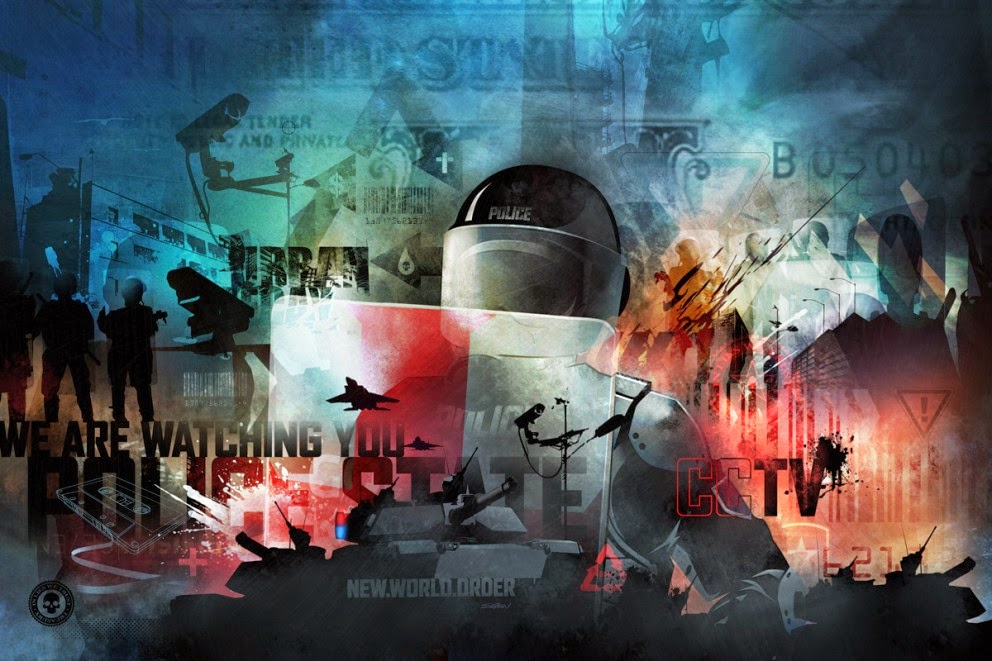
Meet the New Normal, Same as the Old Normal: You Are Still the Enemy Within

By Colin Todhunter

Source: Off-Guardian

Today, we are witnessing the nudging (manipulation) of the population to accept a ‘new normal’ based on a climate emergency narrative, restrictions on movement and travel, programmable digital money, ‘pandemic preparedness’ courtesy of the World Health Organization’s tyrannical pandemic treaty, unaccountable AI and synthetic ‘food’.

Whether it involves a ‘food transition’, an ‘energy transition’, 15-minute cities or some other benign-sounding term, all this is to be determined by a supranational ‘stakeholder’ elite with ordinary people sidelined in the process. An undemocratic agenda designed to place restrictions on individual liberty, marking a dramatic shift towards authoritarianism.

In the 1980s, to help legitimise the deregulation-privatisation neoliberal globalisation agenda, government and media instigated an ideological onslaught, driving home the primacy of ‘free enterprise’, individual rights and responsibility and emphasising a shift away from the role of the state, trade unions and the collective in society.

We are currently seeing another ideological shift: individual rights and freedoms are said to undermine the wider needs of society and the planet – in a stark turnaround – personal freedom is now said to pose a threat to national security, public health or the climate.

As in the 1980s, this messaging is being driven by an economic impulse. This time, the collapsing neoliberal project.

In the UK, poverty is increasing in two-thirds of communities, food banks are now a necessary part of life for millions of people and living standards are plummeting. Indeed, the poorest families are enduring a ‘frightening’ collapse in living standards, resulting in life-changing and life-limiting poverty).

In the US, around 30 million low-income people are on the edge of a ‘hunger cliff’ as a portion of their federal food assistance is taken away. In 2021, it was estimated that one in eight children were going hungry in the US. Small businesses are filing for bankruptcy in the US at a record rate.

The Bank of England’s chief economist, Huw Pill, says that people should ‘accept’ being poorer. This is similar to the response of Rob Kapito, co-founder of the world’s biggest asset management firm, BlackRock. In 2022, the unimaginably rich and entitled Kapito said that a “very entitled” generation of (ordinary working) people who have never had to sacrifice would soon have to face shortages for the first time in their lives.

While business as usual prevails in Kapito’s world of privilege and that of major armsenergypharmaceuticals and food companies, whose megarich owners continue to rake in massive profits, Kapito and Pill tell ordinary people to get used to poverty and the ‘new normal’ as if we are ‘all in it together’ – billionaires and working class alike. They conveniently use COVID and the situation in Ukraine as cover for the collapsing neoliberalism.

But this is part of the hegemonic agenda that seeks to ensure that the establishment’s world view is the accepted cultural norm. And anyone who challenges this world view – whether it involves, for instance, questioning climate alarmism, the ‘new normal’, the nature of the economic crisis, the mainstream COVID narrative or the official stance on Ukraine and Russia – is regarded as a spreader of misinformation and the ‘enemy within’.

Although the term ‘enemy within’ was popularised by Margaret Thatcher during the miners’ strike in 1984-85 to describe the striking miners, it is a notion with which that Britain’s rulers have regarded protest movements and uprisings down the centuries. From the Peasants’ Revolt in 1381 to the Levellers and Diggers in the 17th century, it is a concept associated with anyone or any group that challenges the existing social order and the interests of the ruling class.

John Ball, a radical priest, addressed the Peasants’ Revolt rebels with the following words:

Good friends, matters cannot go well in England until all things be held in common; when there shall be neither vassals nor lords; when the lords shall be no more masters than ourselves.”

The revolt was suppressed. John Ball was captured and hung, drawn and quartered. Part of the blood-soaked history of the British ruling class.

Later on, the 17th-century Diggers movement wanted to create small, egalitarian rural communities and farm on common land that had been privatised by enclosures.

The 1975 song ‘The world Turned Upside Down’ by Leon Rosselson commemorates the Diggers. His lyrics describe the aims and plight of the movement. In Rosselson’s words, the Diggers were dispossessed via theft and murder but reclaimed what was theirs only to be violently put down.

Little surprise then that, in the 1980s, Margaret Thatcher used the state machinery to defeat the country’s most powerful and trade union and the shock troops of the labour movement, the National Union of Mineworkers – ‘the enemy within’. She needed to do this to open the gates for capital to profit from the subsequent deindustrialisation of much of the UK and the dismantling of large parts of the welfare state.

And the result?

A hollowed-out, debt-bloated economy, the destruction of the social fabric of entire communities and the great financial Ponzi scheme – the ‘miracle’ of deregulated finance – that now teeters on the brink of collapse, leading the likes of Kapito and Pill to tell the public to get ready to become poor.

And now, in 2023, the latest version of the ‘enemy within’ disseminates ‘misinformation’ – anything that challenges the official state-corporate narrative. So, this time, one goal is to have a fully controlled (censored) internet.

For instance, US Special Operations Command (USSOCOM) recently awarded Accrete a contract for Argus to detect disinformation threats from social media. Argus is AI software that analyses social media data to predict emergent narratives and generate intelligence reports at a speed and scale to help neutralise viral disinformation threats.

Accrete AI is a leading dual-use enterprise AI company. It deployed its AI Argus software for open-source threat detection with the US Department of Defense in 2022.

In a recent press release, Prashant Bhuyan, founder and CEO of Accrete, boasts:

Social media is widely recognised as an unregulated environment where adversaries routinely exploit reasoning vulnerabilities and manipulate behaviour through the intentional spread of disinformation. USSOCOM is at the tip of the spear in recognising the critical need to identify and analytically predict social media narratives at an embryonic stage before those narratives evolve and gain traction. Accrete is proud to support USSOCOM’s mission.”

‍This is about predicting wrong think on social media. But control over the internet is just part of a wider programme of establishment domination, surveillance and dealing with protest and dissent.

The recent online article ‘How the Government Weaponizes Surveillance to Silence Its Critics’ notes that, on any given day, the average person in the US is monitored, spied on and tracked in more than 20 different ways.

The authors of the article ask us to consider some of the ways the US government is weaponizing its surveillance technologies to flag citizens as a threat to national security, whether or not they have done anything wrong – from flagging citizens as a danger based on their feelings, phone and movements to their spending activities, social media activities, political views and correspondence.

The elite has determined that the existential threat is you. The article ‘Costs of War: Peterloo’, written by UK Veterans for Peace member Aly Renwick, details the history of the brutal suppression of protesters by Britain’s rulers. He also strips away any notion that some may have of a benign, present-day ruling elite with democratic leanings. The leopard has not changed its spots.

As we saw during COVID, the thinking is that hard-won rights must be curtailed, freedom of association is reckless, free thinking is dangerous, dissent is to be stamped on, impartial science is a threat and free speech is deadly. Government is ‘the truth’, Fauci (or some similar figure) is ‘the science’ and censorship is for your own good.

None of this was justified. It only begins to make sense if we regard the COVID restrictions in terms of trying to deal with an economic crisis by closing down the global economy under cover of a public health crisis (see the online articles ‘What Was Covid Really About? Triggering a Multi-Trillion Dollar Global Debt Crisis’ and ‘Italy 2020: Inside Covid’s Ground Zero’ which outline how COVID policies can be explained by economic factors not health concerns).

The economic crisis is making many people poorer, so they must be controlled, monitored and subjugated.

The transitions mentioned at the start of this article along with the surveillance agenda (together known as the ‘Great Reset’) are being accelerated at this time of economic crisis when countless millions across the West are being impoverished. The collapsing financial system is resulting in an interrelated global debt, inflation and ‘austerity’ crisis and the biggest transfer of wealth to the rich in history.

As a result, the powers that be fear that the masses might once again pick up their pitchforks and revolt. They are adamant that the peasants must know their place.

But the flame of protest and dissent from centuries past still inspires and burns bright. So, with that in mind, let’s finish with Leon Rosselson’s lyrics in reference to the Diggers movement (Billy Bragg’s version of the song can be found on YouTube):

In sixteen forty-nine
To St. George’s Hill
A ragged band they called the Diggers
Came to show the people’s will
They defied the landlords
They defied the laws
They were the dispossessed reclaiming what was theirs

We come in peace they said
To dig and sow
We come to work the lands in common
And to make the waste grounds grow
This earth divided
We will makе whole
So it will be
A common treasury for all

Thе sin of property
We do disdain
No man has any right to buy and sell
The earth for private gain
By theft and murder
They took the land
Now everywhere the walls
Spring up at their command

They make the laws
To chain us well
The clergy dazzle us with heaven
Or they damn us into hell
We will not worship
The God they serve
The God of greed who feed the rich
While poor man starve

We work we eat together
We need no swords
We will not bow to masters
Or pay rent to the lords
We are free men
Though we are poor
You Diggers all stand up for glory
Stand up now

From the men of property
The orders came
They sent the hired men and troopers
To wipe out the Diggers’ claim
Tear down their cottages
Destroy their corn
They were dispersed
Only the vision lingers on

You poor take courage
You rich take care
The earth was made a common treasury
For everyone to share
All things in common
All people one
We come in peace
The order came to cut them down
We come in peace
The order came to cut them down

How “Food Shortages” & Economic Collapse Protects the Status Quo

Engineered Food & Poverty Crises Secure Continued US Dominance

By Colin Todhunter

Source: Off-Guardian

In March 2022, UN Secretary-General Antonio Guterres warned of a “hurricane of hunger and a meltdown of the global food system” in the wake of the crisis in Ukraine.

Guterres said food, fuel and fertiliser prices were skyrocketing with supply chains being disrupted and added this is hitting the poorest the hardest and planting the seeds for political instability and unrest around the globe.

According to the International Panel of Experts on Sustainable Food Systems, there is currently sufficient food and no risk of global food supply shortages.

We see an abundance of food but skyrocketing prices. The issue is not food shortage but speculation on food commodities and the manipulation of an inherently flawed global food system that serves the interests of corporate agribusiness traders and suppliers of inputs at the expense of people’s needs and genuine food security.

The war in Ukraine is a geopolitical trade and energy conflict. It is largely about the US engaging in a proxy war against Russia and Europe by attempting to separate Europe from Russia and imposing sanctions on Russia to harm Europe and make it further dependent on the US.

Economist Professor Michael Hudson recently stated that ultimately the war is against Europe and Germany. The purpose of the sanctions is to prevent Europe and other allies from increasing their trade and investment with Russia and China.

Neoliberal policies since the 1980s have hollowed out the US economy. With its productive base severely weakened, the only way for the US to maintain hegemony is to undermine China and Russia and weaken Europe.

Hudson says that, beginning a year ago, Biden and the US neocons attempted to block Nord Stream 2 and all (energy) trade with Russia so that the US could monopolise it itself.

Despite the ‘green agenda’ currently being pushed, the US still relies on fossil fuel-based energy to project its power abroad. Even as Russia and China move away from the dollar, the control and pricing of oil and gas (and resulting debt) in dollars remains key to US attempts to retain hegemony.

The US knew beforehand how sanctions on Russia would play out. They would serve to divide the world into two blocks and fuel a new cold war with the US and Europe on one side with China and Russia being the two main countries on the other.

US policymakers knew Europe would be devastated by higher energy and food prices and food importing countries in the Global South would suffer due to rising costs.

It is not the first time the US has engineered a major crisis to maintain global hegemony and a spike in key commodity prices that effectively trap countries into dependency and debt.

In 2009, Andrew Gavin Marshall described how in 1973 – not long after coming off the gold standard – Henry Kissinger was integral to manipulating events in the Middle East (the Arab-Israeli war and the ‘energy crisis’). This served to continue global hegemony for the US, which had virtually bankrupted itself due to its war in Vietnam and had been threatened by the economic rise of Germany and Japan.

Kissinger helped secure huge OPEC oil price rises and thus sufficient profits for Anglo-American oil companies that had over-leveraged themselves in North Sea oil. He also cemented the petrodollar system with the Saudis and subsequently placed African nations, which had embarked on a path of (oil-based) industrialisation, on a treadmill of dependency and debt due to the spike in oil prices.

It is widely believed that the high-priced oil policy was aimed at hurting Europe, Japan and the developing world.

Today, the US is again waging a war on vast swathes of humanity, whose impoverishment is intended to ensure they remain dependent on the US and the financial institutions it uses to create dependency and indebtedness – the World Bank and IMF.

Hundreds of millions will experience (are experiencing) poverty and hunger due to US policy. These people (the ones that the US and Pfizer et al supposedly cared so much about and wanted to get a jab into each of their arms) are regarded with contempt and collateral damage in the great geopolitical game.

Contrary to what many believe, the US has not miscalculated the outcome of the sanctions placed on Russia. Michael Hudson notes energy prices are increasing, benefiting US oil companies and US balance of payments as an energy exporter. Moreover, by sanctioning Russia, the aim is to curtail Russian exports (of wheat and gas used for fertiliser production) and for agricultural commodity prices to therefore increase. This too will also benefit the US as an agricultural exporter.

This is how the US seeks to maintain dominance over other countries.

Current policies are designed to create a food and debt crisis for poorer nations especially. The US can use this debt crisis to force countries to continue privatising and selling off their public assets in order to service the debts to pay for the higher oil and food imports.

This imperialist strategy comes on the back of ‘COVID relief’ loans which have served a similar purpose. In 2021, an Oxfam review of IMF COVID-19 loans showed that 33 African countries were encouraged to pursue austerity policies. The world’s poorest countries are due to pay $43 billion in debt repayments in 2022, which could otherwise cover the costs of their food imports.

Oxfam and Development Finance International have also revealed that 43 out of 55 African Union member states face public expenditure cuts totalling $183 billion over the next five years.

The closure of the world economy in March 2020 (‘lockdown’) served to trigger an unprecedented process of global indebtedness.

Conditionalities mean national governments will have to capitulate to the demands of Western financial institutions. These debts are largely dollar-denominated, helping to strengthen the US dollar and US leverage over countries.

The US is creating a new world order and needs to ensure much of the Global South remains in its orbit of influence rather than ending up in the Russian and especially Chinese camp and its belt road initiative for economic prosperity.

Post-COVID, this is what the war in Ukraine, sanctions on Russia and the engineered food and energy crisis are really about.

Back in 2014, Michael Hudson stated that the US has been able to dominate most of the Global South through agriculture and control of the food supply. The World Bank’s geopolitical lending strategy has transformed countries into food deficit areas by convincing them to grow cash crops – plantation export crops – not to feed themselves with their own food crops.

The oil sector and agribusiness have been joined at the hip as part of US geopolitical strategy.

The dominant notion of ‘food security’ promoted by global agribusiness players like Cargill, Archer Daniel Midland, Bunge and Louis Dreyfus and supported by the World Bank is based on the ability of people and nations to purchase food. It has nothing to do with self-sufficiency and everything to do with global markets and supply chains controlled by giant agribusiness players.

Along with oil, the control of global agriculture has been a linchpin of US geopolitical strategy for many decades. The Green Revolution was exported courtesy of oil-rich interests and poorer nations adopted agri-capital’s chemical- and oil-dependent model of agriculture that required loans for inputs and related infrastructure development.

It entailed trapping nations into a globalised food system that relies on export commodity mono-cropping to earn foreign exchange linked to sovereign dollar-denominated debt repayment and World Bank/IMF ‘structural adjustment’ directives. What we have seen has been the transformation of many countries from food self-sufficiency into food deficit areas.

And what we have also seen is countries being placed on commodity crop production treadmills. The need for foreign currency (US dollars) to buy oil and food entrenches the need to increase cash crop production for exports.

The World Trade Organization’s Agreement on Agriculture (AoA) set out the trade regime necessary for this type of corporate dependency that masquerades as ‘global food security’.

This is explained in a July 2022 report by Navdanya International – Sowing Hunger, Reaping Profits – A Food Crisis by Design – which notes international trade laws and trade liberalisation has benefited large agribusiness and continue to piggyback off the implementation of the Green Revolution.

The report states that US lobby and trade negotiations were headed by former Cargill Investors Service CEO and Goldman Sachs executive – Dan Amstutz – who in 1988 was appointed chief negotiator for the Uruguay round of GATT by Ronald Reagan. This helped to enshrine the interests of US agribusiness into the new rules that would govern the global trade of commodities and subsequent waves of industrial agriculture expansion.

The AoA removed protection of farmers from global market prices and fluctuations. At the same time, exceptions were made for the US and the EU to continue subsidising their agriculture to the advantage of large agribusiness.

Navdanya notes:

“With the removal of state tariff protections and subsidies, small farmers were left destitute. The result has been a disparity in what farmers earn for what they produce, versus what consumers pay, with farmers earning less and consumers paying more as agribusiness middlemen take the biggest cut.”

‘Food security’ has led to the dismantling of food sovereignty and food self-sufficiency for the sake of global market integration and corporate power.

We need look no further than India to see this in action. The now repealed recent farm legislation in India was aimed at giving the country the ‘shock therapy’ of neoliberalism that other countries have experienced.

The ‘liberalising’ legislation was in part aimed at benefiting US agribusiness interests and trapping India into food insecurity by compelling the country to eradicate its food buffer stocks – so vital to the nation’s food security – and then bid for food on a volatile global market from agribusiness traders with its foreign reserves.

The Indian government was only prevented from following this route by the massive, year-long farmer protest that occurred.

The current crisis is also being fuelled by speculation. Navdanya cites an investigation by Lighthouse Reports and The Wire to show how speculation by investment firms, banks and hedge funds on agricultural commodities are profiting off rising food prices. Commodity future prices are no longer linked to actual supply and demand in the market but are based purely on speculation.

Archer Daniels Midland, Bunge, Cargill and Louis Dreyfus and investment funds like Black Rock and Vanguard continue to make huge financial killings, resulting in the price of bread almost doubling in some poorer countries.

The cynical ‘solution’ promoted by global agribusiness to the current food crisis is to urge farmers to produce more and seek better yields as if the crisis is that of underproduction. It means more chemical inputs, more genetic engineering techniques and suchlike, placing more farmers in debt and trapped in dependency.

It is the same old industry lie that the world will starve without its products and requires more of them. The reality is that the world is facing hunger and rising food prices because of the system big agribusiness has instituted.

And it is the same old story – pushing out new technologies in search of a problem and then using crises as justification for their rollout while ignoring the underlying reasons for such crises.

Navdanya sets out possible solutions to the current situation based on principles of agroecology, short supply lines, food sovereignty and economic democracy – policies that have been described at length in many articles and official reports over the years.

As for fighting back against the onslaught on ordinary people’s living standards, support is gathering among the labour movement in places like the UK. Rail union leader Mick Lynch is calling for a working class movement based on solidarity and class consciousness to fight back against a billionaire class that is acutely aware of its own class interests.

For too long, ‘class’ has been absent from mainstream political discourse. It is only through organised, united protest that ordinary people will have any chance of meaningful impact against the new world order of tyrannical authoritarianism and the devastating attacks on ordinary people’s rights, livelihoods and standards of living that we are witnessing.