
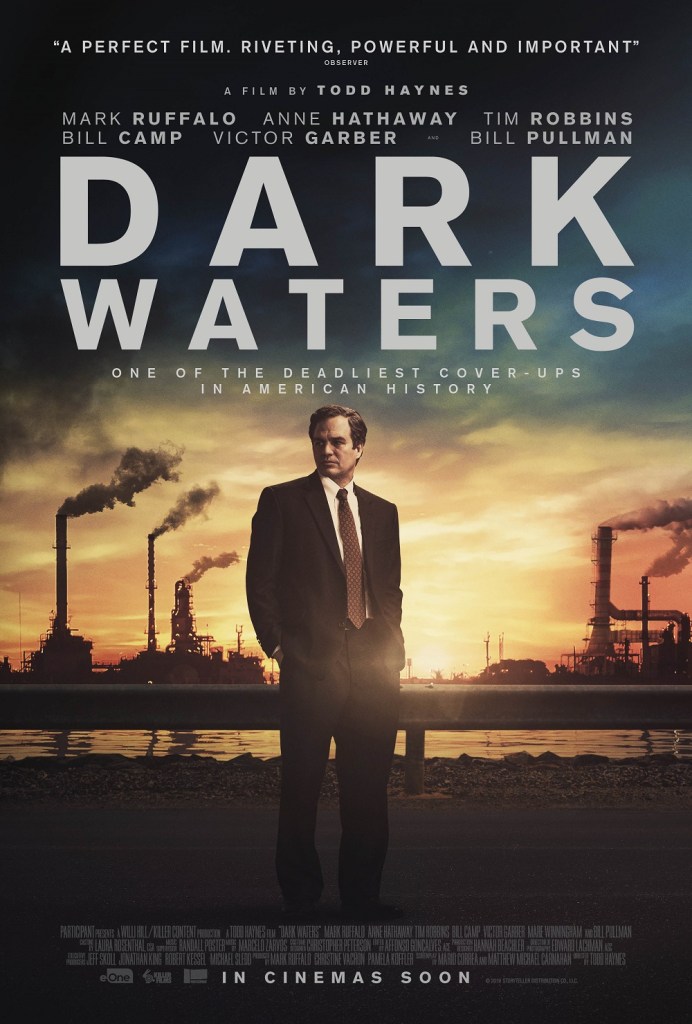
Film Review: “Dark Waters” — Poison and Passion
By Peg Aloi
Source: Arts Fuse
Todd Haynes proffers a richly diverse palette as a filmmaker. Yet he revisits certain themes reliably, whether it’s via an experimental narrative that combines lyrical visuals and magic realism (Poison), or an exploration of the dark underside of fame (Superstar, Velvet Goldmine, I’m Not There), or the struggle to accept one’s homosexuality (Poison, Velvet Goldmine, Far From Heaven, Carol). With a background in semiotics, Haynes deploys an intricate but classic visual style (especially in grandiose period pieces Far From Heaven and Carol), often expressed through complex color designs, exploring truths both psychological and metaphorical. Working closely with his cinematographer Ed Lachman, Haynes crafts films that are unspeakably beautiful stories about pockets of American life.
Generally, Haynes is interested in the toxicity that lies beneath a pleasing surface. His 1995 film Safe is the story of a woman (Julianne Moore) who becomes ill when exposed to chemicals and discovers that she has a condition only beginning to be understood. In addition to portraying the very real impact of various substances (fabric, carpeting, cosmetics, food), the film looks at the more subtle poisoning that comes when emotions are repressed in an unsatisfying marriage, when someone is unable to ask for what they want. With Dark Waters, based on a story written by reporter Nathaniel Rich for the New York Times (and adapted for the screen by Mathew Michael Carnahan and Mario Correa), Haynes trains his sensitive eye on how chemical contamination impacts a small West Virginia town, delving into the layers of corruption that shroud corporate crimes. Like Safe, Dark Waters occasionally has the feel of a subtle, but unintentional, horror story.
Mark Ruffalo plays Robert Bilott, a Cincinnati lawyer who, as the film opens in 1998, has just been made partner in a law firm that specializes in defending corporate clients. Prior to this scene, we see a brief prologue, set in Parkersburg, West Virginia: a group of teenagers is having a beer-fueled frolic at a local swimming hole on a balmy summer night. They enjoy the water’s weird foamy texture. A boat comes near them, holding two men who are spraying a dispersant on the water’s surface. They yell at the trespassing teenagers to get out. A yellowish-green light shines on the surface of the dark blue water. Thus Haynes establishes a color schematic that pits the evil greed propelling the contamination against the hard working residents whose lives are destroyed.
Bilott is visited at his office by two men who bring videotapes that prove that their farm is being poisoned by DuPont, which owns a chemical plant in Parkersburg, Bilott’s hometown. These men have traveled over a hundred miles to see the lawyer because they live next door to his grandmother. Bilott tries to get them to contact a different lawyer because his professional role, defending large chemical companies, is at odds with their needs. But he is moved by the story of Wilbur Tennant (Bill Camp), a cattle farmer who has lost nearly 200 cows to strange illnesses. Bilott confers with his boss (Tim Robbins) and grudgingly gets the go-ahead to pursue action against DuPont.
In a saga that lasts a decade and a half, Bilott works tirelessly, and at the expense of his own health and domestic stability, to find justice for the residents of Parkersburg. His wife, played by Anne Hathaway, keeps the home fires burning, but becomes frustrated with her husband’s singular focus on his work. That work is solitary and grueling, as shown in scenes where we watch him digging through papers in hundreds of cartons, or trying in vain to find research on the dangerous PFOAs that are among the most deadly contaminants in question. Not widely known in the 1990s, PFOA contamination of municipal drinking water is now a familiar phenomenon (including here in upstate New York where I live). As a result of DuPont’s illegal dumping and poorly managed waste disposal, as well as exposure to chemicals at the plant itself, town residents and employees of the plant have experienced a range of serious problems, from birth defects to cancer, caused, apparently, by the city’s biggest, and thus well-loved, employer.
And therein lies one of Bilott’s biggest challenges: fighting to expose the wrongdoing of a corporation that, as far as many residents are concerned, is the only reason they have jobs. But the difficulty goes beyond Bilott being glared at in the local diner, or sneered at by DuPont’s in-house corporate counsel Phil Donnelly (Victor Garber). Tennant is diagnosed with cancer, as is his wife, and they are still shunned by some of their neighbors. Other residents who have brought lawsuits become the targets of arson. Paranoia begins to hound Bilott as he realizes the object of his lawsuit is a deeply dishonest and sociopathic entity (shades of Silkwood here). Unlike the passionate journalist Ruffalo plays in Spotlight, Michael Rezendes, his Bilott is a quiet and calm workaholic, not given to emotional outbursts. But his dogged devotion to the cause is apparent in his exhausted face, his trembling hands, his wordless sobbing. It’s a mature performance from Ruffalo, who is also a co-producer. His steady presence anchors the large cast, largely composed of lawyers in suits and working people in flannel and wool.
The visual opulence one expects from Haynes is subtly rendered here: the interiors appear somewhat drab, the exteriors rather ordinary. But a definite style comes through, once a viewer notices the way yellow and blue tie the film’s visuals together. Along with the color scheme, exquisite lighting and letter-perfect design elements are hiding in the plain sight of this real-life narrative. The music by Marcelo Zarvos is moody, spare, and evocative, an effective counterpoint to the secrets and fears lurking just beneath this story’s surface. Dark Waters may not be Haynes’s most beautiful film, but it may yet prove to be among his most important.

 After the Crash