
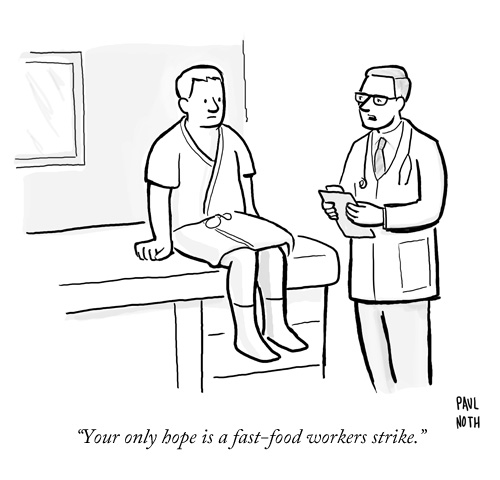
The New Yorker Daily, December 5 2013
Today is the day of the largest global fast food strike yet, targeting major chain restaurants including McDonald’s, Burger King, Wendy’s, Taco Bell and KFC. Organized with the help of Fast Food Forward, the Service Employees International Union and a number of regional activist organizations, fast food workers in 150 cities and 33 countries (including Morocco, Japan, India, Belgium, Germany, Brazil, Argentina and New Zealand) are taking action for better pay and working conditions.
RT will post updates of the event throughout the day here: http://rt.com/news/159180-fast-food-worker-strike/
Sarah Kendzior describes the nature of the struggle that fast food employees commonly experience in the following excerpt from “The Minimum Wage Worker Strikes Back”:
Jenina dropped out of nursing school after her mother lost her job, because she needed the tuition money to pay bills. Her income from McDonald’s, where she started working as a high school senior, helps support her mother and younger sister. Patrick’s Chipotle income helps support his mother, a makeup artist who has struggled to find steady work since the recession. Krystal’s Taco Bell income helps support her son; her sister, who lives with her and works at Jack in the Box; and now, her newborn daughter.
Every worker I interview is supporting someone: an unemployed parent, a child, a sibling, a friend. Most of their friends and family members work in fast food or other service industries. Everyone is in their twenties or older. All but one is African-American.
They dream of different jobs. The women want to be nurses, the men want to work in the automotive or culinary industries. But no one can pay for training when they cannot save for day to day, much less for the future.
As a result, fast food workers are turning to activism: not out of ideological motives, but because overturning the economic system seems more feasible than purchasing the credentials for a new career.
Read the full article here: https://medium.com/debt-ridden/fa4c36eb306b
 After the Crash