
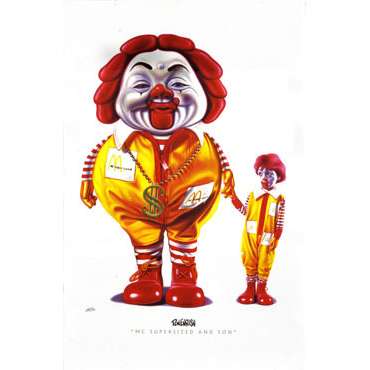
The Continuing Decline of McDonald’s

AC991E1E

By James Corbett

Source: The Corbett Report

Long-time Corbett Reporteers might recall my 2015 video, “Celebrate! McDonald’s is Dying!” where I detailed the many, many woes the fast “food” giant was dealing with at the time, including:

Since then, McCancer’s has been undergoing a sweeping “restructuring” that has seen many layers of lipstick slapped on their factory-farmed pig. This restructuring includes not only cosmetic changes (“All-day breakfasts and new value menus for everyone!”) but behind-the-scenes efforts to trim $500 million from the company’s operating expenses, including buyouts and layoffs at company headquarters and the re-franchising of 4,000 corporate “restaurants.”

The global giant’s influential PR machine has used sleight-of-hand and other tricks to make this restructuring look like a smash success. They used their cheerleaders at the Wall Street Journal to hype “stronger-than-expected” profit and sales figures and their boosters at US News & World Report to hype some highly-selective earnings comparisons suggesting that this “turnaround” is, to use the WSJ’s phrase, “sustainable.”

But one doesn’t have to scratch too hard to reveal the rusty reality beneath this PR paint job.

McPinkslime’s might have “beat expectations” for sales and profits, but beating diminished expectations is hardly a sign of booming business. Just look at the nuts and bolts of the Q3 2016 earnings report: Year-on-year revenue is down 2.9% and net income is down 2.6%. And keep in mind, those numbers are in comparison to the already-terrible 2015 figures.

And that “re-franchising” operation? It cost $130 million in pre-tax charges.

But don’t worry, everyone, they “beat expectations!” Pay no attention to the hemorrhaging corporation behind the curtain!

And now the latest sign of McDonteat’s global retreat (via Corbett Report member “BuddhaForce”): “McDonald’s gives up control of its China business in $2 billion deal.”

The story is fascinating enough in its own right, what with McDonteats throwing in the corporate towel on the largest and fastest-growing consumer market in the world. But the devil is, as always, in the details. Who is purchasing the majority stake in the company’s mainland operations? None other than The Carlyle Group and CITIC Group.

The Carlyle Group’s name will likely ring a bell as one of the largest swamp pits “private equity firms” in the world, and one with its fingers in many a pie, including, of course, 9/11.

CITIC Group, meanwhile, will be familiar to The Corbett Report faithful as a key player in “China and the New World Order,” a Chinese state-owned investment company that helped serve as the Rockefeller-Kissinger nexus between the Deng Xiaoping-era “capitalist roaders” and their western finance oligarch recolonizers.

That these two cesspools are converging on the giant turd of American fast food is fitting enough. The McDonaldization of China is proceeding apace, and the usual crew are there to profit from it.

But as to what this story says about the continuing decline of the once-mighty golden arches, there are two main takeaways to the story, one depressing and one positive.

On the depressing front, there is a simple reason for the across-the-board slowdown in fast food sales in recent years (despite the predictable attempts to overcomplicate the problem in clickbait-y listicle format). For once, the Wall Street Journal gets it right: It’s the economy, stupid. What greater rebuke to the easily-disprovable economic “recovery” nonsense of the Obama years could be possible than pointing out the simple fact that people are too worried about their economic future to splurge on a $5 value meal?

But on a positive note, we can take McFatfood’s woes as a sign that, try as they might with their considerable propaganda resources, the corporate chieftains can’t put their egg McMuffin back together again. People are fed up with fast food. And although some, concerned with cost, are turning to eating at home as the cheaper option, others are more concerned with what’s in their food, where it’s sourced from, how it’s being prepared and who is being paid for it. Who wants instant, nutritionless, food-like substitute rolled up in plastic and slapped down on a tray by surly, overworked servers (or, increasingly, robots) anyway?

For those interested in how they can take part in the real food revolution that will render the McFastfood economy obsolete, may I humbly offer this podcast on guerrilla gardening? Bon appétit!
Carlyle Group’s Latest Acquisition: the JFK Library (!)

150px-Carlyle_Group_historical_logo

By Russ Baker

Source: WhoWhatWhy

Some things you truly cannot make up. Like this: the museum and archives celebrating and exploring the life (if not really wanting to investigate the death) of John F. Kennedy is getting a facelift—courtesy of….the Carlyle Group.

This development was noted, without much fanfare, in a variety of major media. If there was a smidgen of irony, I missed it.

Yet, consider this: The ultimate globe-girdling corporation is playing a major role in preserving the memory of a president who at the time of his death was engaged in what may be described as mortal combat with outfits not unlike Carlyle—if smaller and less global. (I write about this in my book Family of Secrets but you can learn a lot more about JFK versus the corporations in Donald Gibson’s Battling Wall Street: The Kennedy Presidency.)

Kennedy was locked in grim battle with oil and steel and banking interests, hated by mining giants and soda pop companies, resisting pressures from the burgeoning defense industry, and on and on. The list of the offending and the aggrieved was endless. Executives were taking out ads to excoriate him, and even showing up at the White House to practically spit in his face.

“Those robbing bastards,” JFK told Walter Heller, chairman of the Council of Economic Advisors, when Heller mentioned the oil and gas industry. “I’m going to murder them.”—as cited in Family of Secrets, from audiotape held by John F. Kennedy Library and Museum

***

Why is the museum getting a facelift? Apparently, it is to “enhance the visual and interactive offerings.”

Does none of it have to do with the still-mysterious fire that broke out at the museum complex in Boston at approximately the same time as the bombings of the Boston Marathon? Initial news reports suggested that the fire might somehow be linked to the bombings, an event that led to the precedent-setting lockdown of a major American city in a military-style operation.

As with, well, practically everything about that day, we have since been assured that there was in fact no deeper mystery regarding the museum fire—that its cause was accidental and its timing a coincidence. And of course it may well have been, though I (a past user of the archives’ services) was struck by what seemed like a sheepish lack of openness on the part of library personnel when I made inquiries. Call it a reporter’s instincts.

JFK World vs Carlyle World

JFK, who entered the White House as outgoing president Eisenhower warned about the dangerous growth of a “military-industrial complex,” battled constantly with the same forces that today virtually reign supreme. He was an enthusiast of attempts in the mass media to draw attention to threats to freedom here at home, as seen in such movies as Seven Days in May, about a military coup against the U.S. government, and The Manchurian Candidate, about the subversion of our democratic system through mind control.

Times have certainly changed. The CEO of Carlyle, it should be noted, is a Democrat. He worked for Jimmy Carter. Other figures in the Carlyle orbit over the years have been Republicans—including George H.W. Bush, former Secretary of State James Baker III, and former Defense Secretary Frank Carlucci—and high-profile foreigners, including British Prime Minister John Major and members of the bin Laden family.

Carlyle itself is one of the increasing ranks of strange companies that seem to come out of nowhere and are suddenly everywhere and into everything. (You really must treat yourself to a review of its holdings; even in the constrained precincts of Wikipedia, it’s still a wonder to behold—if you just drill down one level, from the military contractors to the pipeline companies, many of which it bought undervalued, reinvigorated with new government funding, and then sold off at great profit.)

As Carlyle puts it on their site:

We are one of the world’s largest and most diversified alternative asset management firms. We manage 120 distinct funds and 133 fund of funds vehicles that invest across four segments, 11 core industries and six continents. Our global size, scale and brand enable us to access opportunities in virtually every market around the world.

Carlyle is the kind of massive, opaque entity that draws its breath and its profits from knowing the right information and having the right connections. As such, it attracts almost no public attention…except when it chooses to do something philanthropic to “enhance” its public image.

We have every right to be amazed that the directors of the John F. Kennedy Presidential Library and Museum decided they needed money so badly that they would take it from the likes of Carlyle. Even more amazing is that they thought, correctly as it turns out, there would be no criticism of this decision and no consequences.

But really—why be amazed? The world has changed a great deal since John F. Kennedy was precipitously removed from the picture after rousing the ire of the very selfsame kinds of interests that today rule the roost.