Saturday Matinee: Metropia

MOVIE REVIEW: TRIBECA: Metropia – Swedish Animated Dystopic Film’s Look is Stunning!

By Sheldon Wiebe

Source: Eclipse Magazine

Metropia is a stranger film than the average dystopia. With a visual design that would be appropriate for 1984 and its depiction of a Europe connected by a vast subway complex called The Metro and a plot that includes a biological mind control device disseminated by shampoo, Metropia is definitely a unique experience.

Roger [voiced by Vincent Gallo] is a drone who works at Supercall, the mother of all telemarketing/tech help companies. He lives in a shabby apartment with his exotic looking girlfriend, Anna [Sofia Hein], and rides a bike to work because he doesn’t trust the Metro. The Sweden in which he lives is a grey, grey place – as is all of Europe, we learn over the course of the film. He is as normal/unremarkable as a person can get. His biggest fantasy is to meet the model for the shampoo that, unbeknownst to him, has left his thoughts open to the ominous Trexx corporation.

Being as normal as he is, Roger is startled to realize that he’s hearing voices – or rather a voice – in his head. Freaked, he manages to finish his shift and get home. The next morning, he has to take The Metro to work – someone has trashed his bike. In the station, he spies the woman from the shampoo. He follows her. She is Nina [Juliette Lewis] and she not only confronts him, she seems to know about the voice in head! She also seems to know what to do about that.

Metropia is a great looking film. The animation – like some absurd CG hybrid of Terry Gilliam’s more fluid cutout work and Gerry Anderson’s Supermarionation – is extremely well done and carries the story as well as setting a very specific mood. Director/co-writer [with Stig Larsson and Frederik Edin] Tarik Saleh keeps things to a very deliberate pace for most of the film, with only a few moments of accelerated action.

Considering the number of people who worked on the script [comparatively few for an animated film], the story seems to be pretty skeletal. Everything moves, more or less, in a single direction and [with only a couple of exceptions] at a single pace – and the film doesn’t quite hang together.

The biggest problem has to be that Roger hears that voice in his head, but is still able to do whatever he wants – which makes him unique in a world of people whose lives are seemingly controlled by others. It’s never explained why this should be – and there’s no real reason for Nina to take him bed, either. Roger is such an unremarkable guy that the film might have worked better had she used her sexuality to get him to do what she wanted with just the promise of sex as a motivator. Still, Gallo’s washed out vocal performance as Roger is spot on, as is Lewis’ turn as Nina. If we buy them, then we buy the film – and they work.

Some of the best moments of the film come with the CEO of Trexx, Ivan Bahn [Udo Kier] explains to investors just how the company works – and how the shampoo figures in the company’s bottom line. His demonstration of the effects of the shampoo –on a Texan named Wayne Marshall [Indy Neidell] – is particularly effective.

Metropia may be flawed, but it’s still quite the visual feast, and definitely worth a look.

Watch Metropia on Kanopy here: https://www.kanopy.com/en/product/5845007

A Pigeon Sat on a Branch Reflecting on Existence

By Simon Abrams

Source: RogerEbert.com

Swedish comedy “A Pigeon Sat on a Branch Reflecting On Existence” has a very particular style of deadpan humor and an equally specific morbid sense of empathy. As in his previous two films, writer/director Roy Andersson (“Songs from the Second Floor,” “You, The Living”) presents several thematically-united sketches of life as it’s experienced by the meek, and the suffering, two groups of people who are (according to Andersson’s films) doomed to inherit nothing. “A Pigeon Sat on a Branch Reflecting on Existence” is, in that sense, a kind of alarmist comedy. It’s a series of comedic sketches about people who are too self-involved to empathize with each other. It’s also a plaintively blunt wake-up call, and an effective demand for viewers’ vigilant sensitivity.

I’m writing this review as a series of direct free-associations because that’s essentially how “A Pigeon Sat on a Branch Reflecting On Existence” presents itself. Like Andersson’s other recent films, “Pigeon” is a movie that’s so viscerally effective that it doesn’t really matter how hard individual scenes clobber you over the head with Andersson’s humanist message: by choosing to isolate ourselves from each other, we die a thousand little absurd deaths every day without ever really moving on.

“A Pigeon Sat On a Branch Reflecting on Existence” doesn’t really have a plot, but it does feature two recurring characters: Jonathan (Holger Andersson) and Sam (Nils Westblom) sell novelty items, but aren’t very good at it. They’re shy and tactless, as we see in any scene where they try to pitch people who could clearly care less about plastic vampire fangs, and rubber Halloween masks. But Jonathan, who is repeatedly teased for being over-sensitive, also suffers from a vague sinking feeling that something is wrong with his life, and that leads to problems with Sam later on.

To be fair, Jonathan’s not completely blameless. In one scene, we see him bullying a store-owner who is too anxious and depressed to address Jonathan and Sam when they demand payment for novelty items that were bought on credit. It’s an awkwardly heated argument since Jonathan and Sam have to argue with their client through a third party: the store-owner’s wife. Jonathan and Sam’s seeming lack of empathy is what unites them with the various other people in “A Pigeon Sat On a Branch Reflecting on Existence.” Several characters receive phone calls that lead them to miss whatever situation is happening right in front of their eyes, like the callous scientist who ignores a monkey she’s performing electroshock therapy on or the desperate barber who doesn’t see his reluctant (and only) client leaving his barber shop. Each time this happens, the person on the phone ironically says “I’m glad that you’re doing fine,” reminding viewers that the opposite is actually true, and that a state of un-fine-ness is actually what passes for normalcy in Andersson’s film.

Andersson is not however a pessimist nor is “A Pigeon Sat On A Branch Reflecting on Existence” a cynical film. On the contrary, “Pigeon” leads viewers through a series of comically bleak vignettes towards a hopefully open-ended conclusion. In a 2009 interview published in MuBI by former “At the Movies” co-host Ignatiy Vishnevetsky, Andersson describes his simultaneously unsparing but ennobling sensibility as “a light without mercy.” Vishenvetsky correctly adds that “There’s a difference between being ‘without mercy’ and being cruel.” You can see exactly what Vishnevetsky means in the most confrontational scene in “Pigeon:” a dream sequence wherein white blue bloods set a giant container full of black slaves on fire, and watch as the container revolves slowly and makes music. The painfully deliberate pacing of this scene makes it surprisingly shocking. You realize what’s happening well before the scene is over, but by the time the scene ends, you’ll also realize that you’ve just seen the most serious scene in “Pigeon.” It’s a howl of inflexible indignation that informs the rest of the film’s slippery pre-apocalyptic comedy.

Andersson is able to essentially lecture his audience into laughing at his funhouse reflections of human insensitivity because he has a very exact style, one that he’s honed after directing hundreds of equally surreal commercials. Andersson takes his time behind the camera. He typically reshoots scenes that feature only a handful of dialogue over and over again, sometimes several dozen times. He doesn’t agonize over shots, according to line producer John Carlsson, but rather just chooses them at his own pace. That sensitivity shows in “Pigeon”‘s sets: life-like models and fixtures that make you feel like you’re looking at street scenes when in fact you’re looking at vividly detailed interior sets that also retain a magical kind of artificiality. The film’s interiors are similarly shot like tableaux vivants that just barely come alive whenever a zombie-like protagonist trudges through. The world of “A Pigeon Sat on a Branch Reflecting on Existence” is, in that sense, fragile, but not really moribund. Andersson’s hysterically impotent characters may, in other words, be perpetually on the verge of a spiritual breakdown, but they never completely fall apart. That kind of mulishly stubborn resilience is very human, and also very funny.

The 100 Year-Old Man Who Climbed Out the Window and Disappeared

By Josh Kupecki

Source: Austin Chronicle

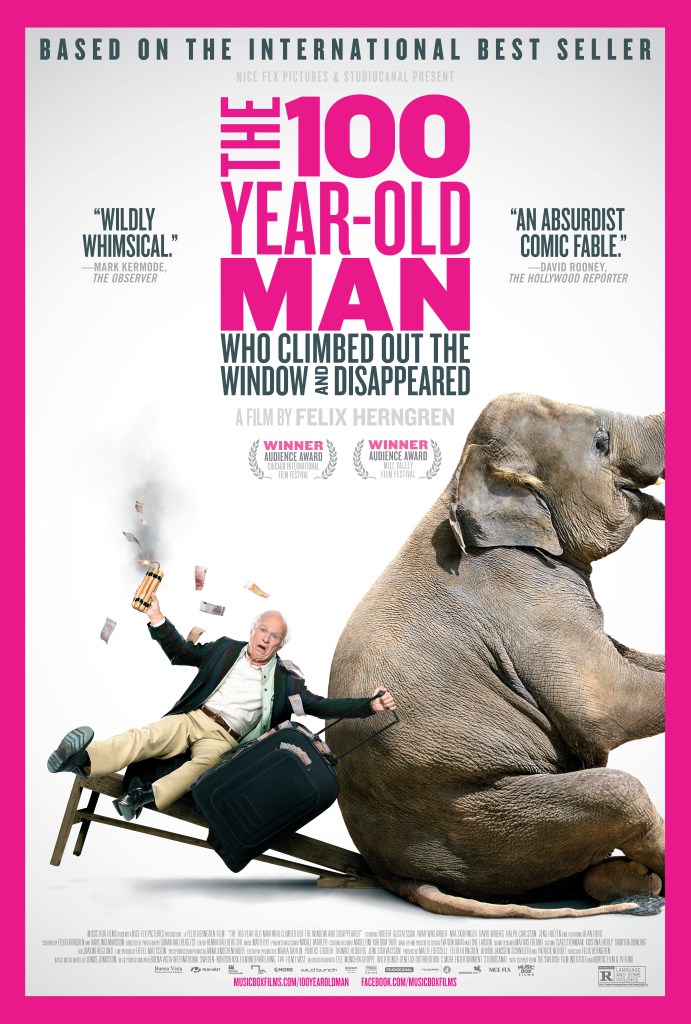
A whimsical comedy based on the bestselling Swedish novel (and book-club fodder) by Jonas Jonasson, The 100-Year-Old Man Who Climbed out the Window and Disappeared begins with exactly that, as Allan Karlsson (Gustafsson) escapes his retirement home on the day of his inauguration into the centenarian club with a “fuck this” attitude and little more than the slippers that bear his first name in Magic Marker. He shuffles off to the bus station where he buys a ticket to the next bus leaving town and inadvertently steals a suitcase with 50 million krona from some local thugs. He hooks up with a retired train attendant, Julius (Wiklander), and together they hit the road, picking up stray characters to add to their entourage while (often unknowingly) skirting the tattooed gangsters after that jackpot. One character owns an elephant. Another can’t decide on a career path, so has almost completed a half-dozen degrees. It is all very fanciful and droll, a mildly subversive and ramshackle Scandinavian version of the Grumpy Old Men on-the-road formula.

But that’s only half the story. Through flashbacks that seem to come whenever the present-day action hits a lull, we see Allan’s life unfold, and what a life that was. From his humble beginnings as the son of a revolutionary, young Allan develops a passion for blowing things up that parlays him into becoming a demolitions expert. There follows a stumbling and drunken shuffle through the history of the major conflicts of the 20th century (the film will be endlessly compared to Forrest Gump), as Allan travels to Franco’s Spain for the Spanish Civil War, helps Robert Oppenheimer develop the atomic bomb, pisses off Josef Stalin to the point where he gets sent to a gulag, becomes a double agent for the CIA during the Cold War, confers with Ronald Reagan, etc. Throughout it all, Allan is oblivious to the impact he has on world events, holding true to the theory espoused by his mother that “life is what it is and does what it does.”

These two narrative threads are constantly jockeying for dominance in a story that has a refreshing nonchalance, but is hindered by the lack of any tension whatsoever. Obviously better served as a novel, The 100-Year-Old Man… still entertains for the majority of its running time, but it feels like two separate movies, a dual shaggy dog story stitched together like Frankenstein’s monster, never breaking free of its quirky literary origins.

Watch The 100-Year-Old Man… on Kanopy here: https://www.kanopy.com/en/product/1053322

Saturday Matinee: A Man Called Ove

By Odie Henderson

Source: RogerEbert.com

“A Man Called Ove” tells the familiar story of the curmudgeonly old man whose grumpy life is brightened by forces beyond his control. These forces take the guise of a much younger person who provides a sense of purpose for the old hero. A film like this rises or falls not only with its central performance, but also with its ability to engage the viewer’s emotions in a credible, honest fashion. Movies like this tend to get dismissed as “manipulative” because audience sympathy for the protagonist is at least partially elicited by flashbacks to a litany of tragic or unfair past events. But all movies are manipulative by default; the effectiveness of that manipulation is the more valid measurement to inspect. On that scale, “A Man Called Ove” is a morbidly funny and moving success.

Adapting Frederick Backman’s Swedish best seller, writer/director Hannes Holm doesn’t veer too far from the storytelling structure we’ve come to expect. Instead, he tweaks expectations with the way he presents the material, and his grip on the film’s tricky, tragicomic tone is masterful. For example, several flashbacks are cleverly presented as the “life flashing before one’s eyes” moments triggered by the suicide attempts of Ove (Rolf Lassgård). Ove is a widower whose daily visits to his recently deceased wife’s gravesite end with his verbal promise to join her in the afterlife. His failures of self-annihilation are due more to bad timing than botched attempts—he is constantly interrupted by neighbors or some distracting event going on in his housing complex. Priding himself on his reliability, Ove feels compelled to stop killing himself to address each interruption.

Keep in mind that the black humor in this situation doesn’t arise from any mockery of Ove’s pain over missing his spouse. That is presented as real, understandable pain. Instead, the humor comes from Ove’s stubbornness as a creature of habit. Perpetually enforcing neighborhood rules nobody cares about nor adheres to, Ove can’t resist the opportunity to scold those who violate them. Yet, for all his crabbiness, there’s a level of selflessness inherent in Ove’s character, a trait he finds infuriating yet he begrudgingly accepts. His wife, Sonja, played as a young woman in the flashbacks by Ida Engvoll, sees this in the younger version of Ove (Filip Berg), and the much older Ove acknowledges it after much bitching and griping. It’s almost as if Sonja is sending him interruptions from beyond the grave just so he can have an excuse to complain to her like he’s done every day since her passing. This compulsive adherence to routine will keep Ove distracted.

Also distracting Ove is the new, young family who moves next door to him. They start off on the wrong foot by crushing his mailbox while ignoring his sign about not driving in the area, and the noise from their young kids is a major annoyance to the childless Ove. Though the husband is originally from the area, his pregnant wife Parvaneh (Bahar Pars) is of Iranian descent and new to the country. It is she who constantly irritates Ove while simultaneously endearing herself and her family to him. Many of his suicide attempts are interrupted by her, and their eventual father-daughter style bond is often predicated on Ove’s opinion that his help is required because he thinks her husband is an idiot.

“You survived struggle in Iran, moving here and learning a new language, and being married to that idiot,” Ove tells her after taking up the task of her driving instructor, “driving a car should be no problem!” Of course, she can’t drive it wherever Ove has those “no driving” signs everybody else ignores.

Admittedly, “A Man Called Ove” throws everything but the kitchen sink at poor Ove. There’s a shocking death early on that haunts him (and us), and he is the recipient of several slights by higher ups at work and in the government. The marriage between the shy Ove and the jovial Sonja is full of love but fraught with personal tragedies. There’s an almost Job-like mercilessness to some of the fates that befall him, yet the film never dwells on them. Instead, they’re presented rather stoically and serve as a means for us to understand why Ove is who he is. This is a movie that softens its hero by giving him a cat, which sounds syrupy until you see how jacked up and scraggly this cat is. “He likes to shit in private,” says Ove to Parvaneh. “Please give him that courtesy.”

One gets the sense that the novel (and the award-winning film version) is so beloved because Ove represents a Scandinavian everyman who saunters on no matter what life throws at him. His admirable resilience toughens like leather, and his love of Saab and hatred of Volvo plays like a beautiful in-joke aimed straight at the hearts of his compatriots. That rivalry even costs him a friendship, though that same friend’s subplot also presents Ove angrily battling the unfeeling agents of bureaucracy that caused him such agony as a young man. Holm pulls everything together in a well-crafted, satisfying package that is nicely balanced between comedy and pathos.

As Ove, Lassgård gives one of the year’s best performances. He’s well supported by the other actors (and the aforementioned cat), but this is a rich, complex performance that is both funny and moving. It would have been easy to just let Ove coast by on his amusing grouchiness, but Lassgård lets us see so deeply under that protective exterior. We feel as if we’ve walked a mile in Ove’s shoes and absorbed his catharsis as our own.

Watch A Man Called Ove on Kanopy here: https://www.kanopy.com/en/product/5563258

Saturday Matinee: Sound of Noise

‘Sound Of Noise’ A Clever, Unique & Musical Heist Film

By Gabe Toro

Source: The Playlist

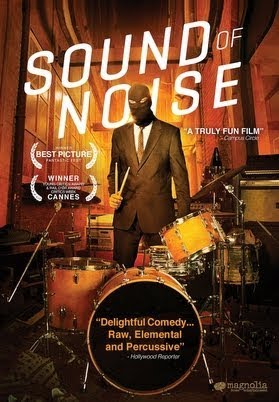
“This is a gig!” screams a gang of masked assailants as they enter a busy Swedish bank. The customers are pushed and prodded, forced into a corner, hiding behind their ruffled suits as the perpetrators begin to activate the shredders, printing cash and destroying it in front of them, an activity that involves the ruffling of dollars, the tapping of keyboards, the clang of coins against glass, and yes, maybe some added percussive activities. It’s music, and it’s only one of many “attacks” from this ambitious group.

A terrorist group by definition, these musicians, who won’t sing or dance, instead perform acts of disruption, seeking no material gain aside from bringing the sound of chaos to everyone’s doorstep. To them, the enemy is convention, and while they arrange their attacks as “movements,” each with its own separate attack point, their weapon of choice are endless looping drums. Essentially, what if “Stomp” had an agenda.

Directed by Ola Simonsson and Johannes Stjärne Nilsson, “Sound Of Noise” is cleverly, strictly defined as a heist film, honoring the conventions of the genre before we even realize nothing is being heisted, exactly. Early on, the two leaders of the gang are even seen scouting and recruiting fellow drummers, reading off dossiers as we watch these musicians struggle in unnatural habitats. This is all straight-faced, of course. Drums are not a joke, they’re a way of life. These guys can’t even flee during a chase scene without picking up some drumsticks.

In hot pursuit is a rogue cop, the only one on the force who seems to understand what this group is doing. Unfortunately, not only is he tone-deaf, but his hearing is dropping out as well. He announces that he will “rid this city of musician scum” but clearly he sees something in this group that he’s been denying about himself for years. Oh, and by the way, his name is Amadeus.

Based around one central gimmick, the otherwise skimpy “Sound Of Noise” doesn’t overstay its welcome, paced in accordance with its musical set-pieces. Not necessarily a musical, it’s moments of downtime still seemingly choreographed by the insistent whir of a Metronome, much like the one our gang leaves at the scene of the crime. As such, it’s terrific fun, building to an unlikely climax involving entire city blocks and a confluence of light and sound more exciting than most climactic blockbuster explosions. Movies have long thrilled in teaching audiences that some problems can be solved with a punch or a finely-tuned monologue or two. Finally, someone has substituted percussion instead. 

Watch Sound of Noise on Kanopy here: https://www.kanopy.com/product/sound-noise