
Saturday Matinee: The Visitor

Witney Seibold Reviews ‘The Visitor’ (1979)

By Witney Seibold

Source: Critically Acclaimed

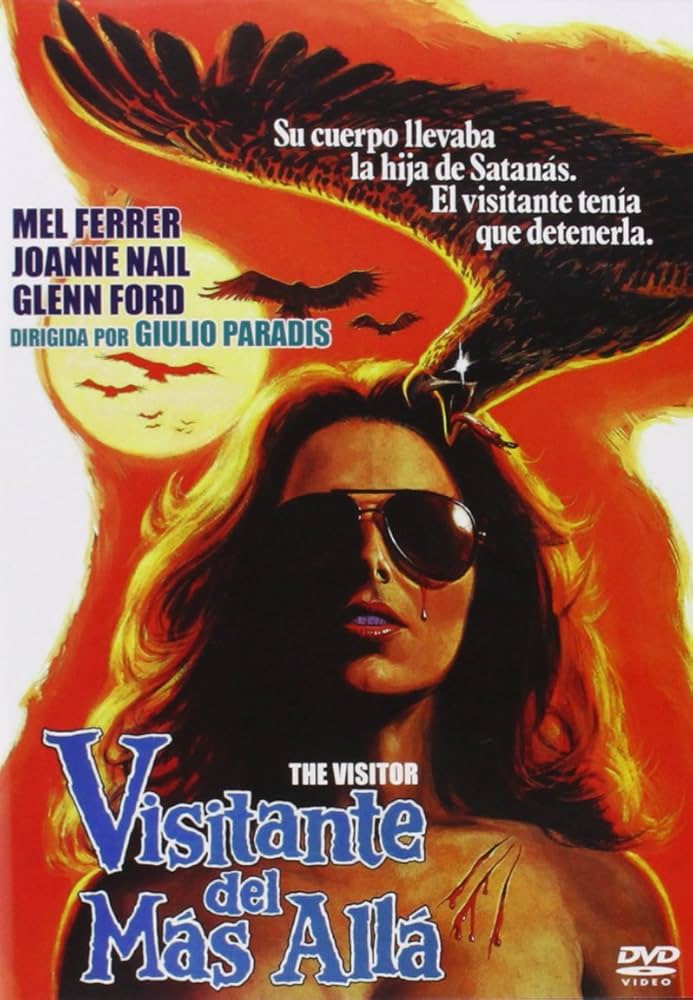
I first encountered Michael J. Paradise’s “The Visitor” at an after-hours, by-invite-only screening curated by my local video store. 

You see: The managers of said video store would, on a weekly basis, acquire whatever 35mm prints they could get a hold of for cheap and/or free. These prints consisted of obscure German comedies, weird sex films, lost genre oddities, sci-fi epics with missing reels, and, in one baffling bout of programming, “My Giant.” Then, in conjunction with a helpful projectionist at the movie theater next door (where I worked at the time), the store managers would invite over employees and friends of employees to view said films, eager to talk aloud in the theater and openly discuss the insanity on screen. These were magical nights of baffling cinematic exploration, and I’m glad to have been invited on several occasions.

It was in this milieu that I was introduced to Michael J. Paradise’s 1979 sci-fi epic “The Visitor,” perhaps one of the most baffling films ever produced. It was such a moving experience that I rushed to my (now long-neglected) criticism blog to review it. That was in 2007. The time has now come to re-visit “The Visitor” and see what new lessons can be learned. Luckily, the film is just as brain-melting as it always was.

Michael J. Paradise is the nom de cinéma of director Giulio Paradisi, an Italian character actor and assistant director who only made four features in his career (one of which was a crime comedy called “Spaghetti House”). “The Visitor” was his second feature, and, from the looks of it, the most ambitious. Tapping into many of the “2001”-inspired sci-fi trends of the time, Paradisi made a film that sought to tie together the cosmos with spirituality, Jesus with space aliens, and apocalyptic genre tropes with an all-star cast. 

“The Visitor” sets its sights on the entire universe, the nature of good and evil, and how humanity is the plaything of warring ancient space deities. The “big questions,” however, are mixed into a psychedelic bouillabaisse of confounding imagery, bad plotting, and weird-ass performances, at least one of which was done entirely under the influence of alcohol. “The Visitor” is insane.

The plot of the film centers on a young girl named Katy (Paige Connor) who is poised to be the next Christ or the next Antichrist, depending on which timeless deity can influence her fastest. On the light side is John Huston and Franco Nero, who oversee an ultra-futuristic space lounge populated by bald children. Nero dispenses Christ-like wisdom while Huston does the legwork; Huston sets up shop on modern-day Earth atop a Los Angeles skyscraper with a cadre of performing space cultists. Many of Huston’s scenes involve his direction of their performance art and his manipulating the stars with his very mind. He wants Katy to become a vessel for – who else? – Yahweh.

On the dark side, we have Lance Henricksen, owner of the Atlanta basketball team, who regularly attends creepy board meetings in a modern high-rise to discuss apocalyptic details with a shadowy cabal of high-powered executives. Henricksen is urged by this cabal (headed by Mel Ferrer) to magically influence young Katy into becoming a vessel for Zatteen, a.k.a. Satan. Katy, meanwhile, has already displayed a propensity for evil: Not only does she have telekinetic powers, but at her birthday party, Katy received a gun as a present (!) and shoots her aunt.

Shelley Winters also appears as a recently-hired nanny for Katy, but I was unsure if she was in the employ of the Huston cult or the Henricksen cult. At the film’s conclusion, she does give a tearful farewell to the Huston character, but that adds no rhyme nor reason. To add a much-needed human element to “The Visitor,” much of the film is seen through the eyes of Katy’s mother Barbara (Joanne Nail), who serves as our protagonist. She will eventually be felled by a gunshot and will spend much of “The Visitor” in a wheelchair.

The above synopsis only emerged in my mind after several viewings of “The Visitor.” While in the midst of actually viewing this Frankensteinian monstrosity, however, one may find themselves totally lost. “The Visitor” takes very long intermissions wherein portentous music pounds at the soundtrack but not much of ultimate consequence happens. The star-manipulating scene mentioned above is neat, I suppose, but it has no influence on the characters or the story as far as I can tell. There is another sequence wherein Katy is particularly at risk at an ice-skating rink, and the film’s poor sense of spatial continuity might have one believing that John Huston is scurrying down 3000 flights of stairs to stop it. At the end of that fateful descent, nothing notable happens.

The most mind-blowing celebrity cameo is provided by Sam Peckinpah who, in 1979, was in dire straits. In 1978, he directed “Convoy,” often seen as the least of his films, and it’s been posited that he accepted make “Convoy” only due to his addictions to booze and cocaine. He appears in one scene of “The Visitor” as Barbara’s ex-husband and Katy’s biological father. Peckinpah’s dialogue appears to have been dubbed, and, as we posited at that midnight screening so many years ago, it may have been because he was too drunk to remember his lines. He certainly seems tipsy and unhappy in his scenes.

In 2007, I was happy to let “The Visitor” melt my brain without much in the way of analysis. It was instantly classified by the midnight audience as a “Holy Fucking Shit” movie, and it still, to this day, enjoys a coveted spot on the “Holy Fucking Shit” shelf at CineFile Video

In 2018, having now seen more bonkers, psychedelic 1970s sci-fi epics, I have a better context for it. Thanks to “2001: A Space Odyssey,” audiences enjoyed nearly a decade of incredibly ambitious sci-fi movies that sought to unlock the deepest philosophical questions about eternity, humankind’s place in the cosmos, and how our consciousnesses may be a vital piece to a vast, astral puzzle. If one is swallowing tabs of acid while watching Carl Sagan interviews, one could easily conceive of something like “The Visitor.” 

I can’t say that the bulk of 1970s psychedelia was necessarily successful – they were big on histrionics but short on actual logic, character, historical theology, filmmaking acumen, or even basic entertainment value – but one can at least admire them for being willing to tip into the surreal to reach something higher. The movies often suck, but I can see why someone might have written something like, say, “God Told Me To” or “Zardoz.” I just couldn’t say how they did.

“The Visitor” will ever remain an oddity, but wow, what a rush! This is one of the crown jewels in baffling psychedelic 1970s freakout cinema and should be shared immediately. Drafhouse Films put out a handsome Blu-ray of it a few years back, and I encourage the purchase of it, sight unseen. I have my copy.  


Watch The Visitor on Kanopy here: https://www.kanopy.com/en/kcls/video/13448350
Saturday Matinee: Night of the Hunter

By Roger Ebert

Source: RogerEbert.com

Charles Laughton’s “The Night of the Hunter” (1955) is one of the greatest of all American films, but has never received the attention it deserves because of its lack of the proper trappings. Many “great movies” are by great directors, but Laughton directed only this one film, which was a critical and commercial failure long overshadowed by his acting career. Many great movies use actors who come draped in respectability and prestige, but Robert Mitchum has always been a raffish outsider. And many great movies are realistic, but “Night of the Hunter” is an expressionistic oddity, telling its chilling story through visual fantasy. People don’t know how to categorize it, so they leave it off their lists.

Yet what a compelling, frightening and beautiful film it is! And how well it has survived its period. Many films from the mid-1950s, even the good ones, seem somewhat dated now, but by setting his story in an invented movie world outside conventional realism, Laughton gave it a timelessness. Yes, the movie takes place in a small town on the banks of a river. But the town looks as artificial as a Christmas card scene, the family’s house with its strange angles inside and out looks too small to live in, and the river becomes a set so obviously artificial it could have been built for a completely stylized studio film like “Kwaidan” (1964).

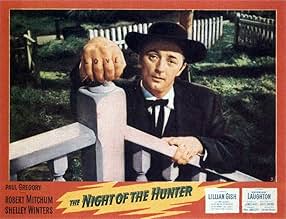
Everybody knows the Mitchum character, the sinister “Reverend” Harry Powell. Even those who haven’t seen the movie have heard about the knuckles of his two hands, and how one has the letters H-A-T-E tattooed on them, and the other the letters L-O-V-E. Bruce Springsteen drew on those images in his song “Cautious Man”:

“On his right hand Billy’d tattooed the word “love” and on his left hand was the word “fear” And in which hand he held his fate was never clear”

Many movie lovers know by heart the Reverend’s famous explanation to the wide-eyed boy (“Ah, little lad, you’re staring at my fingers. Would you like me to tell you the little story of right-hand/left-hand?”) And the scene where the Reverend stands at the top of the stairs and calls down to the boy and his sister has become the model for hundred other horror scenes.

But does this familiarity give “The Night of the Hunter” the recognition it deserves? I don’t think so because those famous trademarks distract from its real accomplishment. It is one of the most frightening of movies, with one of the most unforgettable of villains, and on both of those scores it holds up as well after four decades as I expect “The Silence of the Lambs” to do many years from now.

The story, somewhat rearranged: In a prison cell, Harry Powell discovers the secret of a condemned man (Peter Graves), who has hidden $10,000 somewhere around his house. After being released from prison, Powell seeks out the man’s widow, Willa Harper (Shelley Winters), and two children, John (Billy Chapin) and the owl-faced Pearl (Sally Jane Bruce). They know where the money is, but don’t trust the “preacher.” But their mother buys his con game and marries him, leading to a tortured wedding night inside a high-gabled bedroom that looks a cross between a chapel and a crypt.

Soon Willa Harper is dead, seen in an incredible shot at the wheel of a car at the bottom of the river, her hair drifting with the seaweed. And soon the children are fleeing down the dream-river in a small boat, while the Preacher follows them implacably on the shore; this beautifully stylized sequence uses the logic of nightmares, in which no matter how fast one runs, the slow step of the pursuer keeps the pace. The children are finally taken in by a Bible-fearing old lady (Lillian Gish), who would seem to be helpless to defend them against the single-minded murderer, but is as unyielding as her faith.

The shot of Winters at the bottom of the river is one of several remarkable images in the movie, which was photographed in black and white by Stanley Cortez, who shot Welles’ “The Magnificent Ambersons,” and once observed he was “always chosen to shoot weird things.” He shot few weirder than here, where one frightening composition shows a street lamp casting Mitchum’s terrifying shadow on the walls of the children’s bedroom. The basement sequence combines terror and humor, as when the Preacher tries to chase the children up the stairs, only to trip, fall, recover, lunge and catch his fingers in the door. And the masterful nighttime river sequence uses giant foregrounds of natural details, like frogs and spider webs, to underline a kind of biblical progression as the children drift to eventual safety.

The screenplay, based on a novel by Davis Grubb, is credited to James Agee, one of the icons of American film writing and criticism, then in the final throes of alcoholism. Laughton’s widow, Elsa Lanchester, is adamant in her autobiography: “Charles finally had very little respect for Agee. And he hated the script, but he was inspired by his hatred.” She quotes the film’s producer, Paul Gregory: “. . . the script that was produced on the screen is no more James Agee’s . . . than I’m Marlene Dietrich.”

Who wrote the final draft? Perhaps Laughton had a hand. Lanchester and Laughton both remembered that Mitchum was invaluable as a help in working with the two children, whom Laughton could not stand. But the final film is all Laughton’s, especially the dreamy, Bible-evoking final sequence, with Lillian Gish presiding over events like an avenging elderly angel.

Robert Mitchum is one of the great icons of the second half-century of cinema. Despite his sometimes scandalous off-screen reputation, despite his genial willingness to sign on to half-baked projects, he made a group of films that led David Thomson, in his Biographical Dictionary of Film, to ask, “How can I offer this hunk as one of the best actors in the movies?” And answer: “Since the war, no American actor has made more first-class films, in so many different moods.” “The Night of the Hunter,” he observes, represents “the only time in his career that Mitchum acted outside himself,” by which he means there is little of the Mitchum persona in the Preacher.

Mitchum is uncannily right for the role, with his long face, his gravel voice, and the silky tones of a snake-oil salesman. And Shelly Winters, all jitters and repressed sexual hysteria, is somehow convincing as she falls so prematurely into, and out of, his arms. The supporting actors are like a chattering gallery of Norman Rockwell archetypes, their lives centered on bake sales, soda fountains and gossip. The children, especially the little girl, look more odd than lovable, which helps the film move away from realism and into stylized nightmare. And Lillian Gish and Stanley Cortez quite deliberately, I think, composed that great shot of her which looks like nothing so much as Whistler’s mother holding a shotgun.

Charles Laughton showed here that he had an original eye, and a taste for material that stretched the conventions of the movies. It is risky to combine horror and humor, and foolhardy to approach them through expressionism. For his first film, Laughton made a film like no other before or since, and with such confidence it seemed to draw on a lifetime of work. Critics were baffled by it, the public rejected it, and the studio had a much more expensive Mitchum picture (“Not as a Stranger”) it wanted to promote instead. But nobody who has seen “The Night of the Hunter” has forgotten it, or Mitchum’s voice coiling down those basement stairs: “Chillll . . . dren?”