
NATO’s military intervention in Libya in 2011, which overthrew the regime of Muammar Gaddafi, resulted in a chaotic and murderous failed state. Libyans pay a horrific price for this catastrophe.
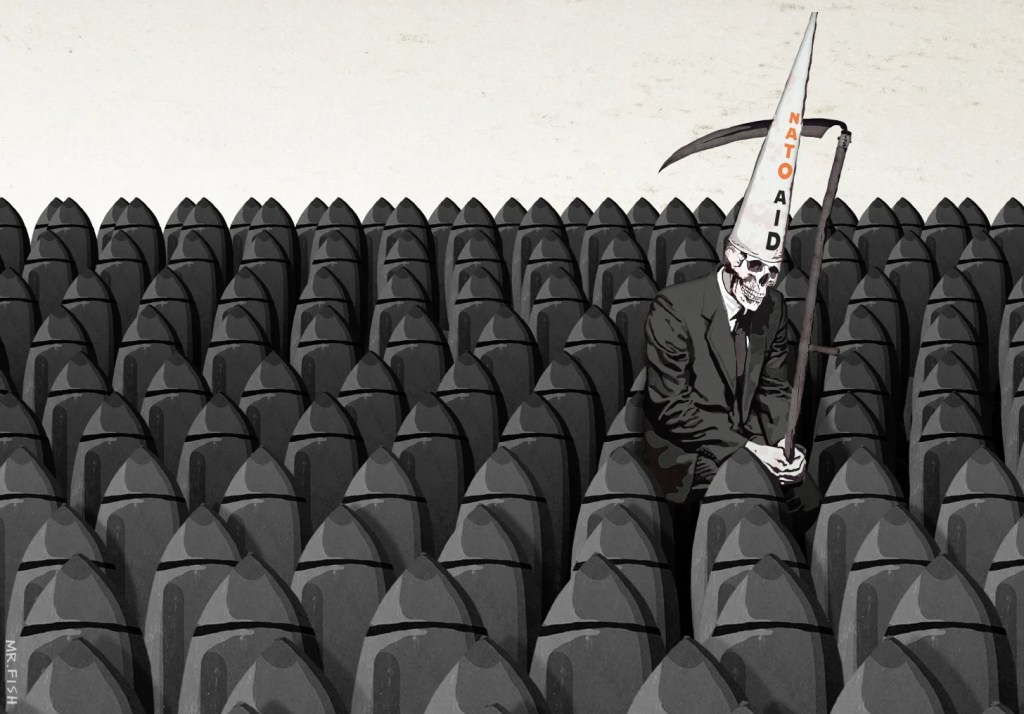
By Chris Hedges
Source: The Chris Hedges Report
“We came, we saw, he died,” Hillary Clinton famously quipped when Muammar Gaddafi, after seven months of U.S. and NATO bombing, was overthrown in 2011 and killed by a mob who sodomized him with a bayonet. But Gaddafi would not be the only one to die. Libya, once the most prosperous and one of the most stable countries in Africa, a country with free healthcare and education, the right for all citizens to a home, subsidized electricity, water and gasoline, along with the lowest infant mortality rate and highest life expectancy on the continent, along with one of the highest literacy rates, swiftly fragmented into warring factions. There are currently two rival regimes battling for control in Libya, along with an array of rogue militias.
The chaos that followed Western intervention saw weapons from the country’s arsenals flood the black market, with many snatched up by groups such as the Islamic State. Civil society ceased to function. Journalists captured images of migrants from Nigeria, Senegal and Eritrea being beaten and sold as slaves to work in fields or on construction sites. Libya’s infrastructure, including its electrical grids, aquifers, oil fields and dams, fell into disrepair. And when the torrential rains from Storm Daniel — the climate crisis being another gift to Africa from the industrialized world — overwhelmed two decrepit dams, walls of water 20 feet high raced down to flood the port of Derna and Benghazi, leaving up to 20,000 dead according to Abdulmenam Al-Gaiti, Mayor of Derna, and some 10,000 missing.
“The fragmentation of the country’s disaster management and disaster response mechanisms, as well as deteriorating infrastructure, exacerbated the enormity of the challenges. The political situation is a driver of risk,” said Professor Petteri Taalas, Secretary General of the World Meteorological Organization.
Taalas told reporters last Thursday that “most of the human casualties” would have been avoided if there had been a “normally operating meteorological service” which “would have issued the [necessary] warnings and also the emergency management of this would have been able to carry out evacuations of the people.”
Western regime-change, carried out in the name of human rights under the doctrine of R2P (Responsibility to Protect), destroyed Libya – as it did Iraq – as a unified and stable nation. The flood victims are part of the tens of thousands of Libyan dead resulting from our “humanitarian intervention,” which rendered disaster relief non-existent. We bear responsibility for Libya’s prolonged suffering. But once we wreak havoc on a country in the name of saving its persecuted — regardless of whether they are being persecuted or not — we forget they exist.
Karl Popper in “The Open Society and Its Enemies” warned against utopian engineering, massive social transformations, almost always implanted by force, and led by those who believe they are endowed with a revealed truth. These utopian engineers carry out the wholesale destruction of systems, institutions and social and cultural structures in a vain effort to achieve their vision. In the process, they dismantle the self-correcting mechanisms of incremental and piecemeal reform that are impediments to that grand vision. History is replete with murderous utopian social engineering — the Jacobins, the communists, the fascists and now, in our own age, the globalists, or neoliberal imperialists.
Libya, like Iraq and Afghanistan, fell victim to the self-delusions peddled by humanitarian interventionists — Barack Obama, Hillary Clinton, Ben Rhodes, Samantha Power and Susan Rice. The Obama administration armed and backed an insurgent force that they believed would do the bidding of the U.S. Obama in a recent post urged people to support aid agencies to alleviate the suffering of the people of Libya, a plea that ignited an understandable backlash on social media.
There is no official tally of the casualties in Libya that have resulted directly and indirectly from the violence in Libya over the last 12 years. This is exacerbated by the fact that NATO failed to investigate casualties resulting from its seven month bombardment of the country in 2011. But the total figure of those killed and injured is likely in the tens of thousands. Action on Armed Violence recorded “8,518 deaths and injuries from explosive violence in Libya” from 2011 to 2020, 6,027 of which were civilian casualties.
In 2020, a statement published by seven U.N. agencies reported that “Close to 400,000 Libyans have been displaced since the start of the conflict nine years ago — around half of them within the past year, since the attack on the capital, Tripoli, [by Field Marshal Khalifa Belqasim Haftar’s forces] started.”
“The Libyan economy has been battered by the [civil war], the COVID-19 pandemic, and Russia’s invasion of Ukraine,” the World Bank reported in April of this year. “The country’s fragility is having far-reaching economic and social impact. GDP per capita declined by 50 percent between 2011 and 2020 while it could have increased by 68 percent if the economy had followed its pre-conflict trend,” the report says. “This suggests that Libya’s income per capita could have been 118 percent higher without the conflict. Economic growth in 2022 remained low and volatile due to conflict-related disruptions in oil production.”
Amnesty International’s 2022 Libya report also makes for grim reading. “Militias, armed groups and security forces continued to arbitrarily detain thousands of people,” it says. “Scores of protesters, lawyers, journalists, critics and activists were rounded up and subjected to torture and other ill-treatment, enforced disappearances and forced ‘confessions’ on camera.” Amnesty describes a country where militias operate with impunity, human rights abuses, including kidnappings and sexual violence, are widespread. It adds that “EU-backed Libyan coastguards and the Stability Support Authority militia intercepted thousands of refugees and migrants at sea and forcibly returned them to detention in Libya. Detained migrants and refugees were subjected to torture, unlawful killings, sexual violence and forced labour.”
Reports by the U.N. Support Mission to Libya (UNSMIL) are no less dire.
Stockpiles of weapons and ammunition — estimated to be between 150,000 and 200,000 tons — were looted from Libya with many being trafficked to neighboring states. In Mali, weapons from Libya fuelled a dormant insurgency by the Tuareg, destabilizing the country. It ultimately led to a military coup and a jihadist insurgency which supplanted the Tuareg, as well as a protracted war between the Malian government and jihadists. This triggered another French military intervention and led to 400,000 people being displaced. Weapons and ammunition from Libya also made their way into other parts of the Sahel including Chad, Niger, Nigeria and Burkina Faso.
The misery and carnage, which rippled out from a dismembered Libya, was unleashed in the name of democratization, nation-building, promoting the rule of law and human rights.
The pretext for the assault was that Gaddafi was about to launch a military operation to massacre civilians in Benghazi where rebellious forces had seized power. It had as much substance as the charge that Saddam Hussein had weapons of mass destruction, another example of utopian social engineering that left over a million Iraqi dead and millions more driven from their homes.
Gaddafi — who I interviewed for two hours in April 1995 near the gutted remains of his home that was bombed by U.S. warplanes in 1986 — and Hussein were targeted not because of what they did to their own people, although both could be brutal. They were targeted because their nations had large oil reserves and were independent of Western control. They renegotiated more favorable contracts for their nations with Western oil producers and awarded oil contracts to China and Russia. Gaddafi also gave the Russian fleet access to the port of Benghazi.
Hillary Clinton’s emails, obtained via a freedom of information request and published by WikiLeaks, also expose France’s concerns about Gaddafi’s efforts to “provide Francophone African Countries with an alternative to the French Fran (CFA).” Sidney Blumenthal, a longtime adviser to Clinton, reported on his conversations with French intelligence officers about the motivations of French President Nicholas Sarkozy, the chief architect of the attack on Libya. Blumenthal writes that the French president seeks “a greater share of Libyan oil”, increased French influence in the region, an improvement in his domestic political standing, a reassertion of French military power and an end to Gaddafi’s attempts to supplant French influence in “Francophone Africa.”
Sarkozy, who has been convicted on two separate cases of corruption and breach of campaign finance laws, faces a historic trial in 2025 for allegedly receiving millions of euros in secret illegal campaign contributions from Gadaffi, to assist with his successful 2007 presidential bid.
These were the real “crimes” in Libya. But the real crimes always remain hidden, papered over by florid rhetoric about democracy and human rights.
The American experiment, built on slavery, began with a genocidal campaign against Native Americans that was exported to the Philippines and, later, nations such as Vietnam. The narratives we tell ourselves about World War II, largely to justify our right to intervene around the globe, are a lie. It was the Soviet Union that destroyed the German army long before we landed at Normandy. We firebombed cities in Germany and Japan killing hundreds of thousands of civilians. The war in the South Pacific, where one of my uncles fought, was bestial, characterized by rabid racism, mutilation, torture and the routine execution of prisoners. The atomic bombings of Hiroshima and Nagasaki were egregious war crimes. The U.S. routinely destroys democracies that nationalize U.S. and European corporations as in Chile, Iran and Guatemala, replacing them with repressive military regimes. Washington supported the genocides in Guatemala and East Timor. It embraces the crime of preemptive war. There is little in our history to justify the claim of unique American virtues.
The nightmares we orchestrated in Iraq, Afghanistan and Libya are minimized or ignored by the press while the benefits are exaggerated or fabricated. And since the U.S. does not recognize the International Criminal Court, there is no chance of any American leader being held accountable for their crimes.
Human rights advocates have become a vital cog in the imperial project. The extension of U.S. power, they argue, is a force for good. This is the thesis of Samantha Power’s book “A Problem from Hell: America and the Age of Genocide.” They champion the R2P doctrine, unanimously adopted in 2005 at the U.N. World Summit. Under this doctrine, states are required to respect the human rights of their citizens. When these rights are violated, then sovereignty is nullified. Outside forces are permitted to intervene. Miguel d’Escoto Brockmann, the former president of the U.N. General Assembly, warned in 2009 that R2P could be misused “to justify arbitrary and selective interventions against the weakest states.”
“Since the end of the Cold War, the idea of human rights has been made into a justification for intervention by the world’s leading economic and military powers, above all, the United States, in countries that are vulnerable to their attacks,” writes Jean Bricmont in “Humanitarian Imperialism: Using Human Rights to Sell War.” “Until the U.S. invasion of Iraq, [a] large part of the left was often complicit in this ideology of intervention, discovering new ‘Hitlers’ as the need arose, and denouncing antiwar arguments as appeasement on the model of Munich in 1938.”
The creed of humanitarian intervention is selective. Compassion is extended to “worthy” victims while “unworthy” victims are ignored. Military intervention is good for Iraqis, Afghans or Libyans, but not for Palestinians or Yeminis. Human rights are supposedly sacrosanct when discussing Cuba, Venezuela and Iran, but irrelevant in our offshore penal colonies, the world’s largest open air prison in Gaza or our drone-infested war zones. The persecution of dissidents and journalists is a crime in China or Russia, but not when the targets are Julian Assange and Edward Snowden.
Utopian social engineering is always catastrophic. It creates power vacuums that augment the suffering of those the utopianists claim to protect. The moral bankruptcy of the liberal class, which I chronicle in “Death of the Liberal Class,” is complete. Liberals have prostituted their supposed values to the Empire. Incapable of taking responsibility for the carnage they inflict, they clamor for more destruction and death to save the world.
 After the Crash