
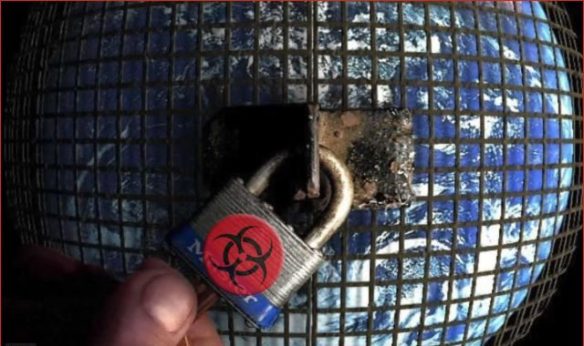
Detect, Deter and Annihilate: How the Police State Will Deal with a Coronavirus Outbreak

By John W. Whitehead

Source: The Rutherford Institute

“Fear is a primitive impulse, brainless as hunger, and because the aim of horror fiction is the production of the deepest kinds of fears, the genre tends to reinforce some remarkably uncivilized ideas about self-protection. In the current crop of zombie stories, the prevailing value for the beleaguered survivors is a sort of siege mentality, a vigilance so constant and unremitting that it’s indistinguishable from the purest paranoia.”— Terrence Rafferty, New York Times

What do zombies have to do with the U.S. government’s plans for dealing with a coronavirus outbreak?

Read on, and I’ll tell you.

The zombie narrative was popularized by the hit television series The Walking Dead, in which a small group of Americans attempt to survive in a zombie-ridden, post-apocalyptic world where they’re not only fighting off flesh-eating ghouls but cannibalistic humans.

For a while there, zombies could be found lurking around every corner: wreaking havoc at gun shows, battling corsets in movies such as Pride and Prejudice and Zombies, and running for their lives in 5K charity races.

Understandably, zombie fiction plays to our fears and paranoia, while allowing us to “envision how we and our own would thrive if everything went to hell and we lost all our societal supports.” Yet as journalist Syreeta McFadden points out, while dystopian stories used to reflect our anxieties, now they reflect our reality, mirroring how we as a nation view the world around us, how we as citizens view each other, and most of all how our government views us.

Indeed, the U.S. government has spent a lot of time and energy in recent years using zombies as the models for a variety of crisis scenarios not too dissimilar from what we are currently experiencing.

For instance, back in 2015, the Centers for Disease Control and Prevention put together a zombie apocalypse preparation kit “that details everything you would need to have on hand in the event the living dead showed up at your front door.” The CDC, in conjunction with the Dept. of Defense, even used zombies to put government agents through their paces in mock military drills.

Fear the Walking Dead—AMC’s spinoff of its popular Walking Dead series—drove this point home by dialing back the clock to when the zombie outbreak first appears and setting viewers down in the midst of societal unrest not unlike our own experiences of recent years (“a bunch of weird incidents, police protests, riots, and … rapid social entropy”). Then, as Forbes reports, “the military showed up and we fast-forwarded into an ad hoc police state with no glimpse at what was happening in the world around our main cast of hapless survivors.”

Forbes found Fear’s quick shift into a police state to be far-fetched, but anyone who has been paying attention in recent years knows that the groundwork was laid long ago for the government—i.e., the military—to intervene and lock down the nation in the event of a national disaster.

We’re seeing this play out now as the coronavirus contagion spreads.

What we have yet to experience (although it may only be a matter of time) is that the government through the imposition of martial law could pose a greater threat to our safety (and our freedoms) than any virus.

As the Atlantic noted about Fear the Walking Dead: “The villains aren’t the zombies, who rarely appear, but the U.S. military, who sweep into an L.A. suburb to quarantine the survivors. Zombies are, after all, a recognizable threat—but Fear plumbs drama and horror from the betrayal by institutions designed to keep people safe.”

Indeed, zombie fiction perfectly embodies the government’s paranoia about the citizenry as potential threats that need to be monitored, tracked, surveilled, sequestered, deterred, vanquished and rendered impotent.

Why else would the government feel the need to monitor our communications, track our movements, criminalize our every action, treat us like suspects, and strip us of any means of defense while equipping its own personnel with an amazing arsenal of weapons?

For years now, the government has been carrying out military training drills with zombies as the enemy. In 2011, the DOD created a 31-page instruction manual for how to protect America from a terrorist attack carried out by zombie forces. In 2012, the CDC released a guide for surviving a zombie plague. That was followed by training drills for members of the military, police officers and first responders.

As journalist Andrea Peyser reports:

Coinciding with Halloween 2012, a five-day national conference was put on by the HALO Corp. in San Diego for more than 1,000 first responders, military personnel and law enforcement types. It included workshops produced by a Hollywood-affiliated firm in…overcoming a zombie invasion. Actors were made up to look like flesh-chomping monsters. The Department of Homeland Security even paid the $1,000 entry fees for an unknown number of participants…

“Zombie disaster” drills were held in October 2012 and ’13 at California’s Sutter Roseville Medical Center. The exercises allowed medical center staff “to test response to a deadly infectious disease, a mass-casualty event, terrorism event and security procedures”…

[In October 2014], REI outdoor-gear stores in Soho and around the country are to hold free classes in zombie preparedness, which the stores have been providing for about three years.

The zombie exercises appeared to be kitschy and fun—government agents running around trying to put down a zombie rebellion—but what if the zombies in the exercises were us, the citizenry, viewed by those in power as mindless, voracious, zombie hordes?

Consider this: the government started playing around with the idea of using zombies as stand-ins for enemy combatants in its training drills right around the time the Army War College issued its 2008 report, warning that an economic crisis in the U.S. could lead to massive civil unrest that would require the military to intervene and restore order.

That same year, it was revealed that the government had amassed more than 8 million names of Americans considered a threat to national security, to be used “by the military in the event of a national catastrophe, a suspension of the Constitution or the imposition of martial law.” The program’s name, Main Core, refers to the fact that it contains “copies of the ‘main core’ or essence of each item of intelligence information on Americans produced by the FBI and the other agencies of the U.S. intelligence community.”

Also in 2008, the Pentagon launched the Minerva Initiative, a $75 million military-driven research project focused on studying social behavior in order to determine how best to cope with mass civil disobedience or uprisings. The Minerva Initiative has funded projects such as “Who Does Not Become a Terrorist, and Why?” which “conflates peaceful activists with ‘supporters of political violence’ who are different from terrorists only in that they do not embark on ‘armed militancy’ themselves.”

In 2009, the Dept. of Homeland Security issued its reports on Rightwing and Leftwing Extremism, in which the terms “extremist” and “terrorist” were used interchangeably to describe citizens they perceived to be disgruntled or anti-government.

Meanwhile, a government campaign was underway to spy on Americans’ mail, email and cell phone communications. News reports indicate that the U.S. Postal Service has handled more than 150,000 requests by federal and state law enforcement agencies to monitor Americans’ mail, in addition to photographing every piece of mail sent through the postal system.

Fast forward a few years more and local police were being transformed into extensions of the military, taught to view members of their community as suspects, trained to shoot first and ask questions later, and equipped with all of the technology and weaponry of a soldier on a battlefield.

The Obama administration then hired a domestic terrorism czar whose job is to focus on anti-government American “extremists” who have been designated a greater threat to America than ISIS or al Qaeda. As part of the government’s so-called war on right-wing extremism, the Obama administration agreed to partner with the United Nations to take part in its Strong Cities Network program, which is training local police agencies across America in how to identify, fight and prevent extremism.

Nothing has changed for the better under the Trump Administration.

Those who believe in and exercise their rights under the Constitution (namely, the right to speak freely, worship freely, associate with like-minded individuals who share their political views, criticize the government, own a weapon, demand a warrant before being questioned or searched, or any other activity viewed as potentially anti-government, racist, bigoted, anarchic or sovereign), continue to be promoted to the top of the government’s terrorism watch list.

“We the people” or, more appropriately, “we the zombies” are the enemy in the eyes of the government. This coronavirus merely ups the ante.

So when presented with the Defense Department’s battle plan for defeating an army of the walking dead, you might find yourself tempted to giggle over the fact that a taxpayer-funded government bureaucrat actually took the time to research and write about vegetarian zombies, evil magic zombies, chicken zombies, space zombies, bio-engineered weaponized zombies, radiation zombies, symbiant-induced zombies, and pathogenic zombies.

However, in an age of extreme government paranoia, this is no laughing matter.

The DOD’s strategy for dealing with a zombie uprising, outlined in “CONOP 8888,” is for all intents and purposes a training manual for the government in how to put down a citizen uprising or at least an uprising of individuals “infected” with a dangerous disease or dangerous ideas about freedom.

Rest assured that the tactics and difficulties outlined in the “fictional training scenario” are all too real, beginning with martial law.

As the DOD training manual states: “zombies [stand-ins for “we the people”] are horribly dangerous to all human life and zombie infections have the potential to seriously undermine national security and economic activities that sustain our way of life. Therefore having a population that is not composed of zombies or at risk from their malign influence is vital to U.S. and Allied national interests.”

So how does the military plan to put down a zombie (a.k.a. citizen) uprising?

The strategy manual outlines five phases necessary for a counter-offensive: shape, deter, seize initiative, dominate, stabilize and restore civil authority. Here are a few details:

Phase 0 (Shape): Conduct general zombie awareness training. Monitor increased threats (i.e., surveillance). Carry out military drills. Synchronize contingency plans between federal and state agencies. Anticipate and prepare for a breakdown in law and order.

Phase 1 (Deter): Recognize that zombies cannot be deterred or reasoned with. Carry out training drills to discourage other countries from developing or deploying attack zombies and publicly reinforce the government’s ability to combat a zombie threat. Initiate intelligence sharing between federal and state agencies. Assist the Dept. of Homeland Security in identifying or discouraging immigrants from areas where zombie-related diseases originate.

Phase 2 (Seize initiative): Recall all military personal to their duty stations. Fortify all military outposts. Deploy air and ground forces for at least 35 days. Carry out confidence-building measures with nuclear-armed peers such as Russia and China to ensure they do not misinterpret the government’s zombie countermeasures as preparations for war. Establish quarantine zones. Distribute explosion-resistant protective equipment. Place the military on red alert. Begin limited scale military operations to combat zombie threats. Carry out combat operations against zombie populations within the United States that were “previously” U.S. citizens.

Phase 3 (Dominate): Lock down all military bases for 30 days. Shelter all essential government personnel for at least 40 days. Equip all government agents with military protective gear. Issue orders for military to kill all non-human life on sight. Initiate bomber and missile strikes against targeted sources of zombie infection, including the infrastructure. Burn all zombie corpses. Deploy military to lock down the beaches and waterways.

Phase 4 (Stabilize): Send out recon teams to check for remaining threats and survey the status of basic services (water, power, sewage infrastructure, air, and lines of communication). Execute a counter-zombie ISR plan to ID holdout pockets of zombie resistance. Use all military resources to target any remaining regions of zombie holdouts and influence. Continue all actions from the Dominate phase.

Phase 5 (Restore civil authority): Deploy military personnel to assist any surviving civil authorities in disaster zones. Reconstitute combat capabilities at various military bases. Prepare to redeploy military forces to attack surviving zombie holdouts. Restore basic services in disaster areas.

Notice the similarities?

Surveillance. Military drills. Awareness training. Militarized police forces. Martial law.

As I point out in my book, Battlefield America: The War on the American People, if there is any lesson to be learned, it is simply this: whether the threat to national security comes in the form of imaginary zombies, actual terrorists, American citizens infected with the coronavirus, or disgruntled American citizens infected with dangerous ideas about freedom, the government’s response to such threats remains the same: detect, deter and annihilate.

How a Minimal Ebola Outbreak Will Devastate the U.S. Economy

By Dave Hodges

Source: Investment Watch

A World Bank analysis of the economic impact of Ebola on national economies suggests that only a minimal outbreak of the virus could very well devastate the United States and its economic interests.

Economic Consequences of the Perceived Threat of Ebola

There are two dominant theories related to the present Ebola crisis. One theory states that the media and certain government sponsored agencies such as the CDC, NIH and the FDA are hyping the Ebola crisis to promote the roll-out of mandatory vaccines. This notion promotes the belief that Ebola will not impact that many people but the fear being promoted will drive people to help people like Bill Gates make a fortune from the inevitable vaccines that  will follow this crisis. The theory certainly has merit.

The second theory postulates that Ebola will serve as a depopulation instrument AND the elite (e.g. Bill Gates) will make money on the demise of much of humanity through the implementation of mandatory vaccines, while Ebola rips through the population claiming millions of lives.

This second theory also proposes that the super-elite need not worry about succumbing to Ebola because of the fact that there are at least two vaccines and one vaccine, the 2006 human-tested Crucell vaccine, is being withheld from the public and is not being reported on in the media despite a paper trail pointing to its existence and possible efficacy as a treatment agent in the fight against Ebola. This fact has given rise to the possibility that the Crucell vaccine is effective, but the majority of the population will be receiving the hastily prepared and subsequently dangerous GSK vaccine. On the surface, this would seem like crazy thinking. However, it is actually very logical thinking because the Obama administration refuses to shut down air travel from West Africa or to shut down our porous border while trying to prevent the possibility of bioterrorism involving Ebola. Any prudent person would shut down the entry points of Ebola into the U.S. Therefore, we need to be asking what does the Obama administration know that the rest of us do not?

Which of the two theories is true? In terms of economic collapse, it does not matter which is true because either scenario will result in economic devastation.

The globalists are already warning the world about what lies ahead. On October 8, 2014, the World Bank warned about economic consequences of Ebola outbreaks on West African economies.

 “With Ebola’s potential to inflict massive economic costs on Guinea, Liberia, and Sierra Leone and the rest of their neighbors in West Africa, the international community must find ways to get past logistical roadblocks and bring in more doctors and trained medical staff, more hospital beds, and more health and development support to help stop Ebola in its tracks,” says Jim Yong Kim, the President of the World Bank Group.

In fact, the World Bank has published an economic analysis and a series of projections regarding the impacted Ebola countries in West Africa.
ebola-economics-in-africa

Ebola’s Critical Mass Impact On the U.S. Economy

What is the threshold of GDP loss that a country like the United States can endure before the wheels come off of the economy? In other words, how much of a percentage impact would Ebola have to have on the economy to devastate most businesses? Recently, the Washington Post published figures which set the historical average profit margin for a U.S. business at 4.6%. This means that if the spin-off effects of Ebola exceeds a 5% impact on the economy, the wheels will quickly come off the U.S. economy. Business failures will lead to a Stock Market collapse. Because the Glass-Steagall Act was repealed under Clinton, the Banks would be the next to fail  because they are recklessly tied to  underwriting and insuring many investment events in the Stock Market and individual savings and retirement accounts would disappear as well when the banks collapse.

Quickly, the country would fall into chaos. As widespread as the cascading economic collapse would become, no amount of martial law would contain the chaos.
Turn your attention to the World Bank chart, listed above, with regard to the projected economic impact on Liberia based upon low, medium and high projected effects  of an Ebola outbreak on their economy. Pay attention to the percentage of loss of their economic base listed in the above World Bank projections.


Ebola’s Impact on Liberia             Percentage of Impact

Low Impact From Ebola                          – 3.4%

Medium Impact From Ebola                   –  5.8%

High Impact From Ebola                         –  12.0%


Some are wondering why Liberia was chosen to illustrate the economic impact of Ebola and what this could potentially mean to the United States economy? Sierra Leone and Guinea have very primitive economies compared to Liberia, therefore, the impact of Ebola on their respective economies would be insignificant as a basis of comparison to the United States. To some extent, a Liberian comparison is invalid on its face because the Liberians do not have anything close to a 3,000 mile salad. In Liberia, there is virtually no “Just In Time” (JIT) delivery which forms the backbone of our service economy here in the United States. However, the Liberian numbers give us some idea of what we could expect in the U.S. when Ebola gains a foothold.

Since the economy of the United States is based upon JIT and our economic institutions are considerably more well-integrated and intertwined than they are in Liberia, what do you suppose would be the low, medium and high impact on the United States? Undeniably, the impact of Ebola as a factor of economic devastation would be catastrophically higher. The social consequences are devastatingly higher as well because a lower percentage of Americans are able to provide their own food supply as compared to Liberia. There are no numbers that I can point to with regard to the low, medium and high impact effect of Ebola on the U.S. economy except to say that any analysis would place the percentage of impact at a far higher rate than the World Bank projections listed for Liberia. It is safe to conclude that even a low impact effect of Ebola on the U.S. economy would exceed the 5% threshold.

When Going Out In Public Becomes Too Much of a Risk

As any politician, sociologist or policeman will tell you that the fabric that holds society together is voluntary conformity and trust. Most Americans obey most laws because we understand the importance of societal cooperation as opposed to the dangers of living in a state of anarchy. The other factor that binds society together is trust. One of the key elements of trust in America is that our citizens trust the fact that it is safe to go out in public. And going out in public is where much of America’s economic business is conducted (i.e. restaurants, movie theaters, shopping malls, football games, concerts, etc.).

Mike Adams, appearing as a guest on The Common Sense Show on October 6, 2014, captured this notion when he stated that when Americans lose trust in the belief that it is safe to be in crowds, the impact on our way of life, and especially on our economy, will be catastrophic.

To illustrate just how devastating the effects can be on the economy when people lose trust in the belief that it is safe to go out in public, let’s take a look at the immediate reaction from the citizens of Dallas when only one Ebola case, Thomas Duncan, surfaced in the city.

When it was announced that Thomas Duncan had contact with some Dallas school children, we saw the immediate impact as Dallas moms began to keep their children home from school. Officials in Louisiana refused to receive Thomas Duncan’s property. Subsequently, and according to the AP and Veolia North America, Duncan’s effects were  disposed of in drums taken from a Dallas apartment where Duncan became ill and were burned at the company’s incinerator in Port Arthur., TX.

It does not matter what I write or what someone broadcasts on their talk show about Ebola, once people perceive there is a threat, even a low-level threat posed by someone like Thomas Duncan, the people will panic. Rationality will not be part of the decision making process. Fear will take over.

How long would police, fire, EMT personnel, hospital personnel, people that service our water supplies and the doctors that service our infirm, stay on the job following an Ebola outbreak? An examination of this question, by using Hurricane Katrina, as a comparison, tells us that by the third day, virtually all essential  services would be seriously compromised because of personnel defections. In this scenario, how would chronically ill people receive their medications? How would people get emergency appendectomies or other emergency medical procedures?  There will be no “911, what’s your emergency”? The factors that bind society together will quickly unravel  as Ebola spreads even on a relatively low level of impact.

What can you do to prepare if the economy collapses because of the economic impact of Ebola?

US Has More Sanctions Against Russia Than Against Ebola

images

By Paul Craig Roberts

Source: PaulCraigRoberts.org

We have known since . . . well, when haven’t we known that our public officials are incompetent [more specifically, incompetent at tasks serving the public interest]. Their incompetence is always expensive, but now it risks a worldwide ebola pandemic.

With so little known about a deadly disease, one would think that with ebola on the rampage in three west Africa countries, air flights to and from these countries would be halted.

When riots or kidnappings present dangers in foreign lands, the State Department issues a travel advisory and warns, and sometimes prevents, Americans from traveling to areas of danger. As the ebola danger goes beyond the person himself, one would think public officials would have halted traffic to and from west Africa. In fact, it is harder for a critic of the US government, especially if the critic is Muslim, to enter the US than for a person infected with ebola. Indeed, there are a number of Russians who cannot enter the US because of unilaterally imposed US sanctions. But there are no sanctions against ebola.

Apparently, public health officials have an outdated and incorrect comprehension of ebola and how it spreads. A sufficient number of medical personnel protected against ebola patients’ body fluids but without respirators have now been infected to indicate that the current strain of ebola can spread by air like flu. This also means surface contact.

Airplane cleaning crews at New York LaGuardia are on strike because there are no precautions or protections for cleaners who could come into contact with ebola from an infected passenger. Neither does the next passenger on an outgoing flight have any assurance that he will not be sitting in the seat occupied by an ebola carrier on the incoming flight.

In fact, something like this might have already occurred. A British citizen who has not been to countries where there are ebola outbreaks has just died in Skopje, Macedonia, apparently from ebola. His companion told authorities that they had travelled straight from the UK. The hotel has been sealed off, and the hotel staff and ambulance crew have been isolated. I assume also the traveling companion, but the report doesn’t say. http://rt.com/news/194640-briton-ebola-macedonia-dead/

Five US airports that have flights to the infected west African countries have imposed screening on incoming passengers, such as temperature checks. This is better than nothing, but if, as is believed, the deadly virus has a long incubation period, this screening would only catch people with symptoms, and, of course, there are many reasons for high temperatures, especially during cold and flu season.

So what our incompetent public officials have arranged is screening that will quarantine people who have caught a cold but fail to catch those carrying ebola who have not yet come down with it.

Par for the course.

Political issues in the Ebola crisis

ebola

By Patrick Martin

Source: WSWS.org

The report that a healthcare worker in Dallas, Texas, one of those who treated Ebola victim Thomas Eric Duncan before his death, has herself contracted the disease, is a significant and troubling event. Dr. Thomas Frieden, director of the US Centers for Disease Control and Prevention, admitted in a television interview Sunday, “It’s deeply concerning that this infection occurred.”

While Frieden claimed that current protocols for treating Ebola patients were effective in preventing the spread of the disease, arguing that there must have been “a breach of protocol,” no actual explanation has been given for how the healthcare worker became infected. She was not one of the 48 primary contacts with Duncan who were being monitored for possible exposure, but worked in a more peripheral role. Her infection was only detected when she contracted a fever and reported it herself.

There are a growing number of such cases, including doctors and nurses in the affected regions of Liberia, Sierra Leone and Guinea, who were well aware of the procedures, and an NBC News photographer, whose infection has caused the quarantining of the entire reporting team, led by Dr. Nancy Snyderman, the network’s chief medical correspondent. These cases suggest that despite the repeated assurances from health officials, there is much that is not known about how the disease is transmitted.

What is certain is that the Ebola outbreak in West Africa is a catastrophe for the people of that region. More than 8,000 people have been infected and more than 4,000 have died, with no signs that the epidemic has been curtailed. The heroic efforts of doctors, nurses and aid workers have been sabotaged by the collapse of the healthcare systems of these countries, among the poorest in the world. Only 20 percent of the affected population in West Africa has access to a treatment center.

It is almost impossible to overstate the dimensions of the disaster. Until this year, Ebola was a disease of remote rural areas that had killed only 1,500 people in 20 previous outbreaks over 40 years. Now the disease has reached urban centers like Monrovia, capital of Liberia, a city of one million, and individuals infected with the virus have travelled from the region only to fall ill in the United States, Spain and Brazil. There are well-founded fears that Ebola could become a global plague, particularly if it reaches more densely populated countries like Nigeria, or the impoverished billions of South and East Asia.

The impotent global response to the immense tragedy in West Africa is a serious warning. The Ebola crisis has proven to be a test of the ability of capitalism, as a world system, to deal with an acute and deadly threat. The profit system has failed. A society organized on the basis of production for private gain and divided into antagonistic nation-states, with a handful of imperialist powers dominating the rest, is incapable of the systematic, energetic and humane response that this crisis requires. It is no accident that the Ebola outbreak takes place in countries that are former colonies of imperialist powers. Guinea was a French colony, Sierra Leone a British colony, and Liberia a de facto US colony since its founding by freed American slaves. Despite their nominal independence, each country remains dominated by giant corporations and banks based in the imperialist countries, which extract vast profits from the mineral wealth and other natural resources. Guinea is the world’s largest bauxite exporter, Sierra Leone depends on diamond exports, Liberia has long been the fiefdom of Firestone Rubber (now Bridgestone).

These countries are unable to provide even rudimentary healthcare services to their populations, not because they lack resources, but because they are exploited and oppressed by a global economic system controlled by Wall Street and other financial and commodity markets. This economic system is so unequal that the 85 richest individuals on the planet control more wealth than the poorest three billion people, nearly half of humanity.

Economic development, particularly over the past 40 years, has created an interconnected and globalized world. Thousands of people travel every day between West Africa and other parts of the world. The revolution in transportation and communications means that what happens in West Africa today can affect Dallas, Boston, Madrid and Rio de Janeiro tomorrow. This makes the Ebola epidemic not a regional event, but a world event.

But the response to the Ebola crisis is carried out by national governments driven by competing national interests, and concerned, not with the danger of the virus to the world’s people, but with how it affects the interests of the ruling class in each nation. Thus there are calls in the United States and Europe for imposing an embargo on travelers from Liberia, Sierra Leone and Guinea, although health experts warn that such an action would cause the economic collapse of these countries, vastly worsening the epidemic and making its global spread more rather than less likely.

Equally reactionary is the Obama administration’s decision to send 4,000 US troops to Liberia, ostensibly to build health treatment facilities. Why are heavily armed soldiers chosen for such a mission? They are not construction workers or healthcare providers. If healthcare workers and journalists have become infected, despite taking every precaution, then certainly soldiers could themselves fall victim to the disease, and bring the virus home with them. The real agenda of Washington is to secure a basis for its Africa Command (AFRICOM), up to now excluded from the continent by local opposition, thus advancing the interests of American imperialism against its rivals, particularly China.

The potential dangers of a disease like Ebola spreading from rural Africa to the world have long been understood by epidemiologists and other scientists. It has been the subject of specialized studies and best-selling books. The issue has even penetrated into popular culture through films from The Andromeda Strain to Outbreak and 28 Days. But the profit system has been incapable of generating a serious effort to forestall an entirely predictable crisis.

The detection of Ebola in the mid-1970s should have been the occasion for the launching of an intensive effort to study the virus, analyze how it is transmitted and develop antidotes and a vaccine. This did not take place, in large measure, as a report last month suggested, because the giant pharmaceutical companies that control medical research saw little profit in saving the lives of impoverished villagers in rural Africa (see “Profit motive big hurdle for Ebola drugs”).

What little research has been conducted on possible cures and vaccines was funded by the US Pentagon, for dubious reasons: at best, to protect US soldiers who might be deployed to the jungles of central Africa as an imperialist invasion force; at worst, to determine whether the virus could be weaponized for use against potential enemies.

What would a serious response to the Ebola crisis look like? It would entail a massive, internationally coordinated response which calls on vast resources on the scale necessary both to save as many as possible of those under immediate threat and to prevent the development of an outbreak on a global scale.

It would mean the mobilization of doctors, nurses, public health workers and scientists from America, Europe, Russia, China and the rest of the world to fight back against a deadly threat to the entire human race. And it would mean taking control of this response out of the hands of the national military establishments, particularly the Pentagon, and the giant pharmaceutical firms, one of the most corrupt and rapacious detachments of big business.