
WikiLeaks’ 10 Most Damning Clinton Emails that Prove Mainstream Media is Scripted and Controlled

d435thf

By Jay Syrmopoulos

Source: The Free Thought Project

Washington, D.C. – With information coming out of WikiLeaks at a fast and furious pace, it’s difficult for the average person to keep up with the many bombshell revelations being exposed.  This is happening so much that the most damning evidence is ending up as background noise in the 24-hour election news cycle without ever making it into the mainstream news.

On October 7th, 2016, WikiLeaks publish thousands of emails belonging to John Podesta’s private email archives. More emails have been released in the days that followed. Podesta is Hillary Clinton’s 2016 presidential campaign Chairman. He previously served as Chief of Staff to President Bill Clinton and Counselor to President Barack Obama.

The Podesta emails give insight into why there has been such little fanfare in the mainstream media regarding many of the most damning allegations against Clinton.

The fact that most of the newsworthy information contained in the emails is not being reported by the corporate media is indicative of the incestuous relationship between the mainstream media and the Clinton campaign – and is on full display in the Podesta emails.

While there are dozens of bombshell revelations contained within the emails –including transcripts of speeches to Wall St. banks that Clinton had refused to release, hidden policy positions, and evidence of collusion with brutal regimes – the most damning is the collusion and control of the U.S. media on display in the emails.

Essentially, the media has been weaponized as a means of controlling public opinion by propagandizing the American people. World renowned academic Noam Chomsky, in his book “Manufacturing Consent: The Political Economy of the Mass Media,” detailed how U.S. media frequently serve as an errand boy for U.S. corporate, military and imperial interests.

Chomsky forwarded the idea of what he called a “propaganda model.” Although the book was written in 1988, it speaks precisely to what is currently taking place and clearly revealed  in the Podesta emails.

“The media serve, and propagandize on behalf of, the powerful societal interests that control and finance them. The representatives of these interests have important agendas and principles that they want to advance, and they are well positioned to shape and constrain media policy.” -Chomsky

With knowledge of what is currently transpiring, here are the ten most damning Clinton emails regarding the media’s collusion with her presidential campaign, with hotlinks to the original WikiLeaks release.

1. Clinton Staff hosts private “off-the-record cocktail party” with 38 “influential” reporters, journalists, editors, and anchors (from 16 different mainstream media outlets including CNN, NBC, CBS, NYT, MSNBC, & more) with the stated goal of “framing the race.”

2. Donna Brazile (CNN contributor at the time, and current DNC Chairman now) leaked CNN town hall questions to Hillary Clinton’s staff prior to the debate.

3. Clinton campaign and the New York Times coordinating attack strategy against Trump.

4. Glen Thrush, POLITICO’s chief political correspondent and senior staff writer for POLITICO Magazine, sends John Podesta an article for his approval. Writes: “Please don’t share or tell anyone I did this. Tell me if I fucked up anything.”

5. Huffington Post contributor Frank Islam writes to John Podesta in an email titled “My blogs in the Huffington Post”, says “I am committed to make sure she is elected the next president.” “Please let me know if I can be of any service to you.”

6. Clinton staffer “Placing a story” with Politico / New York Times: “place a story with a friendly journalist” “we have a very good relationship with Maggie Haberman of Politico” “we should shape likely leaks in the best light for HRC.”

7. John Podesta receiving drafts of New York Times articles before they’re published.

Clinton staff “placing a story with a friendly at the AP (Matt Lee or Bradley Klapper).”

More media collusion: NYT and AP “helpful” to Clinton campaign.

8. Clinton staff colluding with New York Times and Wall Street Journal to paint Hillary’s economic policies in a “progressive” light.

9. CNBC panelist colluding with John Podesta on what to ask Trump when he calls in for an interview.

10. Clinton staff appearing to control the release times of Associated Press articles.

The reality revealed in these emails is one of media collusion with powerful interests, which only serve to keep the American people in the dark about what is actually transpiring. The exact opposite of transparency.

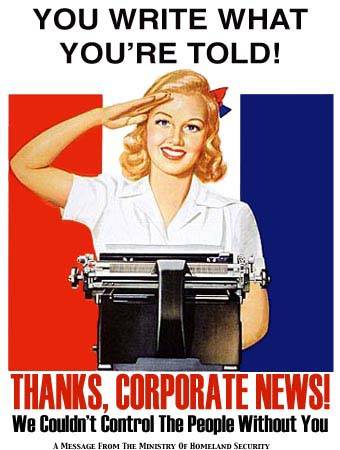
Please share this article to wake people up to the fact that their news is scripted by powerful entities as a means of influencing people’s perceptions!
Will Ukraine Be NYT’s Waterloo?

propaganda_corporatenews

By Robert Parry

Source: Consortium News

For Americans interested in foreign policy, the New York Times has become the last U.S. newspaper to continue devoting substantial resources to covering the world. But the Times increasingly betrays its responsibility to deliver anything approaching honest journalism on overseas crises especially when Official Washington has a strong stake in the outcome.

The Times’ failures in the run-up to the disastrous Iraq War are, of course, well known, particularly the infamous “aluminum tube” story by Michael R. Gordon and Judith Miller. And, the Times has shown similar bias on the Syrian conflict, such as last year’s debunked Times’ “vector analysis” tracing a sarin-laden rocket back to a Syrian military base when the rocket had less than one-third the necessary range.

But the Times’ prejudice over the Ukraine crisis has reached new levels of extreme as the “newspaper of record” routinely carries water for the neocons and other hawks who still dominate the U.S. State Department. Everything that the Times writes about Ukraine is so polluted with propaganda that it requires a very strong filter, along with additives from more independent news sources, to get anything approaching an accurate understanding of events.

Screen shot of the fire in Odessa, Ukraine, on May 2, 2014. (From RT video)

From the beginning of the crisis, the Times sided with the “pro-democracy” demonstrators in Kiev’s Maidan square as they sought to topple democratically elected President Viktor Yanukovych, who had rebuffed a set of Western demands that would have required Ukraine to swallow harsh austerity measures prescribed by the International Monetary Fund. Yanukovych opted for a more generous offer from Russia of a $15 billion loan with few strings attached.

Along with almost the entire U.S. mainstream media, the Times cheered on the violent overthrow of Yanukovych on Feb. 22 and downplayed the crucial role played by well-organized neo-Nazi militias that surged to the front of the Maidan protests in the final violent days. Then, with Yanukovych out and a new coup regime in, led by U.S. hand-picked Prime Minister Arseniy Yatsenyuk, the IMF austerity plan was promptly approved.

Since the early days of the coup, the Times has behaved as essentially a propaganda organ for the new regime in Kiev and for the State Department, pushing “themes” blaming Russia and President Vladimir Putin for the crisis. [For details, see Consortiumnews.com’s “Ukraine, Though the US ‘Looking Glass.’”]

In the Times’ haste to perform this function, there have been some notable journalistic embarrassments such as the Times’ front-page story  touting photographs that supposedly showed Russian special forces in Russia and then the same soldiers in eastern Ukraine, allegedly proving that the popular resistance to the coup regime was simply clumsily disguised Russian aggression.

Any serious journalist would have recognized the holes in the story – since it wasn’t clear where the photos were taken or whether the blurry images were even the same people – but that didn’t bother the Times, which led with the scoop. However, only two days later, the scoop blew up when it turned out that a key photo – supposedly showing a group of soldiers in Russia who later appeared in eastern Ukraine – was actually taken in Ukraine, destroying the premise of the entire story.

Soldiering On

The Times, however, continued to soldier on with its bias, playing up stories that made Russia and the ethnic Russians of eastern Ukraine look bad and playing down anything that might make the post-coup regime in Kiev look bad.

On Saturday, for instance, the dominant story from Ukraine was the killing of more than 30 ethnic Russian protesters by fire and smoke inhalation in Ukraine’s southern port city of Odessa. They had taken refuge in a building after a clash with a pro-Kiev mob which reportedly included right-wing thugs.

Even the neocon-dominated Washington Post led its Saturday editions with the story of “Dozens killed in Ukraine fighting” and described the fatal incident this way: “Friday evening, a pro-Ukrainian mob attacked a camp where the pro-Russian supporters had pitched tents, forcing them to flee to a nearby government building, a witness said. The mob then threw gasoline bombs into the building. Police said 31 people were killed when they choked on smoke or jumped out of windows.

“Asked who had thrown the Molotov cocktails, pro-Ukrainian activist Diana Berg said, ‘Our people – but now they are helping them [the survivors] escape the building.’”

By contrast, here is how the New York Times reported the event in its Saturday editions as part of a story by C.J. Chivers and Noah Sneider focused on the successes of the pro-coup armed forces in overrunning some eastern Ukrainian rebel positions.

“Violence also erupted Friday in the previously calmer port city of Odessa, on the Black Sea, where dozens of people died in a fire related to clashes that broke out between protesters holding a march for Ukrainian unity and pro-Russian activists. The fighting itself left four dead and 12 wounded, Ukraine’s Interior Ministry said. Ukrainian and Russian news media showed images of buildings and debris burning, fire bombs being thrown and men armed with pistols.”

Note how the Times evades placing any responsibility on the pro-coup mob for trying to burn the “pro-Russian activists” out of a building, an act that resulted in the highest single-day death toll since the actual coup which left more than 80 people dead from Feb. 20-22. From reading the Times, you wouldn’t know who had died in the building and who had set the fire.

Normally, I would simply attribute this deficient story to some reporters and editors having a bad day and not bothering to assemble relevant facts. However, when put in the context of the Times’ unrelenting bias in its coverage of the Ukraine crisis – how the Times hypes every fact (and even non-facts) that reflect negatively on the anti-coup side – you have to think that the Times is spinning its readers, again.

For those who write for the Times – and the many more people who read it – the question must be whether the Times is so committed to its prejudices here that the newspaper will risk whatever credibility it has left. The coup regime from Kiev may succeed in slaughtering many ethnic Russians in the rebellious east — as the Times signals its approval — but will this bloody offensive become a Waterloo for whatever’s left of the newspaper’s journalistic integrity?


Investigative reporter Robert Parry broke many of the Iran-Contra stories for The Associated Press and Newsweek in the 1980s. You can buy his new book, America’s Stolen Narrative, either in print here or as an e-book (from Amazon and barnesandnoble.com). For a limited time, you also can order Robert Parry’s trilogy on the Bush Family and its connections to various right-wing operatives for only $34. The trilogy includes America’s Stolen Narrative. For details on this offer, click here.