

By Robert J. Burrowes
Opposed to vaccine mandates, QR codes and other restrictions on our rights and freedom?
Refusing to wear a mask, have the vaccine and stay locked-down when ordered?
Attended a number of demonstrations protesting the government-imposed restrictions in your country? Involved in or supporting the truckers convoys?
Already celebrating some lifting of restrictions in some countries?
Unfortunately, there is one simple reason why the sorts of actions nominated above cannot win back our rights and our freedom: Our various protests are not integrated parts of a comprehensive strategy designed for the purpose. Moreover, in the case of the truckers convoys, they also complicate one already serious problem: supply chain disruptions that are causing serious food shortages. See ‘The Global Elite’s “Kill and Control” Agenda: Destroying Our Food Security’.
And, rest assured, there is nothing to celebrate unless you do not understand what is happening beneath the surface.
Which, uniquely in this case, requires a strategy that recognizes, and addresses, the technological coup d’état that is being carried out against us.
As anyone conversant with the history of peoples’ struggles is well aware, that history is littered with the ‘bodies’ of failed social movements and national liberation struggles, even if some of these ‘bodies’ are still twitching rather than dead.
Ever wondered why the anti-war movement goes around in circles? Or whatever happened to the Occupy Movement? Or why so many environmental and social justice movements go nowhere? Or even why so many national liberation struggles fail, or lose vital gains subsequently to an initial victory.
Well, there are clearcut reasons for their failure and they can be readily identified. I have previously discussed some key reasons in the article ‘Why Activists Fail’.
So let us consider the current freedom movement and analyze why it is on the course to failure at the moment and see if we can turn it around before it is too late. And to do this, we need a sound strategic framework.
Nonviolent Strategy
Sound nonviolent strategy has twelve components – see the Nonviolent Strategy Wheel – and, unfortunately, most social movements and (nonviolent) national liberation struggles are devoid of a comprehensive strategy simply because only the rarest activist has a sense of what strategy really means.
So what is strategy? Very simply, strategy is a planned series of actions (tactics) conducted over an appropriate timeframe that is designed to achieve the two strategic aims that govern the strategy.
You can read more about nonviolent strategy on the Nonviolent Defense/Liberation Strategy website.
For any strategy to be effective, it must be based on a thorough understanding of the conflict in question.
Analysis
Sound strategy in any conflict begins with a deep analysis of what is taking place so that we can identify who is driving it, why they are driving it, how they are driving it, what they intend to implement and what they intend to achieve if successful?
Hence, if we deeply analyze what is taking place around the world at the moment, we can start by observing that we are being told by the World Health Organization, national governments, medical authorities and the corporate media that the human population is at risk of catching a virus (labeled ‘SARS-CoV-2’) that causes a life-threatening disease (labeled ‘Covid-19’) and that we need a long series of restrictions (including lockdowns and QR codes) as well as several injections to protect ourselves from this alleged disease.
So, obviously, any serious analysis must begin with identifying proof that the virus exists, given that it is the supposed cause of everything that follows. Then we can investigate its projected harm.
However, if we seek proof of the isolation of this virus, we quickly discover that there is none.
In fact, since the very beginning of this ‘pandemic’, an increasing number of doctors, scientists and researchers have gone to some trouble to scientifically document for us that, in fact, this ‘virus’ does not exist. See, for example, ‘COVID-19: The virus does not exist – it is confirmed!’ and ‘Statement On Virus Isolation (SOVI)’. And for an account of researcher Christine Massey’s fruitless search over the course of more than a year to find evidence of an isolated virus, via Freedom of Information requests to health/science institutions all over the world, see ‘169 health/science institutions globally all failed to cite even 1 record of “SARS-COV-2” purification, by anyone, anywhere, ever’.
Of course, beyond this, as is well known in some quarters: ‘there is no original scientific evidence that definitively demonstrates that any virus is the cause of any disease’. See What Really Makes You Ill? Why everything you thought you knew about disease is wrong.
However, doctors, scientists and researchers who present evidence such as this are all being censored by government and corporate media and social media. In this context, there is very little space for meaningful debate, let alone space for the truth to emerge into wider view.
If there is no virus, of course, there is no need for any of the restrictions that have been imposed and there is no need for any vaccine. So why have all these restrictions and ‘vaccines’ been imposed?
By this point in any serious investigation, research will have exposed the role of the World Economic Forum in promoting the ‘pandemic’ narrative and, under cover of these ‘virus’/‘vaccine’ lies, progressively implementing its ‘Great Reset’program. Any careful reading of this documentation quickly reveals that the ‘Great Reset’ is designed to utterly transform human society and even human life in accord with elite wishes, which is why the rest of us have not been consulted. This is because the detail outlined in the ‘Great Reset’ documentation, which anyone can investigate for themselves, clearly identifies intended changes to some 200 areas of human activity, essentially characterized as part of the ‘fourth industrial revolution’.
Beyond this, however, other important components of the elite agenda are easily identified. In essence, these include those related to the elite’s intention to kill off a substantial proportion of the human population (using a variety of measures including the ‘injectables’) and enslave those left alive in a technological prison, as is now happening. See, for example, ‘The Global Elite’s “Kill and Control” Agenda: Destroying Our Food Security’, ‘Taking Control by Destroying Cash: Beware Cyber Polygon as Part of the Elite Coup’ and ‘The Government’s Kill Switch for Your Car, Your Freedoms and Your Life’.
And any remaining pretense that some of us live in a ‘democracy’ has been finally exposed as the delusion it has long been, with our rights and freedom eviscerated and the assassination of (now) five national presidents who resisted the elite narrative just the most graphic illustrations of this point. See ‘Killing Democracy Once and for All: The Global Elite’s Coup d’état That Is Destroying Life as We Know It’.
The point is that democratic governance was subverted long ago: it just has many manifestations. As Klaus Schwab, head of the World Economic Forum, declared at Harvard’s John F. Kennedy School of Government in 2017: ‘What we are very proud of is that we penetrate the global cabinets of countries with our WEF Young Global Leaders… like Justin Trudeau.’ See ‘WEF’s Klaus Schwab Boasts of Young Global Leaders Penetration of Western Cabinets’.
These ‘Young Global Leaders’, which means those, including politicians, who represent the Global Elite rather than the people of their countries, include a range of current (or immediate past) national leaders, such as Emmanuel Macron (France), Angela Merkel (Germany), Vladimir Putin (Russia) and Jacinda Ardern (New Zealand). See ‘World Economic Forum Young Global Leaders’ and ‘World Economic Forum’s “Young Global Leaders”’.
So any careful investigation of what is happening globally reveals four fundamental points:
1. Who? The Global Elite is implementing this technological coup d’état. Hence, what little is left of the sovereignty of governments is being destroyed by the coup, and governments are powerless to restore the fundamental rights and freedom that are stake in this conflict. Of course, governments might be allowed to remove particular mandates in some contexts as the importance of particular mandates is superseded by other components of the Elite agenda. Similarly, legal challenges can bear minimal fruit, and not on the primary program.
2. Why? The Global Elite, using the World Economic Forum as its vehicle, seeks total control of the human population and the Earth’s resources.
3. What? This elite agenda, labeled the ‘Great Reset’, encompasses what is called the fourth industrial revolution but includes other components in relation to eugenics and transhumanism as well. The intention is to kill off a substantial proportion of humanity and utterly transform human life and human society for those left alive. See ‘Killing Off Humanity: How the Global Elite is using Eugenics and Transhumanism to Shape Our Future’ and ‘Beware the Transhumanists: How “Being Human” is being Re-engineered by the Elite’s Covid-19 Coup’.
4. How? The ‘Great Reset’ is being implemented by using elite agents such as the World Health Organization, national governments, official medical associations, the pharmaceutical industry and the corporate media to promote the Elite’s lies – that the deadly SARS-CoV-2 ‘virus’ exists and that an onerous series of measures ranging from mask-wearing to lockdowns to multiple injections are necessary to address it – while employing heavy-handed censorship to ensure that the truth, and the evidence to explain it, about the deeper elite agenda is suppressed. Meanwhile, unaware people throughout society are playing their part in implementing the ‘Great Reset’ on behalf of the Global Elite.
So what can we do?
If we are to defeat this (fundamentally technological) elite coup against humanity, our strategy must undermine the power of the Global Elite to conduct it. Unfortunately, our protests (whether in person or by blockading with trucks) against particular mandates cannot undermine, in a strategic sense, the foundations that make possible the underlying elite agenda being inflicted upon us. Briefly, this is because they are incorrectly targeted (at governments rather than foundational elements of elite power in this context) and they are the wrong tactics in this circumstance (especially because of their failure to identify and address the technological elements of the coup), among other shortcomings.
So we have two choices: We can keep doing things that don’t work or refocus what we are doing so that it does have strategic impact.
Strangely, this doesn’t mean that we should stop conducting rallies or even cease the convoys. But it does mean that we need to use these events to explain the deeper agenda behind what is happening and to raise awareness of the strategic actions the wider public must take if we are to defeat the elite program.
Otherwise, while they build relationships and even a sense of solidarity, rallies and convoys are, strategically speaking, a waste of time.
So what does ‘strategic impact’ mean in this context?
Once we understand that the Global Elite is driving the ‘Great Reset’ to impose a global order that serves elite interests, we can identify the appropriate set of strategic goals for defending ourselves and then thoughtfully consider what actions we might take to achieve these goals, that is, actions that actually make a difference.
So what does ‘make a difference’ mean in this context? It means designing and taking action that undermines the power of those driving what is happening to achieve what they want. If an action is simply designed to allow us to express our complaint (often expressed as a list of specific demands that particular things be changed) – as the mass rallies and truck convoys are essentially doing – there is no reason for anything to be achieved. Elites have enormous experience of ignoring us and understand how well it works.
As former US Secretary of State Alexander Haig once noted about a massive anti-war demonstration: ‘Let them march all they want, as long as they continue to pay their taxes.’ See Alexander Haig. As a four-star general, Haig, not regarded as the most intelligent Secretary of State in US history, certainly understood the importance of tactical choice. Most activists have no idea.
Which is why the history of mass mobilizations in these forms failing to achieve significant change is long. And this list starts with the largest demonstration in human history when, as part of a series of large demonstrations that was occurring, up to 30 million people in 600 cities protested the imminent US invasion of Iraq on 15 February 2003. See ‘The World Says No to War’.
And remember the Occupy Movement in 2011? It was huge, mobilizing people to camp in public places in cities all over the world. It’s focus? The 1% (wealthy individuals who own and control the major corporations and manage the financial system in a way that disproportionately benefits a minority while undermining democracy). Its strategy? Essentially occupying public locations. The movement ended after it had been heavily infiltrated – see ‘FBI Documents Reveal Secret Nationwide Occupy Monitoring’ – and police forcibly removed encampments a few months after it had taken off globally.
So why do these movements fail? It is always the same reason: poor strategy, invariably including inadequate analysis, inaccurate identification of target and wrong tactical choice, and often including failure to deal adequately with infiltrators and provocateurs. Although, it should be emphasized, movements usually make a series of ill-informed decisions so that the details of the poor strategy vary from one movement to the next. The point is that people generally do not understand the concept of strategic resistance; they simply confuse any form of mass mobilization with resisting strategically.
Identifying What We Must Resist
Once we identify who is driving the conflict – in this case, the Global Elite, not governments – as well as why and how they are doing it and what they intend, we can identify those foundational components that make possible what the Elite wants to achieve.
So, as noted above, a careful reading of the key documentation soon exposes that the Global Elite intends to kill off a substantial proportion of the human population (using a variety of measures including the ‘injectables’) and enslave those left alive in a technological prison. And this is now happening.
How, exactly, is the Elite doing this?
In relation to its eugenics program, it is using four primary measures: the injections, the massive redistribution of wealth from poor to rich, the destruction of global supply chains (including those in relation to food) and the deployment of 5G. For explanations of these measures, see ‘The Global Elite’s “Kill and Control” Agenda: Destroying Our Food Security’.
In relation to its program of enslavement, it is using a substantial combination of measures which will make those futuristic films look archaic. For a start, the injection, if you are one of those who survive, is intended to turn you into a transhuman slave. See ‘Beware the Transhumanists: How “Being Human” is being Re-engineered by the Elite’s Covid-19 Coup’.
But even those who resist the injection will be enslaved. Using drones, smart phones, GPS devices, smart TVs, social media, smart meters, surveillance cameras, facial recognition software, online banking, license plate readers and driverless cars, you will live under constant surveillance and be readily controlled whether in your home, car or out in the community. And you will be photographed many times each day. As John and Nisha Whitehead have noted: ‘We’re on the losing end of a technological revolution that has already taken hostage our computers, our phones, our finances, our entertainment, our shopping, our appliances, and now, our cars.’ See ‘The Government’s Kill Switch for Your Car, Your Freedoms and Your Life’.
Beyond even this, remember that Covid-19 test to which you submitted? Do you know what happened to your DNA? It was recorded and can be sold. You do not even own your personal DNA! See ‘The Coronavirus (Retention of Fingerprints and DNA Profiles in the Interests of National Security) (No. 2) Regulations 2020’.
Moreover, as Whitney Webb has explained, plans are well advanced to ‘require a digital ID to access and use the internet as well as eliminate the ability to conduct anonymous financial transactions. Both policies would advance the overarching goal of both the WEF and many corporations and governments to usher in a new age of unprecedented surveillance of ordinary citizens.’ See ‘Ending Anonymity: Why the WEF’s Partnership Against Cybercrime Threatens the Future of Privacy’. Obviously, this would also dramatically advance elite control.
In addition, using a combination of technologies largely dependent on 5G, the intention is to digitize our identity and connect it with our bank, health, legal and other records, and create a social credit score that will determine what we can and cannot do and where we can do it. In short, we will be locked in a technological prison, whether it is our own home, our car or our local community, in a ‘smart city’. Physical prisons won’t matter because everywhere will be the prison. Human volition will be unknowingly surrendered by those unaware of the degree of technological control they accepted each time they purchased the latest gadget.
A vital part of this control is explained by Catherine Austin Fitts in this short video on the ‘financial transaction control grid’ being created. See ‘Digital Concentration Camps’.
And, as the World Economic Forum has advertised, by 2030, ‘You’ll own nothing. And you’ll be happy.’ See ‘8 predictions for the world in 2030’.
Welcome to your imminent technocratic dystopia. Human freedom? Gone. Human rights? Gone. Human identity? Gone. Privacy? Gone. Free will? Gone. Anything else that makes life worth living? Gone.
So with this briefest of summaries, hopefully you can see why these rallies and convoys, in themselves, cannot achieve anything significant. Powerlessly begging governments to remove certain vaccine mandates and even other now-familiar restrictions, while ignoring the ongoing technological measures being implemented ‘behind the scenes’, is not impeding, in any way, the elite program to entrap you in a technological prison, assuming you survive the death needle.
Hence, if we wish to resist this elite program effectively, we must identify its foundational components; that is, those components that make what the Elite wants to achieve possible. And then resist these components.
Resisting Strategically
So what are the components that give the Global Elite the power to inflict its agenda upon us?
These include the injections; deployment of 5G; the technologies that enable comprehensive (not just mass) surveillance, digitization (of our identity, banking, health, legal and other records to generate our personal social credit score) and robotization of the workforce; measures to restructure the global economy in favour of the mega-corporations and consolidation of ownership and control of agricultural land as well as the production, distribution and even nature of the world’s food supply. It also includes the power to control the narrative by using government and corporate media and social media to promote Elite propaganda while censoring the truth.
Hence, we must resist these if we are to undermine the power of the Global Elite to control us.
As noted above, rallies and convoys are only useful if we use them to educate people about the true nature and full extent of the threat and inform those involved how to effectively resist this threat. To reiterate, while we are focusing on governments, the various lockdown restrictions and ‘vaccine’ mandates, and employing the wrong tactics, people will be mobilized to no avail. This is because there are plenty of tactical options – see ‘198 Tactics of Nonviolent Action’ – but understanding what has strategic impact in any context is crucial.
Why? Because the nonviolent actions and the numbers participating, in themselves, are not determinative. It is the strategy that determines the outcome.
In short, we must give people the range of actions that will make a critical strategic difference; that is, the precise actions that will undermine the power of the Global Elite to inflict their overall program on us. Unless we do this, our rallies and convoys (and those people who speak at these events) are simply failing to inform their audiences of the vital information that is necessary for us to be successful.
So mass gatherings of resistance (such as protest demonstrations, truck convoys, religious services…), in whatever variation they take, can be useful because they mobilize people with a shared perspective but they only have strategic impact if these people are then ‘deployed’ to take action that undermines the elite’s power to inflict this coup upon us.
To illustrate this point: What is the value of mobilizing an ‘army’ in war? So that you can send it out to fight a strategically-chosen series of battles. What activists do not understand is that we need to mobilize our activist ‘army’ – which is the primary value of the mass mobilizations – but we need to use these mobilizations to inform activists what tactics we need them to undertake subsequently.
Otherwise we have simply mobilized rally participants to be told to go home again and do nothing or, in the case of the convoys, to remain until a very limited set of demands, which do not address the fundamental technological agenda, are granted (which is one option the Elite might consider as the simplest means of dissipating the dissent in this instance).
And given clear indications that police are gathering intelligence about the activists – see ‘Ottawa Police announce digital surveillance of Freedom Convoy protesters, supporters, and donors’ – this can later be used to deal with individuals, which is obviously easier than dealing with large crowds. Moreover, this can occur even if the trucks are not removed by the police and military, although this remains in option, particularly in cities where crowds are smaller, even though it would not necessarily be easy. See ‘Removing trucks could be almost “impossible,” say heavy towing experts’.
Of course, activists can work to build relationships with the police and military as one part of the effort to prevent violent removal. See ‘Nonviolent Action: Minimizing the Risk of Violent Repression’.
Fortunately, this has been happening for some time in some contexts during the past two years, leading to some active police and military officers standing down and encouraging their colleagues to do likewise. See, for example, ‘Freedom Convoy – Speech by Canadian Army Major Stephen Chledowski’ and ‘Conscientious Resignation of Police Officer in Australia’.
But much more effort could be usefully expended in this direction.
Again, however, in itself, this will not undermine the technological nature of the Elite coup.
Nor will using violence, despite what an occasional author is suggesting will be necessary. See ‘The Elite Gathers Its Forces for a Counterattack on the Truckers’.
What Can We Do?
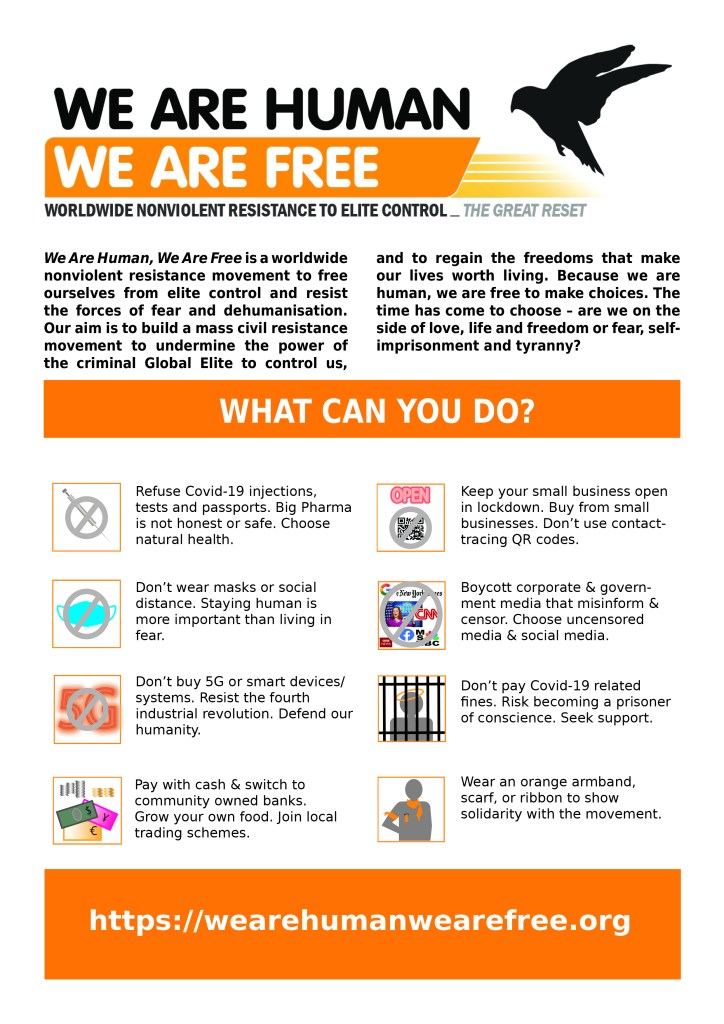
If you are interested in strategically resisting the Global Elite’s technological agenda and other measures associated with the ‘Great Reset’, you can read how to do so on the ‘We Are Human, We Are Free’ website which offers further analysis, resources and a list of 29 strategic goals for doing so.
This includes campaigning to cause civilian and military scientists and technologists to refuse to do any research or undertake any work associated with the fourth industrial revolution and/or transhumanism, to cause workers to refuse to do any work (by producing, distributing or installing any technology) associated with the fourth industrial revolution and/or transhumanism, and to cause consumers to refuse to buy or otherwise acquire any product associated with the fourth industrial revolution and/or transhumanism.
That is, to campaign to cause all sectors of society to refuse to develop and make available, or to purchase/use, technologies associated with the fourth industrial revolution and transhumanism (including 5G and 6G, military weapons, artificial intelligence [AI], big data, nanotechnology and biotechnology, robotics, the Internet of Things [IoT], and quantum computing) because these technologies will subvert human identity, human freedom, human dignity, human volition and/or human privacy. See ‘Strategic Goals related to resisting the fourth industrial revolution and/or transhumanism’.
In addition and more simply, you can download a one-page flyer that identifies a short series of crucial nonviolent actions that anyone can take. This flyer, now available in 15 languages (Czech, Danish, English, Finnish, French, German, Greek, Hebrew, Hungarian, Italian, Polish, Romanian, Russian, Spanish & Slovak) with more in the pipeline, can be downloaded from here: ‘The 7 Days Campaign to Resist the Great Reset’.
Notably, these latter actions avoid certain problems. Because they involve actions by people dispersed throughout the population, rather than people concentrated in one location (as with rallies), they are extremely difficult to interrupt. Hence, they virtually eliminate the risk of violent repression.
If strategically resisting the ‘Great Reset’ appeals to you, consider joining the ‘We Are Human, We Are Free’ Telegram group.
Conclusion
For the first time in history, all of humanity is threatened by a coup d’état that is killing vast numbers of people through a complex series of measures while destroying human liberty and human rights for those not killed outright.
Moreover, for the first time in history, this coup is being implemented by a series of technological measures that promise to imprison those left alive in a hi-tech prison from which there will be no escape.
Hence, given that several foundational elements of this coup are not yet quite fully in place, 2022 will be the most critical year in human history to date.
But to defeat this hi-tech coup we need to be strategically savvy and mobilize enough people to participate. You are welcome to join us.
Biodata: Robert J. Burrowes has a lifetime commitment to understanding and ending human violence. He has done extensive research since 1966 in an effort to understand why human beings are violent and has been a nonviolent activist since 1981. He is the author of ‘Why Violence?’ His email address is flametree@riseup.net and his website is here.

 After the Crash