
We are Closening to a Move Through the Cycle – But First Will Come Disorder

By Alastair Crooke

Source: Strategic Culture Foundation

Is the collective West nearing the end of a cycle? Or are we still in mid-cycle? And could it be an epochal point of inflection?

The question posed at this point is: Is the collective West nearing the end of a cycle? Or are we still in mid-cycle? And is this a four-generational mini-cycle, or an epochal point of inflection?

Is Russo-Chinese Entente and the global tectonic discontent with the ‘Rules Order’ – on the heels of a long trajectory of catastrophes from Viet Nam, through Iraq to Ukraine – sufficient to move the West on to the next stage of cyclical change from apex to disillusionment, retrenchment and eventual stabilisation? Or not?

A major inflection point is typically a period in history when all the negative components from the outgoing era ‘come into play’ – all at once, and all together; and when an anxious ruling class resorts to widespread repression.

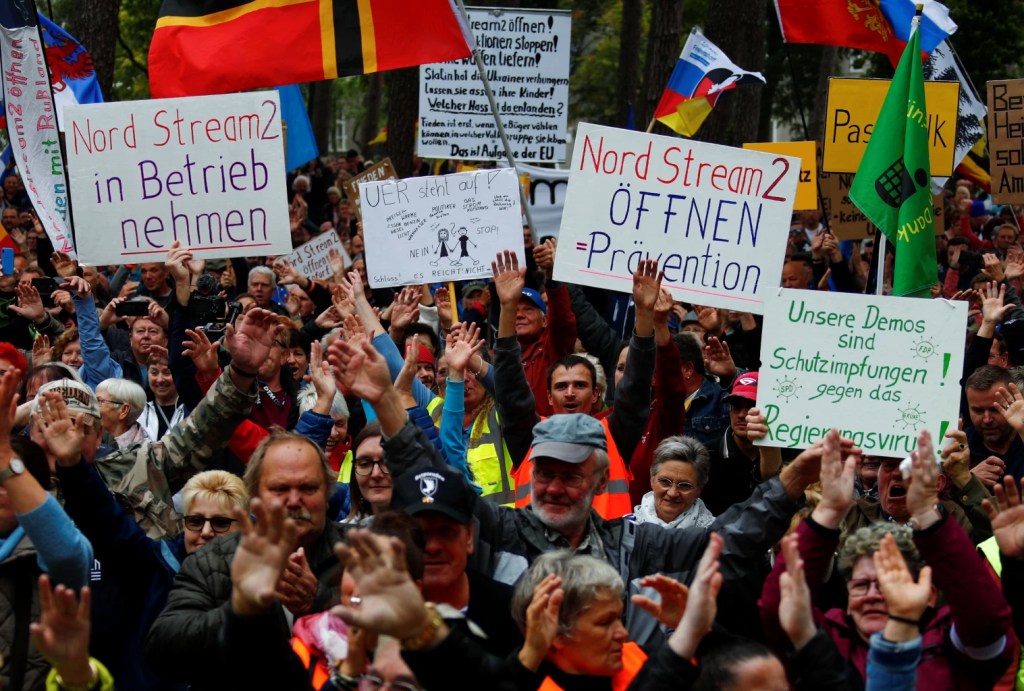
Elements of such crises of inflection are today everywhere present: Deep schism in the U.S.; mass protest in France, and across Europe. A crisis in Israel. Faltering economies; and the threat of some, as yet undefined, financial crisis chilling the air.

Yet, anger erupts at the very suggestion that the West is in difficulties; that its ‘moment in the sun’ must give place to others,and to other cultures’ ways of doing things. The consequence to such a moment of epochal ‘in-betweeness’ has been characterised historically by the irruption of disorder, the breakdown of ethical norms, and the loss of a grip on what is real: Black becomes white; right becomes wrong; up becomes down.

That’s where we are – in the grip of western élite anxiety and a desperation to keep the ‘old machinery’s’ wheels spinning; its ratchets loudly opening and closing, and its levers clanging into, and out of place – all to give the impression of forward motion when, in truth, practically all of western energy is consumed in simply keeping the mechanism noisily aloft, and not crashing to an irreversible, dysfunctional stop.

So, this is the paradigm that governs western politics today: Doubling-down on the Rules Order with no strategic blueprint of what it is supposed to achieve – in fact no blueprint at all, except for ‘fingers crossed’ that something beneficial for the West will emerge, ex machina. The various foreign policy ‘narratives’ (Taiwan, Ukraine, Iran, Israel) contain little of substance. They are all clever linguistics; appeals to emotion, and with no real substance.

All this is hard to assimilate for those living in the non-West. For they do not come face-to-face with western Europe’s repeat re-anactment of the French Revolution’s iconic secular, egalitarian reform of human society – with ‘the specific timbre, flavour and ideology’ shifting, according to prevailing historic conditions.

Other nations unafflicted by this ideology (i.e., effectively the non-West) find it perplexing. The West’s culture war barely touches cultures outside its own. Yet, paradoxically, it dominates global geo-politics – for now.

Today’s ‘flavour’ is termed ‘our’ liberal democracy – the ‘our’ signifying its link to a set of precepts that defies clear definition or nomenclature; but one, that from the 1970s, has drifted into a radical enmity towards the traditional European and American cultural legacy.

What is singular about the present re-enactment is that whereas the French Revolution was about achieving class equality;ending the division between aristocracy and their vassals, liberalism today represents a modification of ideology” that U.S. writer Christopher Rufo suggests, “says that we want to categorize people based on group identity and then equalize outcomes across every axis – predominantly the economic axis, health axis, employment axis, criminal justice axis—and then formalize and enforce a general levelling”.

They want absolute democratic levelling of every societal discrepancy – reaching even, back into history, to historic discrimination and inequalities; and to have history re-written to highlight such ancient practice so that they can be routed out through enforced reverse discrimination.

What has this to do with foreign policy? Well, pretty well everything (so long as ‘our’ liberalism) retains its capture of the western institutional framework.

Bear this background in mind when thinking of the western political class’s reaction to events, say, in the Middle East, or in Ukraine. Although the cognitive élite contends that they are tolerant, inclusive, and pluralistic, they will not accept the moral legitimacy of their opponents. That is why in the U.S. – where the Cultural War is most developed – the language deployed by its foreign policy practitioners is so intemperate and inflammatory towards non-compliant states.

The point here is that, as Professor Frank Furedi has emphasised, the contemporary ‘timbre’ is one no longer merely adversarial, but unremittingly hegemonic. It is not a ‘turn’. It is a rupture: The determination to displace other sets of values by a western inspired ‘Rules-Based Order’.

Being a ‘liberal’ (in this strictly narrow sense) isn’t something you ‘do’; it is what you ‘are’. You think ‘right thoughts’ and utter ‘right speak’. Persuasion and compromise reflect only moral weakness in this vision. Ask the U.S. neocons!

We are used to hearing western officials talk about the ‘Rules-Based Order’ and the Multi-Polar System as rivals in a new global framework of intense ‘competition’. That however, would be to misconceive the nature of the ‘liberal’ project. They are not rivals: There cannot be ‘rivals’; they can only be recalcitrant other societies that have refused the analysis and the need to root out all cultural and psychological structures of inequity from their own domains. (Hence, China is hounded on its alleged deficiency in respect to the Uyghurs).

The cognitive privilege of ‘awareness’ is what lies behind the western ‘doubling-down’ on imposing a global Rules-BasedOrder: No compromise. The moral enterprise is more intent on its elevated moral station than on coming to terms with or managing, say, a defeat in Ukraine.

Just yesterday, the Bank of America in London was forced to cut short a two-day, online conference on geopolitics; and apologised to attendees following the outrage expressed at a speaker’s comments that were deemed ‘pro-Russian’ by some attendees.

What was said? Professor Nicolai Petro’s remarks at the session where he said: “Under any scenario, Ukraine would be the overwhelming loser in the war: Its industrial capacity devastated … and its population shrunk as people departed to look for employment abroad. If this is what is meant by removing Ukraine’s capacity to wage war against Russia, then it [Russia] will have won”. Professor Petro added that the U.S. government had no interest in a ceasefire, as it had the most to gain from a prolonged conflict.

No compromise is allowed. To speak thus, to inhabit the western moral high ground creating ‘villains’, clearly is more important than coming to terms with reality. Professor Petro’s comments were condemned as “rolling through Moscow’s talking points”.

Yet, these cultural revolutionaries face a pitfall, Christopher Rufo writes,

Theirs is actually, not an easy task. This is very difficult, and, in fact, I think is somewhat impossible. If you look at even the Chinese Cultural Revolution in the 1960s … They had a program of economic and social levelling that was more totalitarian and more drastic than anything that had ever happened in the past. [Yet] after the Revolution collapsed, after the period of retrenchment, social scientists looked at the data and discovered that a generation later, those initial inequalities had stabilized … The point is that forced levelling is very elusive. It’s very difficult to achieve, even when you are doing it at the tip of a spear or at the point of a gun.

The levelling project being essentially nihilistic becomes captured by the destructive side of the revolution – its authors so absorbed with dismantling structures that they do not attend to the need to think policies through, before launching into them. The latter are not adept at doing politics: at making politics ‘work’.

Thus, discontent at the welling string of western foreign policy flops grows. Crises multiply, both in number and across different societal dimensions. Perhaps, we are closening to a point of beginning to move through the cycle – toward disillusionment, retrenchment, and stabilization; the prerequisite step to catharsis and ultimate renewal. Yet, it would be a mistake to underestimate the longevity and tenacity of the western revolutionary impulse.

“The revolution does not operate as an explicit political movement. It operates laterally through the bureaucracy and it filters its revolutionary language through the language of the therapeutic, the language of the pedagogical, or the language of the corporate HR department”, Professor Furedi writes. “And then, it establishes power anti-democratically, bypassing the democratic structure: using this manipulative and soft language – to continue the revolution from within the institutions.”
‘NATO’s mission’ leaves Ukraine destroyed

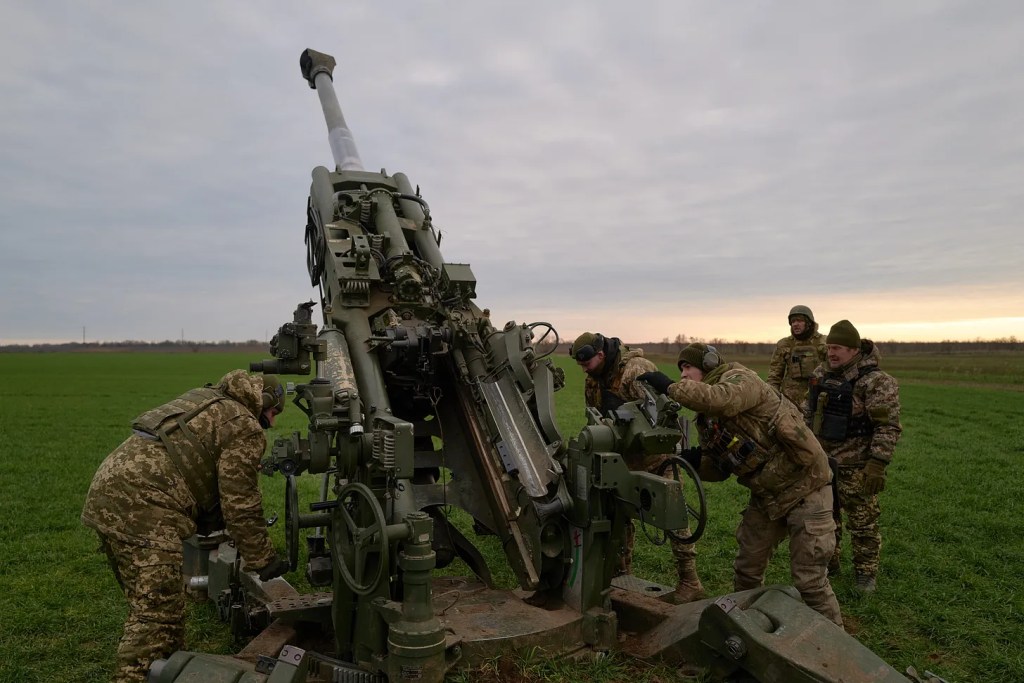
“We are carrying out NATO’s mission.” As Ukraine’s defense minister acknowledges the proxy war, NATO proxy warriors disregard the toll.

(Pierre Crom/Getty Images)

By Aaron Maté

Source: Aaron Maté Substack

Unveiling its latest military assistance package to Ukraine – at $3.75 billion, the largest to date — the White House declared that US weapons are intended “to help the Ukrainians resist Russian aggression.”

For their part, Ukrainians on the receiving end see it differently.

“We are carrying out NATO’s mission,” Ukrainian Defense Minister Oleksii Reznikov said in an interview. “They aren’t shedding their blood. We’re shedding ours. That’s why they’re required to supply us with weapons.” Repeating a rationale offered by his US sponsors in previous wars, including the invasion of Iraq, Reznikov added that Ukraine “is defending the entire civilized world.”

Receiving an endless supply of weapons from NATO countries that shed no blood of their own — all to fulfill their “mission” — is an apt description of Ukraine’s role in the US-led proxy war against Russia. And as one of its staunchest champions, Sen. Lindsey Graham, cheerfully predicted in July, that mission is using Ukraine to “fight to the last person.”

For Ukraine, the costs of fulfilling NATO’s mission are spelled out by former US cabinet secretaries Condoleezza Rice and Robert Gates. Today, the pair write, Ukraine’s “economy is in a shambles, millions of its people have fled, its infrastructure is being destroyed, and much of its mineral wealth, industrial capacity and considerable agricultural land are under Russian control. Ukraine’s military capability and economy are now dependent almost entirely on lifelines from the West — primarily, the United States.”

Rather than seeing Ukraine’s war-ravaged, Russian-occupied, Western-dependent condition as a reason to seek a negotiated end, Rice and Gates in fact regard diplomacy as an outcome to avoid.

“Absent another major Ukrainian breakthrough and success against Russian forces, Western pressures on Ukraine to negotiate a cease-fire will grow as months of military stalemate pass,” they warn. This result would be “unacceptable”, Rice and Gates conclude, because “any negotiated cease-fire would leave Russian forces in a strong position to resume their invasion whenever they are ready.” That is one possibility. Another possibility, unmentioned by the authors, is that a negotiated cease-fire leads to a permanent one. This would entail finally addressing the grievances of Ukraine’s ethnic Russian population – the proximate cause of the post-2014 Donbas war that preceded Russia’s invasion — as well as addressing Russia’s longstanding security concerns about NATO expansion and advanced weaponry on its borders.

On the latter issue, the Kremlin is far from the only advocate. “One of the essential points we must address — as President Putin has always said — is the fear that NATO comes right up to its doors, and the deployment of weapons that could threaten Russia,” French President Emmanuel Macron said last month.

Macron’s comments “appeared to go beyond anything the United States has offered” Russia, the New York Times noted. Unstated by the Times is why such an offer has yet to materialize: as defined by multiple senior US officials right up to President Biden, “NATO’s mission” is not to defend Ukraine, but to use it as a proxy to “weaken” or even cause regime change in neighboring Russia.

Accordingly, the prospect of a negotiated cease-fire must be negated. The US and its allies, Rice and Gates argue, must “urgently provide Ukraine with a dramatic increase in military supplies and capability.” A failure to do so, they warn, could lead to a scenario where “more is demanded of the United States and NATO.” For now, this can thankfully be avoided, because the US enjoys “a determined partner in Ukraine that is willing to bear the consequences of war so that we do not have to do so ourselves in the future.” For proxy warriors, there is indeed no better “partner” than one “willing to bear the consequences of war” fueled from afar.

As a gage of their commitment to Ukraine’s sovereignty and well-being, consider the merits of Rice and Gates’ attempts to appeal to international law. The US, they write, “has learned the hard way — in 1914, 1941 and 2001 — that unprovoked aggression and attacks on the rule of law and the international order cannot be ignored.” Apparently, the US did not learn the same lesson from invading dozens of countries since 1914 – including under the Bush administration, where the authors played instrumental roles in multiple acts of unprovoked aggression, such as the invasion of Iraq. Gates, who carried on as Defense Secretary under President Obama, continued this legacy by overseeing the US bombing campaign that helped topple Libya’s government.

Predictably, Ukrainian soldiers that “bear the consequences of war” are facing heavy losses. Speaking to Newsweek, retired U.S. Marine Corps Colonel Andrew Milburn, who has trained and led Ukrainian forces for the private mercenary firm Mozart Group, reports that in the battle for Bakhmut, Ukraine has been “taking extraordinarily high casualties. The numbers you are reading in the media about 70 percent and above casualties being routine are not exaggerated.”

Ukraine is now “taking high casualties on the Bakhmut-Soledar front, quickly depleting the strength of several brigades sent there as reinforcements in the past month,” the Wall Street Journal reports. “Western—and some Ukrainian—officials, soldiers and analysts increasingly worry that Kyiv has allowed itself to be sucked into the battle for Bakhmut on Russian terms, losing the forces it needs for a planned spring offensive as it stubbornly clings to a town of limited strategic relevance.” According to one battlefield Ukrainian commander, “the exchange rate of trading our lives for theirs favors the Russians. If this goes on like this, we could run out.”

The prevailing indifference to Ukraine’s death toll was recently underscored when Ursula von der Leyen, the European Commission president, made the mistake of acknowledging it. In a speech, von der Leyen noted that Ukraine has lost 20,000 civilians and 100,000 troops since Russia’s February invasion. The Ukrainian military responded by complaining that this was “classified information,” prompting von der Leyen’s office to edit out the figure from video of her remarks.

Meanwhile, the prevailing rejection of diplomacy has even led one of its staunchest European advocates to effectively renounce it. In an interview with Germany’s Die Zeit, former German Chancellor Angela Merkel claimed that the 2015 Minsk II accords – the internationally backed framework for ending the post-2014 Donbas civil war, premised on granting limited autonomy to Russia-allied eastern Ukrainians – was a ruse.

Minsk, Merkel explained, “was an attempt to give Ukraine time.” And it did so successfully: Ukraine “used this time to get stronger, as you can see today. The Ukraine of 2014/15 is not the Ukraine of today… And I very much doubt that the NATO countries could have done as much then as they do now to help Ukraine.”

Merkel, whose government helped broker Minsk, was one of the few NATO leaders to develop a cooperative relationship with Russian President Vladimir Putin. Her comments follow a similar admission from the Ukrainian leader who signed Minsk, Petro Porosenko. “We had achieved everything we wanted,” Poroshenko said in May 2022. “Our goal was to, first, stop the threat, or at least to delay the war – to secure eight years to restore economic growth and create powerful armed forces.” (emphasis added)

The claim by Merkel that Minsk was not intended to make peace, but “to give Ukraine” time to “get stronger” for war has been greeted by Putin and his supporters as confirmation that NATO cannot be trusted to uphold its agreements. (A takeaway newly bolstered by Joe Biden’s recent admission that, despite his campaign promises, the Iran nuclear deal is “dead”).

An alternative explanation is that Merkel is disingenuously attempting to appease pro-war hawks in Germany and beyond, as Moon of Alabama argues. Nicolai Petro, author of the indispensable new book “The Tragedy of Ukraine,” concurs with that interpretation, as he told me in a recent interview. The German and France-brokered Minsk process, Petro argues, were “good faith efforts to bring the hostilities to an end, at least to accomplish a ceasefire from which then further negotiations could be pursued.” The main obstacle, in Petro’s view, came from Ukraine’s far-right Ukrainian nationalists and their allies in Washington, “who basically dismissed the Minsk accords as a non-starter,” and unrealistically sought Ukraine’s complete recapture not only of the Donbas but Crimea as well.

Whether Merkel was being sincere or not, her comments reflect the fact that the aims of the Ukrainian far-right and their DC allies now dominate the NATO states, with voices for peace marginalized and diplomacy shunned.

And now, nearly one year into Russia’s invasion, the proxy war’s NATO cheerleaders have no interest in stopping the bloodshed, despite the open recognition that their mission is helping destroy the country that they claim to defend.