
How China and Russia Are Running Rings Around Washington
By Pepe Escobar
Source: TomDispatch.com
The several hundred Republicans who have thrown their hats into the ring for the 2016 presidential race and the war hawks in Congress (mainly but hardly only Republicans) have already been in full howl about the Vienna nuclear deal with Iran. Jeb Bush took about two seconds to label it “appeasement,” instantly summoning up the image of British Prime Minister Neville Chamberlain giving in to Hitler before World War II; former Arkansas Governor Mike Huckabee spared no metaphor in labeling the agreement “a deal that empowers an evil Iranian regime to carry out its threat to ‘wipe Israel off the map’ and bring ‘death to America’”; Senator Lindsey Graham called it a “possible death sentence for Israel”; this year’s leading billionaire candidate, Donald Trump, summed up his opinion of the deal in one you’re-fired-style word, “ridiculous”; Senator John McCain described Secretary of State John Kerry, who negotiated the deal, as “delusional”; and Senator… I mean, Israeli Prime Minister Benjamin Netanyahu mockingly turned Chamberlain’s infamous “peace in our time” into “peace at any price,” dismissed the deal as a catastrophe filled with “absurdities,” and then appeared on every American media venue imaginable to denounce it. And that’s just to start down the usual list of suspects. Even Senator Rand Paul swore he would vote against the agreement (though his father called it “to the benefit of world peace”), while Wisconsin Governor Scott Walker was typical of Republican presidential candidates in swearing that he would personally scuttle the deal on his first day in the Oval Office.
This, in short, is the mad version of international policy that makes Washington a claustrophobic echo chamber. After all, the choice isn’t actually between Iran having no nuclear “breakout” capacity or regaining that capacity 15 years from now (as the present deal seems to offer); the choice is between an agreement for 15 verifiably non-weaponized years and a guarantee of nothing whatsoever. And if you’ve just checked off that nothing-whatsoever column, the alternative is to somehow crush the Iranians, to force them into submission. It is, in other words, some version of war. Two questions on that: How successful has war in the Greater Middle East been as an American policy weapon these last 13 years? And what makes anyone think that, when even Dick Cheney and crew couldn’t bring themselves to pull the trigger on Iran, Jeb B. or any of the other candidates will be likely to do so in an ISIS-enriched world in 2017?
When you’ve satisfied yourself on those two questions, consider the seldom-discussed larger context within which twenty-first-century nuclear politics has taken place. In these last years, the Pakistanis, the Indians, the Russians, and the Americans, to name just four nuclear powers, have either been expanding or “modernizing” their nuclear stockpiles in significant ways. And god knows what the Israelis were doing with their super-secret, never officially acknowledged, but potentially civilization-busting atomic arsenal of 80 or more weapons, while the North Koreans were turning themselves into a nuclear mini-power. Nonetheless, the focus of nuclear attention and the question of “disarmament” has remained almost exclusively on a country that had no such weapons, has officially disavowed them, and at this point, at least, doesn’t even have a weapons program. And note that no one who is anyone in Washington considers any of this the least bit strange.
In this context, that irrepressible TomDispatch regular Pepe Escobar offers another kind of lens-widening exercise when it comes to the Iranian deal. He focuses on a subject that Washington has yet to fully absorb: changing relations in Eurasia. Few here have noticed, but while the Vienna deal was being negotiated, Russia and China, countries the Pentagon has just officially labeled as “threats,” have been moving mountains (quite literally in some cases) to integrate ever larger parts of that crucial land mass, that “world island,” into a vast economic zone that, if all goes as they wish, will be beyond Washington’s power and control. This is a remarkable development that, despite the coming two months of sound and fury about Iran, won’t be at the top of any news report, which is why you need a website like TomDispatch to keep up with the times. Tom
The Eurasian Big Bang
How China and Russia Are Running Rings Around Washington
By Pepe Escobar
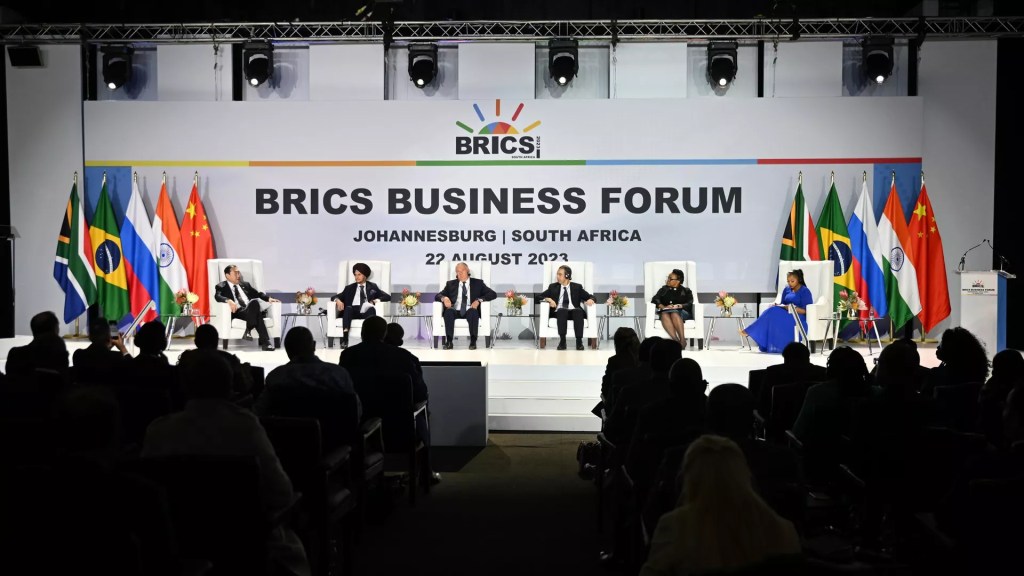
Let’s start with the geopolitical Big Bang you know nothing about, the one that occurred just two weeks ago. Here are its results: from now on, any possible future attack on Iran threatened by the Pentagon (in conjunction with NATO) would essentially be an assault on the planning of an interlocking set of organizations — the BRICS nations (Brazil, Russia, India, China, and South Africa), the SCO (Shanghai Cooperation Organization), the EEU (Eurasian Economic Union), the AIIB (the new Chinese-founded Asian Infrastructure Investment Bank), and the NDB (the BRICS’ New Development Bank) — whose acronyms you’re unlikely to recognize either. Still, they represent an emerging new order in Eurasia.
Tehran, Beijing, Moscow, Islamabad, and New Delhi have been actively establishing interlocking security guarantees. They have been simultaneously calling the Atlanticist bluff when it comes to the endless drumbeat of attention given to the flimsy meme of Iran’s “nuclear weapons program.” And a few days before the Vienna nuclear negotiations finally culminated in an agreement, all of this came together at a twin BRICS/SCO summit in Ufa, Russia — a place you’ve undoubtedly never heard of and a meeting that got next to no attention in the U.S. And yet sooner or later, these developments will ensure that the War Party in Washington and assorted neocons (as well as neoliberalcons) already breathing hard over the Iran deal will sweat bullets as their narratives about how the world works crumble.
The Eurasian Silk Road
With the Vienna deal, whose interminable build-up I had the dubious pleasure of following closely, Iranian Foreign Minister Javad Zarif and his diplomatic team have pulled the near-impossible out of an extremely crumpled magician’s hat: an agreement that might actually end sanctions against their country from an asymmetric, largely manufactured conflict.
Think of that meeting in Ufa, the capital of Russia’s Bashkortostan, as a preamble to the long-delayed agreement in Vienna. It caught the new dynamics of the Eurasian continent and signaled the future geopolitical Big Bangness of it all. At Ufa, from July 8th to 10th, the 7th BRICS summit and the 15th Shanghai Cooperation Organization summit overlapped just as a possible Vienna deal was devouring one deadline after another.
Consider it a diplomatic masterstroke of Vladmir Putin’s Russia to have merged those two summits with an informal meeting of the Eurasian Economic Union (EEU). Call it a soft power declaration of war against Washington’s imperial logic, one that would highlight the breadth and depth of an evolving Sino-Russian strategic partnership. Putting all those heads of state attending each of the meetings under one roof, Moscow offered a vision of an emerging, coordinated geopolitical structure anchored in Eurasian integration. Thus, the importance of Iran: no matter what happens post-Vienna, Iran will be a vital hub/node/crossroads in Eurasia for this new structure.
If you read the declaration that came out of the BRICS summit, one detail should strike you: the austerity-ridden European Union (EU) is barely mentioned. And that’s not an oversight. From the point of view of the leaders of key BRICS nations, they are offering a new approach to Eurasia, the very opposite of the language of sanctions.
Here are just a few examples of the dizzying activity that took place at Ufa, all of it ignored by the American mainstream media. In their meetings, President Putin, China’s President Xi Jinping, and Indian Prime Minister Narendra Modi worked in a practical way to advance what is essentially a Chinese vision of a future Eurasia knit together by a series of interlocking “new Silk Roads.” Modi approved more Chinese investment in his country, while Xi and Modi together pledged to work to solve the joint border issues that have dogged their countries and, in at least one case, led to war.
The NDB, the BRICS’ response to the World Bank, was officially launched with $50 billion in start-up capital. Focused on funding major infrastructure projects in the BRICS nations, it is capable of accumulating as much as $400 billion in capital, according to its president, Kundapur Vaman Kamath. Later, it plans to focus on funding such ventures in other developing nations across the Global South — all in their own currencies, which means bypassing the U.S. dollar. Given its membership, the NDB’s money will clearly be closely linked to the new Silk Roads. As Brazilian Development Bank President Luciano Coutinhostressed, in the near future it may also assist European non-EU member states like Serbia and Macedonia. Think of this as the NDB’s attempt to break a Brussels monopoly on Greater Europe. Kamath even advanced the possibility of someday aidingin the reconstruction of Syria.
You won’t be surprised to learn that both the new Asian Infrastructure Investment Bank and the NDB are headquartered in China and will work to complement each other’s efforts. At the same time, Russia’s foreign investment arm, the Direct Investment Fund (RDIF), signed a memorandum of understanding with funds from other BRICS countries and so launched an informal investment consortium in which China’s Silk Road Fund and India’s Infrastructure Development Finance Company will be key partners.
Full Spectrum Transportation Dominance
On the ground level, this should be thought of as part of the New Great Game in Eurasia. Its flip side is the Trans-Pacific Partnership in the Pacific and the Atlantic version of the same, the Transatlantic Trade and Investment Partnership, both of which Washington is trying to advance to maintain U.S. global economic dominance. The question these conflicting plans raise is how to integrate trade and commerce across that vast region. From the Chinese and Russian perspectives, Eurasia is to be integrated via a complex network of superhighways, high-speed rail lines, ports, airports, pipelines, and fiber optic cables. By land, sea, and air, the resulting New Silk Roads are meant to create an economic version of the Pentagon’s doctrine of “Full Spectrum Dominance” — a vision that already has Chinese corporate executives crisscrossing Eurasia sealing infrastructure deals.
For Beijing — back to a 7% growth rate in the second quarter of 2015 despite a recent near-panic on the country’s stock markets — it makes perfect economic sense: as labor costs rise, production will be relocated from the country’s Eastern seaboard to its cheaper Western reaches, while the natural outlets for the production of just about everything will be those parallel and interlocking “belts” of the new Silk Roads.
Meanwhile, Russia is pushing to modernize and diversify its energy-exploitation-dependent economy. Among other things, its leaders hope that the mix of those developing Silk Roads and the tying together of the Eurasian Economic Union — Russia, Armenia, Belarus, Kazakhstan, and Kyrgyzstan — will translate into myriad transportation and construction projects for which the country’s industrial and engineering know-how will prove crucial.
As the EEU has begun establishing free trade zones with India, Iran, Vietnam, Egypt, and Latin America’s Mercosur bloc (Argentina, Brazil, Paraguay, Uruguay, and Venezuela), the initial stages of this integration process already reach beyond Eurasia. Meanwhile, the SCO, which began as little more than a security forum, is expanding and moving into the field of economic cooperation. Its countries, especially four Central Asian “stans” (Kazakhstan, Kyrgyzstan, Uzbekistan, and Tajikistan) will rely ever more on the Chinese-driven Asia Infrastructure Investment Bank (AIIB) and the NDB. At Ufa, India and Pakistan finalized an upgrading process in which they have moved from observers to members of the SCO. This makes it an alternative G8.
In the meantime, when it comes to embattled Afghanistan, the BRICS nations and the SCO have now called upon “the armed opposition to disarm, accept the Constitution of Afghanistan, and cut ties with Al-Qaeda, ISIS, and other terrorist organizations.” Translation: within the framework of Afghan national unity, the organization would accept the Taliban as part of a future government. Their hopes, with the integration of the region in mind, would be for a future stable Afghanistan able to absorb more Chinese, Russian, Indian, and Iranian investment, and the construction — finally! — of a long-planned, $10 billion, 1,420-kilometer-long Turkmenistan-Afghanistan-Pakistan-India (TAPI) gas pipeline that would benefit those energy-hungry new SCO members, Pakistan and India. (They would each receive 42% of the gas, the remaining 16% going to Afghanistan.)
Central Asia is, at the moment, geographic ground zero for the convergence of the economic urges of China, Russia, and India. It was no happenstance that, on his way to Ufa, Prime Minister Modi stopped off in Central Asia. Like the Chinese leadership in Beijing, Moscow looks forward (as a recent document puts it) to the “interpenetration and integration of the EEU and the Silk Road Economic Belt” into a “Greater Eurasia” and a “steady, developing, safe common neighborhood” for both Russia and China.
And don’t forget Iran. In early 2016, once economic sanctions are fully lifted, it is expected to join the SCO, turning it into a G9. As its foreign minister, Javad Zarif, made clear recently to Russia’s Channel 1 television, Tehran considers the two countries strategic partners. “Russia,” he said, “has been the most important participant in Iran’s nuclear program and it will continue under the current agreement to be Iran’s major nuclear partner.” The same will, he added, be true when it comes to “oil and gas cooperation,” given the shared interest of those two energy-rich nations in “maintaining stability in global market prices.”
Got Corridor, Will Travel
Across Eurasia, BRICS nations are moving on integration projects. A developing Bangladesh-China-India-Myanmar economic corridor is a typical example. It is now being reconfigured as a multilane highway between India and China. Meanwhile, Iran and Russia are developing a transportation corridor from the Persian Gulf and the Gulf of Oman to the Caspian Sea and the Volga River. Azerbaijan will be connected to the Caspian part of this corridor, while India is planning to use Iran’s southern ports to improve its access to Russia and Central Asia. Now, add in a maritime corridor that will stretch from the Indian city of Mumbai to the Iranian port of Bandar Abbas and then on to the southern Russian city of Astrakhan. And this just scratches the surface of the planning underway.
Years ago, Vladimir Putin suggested that there could be a “Greater Europe” stretching from Lisbon, Portugal, on the Atlantic to the Russian city of Vladivostok on the Pacific. The EU, under Washington’s thumb, ignored him. Then the Chinese started dreaming about and planning new Silk Roads that would, in reverse Marco Polo fashion, extend from Shanghai to Venice (and then on to Berlin).
Thanks to a set of cross-pollinating political institutions, investment funds, development banks, financial systems, and infrastructure projects that, to date, remain largely under Washington’s radar, a free-trade Eurasian heartland is being born. It will someday link China and Russia to Europe, Southwest Asia, and even Africa. It promises to be an astounding development. Keep your eyes, if you can, on the accumulating facts on the ground, even if they are rarely covered in the American media. They represent the New Great — emphasis on that word — Game in Eurasia.
Location, Location, Location
Tehran is now deeply invested in strengthening its connections to this new Eurasia and the man to watch on this score is Ali Akbar Velayati. He is the head of Iran’s Center for Strategic Research and senior foreign policy adviser to Supreme Leader Ayatollah Khamenei. Velayati stresses that security in Asia, the Middle East, North Africa, Central Asia, and the Caucasus hinges on the further enhancement of a Beijing-Moscow-Tehran triple entente.
As he knows, geo-strategically Iran is all about location, location, location. That country offers the best access to open seas in the region apart from Russia and is the only obvious east-west/north-south crossroads for trade from the Central Asian “stans.” Little wonder then that Iran will soon be an SCO member, even as its “partnership” with Russia is certain to evolve. Its energy resources are already crucial to and considered a matter of national security for China and, in the thinking of that country’s leadership, Iran also fulfills a key role as a hub in those Silk Roads they are planning.
That growing web of literal roads, rail lines, and energy pipelines, asTomDispatch has previously reported, represents Beijing’s response to the Obama administration’s announced “pivot to Asia” and the U.S. Navy’s urge to meddle in the South China Sea. Beijing is choosing to project power via a vast set of infrastructure projects, especially high-speed rail lines that will reach from its eastern seaboard deep into Eurasia. In this fashion, the Chinese-built railway from Urumqi in Xinjiang Province to Almaty in Kazakhstan will undoubtedly someday be extended to Iran and traverse that country on its way to the Persian Gulf.
A New World for Pentagon Planners
At the St. Petersburg International Economic Forum last month, Vladimir Putin told PBS’s Charlie Rose that Moscow and Beijing had always wanted a genuine partnership with the United States, but were spurned by Washington. Hats off, then, to the “leadership” of the Obama administration. Somehow, it has managed to bring together two former geopolitical rivals, while solidifying their pan-Eurasian grand strategy.
Even the recent deal with Iran in Vienna is unlikely — especially given the war hawks in Congress — to truly end Washington’s 36-year-long Great Wall of Mistrust with Iran. Instead, the odds are that Iran, freed from sanctions, will indeed be absorbed into the Sino-Russian project to integrate Eurasia, which leads us to the spectacle of Washington’s warriors, unable to act effectively, yet screaming like banshees.
NATO’s supreme commander Dr. Strangelove, sorry, American General Philip Breedlove, insists that the West must create a rapid-reaction force — online — to counteract Russia’s “false narratives.” Secretary of Defense Ashton Carter claims to be seriously considering unilaterally redeploying nuclear-capable missiles in Europe. The nominee to head the Joint Chiefs of Staff, Marine Commandant Joseph Dunford, recently directly labeled Russia America’s true “existential threat”; Air Force General Paul Selva, nominated to be the new vice chairman of the Joint Chiefs, seconded that assessment, using the same phrase and putting Russia, China and Iran, in that order, as more threatening than the Islamic State (ISIS). In the meantime, Republican presidential candidates and a bevy of congressional war hawks simply shout and fume when it comes to both the Iranian deal and the Russians.
In response to the Ukrainian situation and the “threat” of a resurgent Russia (behind which stands a resurgent China), a Washington-centric militarization of Europe is proceeding apace. NATO is now reportedly obsessed with what’s being called “strategy rethink” — as in drawing up detailed futuristic war scenarios on European soil. As economist Michael Hudson has pointed out, even financial politics are becoming militarized and linked to NATO’s new Cold War 2.0.
In its latest National Military Strategy, the Pentagon suggests that the risk of an American war with another nation (as opposed to terror outfits), while low, is “growing” and identifies four nations as “threats”: North Korea, a case apart, and predictably the three nations that form the new Eurasian core: Russia, China, and Iran. They are depicted in the document as “revisionist states,” openly defying what the Pentagon identifies as “international security and stability”; that is, the distinctly un-level playing field created by globalized, exclusionary, turbo-charged casino capitalism and Washington’s brand of militarism.
The Pentagon, of course, does not do diplomacy. Seemingly unaware of the Vienna negotiations, it continued to accuse Iran of pursuing nuclear weapons. And that “military option” against Iran is never off the table.
So consider it the Mother of All Blockbusters to watch how the Pentagon and the war hawks in Congress will react to the post-Vienna and — though it was barely noticed in Washington — the post-Ufa environment, especially under a new White House tenant in 2017.
It will be a spectacle. Count on it. Will the next version of Washington try to make it up to “lost” Russia or send in the troops? Will it contain China or the “caliphate” of ISIS? Will it work with Iran to fight ISIS or spurn it? Will it truly pivot to Asia for good and ditch the Middle East or vice-versa? Or might it try to contain Russia, China, and Iran simultaneously or find some way to play them against each other?
In the end, whatever Washington may do, it will certainly reflect a fear of the increasing strategic depth Russia and China are developing economically, a reality now becoming visible across Eurasia. At Ufa, Putin told Xi on the record: “Combining efforts, no doubt we [Russia and China] will overcome all the problems before us.”
Read “efforts” as new Silk Roads, that Eurasian Economic Union, the growing BRICS block, the expanding Shanghai Cooperation Organization, those China-based banks, and all the rest of what adds up to the beginning of a new integration of significant parts of the Eurasian land mass. As for Washington, fly like an eagle? Try instead: scream like a banshee.
Pepe Escobar is the roving correspondent for Asia Times, an analyst for RTand Sputnik, and a TomDispatch regular. His latest book is Empire of Chaos. Follow him on Facebook by clicking here.


 After the Crash